RSS

Grass Roots Movement

Fire Ants and Native Plants

Solenopsis invicta  

Formicidae

Today John and George skipped northward to St. Lucie County to wade through Paleo Hammock, a beautiful site with Water Hickories, meadows of weird Garlic Weed, ancient Native American mounds, distant thunder, and water up to your ankles.

There are so many lovely beautiful species there, why in the world write about the most detested species on Earth…the imported invasive Fire Ant!?  Boo!

By JB

By JB

If you can rise above old grudges, however, they are mighty interesting.  John had fun stirring them up with a stick.  POKE HERE   Fire ants and their associates extend last week’s theme of unexpected twists and turns in why plants (and ants, and sucking insects) wind up where they do.

Often fire ant1 mounds are centered conspicuously around the bases of fibrous-rooted plants, frequently Grasses.  Of course this raises a chicken and egg question:  which comes first, the ant mound or the Grass? Does the ant plant the Grass in the ant mound, or does the ant colony build its mound around the preexisting Grass clump?

Fire ant mound around Eragrostis grass. Cell phone photo.

Fire ant mound around Eragrostis grass. Cell phone photo.

Speculative answer:  The Grass probably comes first, as we see it, because the clump is “always” rooted dead-center in the mound.   If the mound came first, we’d expect the grasses to sprout at different points on the mound, not necessarily the bulls eye.  But if the mound is built around the established Grass, the clump is “ground zero,” and its radiating brush of roots may help define the mound dimensions.  (Maybe)

Let’s pretend Grass-came-first is correct, then why would Fire Ants build around it? (Related question:  Why are they such turf pests?)

Here are possible answers with mixed fact and speculation:

1. NEST REINFORCEMENT.  The Grass could provide ant nest-reinforcement against wind and water, maybe even a little shade.  And more interestingly…

2. FOOD. Fire ants are omnivores.  Although usually thought of as predators, they need plant-based carbs, including roots (fact), and (speculation) possibly root exudates. So maybe the Grass roots are a salad bar right in the nest. And the plot thickens…

3.THIRD PARTIES. Fire ants tend tiny sucking insects underground or at the root crown as sources of sugary honeydew (fact).  Turf managers are aware of associations between fire ants and subterranean aphids on grass roots.  The honey-makers include mealybugs and root-dwelling aphids.  These tiny root-hugging micro-cows seem to have much to do with the fire ant- plant friendship. Read on…

A broad 1994 study of mealybugs showed the little suckers to pester 250 families of plants.   The most-infested family was—and this may surprise you—the Grass Family, with mealybugs bugging 585 Grass species.  If I were a fire ant trolling for a mealybug, I’d start with a Grass. And even more to the point…(the point being involvement of sucking insects)…

In 2011 biologist Shawn Wilder and collaborators in Arizona showed honeydew from diverse sucking insects to boost fire ant colony development, evidently enhancing their competitive ability and fostering their geographic spread. And more specifically…

In 2012 and 2013 Biologist Aiming Zhou and collaborators documented a win-win relationship between fire ants and an invasive crop-pest mealybug named interestingly, Phenacoccus solenopsis.  It’s a love triangle.   The ants get sweet tasty honeydew from the mealybugs and possibly additional root benefits from the plants.   The mealybugs get a safe home, and are ant-tended and spread around.  And the plants enjoy protection from the most ill-tempered creatures on earth, as well as possible soil enhancements.  The relationship helps the fire ants drive away native ants.  The Phenacoccus solenopsis mealybug is an infamous cotton pest, and it occurs in Florida, living on roots and also above the soil line on many host plants, including Grasses.

By JB

By JB

So what exactly is going on here and now with fire ants,  Grass plants, and probably sucking insects is not clear.  What a fertile area for research for a motivated student with tall waders and an EpiPen.  There aren’t many competing researchers, and who needs to travel to exotic field sites when compelling ecological relationships are playing out right in the back yard?

Photos below added Aug. 25 (taken 8/24) a few weeks after the blog was posted.  These photos show the bases of sterile grass plants (Eustachys petraea?) in the center of an ant mound.  The ants were small, reddish, and belligerent.  Probably Fire Ants but no certainty.   The grass bases are infested with mealy bugs. (On a nearby Eragrostis spectabilis centered in an ant mound there were scale insects in the same position.)

Mealybugs at base of grass plant in ant mound near Jupiter FL.

Mealybugs at base of grass plant in ant mound near Jupiter FL.

More from the same ant mound.

More from the same ant mound.

—————————————

1We’re no ant experts.   Perhaps we see also mounds from other small reddish grumpy ant species. But if it walks like a Fire Ant, quacks like a Fire Ant, and burns ankles like a Fire Ant we’re calling the critters fire ants. Do not trust us.

 
6 Comments

Posted by on August 1, 2014 in Fire Ants


Tags:

Seeds of Change

Seeds of Change

Today John and George were so busy putting the finishing touches on our upcoming Native Plants MOOC (yea, it’ll be mobbed).  We didn’t take much field time, except to look at something you see every day but ponder once a decade—native woody plants coming up seemingly isolated where you don’t expect to see them.

That led to some thought on why plants wind up growing where they do.  Oh, I know the answer!   The wind, or a bird, or a bear in the woods drop a seed, and the seed grows.  Got it, but events aplenty happen between the bird ingesting the seed and a tree grows in Brooklyn.  Nature does not work in a human time and space.

For starters, that seed had to arrive from somewhere.  Maybe merely across the creek, or then again, perhaps from across the sea.  There are plenty of transoceanic examples, and the Bottle Gourd stands out.  The species has an archaeological history widespread in the Americas dating back 10,000 years and in Asia almost that long.   Botanists have debated for decades how this species could seem to be native around the ancient world so long ago.  It did not originate twice, on both sides of the Pacific.  Did very very ancient people move it thousands of miles?  One notion is that Easter Islanders took it westward to the Old World.  Another idea is that the first Native Americans brought it from Asia.  Or maybe it floated a few thousand miles.  To test the bobber theory, researchers floated some for about a year in sea water, and let them sit another six years;  the seeds sprouted like new.  Take home lesson:  seeds get around.

So then, the seeds arrived from somewhere near or far, and now they can grow.  Hold on, not so fast.  How long a delay between arrival and growth?   Maybe the season is not right this month.  Maybe conditions aren’t right this century.  How about another thousand years?  Seeds can be patient, and can await environmental cues, such as disinterrment.  In 1879 Professor William Beal at Michigan State University buried in glass jars seeds of several wild species, leaving a time capsule experiment that remains running.  The seeds are tested at intervals, and some remain willing despite attrition.  Going back farther, barley seeds from King Tut’s tomb reportedly sprouted in modern times, although the claim is disputed.

Free of dispute, Canna seeds 600 years old from an Argentinian grave spawned pretty new Cannas.  And their circumstances were weird.  The Canna seeds from the grave were inside walnuts.  Ancient biotechnicians understood how to insert Canna seeds into immature living walnuts, allowing the nuts to mature into rattles.  In 2012 30,000-year-old seeds of a Carnation relative buried (by squirrels) in Russia grew like Rip Van Winkle awakening.  That’s probably the all-time seed nap record.

Native Florida Canna.  Were its seeds 600 years old? (By John Bradford)

Native Florida Canna. Were its seeds 600 years old? (By John Bradford)

Right, so the seeds came from places unknown, then they waited patiently in the soil seed bank.  Now it is time to boogie!  The seed sprouts dutifully, and hello world!  Hello drought, hello shade, hello sun, hello frost, hello competition, hello drowning, hello bugs, hello fungi, hello hungry bunnies.  The perils facing a tender green sprout remind me of leaving home at age 18!

Obviously the conditions must be suitable—that goes without saying doesn’t it?  Probably, but even that boring observation gains interest if the seedling’s establishment requires relationships with other species.  (We’ll come back to this next week.)   It also becomes more interesting if the overall conditions are changing…oh for example, let’s say by Global Warming.  Just this year the Sunshine State figured in an eye-opening example.  In the Proceedings of the National Academy of Science, January 2014, biologist Kyle Cavanaugh and collaborators applied 28 years of satellite imagery to discern, as they say in their own title, “poleward expansion of mangroves is a threshold response to decreased frequency of extreme cold events.”   Where a mangrove might sprout has shifted in just 28 years.  That’s not my lifetime, but that of my son.

Mangrove headed north! (By John Bradford)

Mangrove headed north! (By John Bradford)

Today we looked at a lonesome Gumbo Limbo sapling with its secret history,  a single Pineland Pinweed 10 miles from any known others, and where did that baby Hercules Club come from?  A little imagination beyond “bird dropping” makes it more fun.  Maybe the guilty birds were the last flock of Carolina Parakeets in 1920.   Who can say it ain’t so?

Hercules Club (by John Bradford)

Hercules Club (by John Bradford)

 
11 Comments

Posted by on July 25, 2014 in Uncategorized


Orange-ya Glad for Wasps, Bats, and Potatoes?

Two Leaf Nightshade (Twin Leaf Solanum)

Solanum diphyllum (FL Exotic Pest Pant Council Cat. II invasive exotic)

Solanaceae

Today John and George enjoyed the mangrove swamp at Peck’s Lake near Hobe Sound, a short boardwalk long on biodiversity, including wasps.  We had one of those wasp experiences I sorta like—wasps can be our pals.   (Stockholm Syndrome.)  We somehow riled up the hive, and 133 (I counted) wasps stormed out with gusto and buzzed our heads in a friendly but earnest warning.   We took the hint with equal gusto, and nobody got hurt.

All plant photos today are Solanum diphyllum by John Bradford.

All plant photos today are Solanum diphyllum by John Bradford.

As I arrived at the parking lot, John was already photographing the plant of the day…Two Leaf Nightshade, a member of the genus Solanum, with several additional species in Florida, including spuds.  With odd mismatched leaf pairs and highway-worker-vest orange fruits in pretty clusters, Solanum diphyllum gathers a lot of “likes” on its Facebook page.  You could spot those clustered little oranges from a helicopter.

John was shooting this photo as I arrived on the scene, July 18 at Pecks Lake.

John was shooting this photo as I arrived on the scene, July 18 at Pecks Lake.

The species is native to Mexico and Central America, and like a good weed (and as a garden species) it is scattered elsewhere in the warm climate world, maybe with a helping hand from Global Warming and gardeners in addition to wild creatures.  Today’s invasive exotic decorates the shores of the Intracoastal in Hobe Sound and likewise decorates the shores of the Nile in Egypt, where it fascinated Egyptian biologist Fatma Hamada of the South Valley University  as much as it fascinates us.  Hamada’s 2013 doctoral dissertation is a monograph on Solanum diphyllum, looking into everything from its beautiful internal anatomy to its cytotoxicity against human cancer cell lines. (so, no, those fruits are not for us to eat).
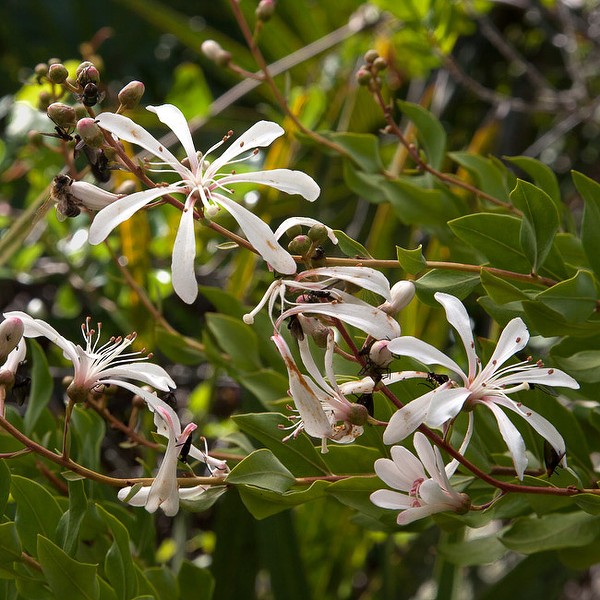
The "orange blossoms"

The “orange blossoms”

One of her findings was particularly intriguing.  Many plants of arid or salty places protect themselves from drought and salinity by accumulating extra dissolved materials in their tissues.  This is true of our Solanum, and here’s the good part: adjustably.  Apparently, and in need for more research, the plant build ups anti-drying compounds when dry, and later secretes the stuff from the leaves when dry times abate.  Maybe.  Another “maybe” is what seem to be patches of natural “sunblock” embedded in the leaf surface.  This little weed has some stuff goin’ on!   Now back to those fruits oranger than an orange.  Univ. of Miami bat expert Dr. Theodore Fleming described (citing earlier work in South American tropical forest) bird-dispersed fruits to be mostly white, black, red, blue, or purple in contrast with mammal-dispersed fruits predominantly orange, yellow, brown or green.  (Please no e-mails:  These are broad perceived trends—with overlaps and exceptions.)

So is Solanum diphyllum mainly a mammal berry?   Probably, although its dispersal in Florida with almost no fruit-eating bats implicates helpful birds and maybe a quadruped or two.  Research in the shrub’s native Mexico proves fruit eating bats to carry the seeds, not necessarily to the exclusion of birds or others of course.  Quibblers may raise a hand, and say, “bats are blind as a bat, so ixnay on the orange uit-frays.”  But recent research reveals increasingly sophisticated vision in bats, including living color.  Here is a quote (2001) from bat biologists Jorge Ortega and Ivan Castro-Arvellano on the Jamaican Fruit Bat widespread in the native haunts of the Two Leaf Nightshade:  “A. jamaicensis uses vision and olfaction to find fruits with brilliant colors and strong odors.”  By the way, bats don’t like getting tangled in twigs at night.  Note how the fruit clusters are presented for EZ access. Now back to Egypt, where as we already know, the Nightshade grows up and down the Nile.   Guess what was first discovered at the Great Pyramid of Giza, and flutters nocturnally up and down the Nile (and far beyond).   The Egyptian Fruit Bat.   Could it be that the corresponding Nile distributions of the Solanum and the bat are mere coincidence?   A connection might seem tempting to contemplate if Egyptian Fruit Bats go for orange-colored fruits.  Who knows?

Egyptian Fruit Bats at the midnight buffet. (From animal.memozee.com)

Egyptian Fruit Bats at the midnight buffet. (From animal.memozee.com)

 
15 Comments

Posted by on July 19, 2014 in Two Leaf Nightshade


Tags: , , ,

The Long Deteriorating “Fishing Ground of Presidents,” St Lucie River/Indian River Lagoon

This deserves to be distributed.

Jacqui Thurlow-Lippisch's avatarJacqui Thurlow-Lippisch

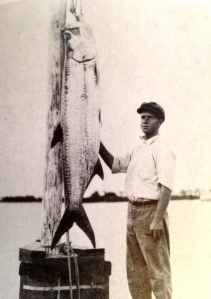
Harold R Johns, posing with a large tarpon, early 19920s, Stuart, St Lucie River. (Photo from Stuart on the St Lucie by Sandra Henderson Thurlow.) Harold R. Johns, posing with a large tarpon, early 1920s, Stuart, Florida, St Lucie River. (Photo from Stuart on the St Lucie by Sandra Henderson Thurlow.)

When the pioneers permanently opened the St Lucie Inlet in 1892, it killed the freshwater grasses that filled the waterways creating a brackish estuary that due to the convergence of tropical and temperate zones, and the nearby warmth of the Gulf Stream, became “the most diverse estuary in North America.” (Gilmore)

After a short period of time, sportfishing thrived in the area, and fishing guides called Stuart the “fishing grounds of presidents” as US president, Grover Cleveland, vacationed and fished the area in 1900 and years after.

In spite of long standing issues with the health of the estuary,  as late as the 1970/80s Dr Grant Gilmore of Harbor Branch documented over 800 species of fish living and breeding in the then healthy seagrasses around…

View original post 598 more words

 
Leave a comment

Posted by on July 14, 2014 in Uncategorized


Willows to the Rescue?

This week John and George sacrificed the usual Friday field work in order to work on our upcoming on-line native plants class to be in play as school starts.  Related to that, I’ve been fretting my second Florida outdoor interest—or let’s say nervous preoccupation—groundwater contamination.  The native plants connection is that millions of landscapers and homeowners who could use native plants with minimal chemical demands, instead spew mind-boggling (perhaps literally) herbicides, fungicides, and insecticides all over the ground, to percolate into the ground-water, which we later call tapwater.  (No, they do not get everything out.)

Salix caroliniana in flower by John Bradford.

Salix caroliniana in flower by John Bradford.

The situation is substantial and worsening, and in my humble opinion is under-publicized.  Somebody ought to start a blog (or a consumer revolution).  It is a joy to see an occasional piece in the PB Post and other Florida papers on this topic.  Yet hardly anybody cares, and a fine chemically tended lawn is a sign of responsibility and solid social status.  Just ask the HOA.  Okay, this paragraph could fill a book.  And such books exist, recently “What’s Gotten Into Us” by McKay Jenkins (2011).
Environmental author Steven Lerner—who has his own books on toxic stinkholes with depressing Florida examples—took a special interest in Tellevast, Florida near Sarasota.  The problems there are not pesticides, but rather defense industry wastes and spills, especially the chlorinated organic solvent called TCE (trichloroethylene) as well as beryllium and varied additional organic solvents.  Chlorinated organics turn up often on lists of carcinogens, for instance, the insecticide DDT, the herbicide 2,4-D, and dioxin.  They are the main rascals in Rachel Carson’s Silent Spring.
TCE is one of the worst U. S. groundwater contaminants.  (The likewise chlorinated herbicide Atrazine is a rival.)   TCE causes mutations and apparently cancers.  It deteriorates into even-more-carcinogenic vinyl chloride.  Sources of TCE pollution include defense-industry factories and aviation facilities.  My first known exposure was in Dayton, Ohio where TCE and additional solvents from Wright Patterson Airbase had visited the local groundwater.  The city erected air-strippers, which are water ventilation towers to transform water pollution to air pollution.

The citizens of Tellevast reportedly suffer disproportionately from cancers and medical troubles ascribed to TCE and other contaminants in the water beneath their feet.  The defense contractor Lockheed Martin owns the facility and is on the hooks for dealing with it.

Well, that’s all nasty, scary, debated, and politicized.  But this is a native plants blog, so, how ‘bout it?   Right!  This all brings us to the Willow Family, the Salicaceae.  The main Florida members of this family are poplars, cottonwoods, and a few willows.  The species in our local area and native to Tellevast is Carolina Willow (Salix caroliniana).

Willow leaves by JB

Willow leaves by JB

How do you oust chlorinated organic chemicals from groundwater without merely redistributing the poison?  There are several approaches but no silver bullet.  The approach of interest in our botanical blog is using poplars and willows for “bioremediation,” to disarm, alter, remove, and sequester the poisons.  It is all experimental, and truly promising at least under controlled conditions.  Poplars and willows are diverse, worldwide, resistant to toxins, easy to propagate, fast-growing, potentially deep-rooted, and able to suck up a lot of water.  They do nuke chlorinated organic pollutants.

Researchers are looking into the comparative efficacy of different species and hybrids.  The cast of species is important because different species flourish in different regions.  One size does not fit all. Poplars outshine willows, yet our own Carolina willow has made the defense team.

Trees detoxify water in multiple ways.  For starters, our green helpers suck up the polluted water through their roots and then alter and imprison the evil molecules in woody tissues.

More remarkable tools in the tree toolbox are enzymes called dehalogenases (dee-HAL-oh-jen-ase) able to clip chlorines off of organic molecules.  That’s almost magic, and to make more useful proteins there’s genetic engineering.  There are already GMO poplars engineered for various growth characteristics, so enzyme enhancement is no huge stretch. In fact, one poplar hybrid is already bioengineered specifically to degrade TCE and other organics.  And get this:  the gene engineered into the trees is a human gene, producing an enzyme to metabolize the carcinogenic molecules.

Risks include the possibility of sequestered toxins re-escaping from products made later from the trees.  Would you want to mulch your veggie garden with their chips?   Surprise chemical breakdown byproducts could emerge, and maybe even ecological misbehavior by the bionic trees.

Similarly armed with dehalogenase enzymes are bacteria, and they are partners in the clean-up and are targets for genetic engineering, which is occurring relevant to TCE.  Bacteria are easier and faster to engineer, incubate, and establish than trees.

Time to wrap this up.  In short, our groundwater is full of bad stuff.  Some of it comes from landscape and turf products where a shift to native species and less lawn would diminish the uckies. Most Florida shallow groundwater and some deep groundwater carries more contaminants than we’d like to know…or drink…even after “purification.”  The solvent TCE is a chlorinated organic goblin.  Tellevast floats 6 feet above TCE-laced water.   We’re not quite ready to plant the town with GMO willows.  But there’s hope for green remediation down the road.  So what the heck, we can load the groundwater up with carcinogens today and let our mutated great-grandchildren plant magic willows.

============================================================

Notes:

For an early in-depth look at the Tellevast situation:

http://www.healthandenvironment.org/articles/homepage/3829

For about bioremediation and TCE: http://clu-in.org/products/intern/phytotce.htm

 
19 Comments

Posted by on July 13, 2014 in Carolina Willows


Tags: , , , ,

Winged Sumac for the Perfect Tan

Winged Sumac

Rhus copallina

Anacardiaceae

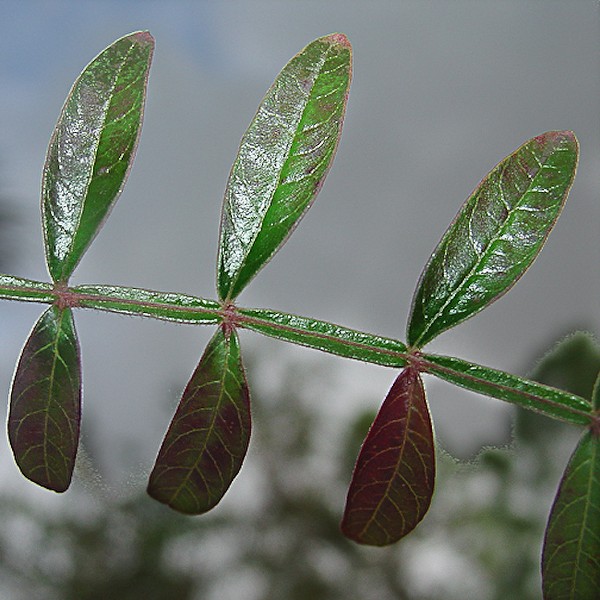
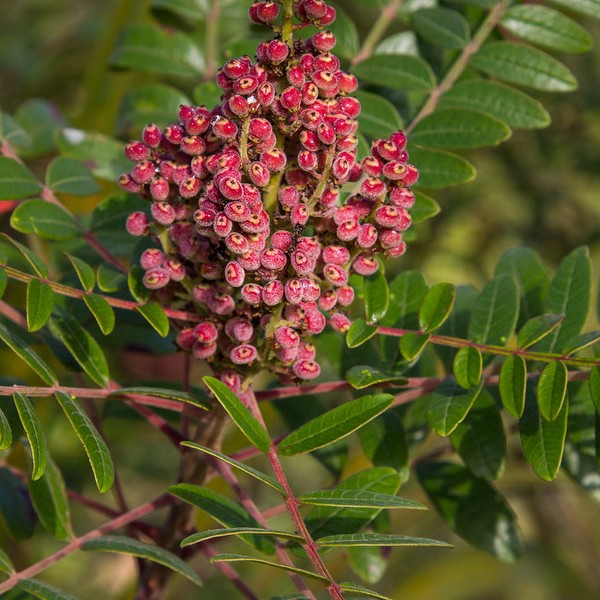
The wing on winged sumac.  All of today's photos are of winged sumac, by John Bradford.

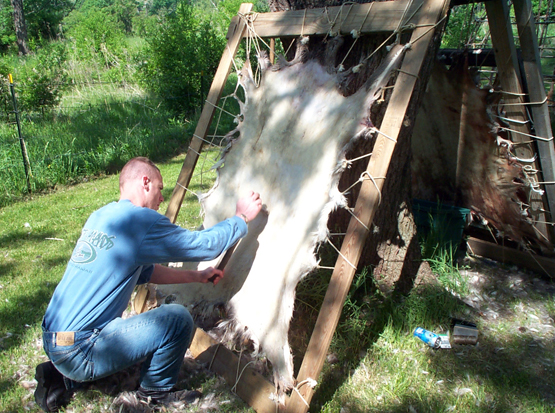
The wing on winged sumac. All of today’s photos except the tanned hide are of winged sumac, by John Bradford.

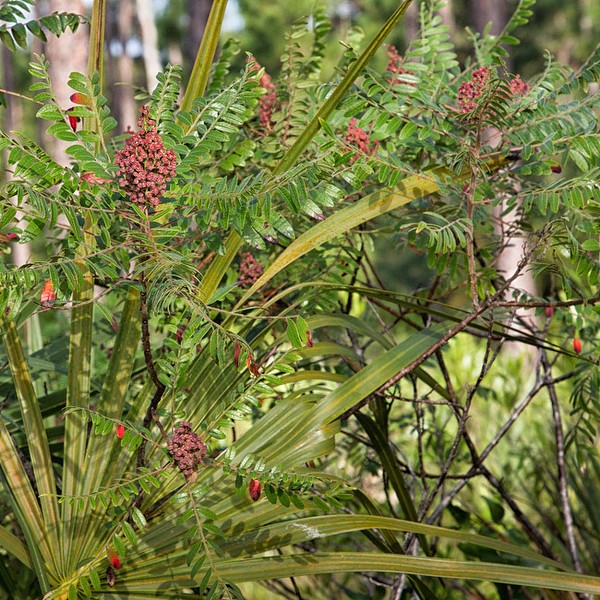
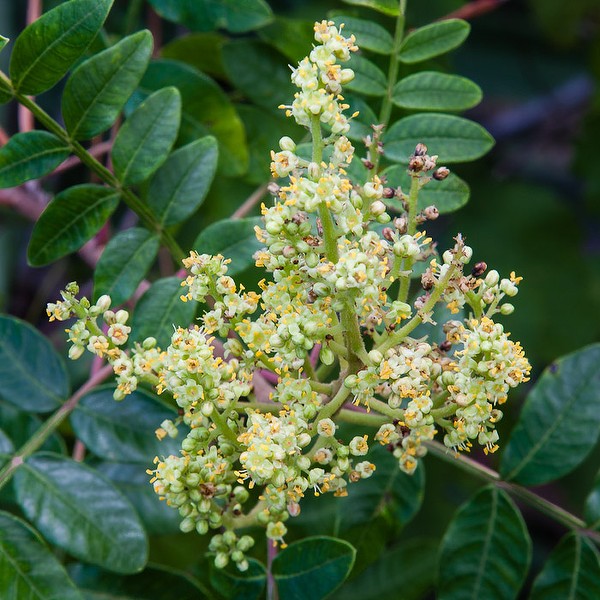
If you moved to Florida from points north and miss fall color, winged sumac offers a little reminder of North Carolina in October.  Fact is, you could even know winged sumac from northern exposure, as it grows all the way from Cuba (probably cultivated) through Florida into Canada.  Northern plant nurseries sell horticultural cultivars of it.  The species is a small tree or a shrub with distinctive compound leaves having a wing running up the middle.  They make pyramids of small white flowers, usually but not always on separate male and female individuals.   The fruits are small red “berries” for the birds.

Around our area we mostly enjoy winged sumac in sandy areas, often at an interface between grassy meadow and woods, and that may not be entirely coincidental, as sumacs serve as steppingstones in ecological succession: Limited research shows winged sumac to specialize in bullying  low grassy vegetation by poisoning the competition with natural herbicides, and altering the habitat in ways that favor woody plants, especially itself.    Winged sumac can form massive clumps, as it smites its foes and spreads by underground rhizomes.

Fruiting tree

Fruiting tree

Sumac bioactivity isn’t limited to squelching weedy competitors.  Species of sumacs around the world have big histories in traditional medicines for more ailments than Uncle Tree could shake a twig at.  And out of that medicinal swirl comes a current point of interest.  Extracts from Sumacs can induce apoptosis (cell suicide) in human cells.  This is the sort of reason I’m no fan of gobbling the wild plants.  Yes, a lot of people in varied cultures make spices and beverages from sumac fruits.  As a Boy Scout, 1960-something, I drank Sumac “lemonade.”  Of course that lemonade comes from the same genus as poison sumac, and some botanists at least historically classified poison ivy in the same genus as Sumac.   I do not know the chemistry but would not be 100% surprised to learn that Winged Sumac might contain a little urushiol, the transdermal irritant so familiar to poison ivy victims.  In the same family, mangoes and Brazilian Peppers are allergenic to some victims.  Here we find also poisonwood.

Flowers

Flowers

The most interesting bioactivity of sumacs is their tannins.   Tannins are natural substances present in many or most plants, but some plants are more endowed than others.  Tannins are plant defender compounds that bind up proteins.   If you want to stop a bug from bugging you one approach is to tie their oral-digestive proteins in knots.  You get a taste of that medicine when you bite a green apple—loaded with tannin–and your spit turns to glue.   Plants sometimes produce tannins in response to insect attack, and plants also produce galls in response to attack, or in response to eggs laid by insects into the plant tissues.  Galls are thus sometimes rich in tannins, including the “Chinese Gall” marketed as a medicine and perhaps for leather-tanning. It grows on Chinese sumac in response to aphids.

The fruits

The fruits

Tannins tan leather primarily by binding the collagen proteins in the skin, improving the texture and making the protein resistant to decay.  Sumacs have served or tanning leather in varied cultures from Asia, through Europe and in North America.  Before the day of blogs, sumac-tanned leathers were preferred by bookbinders.  They are still in use, for example CLICK HERE.  I heard a teacher say the name sumac to come from “shoe-make,” which makes fun sense but is probably not the case, as the name more likely dates to ancient Arabic origins.  The species Rhus coriaria owes its name to shoe-makers, as coriaria comes from the Latin term for leather.

 
7 Comments

Posted by on July 5, 2014 in Winged Sumac


Tags: ,

What Do Gilgamesh,  Rachel Ray, and My Yard Have in Common?

Answer: Capers

Jamaica Caper Capparis jamaicensis

(Caper nomenclature is a jungle.  Even the family assignment is unstable.  Good luck on “the” definitive names to use for capers.  Jamaica Caper goes also as Quadraella jamaicensis, and is widely mis-dubbed  Capparis cyanophallophora— a similar but separate species in the Caribbean and Bahamas.Those who mine the books and Internet will find even more names.  The taxonomy has been mildly “unsettled.”)

Limber Caper Cynophalla flexuosa (aka Capparis flexuosa)

Spiny Caper Capparis flexuosa

John and George were unable today to undertake our usual Friday wilderness encounter, so, staying home, I spy Jamaica Caper in the front yard.  It is a popular local landscape species, usually encountered as a shrub around here.  In our former carefree lives in the Caribbean John and George, who lived simultaneously on separate heavenly islands known for offshore banking, enjoyed the species as a front yard shade tree up to 15-20 feet tall having a trunk 6 inches or more in diameter.  Anything able to flourish on a  limestone outcrop in the middle of the Caribbean is tough, which is one of the selling points of this species in landscaping: sun yep, shade ok to a point,  drought-tolerant,  hurricane-adapted,  pruning-tolerant, fertilizer-free, pest-shunning, low maintenance, and yet always pretty and with color-changing blossoms in spring or early summer.

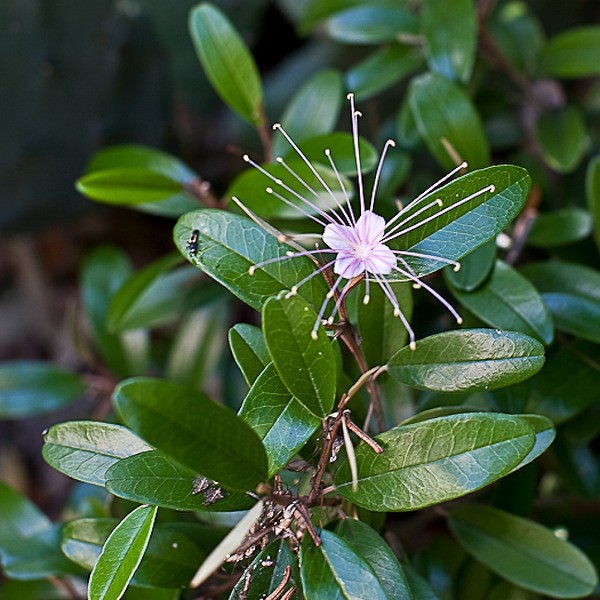
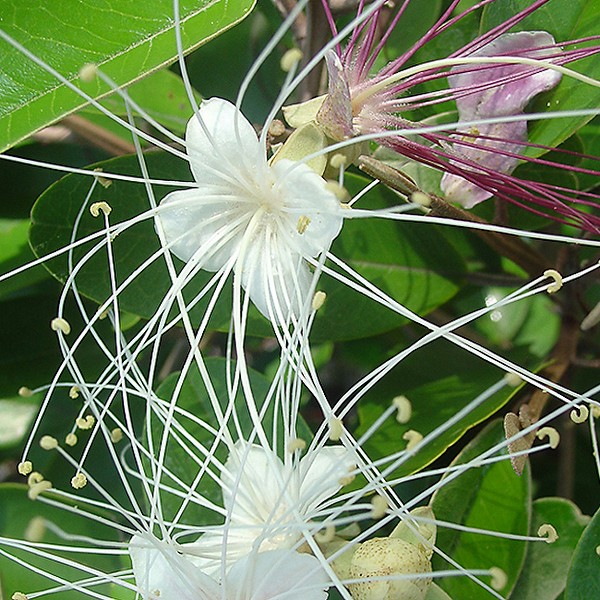
All of today's photos are Jamaica Caper, by John Bradford.

All of today’s photos are Jamaica Caper, by John Bradford.

Changes in flower color are common in the floral world.  The changes are generally interpretable as signals to pollinators concerning nectar availability.

Few shrubs are easier to recognize: The leaves have a brownish-silverish scaly sheen beneath, the leaf buds resemble butter knives, the flowers are pretty big, bowl-shaped, wiskery with long stamens, and transition from white to pale pinky-purple.  The pod looks like a bean, opening to reveal a red interior with blackish seeds.  Hey, that came up recently in this blog.    An added bonus of this species and Limber Caper is hosting  the Florida White Butterfly.  But this is not a how-to-garden blog, horto-info is available in spades by Google, so to avoid reinventing the caper let’s move on to other stuff, after a little geography.

Capparis cyanophallophora close

Jamaica Caper grows naturally from coastal central Florida through the Caribbean and Mexico to Central America.  Limber Caper has a similar distribution, including in Florida.  Limber Caper is, yep, limber-er, sort of a vine-shrub, and its leaves lack that silvery sheen beneath.

What’s that about the Western Wall?   Plants sprouting from unlikely places are always fun, and the Western Wall in Jerusalem hosts a vertical flora of roughly half a dozen indestructible crack-dwellers.  The prettiest is Spiny Caper,  with flowers remarkably similar to our own Florida species, including the color change, and pod with that trademark red lining.  Spiny Caper is the main pickled caper so heavenly on chicken picatta and salmon with lemon and caper sauce.  My second-favorite food on earth after microwaved tofu is an anchovy wrapped around a caper.

Capparasis cyanophallophora frt

Capers are flower buds, although the Capparis spinosa pod has a culinary life of its own. You can see similar buds on our own Jamaica Caper, but please when whipping up Pasta Puttanesca, visit the Piggly Wiggly and buy a jar of the real McCoy.

Spiny Caper has the confused taxonomy and unclear original distribution standard for plants with histories in prehistoric human commerce,  dating back in archaeology, in ancient records, and in the Bible at least to varied ancient Mediterranean and Mesopotamian civilizations.  It grows from the Mediterranean all the way to Australia and Pacific Islands.  No doubt the earliest boats to criss-cross the Mediterranean had capers aboard.

Butter knife buds on Jamaica Caper

Butter knife buds  ans silvery-browny under-leaf scales on Jamaica Caper

 
11 Comments

Posted by on June 27, 2014 in Capparis


Tags: , , ,

Puncture Vine

Tribulus cistoides

Zygophyllaceae


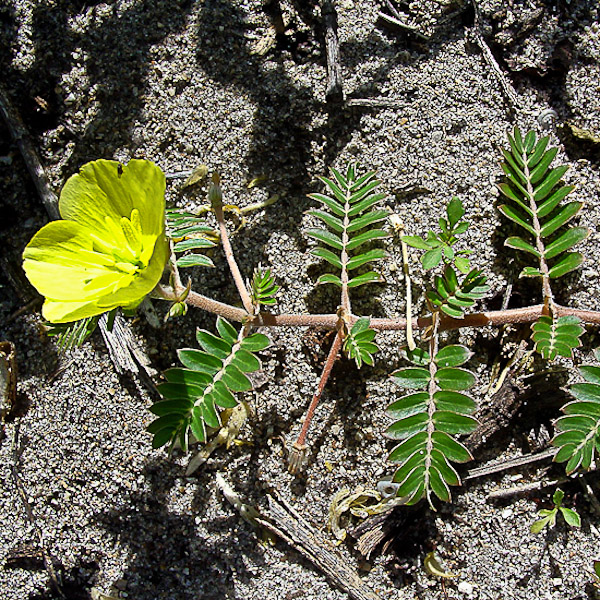
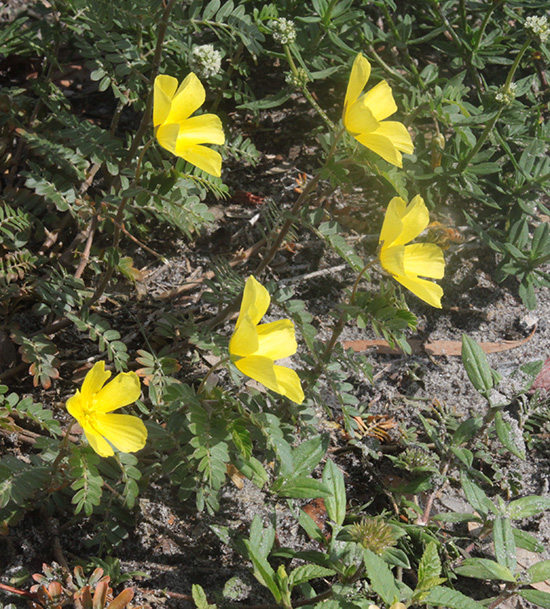
Puncture Vine (by John Bradford). The opposite (paired) compound leaves look ferny.

Puncture Vine (by John Bradford). The opposite (paired) compound leaves look ferny.

Friday John and George searched Halpatioke Park in Stuart Florida for botanical treats. They abound, including the parking lot weeds.  A striking non-native presence on the hottest driest sunbaked weedy sand is the botanical misfit known as puncture vine.  We’ve all seen it sprawling from a pavement crack across the asphalt with opposite ferny leaves and cheery yellow buttercup blossoms.  It is related to Vera Wood trees, similar in flowers and foliage.  Some may know Tribulus (terrestris) as a commercialized botanical “remedy” in a jar.  Others may know puncture vine from a foot stab mishap, the painful burr fruits similar in size, shape, and sensation to those from the sand spur grasses (CLICK).    An example of convergent evolution, as sandspur and puncture vine are unrelated despite superficial burr similarity.

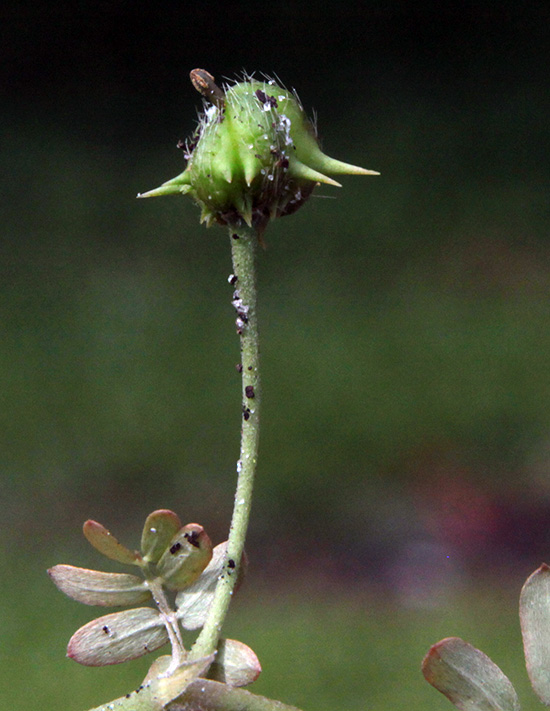
Ouch.  Puncture vine fruit

Ouch. Puncture vine fruit

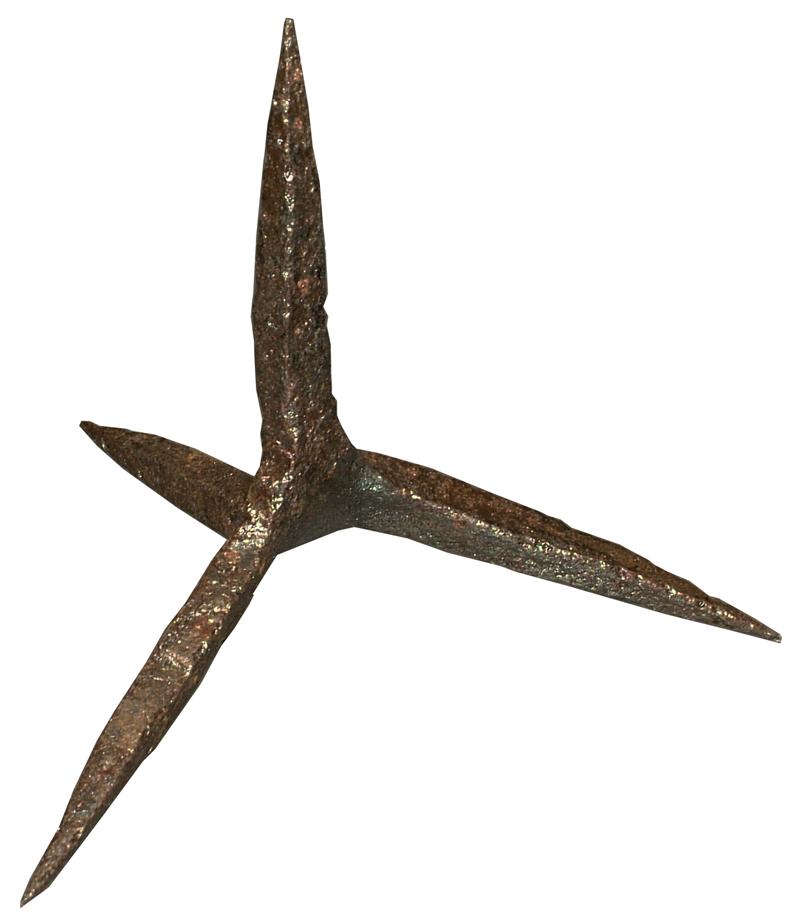
The puncture-prone fruits are armed to the teeth with teeth.  Another an apt name for the plant is caltrop.  A caltrop is an old fashioned device to hobble horses.  Anti-chariot technology. The puncture vine fruit is a little green caltrop.   It can poke a sneaker or a bicycle tire.  Even worse—the things you learn from Wikipedia—some warriors smear lethal arrow poison on the burrs and leave the deadly little booby-traps for unshod foes.

Caltrop (Google Images)

Caltrop (Google Images)


Let’s change the subject to something prettier. The attractive blossoms track the sun, all aligning toward the rays just like digitally coordinated solar collectors.

Sun-trackers

Sun-trackers

Why?  Explanations of floral solar tracking include the heat vaporizing floral fragrances, or to provide an attractive warm haven for pollinators.  Most solar tracking flowers live in cool places where such cozy advantages are obvious.   But why a solar-powered warm-climate weed?  I do not know.  Maybe extra heat helps at times even in warmer climates. It is not always hot year-round 24/7.  And maybe the species evolved in a cooler time or place. Or maybe the direct sunbeams somehow help bees orient to the flowers.   Yellow flowers commonly have UV patterns in the petals; bees see the patterns but we can’t—maybe those sun rays make the patterns pop to a busy bee.

tribulus Solar Dish Systems

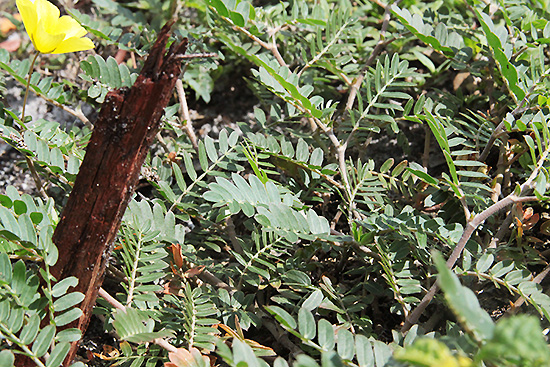
The compound leaves and their leaflets track the sun too, ostensibly to maximize sun exposure for photosynthesis.  The entire ferny leaf orients toward the orb, and as a step further, the individual leaflets “cup” like tiny curved linear sun collectors.  In the image below the brown tilted stick tilts at the sun.  The leaves have the same inclination.

Leaves tracking the sun.  The stick (and leaves) pint to the sun.

The stick, flower, and leaves point to the sun.


The END

tribulus pills

 
15 Comments

Posted by on June 21, 2014 in Puncture Vine, Tribulus


Tags: , ,

Ants in Yer Plants, Ants in Yer Pants

Northern Needleleaf

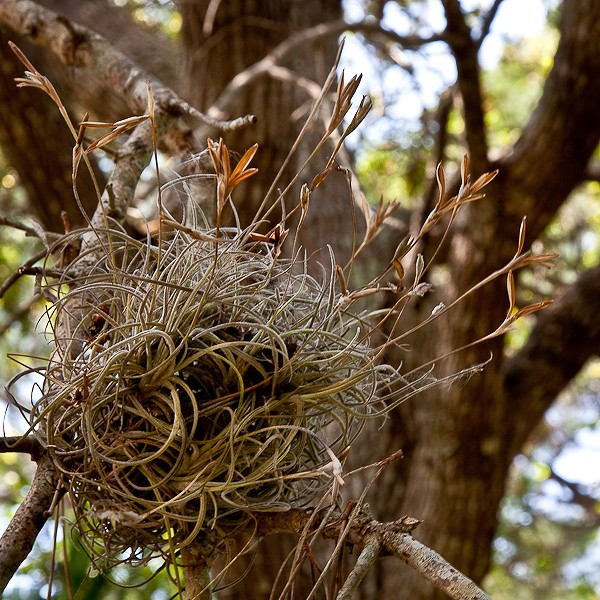
Tillandsia balbisiana and friends

Bromeliaceae

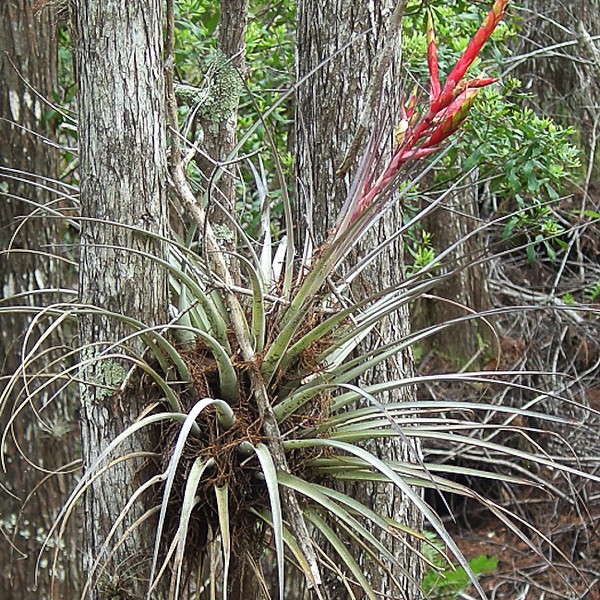
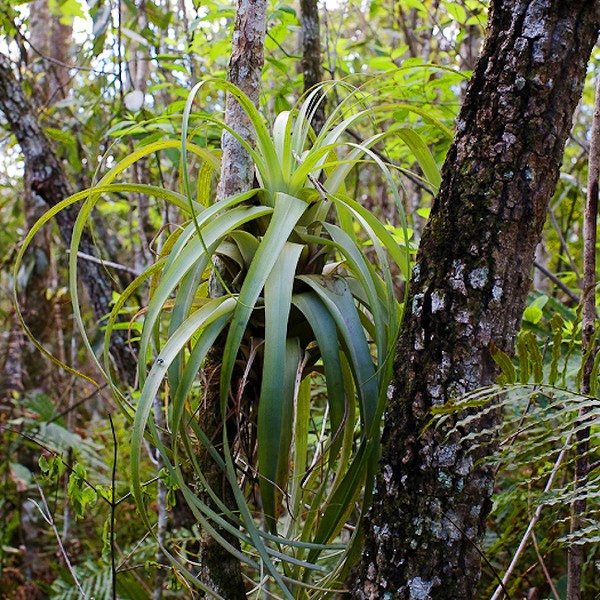
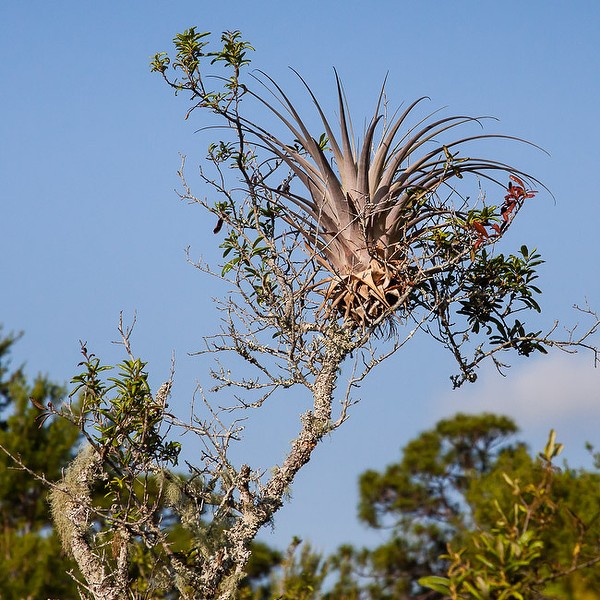
Cardinal Airplant, Tillandsia fasciculata

Cardinal Airplant, Tillandsia fasciculata


Glossary:

Airplant = Epiphyte = Plant living perched on a bigger plant

Local examples:  Ferns, Lichens, Orchids, Mosses, young Ficus, Bromeliads

Bromeliad (bro-MEL-ee-ad) = member of the plant family Bromeliaceae

Local examples:  Lots of garden Bromeliads, Pineapples, wild species of Tillandsia (including Spanish-Moss, Ball-Moss, Cardinal Airplant, Southern Needleleaf and many others)

Note: Today’s photos by John Bradford except for those of the ant-colonized airplant and Potbelly Airplant.  George added those in the Corbett Wildlife Management Area on June 11.


Today John and George sweated through beautiful Jonathan Dickinson State Park, where we greeted a jumbo gator and stumbled through a Bald Cypress swamp, always a fine place to find novel plants.  The Tillandsia epiphytes fascinated both of us, and we enjoyed them in our individual fashions:  John took a panoramic photo, and George got ants in his pants.  (Truly)

Giant Airplant, Tillandsia utriculata

Giant Airplant, Tillandsia utriculata

Click here, if you will, on John’s Gigapan Interactive Panoramic Image.   John shot this view this week in the Dupuis Management Area near Lake Okeechobee.  He  photoshopped in phew phlowers to phan the phlames of phun.  Zoom in and out, pan around in every direction.  He took this picture to be used!

Life sitting up a tree presents special challenges.  When you don’t have roots in the ground, existence is high and dry.  Plus sun-baked, nutrient-poor, codependent, and stormy.  Epiphytes have an array of special adaptations to cope, to cling to life, and to defend themselves and their tree hosts.  In the Bromeliad Family, most famously many species are tank plants with leaf bases arranged into a water-holding vase.  Let us now ignore boring tank plants.

High, dry, windy, nutrient-poor...yet happy.

High, dry, windy, nutrient-poor…yet happy.

Tillandsias are our main native Bromeliads, and they differ from most other Bromeliads as tankless; instead, they have specialized hairs and coats of tiny scales to secure life’s wet necessities.  You can see the absorptive scales easily on Spanish-Moss, Ball-Moss, and Potbelly Airplant.  Discussed in an earlier blog.

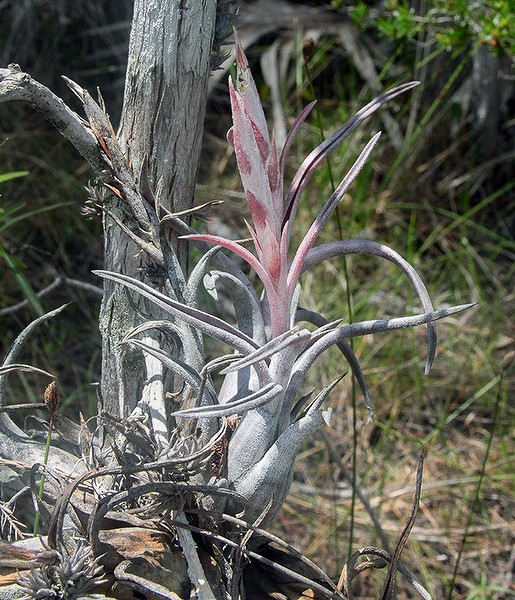
Potbelly Airplant covered with tiny scales

Potbelly Airplant, Tillandsia paucifolia, covered with tiny scales. The potbelly is the potential ant condo.

A less familiar adaptation of some of our local Tillandsias, in particular those with expanded “potbelly” bases, is housing ants.  Varied Tillandsias foster symbiotic relationships with ants, often members of the genus Crematogaster, Acrobat Ants, which typically live in trees.  Let’s see how the happy marriage may work:

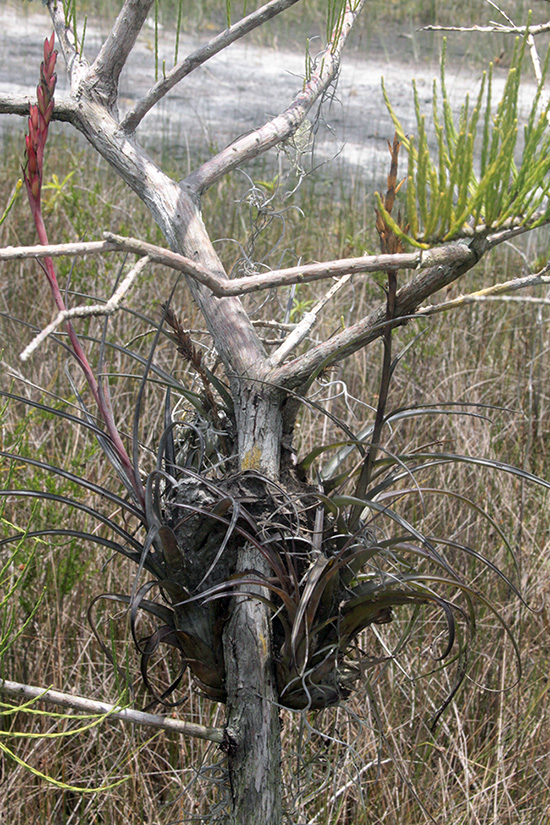
Benefits to the ants:  Spaces between the leaf-bases in the potbelly plant base are protected dry nesting sites.  Our local Northern Needleleaf Tillandsia has nectar glands outside the flowers.  These hosts provide room AND board to their guests.

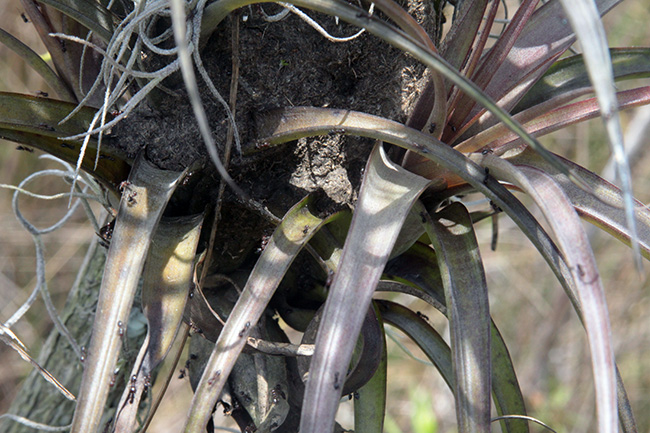
Northern Needleleaf, Tillandsia balbisiana, with ant colony

Northern Needleleaf, Tillandsia balbisiana, with ant colony

Benefits to the Tillandsia:   The ants are belligerent, believe me.  Poke the potbelly and stand back!  Nothing is going to bother that airplant and live.  Sometimes the ants protect the host tree from destructive insects, and may remove pesky vines or competing epiphytes.  Potentially even more important, and in need of more study, researchers think the ants fertilize their hostplant, especially with nitrogen, which is otherwise scarce up in a treehouse.  The ants release nitrogen-rich waste, including uric acid, and they sometimes lug their compostable food and even soil up the treetrunk to the potbelly plant base.  Oh yea, they die and decay too.  The ant-colonized Northern Needleleaf in the photos is bigger and more robust than its antless neighbors.

Northern Needleleaf ant colony at base of plant

Northern Needleleaf ant colony at base of plant

Researchers reported 42% of the Northern Needleleaf specimens to have ants in their plants in Mexico and 25% in the Bahamas.  It is tough to know how common ant colonization is in local populations of Northern Needleleaf, Potbelly Airplant, Banded Airplant, and others.  Interestingly, there is a report of 10-15% of Potbelly Airplants studied in Florida having “weedy” ant colonies.

Ball-Moss, tillandsia recurvata

Ball-Moss, Tillandsia recurvata

 
5 Comments

Posted by on June 13, 2014 in Northern Needleaf


Tags: , , ,

Jeepers Creepers That Sedge Has Peepers

Nutrushes

Scleria species

Cyperaceae (Sedges)

John and George today worked along the Haney Creek Trail near Jensen Beach, a species-rich oasis of wet pine woods, ponds, and scrub.  A dog-walkers mecca it is, and we encountered a jolly Border Collie who, being an eco-friendly pooch, retrieves pinecones.


Tarflower was in bloom today. Photo by John Bradford.

Tarflower was in bloom today. Photo by John Bradford.


There are big Sweetbay Magnolias, Dahoon Hollies with red berries, and Tarflowers abloom, all very nice, and now cast your big white eyeballs downward, and little white eyeballs in the grass return the stare.  The white of your eye is the sclera.  The white eyeball sedge is Scleria.

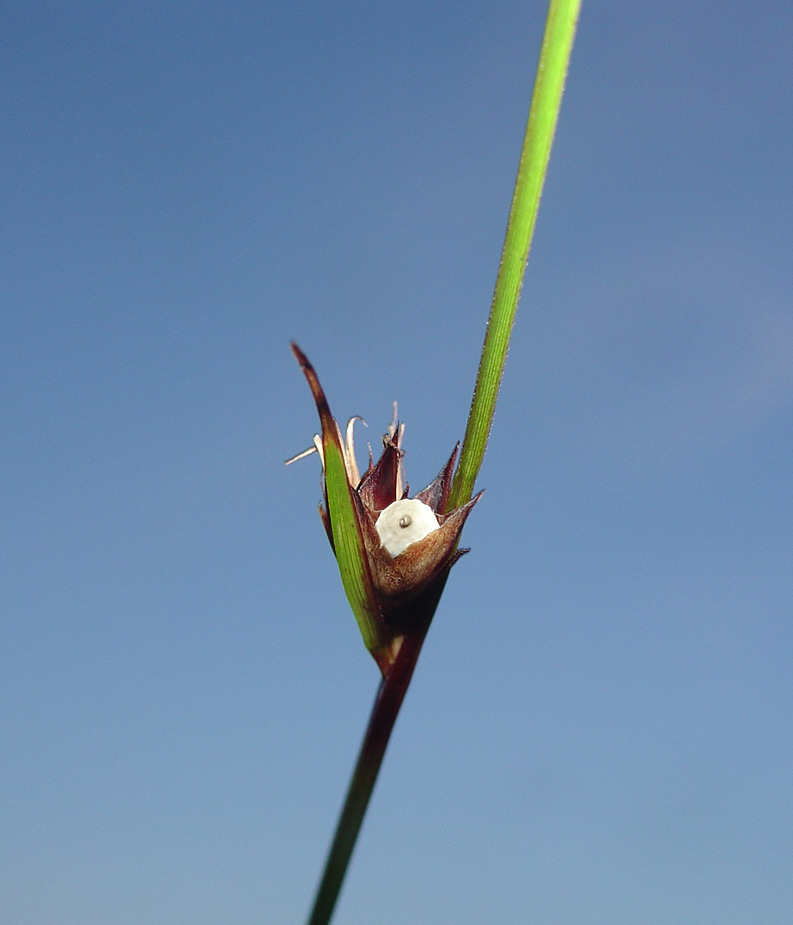
Peekaboo! (Scleria baldwinii by JB)

Peekaboo! (Scleria baldwinii by JB)


Scleria is a successful genus of some 250 species peeping from undergrowth worldwide.  Several species live natively in Florida,  and we have some uninvited exotics, too many species for individual attention.   Interested readers, if they exist, check our website floridagrasses.org.

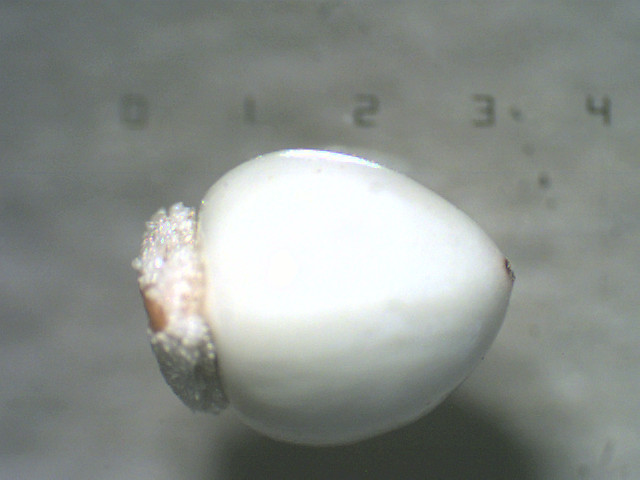
Sedges normally make tiny seedlike fruits, called achenes, which we’ll loosely call seeds; these are brown in thousands of sedge species.  Yet one genus has adopted bright white.  What’s up with that?

Fruits and seeds are all about dispersal.  Duh. So the main point of the glossy eyeball seeds  is most likely to catch the eye.  A plant in the grassy layer is competing with many other seed-makers for creatures to ingest and disperse the seeds.  Scleria seeds are displayed prominently and stand out visually—easily spotted from afar.  Several seed-eating and ground-feeding birds eat Scleria seeds.  One example is the Bobwhite.  The tough cover (sclera is Greek for “hard”) probably helps the seed pass through the bird unscathed.

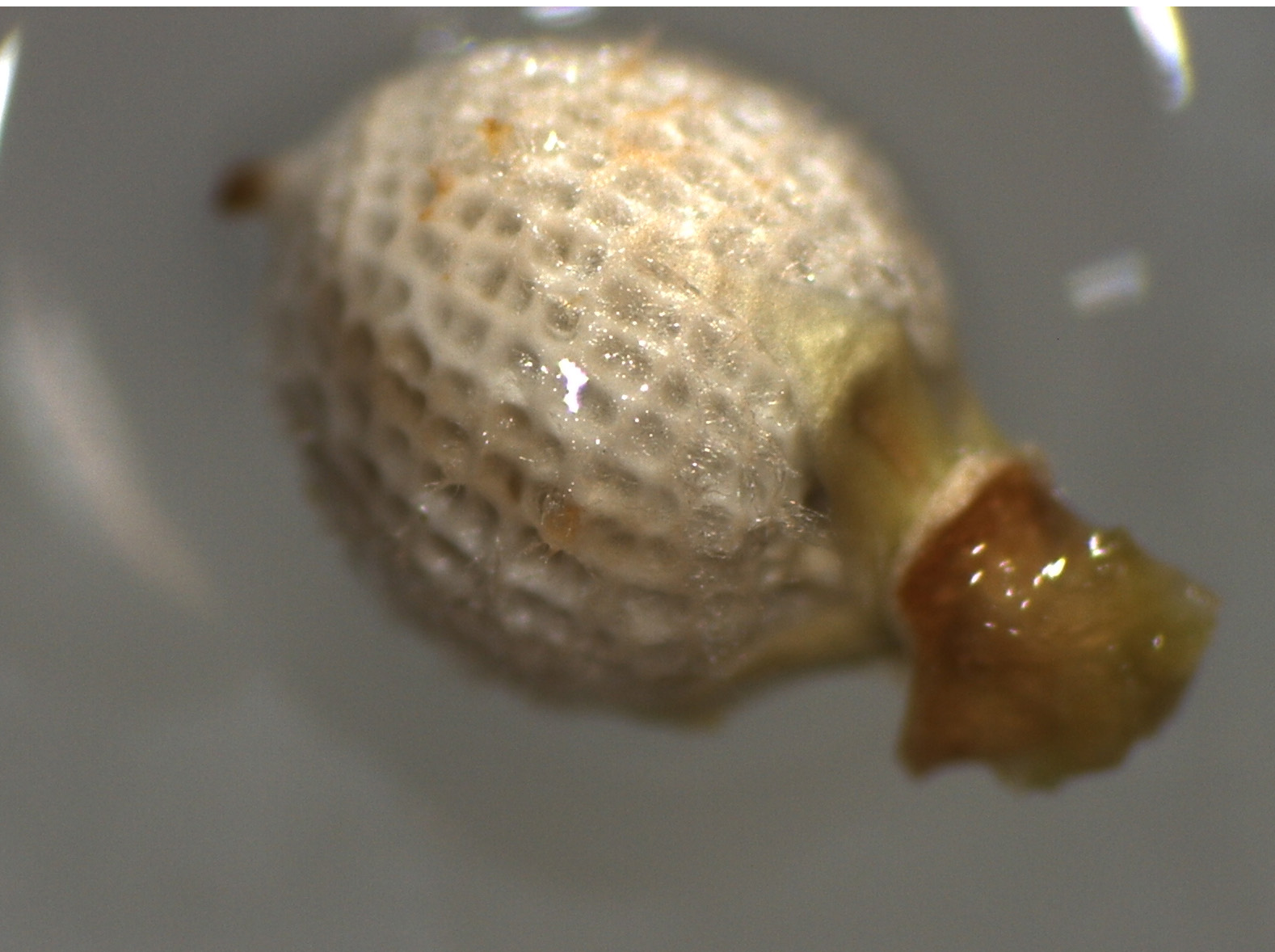
This species (S. reticularis) has a waffle pattern.

This species (S. reticularis) has a waffle pattern.


Part of the in-flight obstacle course is the gizzard, where some birds collect grit to grind their daily bread.  A Weaver Bird roadkilled in Africa had Scleria seeds apparently serving as gizzard stones according to Mike Bingham of the Zambian Ornithological Society.  Bingham noted also that some of the Scleria seeds seem to have been gathered not directly from the sedge plant, but from the ground where the white color may help with selection.  Bird feed suppliers sell small white Proso Millet seeds for ground-feeding birds.  The millet and Scleria are similar.

To add to the mysteries, the seeds of different Scleria species have varied surface textures: smooth, or pock-marked, waffle, or bumpy, or ribbed like a pumpkin.  Go figure.

Scleria triglomerata, dispersed by ants.  The "hypogynium" is the handy dandy ant handle at the seed base, at the left.

Scleria triglomerata, dispersed by ants. The “hypogynium” is the handy dandy ant handle at the seed base, at the left.


It is not just bird distribution, by the way.  One of our largest local Sclerias, S. triglomerata, has a handle called a hypogynium on the seed. (Many additional Scleria species do too.)   Ants use the hypogynium to drag the achenes to their nests, and probably eat the hypogynium away which could promote germination, as occurs in other ant-dispersed seeds.  An ant nest is a natural garden, with tilled soil, compost, and armed guards with an attitude.

 
4 Comments

Posted by on June 6, 2014 in Scleria


Tags: ,