RSS

Author Archives: George Rogers

Unknown's avatar

About George Rogers

Florida botanist

Willow Warnings and Starbucks Bees

The last-standing Cabbage Palm suffers no angst if you chainsaw the rest of the forest.  Slash Pines take their slashing without complaint.   And a Willow takes no notice of a caterpillar munching its neighbor (or does it?).

There’s a vague yet strong movement in the air these days to attribute plants with some ill-defined intelligence, feelings, or mysterious abilities, depending on whose article you read, and what you read between the lines. Pesky authors often hover around the edges of science, monitor scientific journals, and then “reveal” the more dismaying discoveries out of context in an aura of exaggerated mysticism.  Modern-day wizards.  This sort of exploitation of science has always bugged me, and a new wave is going around.  A book published this year by Michael Marder claims botany to be experiencing a “Copernican Revolution” based on “plant thinking.”   A paradigm shift!  Isn’t it fun and attention-getting to be the priest of a paradigm shift!?

You know it’s hot stuff when the New Yorker magazine (Dec. 23 this week) has an article on “The Intelligent Plant.”   Academics are getting themselves into the news with reports of corn plants communicating via root clicks, and sensitive plants learning to recognize false-alarms.

Even as authors deny it, there’s an anthropomorphic smell to the excited books, articles, and blogs.  The implications of plant sentience are precisely what make it newsworthy and exciting, despite a few “aw shucks, I’m not really saying…” The anthropomorphism is a pity, because anyone who knows anything of the birds and the bees already appreciates the beautiful complexity and fine-tuning wrought by hundreds of millions of years of plant evolution.  Plants have excited observers without paradigm shifts for centuries.

Botany is not experiencing revolution.  I think molecular biology is becoming increasingly sophisticated, revealing at ever-finer resolution marvelous complexity and interconnectedness among “lower life forms.”  Call it the increasing refinement of science, not mystical and magical “intelligence.”

That plants “do things” in response to stimulation is no big news.  Think of flowers closing by night and opening by day, or of a Bladderwort in a Florida marsh “sensing” and slurping a tiny creature into the plant’s underwater suck-trap.  A subtle plant action I’ve always liked in the Bignoniaceae Family is that after pollination the two flaplike stigmas clasp together like hands in prayer, encasing the newly arrived pollen and protecting the stigmatic surfaces.  Eerily animal-like.

“Communication” among plants is big news these days.  But really not so new at all.  It has long been known that a function of aspirin (more precisely salicylic acid) is to act as an airborne “Paul Revere” hormone—“pestilence is coming!”  The chemical alarm signal allows the plant under attack to induce defensive mechanisms (which are complex in their own right) in other blissfully complacent neighbors.  A botanical call to arms.  The growing  list of airborne plant-to-plant warning signals will enrich the plant physiology textbooks.   The scent of newly cut grass is probably loaded with bad news.
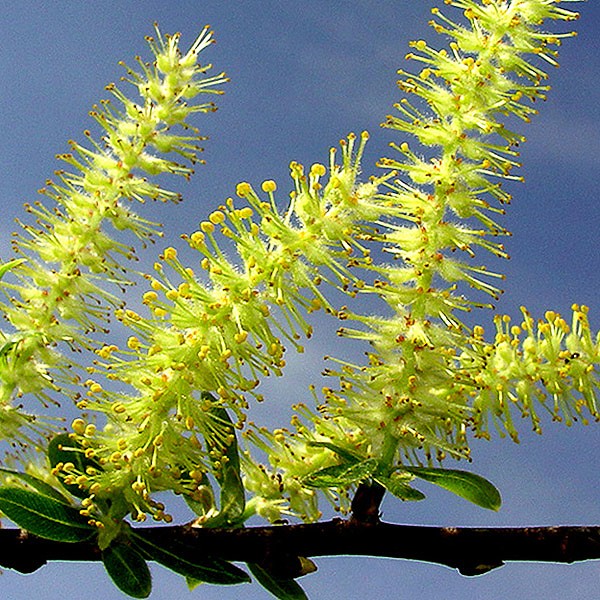
Salicylic acid is named for the Willow genus, Salix,  here portrayed in bloom by John.

Salicylic acid is named for the Willow genus, Salix, here portrayed in bloom by John.

Folks who dig “plant intelligence” a little too much tend to see such plant communication as generous and aware.  But signaling is not some sort of conscious plant-generosity, but rather probably a reflection of the well-established evolutionary principle that if you help those related to you genetically you are promoting survival of your own genes.  And if you participate in a collective defensive mechanism, such as buffalo in a circle, that protects you too.  Chemical signaling within living organisms is standard, unthinking, and well known.   Any botany student can rattle off a list of plant hormones.  Chemical signaling from animal-to-animal or insect-to-insect is commonplace.  So finding chemical signaling from plant to plant  is a wonder of nature, yet not really that surprising, and unrelated to “intelligence” by any distorted definition.
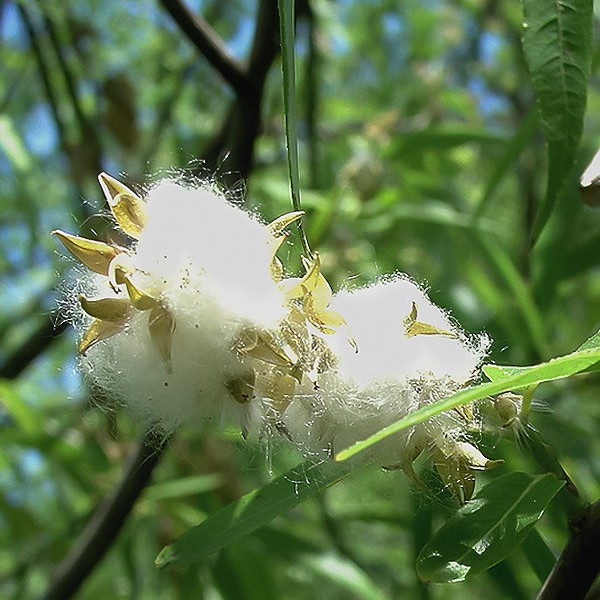
Willow fruit opening (JB)

Willow fruit opening (JB)

Speaking of plant communication, you have seen the TV commercial where the tree falling in the forest does make a sound?  “A little help here.”  Funny-right?  Forester Suzanne Simard may not think it’s all so comical.    She studies mycorrhizae, the fungal threads that extend out of roots into the soil, helping the root secure phosphorus and other nutrients.  She sees mycorrhizae not as extensions of individual trees, but as the LinkedIn of the forest tree community.  Dr. Simard sees the fungal symbionts as a shared subterranean network interlinking the trees in an internet of communication and nutrient exchange, even passing nutrients from that tree “falling in the forest” to the younger trees in need of a boost.  A “mother” tree may help sustain its progeny via fungal connections, like a mother human depositing funds in her college student son’s bank account.  There’s probably a good bit “going on down there”  in the fungal-root realm. Sorting it out will be fun for researchers to come.  Hear it straight from the source: CLICK

A remarkable article in the prestigious journal Science this Spring made the news CLICK, echoing into the popular press.  The obvious role of plant-produced drugs is as natural pesticides.  But a non-obvious role for caffeine turned up…to give the pollinating bees a buzz, as one author put it.  In Citrus flowers, caffeine in the nectar helps a bee remember the flower, and thus return for another sip of nectar, or for a cup o’ joe.

Who will discover tobacco plants addicting bird-pollinators to nicotine?
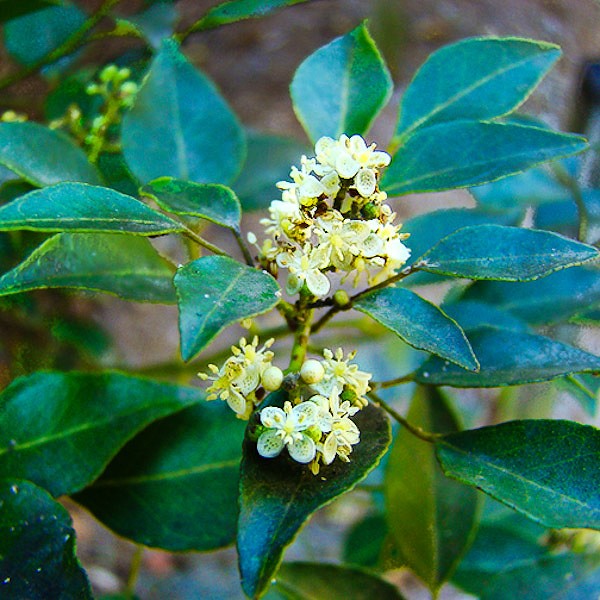
Amyris is a locally native Citrus.  Any caffeine in that sweet nectar? (JB)
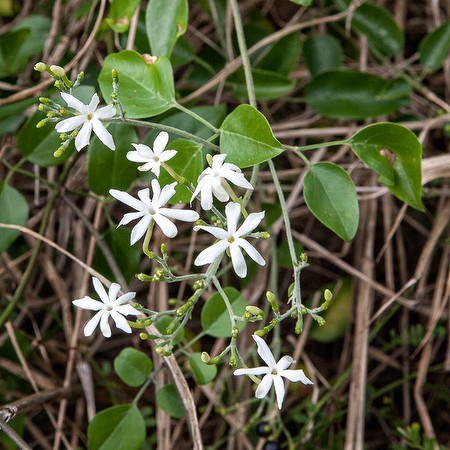
Amyris is a locally native Citrus. Any caffeine in that sweet nectar? (JB)
 
11 Comments

Posted by on December 22, 2013 in Carolina Willow, Uncategorized


Tags: , , , , , ,

Doctor Doctor I Declare—I Spy Leadwort Everywhere!

Doctorbush, Leadwort

Plumbago zeylanica (P. scandens)

Plumbago

Yesterday John and George visited an unnamed coastal hammock remnant near the Hutchinson Island Nuke in St. Lucie County.  Half the site is a tangled wonderland of invasive exotic species resurrected from old illegal dumping.  Get away from the clamboring Brazilian Jasmine (Jasminum fluminense) and the Earpod Trees (Enterolobium) dropping their contorted ears, and there’s a hidden treasure chest of natural biodiversity.

Brazilian Jasmine (invasive species, JB)

Brazilian Jasmine (invasive species, JB)

A sharp line separates the invasive tangle from relatively uninvaded hammock, including the shy understory shrub Velvetseed (Guettard elliptica) representing the Coffee Family.

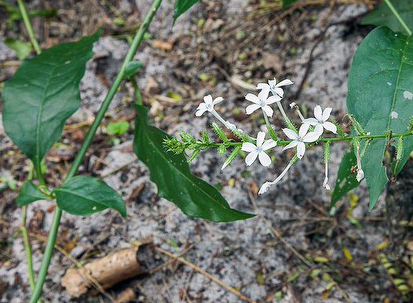
Covering the forest floor—at least in areas not overrun with Sansevieria—is a mix of two medicinal alkaline-loving hammock-dwellers:  Garlicweed (Petiveria alliacea) and Doctorbush, perhaps better known as “native Plumbago” or as native Leadwort.  (The plumb in the name refers to lead, as in “plumber.”)   The pretty white flowers, shade tolerance,  and easy cultivation give Leadwort a place in native species gardens, although the usually-blue-flowered South African species Cape Leadwort (Plumbago capensis) is more familiar down at the garden club. Glands on its leaves reportedly secrete “chalk” taken up from its calcium-rich habitats.

Native Plumbago (JB 12/13/13)

Native Plumbago (JB 12/13/13)

Any plant named Doctorbush better be good for something.  Its bioactive oil plumbagin irritates the skin, a promising omen for medicinal attributes!  Spanning at least 2500 years, Plumbago extracts have treated just about every discomfort known to humanity, from pimples to pregnancy.  Anyone who looks into a lot of plants finds frequent optimistic references to anti-cancer activities.   Usually a fizzle, but Plumbago has garnered far more than the usual share of modern scientifically based cancer interest, at the University of Wisconsin and far beyond.   CLICK

Plumbago zeylanica serves in Africa to welt the skin cosmetically   Long before Popeye’s anchor, Polynesian cultures were well tattooed using a diversity of coloring agents derived from sealife, from caterpillar fungus, and from plant pigments, among them Plumbago zeylanica root extracts, which give black and blue coloration.   The indigenous Hawaiian name for the plant hilie’e means, more or less, “dark dye.”  One of the many explanations of the name leadwort is lead-colored skin damage from the juice.  Anybody want a natural organic (toxic) tattoo?

Like many toxic species, Plumbago is a butterfly larval host, for species including the Cassius Blue Butterfly, which returns as a floral visitor.

Our white-flowered native species has a checkered nomenclatural past.   Are there two species, one in the New World, and a different species in the Old World?   (Plumbago scandens here and a separate P. zeylanica there?)  Or are we dealing with just one conspiracy to take over the world  that is, one broadly defined P. zeylanica.   Flora North America takes the single-species broad view, with the comment, “Plants in herbaria under these two names appear indistinguishable.”  Seems reasonable to me.

No matter how you apply names, the species (or “indistinguishable” species pair) has an enormous intercontinental distribution from New Zealand to Asia to Hawaii to Africa to South America to Florida.  How do they get around?

It probably has to do with the calyx (sepals) which persist upon maturity to encase the small fruits.  The sepals bristle with stout stalks, each capped with a sticky gland.  That is, velcro plus glue.  See Jim Conrad’s picture of the glands:  CLICK (The glue may dry as the fruits mature?)

A lot of flowers have glands at their bases, presumably to hobble thrips or other lil’ pests.  And this is probably a function for the Plumbago velcro-glands.  Yet the persistence of the gland-stalks on a calyx that continues to invest the fruit at dispersal time suggest a second function.  This plant crosses oceans and colonizes oceanic islands.  The seeds have to get there somehow.  Although Leadworts like coastal habitats, they are not strictly maritime.  In the U.S. they turn up in Arizona, in Africa on termite mounds.   Just speculating here: those velcro units look designed for snagging in plumage.  Pelagic seabirds are well known adhesive seed-carriers.  (Would they be careful about keeping a New World species separate from and Old World species?)  I found no specific data on seabirds carrying Plumbago,  so please accept Arni as a surrogate.

 
5 Comments

Posted by on December 14, 2013 in Uncategorized


Tags: , , ,

Bluethreads, Yams, and the Fungi Who Love Them

Bluethreads

Burmannia biflora

Burmanniaceae

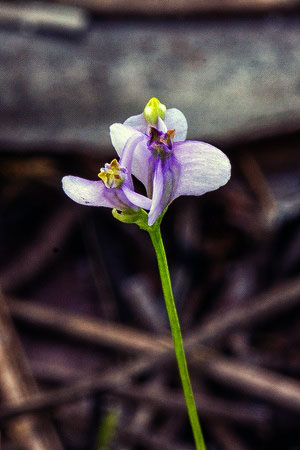
Friday John and George took a late-November look at Jonathan Dickinson State Park and came upon a remarkable species, Burmannia biflora.   The entire plant consists of one or more lilac flowers  teetering on a thread-thin unbranched green stem four inches tall.  The leaves are so tiny as to go unseen, in other words at first glance the plant is a flower on a thread so skinny it is surprising the thread can hold up the blossoms.

This link shows clearly the nearly leafless plants rising from the ground.  CLICK

Inquiring minds want to know, “how does that skinny little “leafless” waif photosynthesize enough to support itself…don’t plants need leaves for that?”

Burmannia biflora Nov. 22 (JB)
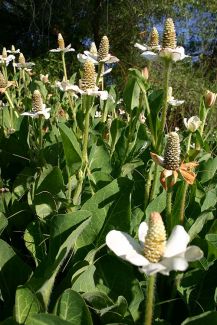
Burmannia biflora Nov. 22 (JB)

Some plants derive some or essentially all of their nutrition from sources other than photosynthesis supported by root-absorbed minerals.  Some species are parasitic on other plants.  Others are carnivorous, although these obtain mainly nitrogen from their “meat” so still must photosynthesize.  Most plants have symbiotic relationships with underground fungi, getting some of their mineral “fertilizer nutrients” from their fungal associates.  And now to get to the point, a few plants take the fungal relationship even further and derive so much substantive nutrition from symbiotic fungal partners that their photosynthetic needs and capacity dwindle, and sometimes disappear altogether.   They become saprophytic by symbiosis, flowering-plant pseudo-fungi.

The Burmannia Family is known for that.  You might see the family as an assortment of mostly (or all?) fungally nourished species, some with merely partial photosynthetic ability and others 100% on fungal life-support.  They become nutritional extensions of their fungal partners.

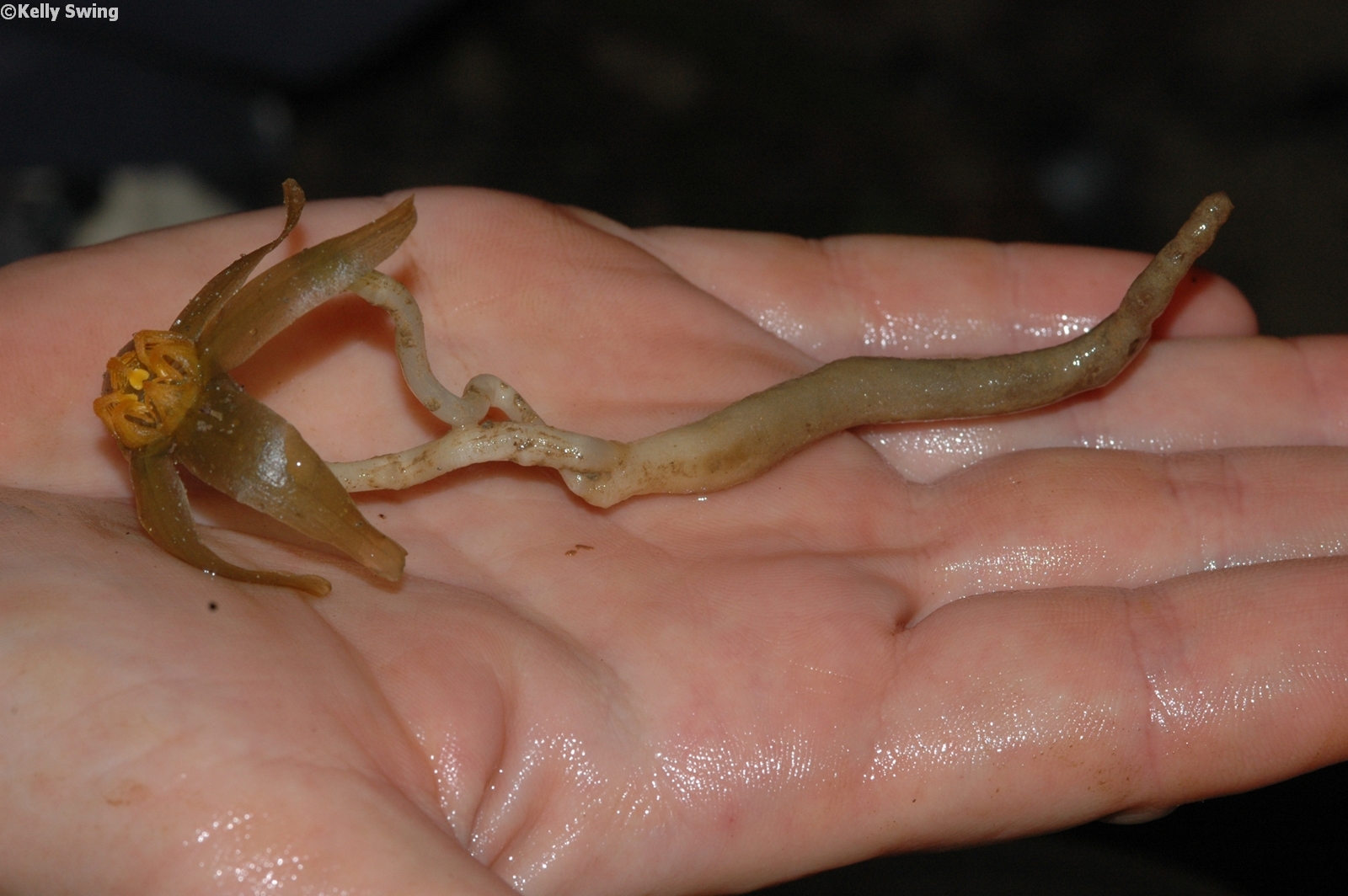
The Ecuadorian species shown below, Tiputinia foetida, unknown until 2005, is obviously completely non-photosynthetic.  There are many additional examples in the Burmannia Family.

Tiputinia by K. Swing.  This is the entire (non-green!) plant behaving like a fungus.

Tiputinia by K. Swing. This is the entire (non-green!) plant behaving like a fungus.

The nutritional relationships of our local Burmannia biflora are, to my incomplete (!) knowledge, not well known and would make a fascinating study.  The plants have some photosynthetic ability, apparently supplemented by a fungal support staff.  The roots are thick, shallow, sparse, and coarsely branched, probably a reflection of fungal symbiosis.  (Look at the root on Tiputinia above.)

In some or all members of the Burmannia Family the roots lack the internal layer known as the endodermis characteristic of “normal” roots with normal nutrient uptake by absorption.  Apparently Burmanniaceae roots don’t absorb in the conventional fashion.

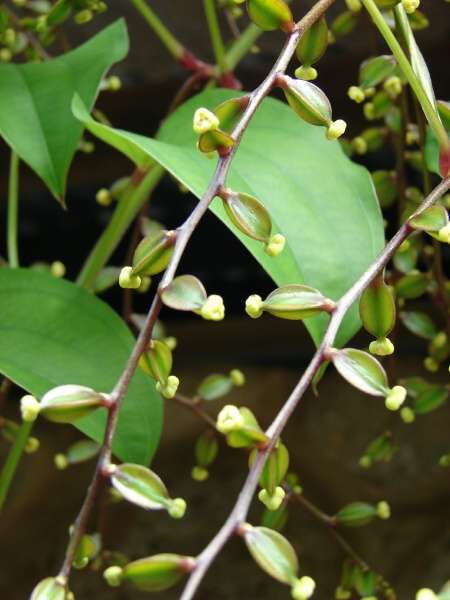
Another oddity of some Burmanniaceae species is a spongy sheath called a velamen, much better known as a feature of the Orchid Family.  Burmannia and its relatives were once erroneously thought to be kin to Orchids.  DNA shows them to be more closely related to yams.  But who needs DNA for evidence?  Compare the wings on the flower bases of Johns’s Burmannia photo above to the similar winged flower bases on many yams, including our own weedy Winged Yam.

Winged Yam, note how similar the winged flowers are to the winged flowers of Burmannia. (By onlyfoods.net)

Winged Yam, note how similar the winged flowers are to the winged flowers of Burmannia. (By onlyfoods.net)

 
5 Comments

Posted by on November 24, 2013 in Bluethreads, Uncategorized


Tags:

Has Melaleuca finally earned the appreciation it is due?!

Melaleuca

Melaleuca quinquenervia

Myrtaceae

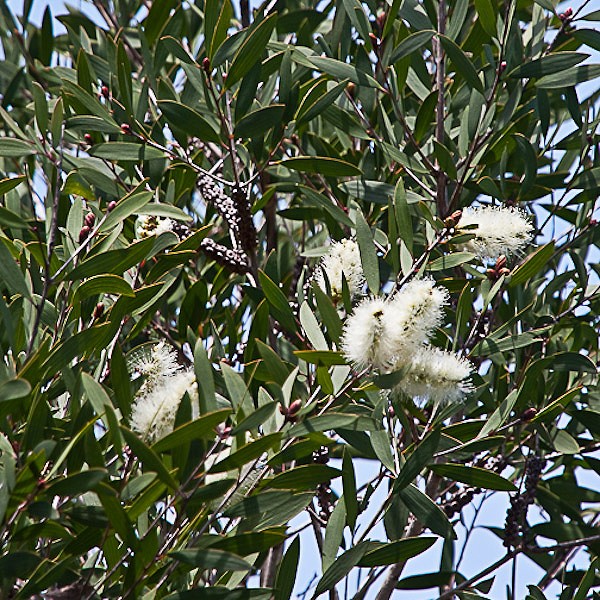
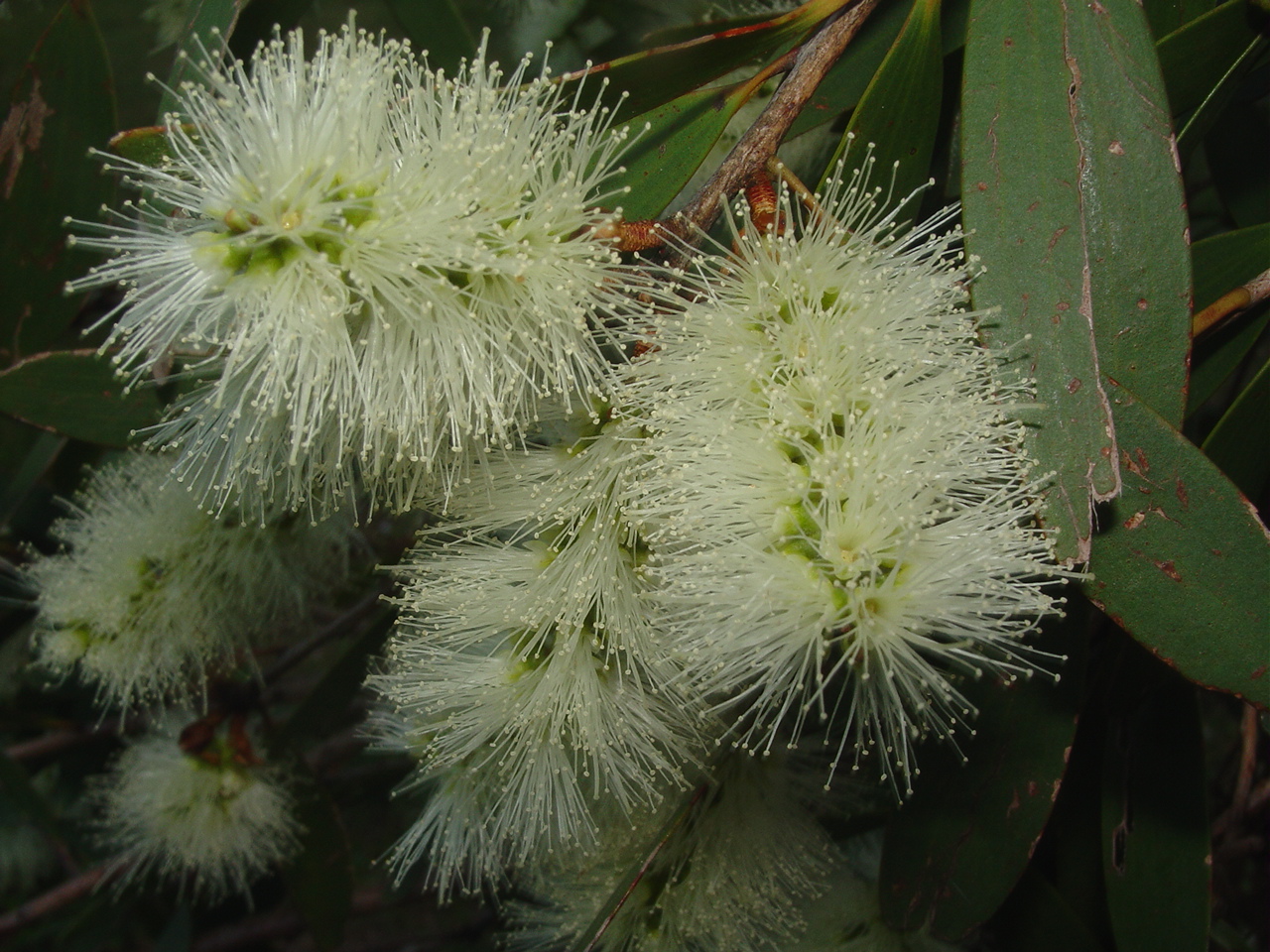
Melaleuca flowers (JB)

Melaleuca flowers (JB)
John and George devoted our usual Friday botanizing yesterday to the computer in an effort to rejuvenate our aging Grass web site (www.floridagrasses.org) limping along on software from the Bush II Administration.
So then stepping back one more day,  Thursday I visited Apoxee Park in West Palm Beach to prepare my Horticultural Taxonomy class, and noted the massive Melaleuca monoculture thereabouts.   Melaleuca is arguably the most loathed botanical bioinvader in South Florida.  But who knows, maybe someday all that biomass will turn out to be good for something better than evapo-transporation swamp drainage. You’d think that most Floridians would know Melaleuca, so it surprises me each year to have students blissfully ignorant of the tree.

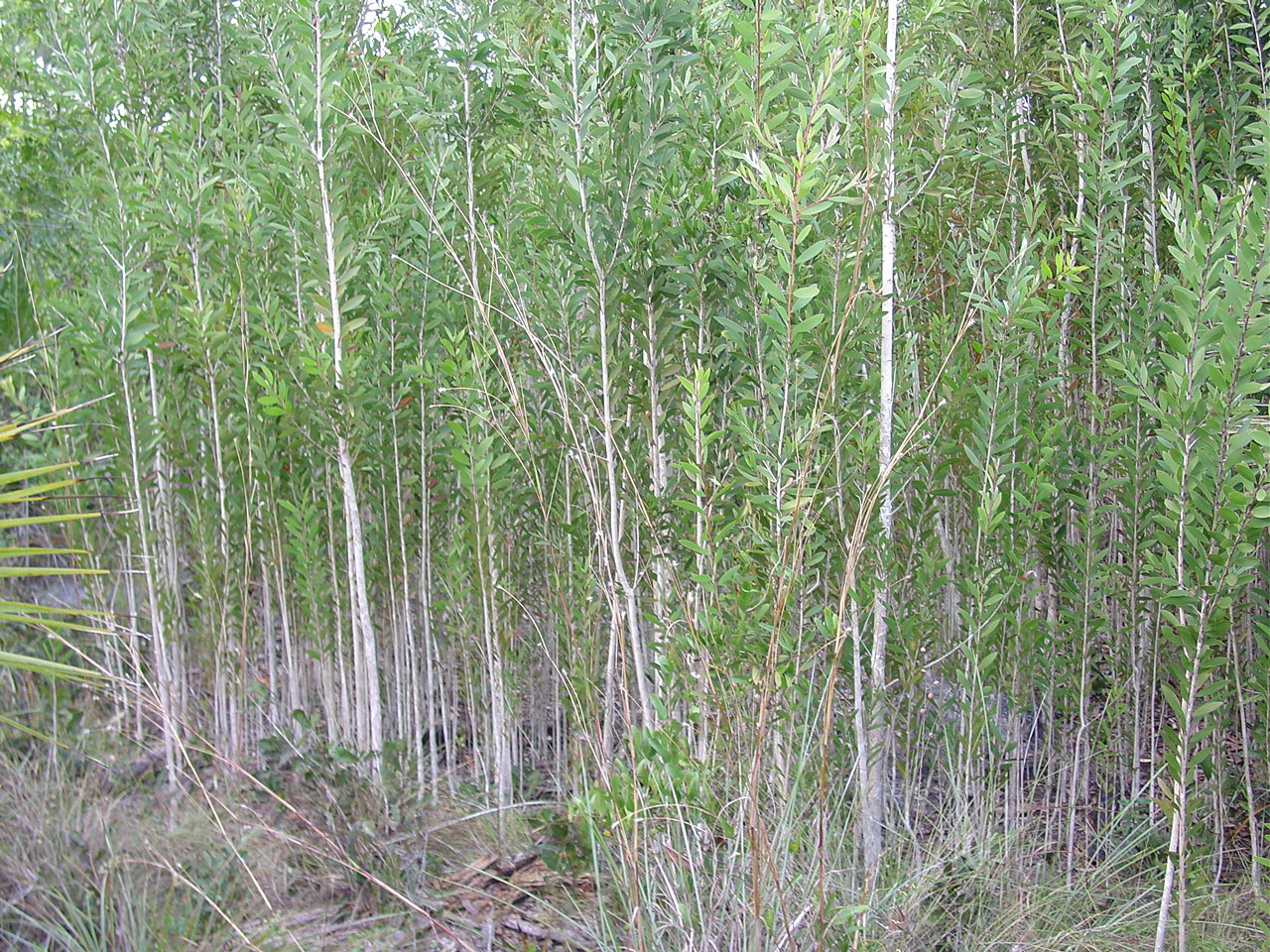
Monoculture

Monoculture

Like it or not, Melaleuca is with us until somebody achieves the holy grail of biocontrol—a super pest able to annihilate it yet harmless to other Myrtaceae.  Until then we might as well know the tree and find something to appreciate about it. Grant me the serenity to accept the things I cannot change.

Have you ever noticed the resemblance of Bottlebrush (Callistemon species) to Melaleuca?  Contemporary taxonomists tend to regard them both as belonging to Melaleuca.  Tightly related they are.  Why did one cousin go bad and the other go good?   “Good” exotic plants can behave for years, but one day turn naughty like Miley Cyrus.  Bottlebrush is following its white-flowered cuz down the road to perdition.  I’ve seen it invading wetlands near Orlando like the red-flowered Melaleuca it is.  The species is now a Category II invasive exotic in the eyes of the Florida Exotic Pest Plant Council.

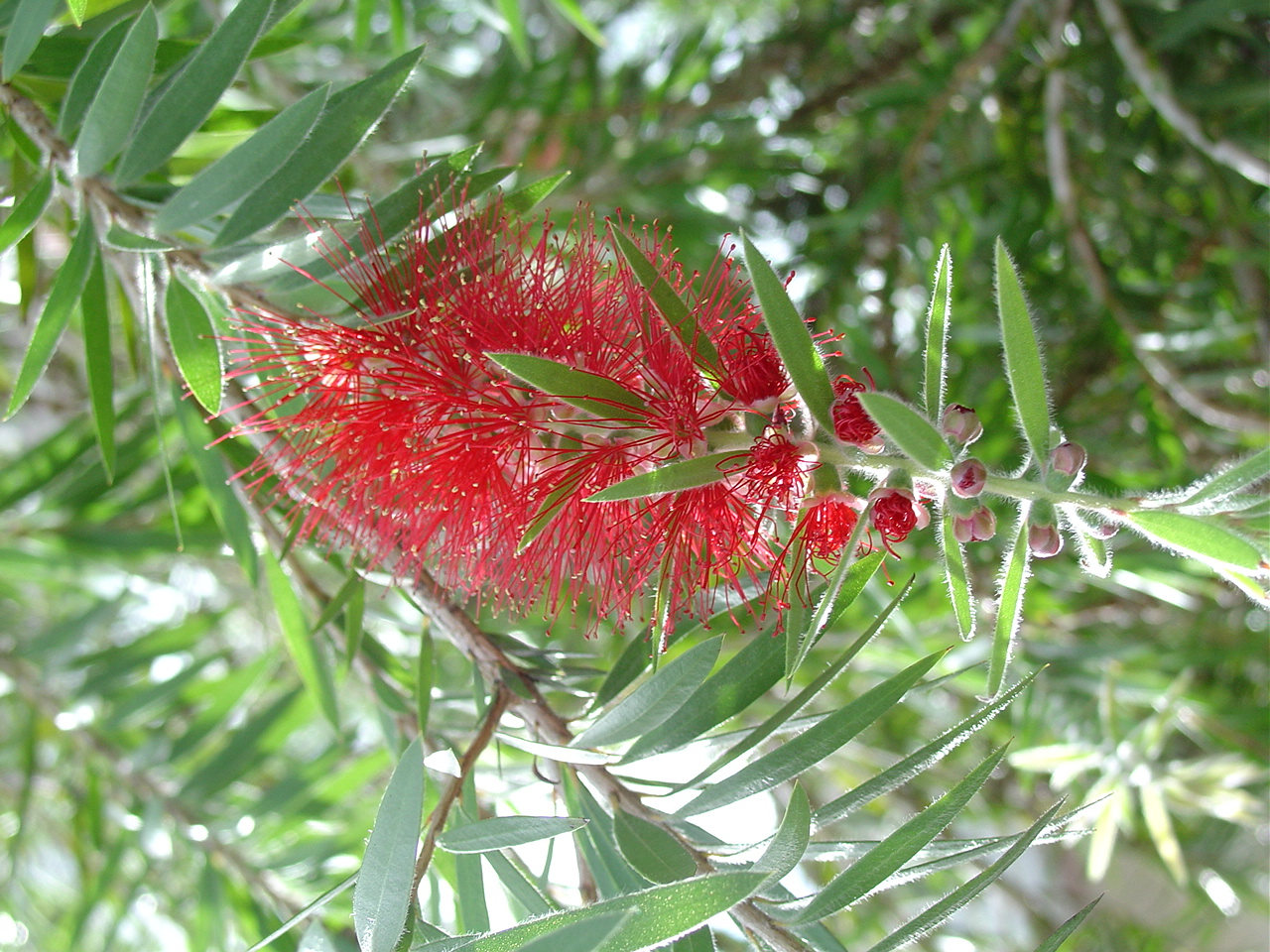
Bottlebrush, or let's just say "Red Melaleuca."

Bottlebrush, or let’s just say “Red Melaleuca.”

Back to white-flowered Melaleuca.  Nothing is totally bad.  Maybe you’d like youthful skin?  Perhaps then tea tree oil (from a different Melaleuca species) is for you.  CLICK  John and I tried it, and we experienced an alluring radiant glow.

Something Melaleuca does well is generate wood!  And wood is a commodity.  Last week in class, as I handed out a handout a snarky student said, “how many trees did you kill for that?”  Hmmmmm, Do we need to farm trees for paper when we have unloved Melaleuca galore?   A superficial Google search shows Melaleuca in paper.  CLICK   And to the extent that wood serves as fuel, there is Melaleuca to burn. CLICK  So then hold off on the Melaleuca-eradicating GMO bugs!  Maybe someday we’ll rejoice in such fast-growing woody biomass to roast pythons and fuel our steam cars.   If nothing else, we’ll mulch our edible weed patches with it.  CLICK

MelaleucaClose

Melaleuca is native to Australia and somewhat beyond.  And here is a little Melaleuca humor:  According to a U.S. Forest Service report, original Melaleuca forests in Australia are declining to the point of requiring special conservation efforts.

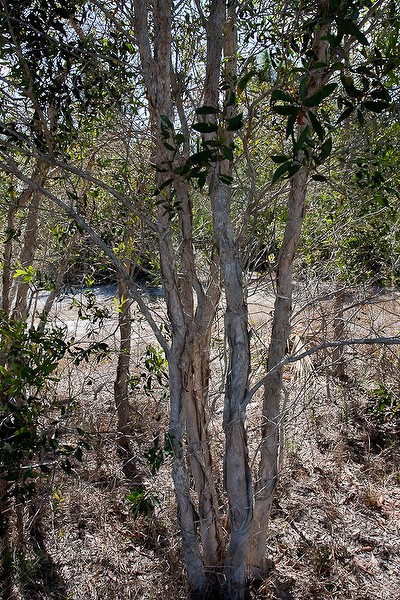
Melaleuca is the local master of surviving fires.  The papery peeling bark holds water as an apparent fire protection, although after it dries the outer bark ignites to the point of conducting low fires into the crown.  That does not necessarily kill the tree.  The leaves are loaded with combustible oil, producing dramatic crown fires.

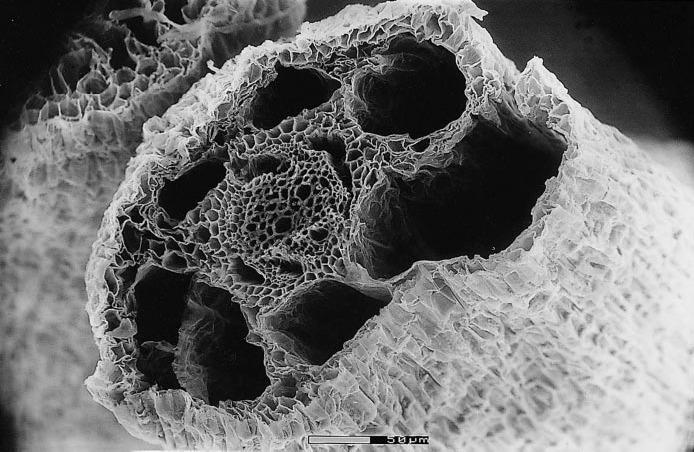
The tree prefers wet places and might be said to benefit from flooding.  Flooding brings forth upward-growing hollow snorkel roots rising to the surface of the water, a little reminiscent of the dead man’s fingers in Black Mangrove.

Hollow Melalauca sp. "snorkel" root  (M. Denton and collaborators, Plants in Action)

Hollow Melaleuca sp. “snorkel” root (M. Denton and collaborators, Plants in Action)

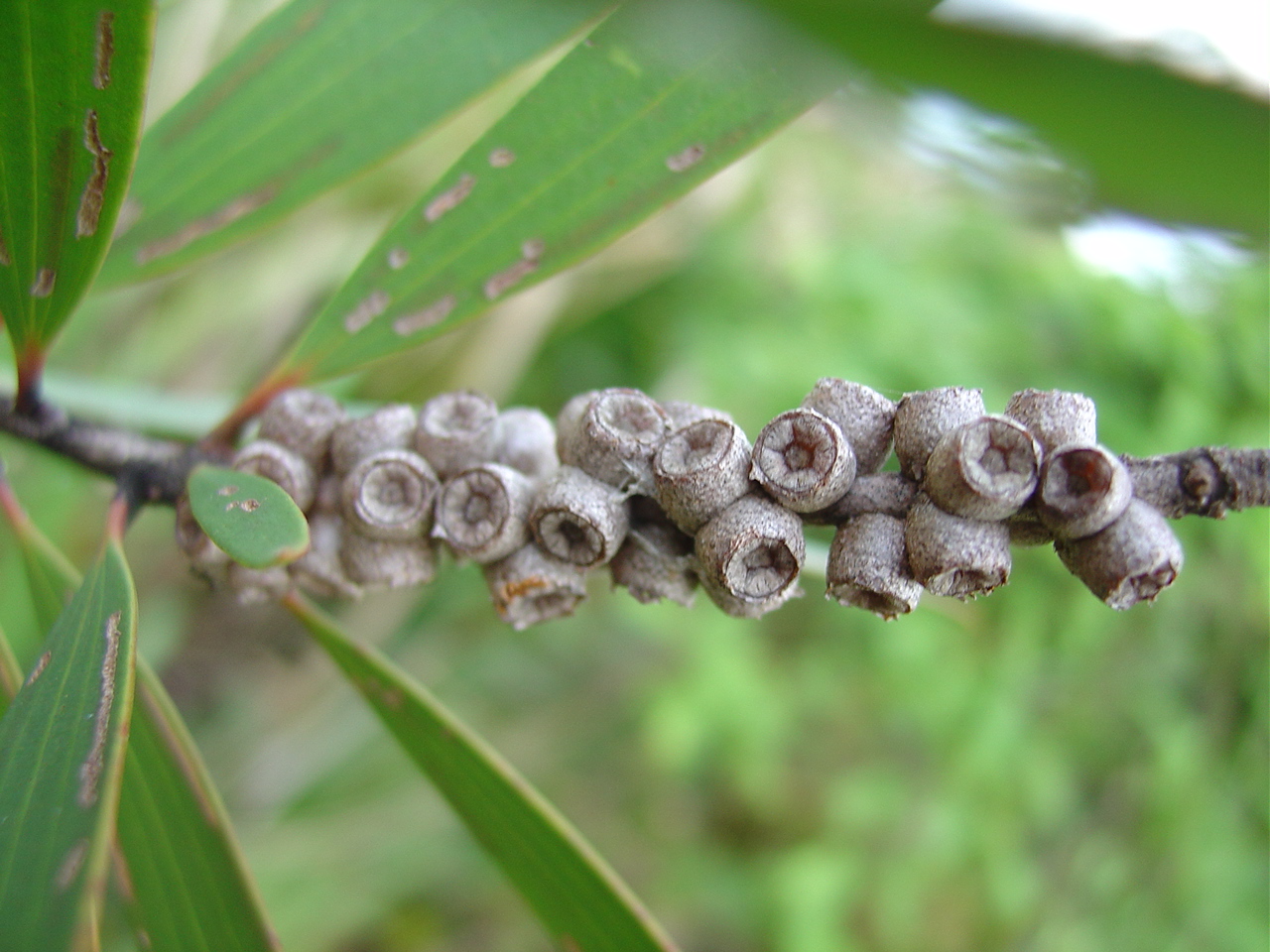
The tiny seeds form in massive quantities in clustered woody capsules.  Some seed release is almost continuous, while other seeds remain in woody capsules on the stem for a “rainy day,” when fire, age or other drying trigger massive release. A single tree can maintain some 50 million seeds sequestered high and dry.

Woody fruits

Woody fruits

Of course many people despise Melaleuca, but why be a hater?  Maybe it is all a matter of how you look at things.  Florida Horto-Pioneer Henry Nehrling had a heart filled with love and optimism.  His positive words permit us to end on a nice note (1933):

“This attractive and useful Australian tree has only lately received the appreciation that is its due…It grows fast and is extremely ornamental.  The small leaves, white bloom, and remarkable white-colored spongy bark which flakes off in rich papery flakes, all add to its charm.”

Henry would be thrilled to know that since the 1930s our opportunities to appreciate the charm have expanded.

Melalaeuca bark

 
10 Comments

Posted by on November 16, 2013 in Melaleuca


Tags: , , ,

OMG! There’s Buttonweed Fouling My Beautiful Lawn! (And my beautiful garbage dump)

Virginia Buttonweed

Diodia virginiana

Rubiaceae

Today John and George visited the Palm Beach County Solid Waste Authority, a dump with benefits: a network of nature trails and ponds and fun times communing with wetland plants and a sunbathing gator.  CLICK for a cyber-visit to the landfill.

As a fan of this native wetland gem, I am dismayed that the suburban lawn-culture has turned Virginia Buttonweed into a reviled hate-weed.  Is the most interesting thing about a wildflower which carcinogen to spray on it?   Spray HERE to glimpse the horror!.

Or go read the garden blogs—you’d think VBW was the Crack of Lawn Doom.  So then to join the ranks of condescending blog-pundits holding forth on what to do if Buttonweed affliction keeps you awake at night: Enjoy it!  (Then turn down the sprinklers.)

VBW is native across much of the eastern U.S. and extends into South America, its spread conceivably aided by migrating waterfowl.  The plant can repopulate from busted fragments, and Canada Geese reportedly eat it. Perhaps they are travel agents, sharing the beauty from golf course to golf course.  Also, the little barrel-shaped fruits become corky and float away.  Today was a good monsoon day for that.  Did I mention that the species is semi-aquatic, probably adapted to wet disturbed shores where floating matters?

In recent times Virginia Buttonweed has turned into a weedy turf pest in the Southeastern U.S., and far beyond, including Asia.  Why has this cute little puppy become a bad dog?  Well, it’s adapted to intermittently wet disturbed sunny places with impaired drainage.  In other words, stream banks, marshy fields, and suburban lawns on compacted soil soused with automatic sprinklers.

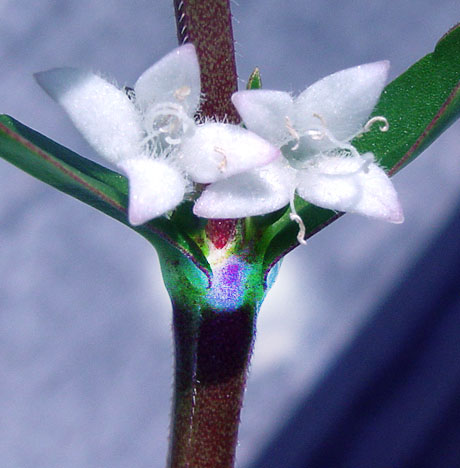
Diodia virginiana yesterday (JB)

Diodia virginiana yesterday (JB)

Among the plant’s odd adaptations are two features sometimes found in other members of the Coffee Family.  First, the tissues contain tiny acid needles probably there to minimize grazing. (Even if the needles do not bother a Goose, they might discourage insects.)  Secondly, around the stem at each node there is a saclike membrane (a specialized stipule).  The membrane is a translucent ziplock bag that holds water around the developing young flowers, around the young fruits, and possibly around tender points of root origin.  The plant can (as I speculate!) collect and retain moisture around its key parts during dry moments in its amphibious life cycle.  No wonder it likes those lawn sprinklers.  CLICK this link to see the membrane in Diodia (teres) as the white cup with fingers on the rim, surrounding the base of the flower.  Having a similar adaptation and even more prevalent in Florida turf is Mexican-Clover (Richardia grandiflora).

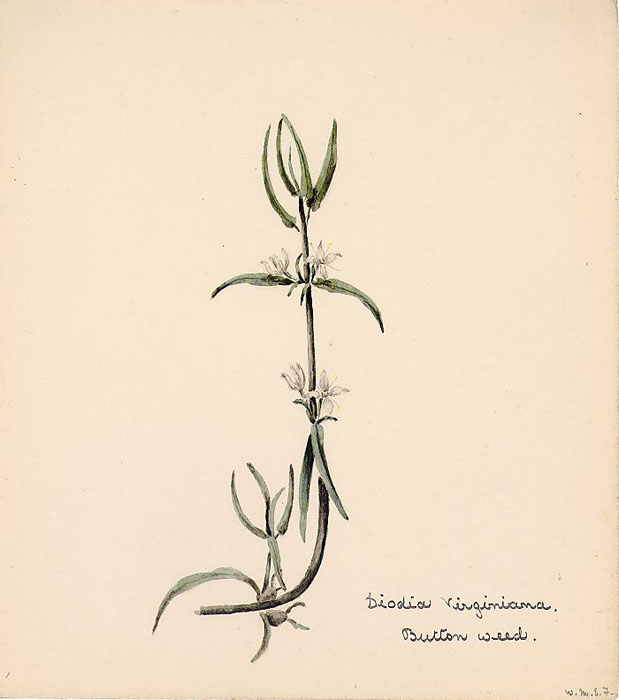
This little wildflower is one tough customer.  It can regrow from it own fragments.  The stem sprouts roots where it contacts the ground.  There is a report of deeply buried seeds sprouting, this being perhaps an adaptation to being covered in silt?  And most intriguingly, the species reputedly forms underground flowers, a feat (if accurate) it shares with its fellow-member of the Coffee Family, Innocence (Houstonia procumbens) and with other unrelated local species, such as Blue Maidencane Grass.  In the old sketch below, it looks like the bottom-most fruits might have been in the mud.

Sketch from the Internet.  Selected to show the lowdown flowers (fruits).

Sketch from the Internet. Selected to show the lowdown flowers (fruits).

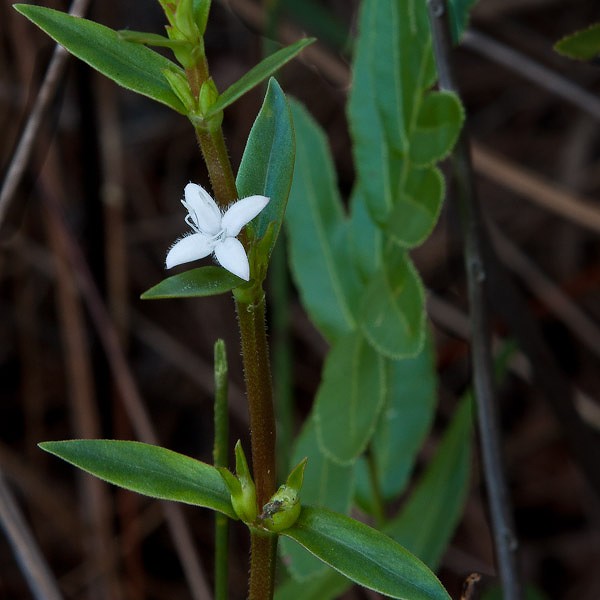
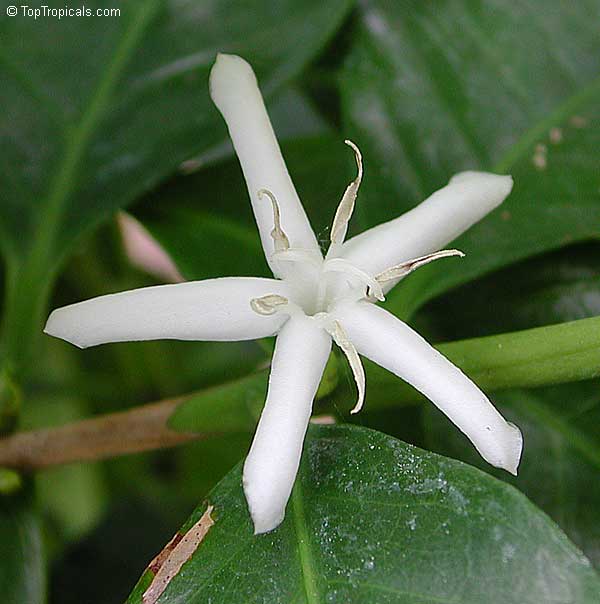
You may ask yourself, “what has this creepy plant got to do with coffee?”  Glad you asked:  it is fun to find out the family relationships of familiar plants, because then family resemblance shine through.  Look how similar the Virginia Buttonweed blossom is to the Coffee flower.  The Buttonweed fruit even looks like a little coffee bean.

All in the family:  Buttonweed flowers looks similar to related coffee flower.

All in the family: Buttonweed flowers looks similar to related coffee flower.

Coffee flower (from Top Tropicals plant nursery)

Coffee flower (from Top Tropicals plant nursery)

 
7 Comments

Posted by on November 9, 2013 in Virginia Buttonwood


Tags: , ,

DYCs are the Bees Knees

Narrowleaf Sunflower

Helianthus angustifolia

Asteraceae

Last Friday John and George trekked the Trail to the River (CLICK), also known as the Halpatioke Nature Trail,  a biodiverse satellite of Savannas State Park, in Port St. Lucie.

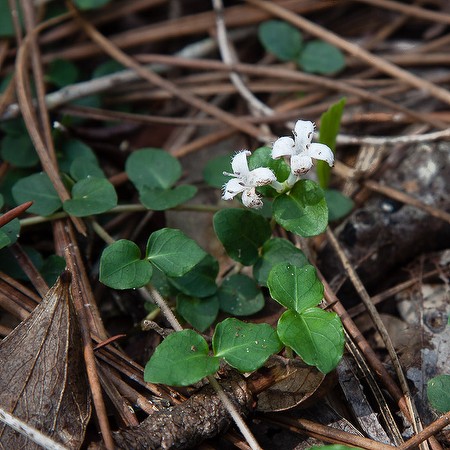
One of the many handsome marvels on the way to the river is Partridgeberry (Mitchella  repens), which I’m sorry, I can only regard as a wildflower from childhood Canadian canoe trips, not a South Florida trail flower.   It just doesn’t fit my world view here!

Partridgeberry (Twinflower, by JB)

Partridgeberry (Twinflower, by JB)

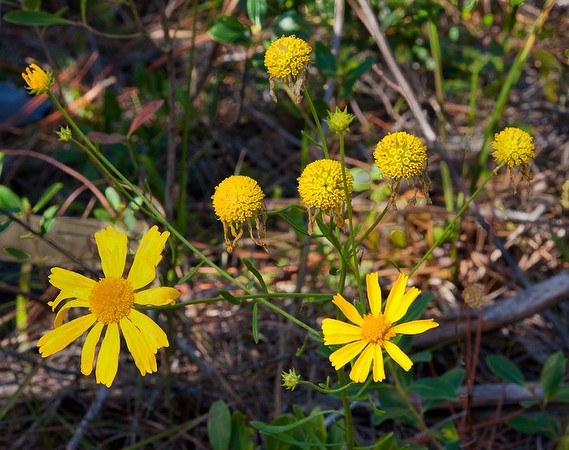
Also along the path are several members of a plant clique referred to by botanists as “DYCs.”  DYC stands for, “darned yellow Composites,” and apt term for anyone who has tried to sort out yellow-flowered members of the Aster Family.  Now please remember the “flowers” in the Aster Family are not real flowers, but rather are clusters of hundreds of tiny flowers all massed into one big false blossom.  A Sunflower is a whole lot of flowers.  (Details on this are in our archives CLICK)

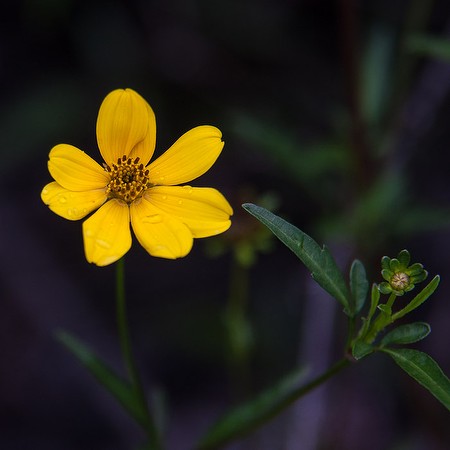
Bidens mitis a DYC (JB)

Bidens mitis a DYC (JB)


Balduina angustifolia, another one (JB)

Balduina angustifolia, another one (JB)

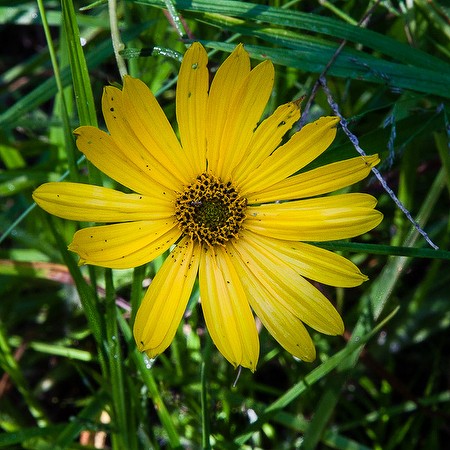
The King of the DYCs Friday was Narrow-Leaf Sunflower (Helianthus angustifolius),  with the lesser Smallfruit Beggarticks (Bidens mitis) as its loyal vassal.

If everything that could be known about Sunflowers were suddenly revealed it might boggle our brains.  They are a group with a lot goin’ on.  Technically, Sunflowers are the genus Helianthus, of which there exist roughly 50 species, all native to North America including Mexico.  About 18 species grow “wild” in Florida, natively or escaped.  From a taxonomic standpoint, they are messy messy messy, with hybrids, ancient and new cultivars, chromosomal variants,  intermediates,  unclear species borders, and divergent classification interpretations.

Narrowleaf SF (the King of the DYCs, by JB)

Narrowleaf SF (the King of the DYCs, by JB)

The big familiar common sunflower is Helianthus annuus, distributed “naturally” from Mexico to Nunavut.   Ancient peoples no doubt helped its transcontinental spread and diversification.  How many native American plant species have achieved agricultural prominence?  Native American humans used it for almost every use conceivable.  Arguably the most interesting ancient uses were culinary, for “seeds,” ground flour, and oil.   There were probably large-seeded (achenes)  cultivars in pre-settlement “horticulture.”

We like sunflower oil today, but a funny thing happened along the way.  After an early history of cultivation in North America partly for livestock forage and chickenfeed, Sunflowers fell of out of agricultural favor but caught on in Russia as an oil crop.  Oil-bearing strains returned to the U.S. from Russia with love in the 70s, and may help our grandchildren’s energy deficit someday.

Another sunflower with ancient “roots” is the so-called Jerusalem Artichoke (Helianthus tuberosus) distributed across much of North  America, including some of Florida.  What does it have to do with Jerusalem or artichokes? Its tuber is a food source and a source of combustible alcohols.

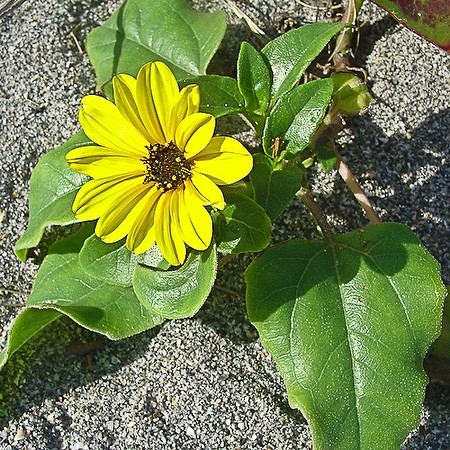
Little Beach Sunflower (by JB)

Beach Sunflower (by JB)

A garden favorite in Florida and far beyond is the Beach Sunflower, Helianthus debilis,  easy to grow and as pretty as a day at the beach.   Amazingly, this highly diverse foot-tall species can hybridize with the big common sunflower.  (See what I mean about messy species boundaries?)

But what about our Sunflower along the trail to the river?  Narrowleaf Sunflower (Swamp Sunflower, H. angustifolius) is a wildflower and a garden selection CLICK.   The flower extends northward and westward from Texas to New York from a southeastern limit probably near the trail to the river.

Narrowleaf SF is a chemical factory.  Aster Family members in general produce an array of smelly and bioactive compounds, so any given species can be a chemist’s goldmine.  Narrowleaf Sunflower has attracted recent attention most importantly for cytotoxic (cell-killing) agents with lethal effect against cultured human cancer cells.  CLICK   This general sort of screening and discovery is not rare, but in an already much-cultivated prolific plant it’s even better.  That would be a parallel history to the life-saving Oncovin chemotherapy from the Madagascar Periwinkle.

Even if Narrowleaf Sunflower turns out not to counter cancer, or even if it does, it feeds bees in spades.  UF Entomology Professor Jaret Daniels describes native bees filling the pollination gaps left by non-native honeybees diminishing from Colony Collapse Disorder, and he points out native wildflowers drawing on average 19 times as many bees as non-native blossoms.  Even better, he lists nine super-charged bee-feeding wildflowers.  Five of the nine are DYC’s, including Narrowleaf Sunflower.

 
2 Comments

Posted by on November 5, 2013 in Sunflower


Tags: , , ,

Root Parasites—Green Mammals?

Black Senna  

Seymeria pectinata

Orobanchaceae

Yesterday John and George tiptoed through the toadstools the Seabranch State Park near Hobe Sound.   The area we explored is a coastal upland scrubby pine woods, and it was beautiful in the comparatively “cool” October morning.  Much of the area is in the light shade of a mixed-species pine canopy, with a carpet of white and green lichens around an odd scattering of Giant Airplants (Tillandsia utriculata) with inflorescences rising from the lichen-lawn vertically 6 feet or more.  Mushrooms were abundant and Keebler-Elf-ish.  Adding to the splendor of it all were flowering Liatris and Polygonella species…a celebration of blooming nature in its vibrant glory.  So why is today’s topic is a dead, black, root-parasitizing annual in its autumn death mode? (Hey, for pretty flowers there are blogs aplenty.)

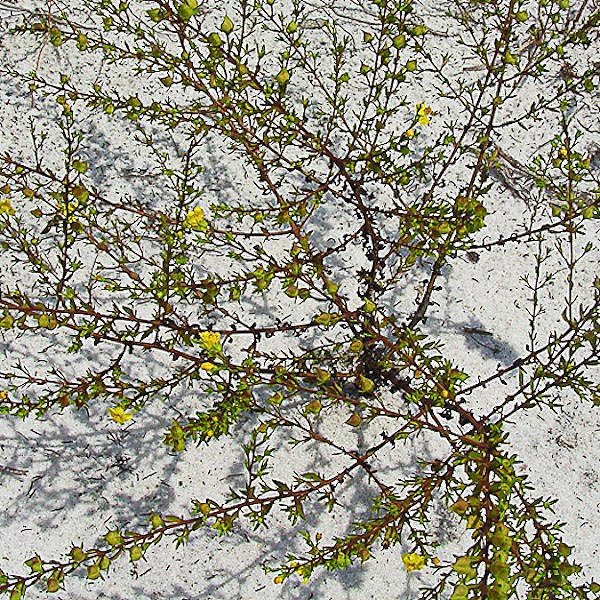
Black Senna on white sand (floral photos taken earlier in year, by JB)

Black Senna on white sand (floral photos taken earlier in year, by JB)

Black Senna belongs to the plant family probably having the largest proportion of root-parasites, the Orobanchaceae.  We have a lot of known root parasites in Florida, and no doubt several undiscovered, especially if you allow indirect fungal connections in addition to direct assault of one root on a neighbor, as we’re examining today.  Most famously and conspicuous are plant species so dedicated to theft they do not even bother to make chlorophyll, for instance in our area  Squawroot (Conopholis)  and Indian Pipes (in the Azalea Family) as well as many other non-green parasites elsewhere in Florida.  The shrub Hogplum (Ximenia americana in the Ximeniaceae) practices the same, and makes green leaves (or greenish-yellow) leaves too.  We have drifted so let’s return to the Orobanchaceae.

 
Black Senna (JB)

Black Senna (JB)

Several Orobanchaceae look like “nice” wildflowers but snitch nutrition and water secretly from the roots of law-abiding neighbors.  Witchweed (Striga) is a widespread crop-destructive parasitic genus so good at theft it can survive in the dark if its host is in the light.

Common on our botanical outings is American Bluehearts (Buchnera americana),  which should be called instead, “American Sneak Thief” for its subterranean larceny.

American Sneak Thief (JB)

American Sneak Thief (JB)

More pretty little parasites are the False-Foxgloves, the many species of Agalinis in Florida and beyond.

Agalinis (JB)

Agalinis (JB)

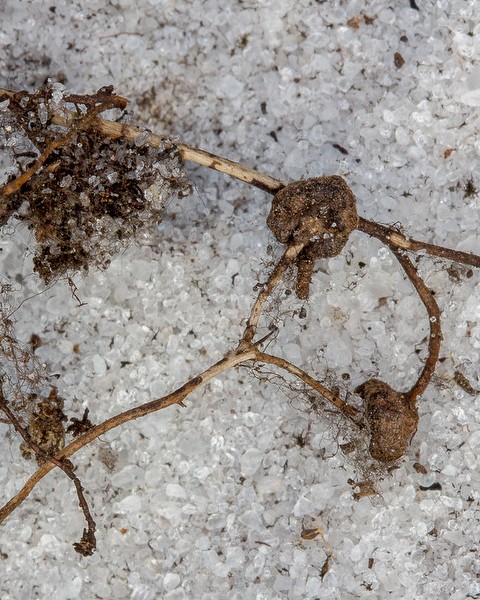
Yaupon Black Senna (Seymeria cassioides) is a pine-tree root parasite causing commercial losses, and thus well studied.  Its young seedlings die if they do not make effective contact with pine roots early in life (unless perhaps the mother plant helps out—stay tuned).  The southern limit of Yaupon  BS is probably  just a tad north of where John and I botanize, but no worries, we have our own local Black Senna, Seymeria pectinata, also parasitic but not studied much.  A glance at one in fruit shows vast numbers or small seeds scattered to find a victim, probably failing to survive without quick host contact.  The plant is an annual, and its distribution is clumpy, reflecting perhaps good spots for snagging host roots.

Black Senna (S. pectinata) root haustoria (root-sucking organs) on BS roots yesterday (JB).  The suckers are the parts that look like the business end of a plumber's plunger.

Black Senna (S. pectinata) root haustoria (root-sucking organs) on BS roots yesterday (JB). The suckers are the parts that look like the business end of a plumber’s plunger.

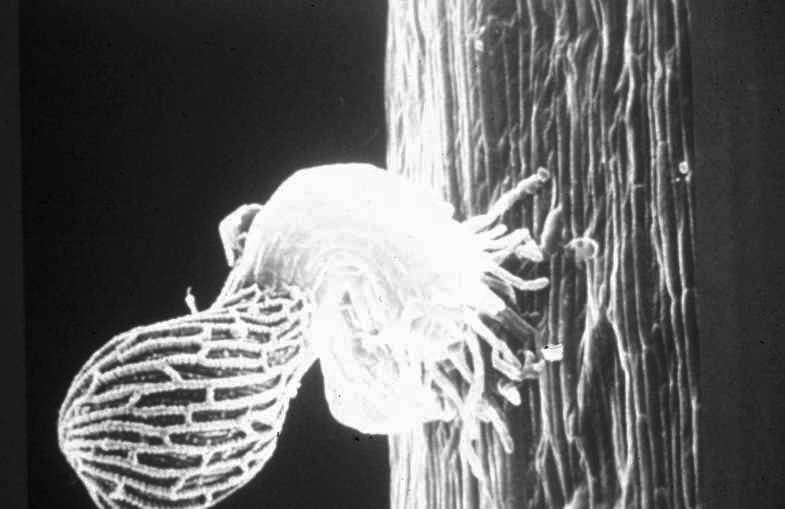
While wondering how a parasitic annual manages to survive from year to year, here is something to ponder:  In some root parasites the seedlings reportedly latch temporarily onto the long-suffering and self-sacrificing mother plant for nourishment until they graduate to a proper host of their own.  Whether or not this occurs in Seymeria is for somebody’s future Masters Thesis.  I never like those anthropomorphic books attributing plants with animal-like qualities, but nursing the young is pretty impressive for a lowdown root-sucking weed.

Hungry Witchweed seedling attaching to corn root (by RJ Musselman SIU)

Hungry Witchweed seedling attaching to corn root like a tick on a dog (by RJ Musselman SIU)


2 Comments

Posted by on October 26, 2013 in Black Senna


Tags: , ,

Lizard’s Tail

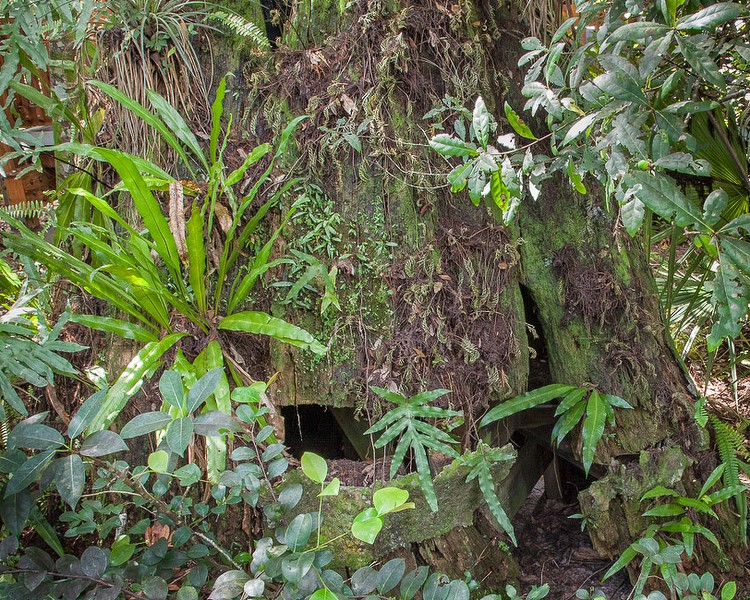
Strap Fern on a big stump (JB)

Strap Fern on a big stump (JB)

Lizards Tail

Saururus cernuus

Saururaceae

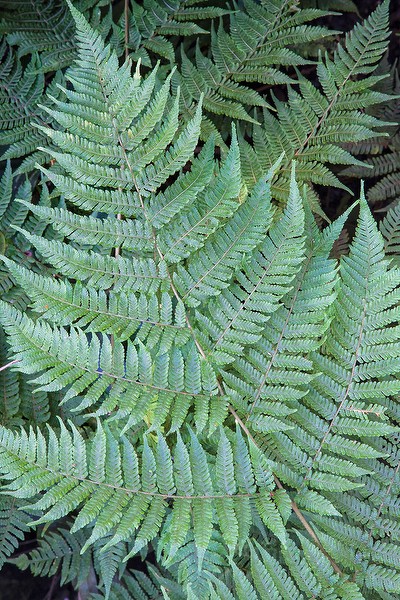
Yesterday John and George migrated south to the Fern Forest Nature Center in Pompano Beach to enjoy 250 acres of ferny, rocky, watery, beautiful jungle.  A well named haven for fern enthusiasts, occupied by umpteen different ferns ranging in appearance from the odd-foliaged Strap Fern (Campyloneurum phyllitidis) to the prehistoric-looking so-called Florida Tree-Fern (Ctenitis sloanei), which is the size of half a tree, and has enormous complex  fronds 3 or even 4 times compound.  Merely sorting out the species of Thelypteris ferns might keep a person busy.

Ctenium sloanei (JB)

Ctenitis sloanei (JB)

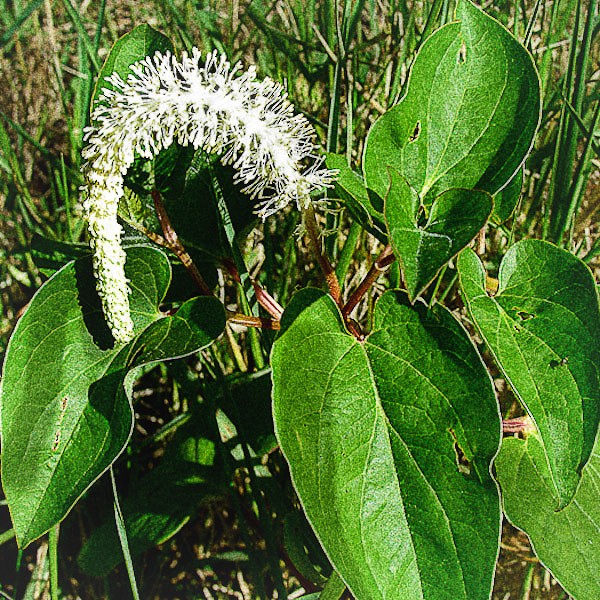
After greeting the ferns and pushing back into the watery swampy shadows a little off the beaten path, there’s another botanical treat:  Lizard’s Tail (Saururus cernuus).  No need to drive too far south for this species, as it extends northward all the way to Quebec.  But Florida is a great place to see this showy, rhizome-spreading, aquatic oddity with its white flower spikes nodding (cernuus) like the tail of a sauros, as in Tyrano-sauros.

Some folks are familiar one way or another with Kava Kava (Piper methysticum), a bioactive member of the Pepper Family with spicy-fragrant heart-shaped leaves and flowers in a narrow rat-tail spike.  Lizard’s Tail is a bioactive relative of the Pepper Family with spicy-fragrant heart-shaped leaves and tiny white flowers in a narrow but showy lizard-tail spike.

You know any plant with pungent bioactive oils has a medicinal history.  A question better than, “what has Lizard’s Tail been used for,” is “what hasn’t it been used for”?  A lot of the historical uses have to do with external applications to relieve pain.  There are even more uses in older China.

Wait a second.  In China?  Yes, the Chinese Lizard’s Tail is a similar sister species, a situation found over and again with plants of eastern North America and eastern Asia.  An ancient Asian practice is to extract the oils with hot water to derive treatments for ailments from  beriberi to urinary complaints.

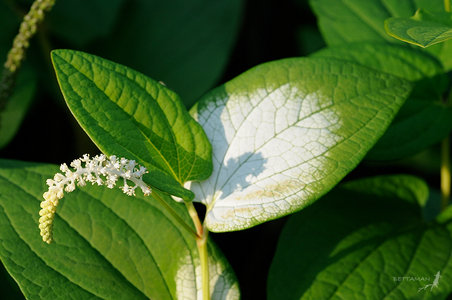
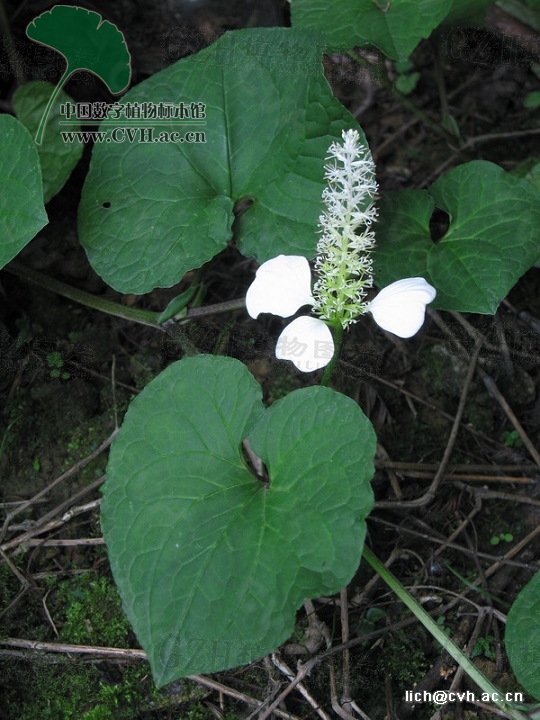
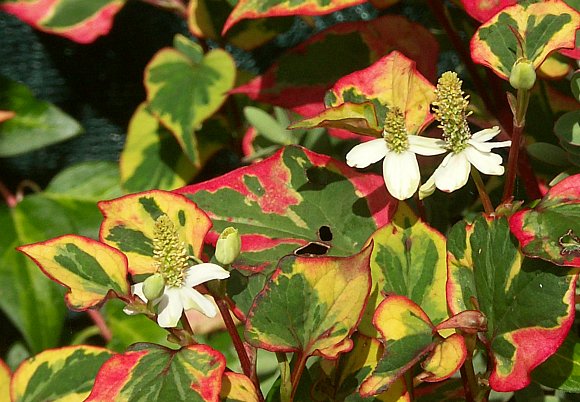
The Chinese species brings up something more fascinating than poultices:  an apparent evolutionary series.  But do not think the series of photos below is meant to reflect sequential ancestry.  Rather, the photos merely represent present-day  cousin-species that could resemble stages in some ancient evolutionary progression involving ancestors no longer with us.  All of the photos represent Saururus or closely related plants in the Saururaceae Family.   Something else important to emphasize is that the showy floral spike in Saururus and its relatives is a mass of many tiny flowers along a stem. Even in the relatives that have what look like single flowers, those are in fact false flowers, as in some Spurge Family, where the “petals” are bracts (variously modified leaves), and the apparent “flower centers” are spikes with those tiny flowers.   With all that stipulated, let’s move forward.

American Lizard’s Tail has a bright white spike of many flowers, collectively attractive to insect pollinators:

American L.T. (JB)

American L.T. (JB)

Want to up the ante and make the spike more attractive?  In Chinese Lizard’s Tail the white spike is enhanced basally with a dash of white on a nearby leaf (or the entire leaf may be white).  The white leaf-splash is sort of a false petal:

Chinese Lizard's Tail with splash of white on leaf.  (Tree of Life Project, permitted use)

Chinese Lizard’s Tail with splash of white on leaf. (Tree of Life Project, permitted use)

So why not go to a more convincing-looking “petal”?  In the related and very similar Asian Gymnotheca involucrata the leaves below the spike have become almost petal-like:

In Gymnotheca the bracts look like petals.  The spike rising above them bears many flowers.

In Gymnotheca the bracts look like petals. The spike rising above them bears many flowers. (Credit in the photo)

And to go a step farther, in the genus Houttynia and its segregate Anemopsis, a wildflower in the Western U.S.,  the spike-bract combo looks convincingly like a single flower:

In Houyttonia the bract-spike combos look like flowers (from wildflowerfinder.org)

In Houyttonia the bract-spike combos look like flowers (from wildflowerfinder.org)

Anenopsis is a wildflower in the western U.S.  The bract-spike combos look like Anemone flowers (Stephen Laymon BLM).

Anenopsis is a wildflower in the western U.S. The bract-spike combos look like Anemone flowers (Stephen Laymon BLM).

 
2 Comments

Posted by on October 19, 2013 in Lizard's Tail


Tags: , ,

Toothache Grass – The Ctenium Tingle

Ctenium aromaticum

Toothache Grass

Poaceae

Last Friday I served as local helper for visiting researchers at the American Bamboo Society’s Annual Meeting.   Although not a Bamboo, the topic of Toothache Grass came up with interest, and lodged in my thoughts this week.   Ctenium aromaticum is one twisted species that shows how so much ties together oddly in the world of nature.

Image

Don’t say I suggested this, but if you bite Toothache Grass, it numbs the mouth dramatically.  Effects like that do not go unnoticed, and the responsible chemistry is interesting.  The grass contains at least three poor man’s anesthetics: pellitorine, dodecadienamide, and isoaffinin.  (Not need to pronounce them, which would be impossible after biting the Ctenium.)  A term for these odd substances is “tingle molecules,” which are of interest in the flavoring and toiletry industries.  Want an underarm deodorant or scalp shampoo that feels zippy like it really works?  Put in a tingle molecule!

Image

Pellitorine has long served in traditional medicine, but not in today’s grass, which actually has no proven dental history, but rather Mt. Atlas Daisy (Anacyclus pyrethrum), a pretty Composite distributed around the Mediterranean cradle of civilization.  In addition to uses against toothache (really), that ancient medicine plant is reputed to cure low T (in mice), enhance male performance (in people), counter bacteria, bug bugs, and more.  Different plants, different continents, same drug, same presumed use—dental analgesic.

Dodecadienamide and isoaffinin have a more local toothache connection, in species of Zanthoxylum, often called “toothache trees.”   We’ve numbed our brain with these in this blog previously:  CLICK

This stuff gets serious.  My son Martin is a Chemical Engineer and U.S. Patent Examiner.  With his inspiration I occasionally take  an interest in industrial plant-chemistry patents.  A 2013 patent involves processes for manufacturing commercial tingle molecules “to impart flavor and/or a tingling and/or warming sensations in the oral cavity and on skin when used in foodstuffs, chewing gum, oral care products, hair care products, colognes, topical cosmetic products or medicinal products.”  The patent application mentions and illustrates isoaffinin in their preliminary discussion of the relevant chemistry.

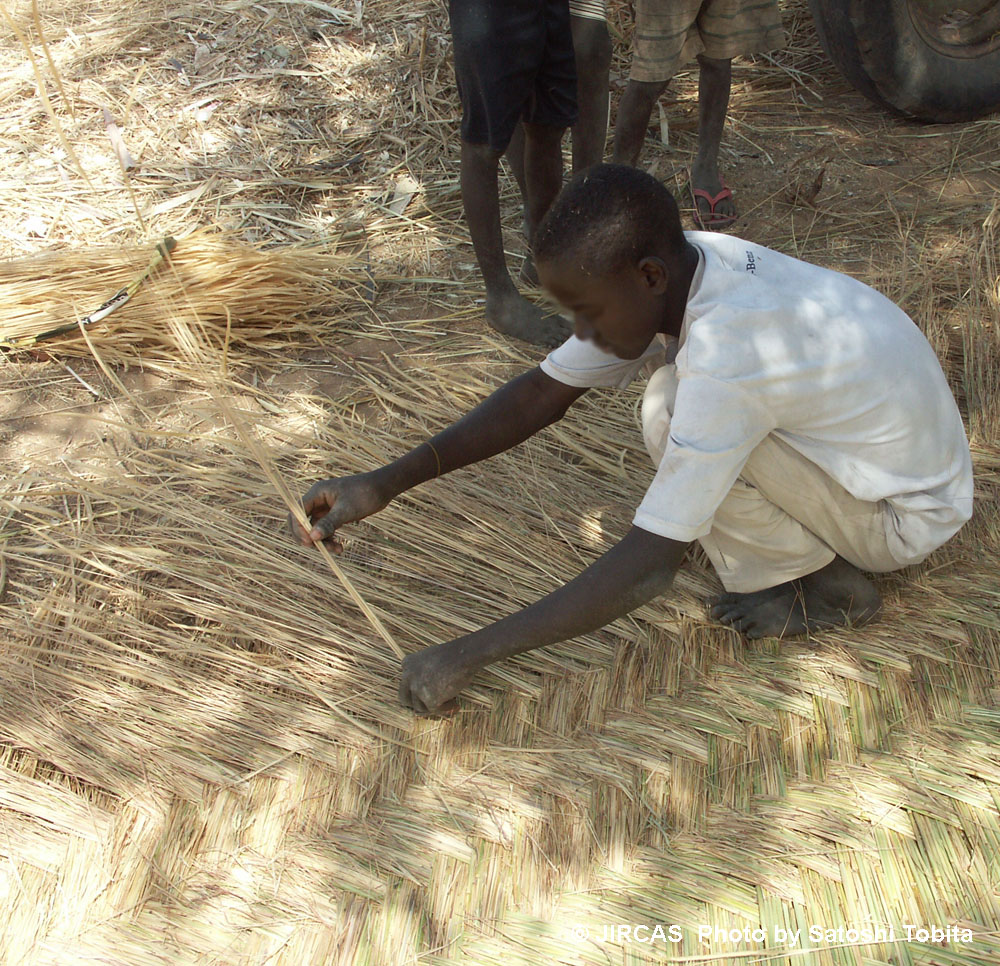
Worldwide there are almost 20 species of Ctenium, in Africa as well as in the New World.  Some of the African species are beautiful with long feathery inflorescences, and serve for thatching and making beehives.  Maybe if the dog bites or the bee stings, a little dab of Ctenium and then it won’t feel so bad.  Also in Africa the livestock do not enjoy tingling tonsils, so an abundance of Ctenium indicates overgrazed pasture in addition to thatching time.

Plaiting with Ctenium in the Sahal (from Fakara Plants).

Plaiting with Ctenium in the Sahel (from Fakara Plants).

 
4 Comments

Posted by on October 17, 2013 in Toothache Grass


Tags: ,

Who Eats Those Beautiful Scrub Fruits?

Sandyfield Beaksedge

Rhynchospora megalocarpa

Cyperaceae

Friday John and George wandered through the several habitats at the Haney Creek Trail in Jensen Beach Florida, where scrub forms a patchwork among depression ponds, streams, pine woods, and weed areas—a rich place to count species, and a pretty place to enjoy Liatris, Polygonella, Goldenrod and much more in colorful autumn bloom.

The "seeds" on Rhynchospora megalocarpa are huge, showy, and plump by sedge standards. (By JB)

The “seeds” on Rhynchospora megalocarpa are huge, showy, and plump by sedge standards. (By JB)

All the floral beauty distracts the eye from the more subtle fruiting beauty.   Turning the attention to the fruits and seeds raises the question of who eats what in the scrub.   What are the ecological relationships in the scrubby food chain?  (Many critters visiting the scrub are not restricted to that habitat.  But bear with me.)   Pygmy Mole Crickets eat algae growing in the sand.   Probably most of the smaller reptiles live on scrubby arthropods.  The blueberries look like birdfood to my casual eye.  No doubt the Gopher Tortoise goes for Gopher Apples.  Among the more conspicuous and intermittently abundant fruits are the acorns.  I just read that a single Scrub Jay can store several thousand acorns per year.   The cute Gopher Mouse (Florida Scrub Mouse) is an acorn eater too.   CLICK

But what do they substitute when the acorns are few?

And that is all the lead-in to a puzzling question.  Who eats the big, glossy, showy “seeds” (achenes) on Sandyfield Beaksedge?  This is one of the world’s most under-studied plants.  When you hear discussion of scrub plants you hear all day long of the various oaks, scrub-rosemary, sand-pine, lyonia species, innocence,  and others, but whoever mentions Sandyfield Beaksedge?  A large, tough bright green sedge scitter-scattered abundantly on that sun-baked sugar sand.  Aren’t sedges supposed to prefer wet places?  (Not all of them.)     Sandyfield Beaksdge represents the large, fascinating, locally diverse genus Rhynchospora,  whose name translates loosely as “beak seed.”   (When you have rhynoplasty you have a “beak job.”)   The beak is on the seedlike fruit.  The beak size and shape varies among the local Rhynchospora species, from almost scary to barely visible.  The genus is in every Florida habitat from standing water to the dryiest scrub.  Sandyfield Beaksedge occurs throughout Florida and into other southeastern states.

In Sandyfield Beaksedge the beak looks like the cap on an acorn, making the entire little “mini-nut” resemble a shrunken acorn, enormous and ostentatious by Rhynchospora standards.  Maybe the achenes are oversized due to a simple need to provide the seedling with extra protection and nutrients in the stressful habitat, but they are too colorful and eye-catching, and prominently displayed for merely that.

R. megalocarpa 6

Thus every time I see a cluster of the large, showy, glossy little “acornlets” on the Sandyfield Beaksedge it bugs me wondering who relies on them for food.  I’m ready to go sit in the scrub all night long with night-vision goggles and watch.  Like little nuts, the SFBS achenes are hard and dry, not squishy and sweet.  I wonder if the true scrub acorn-eaters—the Florida Jay, the Gopher Mouse, and other furry little rodents use the mystery fruits  as substitute acorns as a between-meal snack.  Interestingly, the fruits start out elevated on a wand, and as time passes  the wand bends down to ground level, placing the fruits within easy reach of Mickey and Minnie.

 
4 Comments

Posted by on September 30, 2013 in Sandyfield Beaksedge


Tags: , ,