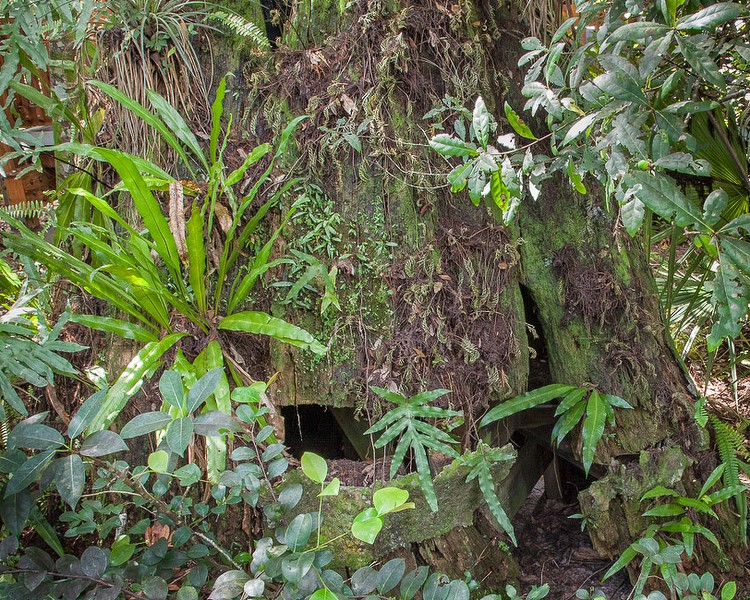
Strap Fern on a big stump (JB)
Lizards Tail
Saururus cernuus
Saururaceae
Yesterday John and George migrated south to the Fern Forest Nature Center in Pompano Beach to enjoy 250 acres of ferny, rocky, watery, beautiful jungle. A well named haven for fern enthusiasts, occupied by umpteen different ferns ranging in appearance from the odd-foliaged Strap Fern (Campyloneurum phyllitidis) to the prehistoric-looking so-called Florida Tree-Fern (Ctenitis sloanei), which is the size of half a tree, and has enormous complex fronds 3 or even 4 times compound. Merely sorting out the species of Thelypteris ferns might keep a person busy.
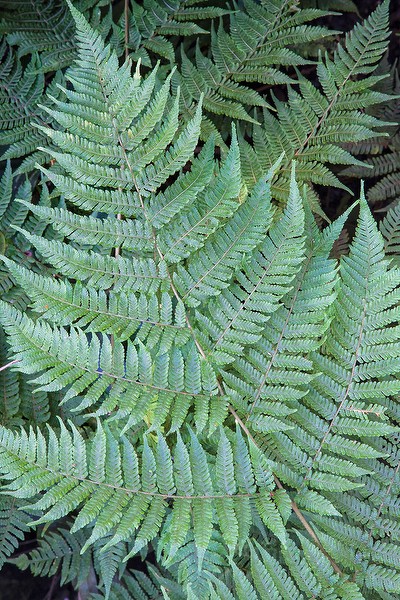
Ctenitis sloanei (JB)
After greeting the ferns and pushing back into the watery swampy shadows a little off the beaten path, there’s another botanical treat: Lizard’s Tail (Saururus cernuus). No need to drive too far south for this species, as it extends northward all the way to Quebec. But Florida is a great place to see this showy, rhizome-spreading, aquatic oddity with its white flower spikes nodding (cernuus) like the tail of a sauros, as in Tyrano-sauros.
Some folks are familiar one way or another with Kava Kava (Piper methysticum), a bioactive member of the Pepper Family with spicy-fragrant heart-shaped leaves and flowers in a narrow rat-tail spike. Lizard’s Tail is a bioactive relative of the Pepper Family with spicy-fragrant heart-shaped leaves and tiny white flowers in a narrow but showy lizard-tail spike.
You know any plant with pungent bioactive oils has a medicinal history. A question better than, “what has Lizard’s Tail been used for,” is “what hasn’t it been used for”? A lot of the historical uses have to do with external applications to relieve pain. There are even more uses in older China.
Wait a second. In China? Yes, the Chinese Lizard’s Tail is a similar sister species, a situation found over and again with plants of eastern North America and eastern Asia. An ancient Asian practice is to extract the oils with hot water to derive treatments for ailments from beriberi to urinary complaints.
The Chinese species brings up something more fascinating than poultices: an apparent evolutionary series. But do not think the series of photos below is meant to reflect sequential ancestry. Rather, the photos merely represent present-day cousin-species that could resemble stages in some ancient evolutionary progression involving ancestors no longer with us. All of the photos represent Saururus or closely related plants in the Saururaceae Family. Something else important to emphasize is that the showy floral spike in Saururus and its relatives is a mass of many tiny flowers along a stem. Even in the relatives that have what look like single flowers, those are in fact false flowers, as in some Spurge Family, where the “petals” are bracts (variously modified leaves), and the apparent “flower centers” are spikes with those tiny flowers. With all that stipulated, let’s move forward.
American Lizard’s Tail has a bright white spike of many flowers, collectively attractive to insect pollinators:
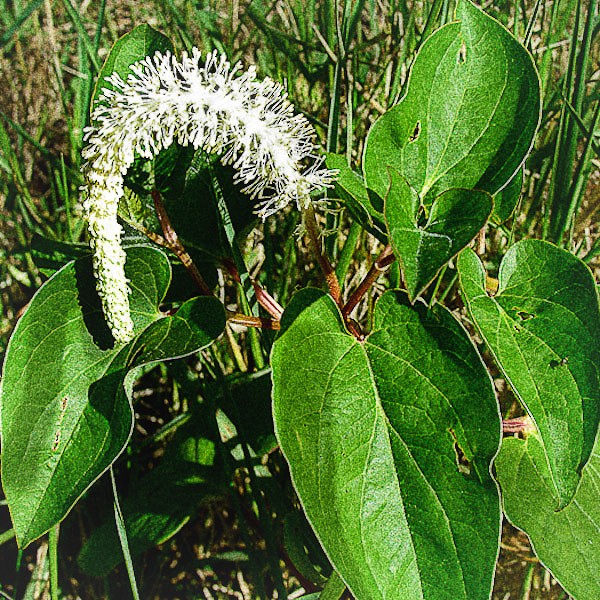
American L.T. (JB)
Want to up the ante and make the spike more attractive? In Chinese Lizard’s Tail the white spike is enhanced basally with a dash of white on a nearby leaf (or the entire leaf may be white). The white leaf-splash is sort of a false petal:
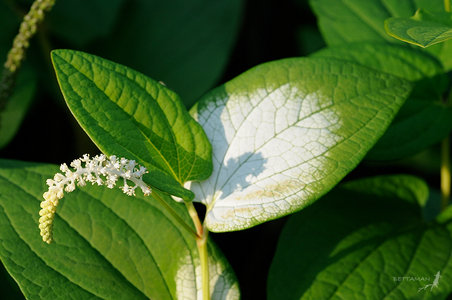
Chinese Lizard’s Tail with splash of white on leaf. (Tree of Life Project, permitted use)
So why not go to a more convincing-looking “petal”? In the related and very similar Asian Gymnotheca involucrata the leaves below the spike have become almost petal-like:
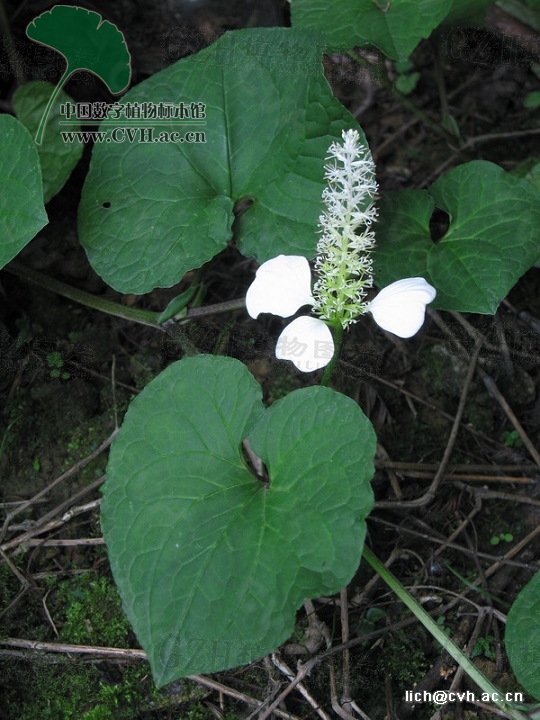
In Gymnotheca the bracts look like petals. The spike rising above them bears many flowers. (Credit in the photo)
And to go a step farther, in the genus Houttynia and its segregate Anemopsis, a wildflower in the Western U.S., the spike-bract combo looks convincingly like a single flower:
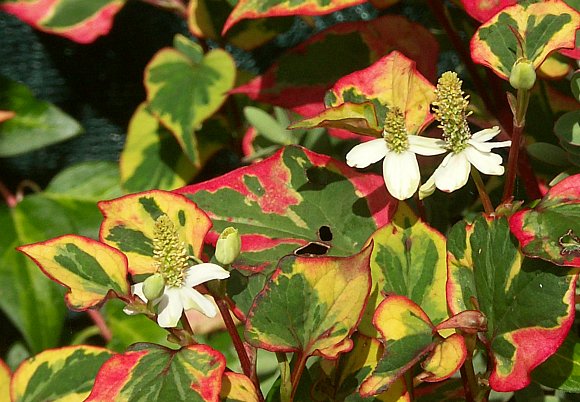
In Houyttonia the bract-spike combos look like flowers (from wildflowerfinder.org)
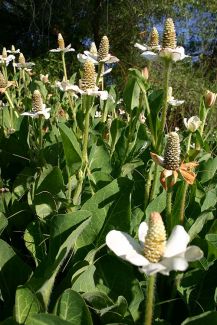
Anenopsis is a wildflower in the western U.S. The bract-spike combos look like Anemone flowers (Stephen Laymon BLM).
 John Bradford
 George Rogers
 George Rogers
 Dee Staley
 Treasure Coast Natives
SmallHouseBigGarden
October 20, 2013 at 2:35 pm
Thank you for this introduction to a group of plants I’ve never seen! All are so pretty in different ways!
George Rogers
October 20, 2013 at 2:40 pm
Houyttonia sometimes turns up was a (wet) garden plant.