Doctorbush, Leadwort
Plumbago zeylanica (P. scandens)
Plumbago
Yesterday John and George visited an unnamed coastal hammock remnant near the Hutchinson Island Nuke in St. Lucie County. Half the site is a tangled wonderland of invasive exotic species resurrected from old illegal dumping. Get away from the clamboring Brazilian Jasmine (Jasminum fluminense) and the Earpod Trees (Enterolobium) dropping their contorted ears, and there’s a hidden treasure chest of natural biodiversity.
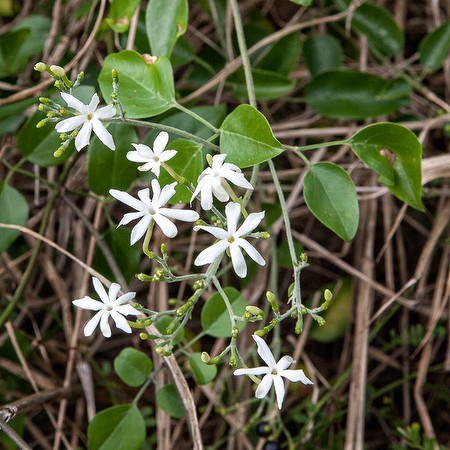
Brazilian Jasmine (invasive species, JB)
A sharp line separates the invasive tangle from relatively uninvaded hammock, including the shy understory shrub Velvetseed (Guettard elliptica) representing the Coffee Family.
Covering the forest floor—at least in areas not overrun with Sansevieria—is a mix of two medicinal alkaline-loving hammock-dwellers: Garlicweed (Petiveria alliacea) and Doctorbush, perhaps better known as “native Plumbago” or as native Leadwort. (The plumb in the name refers to lead, as in “plumber.”) The pretty white flowers, shade tolerance, and easy cultivation give Leadwort a place in native species gardens, although the usually-blue-flowered South African species Cape Leadwort (Plumbago capensis) is more familiar down at the garden club. Glands on its leaves reportedly secrete “chalk” taken up from its calcium-rich habitats.
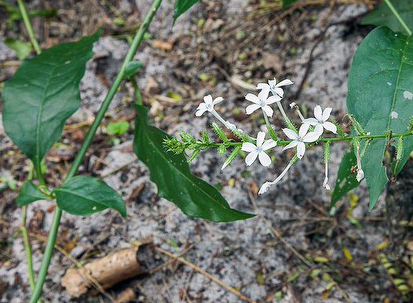
Native Plumbago (JB 12/13/13)
Any plant named Doctorbush better be good for something. Its bioactive oil plumbagin irritates the skin, a promising omen for medicinal attributes! Spanning at least 2500 years, Plumbago extracts have treated just about every discomfort known to humanity, from pimples to pregnancy. Anyone who looks into a lot of plants finds frequent optimistic references to anti-cancer activities. Usually a fizzle, but Plumbago has garnered far more than the usual share of modern scientifically based cancer interest, at the University of Wisconsin and far beyond. CLICK
Plumbago zeylanica serves in Africa to welt the skin cosmetically Long before Popeye’s anchor, Polynesian cultures were well tattooed using a diversity of coloring agents derived from sealife, from caterpillar fungus, and from plant pigments, among them Plumbago zeylanica root extracts, which give black and blue coloration. The indigenous Hawaiian name for the plant hilie’e means, more or less, “dark dye.” One of the many explanations of the name leadwort is lead-colored skin damage from the juice. Anybody want a natural organic (toxic) tattoo?
Like many toxic species, Plumbago is a butterfly larval host, for species including the Cassius Blue Butterfly, which returns as a floral visitor.
Our white-flowered native species has a checkered nomenclatural past. Are there two species, one in the New World, and a different species in the Old World? (Plumbago scandens here and a separate P. zeylanica there?) Or are we dealing with just one conspiracy to take over the world that is, one broadly defined P. zeylanica. Flora North America takes the single-species broad view, with the comment, “Plants in herbaria under these two names appear indistinguishable.” Seems reasonable to me.
No matter how you apply names, the species (or “indistinguishable” species pair) has an enormous intercontinental distribution from New Zealand to Asia to Hawaii to Africa to South America to Florida. How do they get around?
It probably has to do with the calyx (sepals) which persist upon maturity to encase the small fruits. The sepals bristle with stout stalks, each capped with a sticky gland. That is, velcro plus glue. See Jim Conrad’s picture of the glands: CLICK (The glue may dry as the fruits mature?)
A lot of flowers have glands at their bases, presumably to hobble thrips or other lil’ pests. And this is probably a function for the Plumbago velcro-glands. Yet the persistence of the gland-stalks on a calyx that continues to invest the fruit at dispersal time suggest a second function. This plant crosses oceans and colonizes oceanic islands. The seeds have to get there somehow. Although Leadworts like coastal habitats, they are not strictly maritime. In the U.S. they turn up in Arizona, in Africa on termite mounds. Just speculating here: those velcro units look designed for snagging in plumage. Pelagic seabirds are well known adhesive seed-carriers. (Would they be careful about keeping a New World species separate from and Old World species?) I found no specific data on seabirds carrying Plumbago, so please accept Arni as a surrogate.

Arni got into the Plumbago patch (http://www.cyprus-travel-secrets.com/arni-the-new-cute-dog-around-our-cyprus-house.html)
 John Bradford
 George Rogers
 George Rogers
 Dee Staley
 Treasure Coast Natives