RSS

Muscadine Grape: big history and tiny hidy-holes

Vitis rotundifolia

Vitaceae


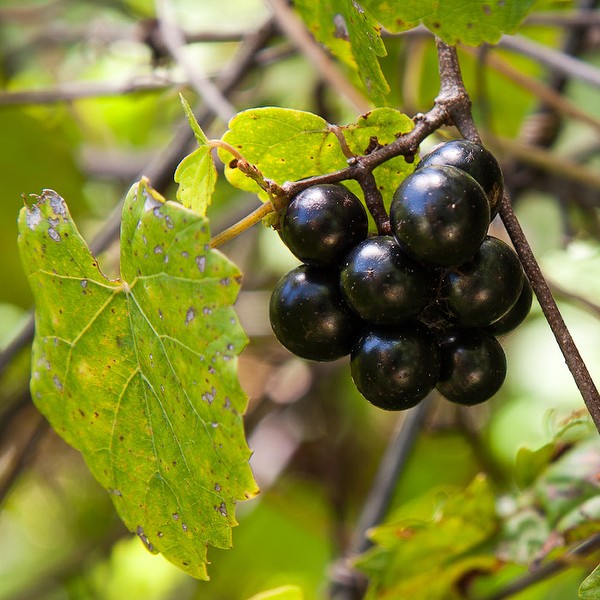
vitis rotundifolia fruits

Muscadine Grapes (by John Bradford)

John and George savored the kind of weather today, the first day of 2016, that migrates snowbirds.   A slice of heaven complete with trapdoor spiders, antlions, dragonflies, and delicate white mushrooms in a dry sand pine woods near Hobe Sound, Florida.


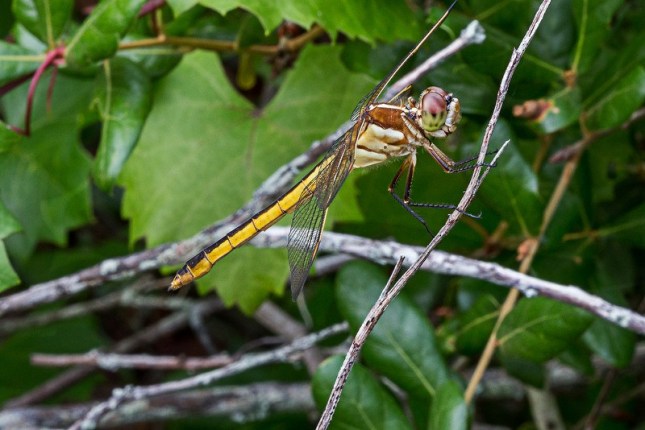
vitis with dragonfly

uscadine with Dragonfly (JB)

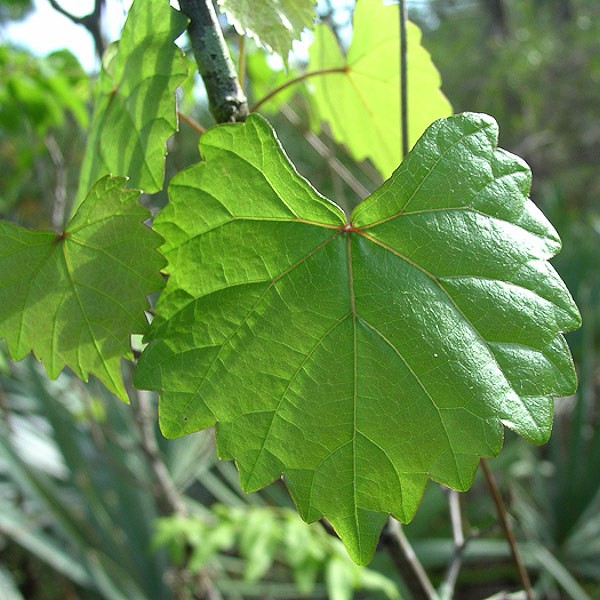
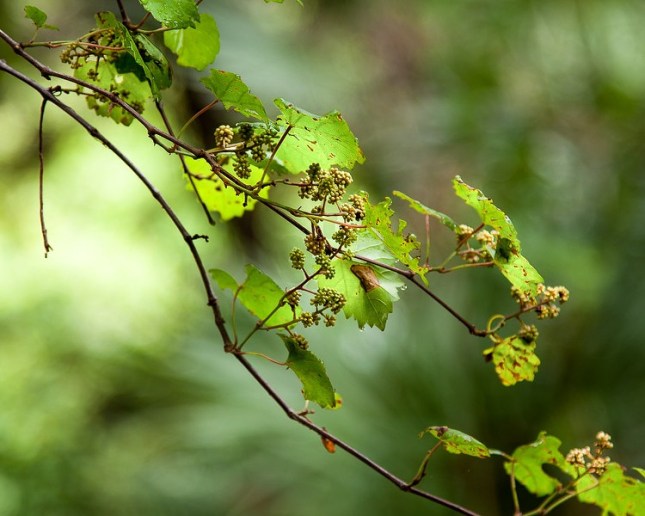
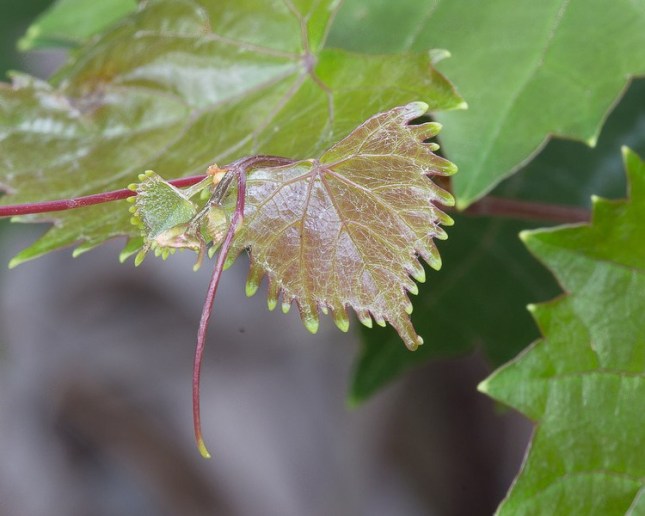
One of my running themes in botany is that a trip to the local state park reveals more fascination than an eco-tourism trip to Shangri-La with a khaki-clad guru pointing out some exotic orchid.   The very thing that makes nature so much fun is its universal accessibility. So today’s state park marvel is Muscadine Grape.   Everybody sees it, or trips over it, one of the most abundant lianas everywhere you go.   It has heart-shaped leaves with big marginal teeth.

Vitis rotundifolia

(By JB)

Muscadine has odd features, even compared with other grapes.   Most grapes have 38 chromosomes, but Muscadine and a few others have 40, making it tough to hybridize.  It does not graft well with other grapes, although you can graft Muscadines onto one another.

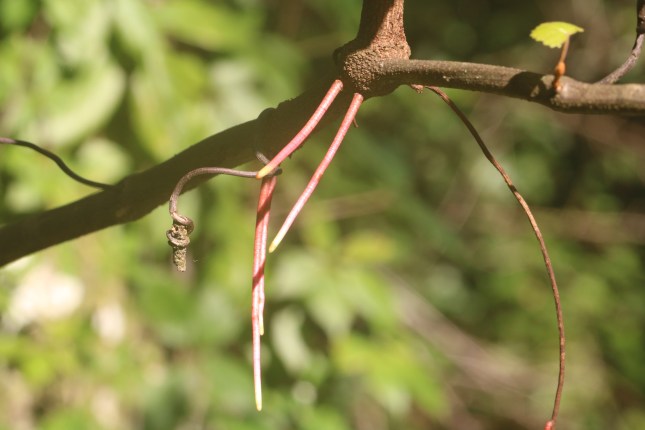
The flowers are usually male and female on separate plants.   And the stems are a little weird, because, although they climb by tendrils (little clingy fingers), they also can sprout roots.   The roots either remain small until the stem contacts the ground, or alternatively much later, the roots dangle like cables from the woody stems high in the tree canopy.

Vitis roots

In most grapes the tendrils are forked,  contrasting with the unbranched tendrils in Muscadine.

Vitis rotundifolia flower

JB

A hand goes up in the back of the room:

“Do they use Muscadine for wine?”   You bet your sweet bippy. It is the oldest cultivated grape in North America, which is easy to assert because Native Americans had the pleasure before Europeans got the knack (see below). Today there are hundreds of cultivars, including the Scuppernong Grapes, originating in North Carolina.

A jumbo Scuppernong vine on Roanoke Island is one of the most intriguing individual plants in all the U.S.   The exact history is unknown, with different versions in different references, but here are the broad facts. The “Mothervine” appears in account(s) by original settlers on the Outer Banks in the 1500s, with Revolutionary War soldiers chiming in on it 200 years later.  Fast-forward two more centuries.  The beast remains alive, well tended, and big despite an accidental brush with road-clearing herbicide. The trunk cluster is multiple feet in diameter, and the leafy bits supported by trellises covered 2 acres before some trimming.

The Mothervine probably is the horticultural work of Native Americans. Were Native Americans in eastern North America wine snobs? Reportedly so, to a limited degree. Did they fancy sun-dried grapes? Actually yes, according to a British sea captain in 1565. It’s only raisin-able after all.

Vitis rotundifolia babies

Simple tendril (JB)

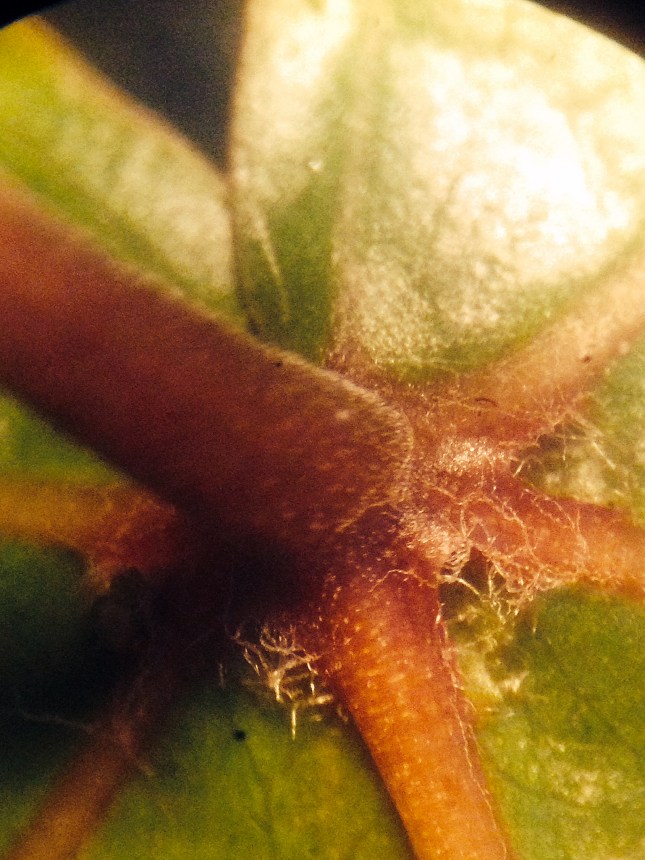
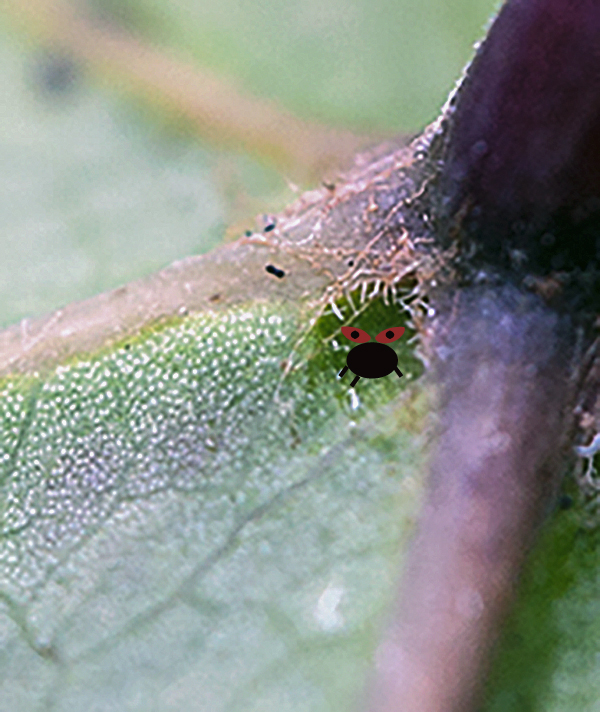
Muscadine and other grapes have a secret. Flip over the leaf and look closely where the petiole joins the blade to spot tiny caves with the doors surrounded by shaggy teeth.   These “domatia” are homes to mites lurking like the Once-ler in their tiny lerkims.

Vitis domatia4

The domatia look like caves (microscope picture)

So, why you ask, would a plant bother to host mites? They’re good predatory mites, it seems, interpretably guarding the plant from bad leaf-munching mites as well as from fungi.

———————————————

vitis domatia AI

Have a Mitey Fine New Year

 
12 Comments

Posted by on January 1, 2016 in Muscadine Grape, Uncategorized


Tags: ,

Water-Lettuce – You Can’t Get It Wet

Pistia stratiotes

Araceae

evan 788

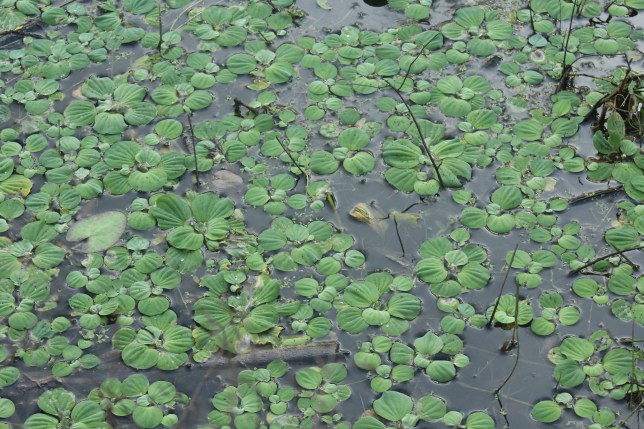
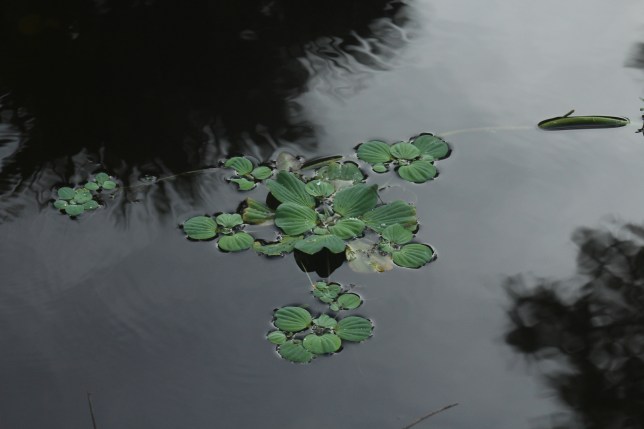
Honeymoon salad (lettuce alone) (by Evan Rogers)

John is away for Christmas, so my substitute field companion today was son Evan, down from North Carolina with camera in hand. We’ve been out in recent days hanging around with hawks and sandhill cranes, mostly by canoe with water-lettuce impeding navigation.

hawk

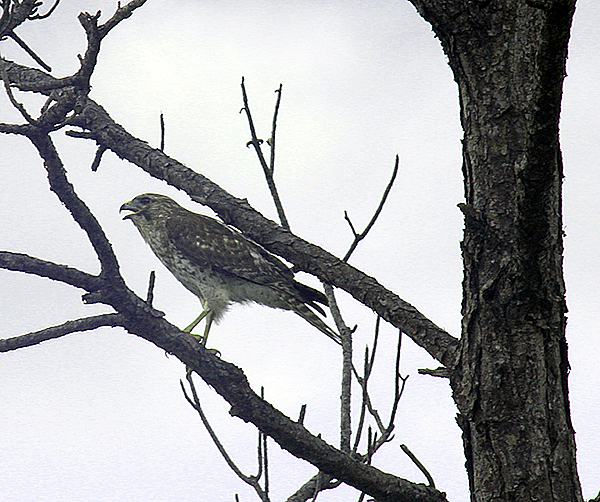
Hawk guarding the marsh (by Evan Rogers)

Is water-lettuce native? One of my most-used local plant handbooks says, “native to Africa,” but that’s the trouble with single sources. Weeds get around, and the small seeds are conceivably transported by migratory birds or even on floating debris.

evan 852

All strung together by stolons…canoe traps (by Evan Rogers)

Who’s to say it didn’t arrive on is own? Aroid specialist Sue Thompson in the Flora of North America is open-minded (and see Notes below):

“Some botanists consider the genus to have been introduced into the United States and many regional floras state that fruits and seeds are not produced in the flora area. However, s Seeds with high rates of germination have been reported from many sites in Florida, however … The status of Pistia as native to the United States has not been resolved; available evidence suggests that it is indigenous.”

Whenever and however it arrived, Water-Lettuce goes back in Florida about as far as botanical exploration.

Water-Lettuce is one of the odder members of the odd Aroid Family, known to native plant enthusiasts for arrow-arum, golden-clubs, and jack-in-the-pulpit. Gardeners and florists love aroids as anthuriums, philodendrons, and spathiphyllums. Funeral homes like them too, as calla-lilies. The sign of an aroid is having small flowers in a spike called a spadix, and a colorful specialized leaf called a spathe wrapped around the spadix.

IMG_8344

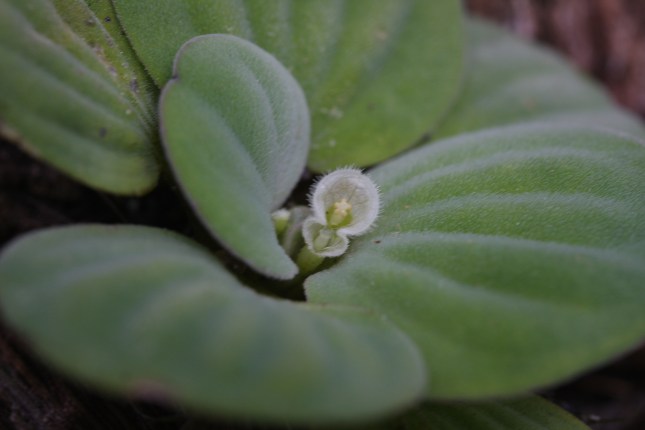
Pixie spathe  (white)  around spadix

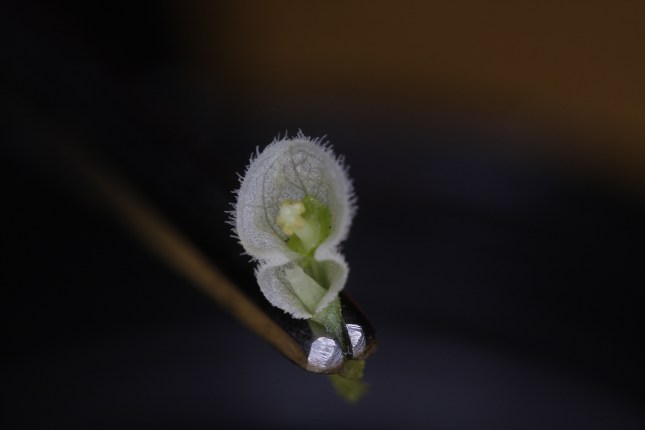
The spathe and spadix in water-lettuce are pretty, reminiscent of a tiny peace-lily. The folded water-lettuce spathe has two expanded openings, the top gap allowing a whorl of male flowers to jut out; below those a single female flowers peeps from its own gap.

IMG_8389

The yellow star is a whorl of male flowers. Below it is one white female flower.

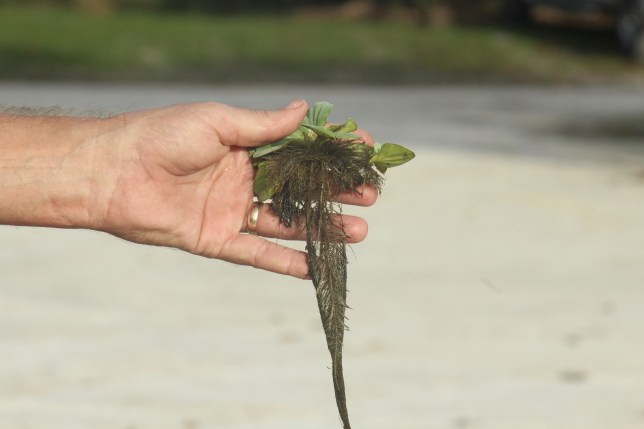
Naturally hydroponic, the fuzzy rosette floats with its roots dangling.   With full sun, swimming in water, nutrients in the soup, and stolons to sprawl forth and conquer, this weed can expand!   That’s bad if it clogs and shades waterways, jams pumps, or decays and stinks.

evan 818

Dangling participles (by Evan Rogers)

On the good side, however, here’s a plant able to pull “sewage” nutrients out of over-enriched waters, suck heavy metals and pesticide residues out of canals, and generate truckloads of biomass if you want biomass. It is not a true lettuce so put away the croutons, but water-lettuce is easily generated compost, although not on edible crops.  And we all cheer for biomass biofuels not competing with food crops, fertilizer-free, and providing bioremediation as a bonus.

—————————

Notes:

Just try to get it wet:   SPRINKLE HERE

For more on the native vs. non-native question CLICK

Crane2

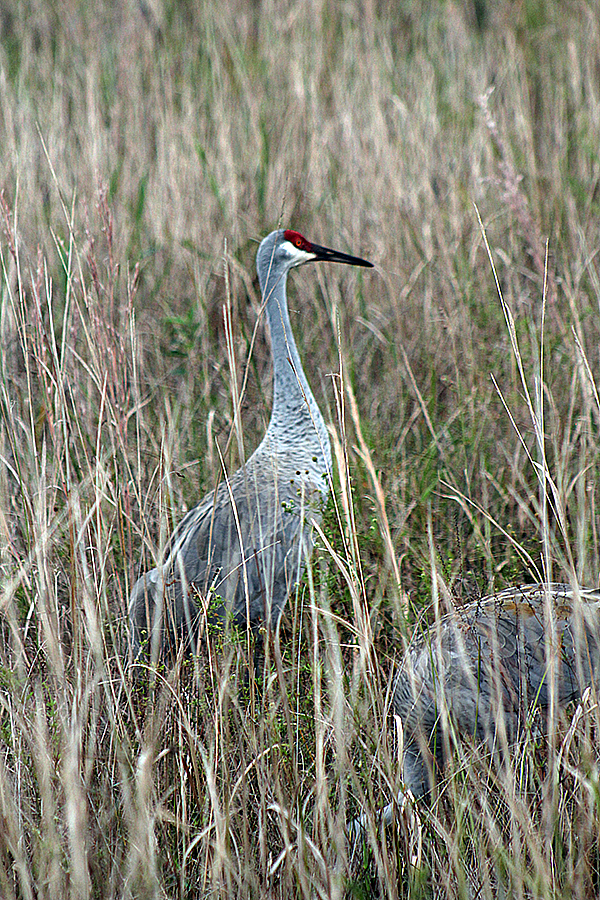
Seed spreader (by Evan Rogers)


12 Comments

Posted by on December 25, 2015 in Uncategorized, Water-Lettuce


Tags: ,

Christmasberry, Wolfberry, Goji Berries

Lycium carolinianum

Solanaceae

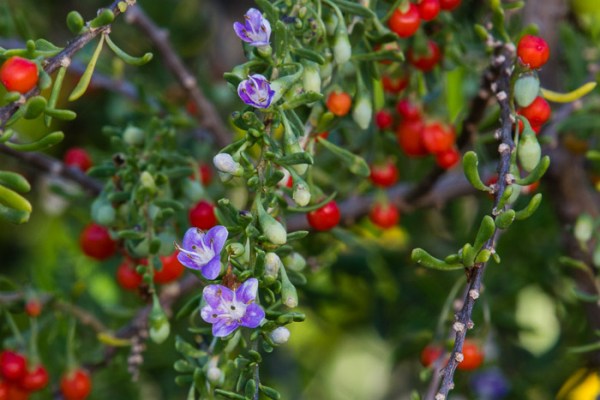
Friday John and George swatted mosquitoes in the mangrove swamp by Peck’s Lake near Hobe Sound, FL. We celebrated the season with Christmasberry in one of its favorite habitats, the smelly briny mangrove marl. The Mangrove Tree Crabs enjoyed the rain, scampering up and down the branches like mouse-sized nightmare spiders.  An invasive fern the size of a human, Giant Brake (Pteris tripartita) looks primitive in the swamp.

pteris

This fern is an oversized weed. It looks much like Bracken Fern. (By John Bradford)

That Christmasberry grows in wet saltwater habitats is interesting, given that its relatives, some 80 species of Lycium, tend toward dry deserty lands all around the world.   Salty is “dry” in a physiological sense, thus not a big jump from arid to mangrove swamp. Another “dryland” plant, a standard in Florida scrub, skipping to mangrove habitats is Hogplum, Ximenia americana.

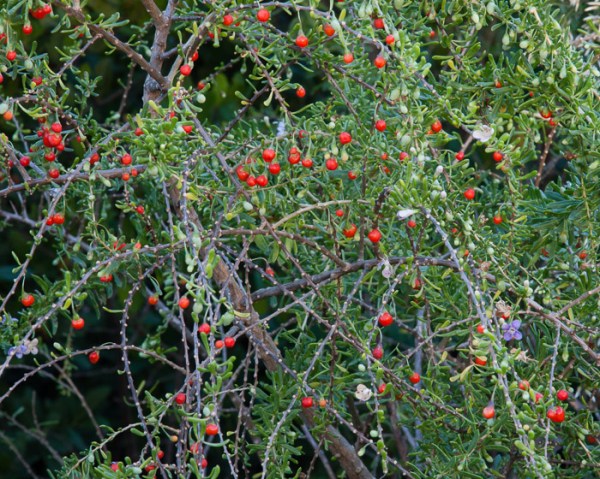
Christmasberry (this and the close-up below by John Bradford)

Christmasberry (this and the close-up below by John Bradford)

Useful plants comfortable in saline soils raise eyebrows as potential crops in a hungry world with rising soil salinities.   Christmasberry crops you say?

Lycium species have bushels of uses, none of them blockbusters, yet worth a second look. Some benefits are ancient, some maybe in the future, and some here and now. Gogi berries from Asian Lycium species are a dietary-health fad. Goji history goes back just about forever, in teas, foods, and medicines.

I dislike enjoying nature by eating it!   Love that yummy blackened scrub jay with goji sauce! Are Christmasberries edible? Yes, no, maybe so.   They have been on the menu for a few thousand years.   At the same time, Lycium represents the druggy Potato Family, related to deadly nightshade, datura, henbane, and other witch’s delights. Reports of Lycium poisoning exist.   So please don’t eat the Christmasberry, even if other web sites urge us onward. Not much of a temptation, really, because they taste bad. The berries contain bioactive alkaloids to help explain Lyciums in ethno-remedies.

Looking into the ethnobotany of Lycium, applications against toothache are repeated abundantly and transcontinentally. Lending some credence to that, the Potato Family has long comforted civilization with pain-reducing extracts. So if Mr. Toothache visits, mash a soothing Christmasberry into the cavity, and e-mail me the result.

lycium 2

Maybe the greatest Christmas gift is to wildlife.   As the human-nutritional literature attests, goji berries bear good things for life, including fatty acids which may explain their service as dried fruit on a string.    Fatty fruits are power-packed fuel for migratory birds, and Christmasberry propels some of the biggest, longest-distance migrators of all, cranes, including our friendly Sand Hill Cranes. Far more-studied, Christmasberries can sometimes account for over half the early-winter energy budget for Whooping Cranes in South Texas, “snowbirds” down from as far yonder as the Yukon, arguably the rarest, most charismatic, magnificent and iconic endangered birds in North America. These avian jumbo jets with 7-foot wingspans need a lot of fuel.

 
8 Comments

Posted by on December 19, 2015 in Uncategorized


Tags: , ,

Shade Leaves and Variegation

Deep Shade and Velvety Leaves

This post is unusual, and certainly not of universal interest!  But it represents what I’ve been chewing on for a few days, so what the hay,  it relates to native plants in a broad way.

Our local Dull Leaf Coffee doesn’t have dull leaves it all. They have a lustrous velvety sheen, and are an example of a widespread adaptation of many understory shade species. Gardeners may be familiar with similar leaves on begonias, on aroids, and on shooting star clerodendrum.
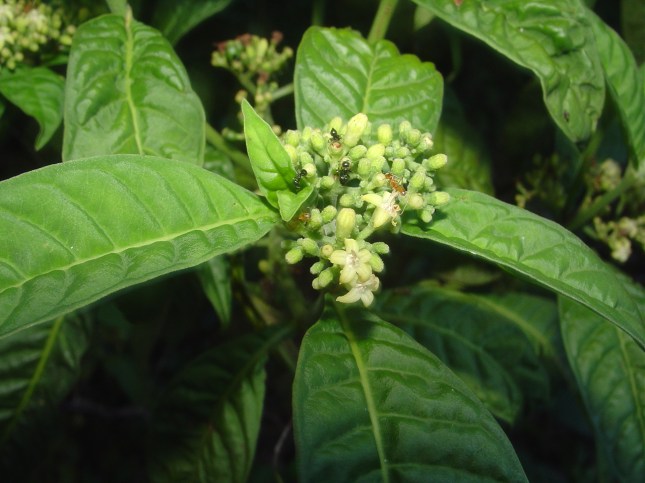
PsySulzneri

Dull Leaf Coffee with velvet leaves. (By John Bradford)

Those velvety surfaces reveal a microscopic array of lenses and solar collectors so “optical” that such leaf surfaces have been studied from the standpoint of lenses. Florida can claim the modern world’s authority on leaf optics, although 19th Century German botanists had a good go at it. Today’s material springs from a couple publications by FIU Prof. David Lee with an assist from “The Life of a Leaf” by Duke University Prof. Steven Vogel. As Dr. Lee notes, it’s not all figured out!   But there’s plenty to discuss, and don’t blame on them shortcomings in my interpretation.

How often do we stop and think of the diversity of leaf surfaces?   What’s more conspicuous in the plant world than all those shades of green, variegations, textures, sheens, twinkles, and lusters?   That green rainbow has meaning.

Some deep-shade species have a blue iridescent aspect, uncommon in Florida native plants, although visible in garden species (for instance Selaginella uncinata shown below) and sometimes in young native Virginia Creeper.   Such iridescent species absorb useful light especially effectively while reflecting wavelengths we perceive as near-blue.
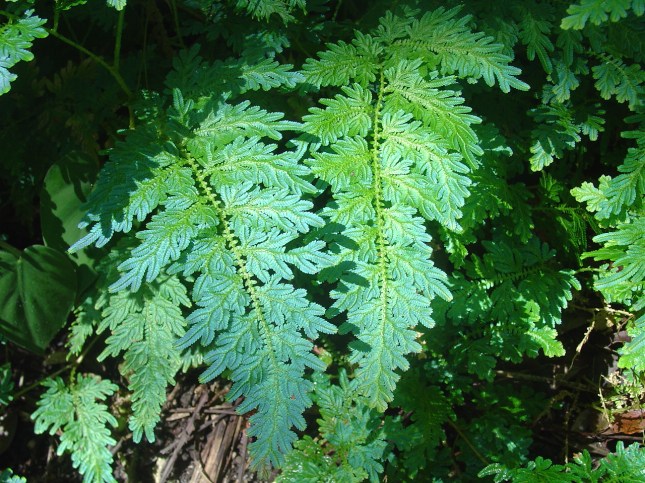
Selaginella uncinata at Fairchild

Leaves apparently use “fiber optics” along their cell walls to transmit light from the surface down deep. Purplish layers toward the bottom of the blade seem to backscatter escaping pass-through light back up into the photosynthetic region for a double dip. Good examples include some begonias, prayer-plants, zebrina, oyster plant, and shooting star clerodendrum.

To get now to today’s feature, velvety shade leaves have convex lens cells on top. They focus incoming light so sharply that bright focal points are sometimes visible through a microscope from these little magnifying glasses.   Additionally, the cells refract into the leaf light arriving at diffuse angles.   The drawing below from a paper by Dr. Lee from the 1980s shows a lens cell with rays arriving at an angle, refracted, and focused into the cell and on downward.  Light arriving obliquely might otherwise be more wasted reflecting off the surface.
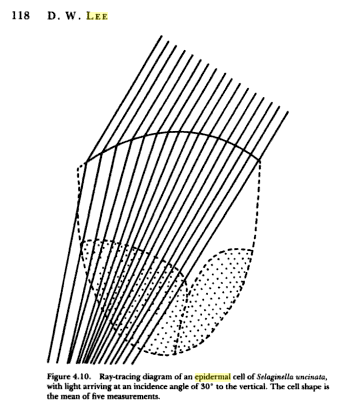
snip 2

The photo below shows lens cells on the surface of a Dull Leaf Coffee.
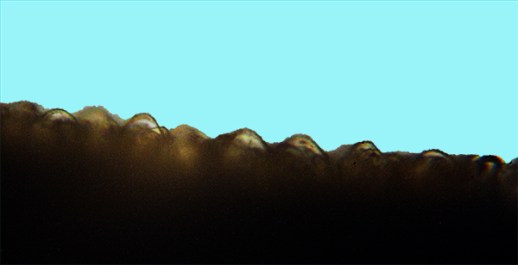
Psychotria sulzneri 600

You might ask, if a certain amount of light enters a leaf, why focus the dose into a smaller brighter beam? And to sharpen that question: Sometimes even under the dense canopy light can be too bright, say during fleeting moments of sun flecks, or maybe dawn or dusk as the sun peeks in.   Couldn’t bright focused beams then be excessive?   Probably, and one protection might be variegation, which we’ll consider in a moment.

There’s more to light entry than merely striking a static surface. The leaf adjusts internally to light intensity.   The sun beams strike tiny Frisbees, chloroplasts, within the layered leaf cells.   Chloroplasts in modest light cluster on the horizontal floor of the cells with their broad faces exposed to maximize capture. Think of closed venetian blinds. When the light is too strong, however, the chloroplasts migrate away from the light and align themselves along the vertical cell walls facing the illumination with their narrow edges.   Open venetian blinds. When the blinds are open a bright focused beam reaches into deeper layers. Thus a benefit of a focused beam might be controlled penetration into the blade with overall great effect.
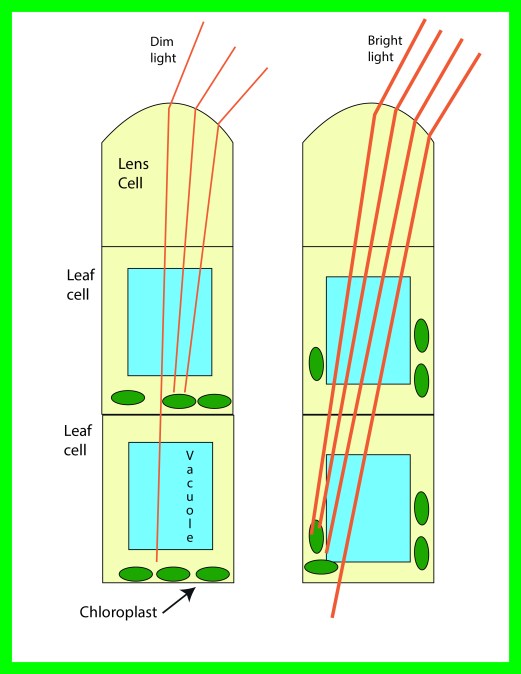
chloroplast orientation

In the illustration above, the two leaf cells on the left under a lens cell have their chloroplasts oriented face-up for maximum light capture.  On the right, the more intense focused beam penetrates as the chloroplasts orient safely edge-wise, capturing the light eventually, just deeper into the leaf.

It is possible demonstrate chloroplast adjustment by covering part of a shade leaf, then shining light on it. The covered portion stays dark green with its chloroplasts in their “shade orientation,” while the exposed portion lightens in color as the chloroplasts adjust into the “open blinds” orientation.

Leaf Variegation

Gardeners oh so love variegated leaves.   Although I think they are pretty, they don’t send me into raptures, maybe due to my preference for native species in landscaping, with so few natives being variegated.   To my eye a highly variegated garden tends to look contrived and unnatural. We do have a few though: some Smilax,   for instance.
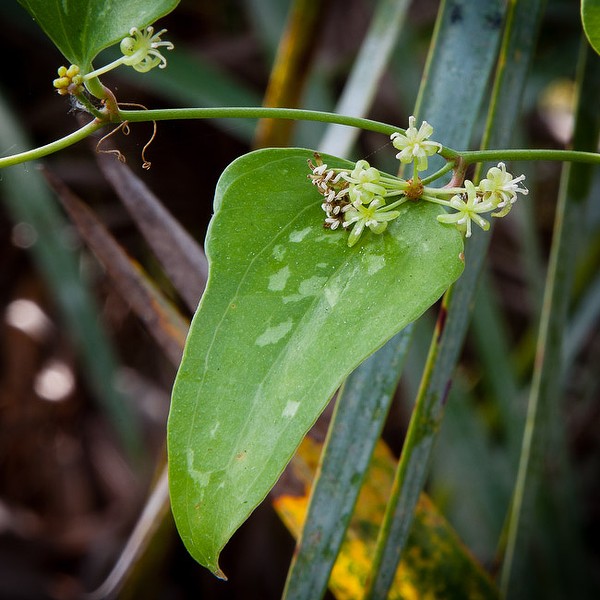
Smilax auriculata jb

Smilax dabbed with the brush. (By John Bradford)


There’s no single known answer for, “what’s variegation good for,” and little hard data.  I’m less confident of the discussion that follows than of the one above. Brace for rampant speculation.

Variegation, defined as patterns in leaf coloration, has arisen many times in many ways. Some of it comes from viral infections, probably no benefit to the plant.   This is the case for the so-called Flowering-Maple, Abutilon pictum.   Many other variegated plants owe their patterns, usually streaks or blotches, to minor mutations during foliar development.   Again, if these are beneficial it is not clear how or why.

But some variegation is clearly genetic, heritable, complex, patterned, and almost certainly usefully adaptive.   But even that is tough to interpret. Botanists have considered various explanations, which are not mutually exclusive, and which may apply differently, combined, or not at all to different species. Ideas about leaf coloration patterns include signals to herbivores of poor nutritional quality or of toxicity (so leave me alone);  or false damage making it look to herbivores like a different pest beat them to the salad bar;  or as camouflage to throw off the herbivore’s innate “search image.’”   Some observers have suggested  leafy colorifics to attract pollinators.

Such critter-based hypotheses may hold water, remembering especially that variegation has arisen many times , but the creature-centric interpretations  don’t take into account an apparent correlation between variegation and dark shaded habitats.

Variegation in deep shade presents an apparent dilemma: variegation diminishes the photosynthetic surface, seemingly not a “good idea” for the very shade-bound plants prone to patterned leaves. But here’s a possible explanation, neither original with me nor “accepted fact”:   deep-shade leaves are good at catching light when the intensity is low, but intensities above the usual gloom can impair photosynthesis, especially in leaves “designed” for low light, including those with lens cells.     Every gardener knows that shade species popped into bright sun suffer.

Those shade-adapted leaves are more delicate than sun-loving leaves, dandy down where it is dark, moist, and still.   But intermittent bright light may be a problem as winds blow, as the shifting sun peeks under the canopy, as sun flecks dance through the foliage. Or where light exposure changes with plant age and stature.

Variegation may sometimes give shade-leaves protection from sporadic sunny moments.

Some plants, such as some Cecropias, tend toward variegation when young and shaded in the understory but not variegated when older, taller and sunnier.   As David Lee illustrated, at least one African-Violet has its variegation increase as the day progresses.

It may be—and there is need for far more research—that some leaves with a varied coloration pattern enjoy the best of both worlds, the non-variegated portions function best in low light, with variegated portions less light-sensitive and thus happier at the brighter moments. A leaf able to function well only in deep shade may waste a lot of photosynthetic opportunity at brighter times, but a two-toned job is ready for anything.
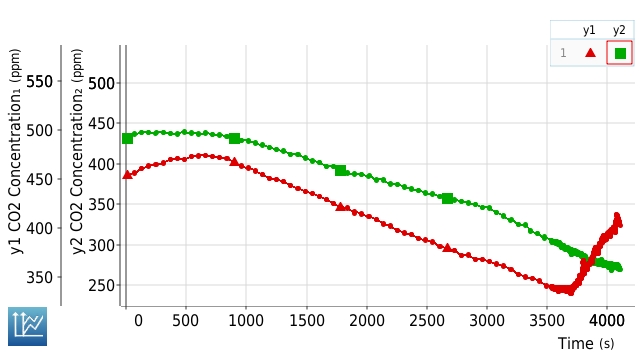
maranta1 extra01

Image above: Apparent advantage of variegation. This graph shows two tissue regions from the same Marnata (Prayer Plant) leaf monitored simultaneously under changing laboratory light exposure conditions (adjustable lamps). The vertical axis shows photosynthesis/respiration as CO2 usage/release. The horizontal axis shows seconds with increasing light intensity. (And heat increased with light intensity.)   The top line (Y2) shows performance by the variegated portion of the leaf. The bottom line (Y1) shows the unvariegated green portion. Under low light they behave similarly, with the green unvariegated portion slightly more responsive to the increasing light. At about 3600 seconds the increasing light and associated warmth caused the unvariegated portion to stop constructive photosynthesis and switch to destructive respiration, releasing carbon dioxide abruptly.   The variegated tissue passed that threshold unscathed, clearly standing up more successfully to the increased simulated sun exposure

 
8 Comments

Posted by on December 10, 2015 in Shade leaves, Uncategorized, Variegation


Tags:

False-Croton

Caperonia palustris

Euphorbiaceae

Good times this autumn exploring with the PBSC Horticultural Taxonomy class, focusing this go-round on exotic species.   One which seems to be severely under-studied, is a member of the Spurge Family related to Crotons and to last week’s Corkwood.   False-Crotons, species of Caperonia, are easy to overlook, hairy-itchy, growing inconveniently in places humans don’t routinely stroll.  They cry out for interpretation.

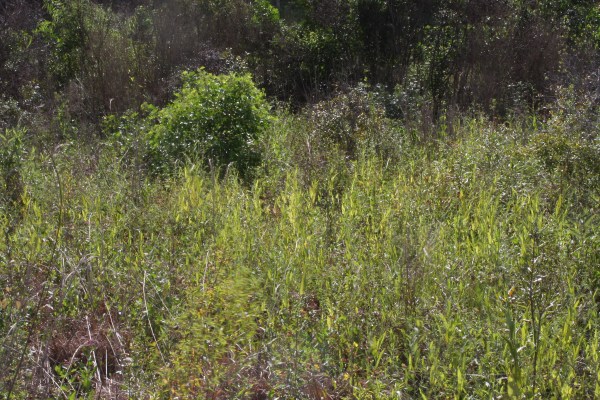
False-Crotons in retention pond

False-Crotons in retention pond

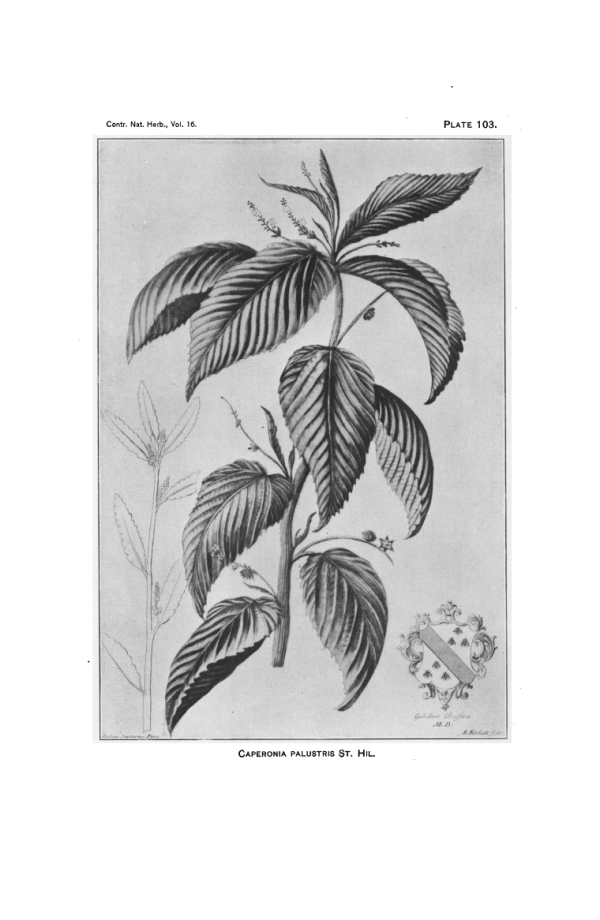
We have two Caperonia species in Florida. They have generated confusion and disagreement, as recently as the 1960s with it unclear if we have two species or merely one, with the resolution being Caperonia castaneifolia, with hairless stems seems to be native, and C. palustris, bearing glandular-hairy stem, is an invasive exotic first reported in the U.S. in Louisiana in 1913 by Ivar Tidestrom.  Ivar was a government botanist who lived his later years in Florida, and was botanically active into his 90s. Tidestrom illustrated his 1913 report with a beautiful drawing, inserted below, dating to approx. 1730.

From Tidestrom 1913, first published approx. 1730.

From Tidestrom 1913, first published approx. 1730.

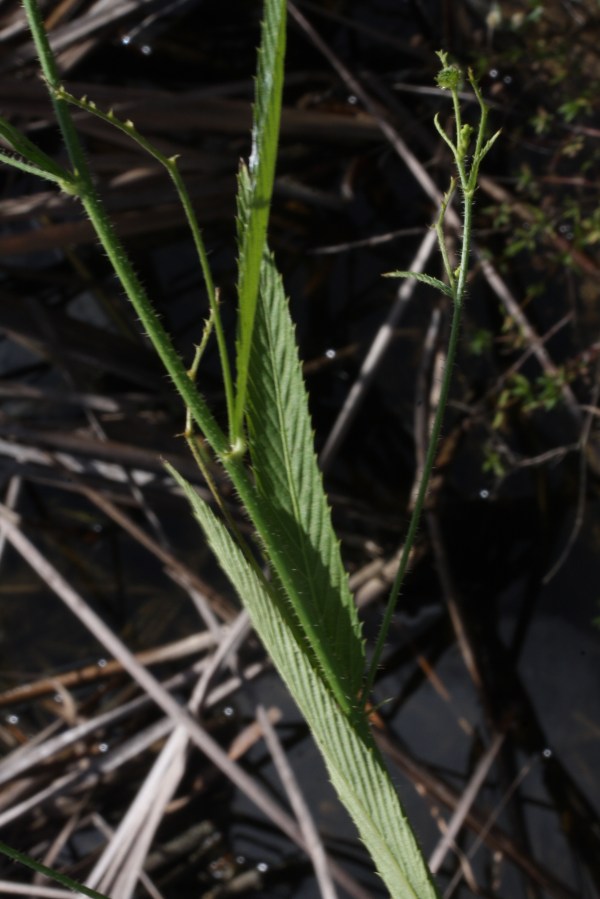
If you want a textbook example of serrate (sawtooth) leaves this is it.
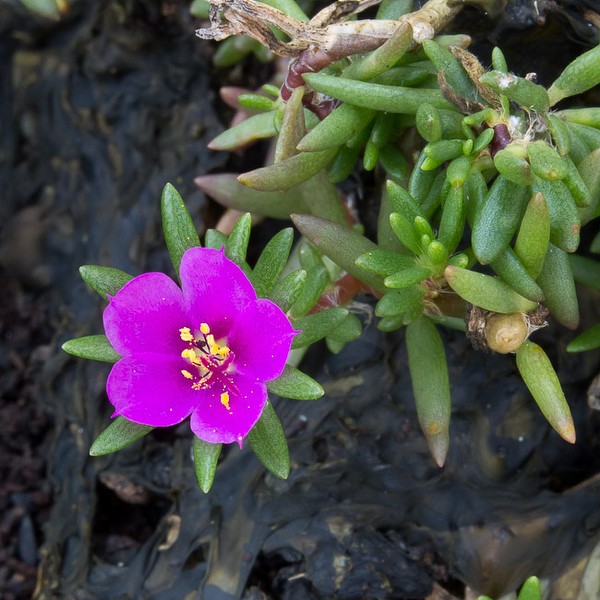
The leaves. Serrations are probably an adaptation to enhance gas (and heat?) exchange.

The leaves. Serrations are probably an adaptation to enhance gas (and heat?) exchange.

This species is adapted to intermittent wet feet. Palustris means of the swamp, such as in ditches and water retention ponds. Its paddy-happiness makes normally genial rice growers cranky with worry about its spread. Rice-related research has shown C. palustris to scoff in the face of control-by-flooding.   Rising waters make it grow insolently taller, and it adds “prop roots” like a miniature mangrove, as well as spongy tissue (aerenchyma) around the base. The related C. castaneifolia reportedly has a white covering on the seeds, perhaps an adaptation to floating.

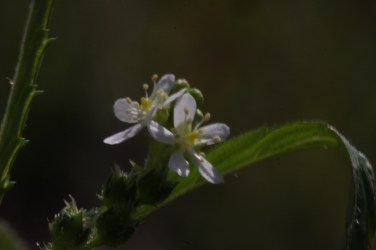
The remarkable feature of False-Croton, and the reason it deserves more study, is the flower arrangement: the flowering stalk has a few female flowers at the base and usually more numerous male flowers above. That is, it is monoecious, no big deal, a situation commonplace in the Spurge Family, including last week’s species, as well as Castor Bean and, to be seasonal, Poinsettia.   More curiously, the male flowers are flamboyant with long white petals.   The females, by contrast, are modest with stubby little petals, or apparently sometimes none. Female petal-envy occurs in other plants, including Jatropha integerrima, so popular in local gardens.

Showy male flowers.

Showy male flowers.  Green females to their left.

In Caperonia the difference is striking, and here’s the puzzle. If the usual purpose of flowers is to attract insects to carry pollen from male stamens to female pistils, shouldn’t the females draw pollinators equally effectively in order to connect the sexual dots?   Why draw buggies to the males but less so to the females? Mission incomplete!

This needs study. When there are differences between male and female flowers in the plant world, the males tend to be larger and showier.   This may be in part because the females devote more biomass to ovaries, fruits, and seeds, but that is not a very satisfying explanation.   Could it be that the flaglike male flowers draw visitors from afar, and once visitors are at hand the female flowers close the deal?

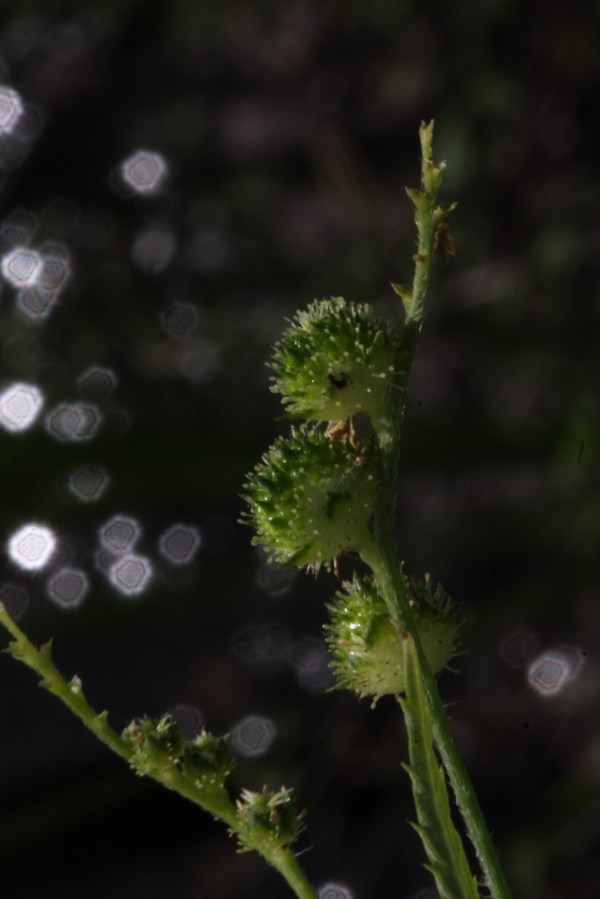
Maybe the female flowers use short-distance attractive methods after the long-range males draw a crowd.   Perhaps the females have scents. They are covered by glandular hairs which might interest visitors (recorded guests include bees, wasps, and flies). The female stigma cluster glistens. And there are sometimes petals, if merely small ones.

Un-showy female flowers (developing into fruits).

Un-showy female flowers (developing into fruits on the right.).

 
2 Comments

Posted by on December 5, 2015 in False-Croton


Tags:

Corkwood

Stillingia aquatica

Euphorbiaceae


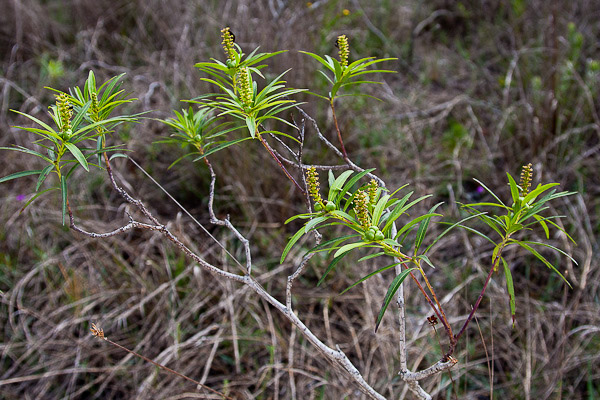
A curious shrub common in local marshes is Corkwood, a confusing English name applied to more than one species. If you prefer, another “book” name is “water toothleaf,” but I’ve never actually heard anybody use that name out loud.  Oh look—it’s water toothleaf!  A stroll along any marsh boardwalk reveals the odd shrub rising stiffly above the herbaceous vegetation.  The giveaway feature is a finger-sized yellow vertical flowering spike, maybe with a dragonfly perched on it.

stillingia mid

Our Stillingia aquatica is probably the only aquatic representative of the poorly studied genus Stillingia, made up of roughly 30 species mostly in western North America to South America. Oddly, a handful of species inhabit Madagascar and Tropical Pacific Islands.   The Old World species prefer maritime habitats, hinting at arrival from the American Tropics on ocean currents?

We have two species around here, the locally common Stillingia aquatica, living up to its name in aquatic habitats, and the locally scarce Stillingia sylvatica, living up to its name preferring the sylvan glen. Some call that one Queen’s Delight. (Don’t ask.)

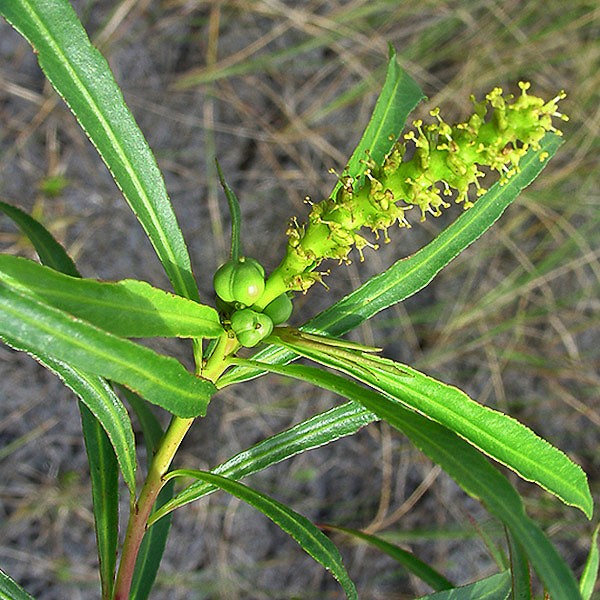
That vertical flower spike is a curiosity, with male (pollen-making) flowers above and female (seed- making) flowers below.  The male portion snaps off as it ages.  Any second-grader knows fowers attract pollinators with gifts of pollen and/or nectar.   The nectar generally comes from glands, nectaries, within the flower. Duh.

But nobody told Stillingia. Its nectar organs are not part of the flower, but rather enlarged stipules (basal appendages) on the small leaves associated with the flowers. Some Stillingias have similar ant-feeding (stipular?) glands on the petioles of the regular foliage leaves. These ant-food glands probably evolved into the flower-adjacent nectaries in the inflorescence.    (Stillingia sylvatica is reportedly pollinated by ants, which needs a much better look.   I’m not sold on that.)    What a weird scenario: flowers losing their real nectaries to have leaf-antfood-glands take over that function. Or so it seems.

To continue with ants, seeds on our two Stillingia species have a food packet, called a caruncle , to attract ants who disperse the seeds. Many plants attach nibbles to seeds to induce ants to drag the seeds home. The food body on the dry-habitat Stillingia sylvatica seed is large, and that in the wetland S. aquatica is small.

stillingia close

Every plant has a history of medicinal uses.   All that gets old, redundant, and unexciting when encountered species after species after species.   But few Florida plants have more prominent and controversial histories in remedies than Stillingias. Name an ailment, and Stillingias have served against it somewhere by somebody, although I’m aware of no authentic applications in modern scientific medicine. Close though!

A prominent recurrent application is against Syphilis.   What makes that more interesting is an old name for Stillingias is yaw-root.   Yaws is an ancient disease, generally not a STD, caused by a spirochaete bacterium similar to that of Syphilis.  Convergence of uses is always noteworthy.

An even-more prominent role for Stillingias turns up repeatedly with a little Google research: against cancers, and in no quiet way. It is an ingredient in the Hoxsey Herbal Therapy initiated by Harry Hoxsey in the 1920s, outlawed in the U.S. in 1960, object of much hulabaloo, and surviving defiantly today at the Hoxsey Clinic in Tijuana despite universal repudiation by modern medicine

——————

Today’s photos are Stillingia aquatica, by John Bradford.

 
6 Comments

Posted by on November 29, 2015 in Uncategorized


Blue Eyed Grass and Blue Eyed Grass

Sisyrinchium xerophyllum (and S. solstitiale)

Iridaceae

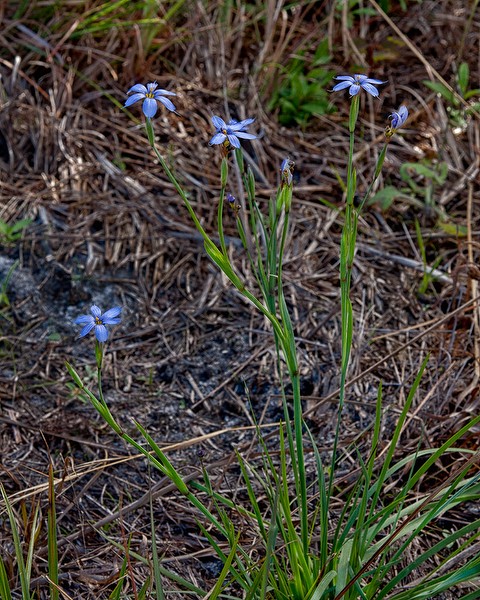
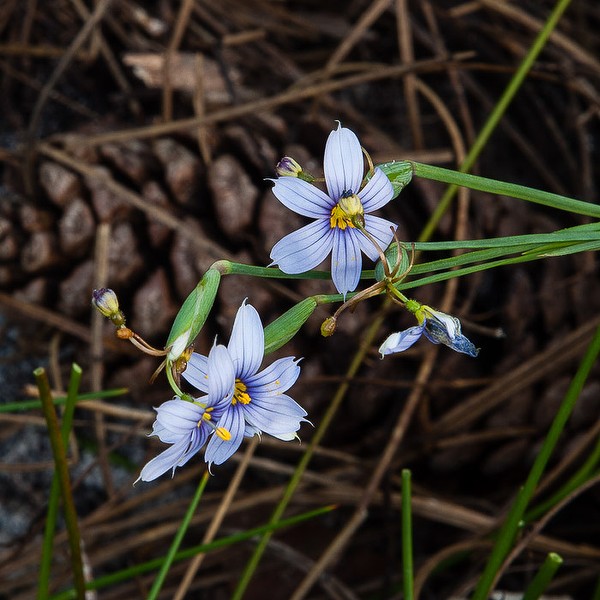
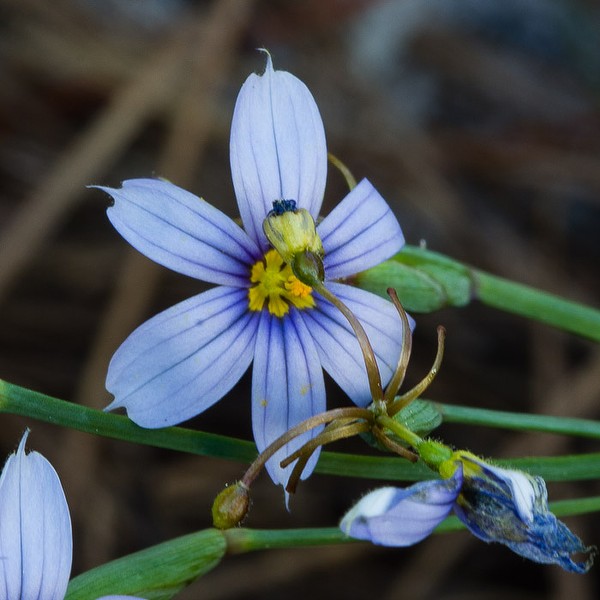
Today John and George enjoyed an autumn day in the Martin County Scrub.   So pretty outside now, with all the invasive exotics colorfully in flower: Pendulous Senna dangling sprays of egg yolk blossoms out of the woody shadows over the roadside snowdrifts of Mexican-Clover. No wonder they call it Florida! The native species were nice too, with the belle of the ball being Blue-Eyed-Grass, a purty lil’ “Iris” with blue flowers having a contrasting starry yellow eye.  (All photos today are S. xerophyllym, by John Bradford.)

Sisyrinchium xerophyllum 2

Sisyrinchiums may be beautiful to the eye, but they have an ugly history classification-wise, with umpteen regional variants, many of them with different chromosome numbers. A good example of a narrowly distributed species is Sisyrinchium funereum from a postage stamp in Death Valley. The same botanist-cum-ornithologist who came up with that handle in 1904, Eugene P. Bicknell, also named the species John and I admired today, or at least gave it its original name, back in 1899.   Remember that year.

If you look at older museum specimens from our general area you find specimens of today’s species consistently labeled using Bicknell’s designation  “Sisyrinchium solstitiale.”   But then comes a mystery….all those older specimens were re-labeled abruptly in recent years as Sisyrinchium xerophyllum, the name you’ll find in current manuals. That might raise your eyebrows. Something’s happening here, and what it is ain’t exactly clear.

Sisyrinchium xerophyllum 3

Now this may sound like boring bookkeeping, and maybe it is, but bear with me a moment: it is not THAT darn boring.   The label-name hijinks revealed an intriguing example of the twists and turns in the classification game.   Call it an example of why I think it is more fun to try to understand nature than to compete in fool’s arguments unrealistically forcing messy evolution into artificially tidy categories.

Looks like the problem is we’re dealing with two names for the same thing.   Oops, did I say “the same thing?”   Not so fast.   Where did that second name, Sisyrinchium xerophyllum, come from anyhow? It too dates to 1899, conceived by Civil War Veteran, erstwhile priest, and California botany professor Edward Greene.

Was this a case of an East Coast botanist and another in California merely unaware of each other  separately naming “the same thing”?   Or is life more complex?

Fast forward to the 70s. Local botanist, the late Dr. Daniel Austin and his colleague Royce Oliver studied these two “things” in depth, concluding that we’re dealing with two distinct species. One being S. solstitiale mostly autumn-flowering, evergreen, living in scrub, and having a special fondness for Sand Pine woods. The other being spring-flowering, losing its leaves each year, and preferring high-pine and flatwoods habitats.     Oliver and Austin suspected the couple to have been separated by ancient cross-Florida oceanic inundation, and further suspected the scrub species to have switched to fall flowering to avoid the dreadfully dry scrub spring drought.  They listed eight physical characteristics distinguishing the two.

sisyrinchium xerophyllum

As so often happens, despite all that documentation, the tide of opinion drifted in the other direction, with more recent taxonomists lumping both under a broadly defined S. xerophyllum.   Sisyrinchium solstitale extincted by the stroke of a pen!   Who needs a meteor strike?

I’m not interpreting what’s right and wrong.   There is no definitive right or wrong here.   Just imperfect data and interpretation. Whatever interpretation prevails, today we stared the ghost of S. solstitiale in its blue eye: in the scrub, among the Sand Pines, evergreen, and blooming in the fall.   Get’s you wondering as you’re wandering…

————————————————

Note: Oliver and Austin’s study was published in the Journal of the Arnold Arboretum 1974: 291.


10 Comments

Posted by on November 20, 2015 in Blue-Eyed Grass, Uncategorized


Tags:

What Goes Up Must Come Down (and Up…and Down…and Up…and Down)….Leaf Movements

John and George searched Jonathan Dickinson State Park today for “Cut Throat Grass” we didn’t find.   Rough walking and a thunderstorm kept camera gear in the car.   Even if we missed the bloody grass there’s always plenty to see, and today under exceptionally dark skies it was enlightening to study the leaf positions on the various Legume weeds, such as Sensitive Brier, Pigeon Pea, Milkpeas, Amorpha, and Rabbit Bells.

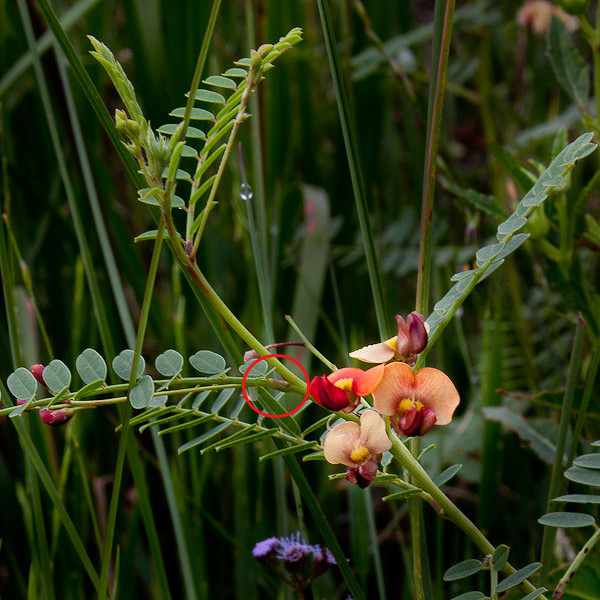
Bladderpod, a Legume. The pulvinus is inside the red circle. (By John Bradford)

Bladderpod, a Legume. The pulvinus is inside the red circle. (By John Bradford)

Many plants move their leaves upward or downward at different times for different reasons, mostly up and perky in the bright of day, and collapsed and droopy at night, sometimes in-between during shade or “down” under stressful conditions. Most notably, many go to sleep at night and wake up in the morning.

Foliar “sleep movements” have fascinated biologists for about as long as there have been biologists. Charles Darwin himself tackled the topic. Perhaps he just liked to say, “nyctinasty,”   the fancy term for what we’re discussing.  As Bob Seeger might tell you, it means “night moves,”  a good name for a band:

Photo not by JB.

Photo not by JB.

Plants with moving leaves include Oxalis, Velvetleaf, members of the Maranta Family, and especially most Legumes.   Ever notice how Legume trees such as Royal Poinciana can sleep at night, or how veggies such as beans and peanuts, take a flop, or how backyard weeds, such as Tick-Trefoils collapse, or how native Legume species know when to fold em’?

The motion comes mostly from changes in cellular water pressure. Legumes have hydraulic leaf-lifts called pulvini (singular pulvinus) visible at the base of the compound leaf where it joins the stem.   The pulvinus is the thick little muscle immediately adjacent to the attachment point.   Sometimes leaflets within a compound leaf have their own little pulvini.

Initiating the motion is where it gets tricky. What pushes the “lift the leaf” button?  Environmental cues come mostly from light and dark, specifically from red and blue light.   Usually even more important is an internal clock. A built-in rhythm.  For a little taste of competing control by light and by a built-in clock, enjoy a little time lapse movie:

CLICK HERE FOR ENTERTAINMENT

The internal clock needs dawn and dusk for setting. If you leave a plant in constant light for enough days the up-down cycle continues but degrades in timing and in intensity until it fizzles out.

Next time you are out and abut among trees at night, take a look at the Legumes: Royal Poinciana, Pride of Barbados, Albizia, Powderpuffs, Sennas, Princess Earring, Pongam, Copperpod, and others, do they sleep at night?

————————————————————————————————-

Extra credit:

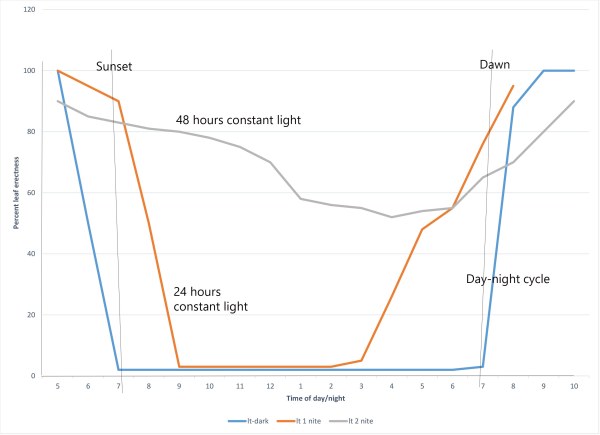
Desmodium light response chart

This diagram shows deterioration of the leaf response cycle in continuous light. The vertical axis shows the degree of erectness of the leaves in terms of percent. The horizontal axis shows 5 pm through the night to 10 pm the next day. By placing three lines representing three nights) on the graph, three days of response by one Tick-Trefoil plant are condensed into one graph.

The blue line (Day-night cycle) shows leaf movements in natural day-night light-dark. The leaves dropped abruptly and fully 6-7 pm, then stayed fully down until rising abruptly and fully 7-8 pm.

The orange line (24 hours constant light) shows the same plant placed in constant light for a night after a night under natural conditions. It drooped full but required two hours 7-9 pm, and started waking up 2-3 AM and required about 4 hours to become almost 100% erect. Its response was mildly degraded.

Continued under constant light through the following night shown by the gray line, the same plant (48 hours constant light) drooped gradually and incompletely, hitting its lowest point around 4 AM, then rising slowly and incompletely until the experiment ended at 10 AM.   Its response was severely degraded.

 
Leave a comment

Posted by on November 13, 2015 in Baybean, Nyctinasty


Tags:

Spatterdock is a Pumpin’ Posie

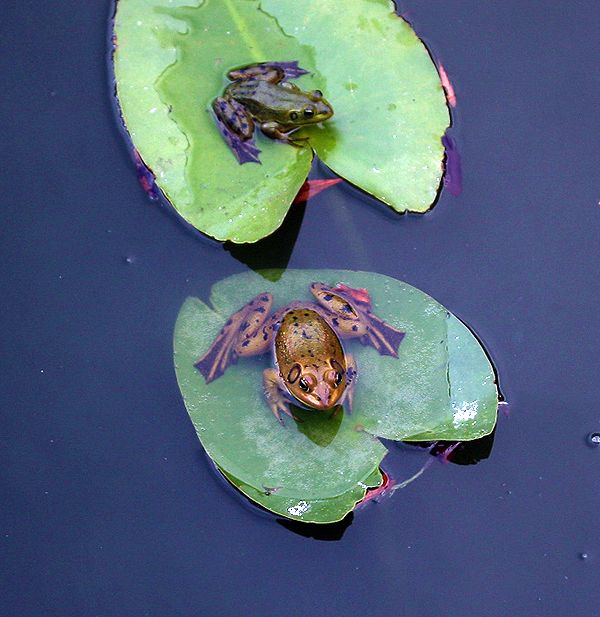
frogs on nuphar

Spatterdock

Nuphar advena (N. lutea)

Nymphaeaceae

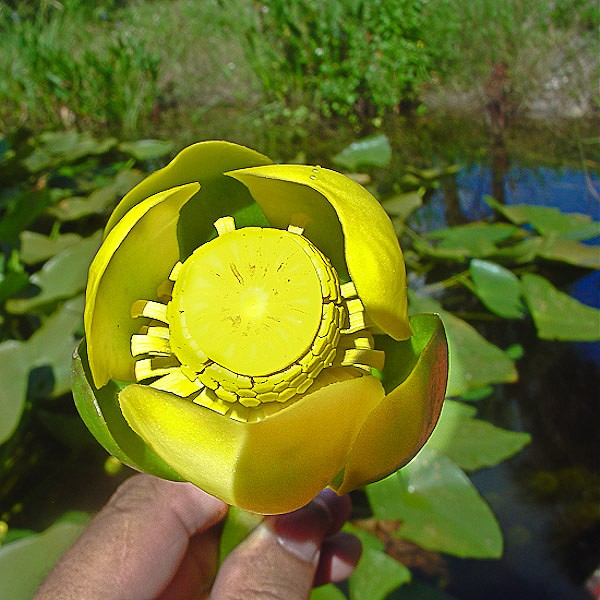
John and I tromped scrub and swamp yesterday, focused on spiders, not posies, so I’m going to turn back time one more day to my native plants class field trip Thursday with our toes in the Loxahatchee riverbank mud. A curious plant swimming with the fishes is Spatterdock, the common water lily with egg-yolk-yellow flowers shaped like tennis balls.

These simple species is a confounded series of confuddlements, beginning with its classification within the flowering plants. Every botany student knows the flowering plants divide into two huge groups, monocots and dicots.   But water-lilies stand apart.   They were around before the monocot-dicot divide.   Primitive as can be.

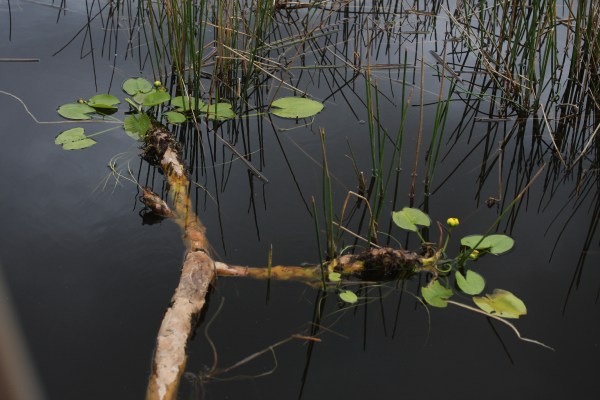
Spatterdock rhizome floating

Spatterdock rhizome floating

Within the genus Nuphar, species concepts remain unsettled, so if you look up our local species you’ll find different names in different books.   Folks who lose sleep (or send condescending corrective e-mails) over such cognitive dissonance should embrace the currents and eddies of evolution. You just can’t shoehorn an enormous dynamic evolving system into division, class, order, family, genus, species. More fun to watch the sky than to name the clouds.

So let’s try to get to something interesting.   The flowers start out female (pollen-receptive), and in a day or so become male (pollen-releasing).   Their fundamental main pollination syndrome, at least in the U.S., may be more or less like this: The flowers start out a little bit open during the female phase, so that visiting beetles brush across the stigma, thus pollinating the flower if they carry pollen. The beetles may become trapped temporarily. Subsequently, as pollen release ensues, the blossoms open. Any trapped beetles would then become dusted, and newcomers could stop by, get dusted, and fly off to entrapment in other flowers still in the female phase.

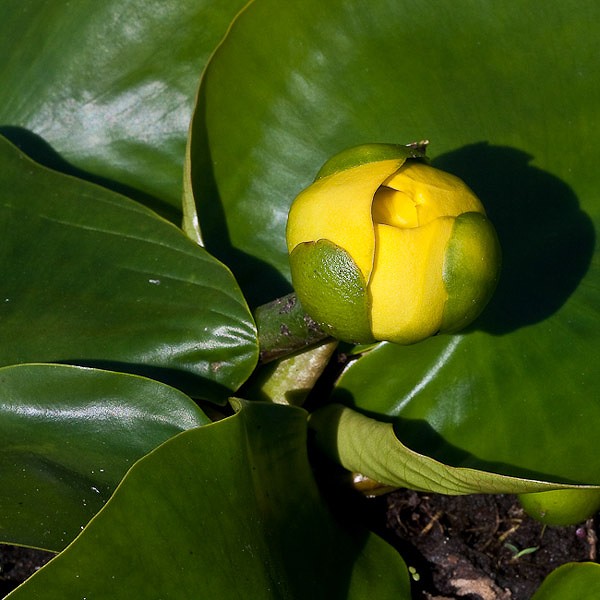
Presumably in the female phase. Come on in! The stigma is just inside the door. (By John Bradford)

Presumably in the female phase. Come on in! The stigma is just inside the door. (By John Bradford)

To whatever extent all that is so, it is not the whole truth and nothing but the truth, because numerous other critters visit, including flies and bees, and in the Old World the spatterdocks clearly don’t have beetle mania.

Male phase, wide open, stamens showing. (By JB)

Male phase, wide open, stamens showing. (By JB)

The fruits ripen above the waves, and contain seeds cooked historically in mush and gruel.   Spatterdock patches in places speculatively owe their existence to pre-European aquaculture, and fossil remains (pollen) is known from ancient human coprolites here in Florida.

The rhizomes are several feet long and many inches in diameter, and starchy. They too have been on the ancient menu, and have history in medicines, often mashed into poultices.   Laundry lists of ancient medicinal uses tend to be boring, unless there are patterns or repetitions.   A recurrent use in old records now on-line perhaps useful to some readers is, “hung up inside to keep witches away.”

The rhizomes live down in stinky oxygen-deprived pond-bottom mud.   How plants manage breathe where the sun don’t shine is always a curious matter, and spatterdock is a rock star in this area. It is an example of something there ought to be (and probably is undetected) more of: active ventilation…pumping….as opposed to the passive diffusion, with wind assistance, so universally attributed to plant gas exchanges.   Spatterdocks have a genius method of “forcing” air through the plant, starting with young leaves, on down through their petioles (leaf stalks) to and through the rhizome, then up and out through older leaves.   The internal air pipes run continuously the whole nine yards.

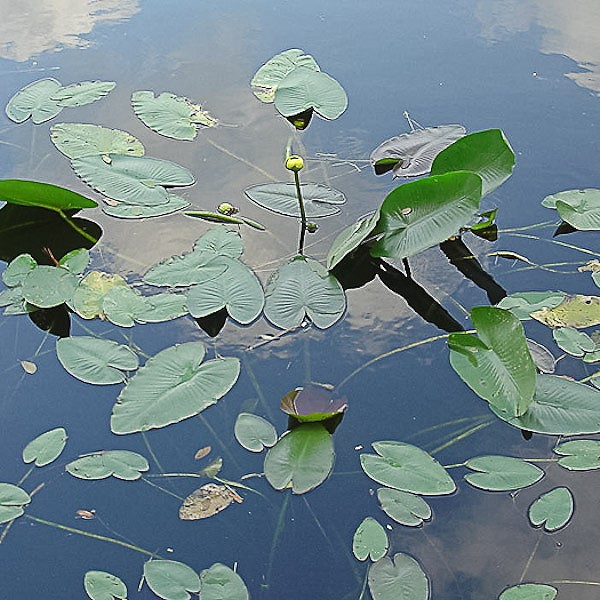
Young leaves floating (some are red). Old leaves flapping in the breeze above the surface. (JB)

Young leaves floating (some are red). Old leaves flapping in the breeze above the surface. (JB)

Air enters the system through the floating young leaves, slowly by diffusion, and more “air” (oxygen) accumulates as a byproduct from the photosynthetic activity in the leaf. Unlike most plants, that “waste” oxygen is not wasted. Instead, the oxygenated air collects in hollow ducts toward the bottom of the leaf. The trapped air cannot escape upward to the outside because a tight barrier (palisade mesophyll) separates the air ducts from the exposed leaf surface above. (The lower leaf surface is in the water, not in contact with the air.)   With the vapors accumulating and unable to escape, pressure builds up in the young leaves.   The botanist who documented all this several decades ago, John Dacey, noted that the young leaves are often reddish.   Botanists generally interpret red in young growth to be sun screen, but in this case Dr. Dacey suggested that the red pigment absorb solar energy, heating the leaf and raising the internal pressure.

The older leaves are different. Instead of building pressure, they release it. They are the vents. The older blades are held above the water in the breeze, presumably able to release water vapor and gases from both surfaces, and the barrier that prevented vapor escape in the young leaves is stretched out with gaps, it has become porous in the old leaves.

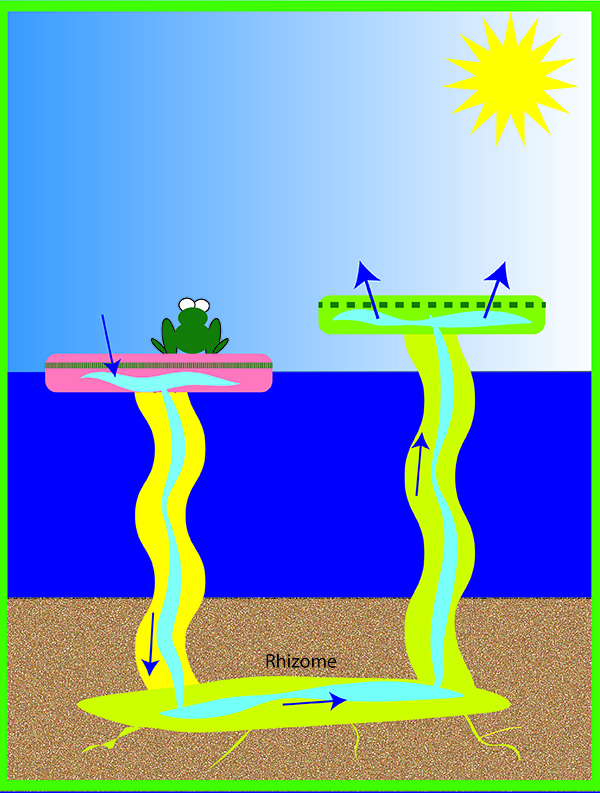
Young red leaf at left. Old leaf elevated on right. Rhizome buried in pond mud. Blue lines are air ducts. Arrows show predominant vapor flow.

Young red leaf at left, with tight restrictive vapor barrier.  Old leaf elevated on right. The vapor barrier has big openings.  Rhizome buried in pond mud. Blue lines are air ducts. Arrows show predominant vapor flow.

So then a mix of oxygen and other vapors flows from the pressurized young leaves, down through the air-hungry sunken rhizome, and then out through the leaky older leaves.   You may ask, “if vapors escape easily through big holes on old leaves but enter reluctantly through a tight barrier in young leaves, how can pressure continue to build and flow?”   The answer is gas-generation inside the plant; it self-pressurizes with its own metabolic activity: oxygen from photosynthesis, carbon dioxide from respiration, and internally released water vapor.

I just love it when plants “do stuff.”

 
9 Comments

Posted by on November 7, 2015 in Uncategorized


Tags: , ,

Salt, Sun, and Succulence

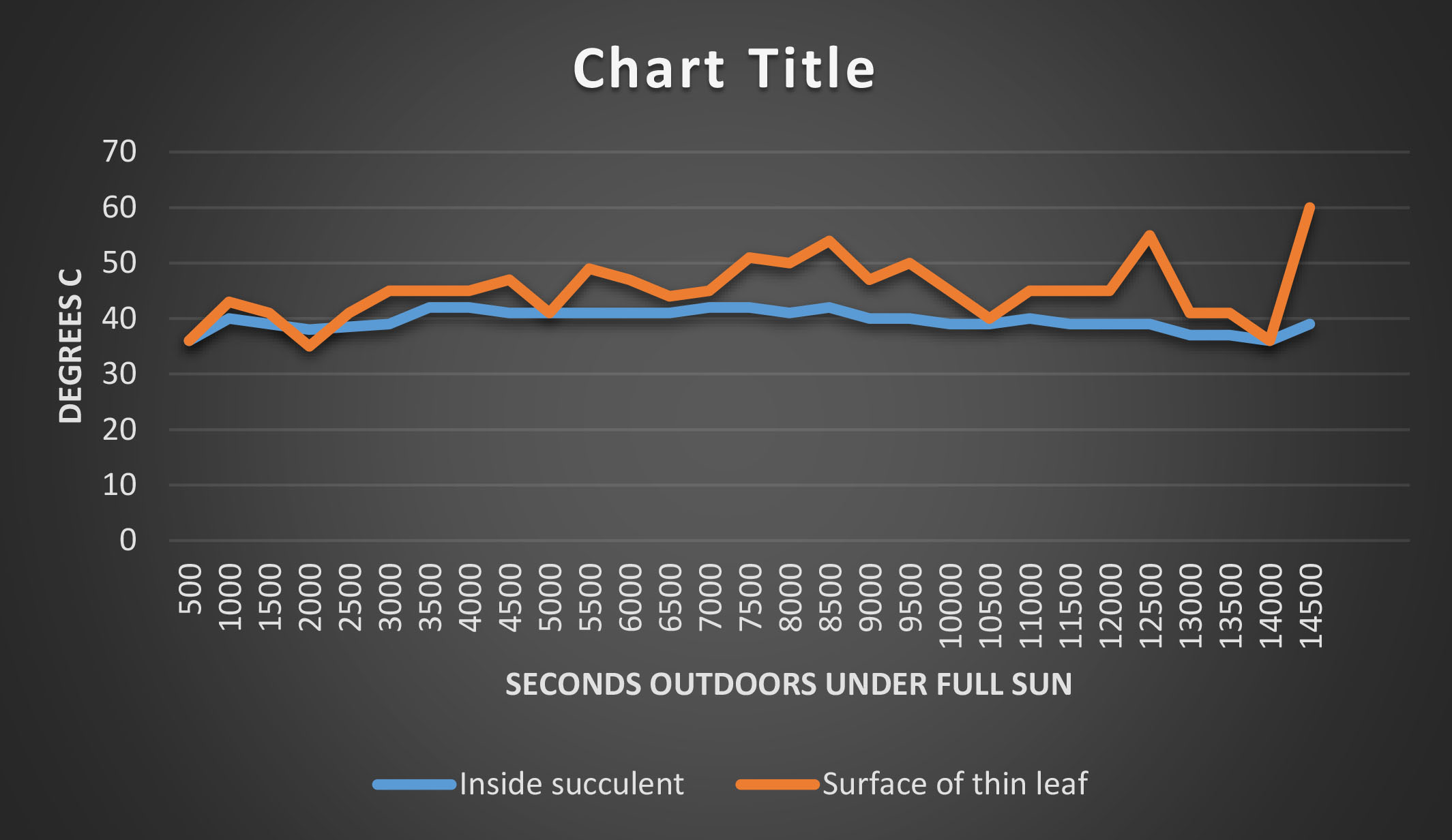
Here is an experiment conducted on a hot sunny day Nov. 3 2015. he vertical axis hsows degrees (centigrade). The horizontal axis shows time, spanning roughly 4 hours. he orange line shows he temperatures at the surface of a regular flat leaf. he blue lines shows the temperatures at the same time and place on the inside of a succulent (Aloe) leaf. It stayed mores stable and mostly cooler

Here is an experiment conducted in full sun on a hot sunny day Nov. 3 2015.  The vertical axis shows degrees (centigrade).  The leaf temperature become high, often exceeding the air.  Forty degrees C = approx. 104 degrees F.   The horizontal axis shows time, spanning roughly 4 hours. The orange line shows the temperatures at the surface of a regular flat leaf. The blue line shows the temperatures at the same time and place on the inside of a succulent (Aloe) leaf. It stayed more stable and mostly cooler.

Succulent plants are odd and beautiful , and I can’t resist them.   Today in a big box store attending to home plumbing repairs, the errand became more fun distracted by the purchase of two non-native succulent charmers, Lithops and Fenestraria presently sitting on the kitchen counter.

By “succulent” I’m referring to plants with thick jello-filled stems or leaves.   Succulence has evolved many times in many places in many unrelated families. Today’s focus is on leaf-succulents.

Most succulents occupy sunny dry habitats. That tempts us into the obvious interpretation of succulence as an adaptation for water storage, like the hump(s) on the camel.  Makes sense—if you go to the desert better have a canteen.   But, as with many simplistic assumptions, a truthful reply is, “well sorta, but not exactly.”  Not that I claim to have total answers! This discussion is established plant physiology mixed with an effort to weave it into a local narrative, sort of like a historian connecting the dots with fragmentary data. You are warned.  These are musings, not hard fact.

“Kiss Me Quick,” a locally native succulent often encountered in hot dry weedy places. (By John Bradford).

So let’s get busy. First of all, why does a plant need to take in water? 1. Photosynthesis requires some. 2. Cells need some for basic maintenance, for nutrient transport, and to remain pressured so they don’t wilt. 3. Evaporative cooling.  Evaporation (or to speak botanically, transpiration) is the big user, reportedly accounting for as much as 97 percent of a plant’s water uptake.  Some trees transpire over 100 gallons per day bringing nutrients upward and cooling the excessive sun impinging on the foliage.

In a hot sunny dry habitat, a plant can’t afford to lavish non-existent water in massive quantities on the evaporative cooling that hot sun demands. And to make the water crisis worse, many arid plants have C4 photosynthesis,  something not to explore today beyond saying it  shuts down transpiration even further.   (As a local example, the somewhat succulent tree Rose Apple can have C4 photosynthesis.)  So you see, plants in dry hot circumstances are in a living hell! With curtailed evaporative cooling, they need a “plan B.”

Plan B is two-pronged: 1) Heat tolerance, and 2) Buffering from spikes in temperature, especially lulls in the cooling wind. Thick watery leaves resist temperature change. Think of it this way, if you pour a gallon of water out into a thin layer (representing a normal thin flat leaf) in the hot sun the water warms instantly.   But if you keep that water in a jug, or in a succulent leaf, the temperature resists change. Think how long it takes to bring a gallon pot of water to boil.

Succulent leaves are not simple water bags, as anyone who has ever sliced one can attest. They don’t generally drip when cut, and their volumes don’t seem to change much relative to wet and dry weather.   They are made of cells, and the cell contents are more of a gel than a liquid.   Think of the gel in a disposable diaper, wet and not prone to give it up.

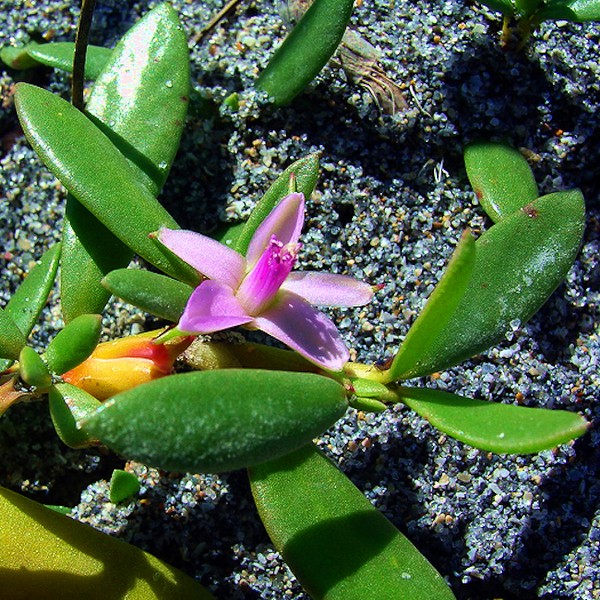
In Palm Beach County Florida most native succulent plants live by the sea: Saltwort (Batis maritima), Sea-Purslane (Sesuvium portulacastrum), Marsh-Elder (Iva imbricata) , Sea-Rocket (Cakile lanceolata), and more.    Is it tough to take up water in maritime circumstances? Sure, rocky and sandy soils, and more importantly, salty habitats are “physiologically dry.”    And to pour salt on the wound, if a plant takes up large quantities of salty water for transpiration, remember that 97%,  its plumbing might choke on crud.   So no surprise seaside plants are often succulent.

Sea-Purslane, a maritime succulent (by JB).

Sea-Purslane, a maritime succulent (by JB).

Often, but not always: those able to shed salt don’t all need succulence. For example, Crested Saltbush (Atriplex pentandra) disposes of the salt into hairs shaped like lightbulbs. When the hair fills with salt it bursts, and goodbye salt.   This species is not particularly succulent.

Those unable to dispose of salt externally, by contrast, hold it in, and those are the seashore succulents. They store salt compartmentalized in each cell,  within a large water balloon filled with salt water (technically the vacuole), like the waste collection system in an RV.   A saltwater bag in each cell, drawing in ever-more water by osmosis,  swells and forces bloated water-retention, suggesting why the beach is rich in thick-leaved species. The plant sheds the excess salt when it sheds the loaded leaves, like that bloated disposable diaper.   Beach-succulents cultivated under salt-free conditions experimentally have shown diminished succulence.

 
Leave a comment

Posted by on November 1, 2015 in Succulents


Tags: