Sisyrinchium xerophyllum (and S. solstitiale)
Iridaceae
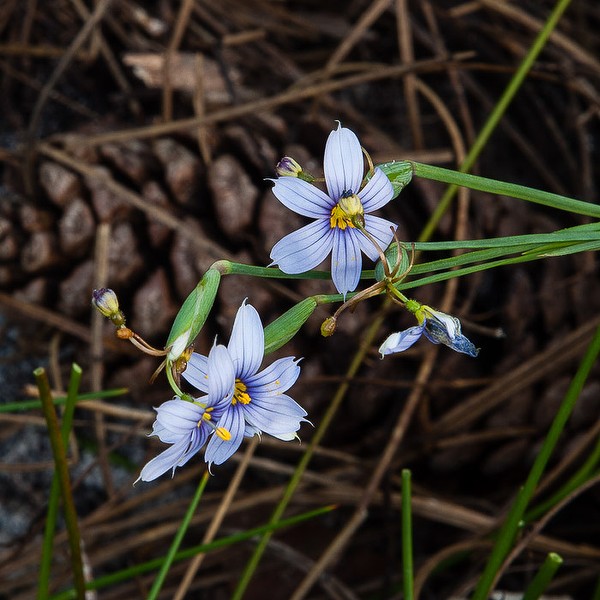
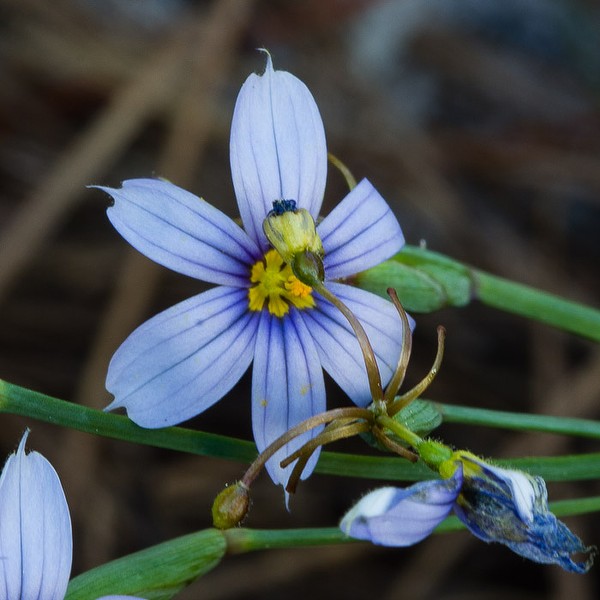
Today John and George enjoyed an autumn day in the Martin County Scrub. So pretty outside now, with all the invasive exotics colorfully in flower: Pendulous Senna dangling sprays of egg yolk blossoms out of the woody shadows over the roadside snowdrifts of Mexican-Clover. No wonder they call it Florida! The native species were nice too, with the belle of the ball being Blue-Eyed-Grass, a purty lil’ “Iris” with blue flowers having a contrasting starry yellow eye. (All photos today are S. xerophyllym, by John Bradford.)
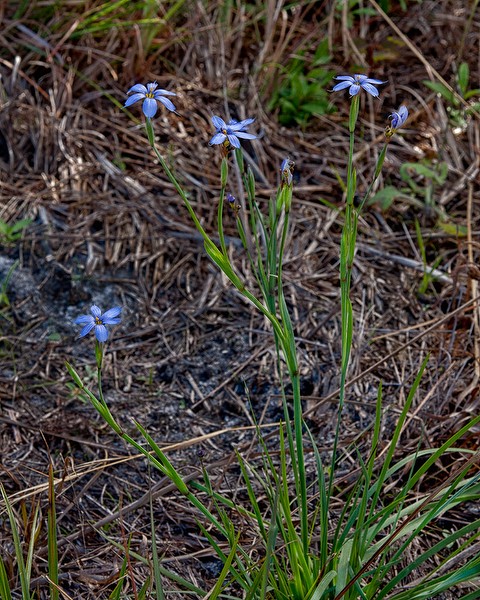
Sisyrinchiums may be beautiful to the eye, but they have an ugly history classification-wise, with umpteen regional variants, many of them with different chromosome numbers. A good example of a narrowly distributed species is Sisyrinchium funereum from a postage stamp in Death Valley. The same botanist-cum-ornithologist who came up with that handle in 1904, Eugene P. Bicknell, also named the species John and I admired today, or at least gave it its original name, back in 1899. Remember that year.
If you look at older museum specimens from our general area you find specimens of today’s species consistently labeled using Bicknell’s designation “Sisyrinchium solstitiale.” But then comes a mystery….all those older specimens were re-labeled abruptly in recent years as Sisyrinchium xerophyllum, the name you’ll find in current manuals. That might raise your eyebrows. Something’s happening here, and what it is ain’t exactly clear.
Now this may sound like boring bookkeeping, and maybe it is, but bear with me a moment: it is not THAT darn boring. The label-name hijinks revealed an intriguing example of the twists and turns in the classification game. Call it an example of why I think it is more fun to try to understand nature than to compete in fool’s arguments unrealistically forcing messy evolution into artificially tidy categories.
Looks like the problem is we’re dealing with two names for the same thing. Oops, did I say “the same thing?” Not so fast. Where did that second name, Sisyrinchium xerophyllum, come from anyhow? It too dates to 1899, conceived by Civil War Veteran, erstwhile priest, and California botany professor Edward Greene.
Was this a case of an East Coast botanist and another in California merely unaware of each other separately naming “the same thing”? Or is life more complex?
Fast forward to the 70s. Local botanist, the late Dr. Daniel Austin and his colleague Royce Oliver studied these two “things” in depth, concluding that we’re dealing with two distinct species. One being S. solstitiale mostly autumn-flowering, evergreen, living in scrub, and having a special fondness for Sand Pine woods. The other being spring-flowering, losing its leaves each year, and preferring high-pine and flatwoods habitats. Oliver and Austin suspected the couple to have been separated by ancient cross-Florida oceanic inundation, and further suspected the scrub species to have switched to fall flowering to avoid the dreadfully dry scrub spring drought. They listed eight physical characteristics distinguishing the two.
As so often happens, despite all that documentation, the tide of opinion drifted in the other direction, with more recent taxonomists lumping both under a broadly defined S. xerophyllum. Sisyrinchium solstitale extincted by the stroke of a pen! Who needs a meteor strike?
I’m not interpreting what’s right and wrong. There is no definitive right or wrong here. Just imperfect data and interpretation. Whatever interpretation prevails, today we stared the ghost of S. solstitiale in its blue eye: in the scrub, among the Sand Pines, evergreen, and blooming in the fall. Get’s you wondering as you’re wandering…
————————————————
Note: Oliver and Austin’s study was published in the Journal of the Arnold Arboretum 1974: 291.
 John Bradford
 George Rogers
 George Rogers
 Dee Staley
 Treasure Coast Natives