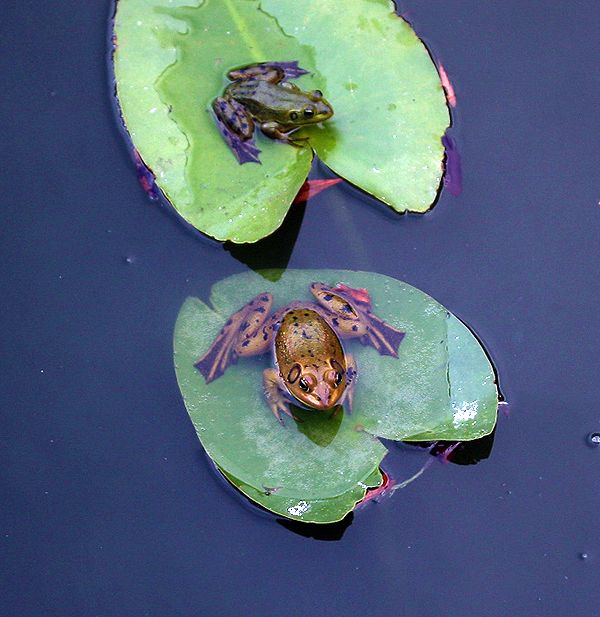
Spatterdock
Nuphar advena (N. lutea)
Nymphaeaceae
John and I tromped scrub and swamp yesterday, focused on spiders, not posies, so I’m going to turn back time one more day to my native plants class field trip Thursday with our toes in the Loxahatchee riverbank mud. A curious plant swimming with the fishes is Spatterdock, the common water lily with egg-yolk-yellow flowers shaped like tennis balls.
These simple species is a confounded series of confuddlements, beginning with its classification within the flowering plants. Every botany student knows the flowering plants divide into two huge groups, monocots and dicots. But water-lilies stand apart. They were around before the monocot-dicot divide. Primitive as can be.
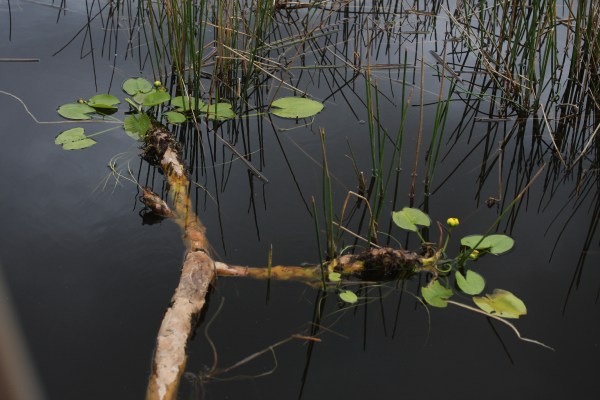
Spatterdock rhizome floating
Within the genus Nuphar, species concepts remain unsettled, so if you look up our local species you’ll find different names in different books. Folks who lose sleep (or send condescending corrective e-mails) over such cognitive dissonance should embrace the currents and eddies of evolution. You just can’t shoehorn an enormous dynamic evolving system into division, class, order, family, genus, species. More fun to watch the sky than to name the clouds.
So let’s try to get to something interesting. The flowers start out female (pollen-receptive), and in a day or so become male (pollen-releasing). Their fundamental main pollination syndrome, at least in the U.S., may be more or less like this: The flowers start out a little bit open during the female phase, so that visiting beetles brush across the stigma, thus pollinating the flower if they carry pollen. The beetles may become trapped temporarily. Subsequently, as pollen release ensues, the blossoms open. Any trapped beetles would then become dusted, and newcomers could stop by, get dusted, and fly off to entrapment in other flowers still in the female phase.
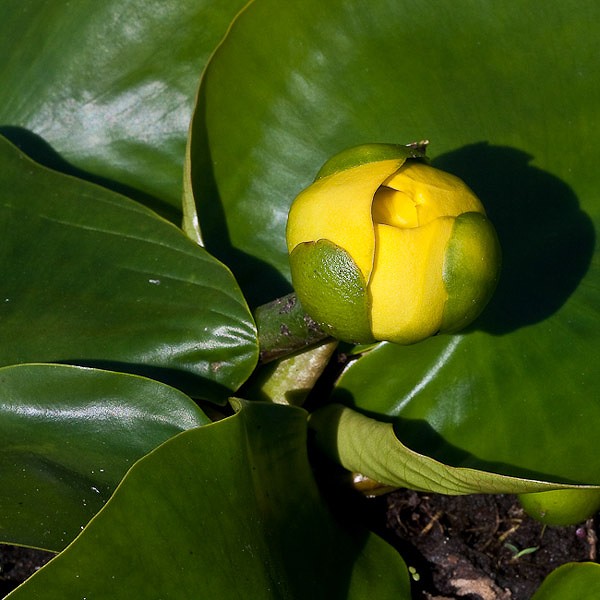
Presumably in the female phase. Come on in! The stigma is just inside the door. (By John Bradford)
To whatever extent all that is so, it is not the whole truth and nothing but the truth, because numerous other critters visit, including flies and bees, and in the Old World the spatterdocks clearly don’t have beetle mania.
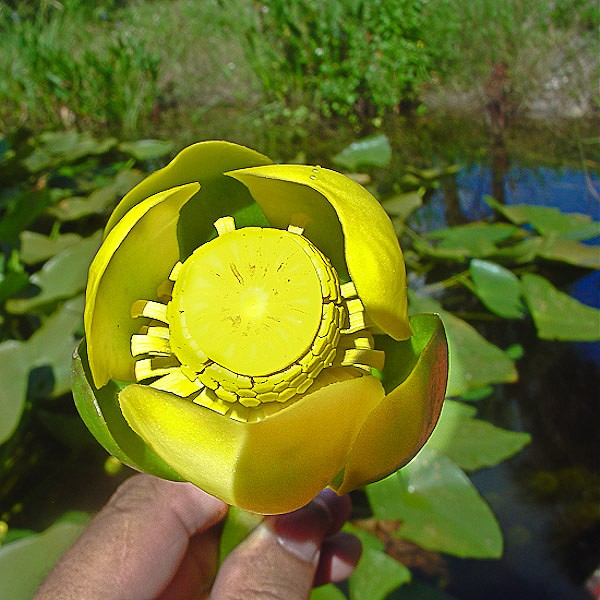
Male phase, wide open, stamens showing. (By JB)
The fruits ripen above the waves, and contain seeds cooked historically in mush and gruel. Spatterdock patches in places speculatively owe their existence to pre-European aquaculture, and fossil remains (pollen) is known from ancient human coprolites here in Florida.
The rhizomes are several feet long and many inches in diameter, and starchy. They too have been on the ancient menu, and have history in medicines, often mashed into poultices. Laundry lists of ancient medicinal uses tend to be boring, unless there are patterns or repetitions. A recurrent use in old records now on-line perhaps useful to some readers is, “hung up inside to keep witches away.”
The rhizomes live down in stinky oxygen-deprived pond-bottom mud. How plants manage breathe where the sun don’t shine is always a curious matter, and spatterdock is a rock star in this area. It is an example of something there ought to be (and probably is undetected) more of: active ventilation…pumping….as opposed to the passive diffusion, with wind assistance, so universally attributed to plant gas exchanges. Spatterdocks have a genius method of “forcing” air through the plant, starting with young leaves, on down through their petioles (leaf stalks) to and through the rhizome, then up and out through older leaves. The internal air pipes run continuously the whole nine yards.
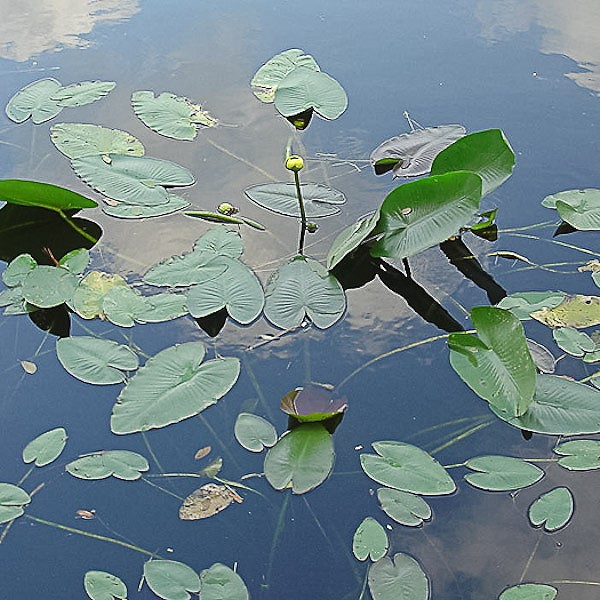
Young leaves floating (some are red). Old leaves flapping in the breeze above the surface. (JB)
Air enters the system through the floating young leaves, slowly by diffusion, and more “air” (oxygen) accumulates as a byproduct from the photosynthetic activity in the leaf. Unlike most plants, that “waste” oxygen is not wasted. Instead, the oxygenated air collects in hollow ducts toward the bottom of the leaf. The trapped air cannot escape upward to the outside because a tight barrier (palisade mesophyll) separates the air ducts from the exposed leaf surface above. (The lower leaf surface is in the water, not in contact with the air.) With the vapors accumulating and unable to escape, pressure builds up in the young leaves. The botanist who documented all this several decades ago, John Dacey, noted that the young leaves are often reddish. Botanists generally interpret red in young growth to be sun screen, but in this case Dr. Dacey suggested that the red pigment absorb solar energy, heating the leaf and raising the internal pressure.
The older leaves are different. Instead of building pressure, they release it. They are the vents. The older blades are held above the water in the breeze, presumably able to release water vapor and gases from both surfaces, and the barrier that prevented vapor escape in the young leaves is stretched out with gaps, it has become porous in the old leaves.
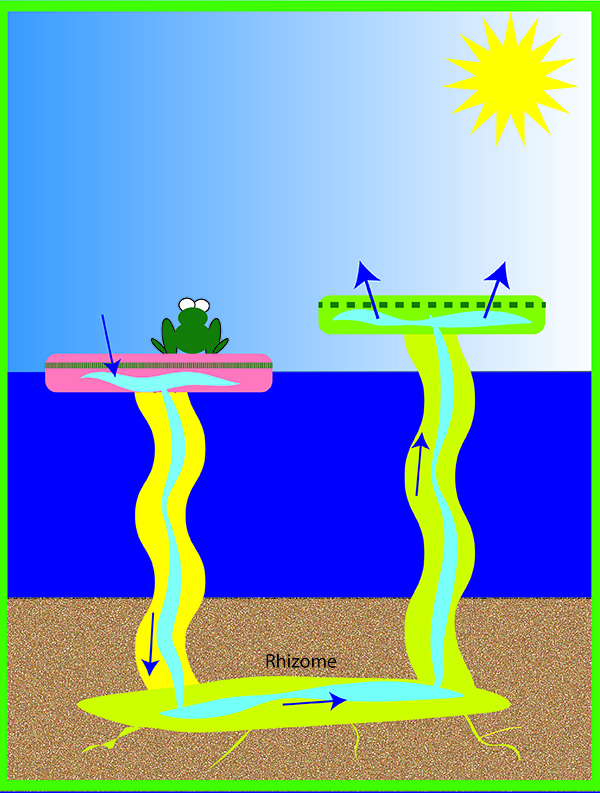
Young red leaf at left, with tight restrictive vapor barrier. Old leaf elevated on right. The vapor barrier has big openings. Rhizome buried in pond mud. Blue lines are air ducts. Arrows show predominant vapor flow.
So then a mix of oxygen and other vapors flows from the pressurized young leaves, down through the air-hungry sunken rhizome, and then out through the leaky older leaves. You may ask, “if vapors escape easily through big holes on old leaves but enter reluctantly through a tight barrier in young leaves, how can pressure continue to build and flow?” The answer is gas-generation inside the plant; it self-pressurizes with its own metabolic activity: oxygen from photosynthesis, carbon dioxide from respiration, and internally released water vapor.
I just love it when plants “do stuff.”

 John Bradford
 George Rogers
 George Rogers
 Dee Staley
 Treasure Coast Natives