RSS

Author Archives: George Rogers

Unknown's avatar

About George Rogers

Florida botanist

Baldwin’s Spikesedge, King Tut’s Nibbles, Tasty Horchata, and the Poisoned Path

Eleocharis baldwinii

(Eleocharis translates loosely as “graceful marsh-dweller.”  William Baldwin was an early American botanist active in Florida and several additional places.)

Cyperaceae (Sedges)

Despite the substantial size of the Sedge Family, we don’t munch many.  Chufa flour is familiar to those who enjoy the Mexican beverage horchata, which to me evokes childhood memories of (nonchocolate) Ovaltine.  Chufa  is more familiar to Floridians as the pesky weed known locally as yellow nutsedge,  Cyperus esculentus. “Esculentus,” meaning edible, is a clue to the past.   Chufa’s culinary history stretches back  4000 years in Africa, especially Egypt.  I can go behind my house and yank up a tasty snack King Tut enjoyed so long ago (but I won’t).  Let’s just say, “when life gives you nutgrass, make horchata.”
el_baldwinii3-medium

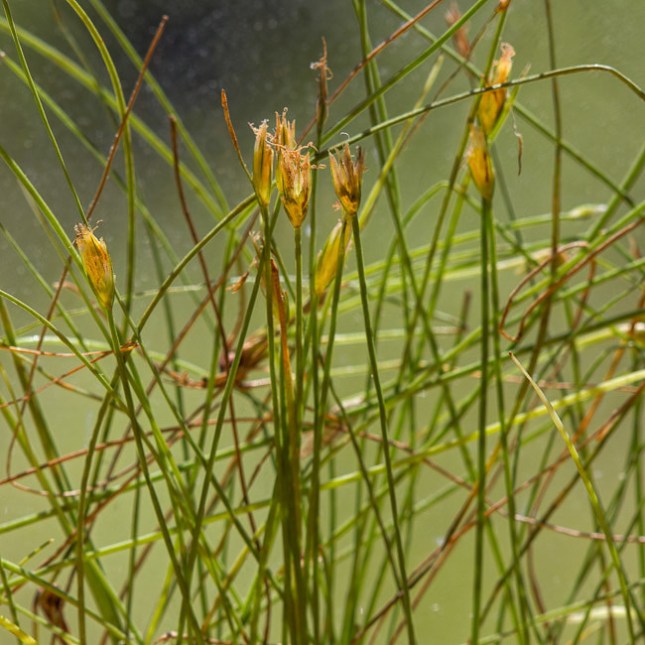
Baldwins Spikesedge, with flowery spikelets on vertical branch tips. By John Bradford.

Another foody sedge is the so-called water-chestnut, which has zero to do with chestnuts and much to do with Chinese cuisine.  It is Eleocharis dulcis (dulcis = sweet), and is a segue into today’s continued exploration with John of the Kiplinger Natural Area in Stuart, Florida.  We ate no Eleocharis, but we tread upon it, Eleocharis baldwinii that is.

This little spikesedge has at least 3 fun features:

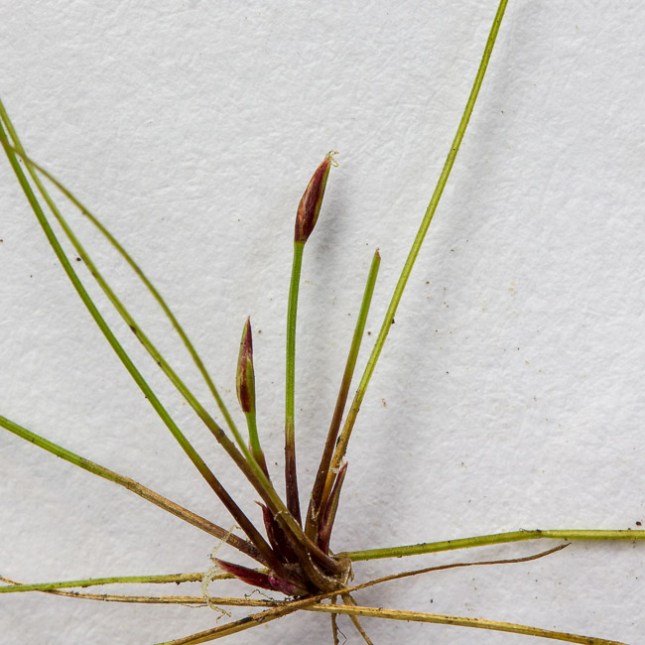
Fun feature 1.  Although most of the flower clusters (spikelets) are elevated like spear tips atop vertical stems, some strictly female spikelets sit directly at ground level.  In a wind-pollinated species, those lowdown flowers out of the breeze are tough to explain, and why female?    Here is a completely untested notion:  most of the raised spikelets pass on to an odd fate described below.   So maybe the shorties escape destiny and can catch wind-borne pollen sifting down from above, assuring some “normal” pollination.
el_baldwinii7-basal-spikelets

Female (seed forming) spikelets remain at ground level.  By JB

Fun feature 2.  This species is amphibious.    It can grow lushly on moist soil or can live submerged, even fairly deep.    In water it becomes  stringy  resembling an imaginary seaweed.  Submersion spreads seeds and drowns  terrestrial competitors.   Emersion snuffs  aquatic competitors. Life is good.

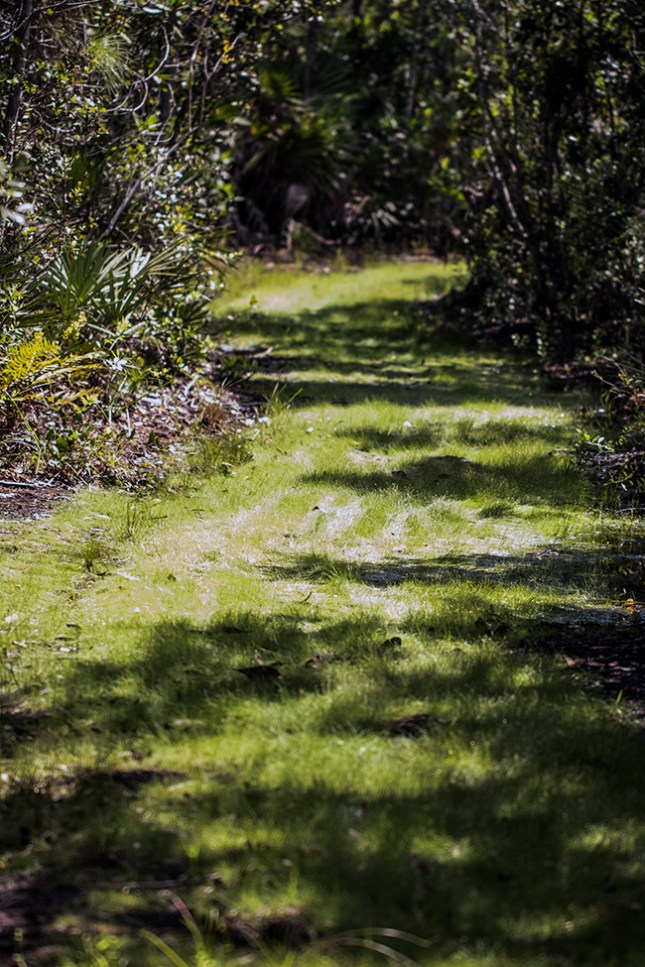
Fun  feature 3.   Our species forms monospecific lawns in disturbed moist places, loving paths and dirt roads, weed-free.
el-path-kiplinger

Baldwin’s spikesedge-covered path in Kiplinger today.   Where are the other-species weeds?

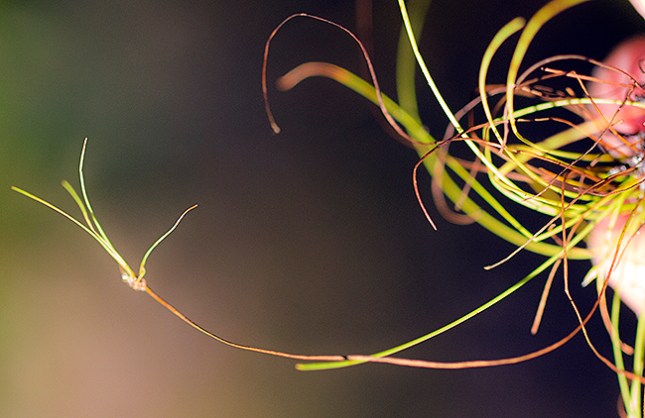
How does it spread?  Well, there are seeds (technically achenes) dispersed in water and birds.   And, more interestingly, the species is “viviparous.”   That is, the spikelet-bearing upright stems elongate until they flop over back to the ground by their own weight.  (Gardeners have seen the same in “walking iris” and similar in “spider-plant.”)

When the tip of the spikelet strikes the earth it spawns a new baby plantlet, thus this species “walks” across the mud.    Some of that growth may come from seeds germinating in the spikelet touching the soil, but I suspect the sproutage to be unrelated to the seeds, or a mix.
eleocharis-vivipary

Baby on a wand.   The wand is a stem that got elongate, bent to the ground, and sprouted that baby.

Walking helps explain how the plant spreads, but any suburbanite with a St. Augustine spread would envy the spikesedge’s freedom from weeds.  How does it do that?   Answer: it makes its own herbicide.
eleocharis-baldwinii-baby

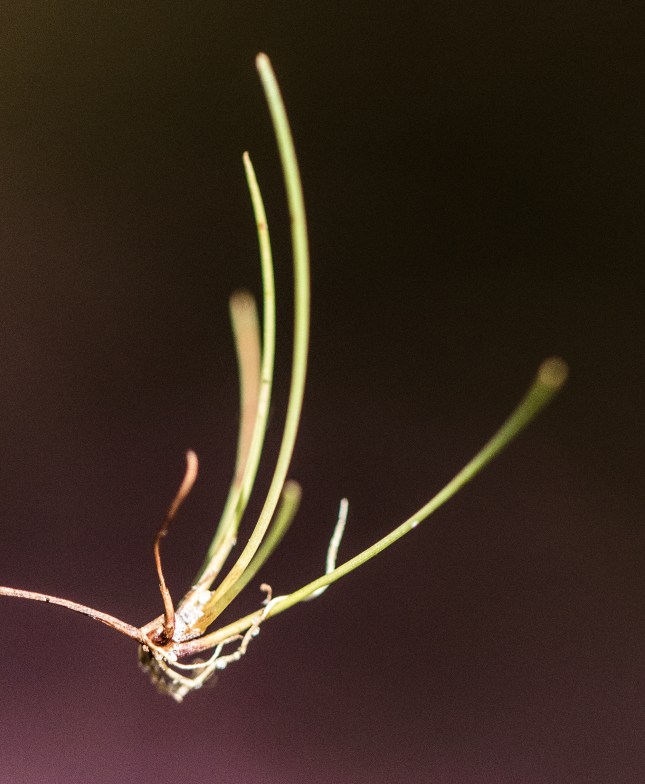
Baby portrait

Earlier botanists noticed how species of spikesedges hold forth in pure colonies, generating a history of research leading to a natural weed-whacker called dihydroactinidiolide.   Spikesedges squelch “the other” sufficiently to generate interest in connection with aquatic weed control.
 
3 Comments

Posted by on September 9, 2016 in Baldwin's Spikesedge, Uncategorized


Tags: ,

Two Thousand Ways Not to Make a Tire

Goldenrods

Solidago species

Asteraceae


Scrambling to hop on a plane and zoom up north to son Martin’s glorious wedding to wonderful bride Phoebe, I’m tossing up the blog early this week.   The matrimonial son is a tire engineer…a blog in honor of the occasion. (Phoebe has a cooler job–she’s an engineer who works on explosives.)

While the rest of the nation catches a nostalgic scent of end of summer Labor Day,  in Palm Beach County we’re catching newsy stuff about tropical storms.   But there are  a few subtle whiffs of my northern-bred seasonal instincts. Cicadas say goodbye-summer.  So do the Goldenrods,   making the meadows glow.   And, no they do not cause hay fever.  Naming them, Linnaeus felt just the opposite, the genus Solidago translates loosely as “making whole.”  Not “making sneeze.”

Solidago fistulosa 7 - Copy

Golden glow, by John Bradford

Goldenrods are a complex group with border disputes, about 100 species around the world, mostly in North America. About 20 in Florida.  An abundant and attractive local standout is Pinebarren Goldenrod, Solidago fistulosa.

Everybody likes Goldenrods.   Remember that “goldenrod” page in forms in triplicate?  Gardeners like them to the point of commercial cultivars and articles in “Fine Gardening Magazine.”

Gall Flies enjoy the plants in their own way,  inducing  big spherical galls in the stem.  One  fly is so solidag-o-centric it is named  Eurosta solidaginis.    It is always fun when biological relationships chain to three or more species*:   Chickadees and Downy Woodpeckers help themselves to the fly larvae within.

Solidago fistulosa 5 - Copy

By JB


Birds are not the only threats to the fly babies.  Parasitic wasps inject eggs into the gall, which upon hatching devour the maggot and sometimes top off the protein with a vegetable…the gall tissue.  One wasp hormonally forces the fly larva to mature matched to the wasp’s seasonal schedule.

Now this where it gets truly interesting—as the biologists noted below have determined— these comings, goings, and microaggressions influence the girths of the galls.   First of all, the plant makes a difference, some clones tending to form  larger galls than others.  (Clones can spread by rhizomes into extensive stands.)

But that is just the trailer for the feature attraction.  Size matters in galls.   If in a locality the fly’s only pests are parasitoid wasps, the bigger the gall the more wasp protection the larva experiences.  On the other hand,  if the larva-eating birds are on the scene, the avian predators seem especially drawn to larger galls, being more conspicuous and/or offering larger larvae.   In that case bigger is not necessarily better with the adaptive consequence smaller galls than without angry birds.

Without falling into the silly trap of “plant intelligence,” the complex and dynamic realm of things plants do has blossomed to remarkable in recent years, including the “plant immune system” (Systemic Acquired Resistance).    Goldenrods reportedly  “detect” pheromones from the male gall flies and then emit defensive compounds to repel the female flies.

Solidago (4) edison - Copy

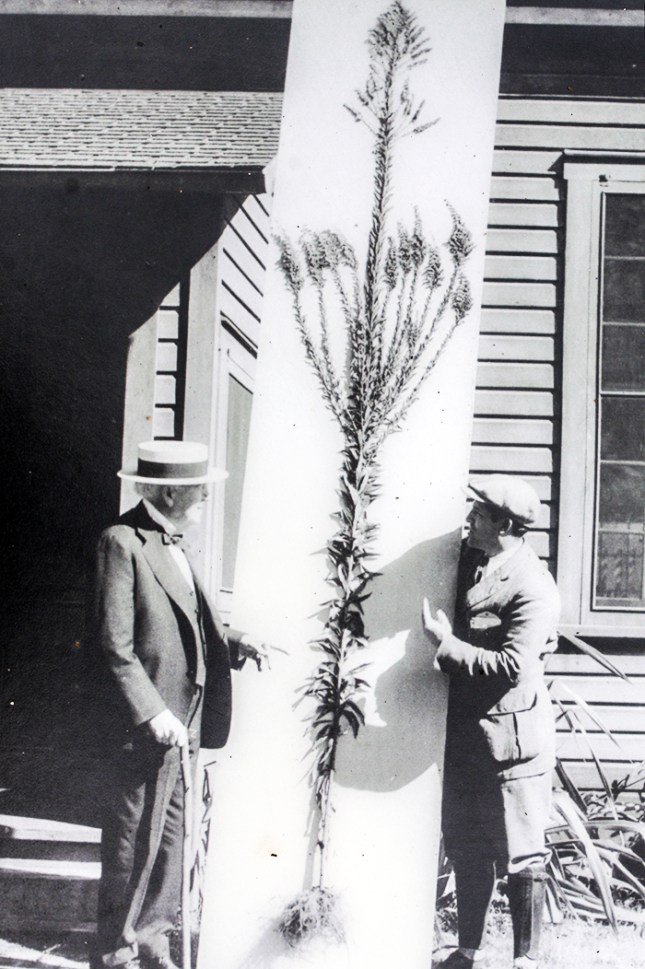
Edison, colleague, and Solidagoedisoniana.”   I took this picture of an interpretive sign at Edison’s Florida house.

Yep, everybody enjoys Goldenrods, and maybe the most fascinating “like” came from Thomas Edison.   Visiting his home in Ft. Myers, visitors learn about Edison’s quest for rubber crops.  After all, his Florida next door neighbor was Henry Ford who had some interest in tires.  Edison tested as many latex-drippy plants as he tested materials for the light bulb,  thousands they say, including a Ficus still on the property, and his primary focus zoomed in on rubber from Goldenrod.   Edison’s experiments  culminated in a breeding program for what was then named Solidago edisoniana (actually S. latissimifolia).

Edison manufactured a few Goldenrod proto-tires and showed them off on a Model-T, but they never panned out commercially, as Brazilian Rubber Trees and synthetic rubber bounced up as better options.  Glad that lightbulb finally glimmered its golden glow.

————————————————————————–

*Most of today’s gall-related info comes from Dr. Warren Abrahamson at Bucknell University who with collaborators has studied these relationships in depth.

This link concerning freeze tolerance in a Solidago gall fly may interest some.   Cryogenics in the maggot realm.

This link talks about Edison’s rubber program.

 
9 Comments

Posted by on September 1, 2016 in Goldenrod, Uncategorized


Fiddler Crabs, Mangroves, and Leather Ferns Getting Along Famously

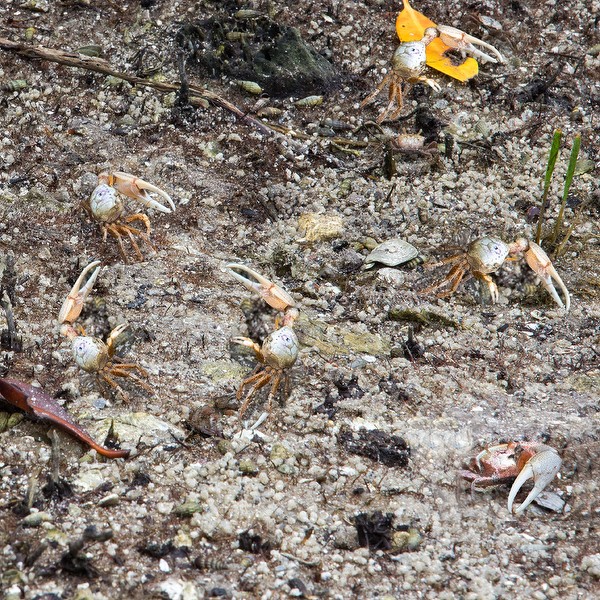
Today, John, lichen-student Bill Grow, and I enjoyed  Kiplinger Natural Area in Stuart, Florida.   That is, until a startling thunderclap sent us scurrying like three comical crabs.   Bill’s lichens engendered a symbiotic frame of mind, and a hoppin’ symbiosis  this afternoon involved a trio of salty species.  Delighted we were to encounter the crabs still fiddling a happy tune along the algae-poisoned St. Lucie River.  The crabs were crab-walking, burrowing, and waving their massive claws like a homecoming queen in a convertible, wearing a giant foam finger.

Fiddler crabs

Crab party by John Bradford

And that’s good for the mangroves.   Biologists have repeatedly noticed, in different terms with different points of emphasis, the mutual benefits of Fiddler Crabs and salt-loving plants.  Anyone who visits a mangrove swamp can attest to Fiddler Crabs too numerous to ignore.   Crowds of burrowing scavengers in the root zone of a tree in a marginal habitat must matter, and they do, apparently overall for the better.

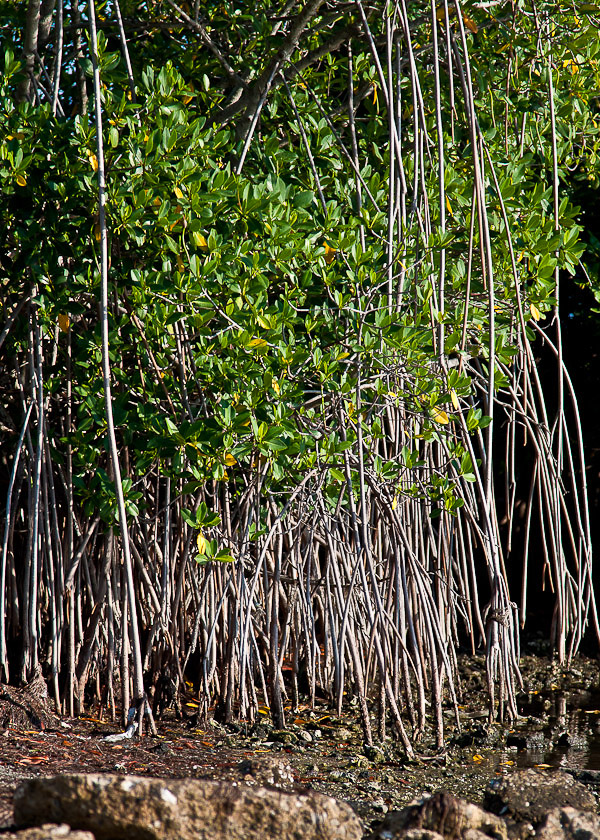
Rhizophora mangle 1

Crab habitat by JB

That tidal mud is suffocating to roots. No problem, the crabs are natural rototillers, and their burrows interconnect into subterranean duct systems.   The soil is salty, yet the reticulated tunnels allow tidal fluxes and rainwater to flush out the salts and toxins.

That soil is nutrient-poor, so thank you crabs for gathering, depositing, spreading, churning, and becoming fertilizer.  Research by biologist Nancy Smith and collaborators documented  enhanced White Mangrove growth in the company of crabs vs. crabless losers.

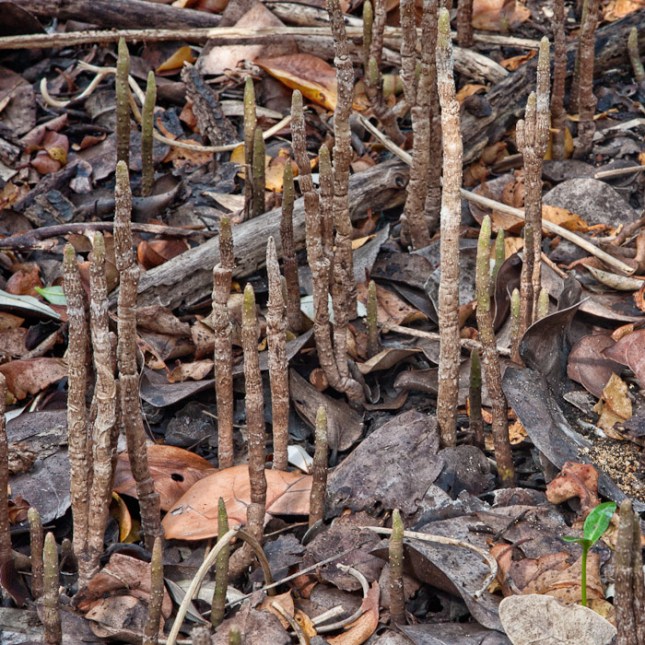
Avicennia germinans 8

Dead man’s fingers by JB

Researchers Erik Kristensen and Daniel Alongi showed the Gray Mangrove (west coast Avicennia marina) to grow leafier seedlings and more “dead man’s fingers” where fiddlers roam.  There’s a hint the Avicennia contributes to the active crab lifestyle beyond the presumed benefit of roots bracing the crab burrows against moving water.  Materials from the happy roots seems to favor microbial growth beneficial for the crab diet of algae and small organic miscellany.

Acrostichum danaeifolium 3

Leather Fern by JB

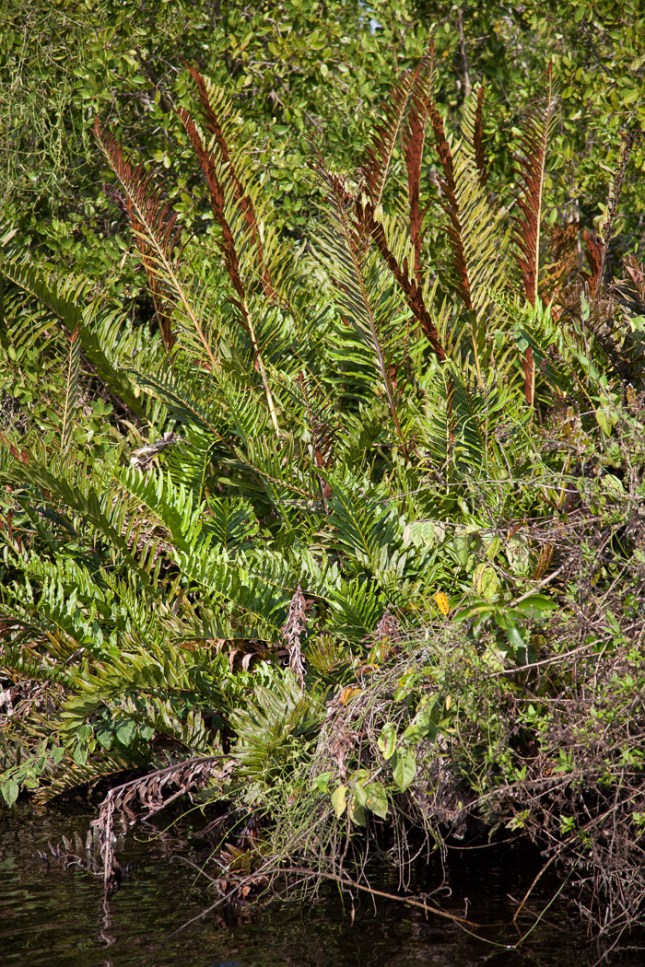
The mangrove swamp along the St. Lucie River  hosts huge Leather Ferns.  According to biologist Peter Hogarth, the crabs have a hand (or a claw) in this too, their enriched mine tailings are “planting mounds” for baby ferns otherwise in  existential peril if not elevated above the brine.

 
8 Comments

Posted by on August 26, 2016 in Uncategorized


Tags:

Mulberry Weed

Fatoua villosa

(Origin of name Fatoua not certain, a surname?, villous means shaggy)

Moraceae

All around the Mulberry Weed the monkey chased the weasel.    The monkey thought it was all in fun…pop goes the Mulberry Weed!
No Friday fieldtrip today.  Displaced by back-to-school meetings.     Contrary to common perceptions, however, meetings don’t scotch botany joy when your guiding principle with plants is, “love the one you’re with.”   The weeds in the parking lot are as interesting to me as any  species.    In tune with such democratic botany, to the right of the door into the meeting hall, in the old mulch among cigarette butts, resides today’s selection spotted during a break:  Mulberry Weed.
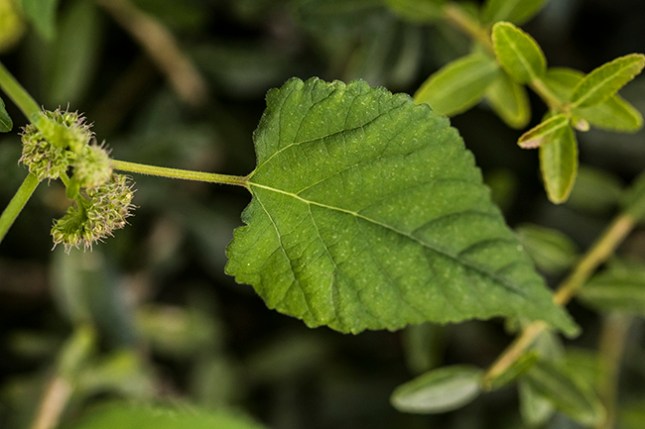
A member of the Mulberry Family, Fatoua villosa invaded the U.S. at about the same time as Herman’s Hermits.  The leaves of this Asian novelty resemble those of our native Red Mulberry.   The two are related, but not that related, so the similarity may reflect some combo of convergent evolution and shared genes, a puzzling situation in classification.

Photos:  True Mulberry on left (by John Bradford), Mulberry Weed and cigarette butt today in Lake Worth, Florida, on right.

Fatoua has skitter-scattered from an apparent debut in Louisiana over much of the U.S., mostly in the South, with cameo appearances northward, to the entertainment of northern botanists.   The northward appearances are no mystery, because the species spreads in horticultural nursery material like Measles spreading through 3rd graders.

Fatuoa LW campus

Flower cluster on left, with mixed male and female flowers

Which brings us to the good stuff:    The plants shoot their “seeds” (to be exact, achenes) like shotgun pellets  3 feet or more.    In a crowded plant nursery a Fatoua infesting a flowerpot can rain seeds on its neighbor pots, and they in turn shower more posies in a chain reaction, and then great big trucks ship them all over to pepper the nation.  Buy a nursery plant and you too may gain a Mulberry Weed.  Or a few.

To make infestation easier, this talented weed matures from seed  to flower back to seed in a few short weeks, even when mere inches tall, maxing out at about three feet.

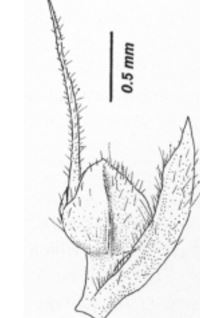
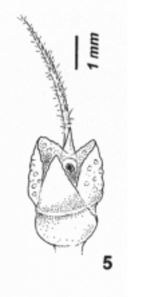
How do those seed shooters work?   In 2003 botanists Carroll Wood and Norton Miller took a peep at it.    The illustrations below are from their work*.  Each inflorescence has mixed male and female flowers.   The female flowers are bizarre. (So are the males but enough is enough.)

A female flower is shown below, with a long hairy style (pollen-receptive organ) rising from the side.  Why displaced to the side?    You’ll see.

Faroua 1

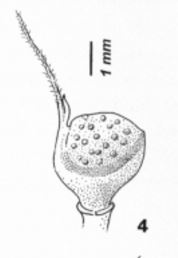
Remove the non-reproductive parts, and the female looks like the illustration below.  The warty “bowl” (developing fruit) to the right of the style hides the single seed preparing to launch.  Note the warts on the cover of the bowl. We’ll see those again.

faroua 2

When it is time to fling, the bowl  explodes its lid open with the seed flying forth like a mortar shell.   The flower shown below has popped its top and shot its seed.  The two halves of the lid now stand vertically like the lid on a jack-in-the-box. You can recognize the ripped-open lid halves by the warts.

Fatoua open fruit

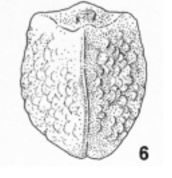
The final drawing shows the projectile seed (achene).

Fatoua achene

——————————————-

*Note: the origin of the illustrations matters.      Both of those botanists were my bosses and mentors long ago and far away, and both are now deceased.   They would have been pleased to share their work.   The artist is Patricia Kernan of the NY State Museum, used with her permission.
 
3 Comments

Posted by on August 19, 2016 in Mulberry Weed, Uncategorized


Trumpet Creeper Cheats a Bit

Campsis radicans (Campsis means curved, perhaps the stamens.  Radicans means rooty.)

Bignoniaceae

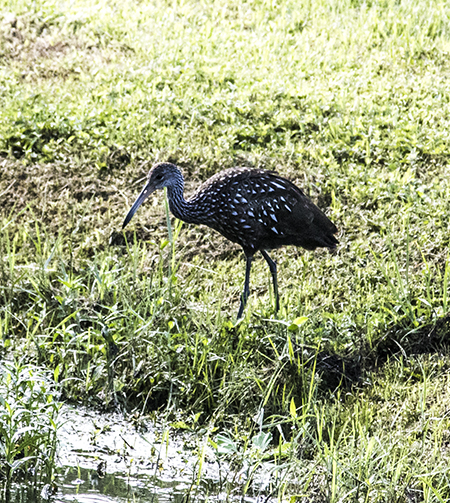
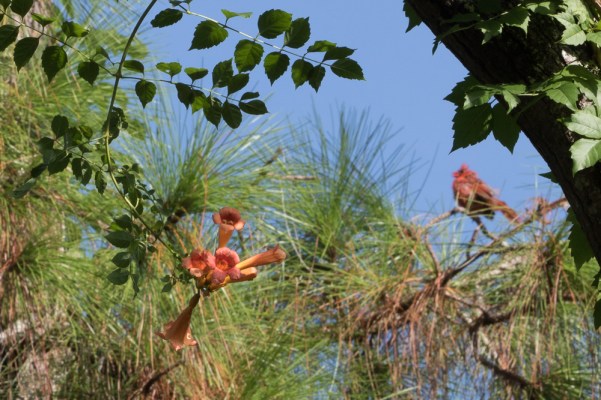
John and I today continued exploring of the Kiplinger Natural Area in Stuart, visited by a curious Limpkin.

Campsis limpkin - Copy

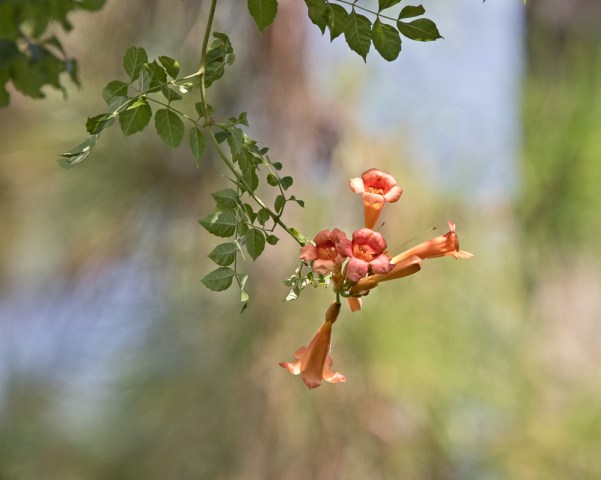
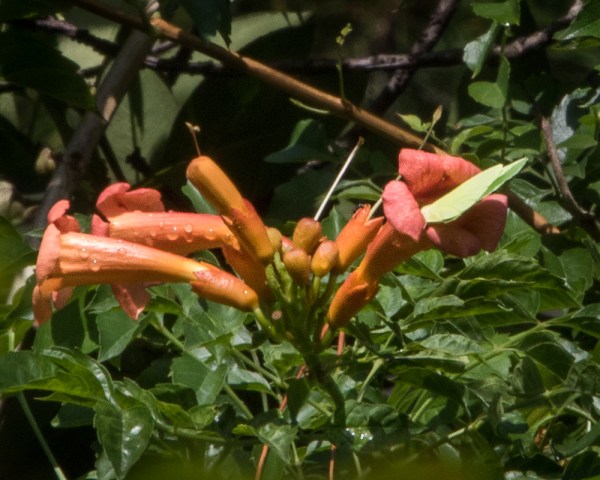
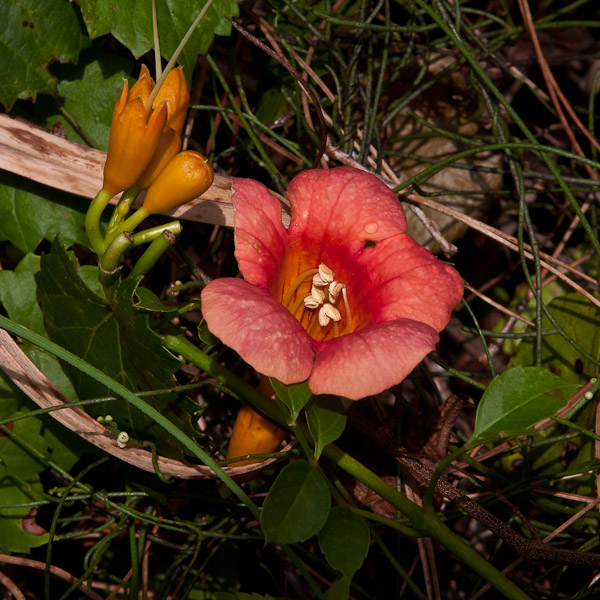
It must be August, with the Goldenrod evoking the summer meadows of childhood.   Among the botanical treats in bloom now is the colorful Trumpet Creeper vine, so showy and “exotic” for a native species.  Those orange trumpets look like something out of a TV special on the Amazon.  Trumpet-Creeper is in the same family as many garden selections, such as African-Tuliptree,  Tabebuias, and Garlic-Vines.

Campsis radicans 4 cluster - Copy

TC by JB

We’re near the southern end of its range which covers most of the eastern U.S., as well as westward and north into Canada perhaps due to human activity.   There are only two Campsis species on Earth,  one in Kiplinger, the other limited to eastern Asia and almost identical to ours.   That’s all there is, there ain’t no more.    Such eastern-North America/eastern-Asia sister-species splits are well known in biology, exemplified  most dramatically by another pair:  American Alligators and Chinese Alligators.

Gardeners please note:  the vine is aggressive, high-climbing, toxic, and irritating to the skin.

Campsis radicans 7 cardinal - Copy - Copy

By John Bradford

Trumpet Creeper is uncommon in South Florida outside of cultivation, and the reason may be our shortage of hummingbirds, the main pollinators.   Extra visitors include bees and butterflies, but studies have shown a threshold of about 400 pollen grains to cause fruit formation, and pollen from the same plant does not work.    In short, a job for a big hungry hummingbird, not a little lightweight bee or butterfly.

Although tough to pollinate, Trumpet Creeper is easy to propagate.  At Palm Beach State College, we grow it from segments of roots.  Thus in nature the vine can probably establish wherever root pieces go, a useful trick in, say, a floodplain where the ground can break apart and float away.

Campsis radicans 6 butterfly - Copy

Hey, I can’t reach the nectar!  (JB)

The stems are odd in structure.    Resembling Poison Ivy, they climb a host tree using tiny clinging roots like centipede feet.    Trumpet Creeper is a structural parasite, reaching great heights freed of the need to make strong supportive wood.     Many readers know that normal woody plants have a green cambium just under the bark to expand the girth of the stem by making strong new wood to the inside as well as new bark to the outside.    Trumpet Creeper, by contrast, makes extra sugar-conducting tissue at the inner core of the stem where there would be wood in a self-supporting species.    In other words, stealing outside support allows the selfish vine to concentrate on fueling rapid growth rather than holding itself up.   (Know anybody like that?)

Campsis radicans 1 close - Copy

By JB

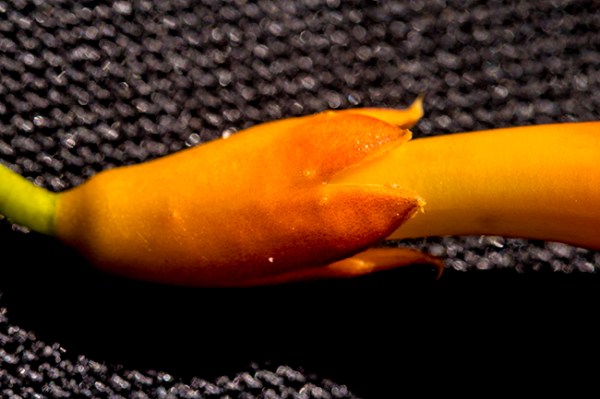
The flowers make enough nectar to feed a bird.   Everybody likes nectar.   Those blossoms are to nectar thieves what a bank is to bandits.  Banks need tough guards.  Trumpet Creeper has armed guards too.   To pay its sentries the flowers have nectaries on the outside at the base (on the calyx).  They look like blisters, and feed belligerent ants who presumably protect the nectar-laden floral base from any varmint that may nip a hole and swipe the sweets.

Campsis glands glands - Copy

Little ant-feeder blister glands on the outside of the flower base

 
15 Comments

Posted by on August 12, 2016 in Uncategorized


Tags:

Ecological Pairs (And Why Boll Weevils Favor Vanilla Ice Cream)

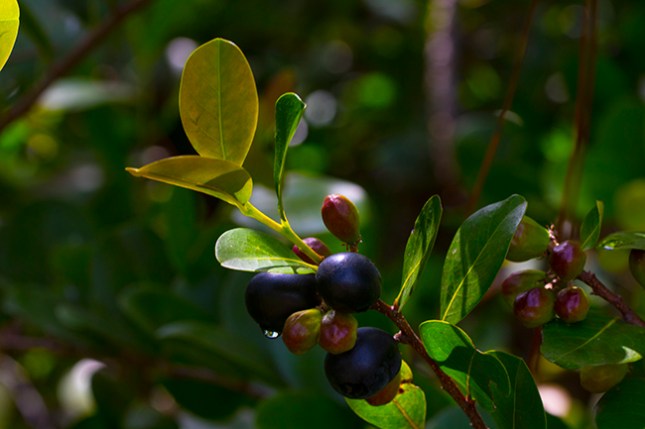
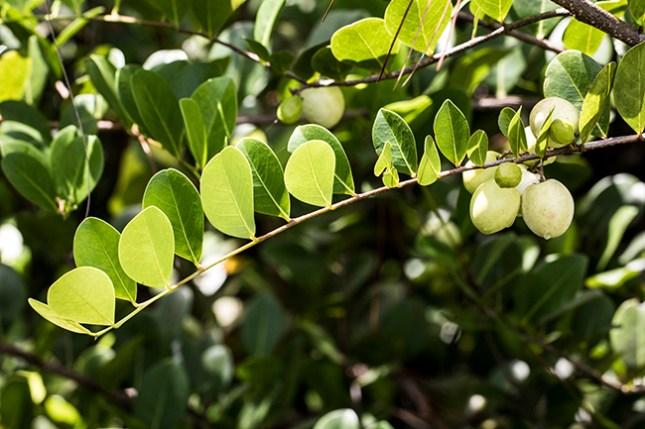
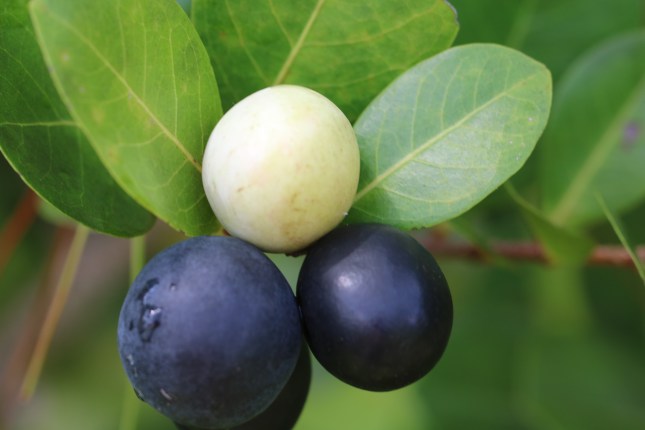
Chrysobalanus icaco and more Chrysobalanus icaco

Cuscuta pentagona and Smicronyx quadrifer

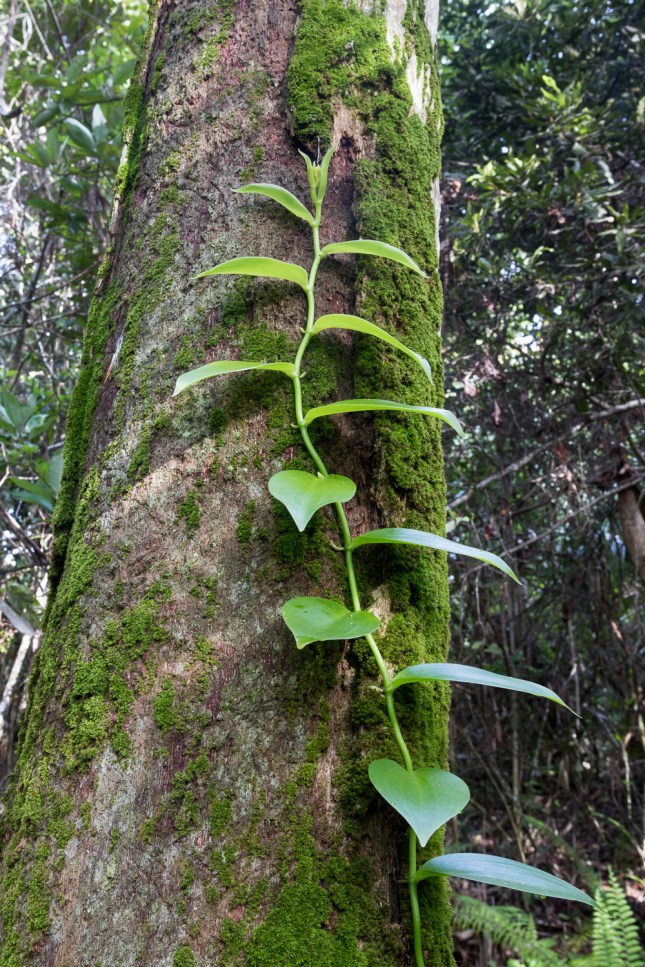
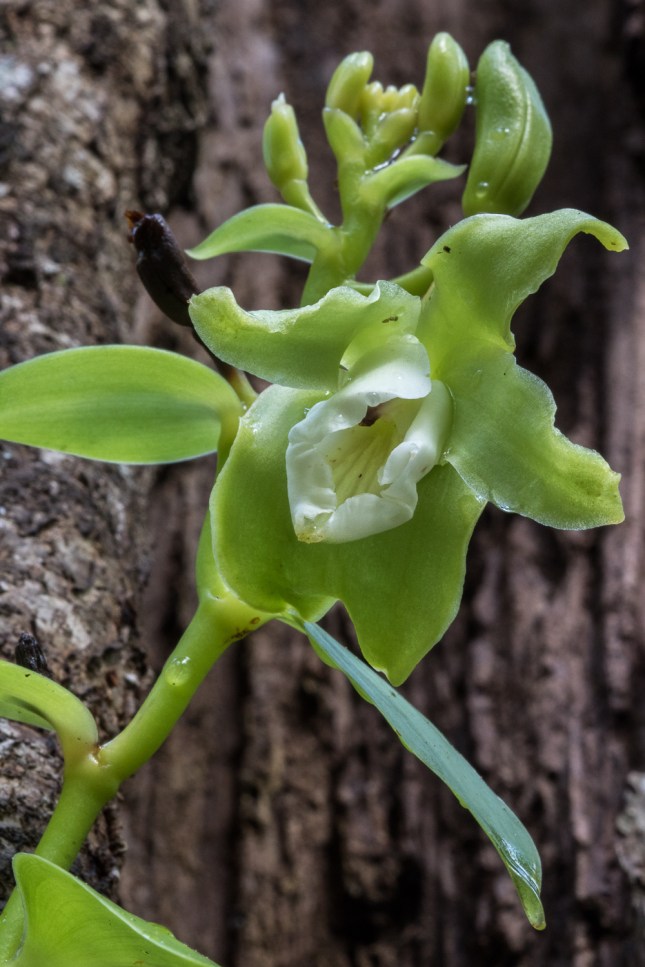
Vanilla mexicana and nobody

Any veteran of third grade knows how in ecology everything is connected to everything in one pulsating web of life.  Well, yea, sorta, okay, maybe, sometimes, but what’s been glimmering this week in John’s and my botany have been species pairs more than ecological networks.  So today is the day of twosomes, like these purple cocoplums and white cocoplums immediately side by side with intertwined branches  in the Kiplinger Natural Area in Stuart, Florida.   Interestingly, the purple-fruited individuals have reddish young leaves in contrast with the absence of reddish foliar hues in the white-fruited individual.  I wonder if the white-fruited individuals are marginally less resistant to sun injury.

Chrysobalanus red

Cocoplum with purple fruit.  Young leaves with reddish tint.

Chrysobalanus white better

No purple in the fruit, no red in the young leaves

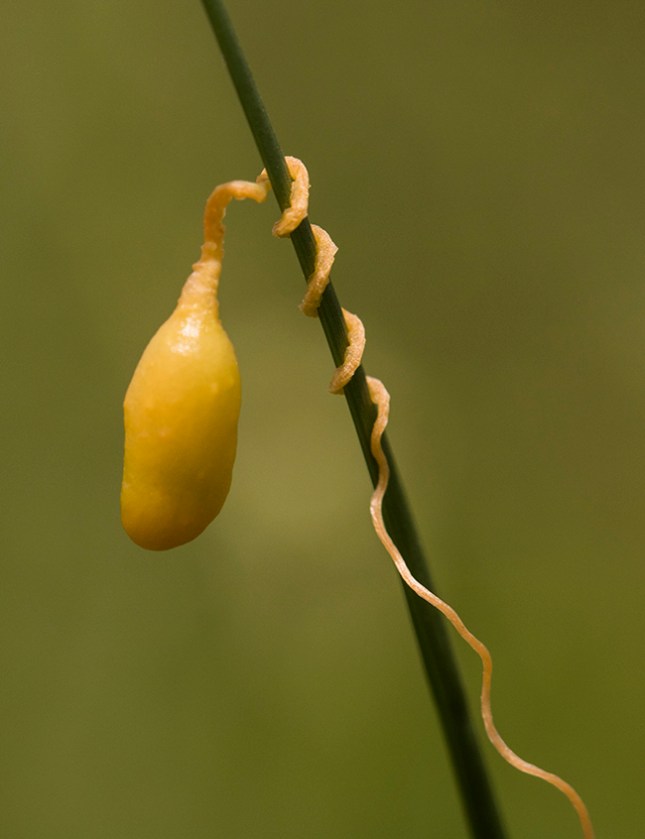
Pretty, but pairs are boring without dynamics.    When it comes to parasites, for example, it takes two to tango.   Or, in the case of parasitic Five-Angled Dodder, we should say it takes three.   The Dodder  sucks the victim’s life juices.   But it gets a taste of its own medicine, as there’s a parasite on the parasite.    The golden dangler in the photo below is not the Dodder fruit, which is a dry capsule.    That dangling pod is the home of the Dodder Weevil.

Cuscuta pentagona (1)

Dodder on a victim, with Dodder Weevil gall

Dodder is apparently a stingy host, being yellow, stringy, and nutrient-poor, so the weevil larvae migrate from the Dodder into the plant the Dodder is parasitizing to add insult to injury.

Dodder exists in scattered patches, locally not  abundant.   So how does the Weevil find it?    Of course nobody knows exactly, and “the” answer lies in a complex tapestry of signaling and sensing.    So let’s do like the politicians and pick one thread out of the intricate mesh and pretend it is the whole truth.

Now we shall oversimplify, extrapolate, and speculate with wild abandon.

Cuscuta pentagona (2)

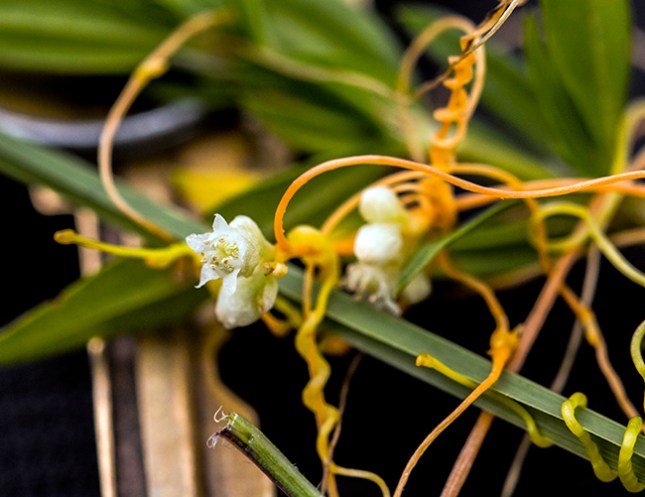
Dodder in flower

The Dodder Weevil is not a prominent topic of research.   Perhaps, however, we can glean a hint of insight from a better-studied Weevil, such as the Boll Weevil.   What draws Mr. Boll Weevil to the Cotton?   Apparently a complex of chemical signals, one being vanillin.

Vanillin as in a vanilla ice cream cone?  Yes. Vanillin is best known for coming from the Vanilla Orchid, but the chemical is widespread in the plant world, being related chemically to an amino acid and being a breakdown product of  plant tissues, especially wood.   Among other signals, pesky bugs use vanillin to find distressed plants, studied most famously in Bark Beetles finding Elm Trees, as well as other insects and their plant “partners.”   Vanillin may be useful in insect scent traps.

If vanillin comes from deteriorating wood, why don’t I manufacture the flavor from wood scraps rather than  nurturing those pesky Vanilla Orchids?   Oh rats, they beat me to it:  commercial vanillin flavoring has come, on large or small scales, from various forest and pulp byproducts and even from animal manure already partly broken down thanks to digestion.  You could get milk and vanillin for the ice cream from the same cow.

John and I were Weevils this week lured to Vanilla, to a Vanilla Orchid that is.   Martin County Ecosystem Project Manager and erstwhile hockey goon Mike Yustin showed us Vanilla mexicana flowering and fruiting in a swamp whose location should not be disclosed.  (Ugly people go steal pretty orchids.)   This is not the commercial Vanilla species, although there’s resemblance.

Vanilla mexicana 1

Vanilla mexicana by John Bradford

Vanilla mexicana ranges naturally from South America to Mexico and the Caribbean.   So is it a Florida native?   Sources differ, and this is not a very interesting question,  given that we’re dealing with a widespread species having microscopic wind-blown seeds.  So, sure, probably Vanilla mexicana seeds dust Florida trees.

A more interesting question is, “if Vanilla mexicana is an outlier at the chilly margin of its distribution far from its tropical population center,”  and if “Orchids tend toward specialized pollinators,”   does this species have a pollinator partner way up north here in Florida?  (Remember, today’s theme is ecological pairs.)

Vanilla mexicana 8

Vanilla mexicana, by John Badford


Possible answers include, maybe the Orchid is pollinated by a generalized pollinator (not likely, nor much fun to discuss);  or perhaps its own special pollinator companion came with it (that would be remarkable); or….in this case other botanists have revealed the probable answer.   In 2015 Masters Degree Student R. Narinda showed V. mexicana to be self-pollinated.   Partner-free and self-sufficient, this unattached species can roam wherever its seeds might blow and not freeze.    The “not freeze” part makes Martin County a reasonable northern margin, at least during some decades.


IMG_2317

Amazing hybrid,  by John “Luther Burbank” Bradford


Good link sent by Pat Bowman

 
7 Comments

Posted by on August 5, 2016 in Uncategorized, Vanilla


Tags:

Buttonbush

Cephalanthus occidentalis (= “western flower-head”)

Rubiaceae (Coffee Family)

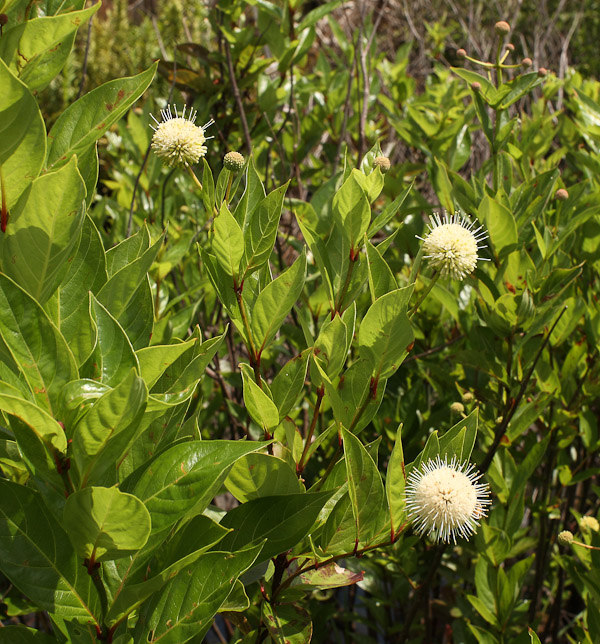
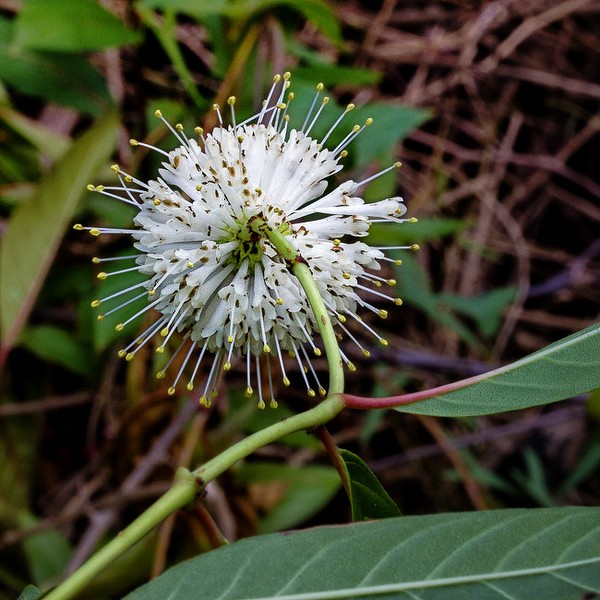
This morning John and I visited the Cummings Library, Palm City, Florida, to lead a brave and heat-tolerant posse into a small Hypericum Marsh associated with the Library.   Even tiny natural areas can be diverse, in this case with everything from flowering Loblolly Bay Trees to tiny insectivorous Sundews.    One of my forever favorites is in bloom there, Buttonbush with its spherical bleached white flowerheads fragrant like perfume in Macys, and buzzing with bugs.

Cephalanthus occidentalis 1 medium jb

Sputniks by John Bradford

The agreeable shrub has a place in ornamental gardens, sometimes under the fitting cultivar name ‘Sputnik’.   (It looks far more like a virus but that name wouldn’t sell many.)

It is better off in the swamp.   In fact, Palm City is my second Cephalanthus encounter within a few days, the prior in Michigan.   There we were exploring botanically a remote wetland notable for housing the rare Copper Bellied Watersnake.  Zoology and botany converge:  the threatened snake likes to linger on exposed Buttonwood root masses to the point that today’s shrub is recommened for planting to restore the snake habitat.

Cephalanthus medium close jb

By JB

You might ask,   “why does the shrub have oversized irregular roots exposed up where snakes hang out?”    Plants in wet soils have diverse mechanisms to cope with deoxgenated mud.  Many have ductwork to ventilate their nether-regions.   Some use fermentation down there.    Some sprawl surface roots across the wet mud.

Buttonbush has its own approach.   It sprouts tangles of new roots above the suffocating ooze.  The bush adjusts the height of its supplementary roots to rising and falling water levels.

Cephalanthus root

White roots coming out of the stem at the trunk base, just above the wet mud

What pollinates those fragrant flower balls?   Just about every nectar-loving creature able to cruise a swamp.    Perhaps moths are the original chief agents, but butterflies,  bees, flies, and even the odd hummingbird participate.

And to keep asking questions, why have hundreds of tiny flowers clustered in a compact head, as opposed to making one big blossom?   The textbook-type answer is that a visit by a lone pollinator fertilizes many individual flowers in one swell foop.    The flowers then mature into countless little dry fruits dispersed by migrating waterfowl swamp to swamp.

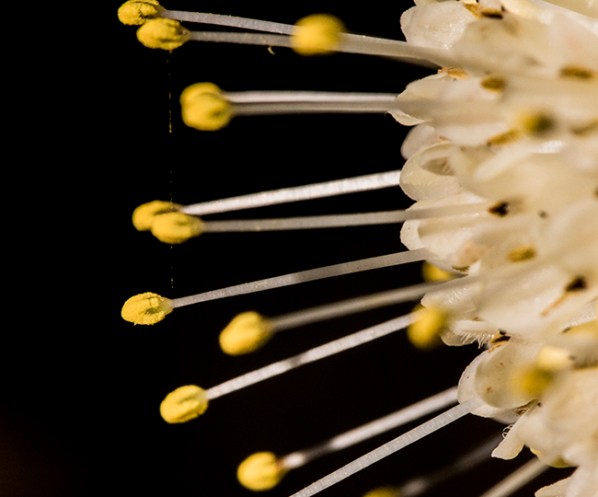
Look closely at a flower.  Anything missing?   The big stigmas jut out of the flowers like Q-tips radiating out of a golf ball.   Stigmas are the female pollen-receptive organs.    The male pollen-making anthers, by contrast, remain hidden.   They release pollen while in the bud onto the stigmas, frosting them yellow pollen, then the stigmas emerge all yellow-dusty-topped.   But wait—wouldn’t that be self-pollination?

Cephalanthus stigmas

Q-tips.  Stigmas covered with yellow pollen.

Not generally, and here is why:   the self-pollen on the stigmas dusts off onto visiting insects but cannot consummate the sexual cycle on the flower of origin.    The only pollen the stigma lets proceed sexually is that the pollinators drop off from other Buttonbush individuals.  So then, on one stigma there are two pollen populations, some grains passively awaiting departure, and recent arrivals ready to boogie.

A long history of service in food or medicine does not mark a species as safe to ingest.    Among many historical ethnobotanical uses of Buttonbush, its main recurrent traditional role is as you might use aspirin, relief of pain and discomforts.   But please stick with CVS.  There are also bioactive compounds able to cause convulsions, paralysis, and vomiting, even fatally.  Don’t ingest wild plants!

Cephalanthus occidentalis 3 stipule jb

Triangular flap, stipule, between leaf bases.   Colleters are hidden beneath. By JB

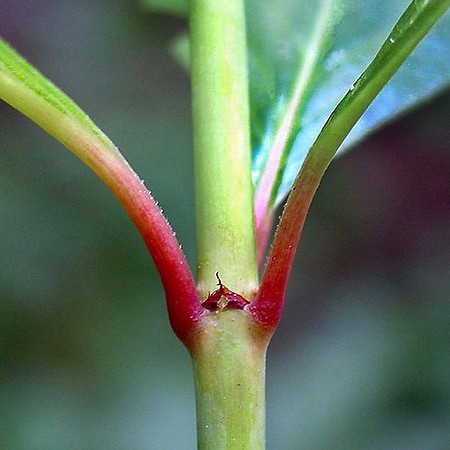
The leaves are opposite or in whorls, with a triangular flap (a stipule) on the stem between the adjacent leaf bases.   Peel back that flap and find erect micro-fingers called colleters (CALL-uh-ters), as in many Coffee Family species.   These cryptic glands are not studied well.   They secrete mucilage when young, probably to paint the immature bud protectively, although conceivably also to feed symbiotic ants in exchange for defensive services.    This question needs study.

Cepha;anthus colleters

Scanning electron microscope view of the colleters on a young stem, stipule removed, courtesy of Dr. Robert Wise, University of Wisconsin

 
8 Comments

Posted by on July 29, 2016 in Buttonbush, Uncategorized


Japanese Millet and Barnyard Grass, Reunited and It Feels So Good

Echinochloa esculenta

Poaceae

This week I’ve been roaming Ohio, Michigan, and Virginia tending my northern family roots and to botanical roots of higher latitudes.   Up north botany is a joy, but unfit in Treasure Coast Natives, so instead here’s something local.  No fieldtrip required.

Echinochloa exculenta far - Copy

Japanese Millet in Jupiter, a golden carpet seeded to fight erosion.

On the west side of the Florida Turnpike just north of Indiantown Road rises a vast new subdivision.   The blossoming mini-mansions echo the pre-2008 gilded era.

As fondly as housing starts signify economic vitality, what a pity to convert greenspace to subdivisions named for the birds they displace..  Still, look beyond the promotional signs and construction dumpsters…there is always something of botanical interest. even in suburbia on steroids.  On the gigantic berms there’s a cultivated grass seeded to hold the bare soil.    That useful species is Japanese Millet, sold in the U.S. for binding soil and feeding fowl.

Echinochloa esculenta middle

Short stature, thick dark heads.  Look at that—on sand.

Japanese Millet once fed people.   Its ancestors count among the oldest plants associated with humans.   Paleontological remains of in China link Echinochloa to people back some 23, 000 years.

Shut Up!   Did you say 23 thousand years?   That is older than clay pottery (about 18,000 years), and there were no wheels back then for wheelbarrows.  Stonhenge was just yesterday by Echinochloa standards.  Cultivated Echinochloa is about twice as ancient as wheat.   An ancient grain in a 2016 residential development is food for thought, as well as food for pretty birds but hopefully not for nasty ol’ rats, because rats are inconsistent with the Bed, Bath and Beyond gated golf active adult package lifestyle.

If Asian Echinochloas are so old in general, what about Japanese Millet itself?   The name Echinochloa esculenta implies a crop species, origins at the hand of humanity.  Another ancient Asian crop is rice, a comparative Johnny-Come-Lately in human affairs.    Somewhere along the line rice and Echinochloas hooked up, perhaps the latter becoming a weed in rice paddies, and/or as a “plan B” when rice crops failed.

A pesky pest might see Echinochloa esculenta and say, “you sure that’s not Barnyard Grass?”    Barnyard Grass (Echinochloa crus-galli) is a common introduced weed round here.  Answer to the pest:  yes you are correct,   just as a dog is a domesticated wolf.

Echinochloa crus-galli inflore New Dev

Wild-growing Barnyard Grass

DNA shows Japanese Millet to be essentially a cultivar (human-derived horticultural variant) of wild Barnyard Grass.  As might be expected in a strain selected for grain, it has small stature, and large thick grainy tops dark in color.   At least one researcher has pegged the pair as synonyms, that is, two names for one species.   Archaeological specimens of Barnyard Grass with oversized (domesticated) grains,  apparently the missing link between the wild species and Japanese Millet, date back to about the era of King Tut.

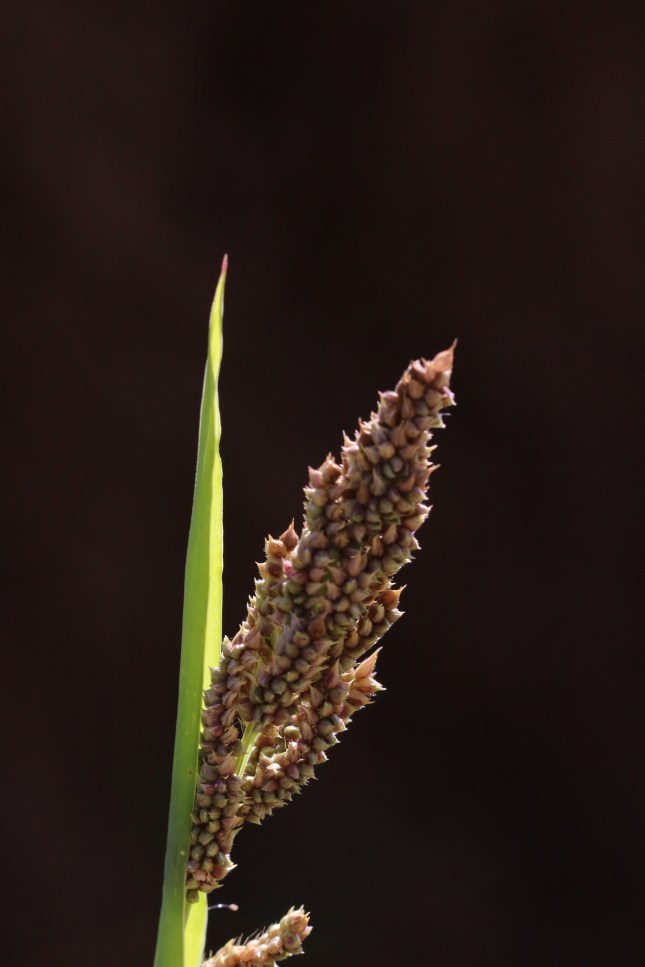
Echinochloa esculenta closeup black background

Japanese Millet, the seed head is thicker, fuller, more compact, darker, and with no or few awns (stiff threads)

So in a single Jupiter, Florida, development project you can stroll and see within a stone’s throw of each other wild Barnyard Grass, spontaneous in a drainage ditch, reunited with its long lost farm cousin right here and now, 7000 miles and 4000 years from their point of separation.

(Some may ask—“can they still interbreed”?)


5 Comments

Posted by on July 24, 2016 in Japanese Millet, Uncategorized


A Dip in the St. Lucie River, “We’re Not Afraid of Lead in the Water”

Microcystis aeruginosa

Anabaena circinalis

Cyanobacteria

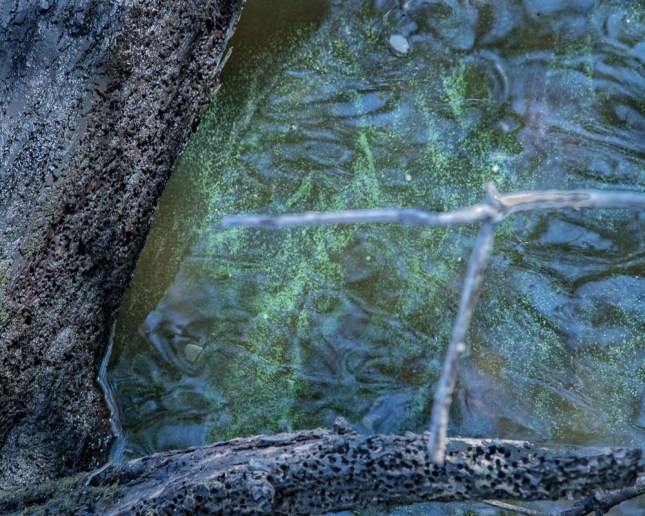
Recently John and George have favored the Kiplinger Natural Area in Stuart, Florida, a mixed habitat with botanical goodies ranging from Gordonia trees now bearing huge white “camellia” blossoms to a Royal Palm towering above the steaming jungle.   A deep dark mangrove swamp there flanks the St. Lucie River.  The same St. Lucie River as toxic algae  fame, so we must take a look.    In fact, John brought a rope ladder, and are we too old to monkey down a rescue device from the boardwalk to the riverbank?  (Yes, but we did it anyhow.) The somber goal was a look at the green menace, peeking a little deeper than all those green canals on Facebook and quickie shots on the news.

microcystis jb

Microcystis, by John Bradford, taken today 7/15/2016, St. Lucie River

First of all, thank you TV news for muddling an important issue.   The trouble is not toxic algae, but rather cyanobacteria.  Repeat, bacteria.    Yes, cyanobacteria are often called “bluegreen algae,”  a misnomer, and yes algae are heterogeneous and poorly defined,   still, cyanobacteria are not algae.  Or to put it differently, I’m more closely related to an alga than a cyanobacterium is.    Cyanobacteria and some true algae just happen to look alike if you don’t look closely.  So let’s look closely now.

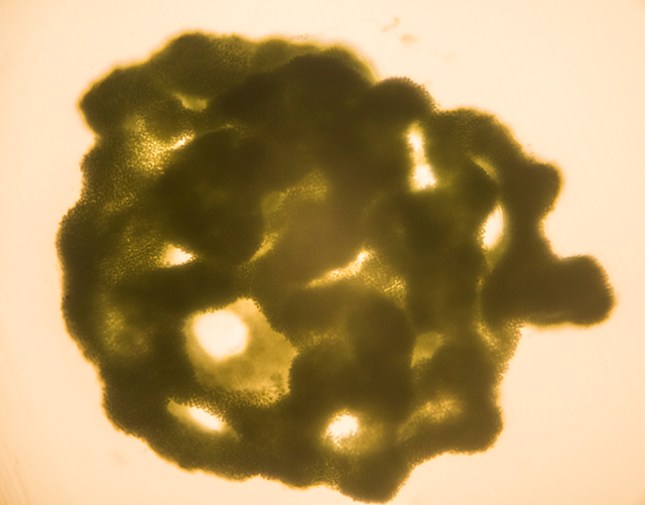
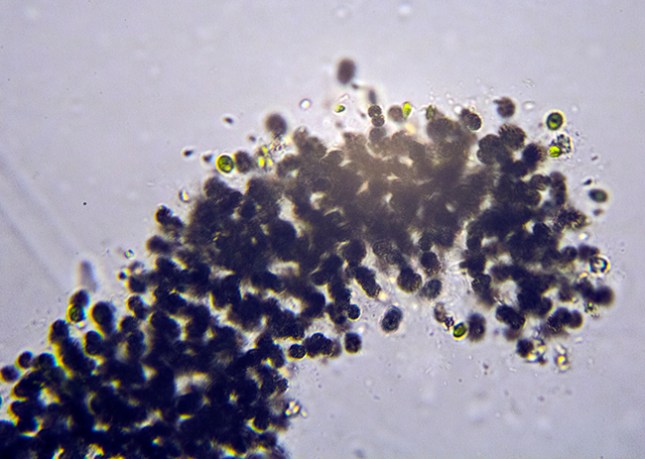
Microcystis

Microcystis as seen microscopically.   It drifts in masses of microscopic cells.  To the naked eye, the variably shaped green specks (or bigger) in the water are these colonies.    Under high magnification each colony resolves into tiny individual cells, all glued together.  The colonies vary in shape and size.

The newscasters have one thing right, the cyanobacteria are toxic with a capital T.    Now, some folks may think of toxic as making your skin itch or causing a cough or diarrhea.     Passing acute discomfort is never as scary as chronic effects, and the potential long-term dangers of certain cyanobacteria are seriously frightening.  The complex world of cyanobacterial poisons is a long list.   Here are some prime examples to curl your hair.  There are plenty more:

Microcystis causes or is strongly implicated in:   gastroenteritis, colo-rectal cancer,  liver damage, and liver cancer.  The most studied toxins from Microcystis are called microcystins; they inhibit fundamental life-critical enzymes, and they promote tumors.   That’s not nice, and that’s not all…

microcystis funnel cake

This Microcystis mass look like a funnel cake at the State Fair.  Microscope view.   Note the tiny individual cells.

Anabaena causes fever, rash, and gastroenteritis.  And worse:  Its toxins are related chemically to insecticides.    The old insecticide SEVIN is a carbamate; so are Anabaena’s saxitoxins which interfere like SEVIN with nerve impulses.   They are similar to pufferfish poisons, and to paralytic shellfish poisoning.

The insecticides Malathion and Orthene are organophosphates; so is Anabaena anatoxin which interferes with the same neurotransmitter system the insecticides damage.  Cyanobacteria invented these killers long before the WII death industry caught on to the same for killing people and bugs.  Just think, we worry (rightfully) about polluting the river with artificial insecticides.   Interesting how “natural” is not all sunbeams and granola, but then again, the massive cyanobacterial blooms are not natural to begin with.

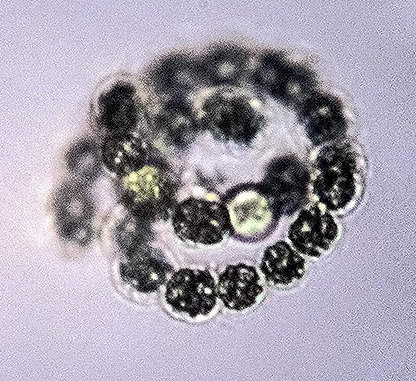
Anabaena circinalis 3

Anabaena circinalis, very high magnification. From same site and water as the Microcystis.  The big oddball cell is a heterocyst, giving these cyanobacteria the ability to capture atmospheric nitrogen.

Lipopolysaccharide toxins are in the cell walls,  external to and oozing from certain bacteria, including cyanobacteria, and come free amply in the water to make us sick.

But what’s a fever compared with tumors, liver destruction—and even worse: cyanobacteria are linked to ALS.    The poison connected to ALS is a rogue amino acid.  Amino acids are the building blocks of proteins.   Oh my,  what if rogue amino acids get built into or childrens’ proteins?

Have there been human poisonings?  Absolutely.  Sixty dead in Brazil where cyano-tainted water was used for dialysis!    Short-term effects are easy to document.   Long-term effects are tougher to track.   An unlucky region in China has high liver cancer rates correlated with cyanobacterial contamination.   I’m going to a suburb of Toledo next week.  Come to think of it, Toledo had microcystins in its tapwater.   Name a livestock species…somewhere it has died from drinking cyanobacterial-infested ponds.

The consequences on a natural aquatic food chain must just be dreadful…a witch’s brew working on the plankton, plants, arthropods, fish, and birds.  Flamingoes have taken a cyanobacterial beating.

Watch the little movie John and I made today.    Let’s entitle it, “How’d You like to Be a Manatee in This Soup”? CLICK to view the brew.

—————————————————————–

Related links:

http://www.ncbi.nlm.nih.gov/pmc/articles/PMC2984099/

http://www.lucasbrouwers.nl/blog/2010/11/cyanobacterial-neurotoxin-evolved-billions-of-years-ago/


2 Comments

Posted by on July 15, 2016 in Cyanobacteria, Uncategorized


Tags: , ,

Nettles Counteract Love Medicine

Laportea aestuans

Urticaceae

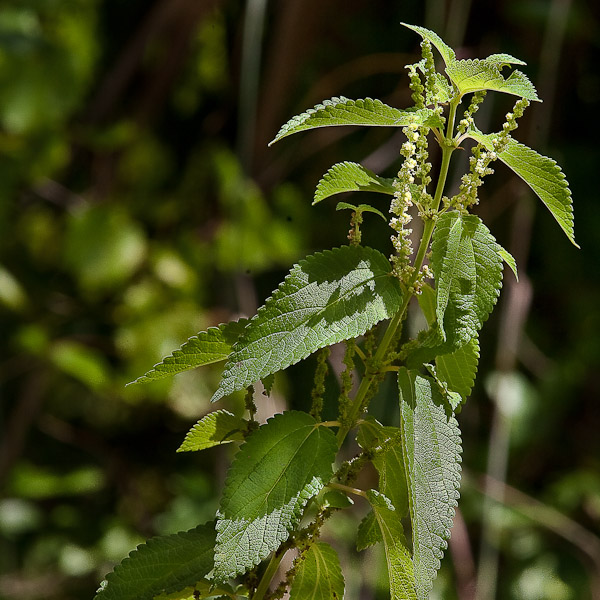
John and I had to postpone bot-projects until tomorrow, but no problem, I visited the Jupiter, Florida, Solid Waste Authority Transfer Station to drop off unused paint.  A trip to the dump reinforces a truth:   everywhere you go there’s botanical adventure to discover.   The interesting Solid Waste Authority weed is nettles, or to be exact West Indian wood nettles, as I just read, a weed of “Waste places.”  Sure enough.

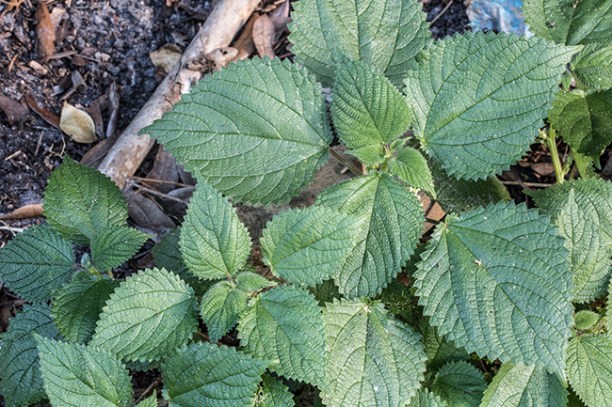
Laportea leaves

West Indian Wood Nettle

The plant manual at my elbow sez the species is not native, but with weeds, well, often you don’t really know, and the Flora of North America, one of my favorite go-to authorities,  leaves the question open.   The species is in Florida, Tropical America, Africa, and into Asia.

That this locally unusual nettle was at the Solid Waste Authority was not coincidental.  Nettles reputedly like nitrogen and phosphorus in high doses,  including places where livestock or human manure have enriched moist, semi-shaded disturbed soils.    The colony at the waste transfer station spreads across a  moist slope just downhill from where garbage trucks tip their soggy loads for transfer to larger trucks…with a lot of stinky organic juice escaping.  You can smell it while photographing nettles.    The only other spot nearby where I’ve seen the same species was at the margin of a plant nursery where similarly N- and P- enriched water drains away.

Around here, this is our only species of stinging nettle in the true Nettle Family, although several non-stinging relatives are abundant.  But today’s feature attraction is the stinger, whose identity is confirmed by my right ankle and right forearm  smarting as I type.   How the sting happens is old hat for this blog.  CLICK

For simplicity I’m going to now speak of “nettles” lumping the related genera Laportea (alternate leaves) and Urtica (opposite leaves).  A local poser, false nettle Boehmeria cylindrica, is no threat to ankle safety.

Boehmeria cylindrica 2

False nettle by John Bradford

You could scarcely find plants with more historical uses in human medicine.  Nettles have a hundred attributed benefits, some of my favorites being abating hair loss,   boosting memory, stopping nosebleeds when inhaled as snuff, and, as noted by former local botanist Dan Austin,  to “counteract love medicine.” (Should that need arise, run to the Solid Waste Authority, stand in the nettle patch, and breath deeply…love medicine will wear off abruptly.)      Not my cup of tea, nettles, especially young ones, have long uses as potherbs, as tonics, and in beverages, probably not a great idea given the calcium oxalate and other toxins they bring to the table.

In a comment below Pat Bowman added an important old use for nettles:  as a source of vegetable rennt for cheese making.

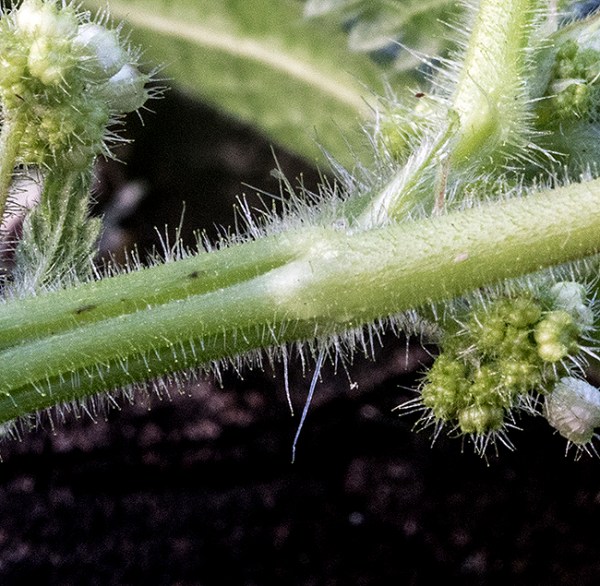
Laportea hairs

The big hairs contain the ouch.

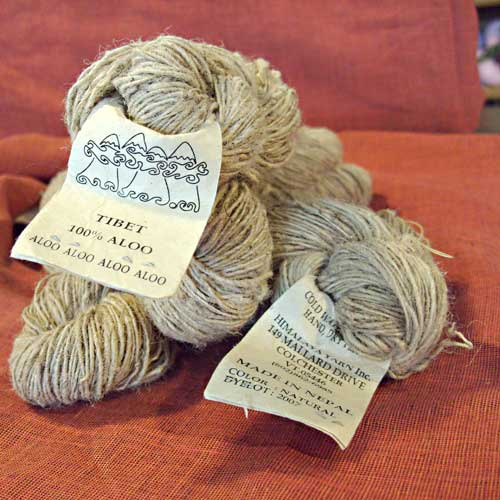
Related closely to the commercial fiber species ramie, which has escaped cultivation here in Florida, nettles are ancient sources of textile fibers, intertwined historically with flax and hemp.   Tibetan giant nettle (Giardinia diversifolia) is a cultivated nettle fiber in Nepal and beyond.

himalayan nettle shimmer green

Himalayan Yarn, from Tibetan Giant Nettle, by Shimmer Green, permitted use via Creative Commons

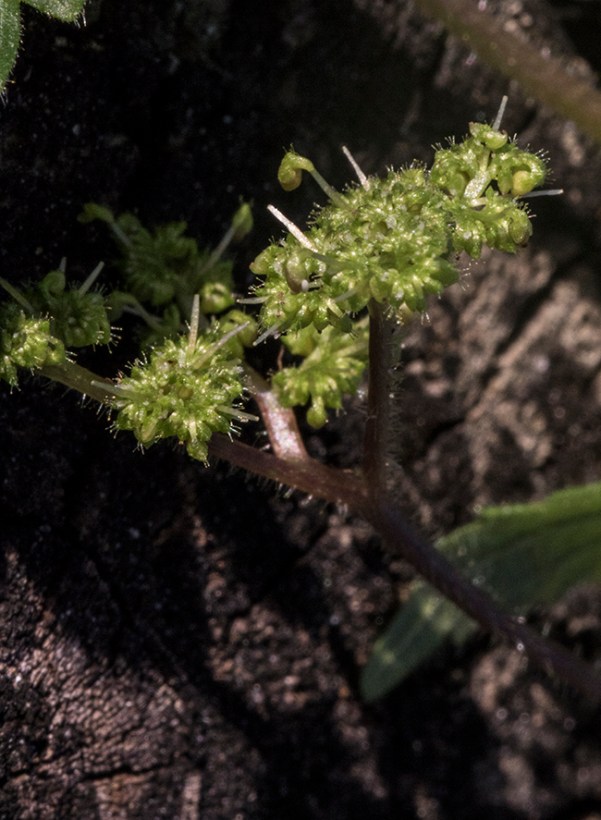
Now for the best part.   The flowers are separately male and female, in today’s species on the same plant.    Pollination is by wind, and the blossoms don’t merely drop their precious pollen passively onto the breeze.  Instead, they pop it out like little firecrackers.

Laportea female

Female flowers

Laportea male

Male flowers

You better enjoy this little video now, because I had to get down on my belly in the sting zone, in the garbage leachate,  with a Roseate Spoonbill and a Wood Stork as quiet witnesses to make this all possible.  So VIEW THIS…CLICK

And to wrap it up, nettles from a different angle, added in a comment by Leonore Alalniz:

Dense greenery
claims again that earthen-rich plot
and asks that I focus on re-emerging,
ever-present energy.

Aware of the initial sting
I settle
my mind and harvest bare-handed
first chlorophyll of Spring.

Into tissue beyond my skin
the Nettle
brings on summer’s heat ‘n pleasure
I longed for all Winter.


Tags: , ,