RSS

Author Archives: George Rogers

Unknown's avatar

About George Rogers

Florida botanist

Willy and the Dangerous Doodlebug

An Existential Kiplinger Tale

If you wanted to pinpoint something in nature to undermine the theory of evolution, I’d suggest the Doodlebug,  one improbable piece of creation.      As a biologist firmly marinated in evolution, I still scratch my head over how an insect larva could evolve the practice of digging a death pit, sitting in the bottom waiting for ants to tumble in, and then flinging sand on the victims to knock them down into the fatal funnel   I mean come on now, flinging sand!?   I’d like to see the incremental series of evolutionary steps leading to that!  (Do not get me wrong, it happened, and the fact is, today’s insects belong to the large Lacewing Family, with a fierce menagerie of predatory larvae.)

Doodlebugs owe their old-fashioned name to their squiggly wiggle lines in the sand.   They are be better known these days as ant lions, such an apt name.

We did not want to dig one up to its peril, so it was more lion-friendly to provide a link so you can view the hideous microbeast extracted from its conical pit.  CLICK  (And no, we did not plop an ant into a lion’s den.  All events today were purely observational.)   Those jabberwock jaws chomp with injection needles on the inner surfaces to shoot poison into the prey, and to suck out its vital juices.

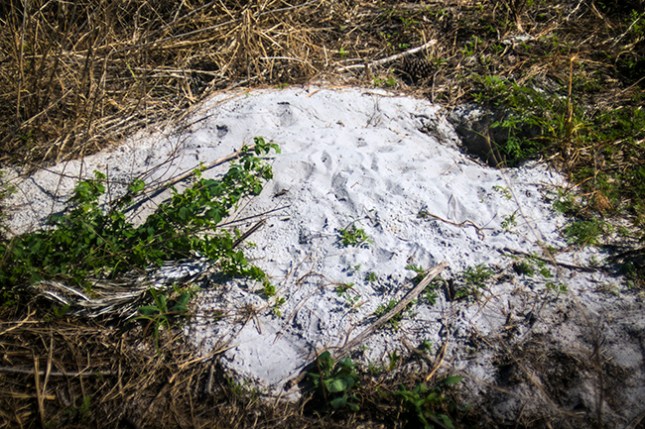
Everyone in a warm dry place has seen the little cones of uncertainty, depending on the species, say an inch deep and 2 inches in diameter in dry sand, often but not necessarily under an overhang.   Surprisingly, the species are quite varied, over 20 in Florida and vastly more globally.

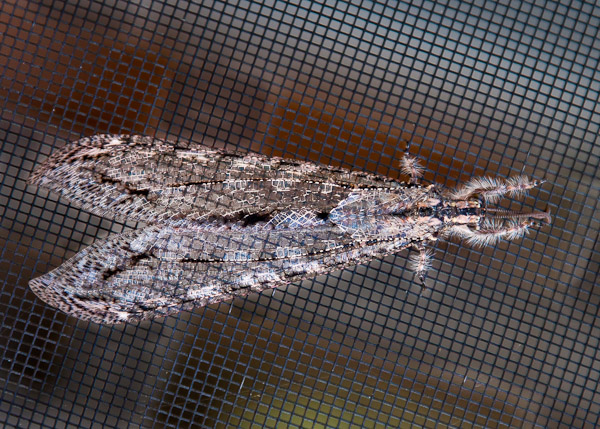
ant-lion-lacewing-vella-americana-small

Adult on John’s screen, by John Bradford

After lurking in a hellhole for months the larvae form spherical cocoons to soon emerge as gorgeous lace-winged adults whose job is to mate and lay eggs in a brief multi-week sexcapades.   They hook up on trees, with pheromones implicated as their match.com.  The adults are nocturnal and go to light,  perhaps drawn collectively to translucent leaves in the gloaming or to moonbeam love beacons?   The light-attraction is key to human-ant lion encounters, as they flutter onto  screens blocking access to the wonderful lights just beyond.

What a pity we don’t sit on screen porches any longer.    We miss a lot of good bugs and all the  nocturnal froggie and katydid audio, not to mention evening porch conversation with trains in the distance. This summer camping in Michigan, the lightning bugs were magical deja vu glimmers of summers before Comcast.

You can now watch the lion-ant battle to the finish John and I witnessed today in Kiplinger.  DOODLE HERE for the action.


5 Comments

Posted by on November 18, 2016 in Ant Lion, Uncategorized


Tags:

Balsam-Pear, Balsam-Apple, Cerasee

Momordica charantia

(“Momordica” comes from Latin for bitten because the seeds look chewed.   Charantia is  perhaps an old name for this anciently cultivated species?)

Cucurbitaceae, the Gourd Family

Friday.   Cool. Sunny. Breezy.  Time to relax and enjoy the Kiplinger Natural Area.  Or cyber-enjoy it thanks to John’s evolving photo-study.   CLICK

A weedy alien vine in Kiplinger has quite a history.   Part of the reason it surfaced as interesting today is a patch by the entrance to a subterranean Gopher Tortoise burrow.   Gopher’s like tasty fruits, such as, well, Gopher-Apple, so today’s “apple” looks like gopher fare to me.  Now I have no evidence that Bilbo Baggins Tortoise put the seeds by his front door of his dugout bungalow.   But the alternative explanation, chance, is no fun, and being an election year, you can choose the truth you like.    I chose the tortoise deposited the seeds in the dooryard.

momoedica-tortoise-burrow

Momordica vine to the left.  Tortoise hobbit hole to the right.

Living in the Caribbean, I came to know it as Cerasee as a valued medicinal tea.   The plant generates nearly every category of plant chemical WMDs, from alkaloids to steroids.   That ties in with ancient and sundry medicinal uses from its original Africa spreading to to India, Tropical Asia and beyond.  Med-apps are far too many to list, although they feature treating diabetes, plus such contradictory extra benefits as aphrodisia and induction of vomiting, hopefully not on the same evening.

Drug-loaded species attract research  attention, in this case in multiple connections including for antibiotics, anti-cancer compounds, and steroidal precursors.  Bitter principles in the fruit confer pest resistance, raising the eyebrows of agriculturists wondering if such defense may be bred or engineered into more vulnerable crops.

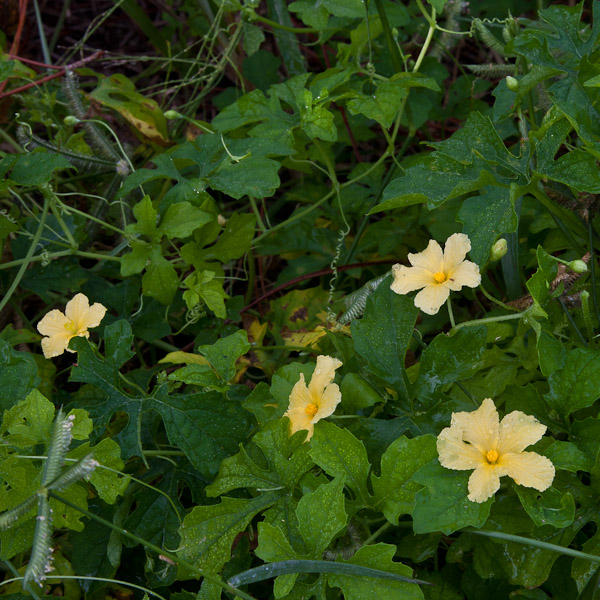
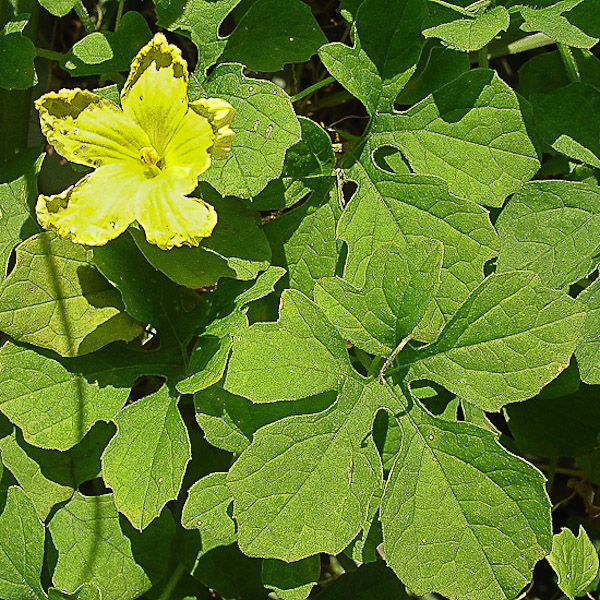
momordica-charantia-4

The flowers.  Todays plant pictures by John Bradford.

So obviously,  do not harvest and consume it.   Rule of this blog:  never eat wild plants.

Cerasee has been a food in the Old World for hundreds or thousands (?) of years.   That may seem odd, given the toxins,  but then again,  as with many anciently cultivated species, folks long ago developed domesticated strains.  The Bitter Melon Karala from India  is an example, and there are several edible Asian cultivars.  The cultivated fruits vary in shape, flavor, and colors from near white or greenish to orange or red.  They range from a  couple inches long as in Florida, to about 18 inches in one or more cultivar(s).   According to research dating to 2004, evidence indicates a single domestication event followed by diversification and dispersal.   All of the cultivated strains differ genetically together from the wild(ish) species.

Sierra Exif JPEG

Remember, the Balsam-Pear encountered growing wild in Florida is not one of the garden types.   How did it get here?  Probably from Africa during the slave trade.  Once on this side of the sea, the red-coated seeds allowed secondary dispersal by animals.  And by people too.

The bitterness of the fruit rind protects the seeds until they are ripe.  Then the noxious fruit opens to reveal the seeds rendered tasty and attractive by a red coating called an aril.

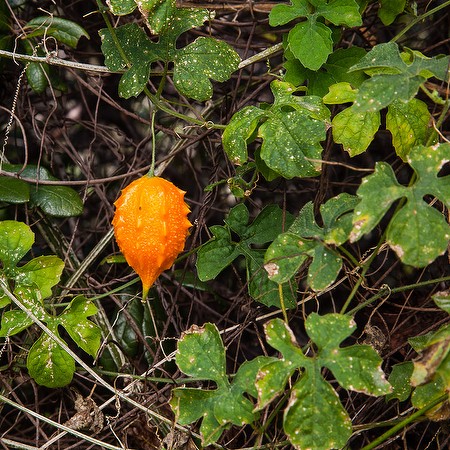
momordica-charantia-5

The orange pod with its bitter rind.

The flowers are unisexual, both sexes on the same vine.  Apparently because the male flowers on the vine can pollinate the females on the same vine, the male flowers mature about two weeks before the females to encourage crossing with other vines before the opportunity for the extreme inbreeding of self-pollination.

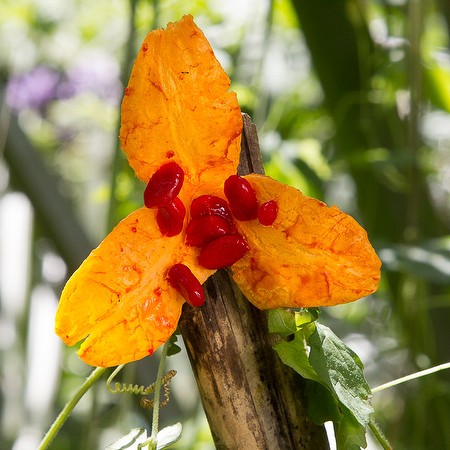
momordica-charantia-4-1

The fruit opens to reveal bird-dispersed (and tortoise-dispersed?) seeds with a fleshy red coating (the aril).

So then, back to the tortoise.  They have, I think, a lifespan similar to a human so they need Medicare pharmacy benefits too.   Maybe the tortoise in Kiplinger needed a little tonic tea, or maybe even a little turtle aphrodisia, bringing a few seeds to his sandy Hobbit-tat.

 
8 Comments

Posted by on November 11, 2016 in Balsam-Pear, Uncategorized


Tags:

Linden Leaf Hibiscus, Two Species in One Shrub

Hibiscus furcellatus

(Hibiscus is an ancient plant name.  Furcellatus means forked, in reference to the forked “antlers” at the flower base.)

Malvaceae

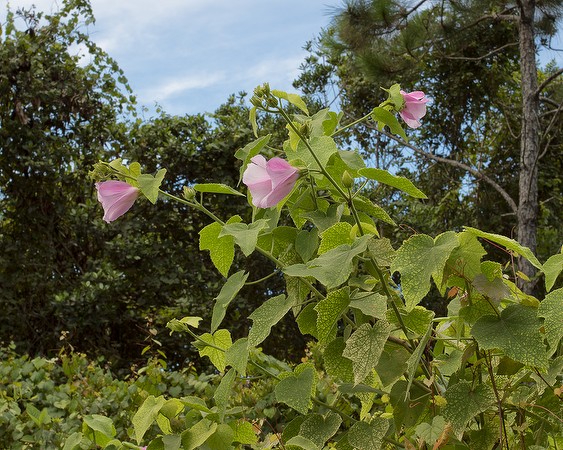
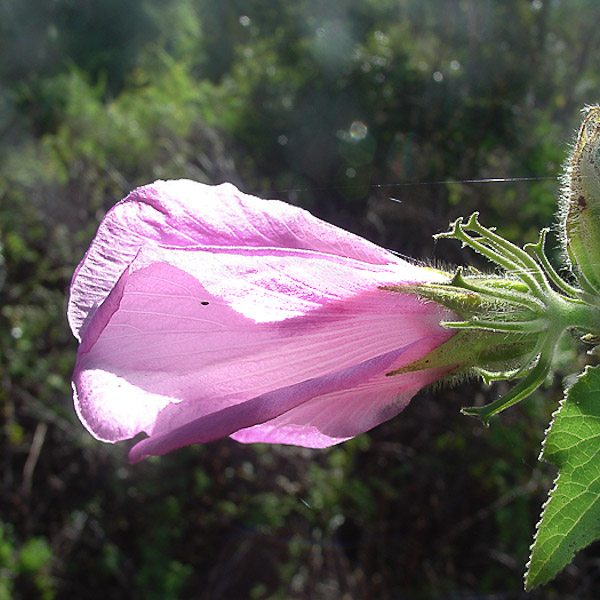
hibiscus-furcellatus-8

All photos are H. furcellatus, by John Bradford.

One of the showier flowering shrubs around Southeast and South-Central Florida is the Linden Leaf Hibiscus, growing fast, and standing tall with big shocking very-pink blossoms all showy and decorative. The species is almost as ornamental as any garden-variety Hibiscus, and in Hawaii Hibiscus furcellatus is a garden flower, as well as one of the cluster of Hawaiian native Hibiscus species.   It once was widespread in Hawaiian lowlands just as it decorates wet soil Florida.

Linden Leaf Hibiscus has ancient history in Hawaii as a laxative, a nice example of an island culture finding the same use for a species distant mainlanders did, that is, Hibiscus species are sources of laxatives in other cultures.

hibiscus-furcellstus-2

Note the barricaded flower base.  No sneaking in from the south flank!

Native to Florida, and native to Hawaii?  Isn’t that odd?   Yes, but then again the native Hawaiian flora didn’t flow forth from volcanoes.   Hawaiian botanists suspect Hibiscus furcellatus to have arrived by seed drifting on the ocean, probably from Central America.   How far from, oh say, Panama to Hawaii?  Wonder how long that floating pioneer seed was in the brine.

If a seed floated up onto a Hawaiian beach, it would have grown into one lonely plant.    Being solo, there would have been no mate to pollinate it, nor were its natural pollinators handy, but no worries.   Hibiscus species tend toward a self-pollination mechanism as back-up system.  They make vast seed crops in Florida, littering disturbed mud with countless seedlings.    The flowers “look” like they are fundamentally hummingbird adapted, but hummingbirds are sparse locally, so those profuse seedlings must come from bee-visitation, and/or from that self-pollination capability.

hibiscus-furcellstus-6-big

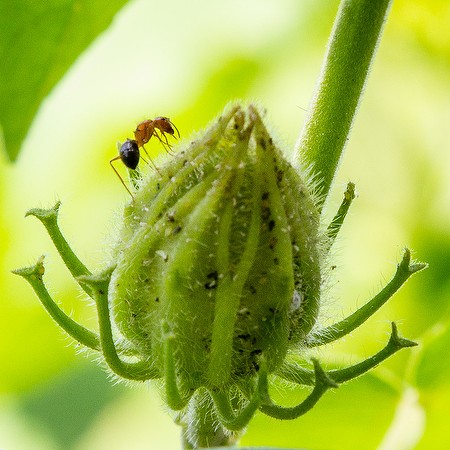
Ant(lers).  Do the barricades protect the bud, or the ant, or the ant food?


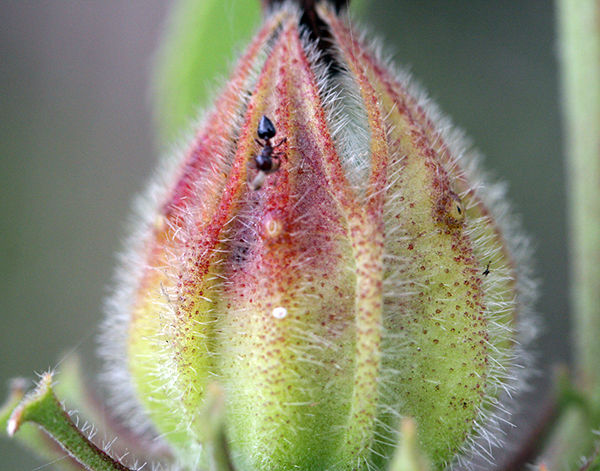
,The flower owes its name “furcellatus” to forked antlers (modified bracts) surrounding the nectar-rich flower base in this and related species.    The antlers look like they block nectar thieves from side-stepping the front and center proper entrance.   And if the branched barricade is not discouraging enough to flank attacks, the outside base of the flower feeds guardian ants from “extrafloral” nectaries.

hibiscus-furcellatus-ant-at-h-furcellatus-gland-3

Ant headed to nectary on flower bud

The early origins of Hibiscus furcellatus are a mystery to ponder.  Our species seems to be an ancient hybrid of two other species, having two different sets of chromosomes, one full set from each of its parents.  That would be like me having a full set of human chromosomes AND a full set of chimpanzee chromosomes.  One Hibiscus furcellatus chromosome set (called G) probably originated in Africa, as tough as that may be to imagine.  There remain on Earth other species having the G chromosome set uncombined with others.   The second chromosome set (called P) probably originated in the New World where there exist a total of four species having the same ancient GP combo, despite the absence of any known extant species with P alone.   Maybe some bored future genetic engineer will separate the two chromosome sets and re-constitute the two ancestral species.

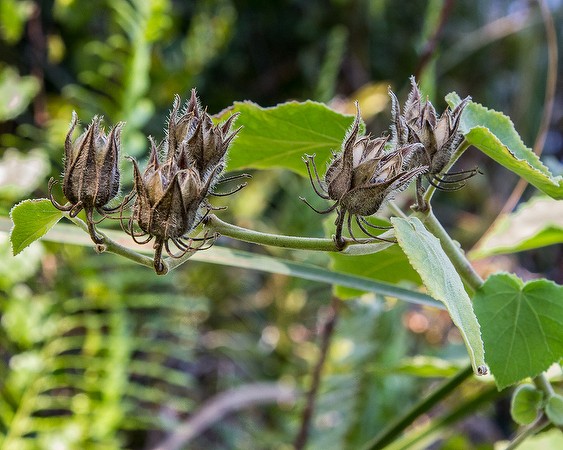
hibiscus-furcellatus-7

Seed capsules

 
5 Comments

Posted by on November 4, 2016 in Linden Leaf Hibiscus, Uncategorized


Tags:

Saltbush

Baccharis halimifolia and local relatives

(Baccharis comes somehow from Bacchus, the god of wine.  Halimifolia refers to a different plant with similar leaves.)

Asteraceaeae


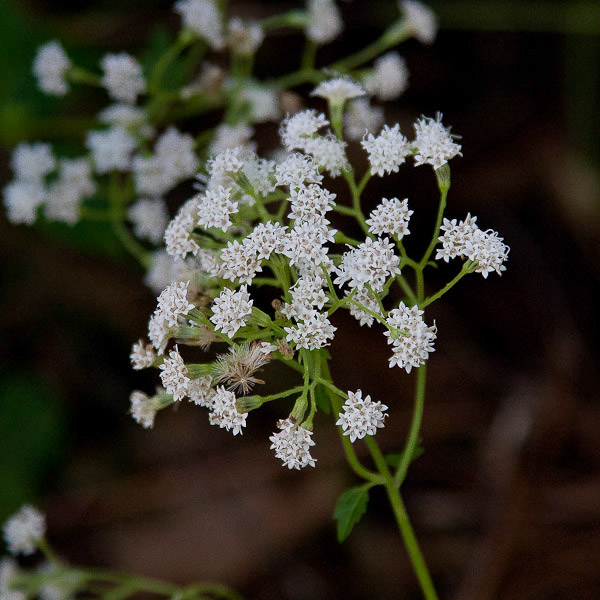
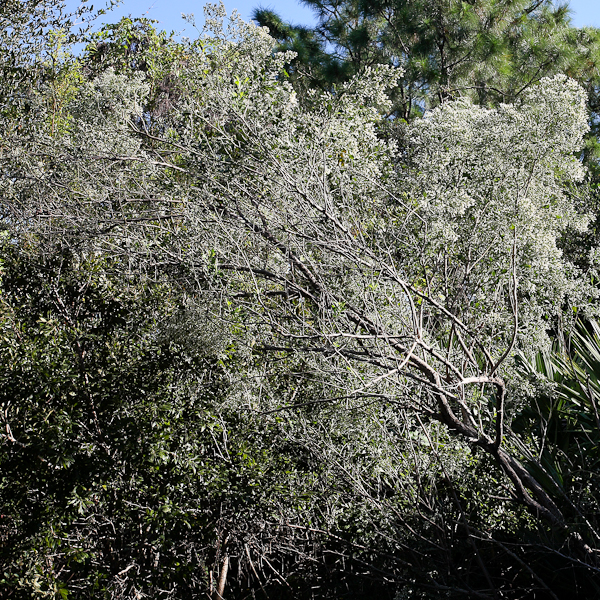
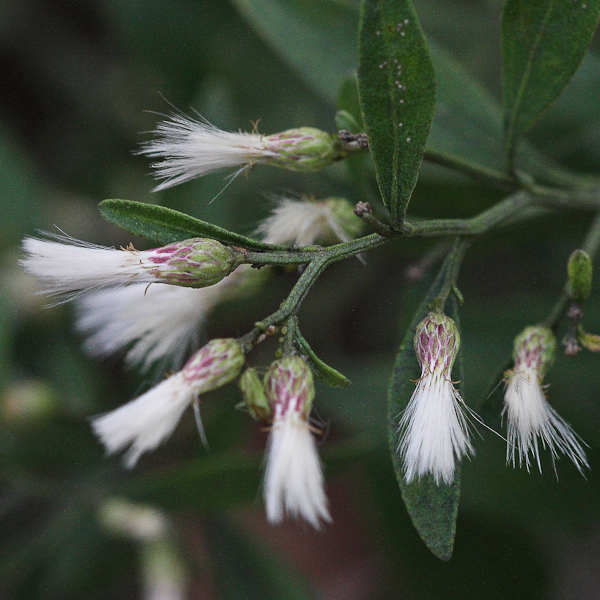
Working in the Kiplinger Natural Area  in Stuart, Florida, today, John and George enjoyed a dozen wildflowers in peak display, so beautiful:   White-Snakeroot,  Bluecurls, Liatris, Coin-Vine, and so many more.     In the garden of native delights is a fall-flowering species with curious attributes,   Saltbush, Baccharis halimifolia.    In our area we have also Baccharis glomeruliflora (flowers in tight clusters) and B. angustifolia (narrow untoothed leaves), representing a widespread genus of over 350 species.

ageratina-jucunda-5

Hammock Snakeroot by John Bradford

For starters,  the distribution of Baccharis halimifolia is odd, with a population in eastern Canada, then a gap of over 400 km to New England, down the U.S., into the Caribbean and Mexico.    This is one widespread plant.   And then some:  it has escaped cultivation or otherwise invaded around the globe, even in the Mediterranean and in Australia, where it is a pest battled with a destructive rust fungus.   The species is not welcome in many places because it accumulates in pastures and is fatally cardiotoxic to some grazers.  I don’t know where the poisons reside, but the leaves have secretory glands probably responsible for protective secretions.

baccharis-haliminfolia-2

Saltbush in bloom  by JB

The individuals are separate males and females (proper term,  dioecious, die-EE-shus).  That’s no biggie,  but the odd thing is, how many dioecious plants have male-female differences other than the flowers?   That is rare in my experience.  According to a USDA publication, the males have longer shoots, softer leaves, faster growth, and earlier seasonal senescence than the females.   Sounds like maybe the males are more “designed” to reach out and scatter pollen, in contrast with females who need more sturdiness and an extended season to make fruits.  Pollination is by wind and by insects.  The small wind-dispersed fruits are on parachutes.

baccharis-haliminfolia-3

Female flower clusters by JB

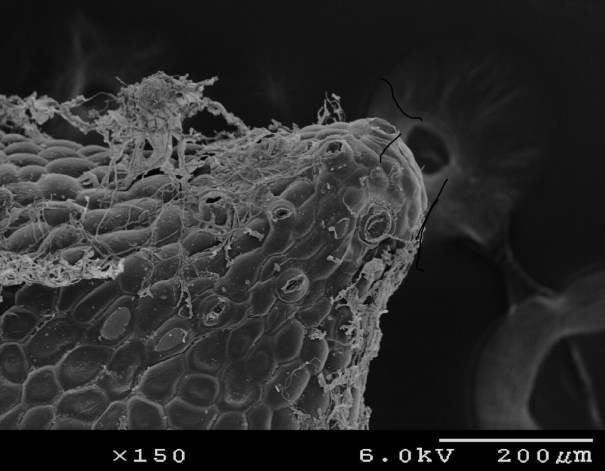
Species of Baccharis have an adaptation sometimes associated with salt-tolerance…water-emitting valves called hydathodes at vein tips.   Hydathodes resemble the drip-emitters used in irrigation, flushing out water and anything in it such as excess salt.

baccharis-hydathode

Baccharis hydathode by Dr.  Bob Wise, Univ. of WI Oshkosh, with permission. Scanning electron microscope view.

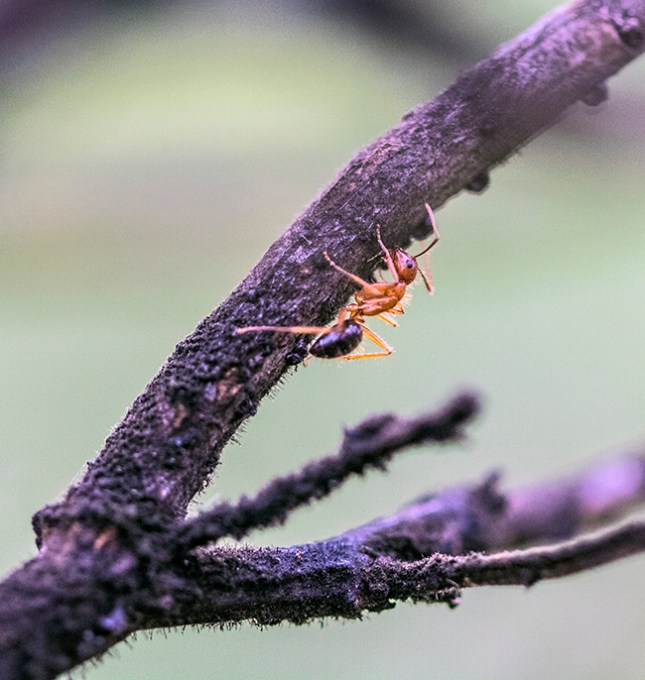
John and I have been watching ants scramble around the Saltbush.  The ants come marching two by two to tend sucking insects.    The sucking insects we’ve seen are aphids and perhaps two species of scale insects.  (Baccharis is the main Florida host for Green Scale.)  Such insects “suck” sugary sap from the host plant.   The sugary goo passes through the lil’ sucker to drip forth from the other end as “honey dew.”   The honeydew can spread and grow black fungi called sooty mold, and some of it follows a more interesting path as ant food.

baccharis-halimifolia-ant

Ant on Saltbush today.  With scale insects and sooty mold.

baccharis-scale-2

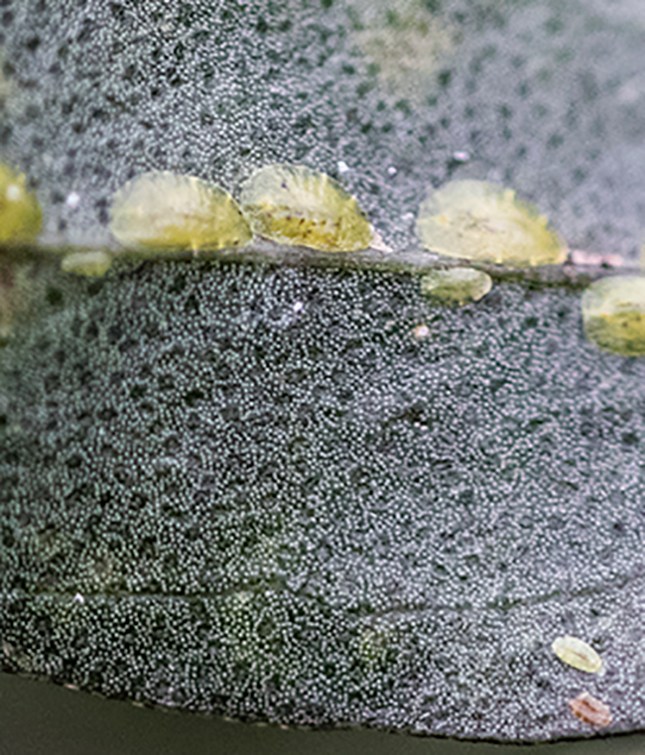
Green Scale on the leaf today

That ants crave honeydew and tend its makers like farmers tending cows is well studied, producing conversations about three-way symbiosis: win-win-win.  The plant gains armed guards.   The ants get sweet treats.  And the sucking insects, well, if they are not merely exploited, might get help in dispersal and might be under the protection of their creepy little shepherds.

CLICK to see a similar symbiosis, of all things, on the inside the stem of a different plant.

 
4 Comments

Posted by on October 28, 2016 in Saltbush, Uncategorized


Tags:

Zombie Plants – The Green Undead Awaken on Halloween (if it rains)


(More technically, Poikilohydric Species play possum)

This week’s fieldtrip is tomorrow, so with no crystal ball, so I’m taking a little pre- trip literally to the back yard.   Today we’re talkin’ plants with no roots and no internal plumbing, or almost none.    All water goes in through the foliage as it rains, but when dry the plants look and act like death, until resurrection when soggy returns.     Although there is a spectrum of possibilities and variation in mechanisms,  the interesting cases are not mere wilting or  closing up shop, but rather extreme deeply suspended animation, essentially lifeless.   You wonder how long a plant in that state can rise from the grave.  Answer: long.

Remember the term poikilohydric (= plant zombie).

Florida is a great place to encounter these resurrecting oddballs.   We have a lot of epiphytes, some of which behave poikilohydrically, most famously our Resurrection Fern (Pleopeltis polypodioides) as photographed by John Bradford:

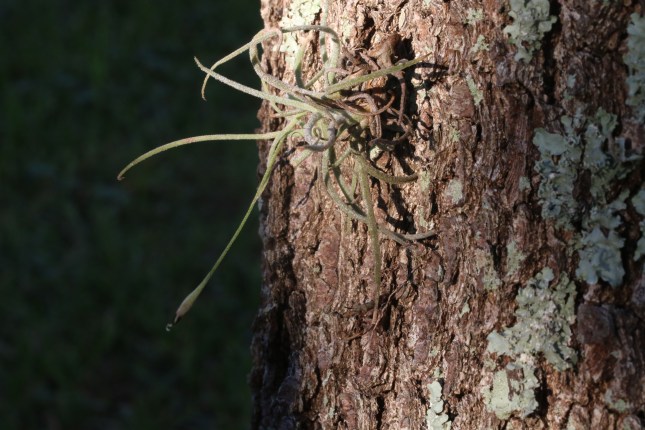
Spanish-Moss and its cousin Ball-Moss (Tillandsia recurvata) may not be full-blown dry-and-diers, but they get mighty thirsty hung out to dry.
img_4279

Ball-Moss on tree trunk

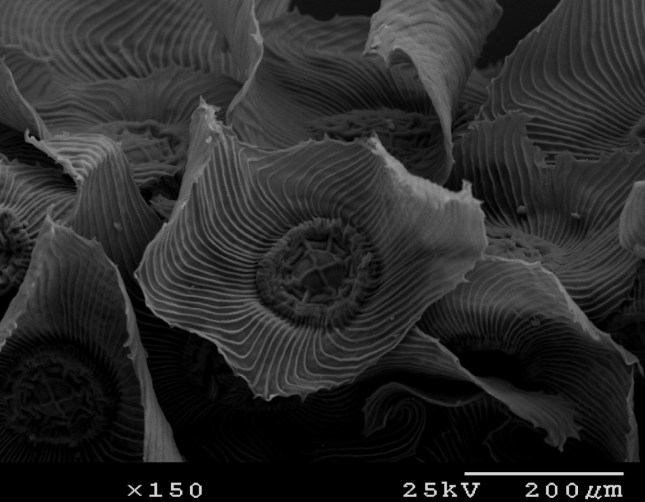
These species use umbrella-shaped scales (think micro-toadstools for second analogy in one sentence) to capture and distribute rainfall.
poikilohydry-tillandsia-us-bw

The scales on Spanish-Moss leaf.  By Robert Wise, Ph.D., Univ. WI Oshkosh, with permission. Scanning electron microscope. The scale is anchored like a toadstool at the middle.

One drop can irrigate an entire scaly leaf as we will see momentarily.  The scales have intricate structure, and flip down in the presence of water.  Water moves from scale to scale like an electric current traversing a wire.  Watch this video of one drop going a long way. CLICK TO SEE!

What is so astonishing is the depths of the Snow White slumber.  Hard-core cases go through profound internal biochemical and structural reduction and disassembly.  Internal membranes collapse or disappear.   Special protective proteins, enzymes, and electrolytes form.  Internal cellular components vanish.  Some go so far as to dismantle their photosynthetic apparatus, and reconstruct it upon remoistening.    Seen with a microscope the leaf cells look deceased.  Then it all comes back.

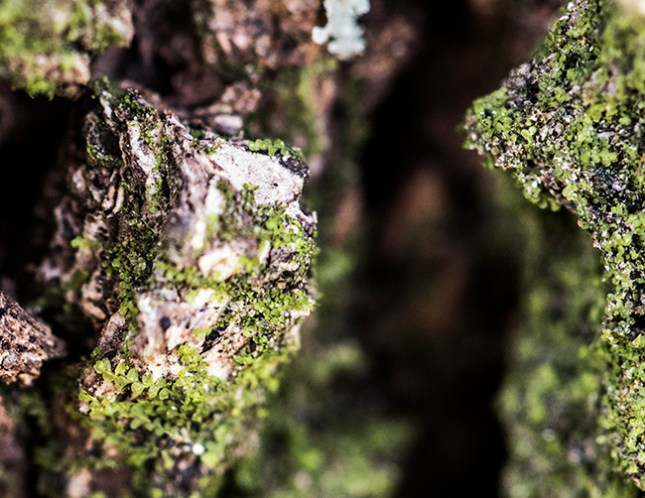
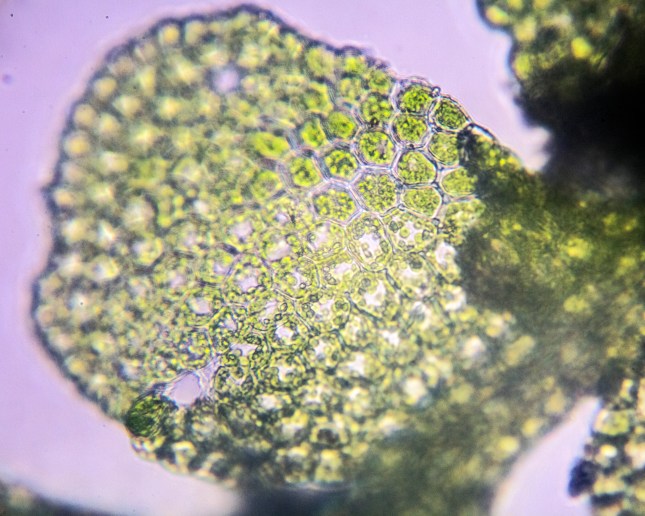
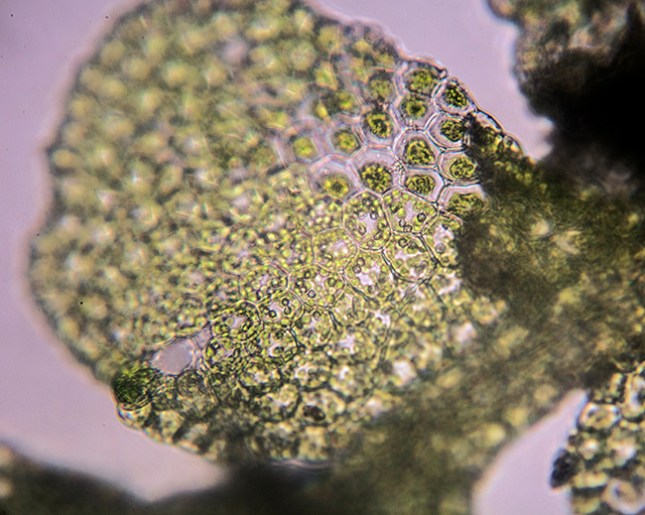
Below is a series of photos of a liverwort from a tree in my yard.  After the photo showing the liverwort on the hot dry bark are three microscope views of the same leaf at the same magnification, the first snapshot while dry, the 2nd  photo 15 minutes after re-moistening, and the third shot about an hour later.   Notice that in the dry condition the cells look hollow with no apparent chloroplasts (the green disks in the later photos).  The chloroplasts are either gone  or collapsed into a thin film against the outer walls of the cell.   Yet just minutes post-moistening chloroplasts appear magically, and after an hour the previously deadish cells look perky.
poikilohydry-liverwort-on-tree-expanded

Liverwort on hot dry tree trunk

poikilohydry-liverwort-leaf-dry

A dry leaf, microscope view, from the liverwort.  Notice the hollow “empty” cells.
poikilohydry-liverwort-leaf-wet-15-minutes

Fifteen minutes after wetting.  Chloroplasts (little green dots) already returning!
poikilohydry-liverwort-approx-one-hour

About an hour later

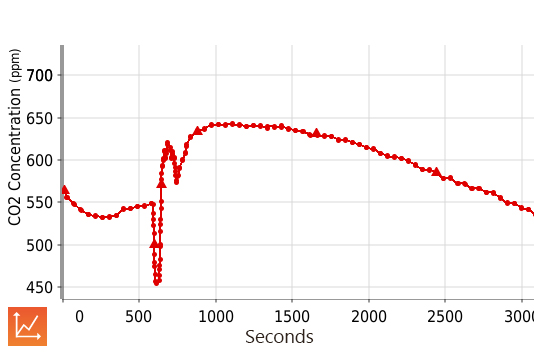
The reappearance of chloroplasts is a jiffy.  What is truly mind-boggling after wetting, however, is the instant return of respiration, intake of oxygen and expulsion of carbon dioxide, such as our breathing.    In their dry state poikilohydric plants show no detectable, biological activity.    Within seconds of rewetting carbon dioxide exhales.  (The very first carbon dioxide given off is probably not from metabolism, but merely forced out of nooks and crannies by the wetting, then metabolic carbon dioxide from life renewed follows in a few more seconds.) The graph below shows warp-speed carbon dioxide release by a remoistened moss.   So fast it’ll make your head spin.
poikilohydry-dry-moss03

Rapid carbon dioxide release.   Moistening was at about 650 seconds.  The fast dip happened as the water was squirted onto the dry leaf, perhaps from the gases in the pipette.  The mall first peak near 700 seconds is probably non-metabolic carbon dioxide, followed by the broader breath of metaboliic carbon dioxide as Rip Van Winkle awakens.  No time wasted!

Why that burst happens is not well understood.  I mean, why would the plant start respiring, burning sugars, before it is ready to replensih its own sugars by photosynthesis.  One line of thought is metabolism revs up like “gentlemen start your engines” before the transmission engages, that is, before all the plant’s membranes and internal structures return to working capacity.    The slumbering plant needs to work fast to exploit a fleeting cloudburst.
poikilohydry-cladonia

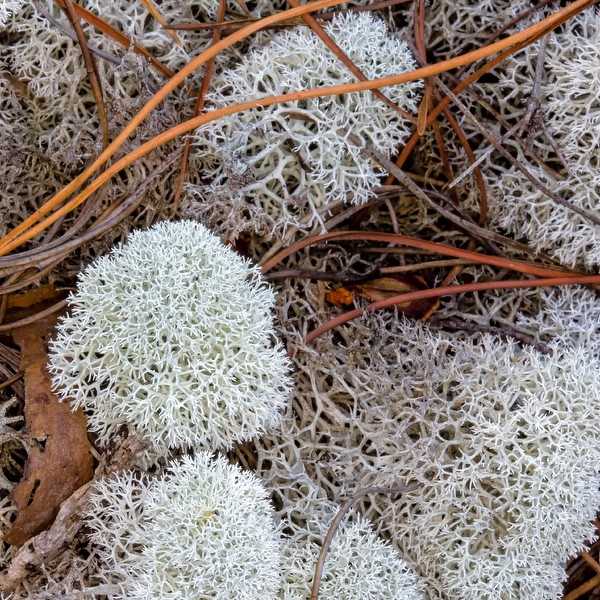
Poikilohydric lichens by John Bradford, followed below by moist and dry Selaginella by JB.

The distribution of plants with poikilohydric superpowers is broad and spotty.  The “lower” plants with no roots or veins need it, having no ability to take lift water from the soil and no pipes to move it internally:  some algae, lichens, mosses, and liverworts.     Rootless rain dependence may seem like a drag,   but it is a plus for living rootless on tombstones, telephone wires, and tree trunks.  Some plants with roots and veins, “vascular plants,” have poikilohydric representatives, including fern allies (our local Selaginella),   ferns, and assorted Dicots and Monocots, including a few grasses and sedges.

You might ask, how could so many different unrelated  plants come up with the same bag of tricks?  Well, convergent evolution is not rare, but more tantalizing, the ability of mature plants to go into quasi-death-dormancy is mirrored in something all seed plants have—seeds.  The genetic mechanisms that allow seeds to lie dormant and dry for centuries might extend sometimes in some species into adult life (and death, and life).
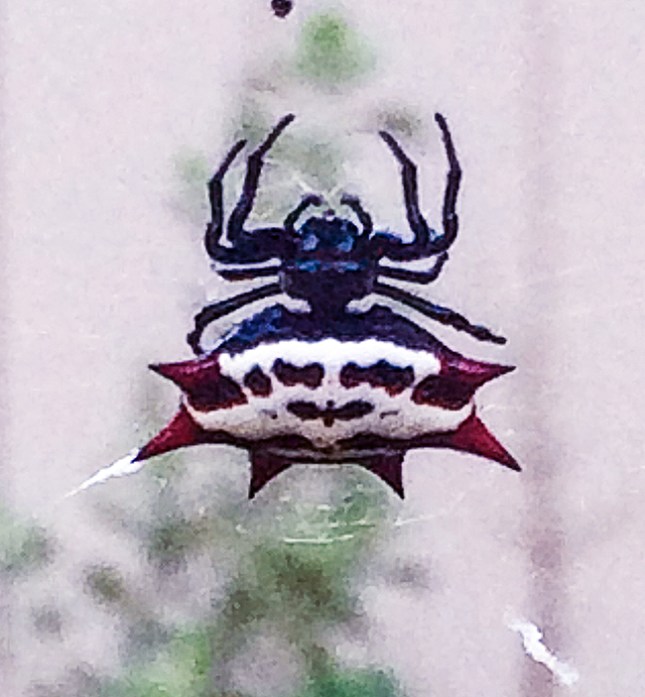
spider

Hanging around the liverwort tree, by Donna Rogers

 
9 Comments

Posted by on October 21, 2016 in Uncategorized


West Indian Pinkroot

Spigelia anthelmia

(Adriaan van den Spieghel was a Flemish anatomist.   Antihelmitic medications expel worms.)

Strychnaceae (traditionally Loganiaceae)

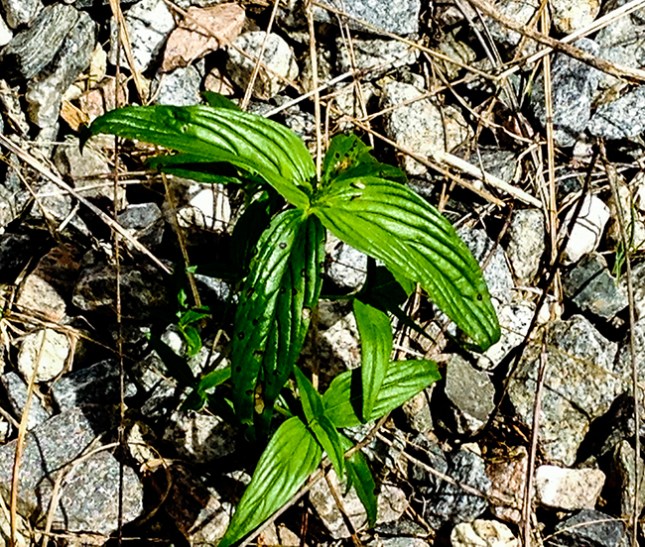
Train tracks are interesting to botanize because they represent severely modified habitats, because the stone used for the rail beds is geologically novel for our area, and because trains spew fruits, seeds, and plant fragments from points yonder.    Today I stopped briefly along the track leading from WPB to Indiantown for a quick peek, and such a peep never disappoints.    In the rocky rail bed is a native annual nobody would call rare, yet not  encountered often around here: Spigelia anthelmia.  Lots of them.

spigelia-on-rocks-cphone

Spigelia anthelmia today on the RR tracks

U.S.  Spigelias are a weird bunch, one is a stunning wildflower, two are rare and localized in Florida,  and a Brazilian species buries its fruit ostrich-style.    But let’s stay local.

This is a plant with serious history in traditional medicine.  (Warning—cardiac-poisonous.)   Throughout its natural distribution from South America through the Caribbean into southern Florida,  West Indian Pinkroot has medicated several cultures in multiple languages.    Moreover, weedy dispersal in Africa, India, and Asia has spawned similar uses across the sea.   Relatively minor applications include treating hearts and killing fish.

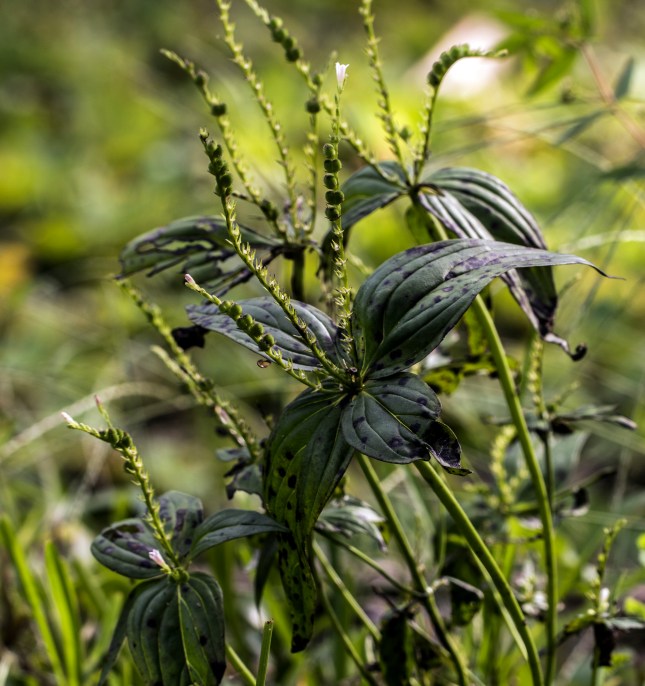
spigelia-plant-riverbend

The superstar therapy from Spigelia anthelmia is to evict parasitic worms.  The practice is hundreds (thousands?) of years old and widespread.    The founding father of plant classification, Carl Linnaeus, who named the species, helped write a book on the Spigelia anthelmia  worm cure in the 1750s.    Linnaeus was as physician, by the way.

Does it work?   I believe so, but stand back.   Some of the most diverse and potent bioactive compounds in plants are alkaloids (caffeine, nicotine, ephedrine, heroin(e), morphine, cocaine), and Spigelia anthelmia yields many.   It is not kidding around. The root crushed and sniffed sends a dagger into the sinuses.    Of these, the best known, perhaps the main worm killer, is called spiganthine.

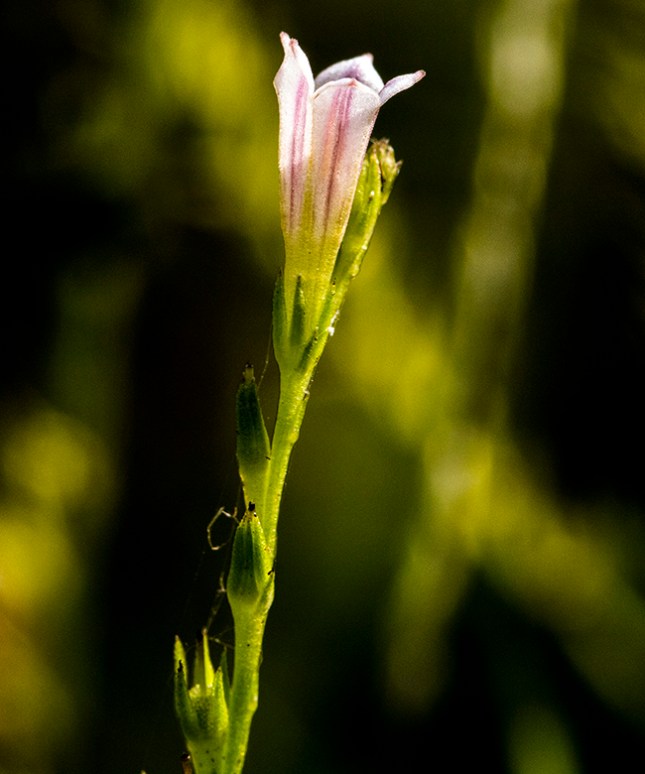
spigelia-flower-650

A self-pollinating flower

The poisons are so prevalent and the history in medicine so robust, the species has attracted modern research, and it is available as a homeopathic tincture.     The plants are a potential  cheap locally produced source of worm-be-gone for livestock  where commercial pharmaceuticals are too expensive.

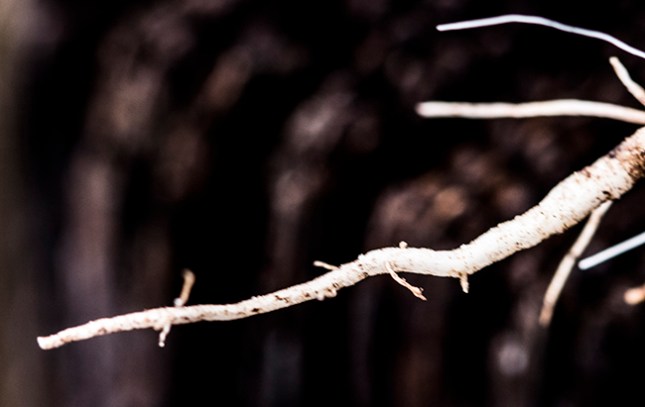
The fame as a de-wormer no doubt comes from proven effectiveness, despite collateral dangers.    Yet a secondary factor may have contributed to the glory.   Long ago people often interpreted the appearances of plants as clues to benefits.    For example, a flower shaped like a fetus hinted at help in childbirth, and so forth.    Although not THAT different from other roots, the Spigelia root looks a bit like a veterinary nematode.

spigelia-root

A little wormish maybe?

All that toxicity may have another benefit, to protect the regal cydosia moth which occupies today’s species as a larval host.    In fact,  Spigelia anthelmia may be its only Florida host, as the moth relies on members of the Loganiaceae or Strychnaceae, and the local menu offers few.

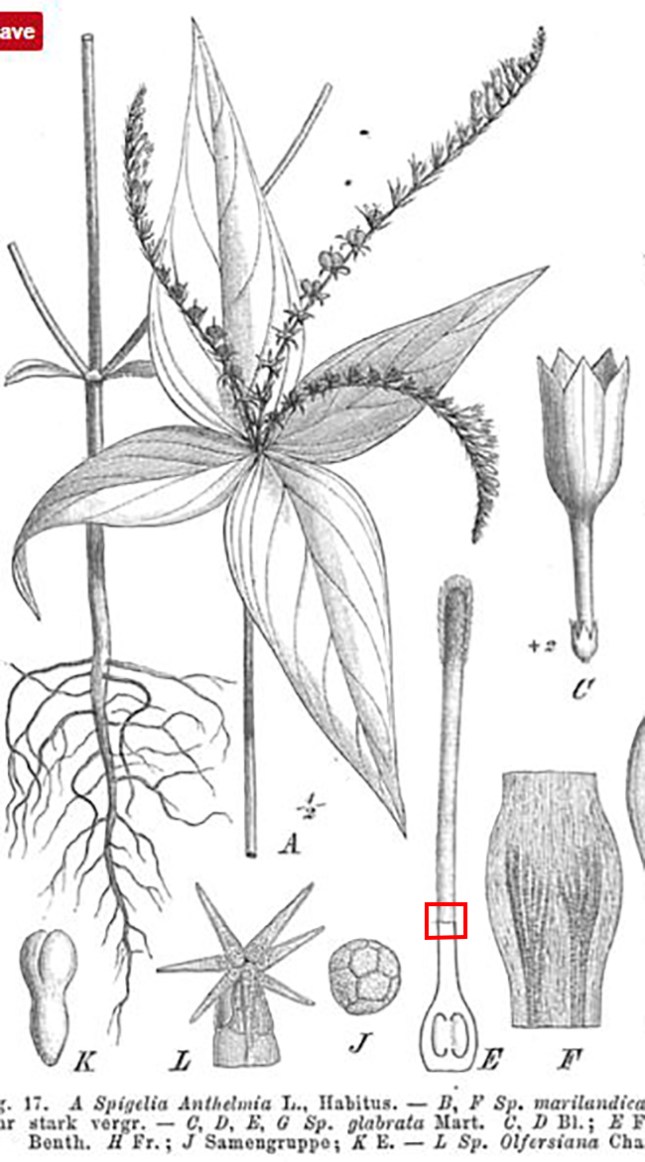
Look closely at the old botanical illustration below and enjoy a quick botany lesson.  The organ labeled  “E” is the pistil.   The sexual process requires rootlike threads sprouting from pollen grains on the fuzzy pistil top to grow down  inside the pistil and deliver sperms to eggs at the broad pistil base by the letter E.

Spigelia has an odd checkpoint along the sperm delivery pathway.   Its pistil snaps off at that black suture running across the pistil inside the red box.    Why?   In most Spigelia species the snap-off presumably happens after the initial sperm delivery in order to prevent unwelcome late inseminations.

Today’s species is a special case, however, being self-pollinated.    Botanists have interpreted the snap-off in S. anthelmia as a means to allow the stronger pollen to achieve delivery,  followed by snap-off to block slower-growing tubes from genetically defective pollen resulting from the extreme inbreeding.    It is culling the pollen the same way a breeder may cull defectively inbred puppies.

spigelia-snip

The tall organ marked E is the pistil.  The sperm delivery tube must grow  from pollen at the fuzzy tip downward to the broad base by the letter E.  The snap-off point is the line inside the red box.

Looking on the advantageous side, a plant able to fertilize itself can establish a new population where one lone seed may drop…perhaps off a choo-choo rumbling past Jupiter.

 
11 Comments

Posted by on October 14, 2016 in Spigelia, Uncategorized


Does Bald Cypress Worry When Hurricanes Approach?

Well,  what do you do when the house is as ready as possible and you’re sitting waiting for Matthew?   Hunker in the bunker and write a blog.   Putting up the hurricane shutters revealed a little native Florida,  bringing forth lizards, a tree frog, a nervous zebra longwing, and a friendly wasp solo in its papery nest.  Hope they all creep, buzz, and flutter to safety.  Butterfly in a hurricane!?   Sounds like my autobiography.

Standing tall in the face of the big blow are Bald Cypresses.

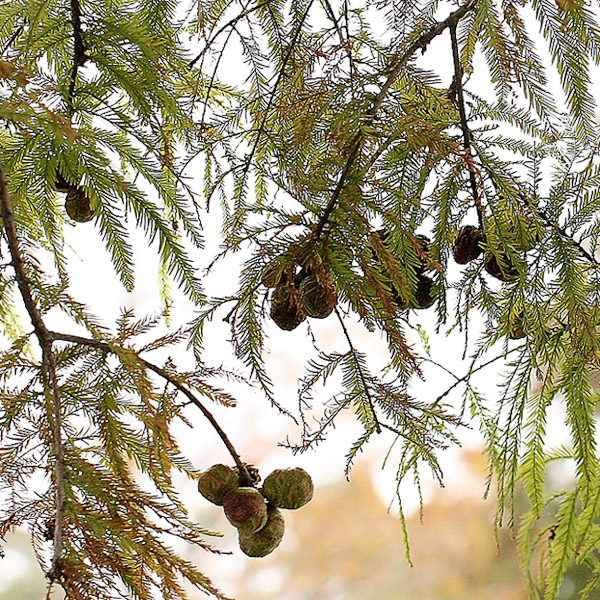
taxodium-distichum-2

Bald Cypress seed cones.  Photos today by John Bradford.

The relationship between Bald Cypress and Pond Cypress gets a word.  Modern molecular studies show the two as so close genetically that most botanists treat them as varieties of the same species, as for example Flora North America.

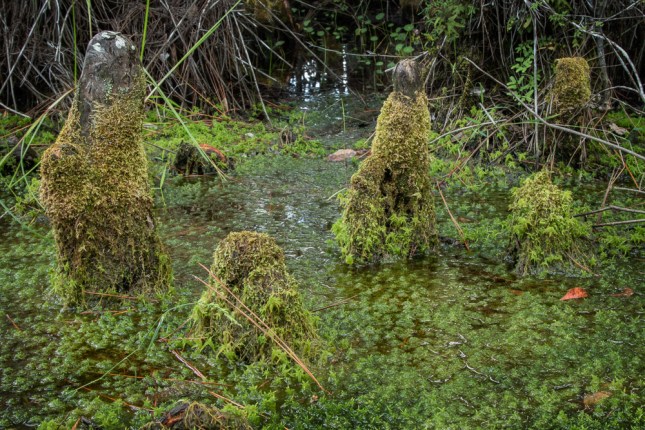
Our blog has a pre-existing condition on the tree’s knees:  CLICK FOR KNEES

Today’s question is,  why is Bald Cypress deciduous?    After all, we don’t have many fully leaf-dropping trees in South Florida.     So why such a prominent exception?

Why do deciduous trees exist to begin with?  In many warm climates having a dry season trees shed foliage when water is too limiting for photosynthetic efficiency.  I used to work in Venezuela where people raking and burning leaves at the curb reminded me of  October in Michigan.    Where’s the cider?

Maybe the Florida dry season could have something to do with the baldness.    But then again, these are trees of the wettest habitats, and only a few local trees shed in our not-that-dry winter/spring anyhow.   So dodging the Florida dry season is not a gratifying explanation.

As with all evolutionary questions,   it pays to look broadly in space and time.   Bald Cypress once spread across much of cold North America, to be shoved into the Southeastern U.S. by glaciation.    A northern origin helps explain deciduousness, given that most cold-climate trees dare to bare.  Perhaps Bald Cypress brought the condition from cold beginnings as I brought my ice skates.  Some of our other local deciduous trees, such as red maple and pop ash, are snowbirds as well, and interestingly swamp-dwellers likewise.

taxodium-ascendens-4

Yet writing off BC’s seasonal twig-shedding as northern baggage may not say it all.  This is the alpha tree of our swamplands,  and seasonal baldness seems to agree oddly with its Florida lifestyle no-matter the point of origin.

In the large world of conifers, deciduous species are unusual.    They are Taxodium, its close relatives Metasequoia and Glyptostrobus (which also makes knees),  and the more distantly related Larches, including Tamaracks.   Maybe this leaf-droppy crew tends to have something in common to help explain such rare deciduousness in conifers which otherwise cling to their needles even in the far north.  One thing the deciduous conifers have in common is prior life in ancient near-arctic wet forests.

taxodium-ascendens-9

No place for nice roots

The deciduous conifers all went through long formative periods where root function is especially challenged.  And yes, I’m out on a thin speculative limb.   Metasequoia is almost extinct so ignore it.    The other deciduous conifers flourish far from the ancient arctic, yet all with proclivities for habitats with impaired root function.   True of Bald Cypress?  Absolutely: no matter how you interpret the knees, they probably have to do with horrid soils, which not only are  oxygen-deprived under water but also probably not generous with nutrients, toxic,  and not hospitable to symbiotic microbes.

Not documented so far as I know for Bald Cypresses, but research shows deciduous larches to have special adeptness at transforming sugars from the foliage to  permanent stem wood before ditching  their temporary cheap leaves.

If Taxodium arrived here from far north, has it adjusted visibly to the Southeast after arrival?  Maybe that adjustment is the variety we call Pond Cypress.     Pond Cypress seems to have leaves adapted especially to diminish the water loss root-challenged trees can’t afford…less flat, arranged all around the twig, and pressed more or less together around it.

So to sum up my daydream, maybe Bald Cypress came southward pre-armed to deal with root-nasty conditions, and then went a little farther by spawning even-more-self-protective Pond Cypress?  Something to  think about here in the cone of increasing certainty.


2 Comments

Posted by on October 6, 2016 in Uncategorized


Saw Palmetto Needs Its Saw Sharpened

Serenoa repens

(Sereno Watson was an American botanist.   Repens means lying down.)

Arecaceae

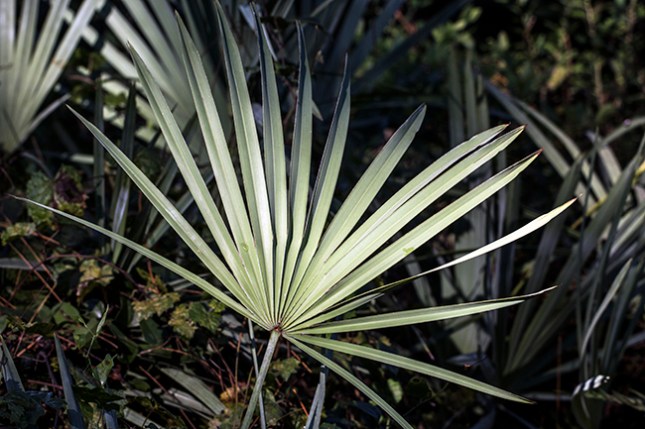
serenoa-leaf-in-sun-copy-2

Today’s sweaty trek was a lap of the Kiplinger Natural Area in Stuart with Beautyberries in purple splendor and species of Chaffheads putting on the purple as well.    The sun flecks through the pines lit up the Saw Palmetto fronds like stage lights, so what the heck, today it’ll be the dominant species around here, Saw Palmetto.
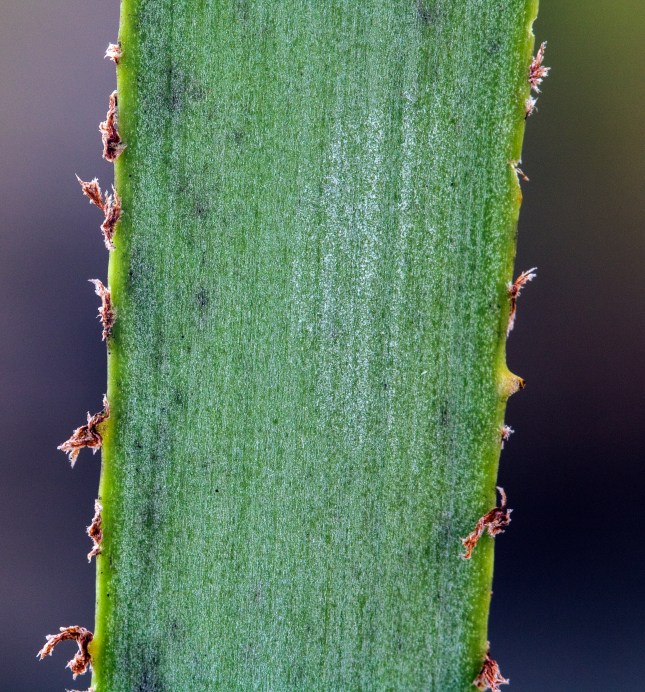
sabal-etonia-4

Sabal etonia, Scrub Palmetto, is similar but toothless.  By John Bradford.

Being everywhere and familiar to all, Saw Palmetto is festooned with Google-ish info and some mis-info.    We’ll knock off the uber-documented facts expediently,  knowing you can explore further on the Internet, and then ponder a couple less-obvious palmetto puzzlers.
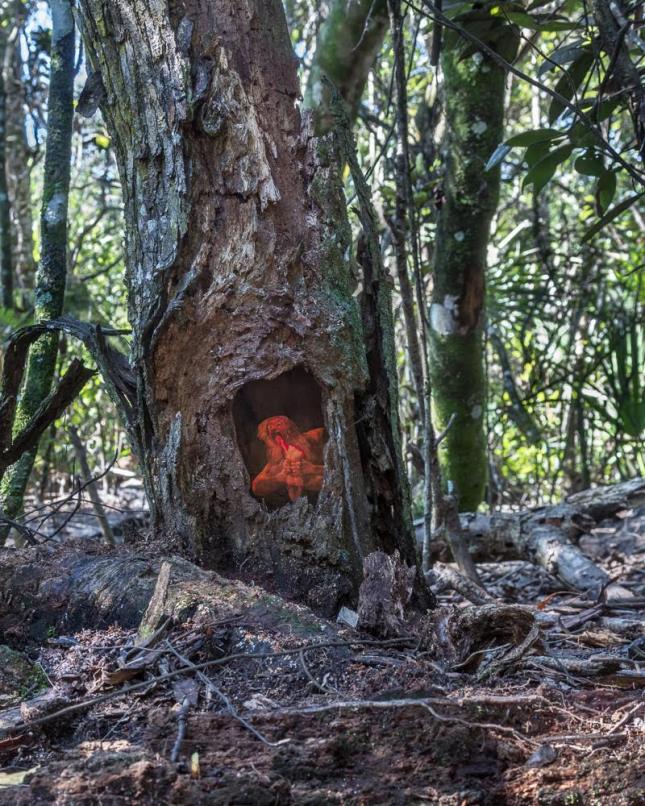
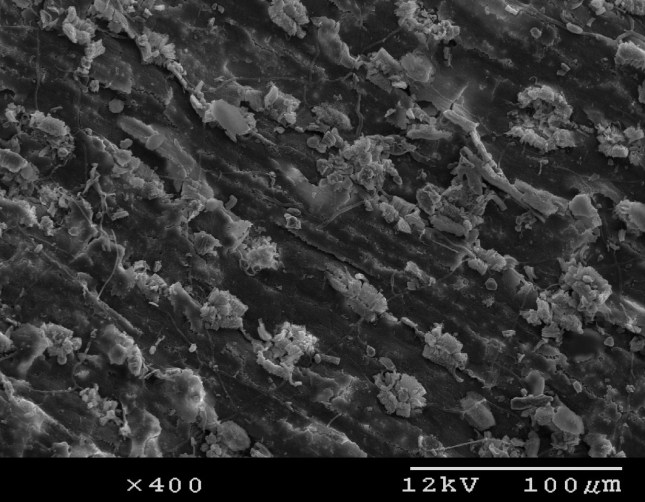
serenoa-wax

Palmetto leaf wax, electron microscope image, by Dr. Bob Wise, Univ. WI

Well Known Stuff:

  1. Saw Palmettos come in silver and in green. The silver comes from wax granules making the leaf reflective and sun-tolerant.   Green individuals have less sunscreen.  The species grows in habitats ranging from full sun to shaded, so it makes sense to have populations mixed for this character.   Some sunny types,  some shady characters. Diversify, or at least that’s how I see it.  The wavy covering can become discolored with black  Meliola fungi, or from sooty mold.
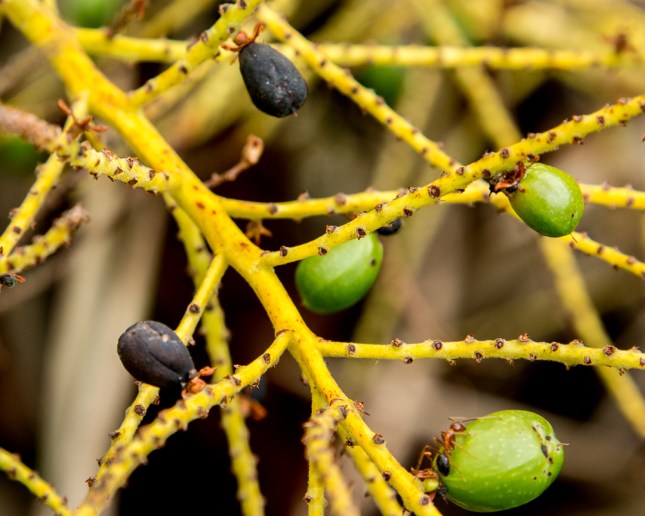
  2. The so-called berries (drupes) are an industry in Florida amounting to a harvest of over 7 million kg/year.  There’s a long-standing history of application for prostate health.    Formal scientific studies seem to fail to confirm benefits, although the market abounds.


serenoa-repens-11-fruit-copy

Fruits and ant, by John Bradford

Saw Palmetto “prunes” must have been good for Jonathan Dickinson, shipwrecked at Jupiter in 1696 and surviving with a small group of castaways partly on dried Saw Palmetto fruits while traveling under life-threatening conditions (five died) up the coast to St. Augustine.   It must have been good for JD’s prostate, because he went on to become Mayor of Philadelphia.

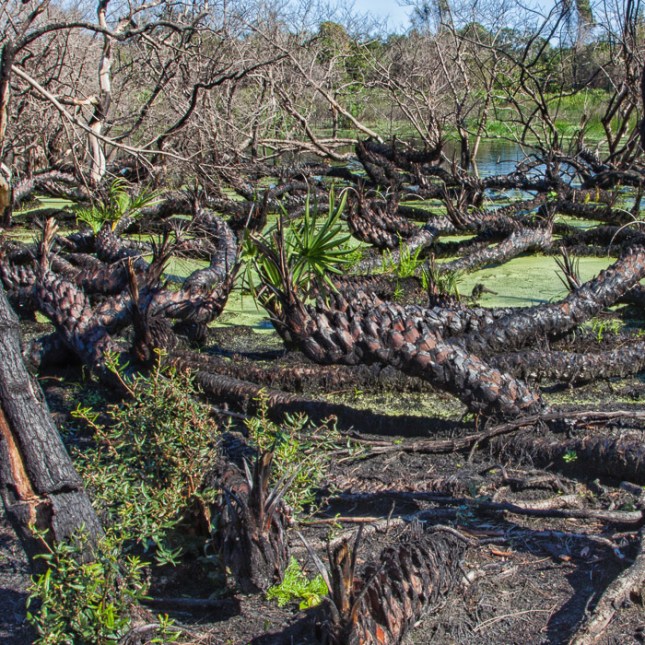
  1. Saw Palmettos cook happily in fire, and recover in a jiffy.
  2. You can make cool darts and dart launchers from the leaf stalks, but that is beyond the scope of today.
serenoa-repens-8-burn-copy-2

Scorched, and on the mend, by John Bradford

Weirder Stuff:

  1. Saw Palmetto clones can live a long time by rhizomatous spreading and branching, even if individual above-ground shoots perish or burn. Take a guess.   Botanist Mizuki Takahashi and collaborators recently compiled evidence suggesting maybe 10,000 years.  That’s almost back to the Pleistocene Epoch.    I could eat Saw Palmetto fruits from the same clone as Jonathan Dickinson, but I don’t want to.   He and I agree they are revolting. I’d rather eat a pickled prostate.
  1. The roots have air channels, hollow pipes conducting air who knows how deep into the underground. Down-bound air channels are common in marsh plant in suffocating waterlogged soil.  Perhaps my ignorance is showing, but Saw-Palmetto is the only example of rooty air ducts I know in a scrub-dweller.   The species, however, is not restricted to scrub.   Maybe the air ducts allow the roots to go extra-deep in the seasonally soggy-to-waterlogged pine woods soils where Saw Palmetto rules.    The roots need study by somebody with a shovel and a strong back

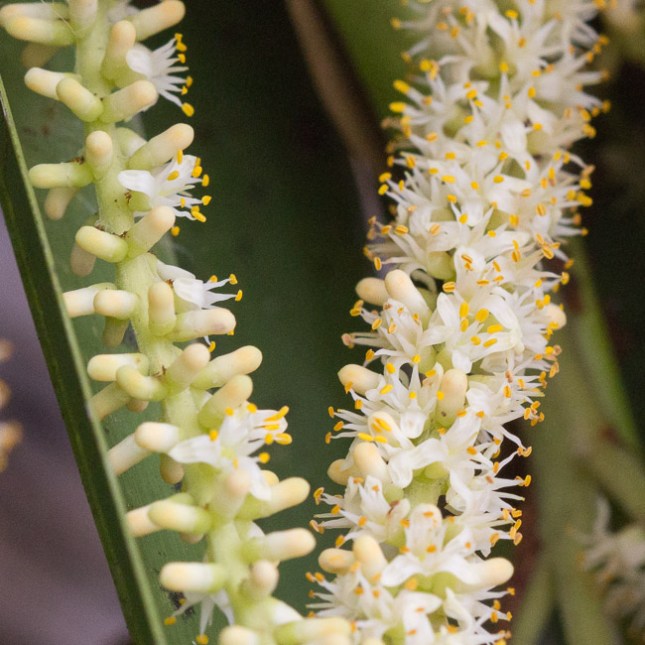
    serenoa-repens-10-gperts-copy-copy

    Flowers by JB

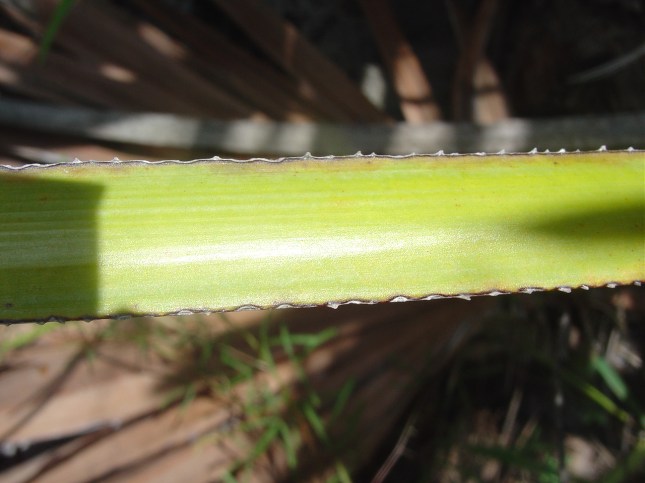
  1. The leaf stalks (petioles) have saw teeth. Duh, everyone knows that.  That’s why it’s called Saw Palmetto.   But why the teeth?   The obvious answer is to protect the palms from animals who might eat it, or might climb into it to eat unripe fruit or flowers,  or might trample it.    Perhaps, although to my outlook it is hard to imagine any animals being a big threat now or earlier in the plant’s evolution, even those giant Pleistocene herbivores mashing around.   But you never know.   In any case to go a bit beyond, any other potential benefits from the dentition?   Maybe:

Although I’ve never heard it said about Saw Palmetto (perhaps missed it), I have seen speculation that the Saw-Grass saw blades blow in the wind to slice and dice competing plants.   Makes sense for Saw Palmetto.  The leaves last 3-3.5 years, too long to tolerate pesky vines encroaching.     Look out across a stand of Saw Palmetto.  Even when the non-Palmetto plants are all entangled, the Palmetto tends to be relatively free.

Saw Palmeto is most closely related to the Paurotis Palm, which has big petiole teeth.   Those on Saw Palmetto may be more or less vestigial from big-tooth predecessors.

serenoa-repens-copy-copy

Prickles by JB

The teeth come in varied shapes, the biggest and best hooking back.   The leaf blade is a big sail attached to a long flexible petiole with those recurved teeth.  With its blade twerking in the wind, the sawtooth petiole would almost have to snag and yank any vines it contacts.

serenoa-teeth-frayed-2-copy

Why are these prickles so tatty?

Evidence that that might (repeat, might) be true comes from a magnified peep at the teeth, especially near the tops of the petioles, where the teeth tips sometimes appear abraded and frazzled as though worn out.  A dull saw, perhaps?

slothy

The rare Kiplinger prostativore, snapped by JB


Tags:

Three-Awn Grasses Are Negative Campaigners

Aristida sp.

Poaceae

Today John shot a new panoramic photo (gigapan) in Jonathan Dickinson State Park to continue documenting recovery after a prescribed burn.  That was before we left the IPad in the woods in the thundershower.  (No worries—it had a happy ending, and compelled a second trip to a lovely park.)

a-spiciformis-2

Monoculture.  See notes on photos below.

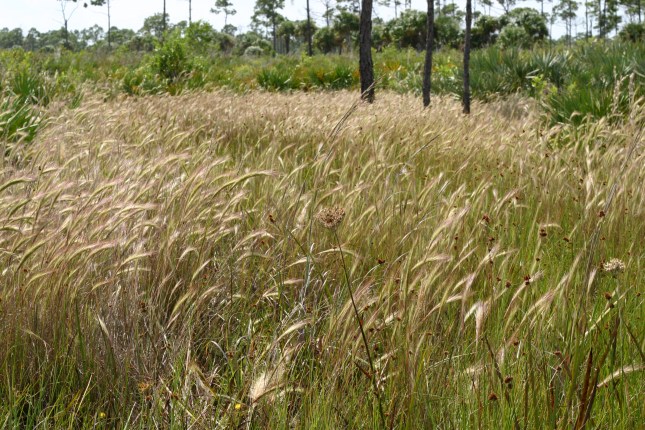
Prescribed burning keeps much Florida acreage in a fire-dependent  “early” successional stage.  A recurring thought overlooking such fire savannas is the prevalence of grasses, as opposed to understory plants from other families.  Several reasons, not of much interest today, help explain this, including fire-resistant rhizomes and the ability of grasses to rise from basal growth points after the tops succumb to  flames, to deer, or to John Deere.  Many grasses, including three-awns,  have what’s called C4 photosynthis, a special advantage in hot climates.

Let’s zoom  like a gigapan on one component of grassish domination… monocultures of just one grass genus, Aristida.     Aristidas are a big bunch, over 300 species around the warm world.   Why so successful?

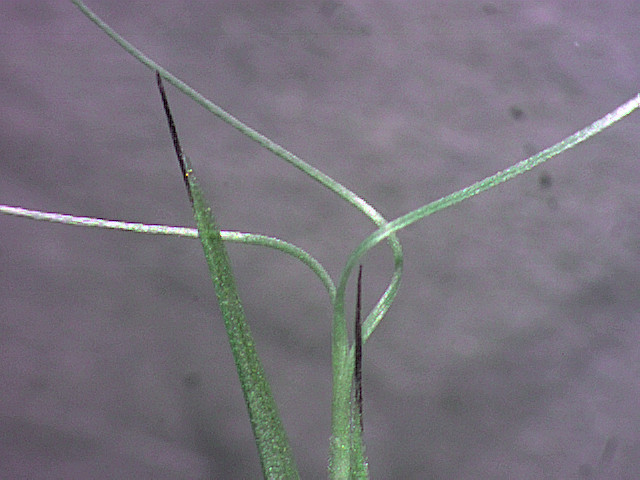
To start with a fun if not important answer, their name gives a clue about one advantage, they are three-awn grasses.  An awn is a bristle, and each spikelet (seed-head) has three of them.   What’s so great about that?

So many great things!   Herbivores probably don’t much cotton to needle salad.     Moreover, associated with the “seeds” (achenes) the awns catch on fur, wind, and water to disperse.  Also they may help lodge against other vegetation or take hold on the soil.   That awns serve diverse functions is hinted by their diversity in abundance, lengths, orientations,  postures, shapes,  barbs, stiffness, and probably responses to moisture.

a-purpurascens-awns

Awns are three, easy ID

In some species all the awns are coequals, while in others the central awn dwarfs the other two.   Many additional grasses have awns, if not in triplets, and looking beyond Aristida, awns contribute to photosynthesis and help position the seed for optimal water uptake.   To drift  into left field, I wonder if they absorb water or nutrients.

Speaking of nutrients,   how does a monospecific understory of grass secure the nitrogen it needs?    In contrast with grasses,  legumes and many  other plants have nitrogen-fixing nodules.  And frequently free-living soil microbes contribute, as does decaying organic matter.

a-gyrans-awns

Doing the twist

Now we could do the obvious and fret over how meadows of grass get the nitrogen they need to survive as the fittest.   But turn the beat around… and take a page from the presedential politics playbook.   There are two ways to get ahead,  rise up on your merits (boring), or tear down the opponents.

So, in honor of 2016, how do Aristidas manage to become President of the Park?   They are negative campaigners.  The explanation requires some shameless speculation and extrapolation of limited research.   Just read on:

Aristidas are early-succession plants, pioneers.  Any ecology book tells us that pioneer species soon give way to different replacement species, these soon booted out by bigger better species, and so forth.    Another name for pioneer species is weeds, and some very talented weeds are legumes with their nitrogen-fixing nodules. Legumes are all over Jonathan Dickinson Park, but not among the Aristidas.  Why don’t legumes and their power-nodules move in there?

Aristidas filibuster.  They expand and overstay their fair turn in the succession parade.   Some of their advantages are obvious, such as those awns, and tough rhizomes, but there’s a more interesting trick up their sleeves.   Three-awns repulse their would-be replacements by destroying the nitrogen-fixing bacteria critical to the interlopers.   Aristidas loathe legumes, turning the pretty pink nodules to black.

a-spiciformis-3

How’d you like a mouthful of that?

Of course if you deprive the foe of nitrogen you do need to get your own.   Three-awns  can probably acquire it rapidly after a fire, but so much more intriguing is the increasing research on nitrogen-fixation by grasses with the assistance of bacteria different from the ones the grasses suppress.    Purple three-awn  has associated with its root sheath nitrogen-fixing bacilli belonging to, or similar to, Bacillus (Paenibacillus) polymixa, perhaps cryptically contributing to the grasses persistence in the face of competitors.

Time to wind down,  but let this then be a lesson to all political hopefuls.  You too can grow up to be President.  Be stubborn.  Be bristly.  Be toxic.  And most importantly,  have grass-roots support.


Note on today’s photos.  These are from a project John and I worked on ca. 2007.   I do not recall who shot which.  We know what the species are but that info is suppressed as a distraction.  The essay concerns ecology, not taxonomy.

 
6 Comments

Posted by on September 23, 2016 in Uncategorized


Caribbean Apple Cactus

Harrisia fragrans


Cactaceae

harrisia-fragrans-2
Howya like them apples?  Today’s photos by John Bradford.


William Harris was a botanist/horticulturist in Jamaica.  Fragrans means fragrant.

This blazing day went to the purpose of searching the western margins of Savannas Preserve State Park and nearby near Jensen Beach, Florida, for the rare and probably-not-native Agave neglecta.   Let’s neglect the agave for today’s story.   Searching for an agave sounds like a mission to Mexico, and the scrubby ridge along the Florida East Coast RR is so high, dry,  bleached,  white,  and glaring it hurts the eyes. (Of course that may have had something to do with a prior trip to the eye doctor today. Never visit scrub when dilated.)   Today’s motorized posse were John, Savannas SP Biologist Doug Rogers, and George Rogers.

The joy of a mission is the journey, and today’s journey had a desert ambiance reinforced at every turn with multiple species of agaves, prickly pear cacti,  and best of all,  Caribbean apple cactus  I’ll bet within a stone’s throw of where Florida botanist John Kunkel Small discovered it in 1917.

harrisia-fragrans-1

Traditionally Harrisia cacti in Florida comprised a trio:  H. fragrans confined to the area we visited today,  H. simpsonii at the southern tip of the state, and H. aboriginum on the Gulf Coast.   Studies have suggested interpreting H. simpsonii and H. fragrans to be a single species.

The name H. aboriginum hints at a fun fact—Harrisia cacti in Florida have association with pre-European middens, and the tasty fruits must have been a pleasure to the earliest humans in town.   Did humans long ago perhaps bring Apple Cacti from the Caribbean, as they might have brought papayas, agaves, and who knows what?

harrisia-fragrans-5

harrisia-fragrans-6

In an evolutionary sense, Harrisia flowers were probably originally bat-pollinated, but hang on, even though they look bat-ish divergence from such possible beginnings seems to have occurred.  Botanist J. R. Sandoval and E. M. Ackerman recently studied  Harrisia portoricensis in Puerto Rico, and their observations are puzzlers:  Animal visits were infrequent, and the flowers are not matched to the needs nor ways of bats.   Those botanists, noting that most Harrisia species live on Caribbean islands, suspected that hurricane-disruption of bat populations forced the cacti to diversify their pollination help.

harrisia-fragrans-are
That is one fancy wind-pollinated flower! Maybe.   Illustration from Britton and Rose, Illustrated Cacti,  public domain via Creative Commons.

Disappointingly though, they found the flowers to be not great matches to hawk moths either, although hawk moths do pitch in. The most important floral visitor was  wind, causing self-pollination by knocking the pollen-making stamens and pollen-receptive stigmas together in the same flowers.  They called it a “wind-aided self-pollination system.”   Island dwellers learn to make-do.

Pollination study of the  Apple Cacti here in Florida might be fun and illustrative.  We don’t have much or any (?) bat-pollination. Biologist Jon Moore found beetles in the blossoms.      We have plenty of wind.

About these ads

Occasionally, some of your visitors may see an advertisement here
You can hide these ads completely by upgrading to one of our paid plans.

UPGRADE NOW DISMISS MESSAGE

 
5 Comments

Posted by on September 17, 2016 in Uncategorized