Spigelia anthelmia
(Adriaan van den Spieghel was a Flemish anatomist. Antihelmitic medications expel worms.)
Strychnaceae (traditionally Loganiaceae)
Train tracks are interesting to botanize because they represent severely modified habitats, because the stone used for the rail beds is geologically novel for our area, and because trains spew fruits, seeds, and plant fragments from points yonder. Today I stopped briefly along the track leading from WPB to Indiantown for a quick peek, and such a peep never disappoints. In the rocky rail bed is a native annual nobody would call rare, yet not encountered often around here: Spigelia anthelmia. Lots of them.
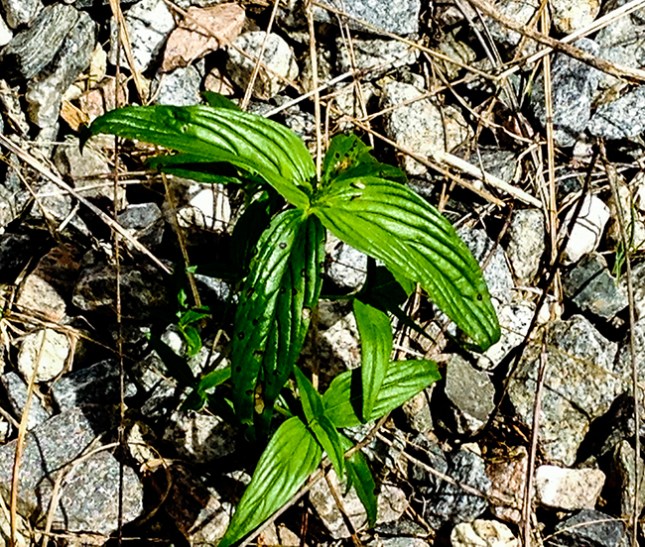
Spigelia anthelmia today on the RR tracks
U.S. Spigelias are a weird bunch, one is a stunning wildflower, two are rare and localized in Florida, and a Brazilian species buries its fruit ostrich-style. But let’s stay local.
This is a plant with serious history in traditional medicine. (Warning—cardiac-poisonous.) Throughout its natural distribution from South America through the Caribbean into southern Florida, West Indian Pinkroot has medicated several cultures in multiple languages. Moreover, weedy dispersal in Africa, India, and Asia has spawned similar uses across the sea. Relatively minor applications include treating hearts and killing fish.
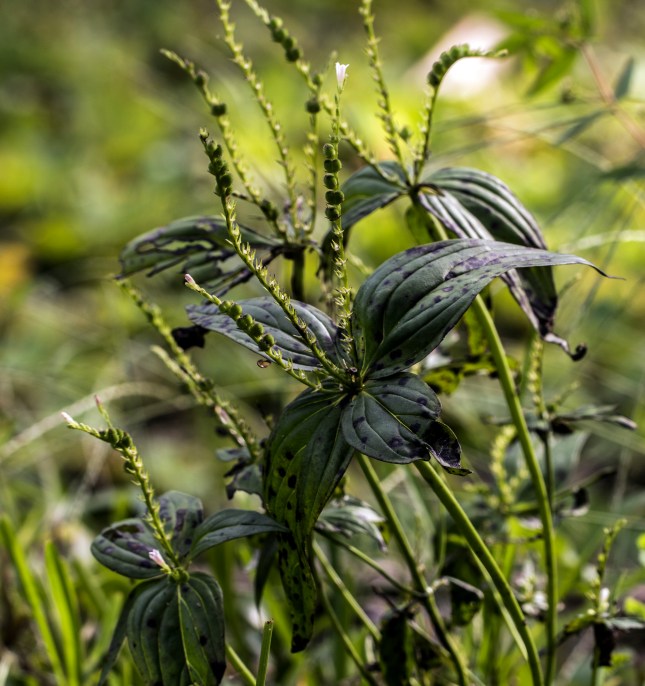
The superstar therapy from Spigelia anthelmia is to evict parasitic worms. The practice is hundreds (thousands?) of years old and widespread. The founding father of plant classification, Carl Linnaeus, who named the species, helped write a book on the Spigelia anthelmia worm cure in the 1750s. Linnaeus was as physician, by the way.
Does it work? I believe so, but stand back. Some of the most diverse and potent bioactive compounds in plants are alkaloids (caffeine, nicotine, ephedrine, heroin(e), morphine, cocaine), and Spigelia anthelmia yields many. It is not kidding around. The root crushed and sniffed sends a dagger into the sinuses. Of these, the best known, perhaps the main worm killer, is called spiganthine.
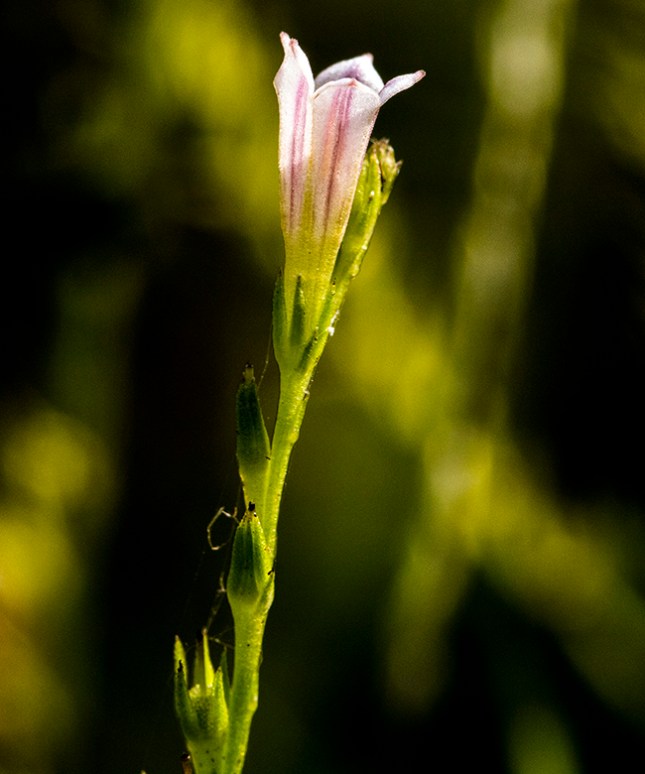
A self-pollinating flower
The poisons are so prevalent and the history in medicine so robust, the species has attracted modern research, and it is available as a homeopathic tincture. The plants are a potential cheap locally produced source of worm-be-gone for livestock where commercial pharmaceuticals are too expensive.
The fame as a de-wormer no doubt comes from proven effectiveness, despite collateral dangers. Yet a secondary factor may have contributed to the glory. Long ago people often interpreted the appearances of plants as clues to benefits. For example, a flower shaped like a fetus hinted at help in childbirth, and so forth. Although not THAT different from other roots, the Spigelia root looks a bit like a veterinary nematode.
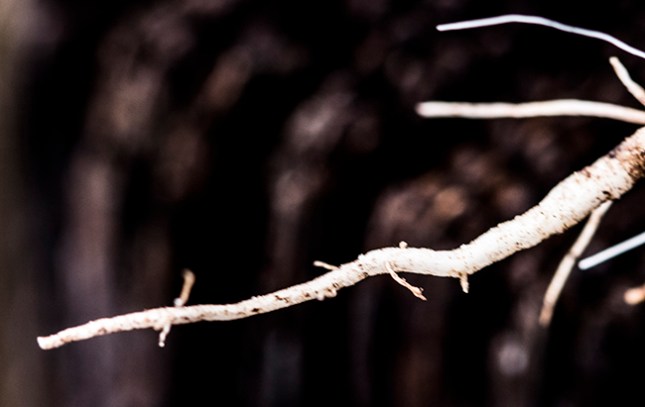
A little wormish maybe?
All that toxicity may have another benefit, to protect the regal cydosia moth which occupies today’s species as a larval host. In fact, Spigelia anthelmia may be its only Florida host, as the moth relies on members of the Loganiaceae or Strychnaceae, and the local menu offers few.
Look closely at the old botanical illustration below and enjoy a quick botany lesson. The organ labeled “E” is the pistil. The sexual process requires rootlike threads sprouting from pollen grains on the fuzzy pistil top to grow down inside the pistil and deliver sperms to eggs at the broad pistil base by the letter E.
Spigelia has an odd checkpoint along the sperm delivery pathway. Its pistil snaps off at that black suture running across the pistil inside the red box. Why? In most Spigelia species the snap-off presumably happens after the initial sperm delivery in order to prevent unwelcome late inseminations.
Today’s species is a special case, however, being self-pollinated. Botanists have interpreted the snap-off in S. anthelmia as a means to allow the stronger pollen to achieve delivery, followed by snap-off to block slower-growing tubes from genetically defective pollen resulting from the extreme inbreeding. It is culling the pollen the same way a breeder may cull defectively inbred puppies.
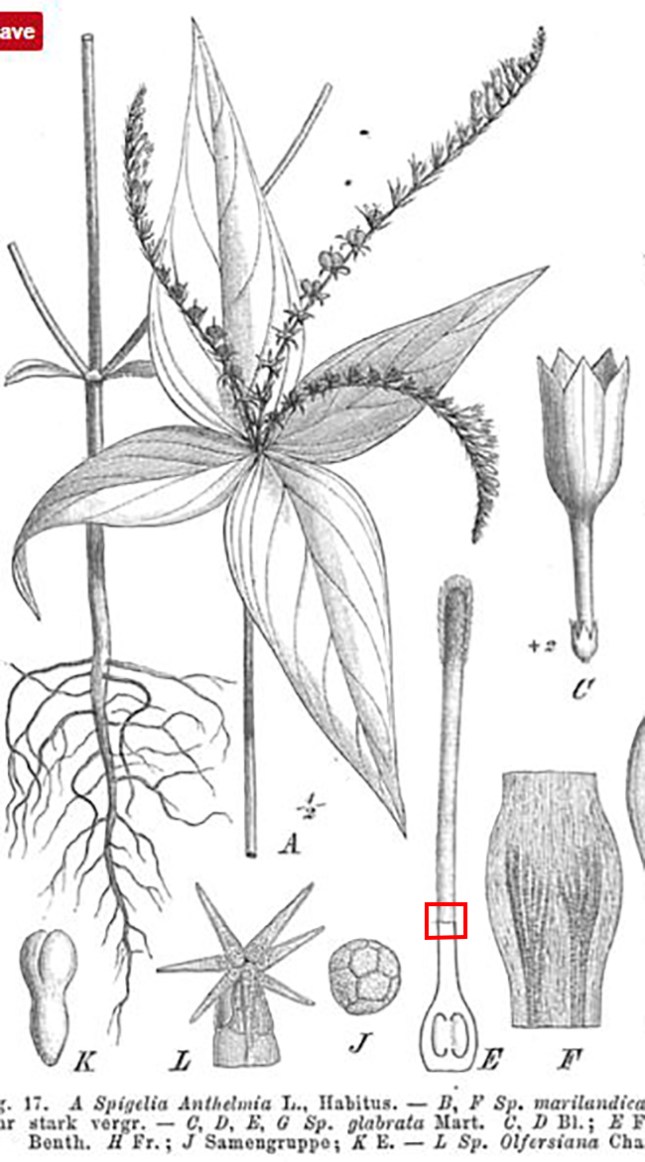
The tall organ marked E is the pistil. The sperm delivery tube must grow from pollen at the fuzzy tip downward to the broad base by the letter E. The snap-off point is the line inside the red box.
Looking on the advantageous side, a plant able to fertilize itself can establish a new population where one lone seed may drop…perhaps off a choo-choo rumbling past Jupiter.
 John Bradford
 George Rogers
 George Rogers
 Dee Staley
 Treasure Coast Natives

Steve
October 15, 2016 at 7:17 am
Awesome article, and RR tracks rock!
George Rogers
October 15, 2016 at 1:53 pm
Hi Steve, Thanks…bet you’ve found some odd items along the tracks here and there. You ever have any involvement with the more northerly Spigelias?
Suellen Granberry-Hager
October 15, 2016 at 7:48 am
Interesting links. The regal cydosia moth is a new one for me. Maybe next time you teach the Weeds class you should take them to some railroad tracks.
George Rogers
October 15, 2016 at 1:54 pm
I’m scared to take myself to the RR tracks … images of mishaps increasingly narrow my class fieldtrip ambitions
Annie Hite
October 15, 2016 at 11:25 am
Would you ever have time to speak to a garden club? You have quite a following with Jupiter-Tequesta Garden Club members.
George Rogers
October 15, 2016 at 1:55 pm
Hi Annie, sure, especially so nice and close and convenient.
Mal Levittoux
October 15, 2016 at 3:33 pm
i am such a happy reader, it is all so interesting, thank you, George
George Rogers
October 15, 2016 at 4:27 pm
Thanks Mal, Can hardly wait to see what you’re up to today…
theshrubqueen
October 15, 2016 at 4:51 pm
I will go and look at my RR tracks – I think it is BPepper down there! Bought Coontie today, very happy.
George Rogers
October 16, 2016 at 8:42 am
The RR tracks up through the Jensen Beach area are a botanical wonderland. A coontie is a little green bundle of joy. Wonder if its a boy, or a girl.
theshrubqueen
October 16, 2016 at 8:56 am
I will have to look, I walk by the tracks frequently. Not sure about the Coontie, I will look closer. Tomorrows vase will have Hymenocallis from the natives garden.