Cephalanthus occidentalis (= “western flower-head”)
Rubiaceae (Coffee Family)
This morning John and I visited the Cummings Library, Palm City, Florida, to lead a brave and heat-tolerant posse into a small Hypericum Marsh associated with the Library. Even tiny natural areas can be diverse, in this case with everything from flowering Loblolly Bay Trees to tiny insectivorous Sundews. One of my forever favorites is in bloom there, Buttonbush with its spherical bleached white flowerheads fragrant like perfume in Macys, and buzzing with bugs.
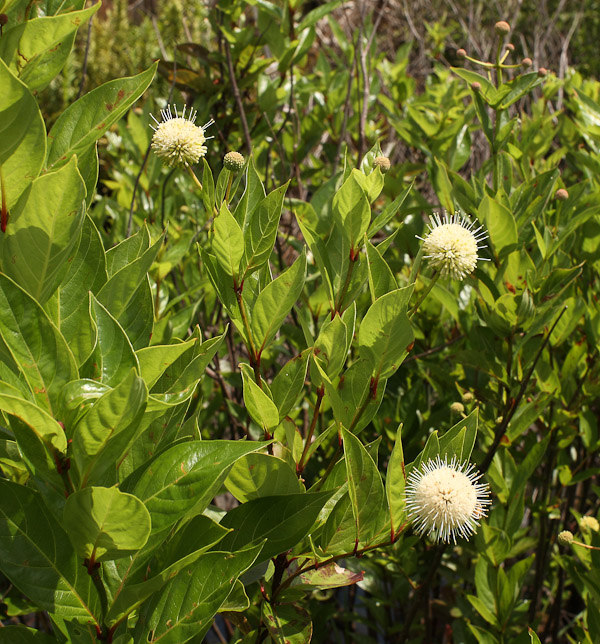
Sputniks by John Bradford
The agreeable shrub has a place in ornamental gardens, sometimes under the fitting cultivar name ‘Sputnik’. (It looks far more like a virus but that name wouldn’t sell many.)
It is better off in the swamp. In fact, Palm City is my second Cephalanthus encounter within a few days, the prior in Michigan. There we were exploring botanically a remote wetland notable for housing the rare Copper Bellied Watersnake. Zoology and botany converge: the threatened snake likes to linger on exposed Buttonwood root masses to the point that today’s shrub is recommened for planting to restore the snake habitat.
By JB
You might ask, “why does the shrub have oversized irregular roots exposed up where snakes hang out?” Plants in wet soils have diverse mechanisms to cope with deoxgenated mud. Many have ductwork to ventilate their nether-regions. Some use fermentation down there. Some sprawl surface roots across the wet mud.
Buttonbush has its own approach. It sprouts tangles of new roots above the suffocating ooze. The bush adjusts the height of its supplementary roots to rising and falling water levels.
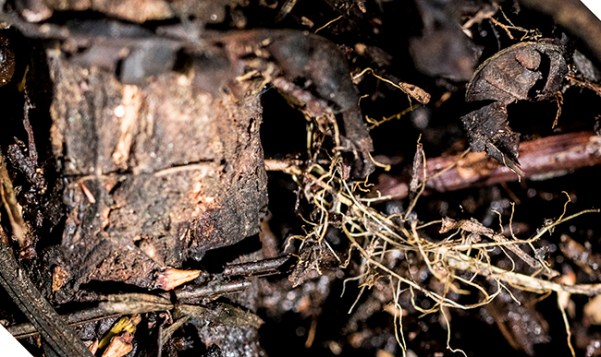
White roots coming out of the stem at the trunk base, just above the wet mud
What pollinates those fragrant flower balls? Just about every nectar-loving creature able to cruise a swamp. Perhaps moths are the original chief agents, but butterflies, bees, flies, and even the odd hummingbird participate.
And to keep asking questions, why have hundreds of tiny flowers clustered in a compact head, as opposed to making one big blossom? The textbook-type answer is that a visit by a lone pollinator fertilizes many individual flowers in one swell foop. The flowers then mature into countless little dry fruits dispersed by migrating waterfowl swamp to swamp.
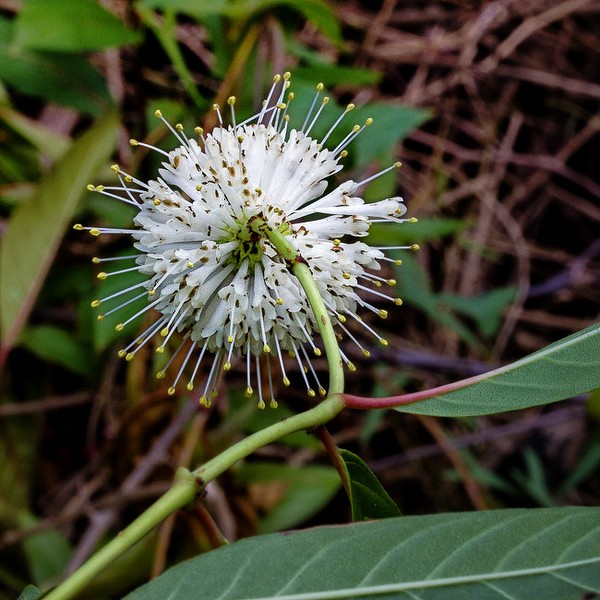
Look closely at a flower. Anything missing? The big stigmas jut out of the flowers like Q-tips radiating out of a golf ball. Stigmas are the female pollen-receptive organs. The male pollen-making anthers, by contrast, remain hidden. They release pollen while in the bud onto the stigmas, frosting them yellow pollen, then the stigmas emerge all yellow-dusty-topped. But wait—wouldn’t that be self-pollination?
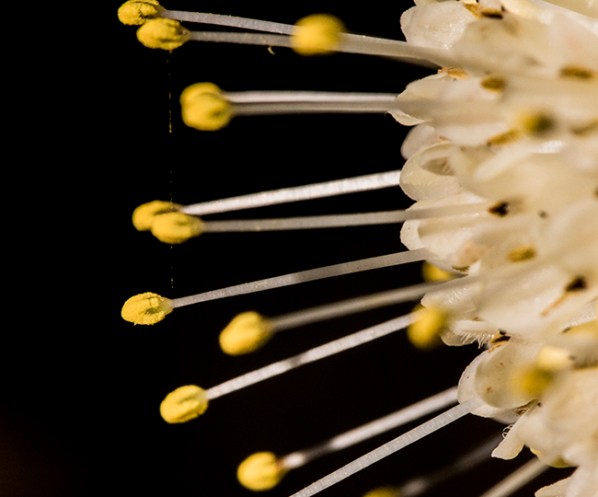
Q-tips. Stigmas covered with yellow pollen.
Not generally, and here is why: the self-pollen on the stigmas dusts off onto visiting insects but cannot consummate the sexual cycle on the flower of origin. The only pollen the stigma lets proceed sexually is that the pollinators drop off from other Buttonbush individuals. So then, on one stigma there are two pollen populations, some grains passively awaiting departure, and recent arrivals ready to boogie.
A long history of service in food or medicine does not mark a species as safe to ingest. Among many historical ethnobotanical uses of Buttonbush, its main recurrent traditional role is as you might use aspirin, relief of pain and discomforts. But please stick with CVS. There are also bioactive compounds able to cause convulsions, paralysis, and vomiting, even fatally. Don’t ingest wild plants!
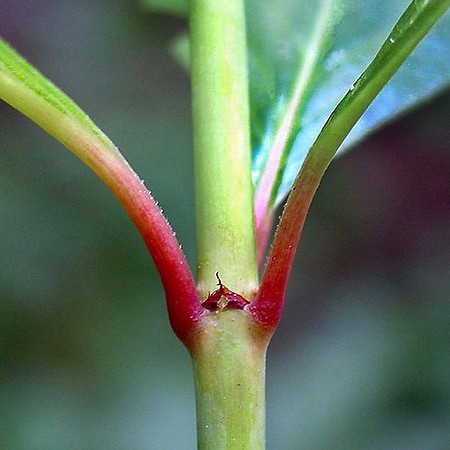
Triangular flap, stipule, between leaf bases. Colleters are hidden beneath. By JB
The leaves are opposite or in whorls, with a triangular flap (a stipule) on the stem between the adjacent leaf bases. Peel back that flap and find erect micro-fingers called colleters (CALL-uh-ters), as in many Coffee Family species. These cryptic glands are not studied well. They secrete mucilage when young, probably to paint the immature bud protectively, although conceivably also to feed symbiotic ants in exchange for defensive services. This question needs study.
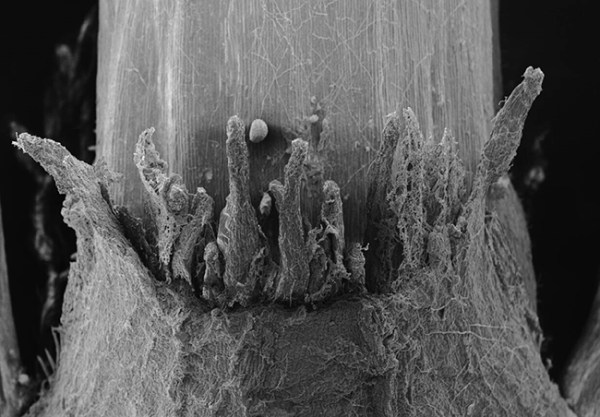
Scanning electron microscope view of the colleters on a young stem, stipule removed, courtesy of Dr. Robert Wise, University of Wisconsin
 John Bradford
 George Rogers
 George Rogers
 Dee Staley
 Treasure Coast Natives