RSS

Author Archives: George Rogers

Unknown's avatar

About George Rogers

Florida botanist

Cooties on the Carapace and Suctoria’s Secret

Starring Pseudemys species

Emyidae

With co-star  Basicladia chelonum (Arnoldiella chelonum)

Holidays make for idle hands—a an extra opportunity for swampy play.   Thus the off-schedule post.  Happy 4th!turtle with algae better - Copy - Copy
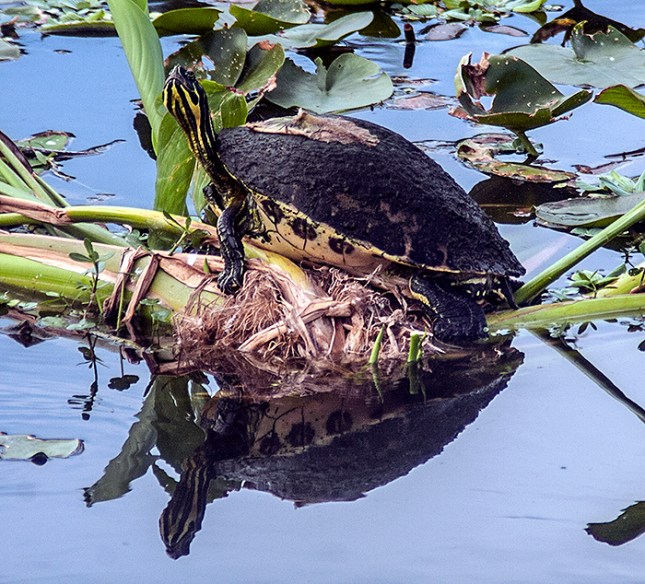
Ever notice how cooters on logs have a shag carpet on their backs?    Today I snitched a pinch of turtle turf and enjoyed it microscopically.    The turtle was not even inconvenienced.

Teachers like to cite the turtle toupee as an example of the ecological relationship called commensalism where one party gains while it’s all the same to the other: a “win—I don’t care” relationship.     In such Kindergarden accounts the algae gains a happy home with no consequence to Yertle.

But it is richer than that.     First of all, although multiple algae and some cyanobacteria ride turtles, the alga Basicladia chelonum rules—it lives exclusively on turtles, and is abundant on them.   The alga has evolved  100 percent dependence.
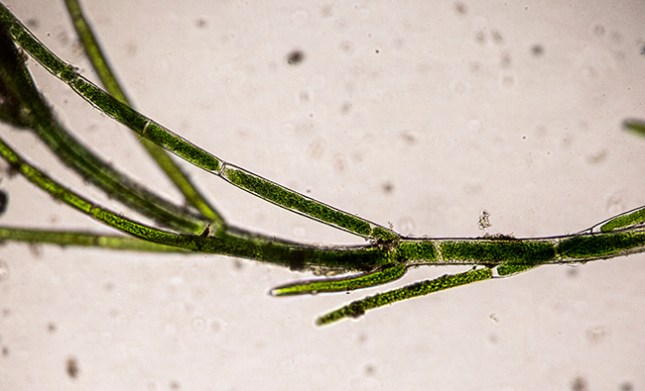
Basicladia branched

Off the turtle.  I believe this is Basicladia chelonum.  Trust my ID if you dare. Microscope view.

The piggyback alga is unknown to harm its host.   And perhaps it’s a friend with benefits.   Biologists in the 1950s kicked the question around inconclusively, speculating that the algae perhaps give camouflage.    But what  hungry beast worries an armored  turtle?    If the alga is camo, it hypothetically helps the lurking turtle hide from its prey, until snap!   Personally strikes me as far-fetched, but then again so do helicopters.

Another old hypothesis is that the algae are turtle food.    Can you imagine one trying to reach around and grab salad from its back?      Nobody thinks that, of course, but do turtles eat algae off of each other?  (Hours sitting in canoe with binoculars and note pad.)   Also possible,  maybe the algae are a big green evaporative cooler.   Like any of these ideas?    Nobody has done enough research to know.

There is another possibility.  In 2005 engineering student Colleen Bennett studied the antibiotic effects of Basicladia algae.  A sanitary turtle is a happy turtle.
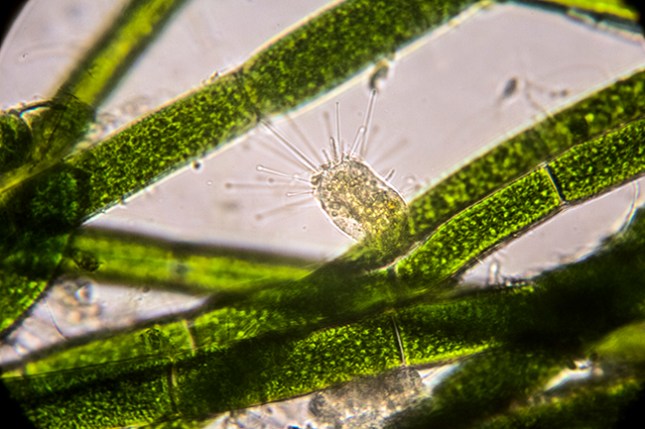
Basicladia suctorian

Hey—what’s that on the alga?

The algal fuzz is creeping with life, an inhabited little planet.  The creatures on the shell wonder if they are alone in the turtleverse, or if there are other turtles out there with alien life.    What can you find in the wet green carpet?  Answer…more than I can list.   More than I know.  Probably some “new species.”   Let’s see:  tiny tagalong algae of many sorts,  microcrustaceans,  and my personal favorites, a  menagerie of weird  Protists resembling creatures from another galaxy.

Today I found Rotifers, peppy little “wheel animals” spinnin’ and popping.  Here is one fresh from the turtle.

CLICK TO SEE FOR YOURSELF.

They were loitering with Suctorians.    Now, Suctorians are about as odd as critters can be, and yes they suck.  Suctorians have tentacles,  usually in paired tufts  and with swollen tips.   When a small creature touches,  the tentacles stick, sting, and suck.    I mean it…they suck the vital juices right out of the prey.  Suctorians are not nice, and they have poor table manners.  CLICK HERE to see a Suctorian from the catch of the day brandishing its right to bear arms.    Spoiler alert:  its movements are subtle.

The takehome lesson is the topside of a turtle is a squarefoot ecosystem.   It’s hopping and happening.   And severely under-studied so far as I know.   What else is lurking in that little green jungle?  and is the turtle really so oblivious?
 
6 Comments

Posted by on July 5, 2016 in Uncategorized


Sunny Bells, Heads Down, Seeds Up (Sometimes)

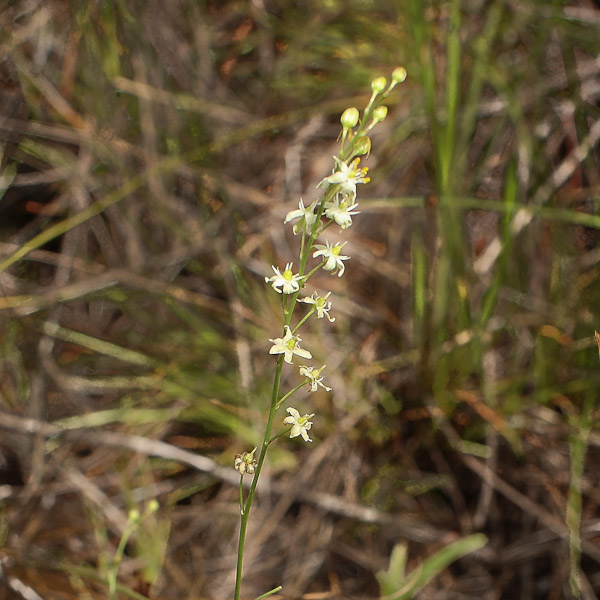
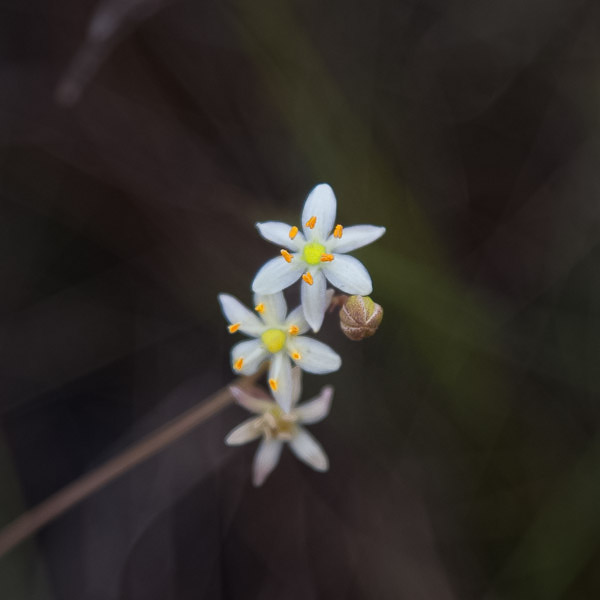
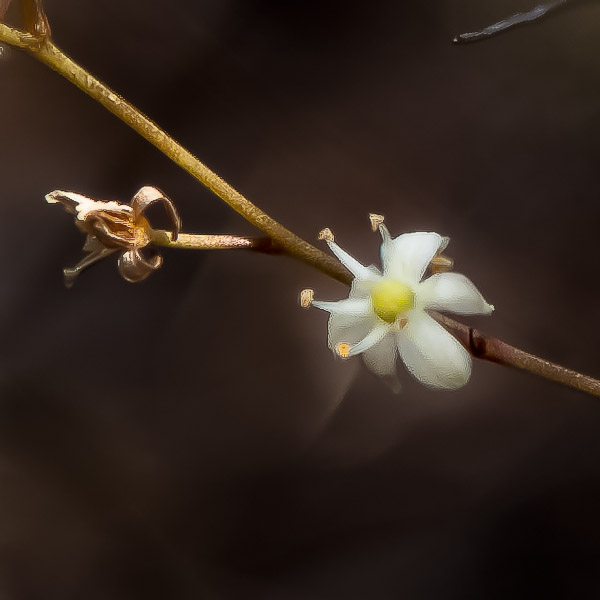
Schoenolirion albiflorum

Agavaceae

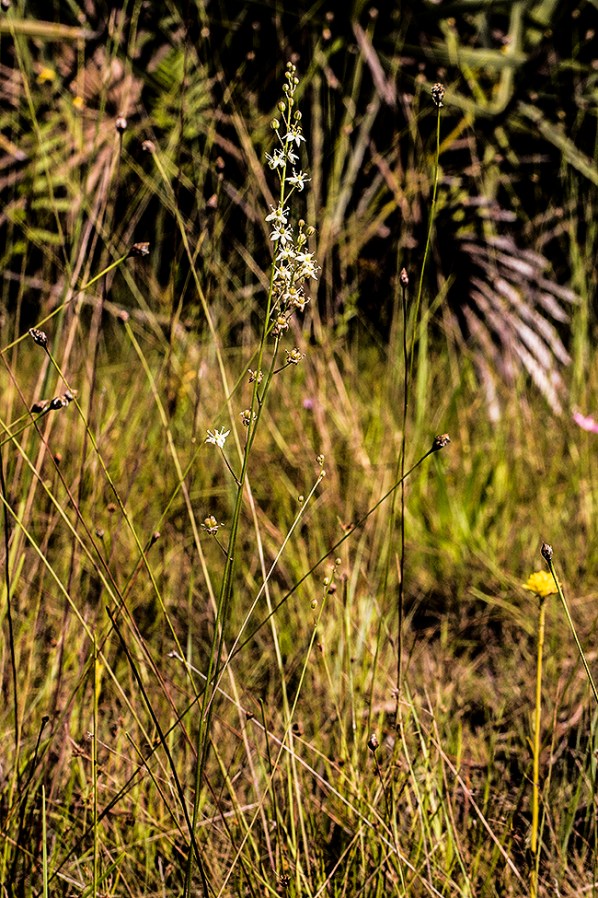
Today John and I explored Riverbend Park at the western edge of Jupiter, Florida, one of the most biodiverse natural areas hereabouts.    You always encounter something cool, from liverworts to turkeys.  This morning the pileated woodpeckers were knocking on wood.  Our primary objectives were water horn ferns, Ceratopteris pteridoides, but John has not processed the images yet.  No problem, Riverbend has plenty to ponder.   In bloom today was a pretty little curiosity some call Sunny Bells.   Its branched wands of white bells rise from a rosette of knitting needle leaves down in the wet marsh soil.

Schoenolirion far

The habitat. How it looked today.

Normally I don’t chat up boring taxonomic relationships.    But maybe you will find Schoenolirion a tolerable exception.   Won’t take long, the entire genus is just three species.  Like many genera around the fringe of the massive Lily Family,  Schoenolirion  has a checkered past of inconsistent assignment to different families.    Lily-relatives have been a taxonomic bugaboo for a long time.    DNA places Sunny Bells in the Agave Family, anchored in Mexico and the western U.S.

A lot of Florida plants have Tex-Mex ancestry.    Although we can’t know about extinct species, the three living Schoenolirions seem to reflect two separate lineages branching separately out of the Southwest, one  offshoot headed north and east (Georgia, NC), the other to the south and east (Florida), and the third species left behind out west.   Schoenolirion wrightii is the westernmost species, extending from Texas into Alabama.   It seems to show its Agave Family xeric origins in its habitat preference, out-west dry after a wet spring.    The chromosome number is 24.  Hang on to that number. It matters. Two dozen.

Schoenolirion albiflorum 1

Does it look like an Agave?  (Yes, a little) By John Bradford

The species that split off to the north and east is Schoenolirion croceum, sort of “centered” in Georgia to North Carolina (and in Texas).  This species is so similar to S. wrightii that its status as “separate” is dubious, although it has two idiosyncrasies.  1.  Its chromosomes numbers are mixed as 24 (rarely), 30, and 32.    That’s just weird, and there is another difference,  2. yellow (vs. white) flowers.  So if Texas is the original home Pardner, this species headed northeast altering its flower color and “experimenting” chromosomally.

Schoenolirion albiflorum 2

By JB

That brings us to our own S. albiflorum.   It too could be seen as having its origins in Texas or Mexico,  resembling its western cousin S. wrightii by retaining white flower coloration, by doubling wrightii’s chromosome number to 48 or 49, developing a branched inflorescence (vs. unbranched in the other two species), and switching from seasonally dry to almost always wet.     Interestingly, the other two species have bulbs at their bases, but not S. albiflorum.  Maybe a bulb is no asset in 24/7 wet habitats.

Schoenolirion albiflorum 3

By JB

What S. albiflorum sports in place of a bulb is unusual.   It has a short vertical rhizome which dies at the base and regrows at the tip.   From the rhizome radiate contractile roots.    Contractile roots work like rubber bands by shortening and pulling the rhizome continually downward safely into the soil, like a turtle’s head contracted into its shell.  Sunny Bells keeps its head down!

Turn back a moment to S. croceum, the yellow-flowered species centered in Georgia.  The seeds have an unusual two-fisted adaptation.    Many species have seeds unable to germinate until they experience a cold period followed by warming in the spring.  Others require a warm spell, thus sprouting during or at the end of summer.  Neither is remarkable.   And now for the good stuff:

Schoenolirion  seeds work both ways.  A warm treatment kicks them to sprout, but with a proviso, only in the dark.   Thus they begin growth in the autumn strctly underground out of harm’s way until spring,  when they can surface into the light of day already growing with a head-start.   Alternatively, a cold treatment can do the trick, but, unlike the warm-treated seeds, the cold-treated seedlings rise readily  in daylight.   Thus in the spring the species has a first team and a second-string.  A  batch of the older fall-sprouted seeds are ahead of the curve, but only if they survive winter.   If the frosty months kill the sooners, no problem, Sunny Bells has a fresh spring cohort eager to rise and shine with no further delay.

If you are now grousing, well, yea, classification boring, you still have a shot at amusement.    Here’s a useful little snippet from an old ethnobotanical report:

schoenolirion snip

Large leaf?

Sandhill

Sandhill Cranes bound for Riverbend!

 
4 Comments

Posted by on July 1, 2016 in Sunny Bells, Uncategorized


Tags: , , ,

White Indigo Berry, bob bob bobbin’ along

Randia aculeata

Rubiaceae

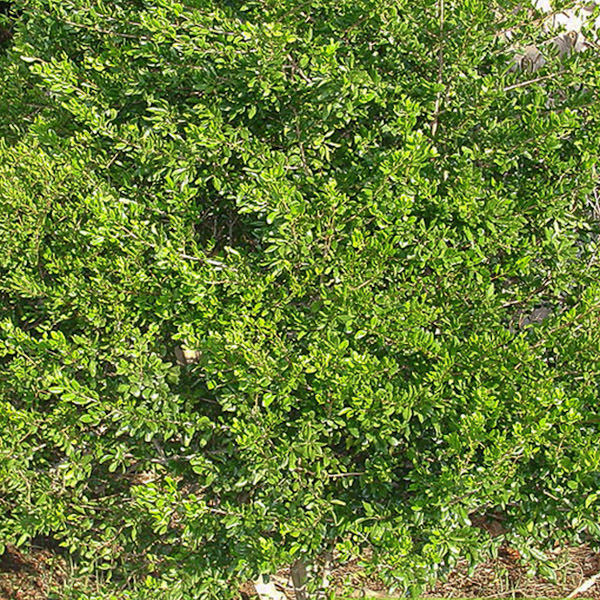
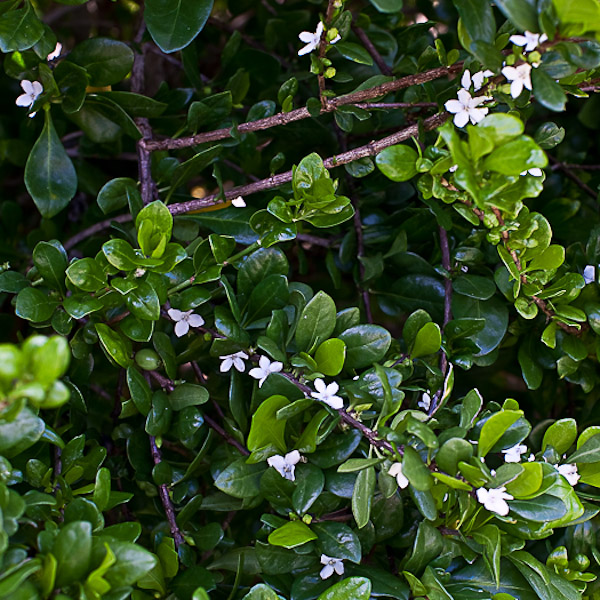
John and I today botanized Maggy’s Hammock near Pt. Salerno, Fl, one of the nicer and botanically rich hammock remnants we know in Martin County, complete with massive oaks,  handsome hickories,  lancewoods,  and graytwig bearing fancy stinkbugs.   In flower was one of my all-time favorite plants, White Indigo Berry, Randia aculeata. (Aculeata means thorny.)    This gnarly, spiny slowpoke ranges from Florida through the Caribbean to South America.  It is poorly studied, which is a pity, because this idiosyncratic shrub clearly harbors secrets.  We’ll guess at some.

Randia aculeata 1 - Copy

W.I.B.  Photos today by John Bradford.

A member of the Coffee Family, it is related to Gardenia, and thus has fragrant flowers looking like those on coffee itself.  Even smellier, the related Randia ruizana a perfume plant, called Angel of the Night.   Bees, butterflies, and who knows what else visit our species, perhaps moths?
As a good member of the Coffee Family, Randias are little green Big Pharmas.    Every plant you encounter has some history in medicine somewhere, or some positive medically compelling screening result,  but species of Randia  have more historical and present-day points of medicinal interest than you can shake a stick at,  serving for everything from parasitic worms to easing pain,  an attribute well known in other members of the family.   In Mexico White Indigo Berry is traditionally the Rx for venomous serpents.  Just what the doctor ordered when the doctor is a snakebite specialist known as a culebrero.   (Culebra = snake.)  Silly legend?   Now hold on, before that derisive snort  consider a study by the National Polytechnic Institute in Mexico City illuminating multifaceted ways  Randia aculeata extract protects mouse tissue from toxic venom.
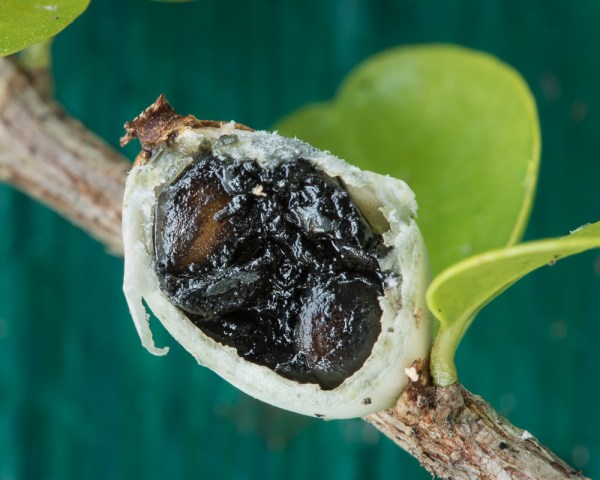
The fruit has a specialized structure.   When ripe it is about the size of a marble and white or creamy on the outside.   Inside, though, the seeds are plastered in a dark blue pulp.    The blue goo gives blue dyes for skin and fabric, including calico.

Randia aculeata 2 - Copy

How it looked today

I guess the pulp might be more or less edible (?) although not attractive, although the many bioactive contents worry me.  Randia eaters might prefer Randia formosa (Rosenbergiodendron formosum)  known as Blackberry Jam Fruit, which offers more-luciousness.

Randia aculeata 4 - Copy

The goo shrinks and coats the seeds.

General experience around White Indigo Berry shows a lot of the fruits not to wind up as bird food, although many perhaps do too.    I think we have a case of an originally fleshy birdfood fruit evolving into a bobber riding the ocean waves.  Did I mention that Randia aculeata favors maritime habitats?    The dark inner pulp shrinks,  coating the seeds and creating air space.

That flesh is called “pulpa.”   It is not ordinary fruit flesh, but instead comes from the innermost fruit layer in intimate contact with the seeds.   I bet this material contains germination inhibitors to keep the seeds safely asleep while afloat, like Astronauts in suspended animation for 1000 years en route to a distant galaxy.

To descend deeper into shameless speculation,   species of Randia, like many plants, make mannitol.   In the plant world as well as in the hospital, mannitol can help restore or alter electrolyte balance,  which is why it works as a laxative, drawing water osmotically into the intestine.    A fruit floating in the salty sea may need to draw in water osmotically too, given its bath in the water-sucking salty sea.   Mannitol in the pulp might help, and/or it may retain precious water elsewhere in the plant coping with a dry sandy salty habitat.    Mannitol or not, that tar covering the seeds obviously protects them physically, and the toxic ingredients probably suppress stowaway bacteria and fungi during the voyage.

 
7 Comments

Posted by on June 25, 2016 in Uncategorized


Match Weed

(with many silly English names having to do with fogs, and frogs, turkeys, and tangled feet you see in books but never hear any real person use)

Phyla nodiflora (Lippia nodiflora)

Verbenaceae

Too hot and stormy for fieldtrips today, so John and I worked inside, where I learned a photo thing or two from the Master.

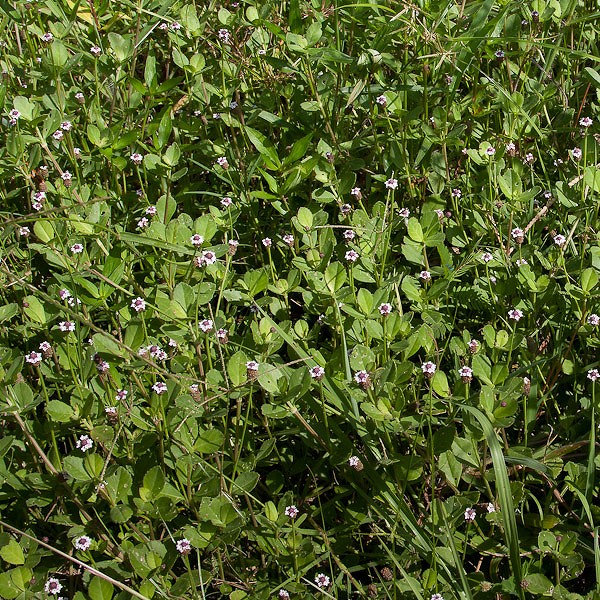
If you live in a warm region anywhere from West Palm Beach to India, chances are you can go outside and within a few minutes find Match Weed. There’s one near you.   This pantropical weed grows anywhere it is warmish and not too dry, including sun, shade, lousy turf, canal banks, mud flats, and on and on.   Some see it as a lawn replacement. Many see Phyla as a medicinal plant.   It is related to the natural sweetener Lippia dulcis. To others it is an invasive exotic menace.  Some sell it.  Some sell herbicides to destroy it.    And speaking of toxic herbicides, this plant makes its own to suppress the competition.  Is the species native to Florida?  Well, “native” is tough to pin down with worldwide weeds.

phyla jb

Photos, except microscope view, by John Bradford

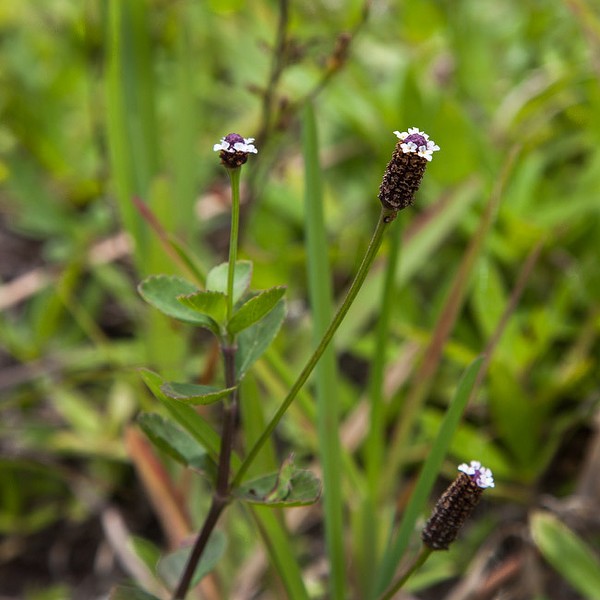
This pretty plant is a mighty weed.   A horizontal running stem scoots across the ground like a road seen from a helicopter, every few inches producing nodes (nodiflora)  bearing a tuft of leaves, a cluster of roots, and a stalk a few inches tall with a compact flowering spike.   Each node can “stand alone” if the sprawling plant fragments, or the interlaced runners can carpet the ground as a single genetic individual.   Immortal.

If the weed decides to reproduce in a fashion besides fragmenting its stems, there is a plan B, plus a plan C to make baby Phylas.  Fog Fruits. Frog Fruits. Turkey Tanglefoots.

phyla nodiflora jb far

Plan B is good old-fashioned pollination.   This is a “textbook” butterfly-pollination species, supplemented by reported suspected pollination by bees and even by ants.  The anthers at the entrances to the teensie flowers near the ground are ant-accessible.   The spikes mature slowly from base to top, having old spent flowers below and unopened young buds above.    The flowers change color, as many blossoms do, first sporting a yellow eye, later transitioning to a purplish eye indicating altered nectar-availability status.

Plan C covers the contingency of no pollinators.  A handy skill for a mobile weed, the flowers can pollinate themselves without help, thank you very much, and make seeds independently.

Phyla nodiflora 3

Matchweed has matchless eco-superpowers.  It inhabits a sandy meadow behind my house,  and yet you could find some far away in a seasonal lake bottom,  or on nasty gypsum,  or most remarkably in salty  wetlands subject to occasional maritime flooding.  A study from California found Phyla exuberance enhanced by increasing salinity to a point.   The leaves have tiny salt-secretion glands.  Pass the salt!  No worries.

phyla hair

All aligned the same way, these bumpy anklebiters cover the underside of the leaf.   I am not sure, but the scattered small dots might (might) be the salt secretion glands.   Highly magnified microscope view.

Match Weed is not just a butterfly nectar plant, but also larval nursery for multiple species of lepidopterans, including the Common Buckeye Butterfly.   Maybe all those caterpillars help solve a mini-mystery.  On the undersides of the leaves are of specialized “hairs” all lined up in the same direction.  The hairs are roughly T-shaped, broad at the center, and tapering to a sharp point at each end.   Attached at the center they look much like the cleats used to secure a rope to the deck of a boat, if nautical cleats had wicked sharp ends.    Or maybe that twirly spinning sprayer thing on the floor of a dish washer. Weird, and scary looking.    Similar deterrents occur in other plant families, and are called “malpighiaceous hairs.”   In any case, a caterpillar cruising the leaf and munchin’ the free salad might get the point.

 
17 Comments

Posted by on June 17, 2016 in Phyla, Uncategorized


Tags: , , , , ,

Tarflower is Tacky

Bejaria racemosa

Ericaceae

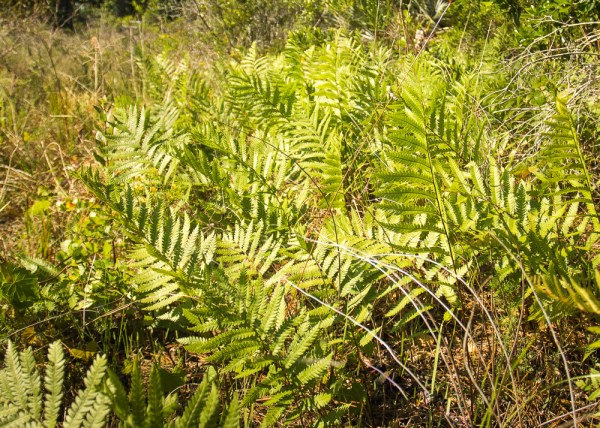
Today John and George beat the rain to the Haney Creek Natural Area in Jensen Beach, Florida, always a joy to visit with ponds, marshes, scrub, and pinewoods all jumbled. It was pretty there today, with Liatris starting to bloom, Cinnamon Ferns in  morning sunflecks, and Tarflower showing off all around.

Bejaria racemosa 4

Tarflower as it looks in June.  The photos today, except for some details to show specific points, by John Bradford.

Tarflower is a curious shrub in the Azalea Family representing locally a genus of about 15 species otherwise in Tropical America, mostly high-elevation South America.   Good lookin’—with big white and pink-infused flowers aplenty, followed by woody capsules resembling sliced bundt cakes.  So striking yet skimpy in the nursery trade?    Reportedly a nuisance to propagate, and presumably fussy about its conditions.

If you live in the scrub your ecology is automatically interesting, and today’s species has notable quirks.   You seldom encounter another shrub with a bristly-er stem, which makes Tarflower easy to recognize at any age, any season.    An aphid’s nightmare.

Sierra Exif JPEG

Bristly!

A more notable quirk gives the shrub its name.   Clear, super-sticky viscous stickum covers the flower.   Sometimes enough to form drops.  It reminds me of freshly applied varnish.

Bejaria racemosa sticky

Strong glue

And why does the plant pump it forth?

Possibility number 1.    The obvious first thought is it’s tanglefoot to protect the flowers.    Cooties may come looking to munch soft petal tissue or to pilfer pollen.  They check in, but don’t check out of the Tarflower Hotel.    Wouldn’t it be something if the goo had insecticidal or antibiotic ability along with being passive flypaper?     People who don’t get to Dollar General have actually used it as flypaper.    (Remember that when you go off the grid.)  Yes, arthropod stiffs often mar the delicate alure of the floral display.  With no data or evidence, possibility number 1 disagrees with my hunches.

bejaria racemosa trapped bug

Shoulda listened to Mom!

Possibility number 2.    Why do you varnish a picnic table?  Tarflower makes big, abundant, kinda-delicate flowers in the nastiest conditions: wind, drying, pelting rain, withering heat, UV.   John and I aren’t tough enough to stay in the scrub long.  Maybe that stuff is Scotch Guard.

Bejaria racemosa stickum

The plant makes a lot of the sticky syrup.  Here it is literally dripping from the flower today.

Possibility number 3. Tarbaby bugs pegged to the posies suggest a third explanation, put forth long ago by the late Cornell University Professor Thomas Eisner, who has repeatedly suggested the shrub to be a carnivore.   That may seem unlikely if you start wondering how ephemeral flowers might ingest flesh before they drop away.   That dropping is the clue.   Suppose the petals with attached insects fall to the earth where the roots and symbiotic fungi snag the buggy booty.    There is probably much flower-to-ground recycling in the plant world.   If the flowers arrive at the root zone bearing protein bars, well that’s nifty, especially on the nutrient-starved sandy soils where Bejarias abide.   What we need in order to to check it out are radioactive flies to determine if their scintillating nitrogenous components wind up in the roots, shoots, and fruits.

Bejaria bug on fruit

Glued to the fruit.

 
9 Comments

Posted by on June 10, 2016 in Tarflower, Uncategorized


Tags:

Slime Molds Are Smarter Than The Average Lowlife

All alone at twilight in the deep dank woods, you might happen upon mysterious little beings…not elves or pixies, but silent creepers stranger than fiction, Slime Molds.   One visited my pal Pat Bowman this week in Virginia….who, entranced, showed the Blob to her granddaughter, snapped some pictures, pointed to the right music, and suggested this life form for the blog.    Right on!  And three cheers for a groovy grandmother who shows slime molds to the children.    A gift more precious and real than Disney.

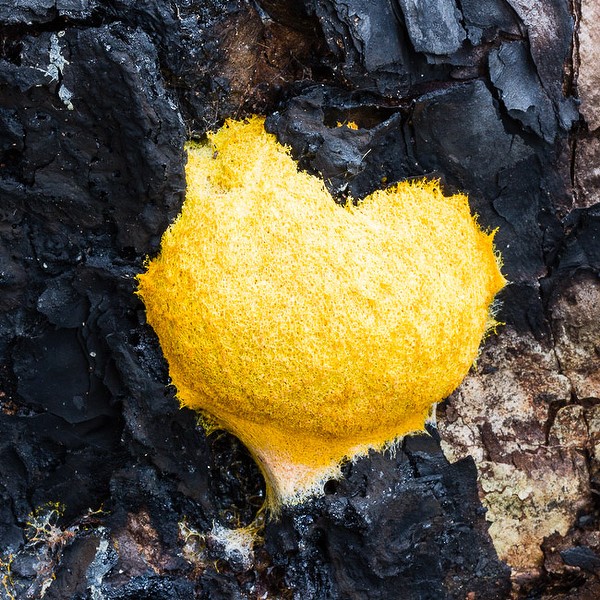
Slime molds may sometimes look like the dog hurled, but others come in rainbow colors, and some even glow in the dark.  They are smart too…more on that in a moment.  They may be slimy, but are not terribly or always so.    And they are not molds, that is, they are not fungi.

SM’s haunt their own little corner of evolution.    Even with DNA evidence, their relationships remain a little murky.   We’ll gloss over the textbook material by saying they are Protists probably most closely related to amoebas, although that doesn’t tell us much.      Slime Molds come in two (or three depending on your standpoint) different types, but I don’t want to slip into academic taxonomy.    Better to get acquainted in a friendly way with something any native plant enthusiast may discover out in a natural habitat, or overlook.   Here’s a good jumping off point link for those wishing to look deeper. CLICK 

Slime mold JB

By John Bradford (Fuligo septica?)

You might say a slime mold resembles (or is in a sense) a giant amoeba, sometimes as large as a saucer, although its mass originates from aggregation of smaller cells during their odd life cycles.   In any case, during the “big amoeba” stage the slime mold slithers and streams, engulfing organic nutrition as it flows.  Seen with time lapse, some seem to pulsate as they go.  Enjoy this video, remembering this is a single cell, sort of:  CLICK

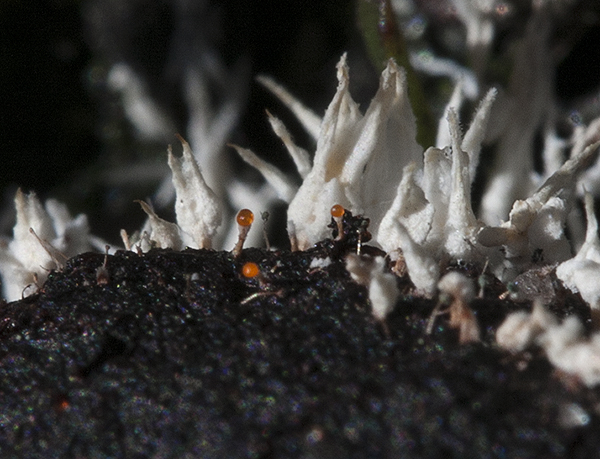
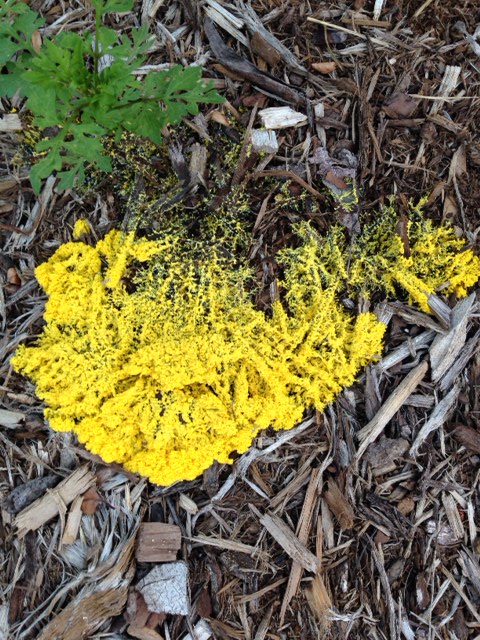
You don’t see Slime Molds each day, and if you don’t look, you might never unless one shows itself on old wet wood mulch, then looking like a melted candy bar.   The relatively common plasmodial slime mold Physarum polycephalum is bright yellow and easy to spot.   Smaller cellular slime molds are variable in size and aspect, often hiding in decaying wet wood, or on moist manure.  Spot them by their Tootsie Roll Pop spore cases, sometimes in vibrant colors.   When the going gets rough, slime molds disappear, some forming dormant stages able to sit tight 75 years or more.

trichia-decipiens-slime-mold-on-hog-manure

I suspect the golden globes to be the slime mold Trichia decipiens, but never trust a guy who lies down in a meadow and contemplates hog manure.

“Plants” and other life forms can be intricately responsive to their environment in ways previously under-observed and under-appreciated, now more visible via various technologies.  Sometimes the intricacies from an anthropomorphic standpoint look like intelligent behavior.   Slime Molds are darlings of the “plant intelligence” fanciers, and of pundits who like to self-promote by misrepresenting overblown semi-science as we gasp in rapt awe.   That said, a humble lowly Slime Mold can achieve  surprising aptitude in efficient streaming, which is far from random or disorganized.

physarum 2 pb

Physarum on old mulch, by Pat Bowman

Applying the results of broad “exploratory” slithering, Slime Molds can organize themselves into networks connecting food sources in optimal patterns, when viewed from above suggestive of road systems linking major cities.   Or to a different imagination, maybe something ectoplasmic out of Ghostbusters.


slime mold john

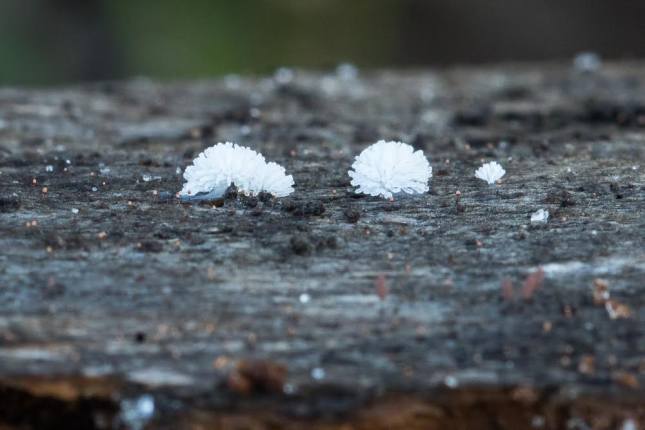
Photo by John Bradford.  Ceratiomyxa fruticulosa?


After a probing slither, they abandon foodless cul-de-sacs to stream only where there’s a reward.  Some overcome “inhibitions” and cross initially intimidating barriers, as I might hesitate to cross a frayed rope bridge  until spotting a cheeseburger across the chasm.    I always thought of an amoeba as a nasty germ that caused dysentery,  not as the Brainiac of the lower life forms.   Live and learn. (Slime Molds do.)

 
9 Comments

Posted by on June 4, 2016 in Uncategorized


Royal Palms are Giant Featherdusters

Roystonea regia

General Roy Stone 

Arecaceae


No fieldtrip today.  John and I both had other obligations, thus a step back to horto-historical themes otherwise dominating my earlier week, such as Florida horticultural titans Pliny and Egbert Reasoner.  Among a million accomplishments, they introduced to horticulture in the 1880s one of the the largest and most important native South Florida trees, the Royal Palm.  Their historic house came down about a year ago.

But, oops, back up already.    How do ever know who in a world of millions of citizens who really first brought a species into cultivation?    Unknowable, so we’ll just give the Reasoners credit for major early prominence—they have no deficit of acclaim—and the fact is, there may have been an earlier introduction, of sorts.   Wind back another century.  In 1774 another icon, William Bartram,  described what were apparently Royal Palms near Astor, Florida by the St. Johns River  a couple hundred miles from their warmer natural range in southernmost  Florida and points south.

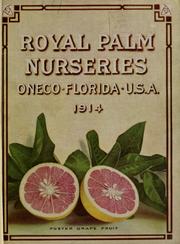
reasoner grapefruit

How Bartram wrote of vanished tropical palms substantially too far north has been the subject of about as many speculations as the vanished Jimmy Hoffa.   Ideas include that Bartram had described a different species, that Bartram had actually seen the species on a boat trip in coastal South Florida, that a former Royal Palm population near the St. Johns River had existed but died (by a big freeze in 1835, or by fire, or by exploitation to manufacture walking sticks).    I don’t know.    The old repeated explanation I find most pleasing without critical analysis is that Native Americans took them there from South Florida, and that the trees had matured between lethal frosts.    Anyhow, back to the accomplished Reasoners.

Pliny Reasoner came alone from Illinois to the Bradenton area in 1881 riding an early wave of southward expansion, and founded at what is now Oneco (part of Bradenton) arguably the oldest, biggest, most important, longest-running plant nursery in Florida.   His endeavor, soon joined by brother Egbert and other family members, sold just about everything from pink grapefruits to Royal Palms.    Their catalogs were literary works.   Pliny’s term in Florida ran from age 17 to death by Yellow Fever at age 25.   In that blink of an eye he founded a business empire, wrote a still-useful bulletin for the USDA, became internationally famous, and brought Royals Palms into cultivation, naming the nursery the Royal Palm Nursery, later changed to Reasoner’s Tropical Nursery in rebirth after The Depression.

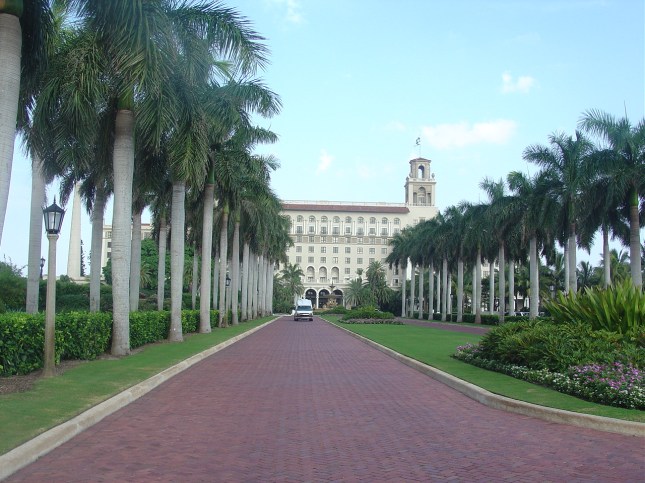
Roystonea regia Breakers

Here’s how it happened.   Pliny befriended another famous horticultural character who appeared last week in this blog, Charles Torrey Simpson.    Male bonding occurred on a sheriff’s posse to track down the infamous “Sarasota Vigilance Committee” (band of lowdown murderous varmints).   The manhunt worked out pretty well, and the wisp of the friendship relevant today is their explorations of the SW Florida coast on a small sailboat boat called The Permit owned by a friend of Simpson’s.   Simpson was a salty old sailor, whose very pregnant wife did not seem to enjoy coming along for the ride.

Together Simpson and Pliny brought Royal Palms from near Cape Sable, and the rest is history.    Years hence Simpson with other friends toted additional Royal Palms back from Royal Palm Hammock (Paradise Key), and Simpson knew a stand in what is now Miami.  To his dyspeptic annoyance, a “brutal greedy man” destroyed the site “in the hopes of making money from tannic acid in the bark of mangroves.”  (The culprit failed…but what the heck, subsequent development would have nuked them anyhow.)

A taxonomic question I do not want to engage is “Florida Royals” (R. elata) as a species distinct from those in Cuba and points south  (R.  regia).   Modern taxonomists recognize just one broad species.  Ancient interchange of Royal Palm fruits between Florida and Cuba and elsewhere is easy to envision by birds, fruit-eating bats, flotation, and prehistoric canoe.

The trees have an odd biological feature.  Everyone knows legumes have symbiotic Rhizobium bacteria in root nodules.  The bacteria fix nitrogen (capture atmospheric nitrogen for plant use) , and they produce auxin hormones (IAA) wirh complex functions, presumably related to the host-bacterial relationship.    But how many monocots can you name with Rhizobial nodules?  The only one I know of is today’s species.

Three cheers for Royal Palms!—if one of those hefty fronds doesn’t fall on the baby carriage.   We all love them.    Well…not everyone.   Let’s end with yet another rock star of Florida horticulture:    Landscape Architect William Lyman Phillips, who designed landscapes for everyone from the rich and famous to the WWI dead,  wasn’t a fan.    One of the greatest planting planners in Florida history called the trees “feather dusters.”

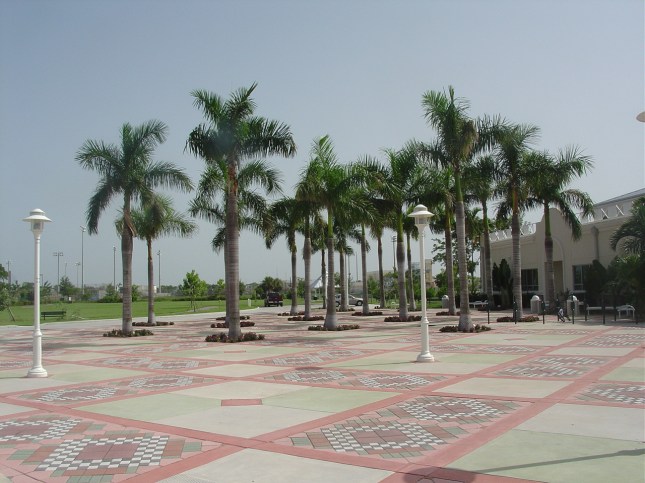
Roystonea regia

 
1 Comment

Posted by on May 27, 2016 in Royal Palm, Uncategorized


Rattleboxes and Rabbit Bells

Crotalaria species

Fabaceae


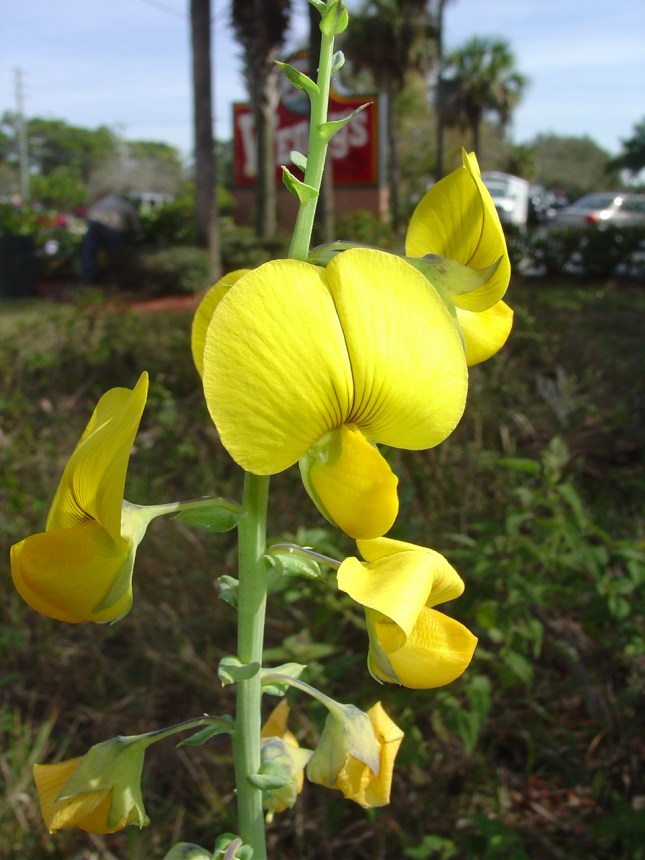
This morning was a time to help John photodocument the aftereffects of fires in Jonathan Dickinson State Park,   although charred boonies aren’t all that aesthetic.  Scattered around the park are yellow flowery Rattleboxes.   Rattleboxes are species of Crotalaria;  Rattlesnakes  are  in part species of Crotalus.   What do rattleboxes and rattlesnakes have in common?  Beyond the rattle…poison.   Showy Rattlebox, C. spectabilis, has killed horses, sometimes after a prolonged delay.     Researchers apply the toxin deliberately to suppress an animal’s blood pressure.

Crotalaria spectabilis Jan1

Showy Rattlebox (by John Bradford)

But don’t they eat Rattlebox seeds around the world?   Yes, but…There are hundreds of species of Crotalaria of unequal nastiness.    Being on the menu is no guarantee of complete safety, as not every culture has a long life expectancy,  and diet-related illnesses may be cryptic.     (Rattleboxed horses sometimes die in the possession of their next owner.) Here’s the obvious thing:  do not eat wild plants.    Read about them in Treasure Coast Natives,   take beautiful photos, and then buy veggies properly.

CrotalariaSpectabilis

Showy Rattlebox by Wendys

Showy Rattlebox is abundant locally, with pizzazz yellow blossoms an inch across.  It differs from most local relatives by having simple (vs. compound) leaves.  Such a showboat might be assumed to have come from its native tropical Asia as a garden flower, but no.   The Florida arrival is more interesting, so read on:

The superstar plant introducer in  earlier Florida—and there were many—was David Fairchild, immortalized at Fairchild Gardens in Coral Gables.  Fairchild was not a mere plant introducer on steroids but equally a  champion “social networker.”   His friends,  associates, and patrons included the rich, influential,  and famous of that era, including notables in science and industry:  Henry Flagler,  Charles Deering of International Harvester (his brother built Vizcaya),   Glenn Curtiss of the Curtiss Aeroplane and Motor Company,  Orville Wright,  Thomas Edison,  and you get the idea.    Fairchild’s father-in-law was Alexander Graham Bell.    Accounts vary, but Fairchild was directly or indirectly responsible for the introduction of a couple hundred thousand exotic species, crops, varieties, and cultivars of plants.

A tree Fairchild brung from China and distributed in the U.S. 1905-1907 was Tung Oil (Aleurites fordii),  then valuable in products from printing ink to ammunition.  In the early 20th Century Tung  supported 400 growers in and near Alachua County,  but then it fell into disgrace as a  Category II invasive exotic.   Times change.

This all leads back to Crotalaria spectabilis.   Tung farms grew predominantly on poor sandy soils left denuded from pine deforestation.   The system needed enrichment, and Fairchild introduced  Showy Rattlebox in the U.S. around 1914 as a sand-loving, heat-tolerant, nitrogen-fixing legume to goose up the Tung.  And as an added benefit, Fairchild suggested Showy Rattlebox to deter nematodes, especially among papayas.   He apparently was not fully aware of the dangerous livestock toxicity.    As with Tung, Showy Rattlebox slipped from celebrity to invasive weed and veterinary menace.

Farmers could not afford commercial fertilizer during The Great Depression.   Growing Crotalaria for nitrogen fixation and as green manure was a comparatively cheap alternative.   One agricultural agent reported purchase of over 20,000 pounds of Crotalaria seed (C. spectabilis and C. pallida) in and near Orange County during 1931.   (Crotalaria pallida is another showy introduced Crotalaria, called Smooth Rattlebox, easily distinguished from C. spectabilis by having three-parted leaves.)

Crotalaria rotundifolia 5

Rabbit Bells (JB)

The native Ornate Bella Moth is a Crotalaria specialist feeding naturally on indigenous Crotalaria species.  Due to dietary and ecological expansion, the moth may be a natural biocontrol for the invasive exotic crotalarias, damaging them with gusto while hopefully remaining in better ecological balance with the native species.    There are four native Crotalaria species in Florida, and about 10 invasives.  The moth will be busy for some time, as the seeds can survive 60 years in the soil.

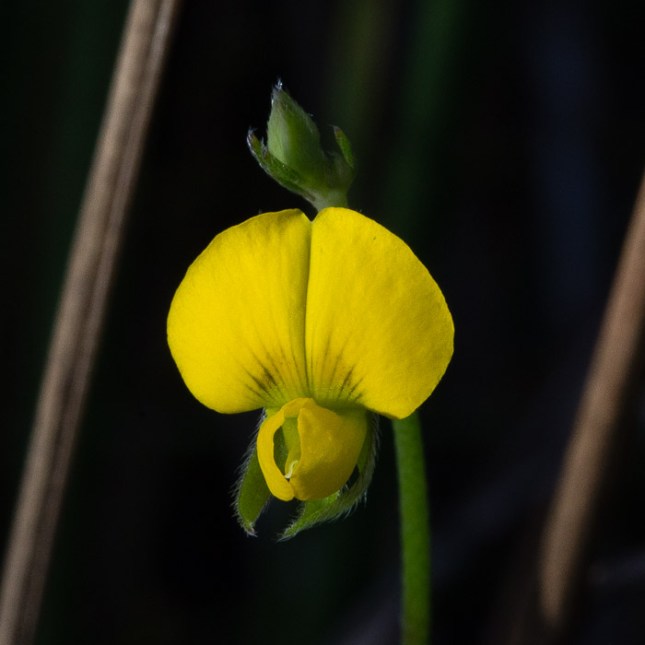
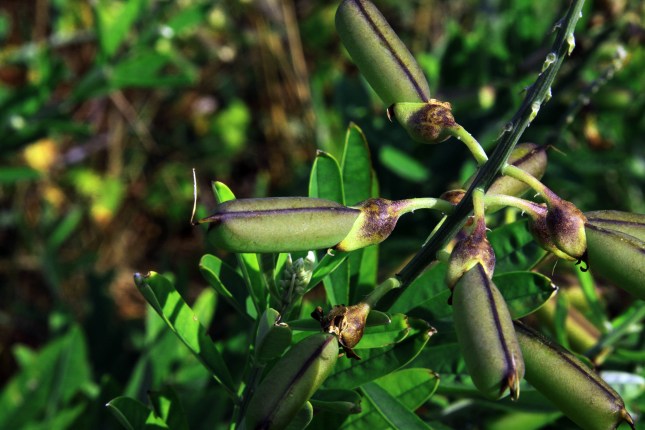
Let’s close with one of the native species, common in JD Park, Crotalaria rotundifolia, better known as Rabbit Bells.  It is just a lil’ rattler, with simple leaves, on sunny sandy soils.    This variable and vaguely defined species makes big poofy inflated pods.    Why should this or any plant make fruits resembling dirigibles?    Simplistic speculations are possible and not mutually exclusive:  for flotation, for temperature insulation, for padding, for isolating seeds from pests and parasites (with perhaps the gas within inhospitable to tiny varmints), or for containing vaporized hormones.   Botanists have discerned another more subtle explanation for inflated pods in other plants.     Seeds respire and give off carbon dioxide.   Carbon dioxide is the main input into photosynthesis.  So why waste it?  In poofy pods the internal air space seems to be a carbon dioxide tank, capturing the “waste” carbon dioxide coming out of maturing seeds and feeding it to the inner pod wall to photosynthesize.    Perhaps out in the bright sun those translucent pods can use light on their otherwise passive inner surfaces, and make the seeds pay their own way with a CO2 toll for the zeppelin ride.

Crotalaria spectabilis pods

Showy RB inflated pods

 
5 Comments

Posted by on May 20, 2016 in Uncategorized


Boston Fern…A Tale of Three Cities

Nephrolepis exaltata

Nephrolepidaceae

The weekly Friday field trip got swatted down by waiting for the nice repair man in my kitchen as I write. So I’ll back the camera up to a fun green Wednesday meeting with the Broward Co. Native Plant Society at the Secret Woods Nature Center in Ft. Lauderdale.

A great part of “botanizing farther south” is more ferns.   A dominant species at Secret Woods is Boston Fern, not that it is rare up here in Palm Beach County.    But why is it called Boston Fern?  (Be patient, we are getting to that.)  Boston Fern was once a huge single-species industry, interestingly dating back to the turn of the 20th Century orgy of unfettered exotic plant introductions.     Sort of ironic that a pillar of the early Florida nursery industry was a native.    I grew up with a big one hanging from the fireplace mantle.

Nephrolepis exaltata 1

Today’s pictures by John Bradford

In 1897 the proactive Soar Brothers, John and Francis, started a plant nursery in Miami following the arrival of the Flagler RR in 1896.  Population of Miami:  50.

Six years later, naturalist Charles Torrey Simpson moved there from Washington DC, having lived in Bradenton previously.   Simpson had about as wild and diversified life as humanly possible:  marching to the sea with Sherman, sailing the seven seas in the Navy, mining coal, as “Charley Carpenter,” befriending horticultural icon Pliny Reasoner (whose mother disapproved of the friendship), conducting an extra-marital affair that bit him deservedly in the butt, serving on a sheriff’s posse catching bad guys, farming in Nebraska, working at the Smithsonian as a malacologist, and THEN becoming a founding father of Miami horticulture and Everglades conservation.   (A retirement hobby.)   Before enduring the 1926 Miami hurricane, and being robbed.

Nephrolepis exaltata 3

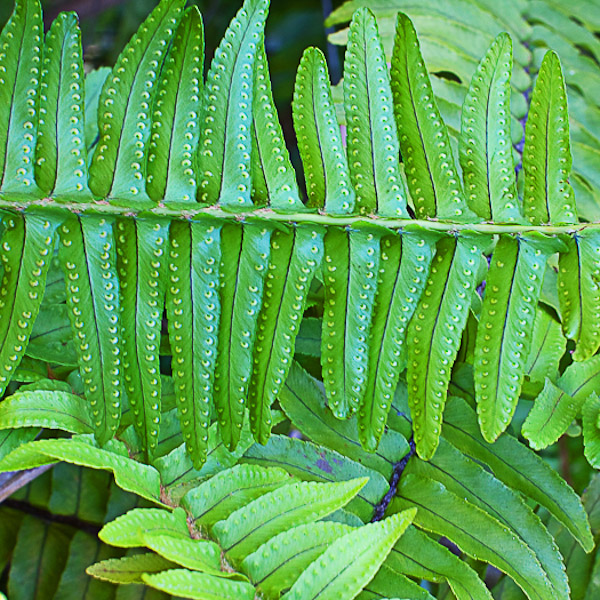
The leaf dots are the “sori” where spores form.

In 1903 the Soar Brothers, Simpson, and friends took a grueling multiday field trip to what was then called Paradise Key (now Royal Palm State Park).    They brought back three items of note:  royal palms, Boston ferns, and a stinking deceased rattlesnake.    The plants made it into cultivation.  Lugging the awful toxic snake on his sweaty back took the blame for making John Soar dangerously ill.    He survived, and the Soars may have been the first growers to popularize Boston Fern.

Nephrolepis exaltata 2

Now a brief space and time warp…to 1912.    Frank Ustler worked for a greenhouse in Massachusetts growing Boston Ferns (originally from the Soars?).   Ustler figured tropical ferns to grow more cheaply in Florida than in Massachusetts, and came to Orlando for a try.  It worked.  After hassles raising venture capital,   Ustler took over an abandoned pineapple shed and launched a Boston Fern industry as well as a family dynasty, Ustler Brothers Nursery.  Of courses, as the years went by,  Apopka branched into additional ferns, and then all manner of foliage as well as vegetables.  With his brothers, the nursery moved in 1917 to Apopka, which became dubbed “Fern City.”    Joining the menu later was the non-native Leatherleaf Fern, according to contradictory legends discovered by local growers as either packing material in orchids, or as a houseplant at a florist’s.    In any case, dominated by these two ferns, one native and one not, “Fern City” was shipping a million ferns a year in 1927, including probably the one on my mother’s fireplace mantle.

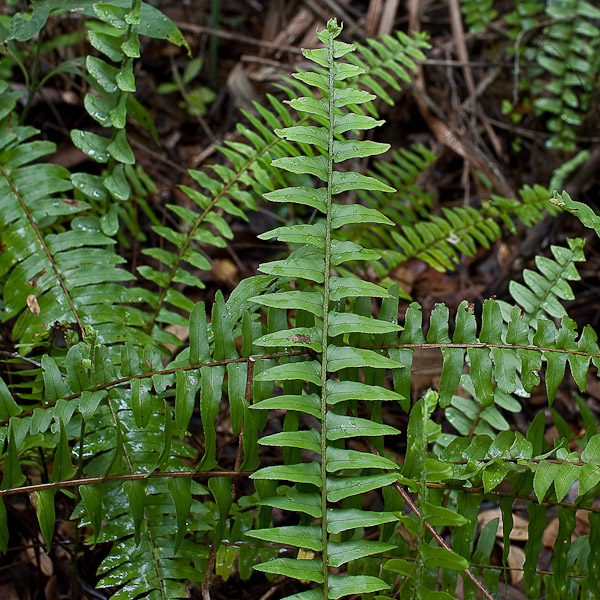
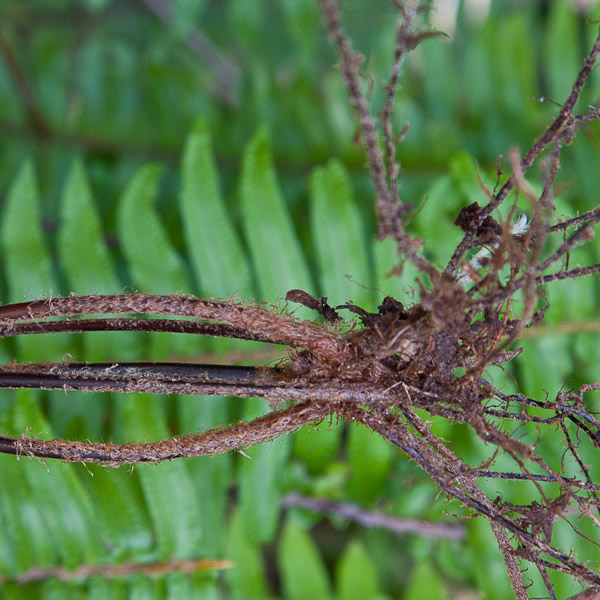
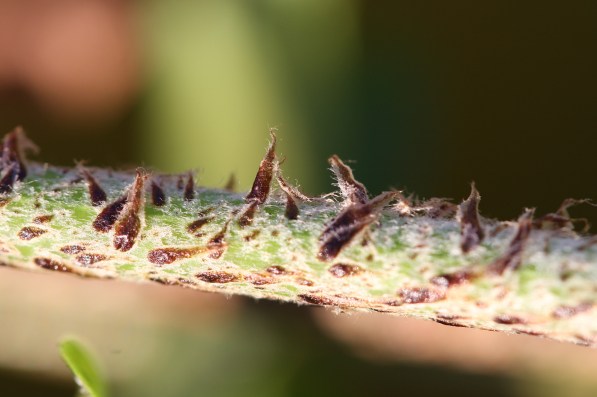
Note.  Several similar Nephrolepis  ferns cultivated and wild in Florida are related to Boston Fern.    Boston Fern is easy to distinguish.  Look at the bases of the leaf stalks.   BF is having a “bad hair day” with light tan monotone scales (hairs) sticking out at rakish angles.   The similar invasive exotic Asian Sword Fern has its scales with a dark center, and pressed flat up against the leaf stalk.    Also common and an invasive exotic, the Tuberous Sword Fern is the only one with rounded leaflet tips (not pointed) and underground tubers.  Giant Sword Fern, generally regarded as native, has its leaflets on distinctive little stalks.  An unusual garden escape around Miami, Scaly Swordfern, has coarsely  irregular leaf margins (in all the others the margins are nearly smooth, or have tiny serrations).

Nephrolepis exaltata 4

Bad hair day in Boston

Nephrolepis multiflora scales

Scales on invasive exotic Asian Sword Fern – dark centers, mostly pressed to the stalk

NephBiserrClose

The leaflet bases on Giant Sword Fern, probably native, have little stalks.   The cultivated Macho Fern is derived from this species.

 
15 Comments

Posted by on May 13, 2016 in Uncategorized


Virginia Chain Fern

Woodwardia virginica

Blechnaceae

Today John and George, peparing a presentation at the Palm City Public Library (probably July 29 2016) explored a pretty St. Johnswort marsh adjacent to the library,  with flowering St. Johnsworts,  Tall Pinebarren Milkworts,  Eupatoriums,  and  Rosegentians.   We marveled at something we deemed marvelous long ago:  that the leaves of Virginia Chain Fern line up along the snakey rhizomes often all facing the same direction like solar panels.   Sometimes an entire meadow can have the VA Chain Ferns all in conformity.  How much of this alignment is a slow growth response, and how much is a short-term adjustment will be interesting to measure.

woodwardia lined up

Ten-Hut!

However, back in 1899 a remarkable individual beat us to it fittingly, in Virginia…at the Great Dismal Swamp.    I don’t normally provide a bio for every biiologist with a discovery before 2016, but William Palmer (1856-1921) was so exceptional, a few words might be interesting.    Recording that Virginia Chain Fern orients to the sun was not his oddest feat.    Contenders for that included stuffing the last passenger pigeon on earth (he did not kill it),    making models of fish and squid still displayed at the Smithsonian Institution (where he worked),   discovering an extinct seaturtle, casting  a mold of a Mexican meteorite, preserving a whale skeleton,  researching the Florida Burrowing Owl,  and boiling eggs in a volcano.     Palmer specialized in birds and ferns, which brings us back to Virginia.

Woodwardia virginica 7

This and all photos below by John Bradford

Virginia Chain Fern has a huge north-south range, from here to northern Canada,  mostly in the Atlantic Coastal Plain and into the Midwest.    And that footprint a mere remnant.  In 2001 botanists K. Pigg and G. Rothwell found  our fern fossilized about 14 million years ago in Washington State,  showing how the modern distribution of a plant may be misleading about its history.  Who knows, it may have extended even into Asia.

You’ll never have trouble recognizing Virginia Chain Fern.  Hold it up to the light, look at the bottom of the leaf, and see looping chains made by the veins.

Woodwardia virginica 3

Chain chain chain

The spore-making regions, called sori, develop bounded by the loops of the chain.   According to some reports, the plants tend to enter their spore-making phase in response to disturbance.

woodwardia mature sori

The spore-making sori are inside the links.

Two reported spore-inducing stimuli are fire (no surprise) passing over the rhizome safe in the mud, and well, you guessed it of course, beavers.  (What!?)  That needs a little more research.  But then again,  the ferns do inhabit wet mud, and beavers  make mud wet.


6 Comments

Posted by on May 6, 2016 in Uncategorized