Goldenrods
Solidago species
Asteraceae
Scrambling to hop on a plane and zoom up north to son Martin’s glorious wedding to wonderful bride Phoebe, I’m tossing up the blog early this week. The matrimonial son is a tire engineer…a blog in honor of the occasion. (Phoebe has a cooler job–she’s an engineer who works on explosives.)
While the rest of the nation catches a nostalgic scent of end of summer Labor Day, in Palm Beach County we’re catching newsy stuff about tropical storms. But there are a few subtle whiffs of my northern-bred seasonal instincts. Cicadas say goodbye-summer. So do the Goldenrods, making the meadows glow. And, no they do not cause hay fever. Naming them, Linnaeus felt just the opposite, the genus Solidago translates loosely as “making whole.” Not “making sneeze.”
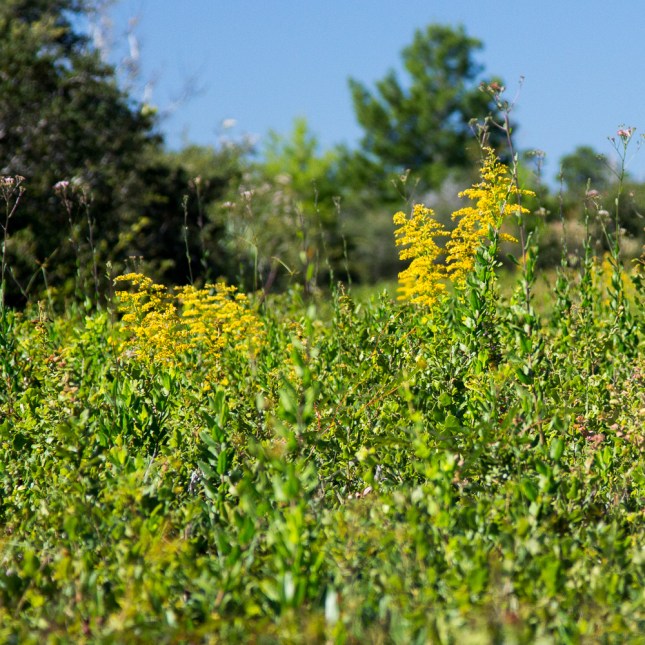
Golden glow, by John Bradford
Goldenrods are a complex group with border disputes, about 100 species around the world, mostly in North America. About 20 in Florida. An abundant and attractive local standout is Pinebarren Goldenrod, Solidago fistulosa.
Everybody likes Goldenrods. Remember that “goldenrod” page in forms in triplicate? Gardeners like them to the point of commercial cultivars and articles in “Fine Gardening Magazine.”
Gall Flies enjoy the plants in their own way, inducing big spherical galls in the stem. One fly is so solidag-o-centric it is named Eurosta solidaginis. It is always fun when biological relationships chain to three or more species*: Chickadees and Downy Woodpeckers help themselves to the fly larvae within.
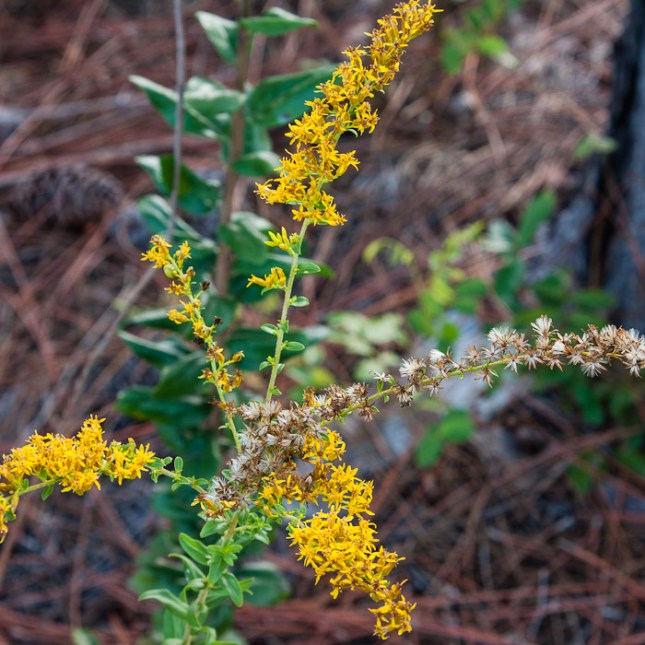
By JB
Birds are not the only threats to the fly babies. Parasitic wasps inject eggs into the gall, which upon hatching devour the maggot and sometimes top off the protein with a vegetable…the gall tissue. One wasp hormonally forces the fly larva to mature matched to the wasp’s seasonal schedule.
Now this where it gets truly interesting—as the biologists noted below have determined— these comings, goings, and microaggressions influence the girths of the galls. First of all, the plant makes a difference, some clones tending to form larger galls than others. (Clones can spread by rhizomes into extensive stands.)
But that is just the trailer for the feature attraction. Size matters in galls. If in a locality the fly’s only pests are parasitoid wasps, the bigger the gall the more wasp protection the larva experiences. On the other hand, if the larva-eating birds are on the scene, the avian predators seem especially drawn to larger galls, being more conspicuous and/or offering larger larvae. In that case bigger is not necessarily better with the adaptive consequence smaller galls than without angry birds.
Without falling into the silly trap of “plant intelligence,” the complex and dynamic realm of things plants do has blossomed to remarkable in recent years, including the “plant immune system” (Systemic Acquired Resistance). Goldenrods reportedly “detect” pheromones from the male gall flies and then emit defensive compounds to repel the female flies.
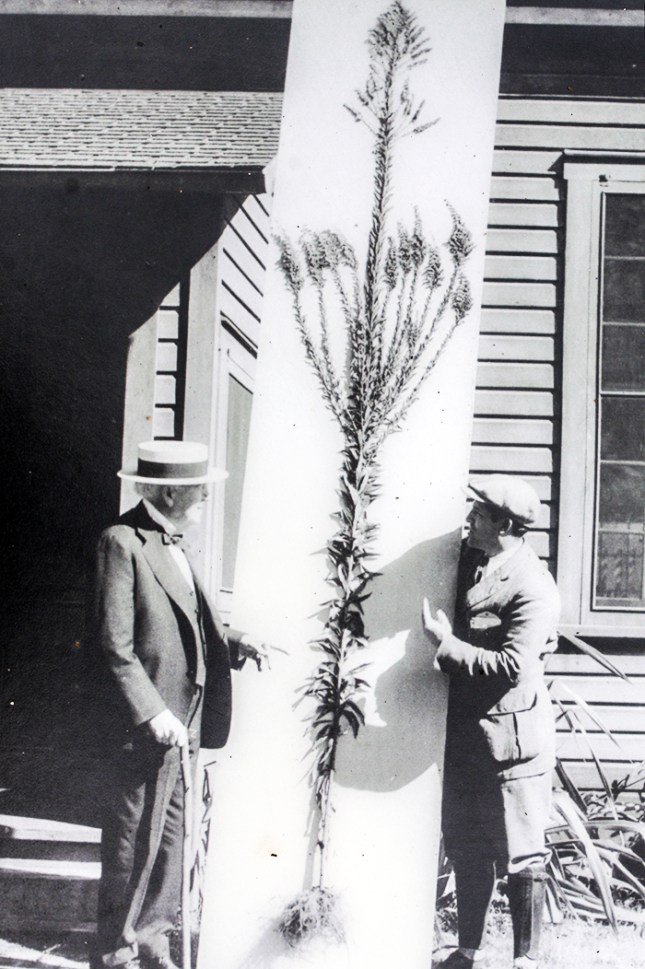
Edison, colleague, and Solidago “edisoniana.” I took this picture of an interpretive sign at Edison’s Florida house.
Yep, everybody enjoys Goldenrods, and maybe the most fascinating “like” came from Thomas Edison. Visiting his home in Ft. Myers, visitors learn about Edison’s quest for rubber crops. After all, his Florida next door neighbor was Henry Ford who had some interest in tires. Edison tested as many latex-drippy plants as he tested materials for the light bulb, thousands they say, including a Ficus still on the property, and his primary focus zoomed in on rubber from Goldenrod. Edison’s experiments culminated in a breeding program for what was then named Solidago edisoniana (actually S. latissimifolia).
Edison manufactured a few Goldenrod proto-tires and showed them off on a Model-T, but they never panned out commercially, as Brazilian Rubber Trees and synthetic rubber bounced up as better options. Glad that lightbulb finally glimmered its golden glow.
————————————————————————–
*Most of today’s gall-related info comes from Dr. Warren Abrahamson at Bucknell University who with collaborators has studied these relationships in depth.
This link concerning freeze tolerance in a Solidago gall fly may interest some. Cryogenics in the maggot realm.
This link talks about Edison’s rubber program.
 John Bradford
 George Rogers
 George Rogers
 Dee Staley
 Treasure Coast Natives