RSS

Tag Archives: Cyanobacteria

Bladderworts High and Dry Where Bladders Don’t Belong

Utricularia cornuta

(A utricle is a bladder. Cornuta means horned, referring to the spur on the flower.)

Lentibulariaceae
ut corn 2

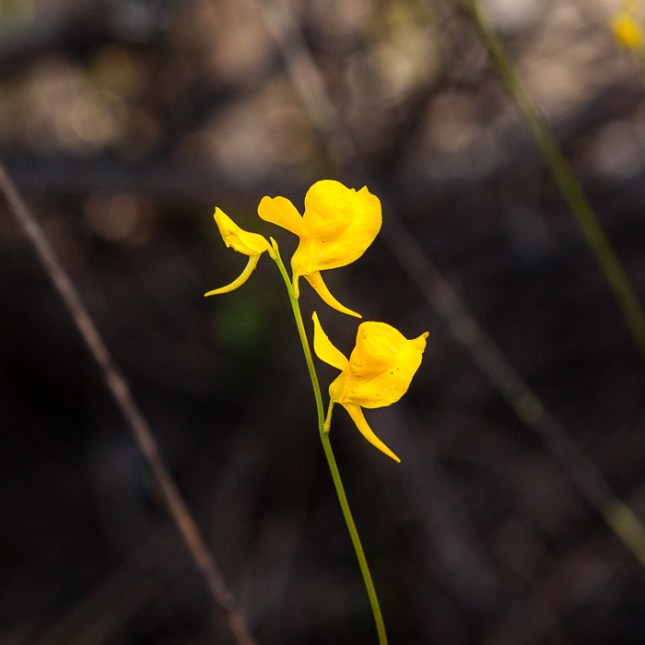
Horned Bladderwort by John Bradford.

Many wildflower enthusiasts are familiar with Bladderworts, species of Utricularia.    Utricularias are generally thought of as aquatic carnivorous plants dangling microscopic suction traps in the water.  The traps have trigger hairs and a trap door. When a minute swimming arthropod bumps the trigger, the trap sucks the victim in for lunch. That is documented richly on the Internet so no need for more here.

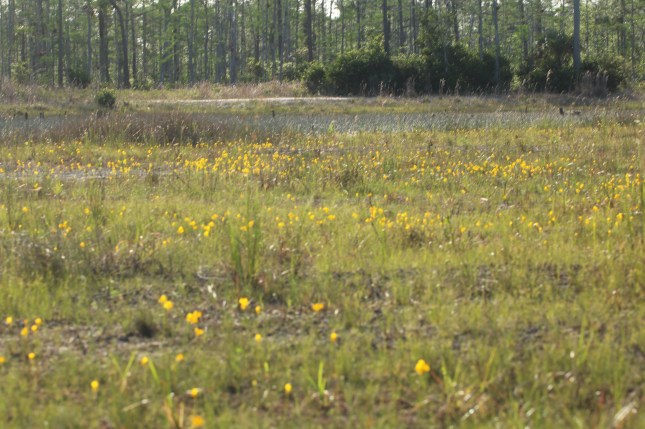
What has been interesting me this week is Utricularia growing in moist sand, often by the thousands in drifts of yellow.    Any questions? Question 1:  What pollinates a hundred thousand bright yellow blossoms all glorious at once in a couple acres?  That’s a blog for another day.
IMG_2064

Question two is the topic for today:  How can an aquatic water-filled bladder catch water-borne prey while stuck in sand?  There has to be more to the story. There is, some of it well known, some mysterious.   As the pundits say, “let’s unpack it.”

First of all, don’t the plants root in the sand? No—Utricularia has no roots, although we will soon see leaf-ish structures functioning much like roots.

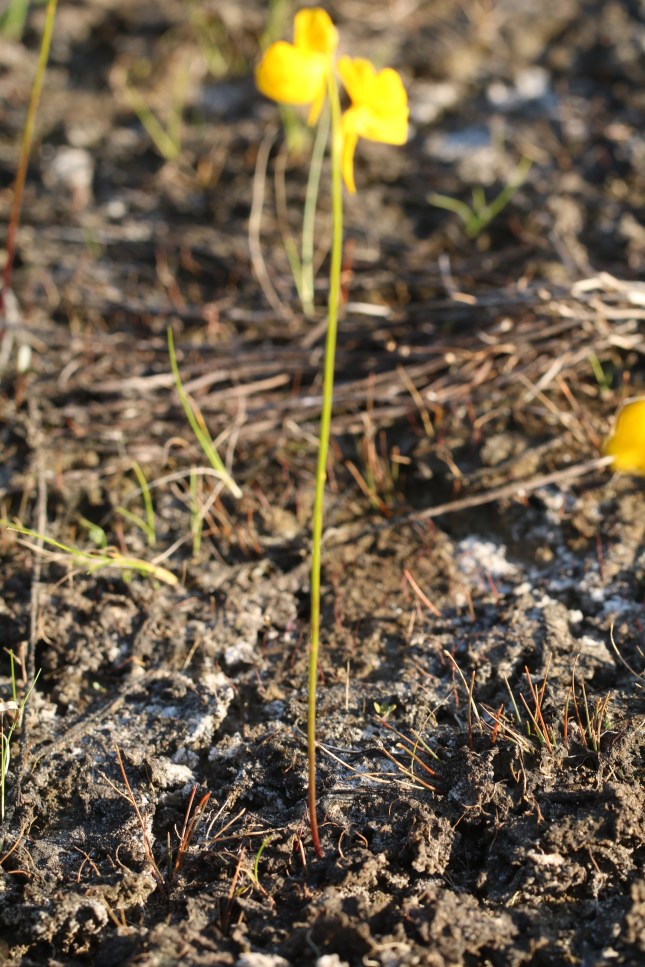
But let’s stay above ground a moment.   Plants typically need to photosynthesize, and that is a job for leaves.  But where are the photosynthetic leaves?  The plants look like a bare stalk with a flower out of focus on top.
IMG_2109

utricularia cornuta snorkel stems 1

Vertical pins rise from the leafy mesh below the surface.

Just below the soil surface stringy leafy segments form a horizontal mesh, think of a smashed plate of spaghetti.  From that mesh millions of pin-sized segments rise vertically from the soil into the light of day.  The collective surface area of countless pins is substantial, like the microvilli in an intestine. They are green or partly red (sunscreen? damage?) and probably allow for photosynthesis, and conceivably help aerate the leafy portions below the surface, especially during flooding.    Room for research here!

A growing literature is revealing the idea of the trap feeding the plant by catching and digesting prey as simplistic.   The traps seem to be micro-ecosystems unto themselves.  CLICK

Trap-dwellers include microscopic protists, such as ciliates, bacteria, fungi, algae, and so-called bluegreen “algae.” Bluegreen “algae” are photosynthetic cyanobacteria often able to “fix nitrogen,” that is, convert atmospheric nitrogen to fertilizer.

The microbes manufacture nitrogen fertilizer inside the trap, you say?   Isn’t the main point of the carnivorous plant to obtain nitrogen from breaking down the insect victims? And photosynthetic bacteria inside the trap provide the same benefit without bloodshed?   Yes, if not studied adequately yet.

OK then, nitrogen-fixing cyanobacteria live inside the trap, possibly contributing to the plant’s nitrogen nutrition, what about outside the trap?   Not a new idea.  Botanists have recorded cyanobacteria clinging to the outsides of traps in the water.

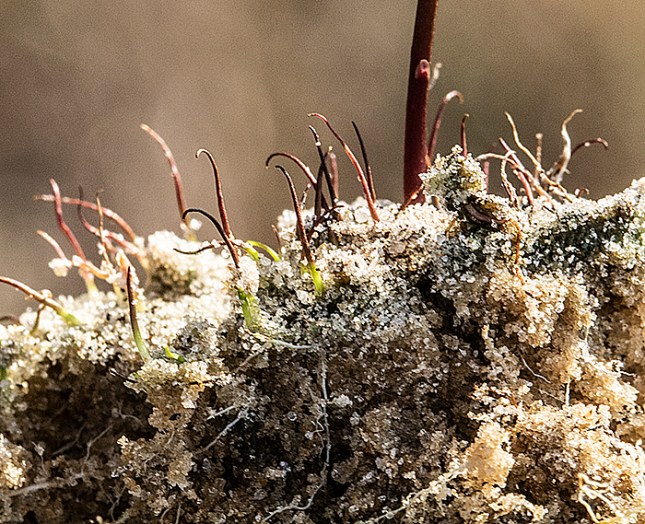
So now think about that comparatively dry meadow of sand-dwelling utricularias.   Could  cyanobacteria in the sand be enriching the soil, maybe replacing the need for aquatic bug-catchery?

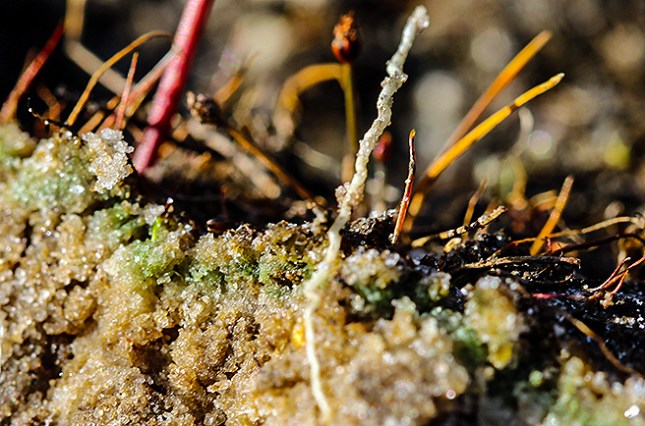
A close look at a population of Utricularia on “dry” land shows them mostly to rise from a thin surface carpet of periphyton, although not always, and there’s more to the picture.  Under the Utricularia is a blue-green living layer a fraction of an inch under the ground surface.   It looks like a miniature seam of coal.
utricularia gtreen band

A living blue-green seam in the soil

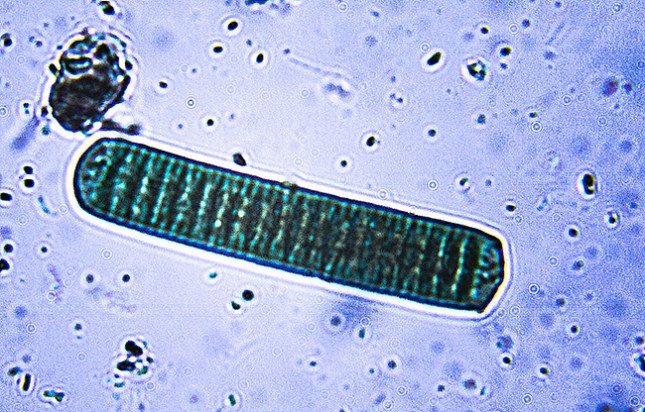
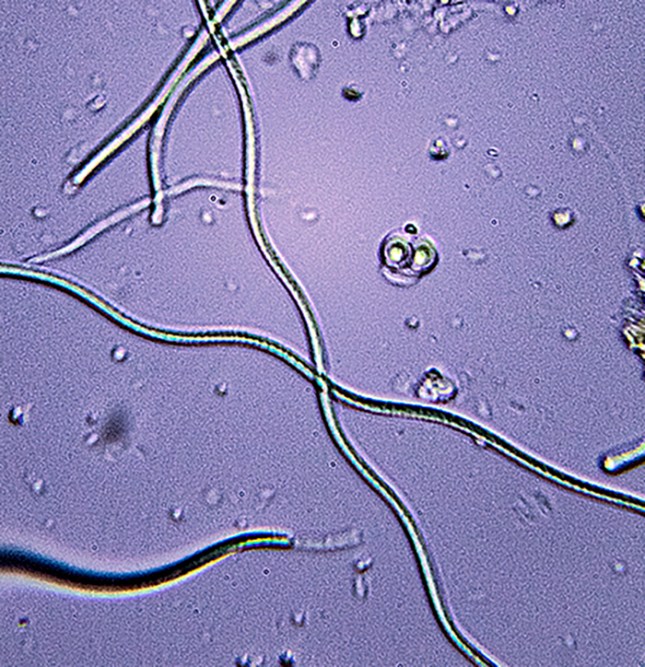
With room for more data (!), I suspect the land-living Utricularia is deriving nitrogen and possibly additional nutrition from the subsurface blue-green layer.  A look at that layer with a microscope shows it to consist in large part of, you guessed it, cyanobacteria.
utricularia cysnobacteria3crop

Cyanobacteria from the blue-green layer at the base of a Utricularia.

The plants form a thick brushlike mass  of rootlike leaves usually just below the green layer, or sometimes branching directly into it too.   The false roots can have traps, which exist to absorb nitrogen.   But who said it has to come from within?  Traps bathed in nitrogen fixed by a living soil layer of Cyanobacteria might as well absorb it from the outside as well.


2 Comments

Posted by on March 27, 2020 in Uncategorized, Utricularia cornuta


Tags: , ,

Bluegreen “Algae,”   Pink Flamingos, Red Tides, (and Nonpolluting Buses)

Cyanobacteria

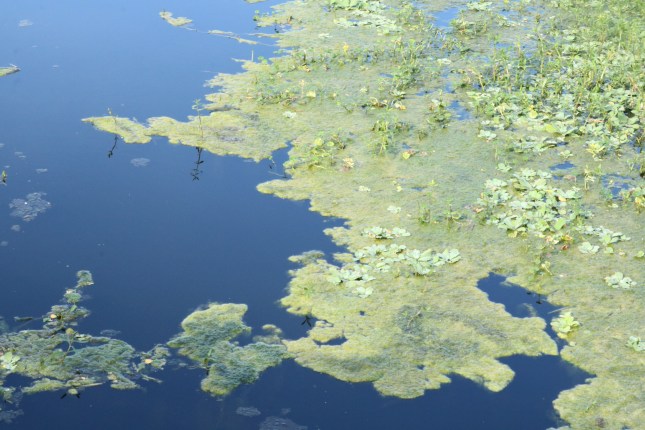
Not many plants have a more diversified story than Cyanobacteria.  We know them in Florida as villians of “toxic algal bloom” news, featured even in the gubernatorial race.    That horror story is not my focus today.  Google will unleash that mess abundantly already.  Quickly, however, toxic “algae” blooms are not limited to the Florida Active Adult Lifestyle.  Ask the residents of Toledo who drink Lake Erie, or what’s left  of my home town, Wheeling, W.Va. where “a green paint spill” reported in the Ohio River turned out to be Cyanobacteria.  The problem is global, making it tough to point the finger of blame too ardently at any particular political entity, or demanding simplistic politicized “do something.”

IMG_3961

Now hear this!…bluegreen “algae” are not algae.  They are Cyanobacteria. Even though the term “algae” is vague, Cyanobacteria are no more algae than I am.  They are large photosynthetic bacteria.

Cyanobacteria or similar paleo-germs are contenders to be the oldest life on Earth.  The globe is about 4.5 billion years old, with Cyanobacterial evidence extending back over 3.5 billion years.   Contrast that with humans, here for maybe 2 million years.    So then Cyanos are some 2000 times older than we are.  We curse them for polluting rivers, yet, looking back a few billenia, who kickstarted  the biological world with original oxygen?

BGA from fish tankCLOSE2

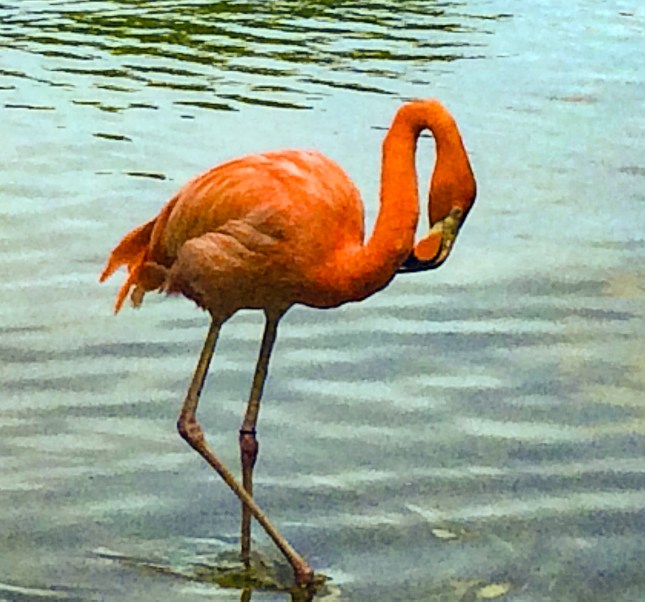
And even better, who makes the Flamingos pink?   With variation from species to species and from place to place, in a general sense Flamingo pink coloration owes mostly to pigments from Cyanobacteria, including the genus Spirulina on sale now in a health food store as a dietary aid.   I wonder if Spirulina over-consumption will give a ruddy glow.  (Just kidding.)

What about those pink Roseate Spoonbillls John and I witnessed today in Riverbend Park? They are more carnivorous than Flamingos, and their rosy pigments come from the little creatures they catch in their spoons, although ultimately the pink ink comes from plankton, presumably Cyanobacteria and perhaps also true Algae.  In the Spoonbill’s case, the path to pink may be complex.

CLICK HERE for quick peek at some Spoonbill Action!

Cyanobacteria have astounding grit.   They grow on trees, on rocks, on my back porch, on wet concrete, and mostly in salt and fresh water, where we may try to suppress them with shade.  Shade doesn’t work; some species cope by using cells called akinetes (AY-kuh-neats) able to sink and wait out bad times.

Many Cyanobacteria, especially planktonic species, including the Microcystis in toxic blooms,   have “air bladders.”  When the cell is near the sunny water surface photosynthesis there depletes buoyant carbon dioxide from the bladder and creates sinky heavy carbohydrates.  The cell thus loses buoyancy and sinks to deeper waters where there is less sun and more nutrients, such as phosphorus.   Down in the dark, the cell stocks up on nutrients, burns its heavy carbohydrates, generates carbon dioxide back into the bladder, and rises anew.  The yo-yo cycle is daily.

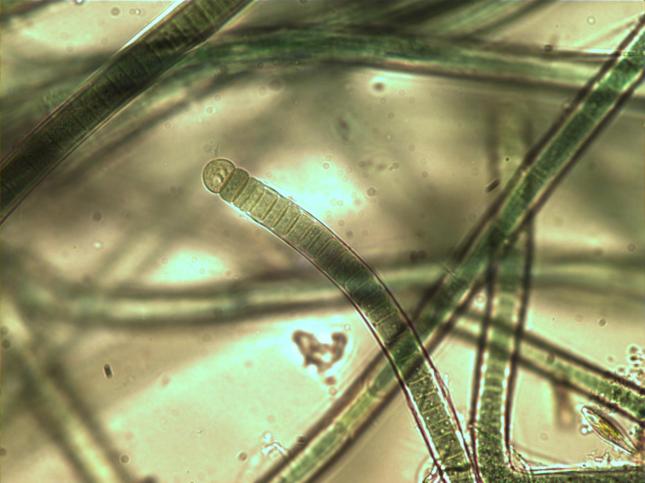
Lyngbya

Lyngbya, with sheath

Fast growers demand much nitrogen.   Problem is, most plants can’t use nitrogen gas from the air.   Good thing we have Cyanobacteria with specialized cells called heterocysts to convert atmospheric nitrogen to ammonium fertilizer to their own benefit, to the benefit of plants that share their soil,  such as in Florida wet prairies, and to the benefit of many symbionts.

Cyanobacteria have more symbiotic relationships than you can shake an alga at.  They hook up with:  true algae, cycads, diatoms, ferns (including the floating fern Azolla used to fertilizer rice), flowering plants, fungi, hornworts, liverworts, marine worms, mosses (including Sphagnum), radiolarians, sea squirts, sponges by the dozen, and more, including partnerships awaiting discovery.  Oddly enough, if we shift our attention momentarily to the Red Tides befouling the beaches, those little agents of destruction are Dinoflagellate Algae, and guess what, Dinoflagellates and Cyanobacteria are known to have symbiotic relationships.   Every Cyanobacterial symbiosis has a story, but enough is enough for now.

Yet permit me one little example, the Southern-Hemisphere flowering plant genus Gunnera is unique so far as is known, having cyanobacteria living inside the host’s cells.   This growth-promoting intimacy is of interest in a hungry world, not merely because some Gunneras are food, but conceivably the little internal fertilizer generators could be extended to other crop plants.

Now for the surprise ending.  Not all Cyanobacteria are photosynthetic.  Recently in Spain some  turned up 2000 feet underground.   They get their energy from hydrogen just like a fuel cell.  Just think, the most primitive “plants”  of the deep past are demonstrating the most advanced energy form we know.

flamingo

Photo by Donna Rogers


Tags: , ,

A Dip in the St. Lucie River, “We’re Not Afraid of Lead in the Water”

Microcystis aeruginosa

Anabaena circinalis

Cyanobacteria

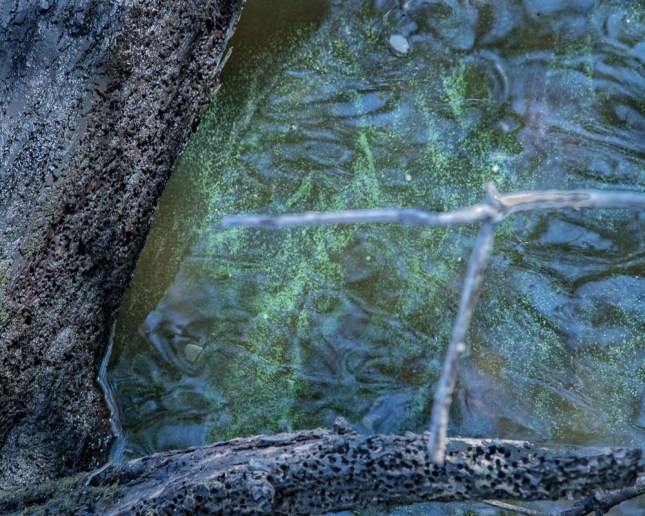
Recently John and George have favored the Kiplinger Natural Area in Stuart, Florida, a mixed habitat with botanical goodies ranging from Gordonia trees now bearing huge white “camellia” blossoms to a Royal Palm towering above the steaming jungle.   A deep dark mangrove swamp there flanks the St. Lucie River.  The same St. Lucie River as toxic algae  fame, so we must take a look.    In fact, John brought a rope ladder, and are we too old to monkey down a rescue device from the boardwalk to the riverbank?  (Yes, but we did it anyhow.) The somber goal was a look at the green menace, peeking a little deeper than all those green canals on Facebook and quickie shots on the news.

microcystis jb

Microcystis, by John Bradford, taken today 7/15/2016, St. Lucie River

First of all, thank you TV news for muddling an important issue.   The trouble is not toxic algae, but rather cyanobacteria.  Repeat, bacteria.    Yes, cyanobacteria are often called “bluegreen algae,”  a misnomer, and yes algae are heterogeneous and poorly defined,   still, cyanobacteria are not algae.  Or to put it differently, I’m more closely related to an alga than a cyanobacterium is.    Cyanobacteria and some true algae just happen to look alike if you don’t look closely.  So let’s look closely now.

Microcystis

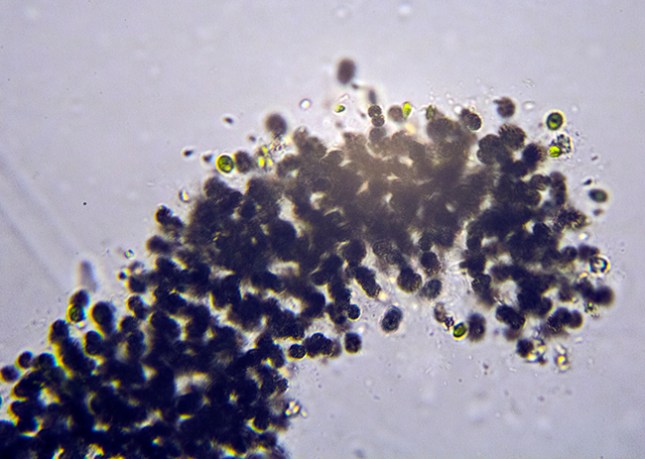
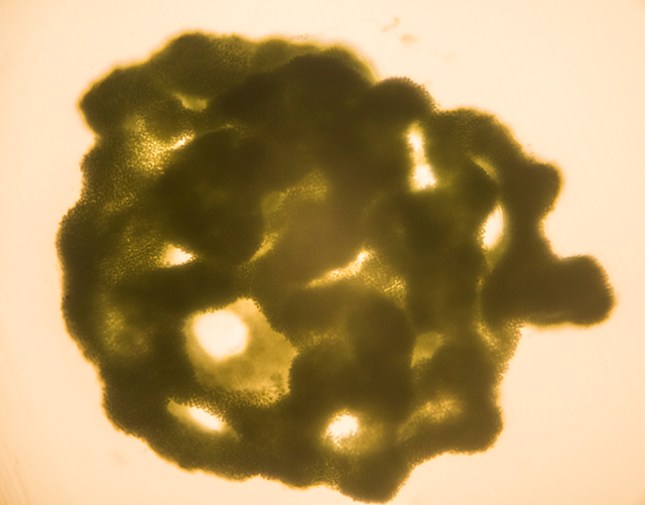
Microcystis as seen microscopically.   It drifts in masses of microscopic cells.  To the naked eye, the variably shaped green specks (or bigger) in the water are these colonies.    Under high magnification each colony resolves into tiny individual cells, all glued together.  The colonies vary in shape and size.

The newscasters have one thing right, the cyanobacteria are toxic with a capital T.    Now, some folks may think of toxic as making your skin itch or causing a cough or diarrhea.     Passing acute discomfort is never as scary as chronic effects, and the potential long-term dangers of certain cyanobacteria are seriously frightening.  The complex world of cyanobacterial poisons is a long list.   Here are some prime examples to curl your hair.  There are plenty more:

Microcystis causes or is strongly implicated in:   gastroenteritis, colo-rectal cancer,  liver damage, and liver cancer.  The most studied toxins from Microcystis are called microcystins; they inhibit fundamental life-critical enzymes, and they promote tumors.   That’s not nice, and that’s not all…

microcystis funnel cake

This Microcystis mass look like a funnel cake at the State Fair.  Microscope view.   Note the tiny individual cells.

Anabaena causes fever, rash, and gastroenteritis.  And worse:  Its toxins are related chemically to insecticides.    The old insecticide SEVIN is a carbamate; so are Anabaena’s saxitoxins which interfere like SEVIN with nerve impulses.   They are similar to pufferfish poisons, and to paralytic shellfish poisoning.

The insecticides Malathion and Orthene are organophosphates; so is Anabaena anatoxin which interferes with the same neurotransmitter system the insecticides damage.  Cyanobacteria invented these killers long before the WII death industry caught on to the same for killing people and bugs.  Just think, we worry (rightfully) about polluting the river with artificial insecticides.   Interesting how “natural” is not all sunbeams and granola, but then again, the massive cyanobacterial blooms are not natural to begin with.

Anabaena circinalis 3

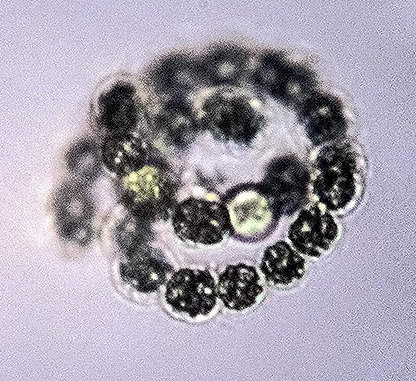
Anabaena circinalis, very high magnification. From same site and water as the Microcystis.  The big oddball cell is a heterocyst, giving these cyanobacteria the ability to capture atmospheric nitrogen.

Lipopolysaccharide toxins are in the cell walls,  external to and oozing from certain bacteria, including cyanobacteria, and come free amply in the water to make us sick.

But what’s a fever compared with tumors, liver destruction—and even worse: cyanobacteria are linked to ALS.    The poison connected to ALS is a rogue amino acid.  Amino acids are the building blocks of proteins.   Oh my,  what if rogue amino acids get built into or childrens’ proteins?

Have there been human poisonings?  Absolutely.  Sixty dead in Brazil where cyano-tainted water was used for dialysis!    Short-term effects are easy to document.   Long-term effects are tougher to track.   An unlucky region in China has high liver cancer rates correlated with cyanobacterial contamination.   I’m going to a suburb of Toledo next week.  Come to think of it, Toledo had microcystins in its tapwater.   Name a livestock species…somewhere it has died from drinking cyanobacterial-infested ponds.

The consequences on a natural aquatic food chain must just be dreadful…a witch’s brew working on the plankton, plants, arthropods, fish, and birds.  Flamingoes have taken a cyanobacterial beating.

Watch the little movie John and I made today.    Let’s entitle it, “How’d You like to Be a Manatee in This Soup”? CLICK to view the brew.

—————————————————————–

Related links:

http://www.ncbi.nlm.nih.gov/pmc/articles/PMC2984099/

http://www.lucasbrouwers.nl/blog/2010/11/cyanobacterial-neurotoxin-evolved-billions-of-years-ago/


2 Comments

Posted by on July 15, 2016 in Cyanobacteria, Uncategorized


Tags: , ,