RSS

Get Out Your Umbrella!   A Meteor Smacked a Flock of Bats!

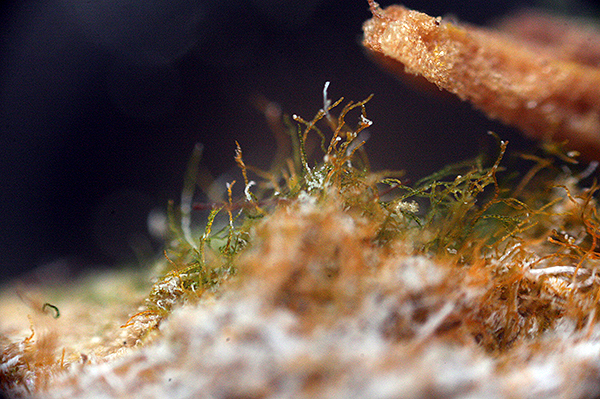
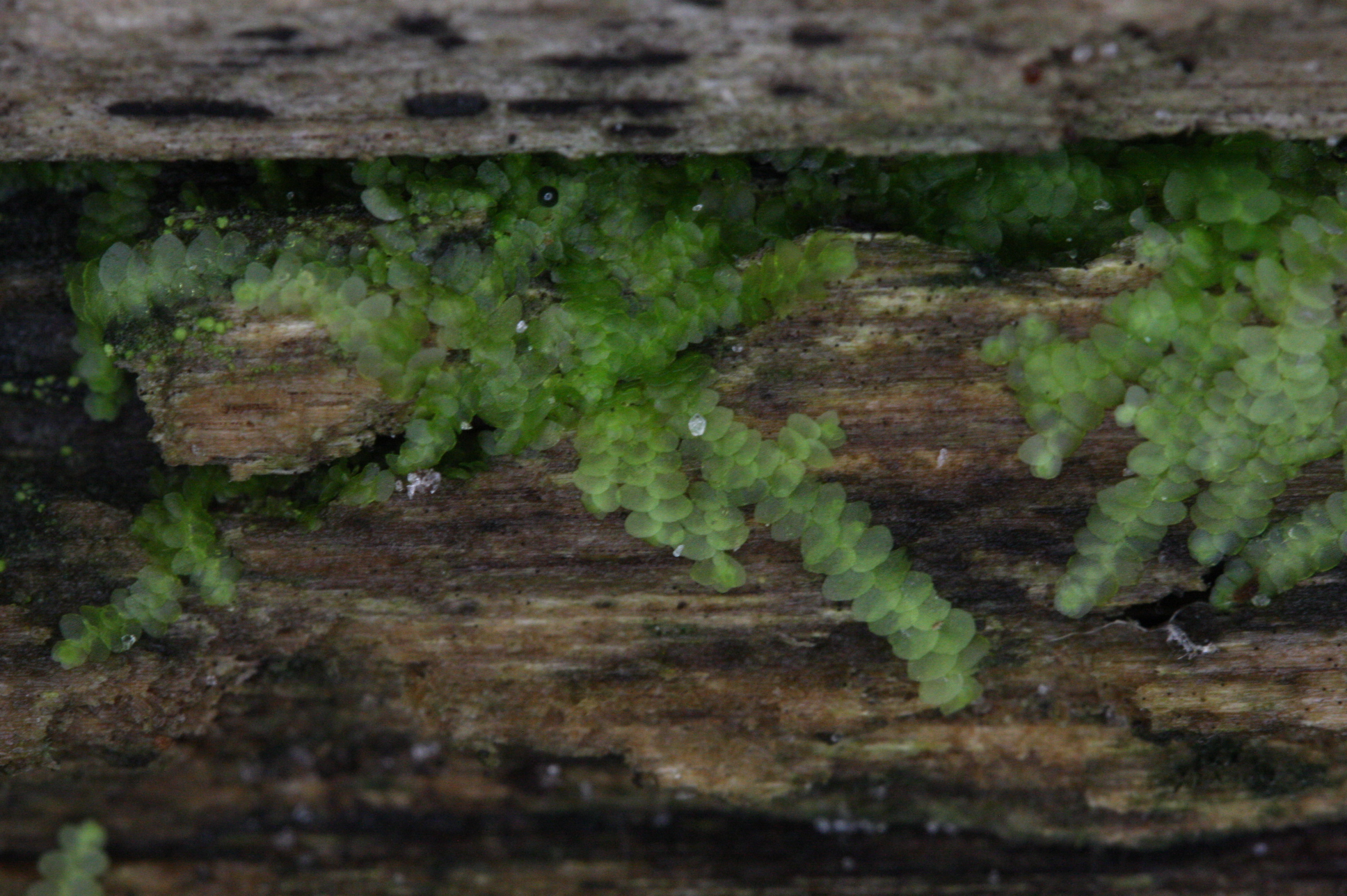
 Trentepohlia aurea

Green Algae

John and George are both leaving town awhile, locking the blog in limbo for a few weeks. One last shot before bon voyage.  Then no more clutter in your in-box from us.  We’ve been exploring Seabranch State Park near Hobe Sound, Florida for several weeks. Arguably the most diverse region there is a dense wet coastal swamp.  Today’s odd plant hangs out in the swamp, although the photographs come from other sites.

What would you think if the rain fell bloody red? It happens. To some folks blood from above portends the end of times.  To others a meteor obviously whalloped an unlucky flock of bats. Not that far fetched after all, a meteor strike did eliminate the dinosaurs 60-some million years ago. To the more scientifically sanguine, red dust picked up somewhere by atmospheric currents explains the coloration. Case closed.

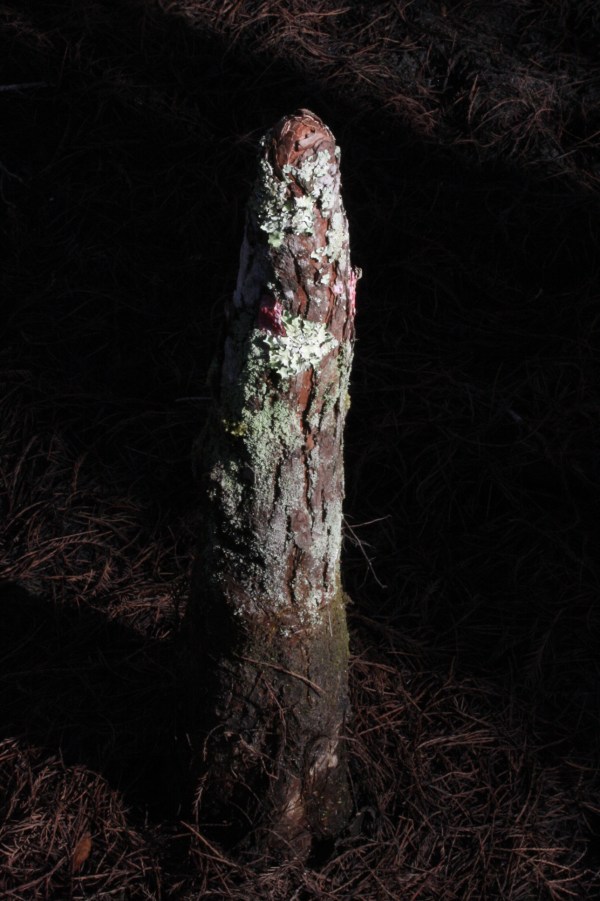
Trentepohlia on tree bark

Trentepohlia on tree bark

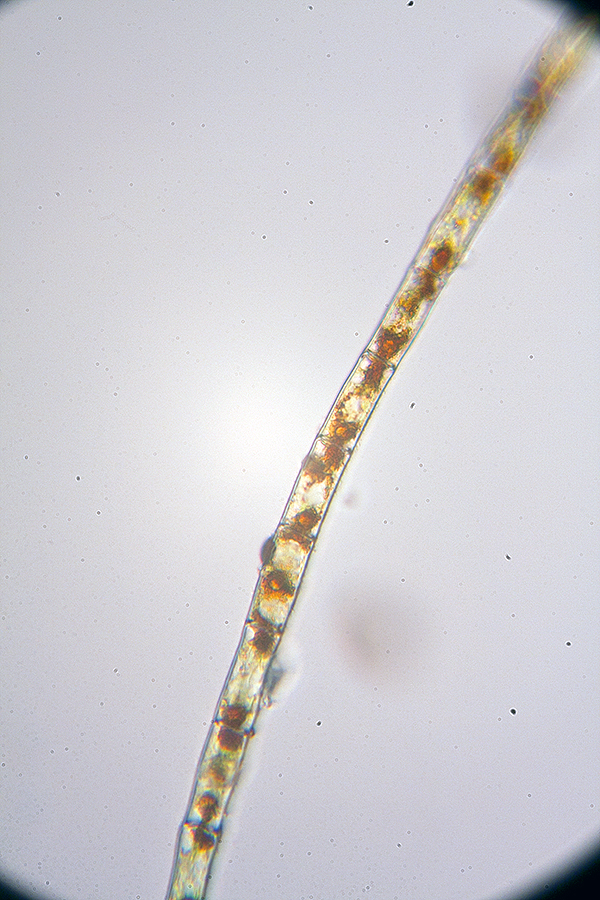
A microscope might help.  Aha!  Those reddish raindrops aren’t Sahara dust, but rather a soup of living cells.  But, oh my,  as a team of physicists—repeat, physicists—concluded, these don’t look like any cells we’ve seen before, so they gotta be extraterrestrials. Space brood is serious stuff!

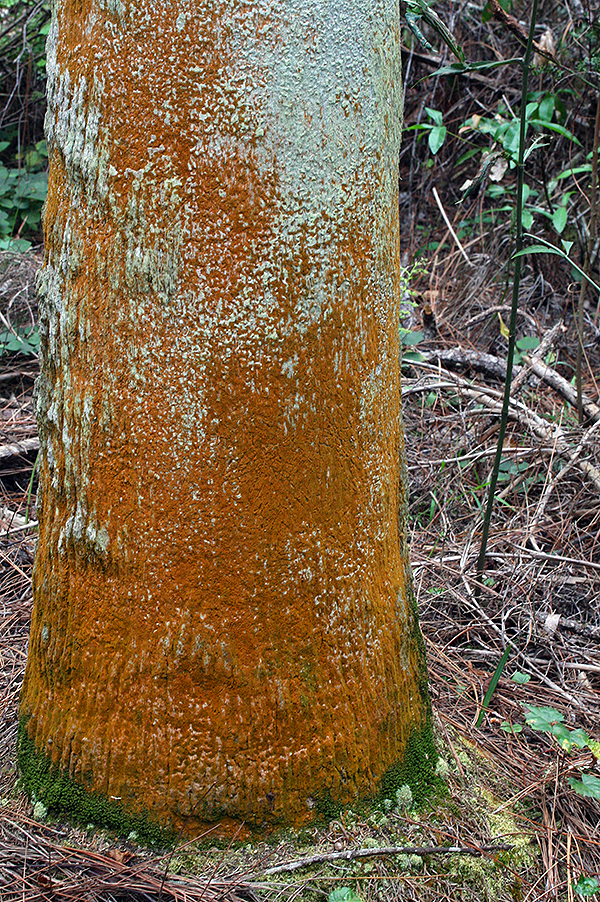
Trentepohlia on a palm trunk

Trentepohlia through the microscope

More or less this scenario played out in connection with red rainfalls in India in 2001…and before…and after. How often does a botanical garden solve a newsworthy scientific mystery?  What do microbiologists do when presented with cells of an unknown type, at least before DNA technology? Culture them, especially when they look like spores.  Can you imagine the potential consequences of culturing alien spores?  There’d be some finger-pointing among the oozing survivors!  When the Tropical Research Garden and Research Institute in India risked unleashing the galactic fungus, the hatchlings THANK GOODNESS were earthlings— the common alga Trenepohlia.  Here is a report on a similar event in Sri Lanka. CLICK

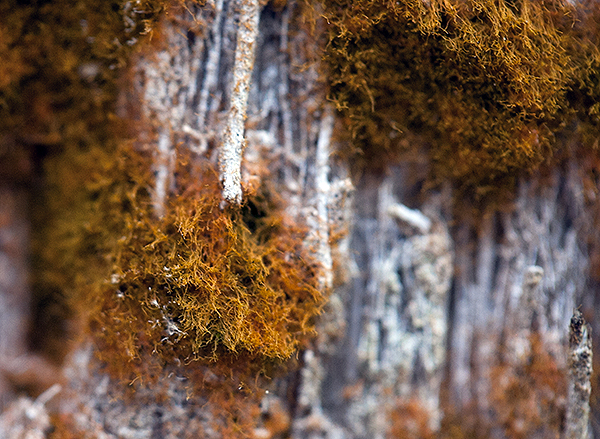
Trentepohlia up close on tree

Trentepohlia up close on tree

If Florida had a  tropical climate we too might experience funny rain. We have plenty of Trentepohlia, and you’ve probably seen it, at least if you stroll through swamps. It forms golden yellowish carpets on tree trunks.    Some Trentepohlias are not content to enjoy a mere free perch—they can parasitize their tree host, although I don’t think our Florida Trentepohlia aurea plays that nasty game.

Closer view

Closer

Trentepohlia is a Green Alga in a classification sense, even though it’s not colored green. The color deviation comes from high dry life on tree trunks.   An alga out of water needs sunscreen. The orange pigments are related to the carotenes in oranges and carrots, giving Trentepohlia its sunshine hue, and making its spores resemble bat gore, which I’ve never seen.

 
4 Comments

Posted by on February 17, 2015 in Trentepohlia


Tags:

Mama Mia – Could That Be Chia? (In Seabranch State Park!)

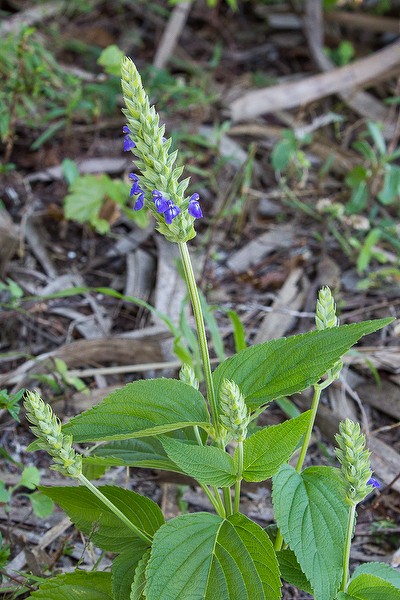
Salvia hispanica

Lamiaceae

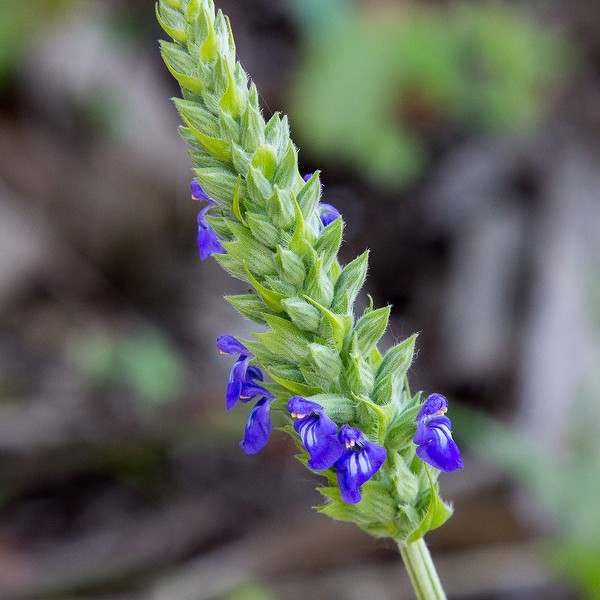
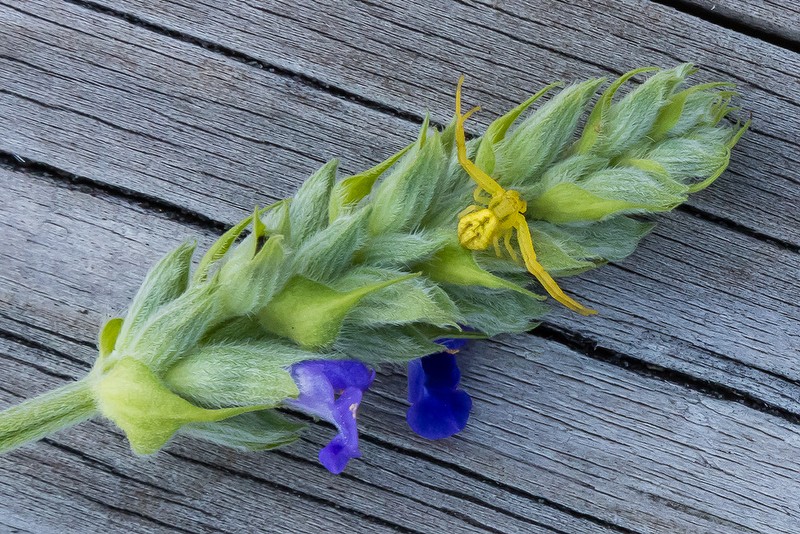
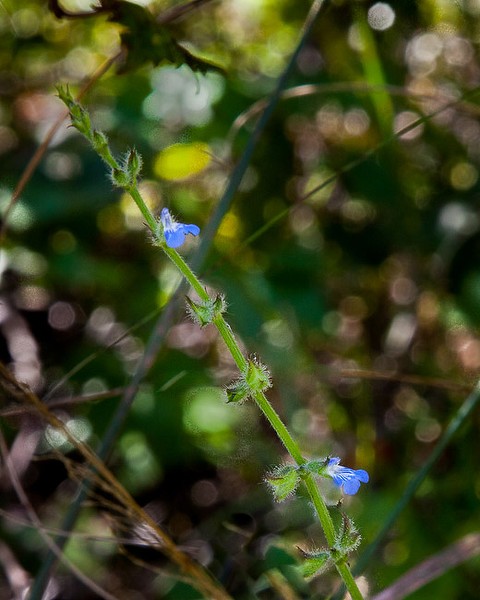
Something John and George did not expect in Seabranch State Park today was ch- ch- ch- Chia. It’s a perky mint similar to the native wildflower Salvia occidentalis although with the blue flowers crowded into a dense spike instead of spaced out widely.

Salvia hispanica.  (All photos today except the Chia pet by John Bradford.)

Salvia hispanica. (All photos today except the Chia pet by John Bradford.)

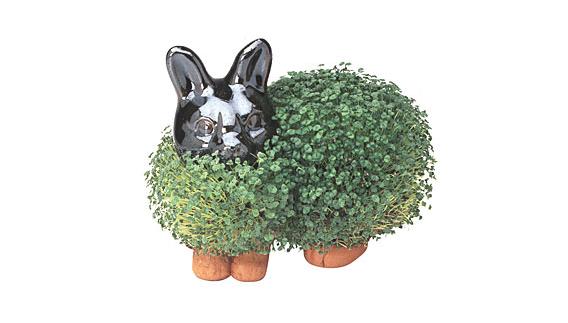
Everybody who has ever watched TV or battled their way through Walmart of course has seen Chia pets, maybe Homer Simpson with a rakish hairdo of Chia seedlings. I hope you’ve grown one at some point. We sometimes use them in my plant physiology class to demonstrate plant responses to light of different colors. They bend it like Beckham towards blue light.  The seedlings do not resemble the adult mint.

Chia-Pet-Bunny

If you’re up on contemporary healthful eating trends, you probably know Chia seeds attributed with healthful benefits.

Salvia hispanica today

Salvia hispanica today

To be technically correct, there are multiple closely related and very similar species of Chia. Though sold under the single name Chia even by a single company, the seedling species sprouting on the ceramic pig is usually or always Salvia columbariae, whereas the dietary Chia seed is today’s Salvia hispanica.

Chia, with a pet

Chia, with a pet

Both grow in arid western North America, so maybe it’s not severely dismaying to find Chia blooming merrily in the sandy sun-baked arid scrub in Florida.  Chias have history as snacks and meds in pre-European North American cultures.  It seems the perception of the seeds as healthy and energizing dates back thousands of years. A fad diet for the Mayans. Anyone who has slathered the seeds on Elmer Fudd’s noggin knows that when moistened they expand as a gelatinous mass. So naturally the traditional applications include poultices and plasters. Perhaps more interestingly, and I say this as an ophthalmology patient, ancient peoples with a painful particle in their eye, or maybe an intrusive bug, would pop a seed under the eyelid to let the expanding jelly could capture the irritant for easy extraction. Who would think a novelty is sold on TV would have a serious time-honored history?

Salvia occidentalis

Salvia occidentalis

The time-honored history may turn into a time-honored future, if you can believe material put out by the purveyors of Chia products.  According to the main supplier, and I know no reason to doubt them, farming Chia has become an industry in Uganda, where relief from hunger and poverty is life-giving. Photographs from Africa look exactly like the Salvia hispanica John and I enjoyed this morning.  I don’t know if the claims are the whole truth, or if there’s an undisclosed downside, or if there is self-serving exaggeration, but at first glance it seems that buying a silly Chia pet at Walgreens may put food in the mouth of a child on the other side of the world.

Note:

This video is of interest.

 
4 Comments

Posted by on February 13, 2015 in Chia


Tags: ,

Golden Club

Orontium aquaticum

Araceae (Aroid Family)

Today John and George planned an upcoming botany walk in Seabranch State Park near Hobe Sound, Florida.  We didn’t have much chance to explore new flora and fauna, but no problem, because this is February, time to visit the swamp. There are three reasons I stomp the swamp in February: 1. The low water level allows access to regions nasty during the rest of the year.  2. The bald bald cypresses allow light to the forest floor, promoting green life galore in what would otherwise be the deep dark shadows. A time for bromeliads, liverworts, mosses, seedlings, and marvels to find.  3. No bugs.

Bright spots down in the wet are golden clubs, unique members of the Aroid Family.  I’ve been fascinated with these showpieces ever since I was a student, and for over a decade have enjoyed a population near my home in Jupiter along brackish Jones Creek. With no solid data, I suspect this to be the southernmost population in eastern Florida.  The plants grow directly in shallow water or very near it.

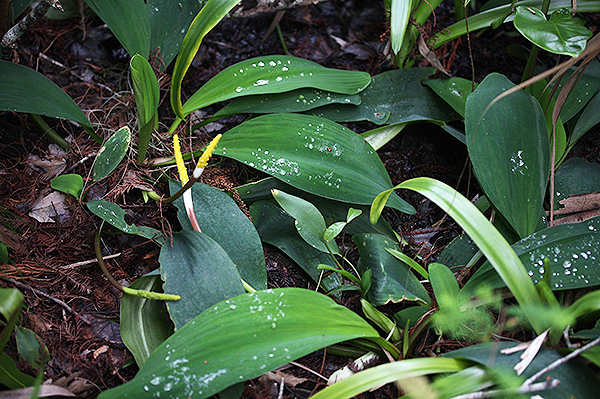
Golden clubs today in Jones Creek, Jupiter, Florida

Golden clubs today in Jones Creek, Jupiter, Florida

Orontium is a genus with just one species distributed mostly across the eastern United States from Massachusetts to Florida to Louisiana. Oddly, one or two fossil species are known too.  The plants are so odd and beautiful that botanists Robert Godfrey and Jean Wooten used a drawing of one as the frontispiece in their classic manual, Aquatic and Wetland Plants of Southeastern United States.

What fly could pass this up?

What fly could pass up this bad boy?

And now a nod to the name. A reasonable person might think,  “these are golden clubs, and oro means gold,  well that makes sense.” But according to contradictory reliable research, the name comes from the Orontes River in Syria, with ancient myths, legends, and history, including a different plant the ancient Greeks called by a name similar to Orontium.

Humans have eaten the rhizome and the seeds.  And humans have gone over Niagra Falls in a barrel.   Bad ideas IMHO. Like other Aroids, GC bristles with calcium oxalate crystals.  Lots, and calcium oxalate can nuke your kidneys.    I’m not convinced repeated boilings make it as pure as the polluted snow just because folks who want to eat nature say so.  It you want to eat Aroids, why not go to Publix and buy Malanga Root?

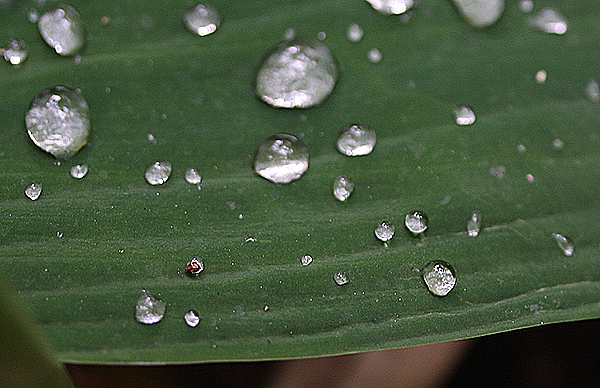
So what’s so weird about golden clubs? Start underground. How many plants do you know with a vertical rhizome? The rhizome is about the size of an upright hotdog, which is a corndog,  buried far down in the swamp mud, and it creeps deeper with time.  The roots are contractile, that is, rubber bands to pull the rhizome down out of harm’s way ready to sprout another day, or to wash ashore far away. Offhand, the only vertical rhizomes on other plants coming to my mind are on ferns.  By the way, another native species with contractile roots is coontie. Golden club leaves look like broad blue-green straps with tiny parallel veins.  Like a duck, water rolls off in sparkling droplets.

Like the hood on a well polished Corvette.

Like the hood on my Bentley after Jeeves waxes and buffs.

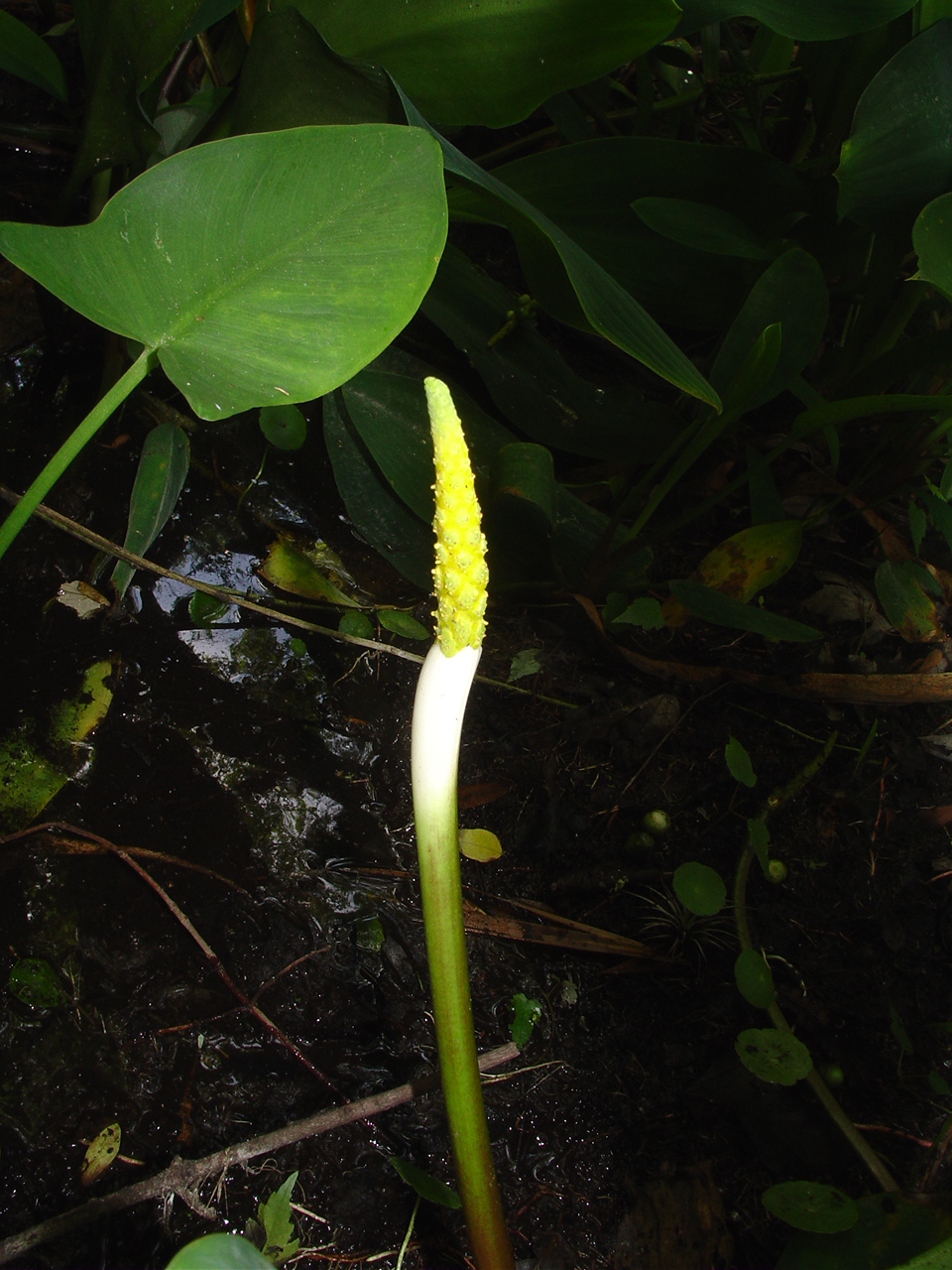
The best is yet to come, the flowering spike. First a quick lesson on the Aroid Family.  Aroid’s are known to gardeners and Home Depot shoppers as, for example, anthuriums, caladiums, colocasias, calla lilies, spathiphyllums, and many more.  Native plant enthusiasts might be familiar with arrow arums, sweet flags, and additional species.  Bring some of these to mind, and in your mind’s eye you will see a flowering spike called a spadix in association with a modified leaf called a spathe.  On those red florists’ anthuriums the spadix looks like a bumpy cigarette;  the spathe is that waxy scarlet leaf alongside it. Usually the spadix is not showy, and the spathe is the colorful flag. Or to phrase it for us native plant buffs, Jack is the spadix in the pulpit is the spathe.

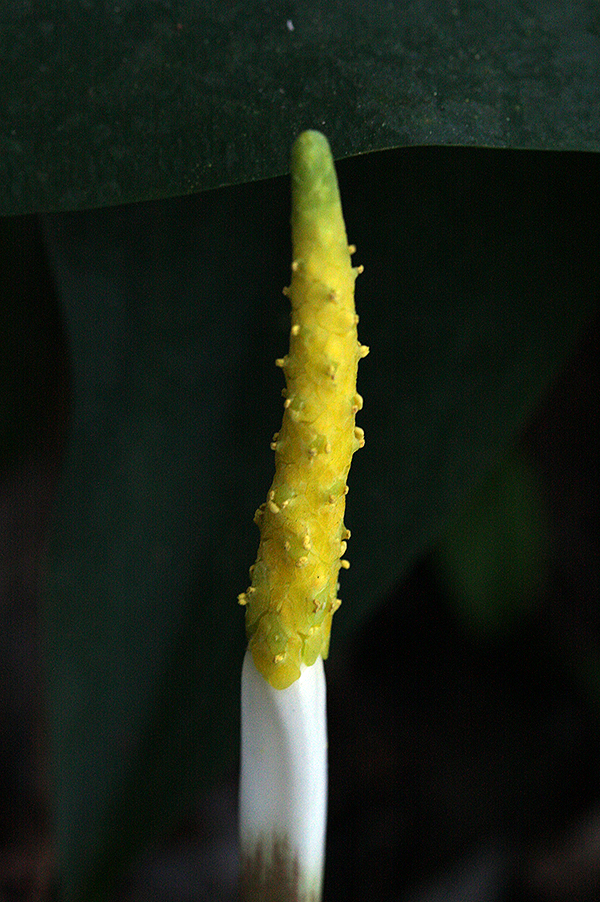
The spadix.  Twenty-some wee flowers visible.

The spadix. Twenty-some wee flowers visible.

In golden clubs the vestigial spathe is effectively absent. The spadix has taken over the showy function. It puts the golden in golden club. And what pollinator is lured to that goldfinger?  Apparently species of flies, with room for more research.

The pretty yellow spadix has numerous little flowers embedded in it. Toward the base of the spadix the flowers are bisexual, and toward the top the flowers are male. The bisexual flowers mature into a blue-toned fruit with one seed. The seed is separated from the fruit by a layer of Jell-O of unclear significance. Maybe the goo  gives the fruit buoyancy.  Maybe it sticks to a bird’s foot or to a passing gator or to the leaf on a waterlily.

 
2 Comments

Posted by on February 6, 2015 in Golden Club


Tags: , ,

Hat Pins, Isoetids … and bassackwards gases

Eriocaulon decangulare, E. compressum

Eriocaulaceae

John and George enjoyed getting out into the piney forest today; after a chilly dawn the day turned spectacular.  We planned a group walk through a scrubby pinewoods zone in Seabranch State Park. Most of today’s sightings have already entered this blog, so we’ll drift to the marshy area near the swamp where we’ve spent much time lately. (OK, we got lost there.) (Really)

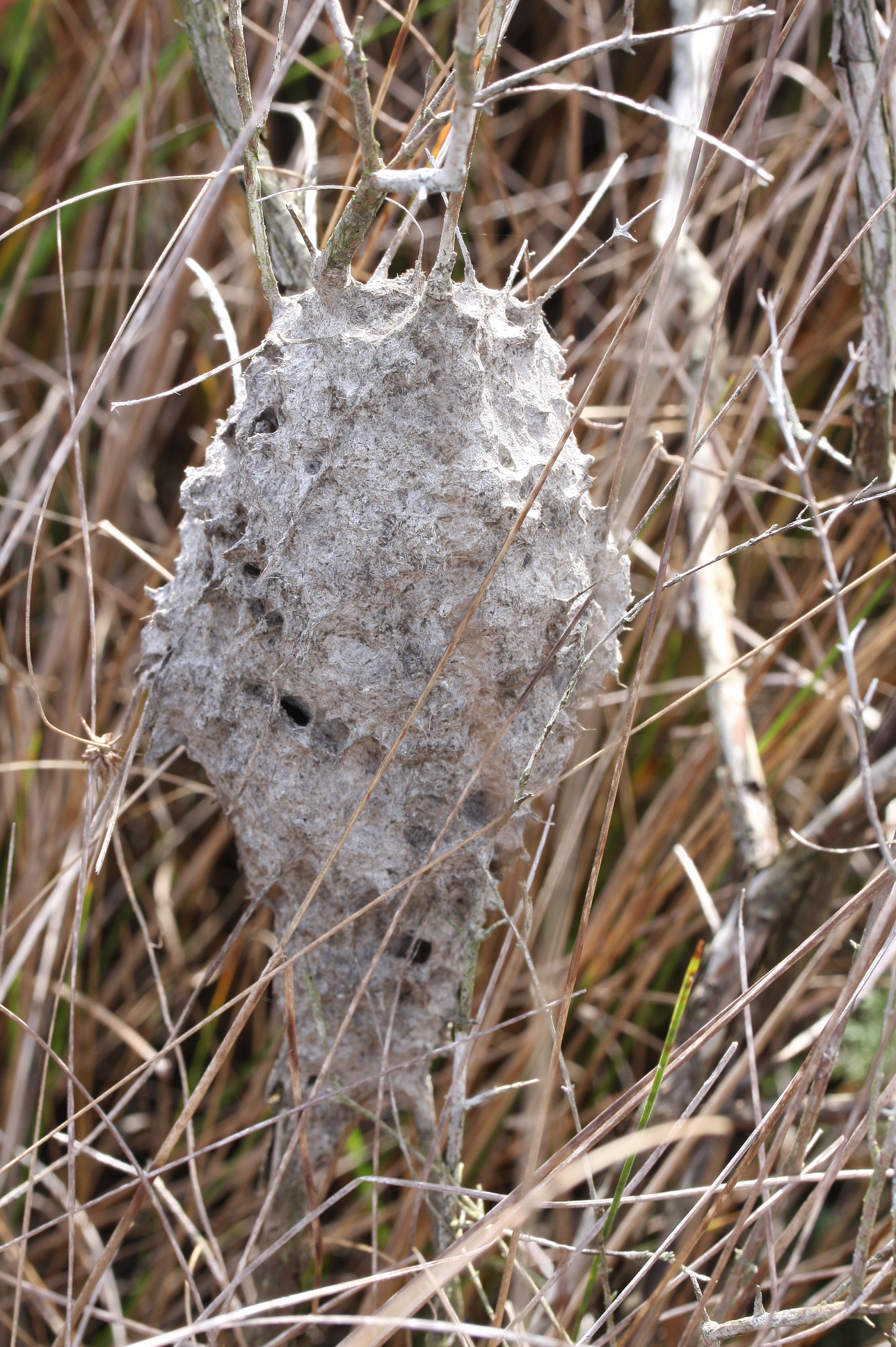
Ant nest in marsh.  Crematogaster atkinsoni?

Ant nest in marsh. Crematogaster atkinsoni?

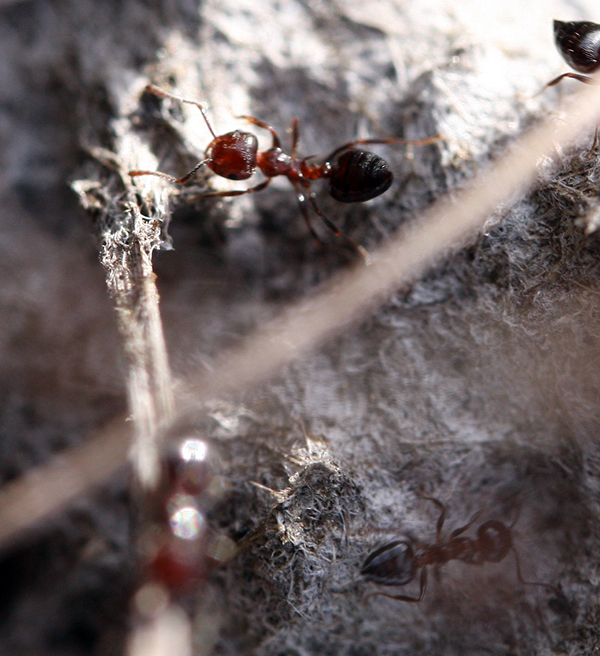
Hello there

Hello there … who bumped our nest?

As an aside due to John getting us into ants, in every sense, here is some ant biz.   In marshy places (this photo from the Cypress Creek Natural Area) are ants in big papery nests resembling hornet nests, and presumably safe above the high water line.   They seem to be Crematogaster atkinsoni, known to behave this way in Florida.  But don’t bet the (ant) farm!  This is a plants blog.

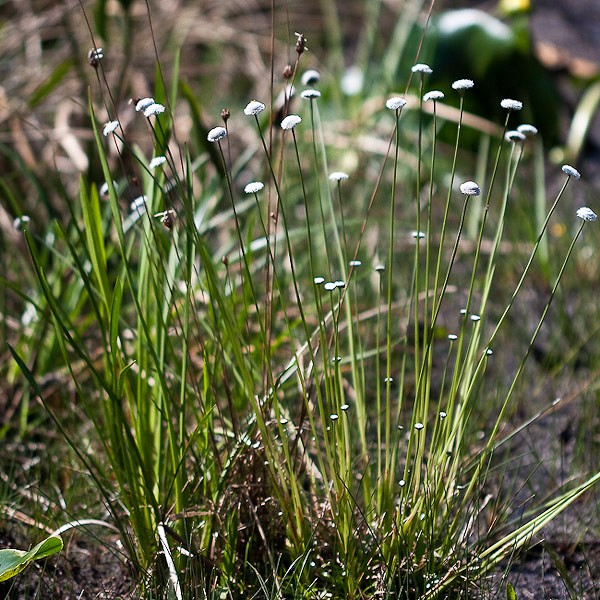
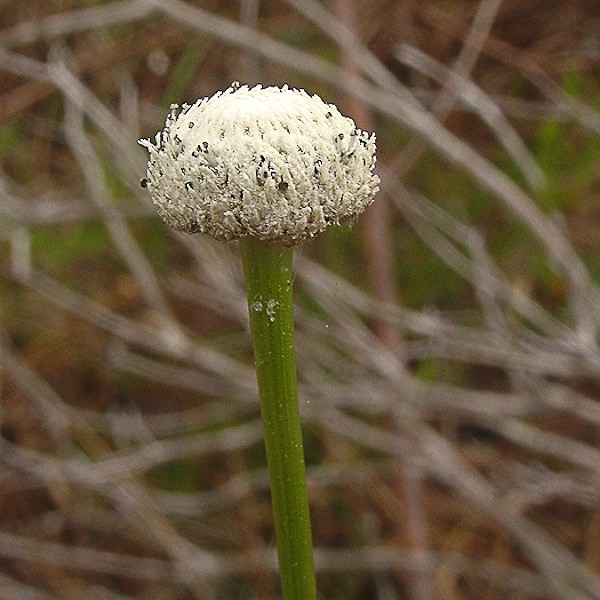
Attractive in the midwinter sunshine are species of Eriocaulon and similar genera in the Pipewort Family. They go by several English names: Hat Pins, Pipeworts, Bog Buttons.  Some folks hitch the different English names to individual genera, but the species all look too much alike for single handles to stick to single species.  The flower stalks truly do look like hat pins, the plants standing from a few inches tall to knee-high depending on the age, habitat, and species.

Eriocaulon compressum (by John Bradford)

Eriocaulon compressum (by John Bradford)

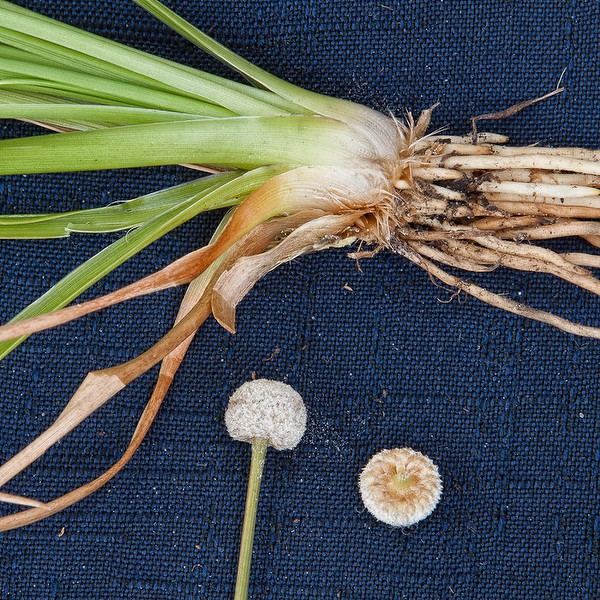
Now consider briefly a separate group of aquatic plants, the genus Isoetes, also known as quillworts.  There are plenty in Florida but not in our immediate haunts. The reason for an intrusive Isoetes non sequitur is to explain the name “isoetids,”   defined as plants resembling Isoetes not as genetic relatives, but as unrelated species sharing a peculiar aquatic growth form.  They look like slightly succulent grasses.  The plants have air channels in their leaves and roots, and have roots clustered intimately with the leaf bases. The root mass is disproportionately large relative to the foliage.

Ten-angle Pipestem, the root mass is intimate with the leaf bases, and there's a lot of root. (By John Bradford)

Ten-Angle Pipewort, the root mass is intimate with the leaf bases, and there’s a lot of root. (By John Bradford)

The isoetids have a unique life style to go with their characteristic life form.  The most abundant and thoroughly studied example  in our area is the so-called Ten-Angled Pipewort,  Eriocaulon decangulare. The similar Eriocaulon compressum has the same structure.

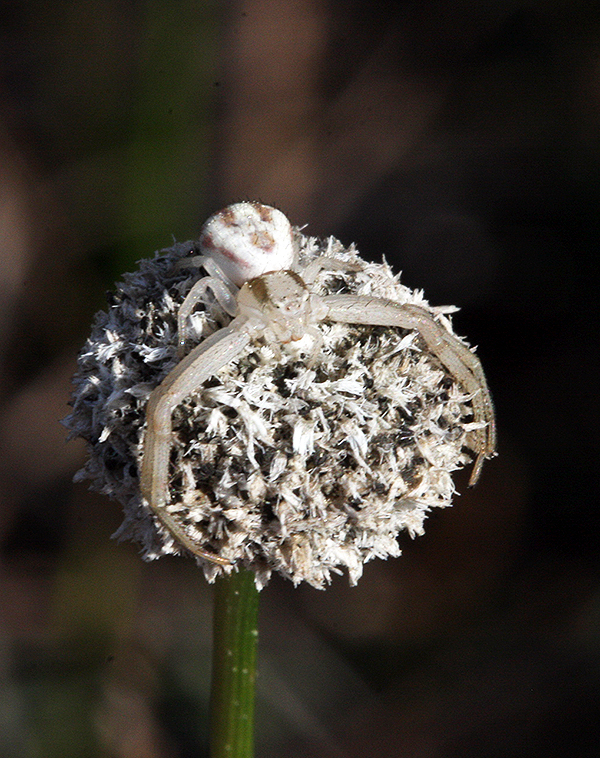
Eriocaulon compressum with hanger-on

Is this a tuffet?  Eriocaulon compressum with comfy guest

If you’ve read through the boring blah blah blah this far perhaps you’re waiting to see the shockingly unique life style unveiled. Here we go:  In second grade we all learned that plants absorb carbon dioxide through their foliage to let photosynthesis manufacture sugars. But today we learn that is not the whole truth and nothing but the truth.

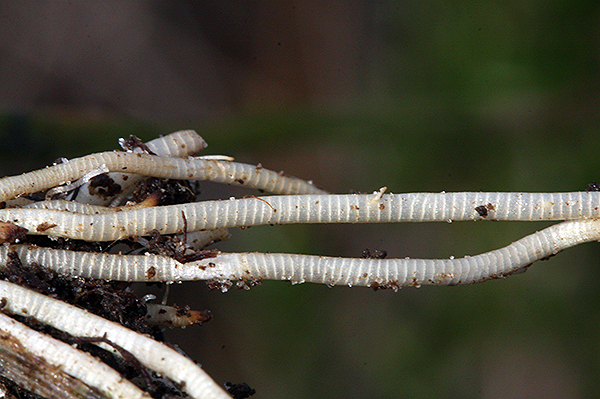
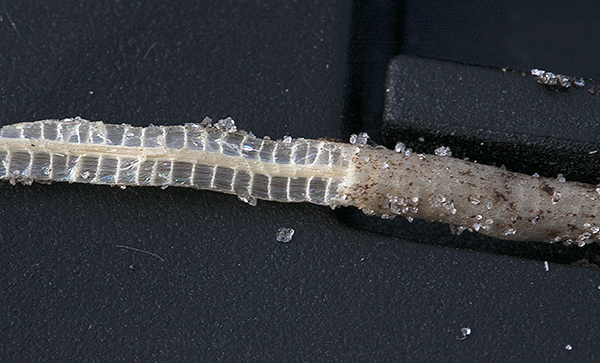
Ten-Angle Pipestem roots, showing air channels.  The following photo shows the same root cut open.    Gasses pass through the reinforcing cross-supports.

Space worms?  No,  Ten-Angle Pipewort roots, showing air spaces. The following photo shows the same root cut open. Gases pass through the porous reinforcing cross-supports.

Eriocaulon decangulare root cut open

Eriocaulon decangulare root cut open to show the air channels

When you spy a plant with big puffy air channels in its leaves and roots, it is natural to assume a ductwork system open to the clear blue sky.  Those roots need help down in the mud!  But no—wrong, or partly wrong.   Here’s the problem. Many isoetids live completely submerged with no opening to the air.   Ooops, we have the airshaft upside down—-they are exchanging gases through the roots.

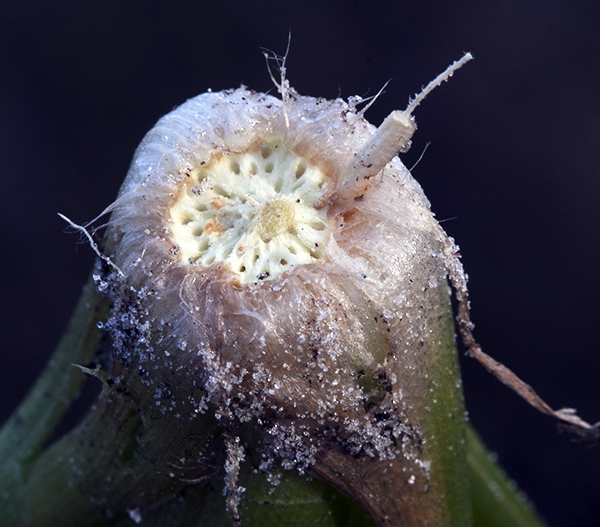
Ten-Angle Pipewort root-stem-leaf junction upside-down.  The fluffy material around the margin are inverted leaf bases.  The porous white center is the inverted stem base with its air channels.  At 2 o'clock a single inverted  root enters the system delivering CO2 immediately at the leaf bases and the stem air-channels.  (The thin thread at the tip of the root is a vein left behind when the spongy exterior was stripped off.)

Ten-Angle Pipewort root-stem-leaf junction root end-up. The fluffy material around the margin are leaf bases. The porous white center is the inverted stem base with its air channels. At 2 o’clock a single upside-down root delivers CO2 immediately at the leaf bases and at the stem air-channels. (The thin thread at the tip of the root is a vein left behind when the spongy exterior was stripped off.)

A completely or partially submerged plant lives in stinky goo with plenty of decay going on down there. The roots absorb carbon dioxide from soil microbial activity, bacterial waste gas,  sending the CO2 upward to the leaves for photosynthesis. And waste oxygen escapes down and out through the roots.

This creates the possibility of symbiotic relationships with soil bacteria happy to “breathe” that waste oxygen exiting the roots, and eager to make carbon dioxide to enter the roots.  Maybe those bacteria are even decaying material the plant produces.  I’ll bet that’s happening with Eriocaulon, but am not aware of research showing it in that genus.  Gas-exchange symbiosis with root bacteria is, however, documented in Isoetes itself.  Just think, the entire cycle of life, a mini ecosystem, all in one cubic foot of soil. Maybe.

Ten-angle pipestem flower head (by John Bradford)

Ten-Angle Pipewort flower head (by John Bradford)

———————————————-

Note.  For a deeper look: Raven, J. A. et al.  The role of CO2 uptake and CAM in acquisition of inorganic C by plants of the isoetid life-form: a review, with new data on Eriocaulon decangulare L.  New Phytologist 108: 125-148. 1988.

 
1 Comment

Posted by on January 29, 2015 in Eriocaulon


Tags: ,

Blackberry Jam

Rubus (subgenus Rubus) species

Rosaceae

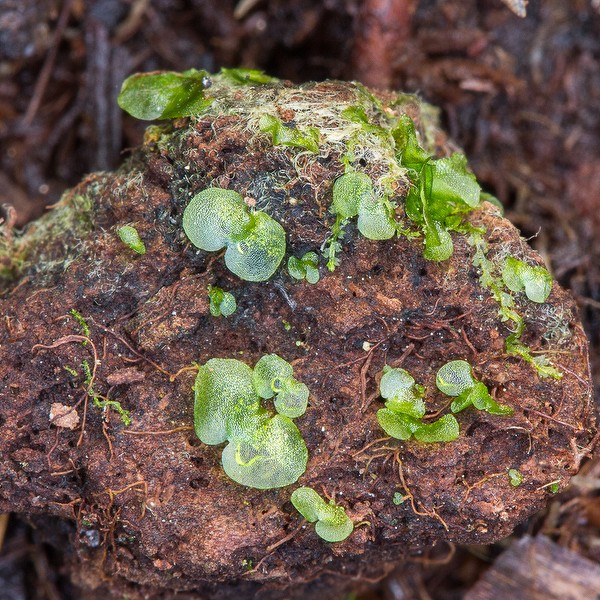
Seeking botanical good times in the Seabranch State Park swamp this week and last, near Hobe Sound Florida, John and George just can’t stay out of the swamp, though the mosquitoes may shift that obsession.  John shot a gigapan panoramic image of the mire. (See if you can find me mooning the reader therein.)  Also underfoot were germinated fern spores, more properly known as fern gametophytes, a pretty picture for today although not a topic to explore right now.

Fern babies (gametophytes). By John Bradford. These are about 1/4

Fern babies (gametophytes). By John Bradford. These are about 1/4″ across.

Some of the more eye-grabbing and pants-grabbing specimens are blackberries, in full bloom in January.  Let’s give them their due.  I’ve seen blackberries called a “taxonomist’s nightmare,” but that would be a taxonomist who feels that variation must conform dutifully to a human concept of distinct species. I see blackberries a little differently—as a taxonomist’s dream come true, in the sense of a complex dynamic pattern of organization that couldn’t give a hoot about human preconceptions.

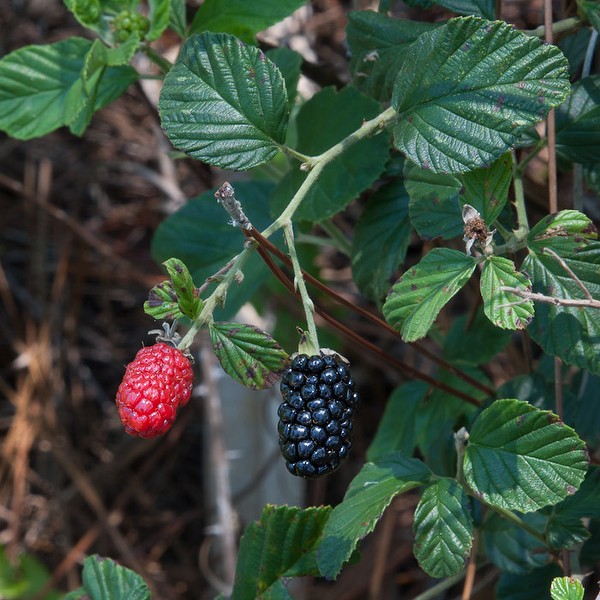
Blackberries (By JB) (Old picture, out of season, not taken this week.)

Blackberries (By JB) (Old picture, out of season, not taken this week.)

Nobody can say how many species of blackberries exist, because they do not sort into traditional species.  (Allow me now for convenience to expand the conversation to embrace blackberries, raspberries, and other close relatives making us the entire genus Rubus.)  Worldwide there are perhaps 700-1000 “species” of sorts, but more interestingly there are also thousands (repeat, thousands) of widespread genetically identical clonal variants, hybrids, possible ancient cultivars, and sundry evolutionary offshoots, including strains with abnormal chromosome numbers.    (In short, pseudo-species separated by small genetic differences arising in a moment by cloning, as opposed to true species evolving gradually by accumulated genetic processes.)

At least four population characteristics make blackberries so devilishly interesting:

1. Everything eats them. As the most delicious food on earth, blackberries feed everything from rodents to raccoons to bears to birds. I once had a golden retriever who enjoyed berry picking.  The creatures move them all over the place aided by little piles of natural fertilizer. This might help explain why so many “types” of blackberries are so geographically widespread.   As an example, cloudberry  (Rubus chamaemorus) circles the globe at northern latitudes, wobbling as far south as Long Island.

2. Everybody eats blackberries. As long as there have been hunter-gather humans they have certainly hunted and gathered blackberries.  Blackberry seeds dot coprolites. (The Coprolites were not an ancient mesopotamian kingdom.) Blackberries long long ago were probably ancient camp followers thriving on waste heaps near human settlements, where humans could go select, perpetuate, and spread their favorite strains, probably creating ancient cultivars. You can be sure that our ancestors helped stir the blackberry genetic pot bringing different variants together, inadvertently producing hybrids, and moving them around.

3. Many blackberries reproduce asexually. They clone.  Many form non-sexual seeds genetically identical to the mother plant. This skill allows minor genetic variants, hybrids, and clones favored by bears, birds, Neanderthals, or the climate to expand their populations and spread.

4. Species of Rubus can be careless about their chromosomes. “Normal” plant species (with very many exceptions) have chromosomes in pairs. But blackberries and their relatives sometimes sport multiple chromosome sets and other chromosomal aberrations. You can get away with that when you reproduce asexually, as the main problem with screwy chromosomes is a thwarted sexual cycle. And blackberries are happy to hybridize.

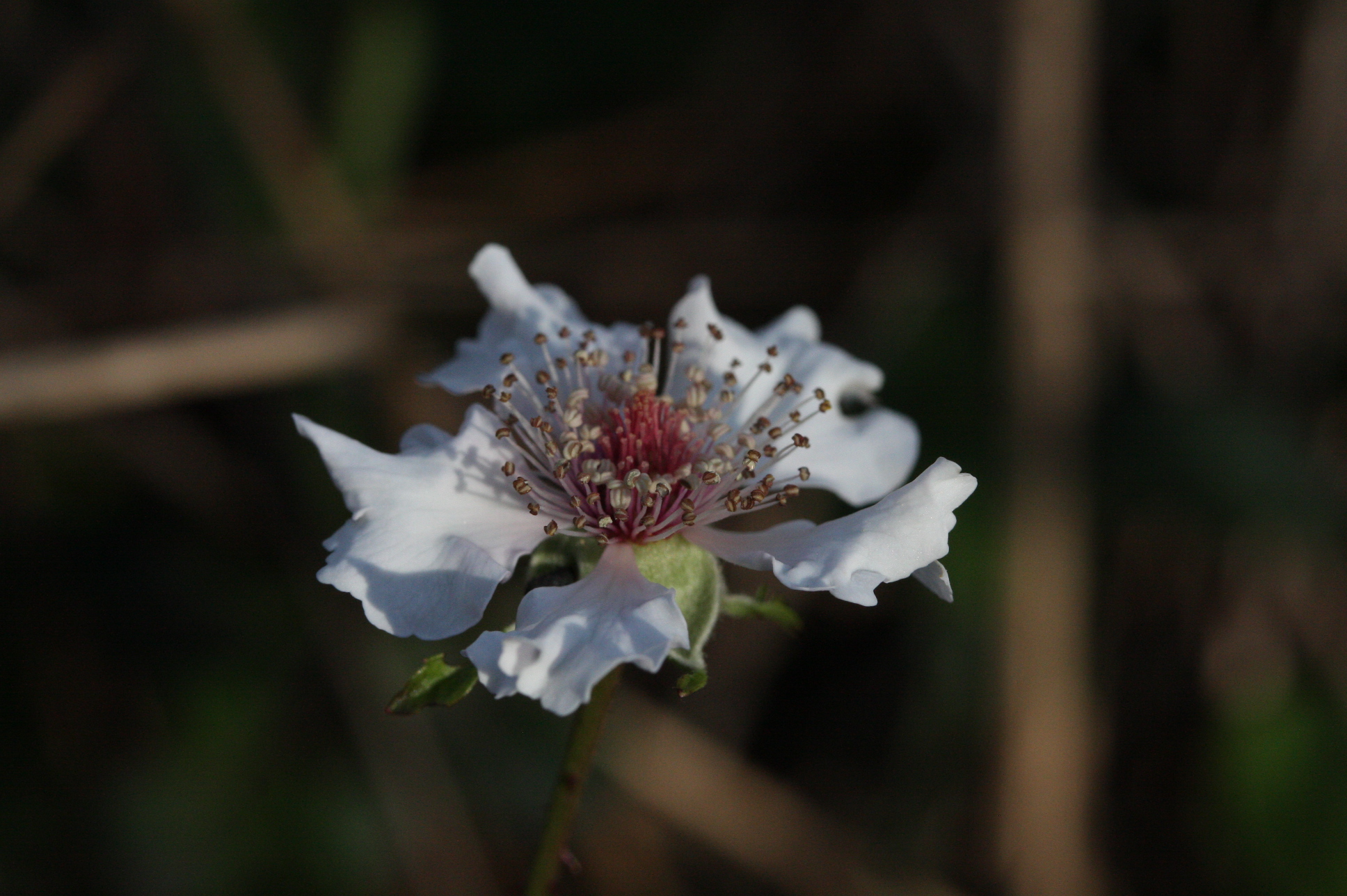
Blackberries are in bloom now.  Look like little roses, don't they?

Blackberries are in bloom now. Look like little roses, don’t they? Photo taken this week.

So let’s sum up the messy situation. Here you have a group of plants moved around by every living thing and monkeyed with by every prehistoric human.   Mobility brings divergent evolutionary lines together, providing chances to hybridize, which blackberries are so willing to do. Hybrids on average have a rough time facing the real world, unless they are able to clone asexually; oh yeah, did I mention blackberries do that…and then move around again by crows or Cro-Magnons just to stir things up more.

One way to tackle such a complex situation is to grab one thread and yank on it. Let’s do that for our local blackberries. Even that’s not so easy to do, as you may understand from reading this, because a glance at different references reveals the expected disagreement as to what species of Rubus live in our local counties. Let’s go arbitrarily with one modern reference and pull forth three species names: Rubus cuneifolius, R. pensilvanicus, and R. trivialis.  Are any of these locals fuzzy to define or otherwise involved in genetic mischief?

Rubus cuneifolius is a nice “diploid” (with paired chromosomes) species, or is it? Strains with chromosomes in sets of three and four are reported. One sign of taxonomic confusion within a species is synonymy, that is, the existence of additional names interpretably pertaining to that species. I got bored and quit counting after finding 18 synonyms, including the “Rubus dixiensis.”  Makes me want to whistle.    

Another interesting measure of messiness is finding documented hybrids involving a purported species.  I quickly found five and quit counting.  One of them is especially intriguing. Our Rubus cuneifolius is in South Africa an invasive exotic, and seems to hybridize with multiple African species, most saliently with Rubus longepedicellatus.   These two species have spawned what’s known as a hybrid swarm.  The swarm is a geographically widespread series of novel strains not belonging to either parental species.  “Shake-n -bake”  instant species!

Some books say we have Rubus pensilvanicus, others that we have R. argutus.   I sure don’t want to quibble on this question, because the whole point of this post is to underscore the murkiness.   So easy to be expert when simplistic!  Botanical life gets more complex than “either-or.”  Rubus pensilvanicus is no clean-living species.  On the U.S. West Coast, it has generated a hybrid mess with at least one western species, a pattern reminiscent of our sordid South African story.

OK then, what about Rubus trivialis…do we have one true blue species here?  Naw—guess what one of its hybridization partners is, our own Rubus cuneifolius, the same species that mixes it up in South Africa fools around here in Florida with R. trivialis.

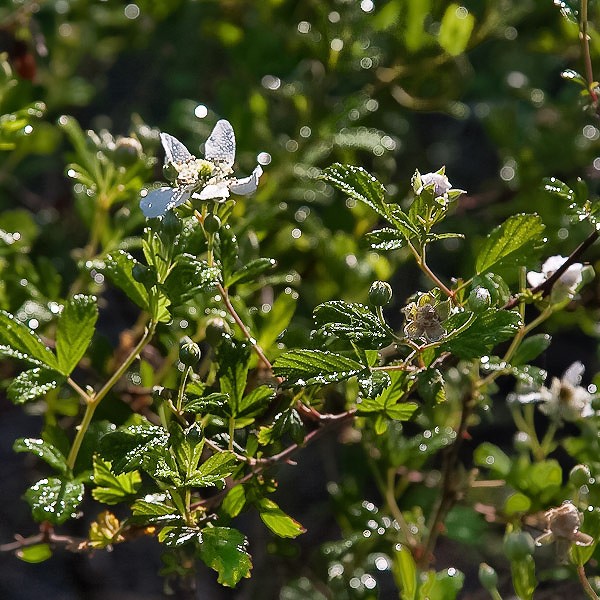
Blackberry branch (by JB)

Blackberry branch (by JB)

So when John and I snag in blackberry bramble and say “oh rats,” is it Rubus pensilvanicus, R. argutus, R. trivialis, R. cuneifolius, or none of the above…or a mix of the above?  Or a mix of the above and more?  (I did not label the photos.)

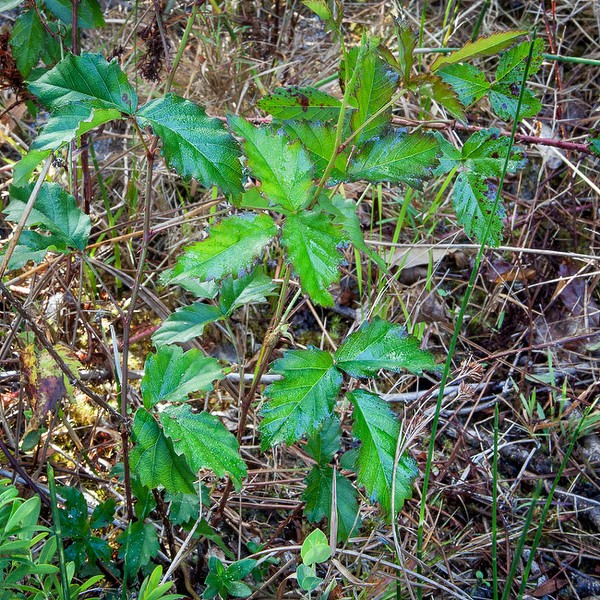
BB Foliage (by JB)

BB Foliage (by JB)

 
7 Comments

Posted by on January 24, 2015 in Blackberries


Tags:

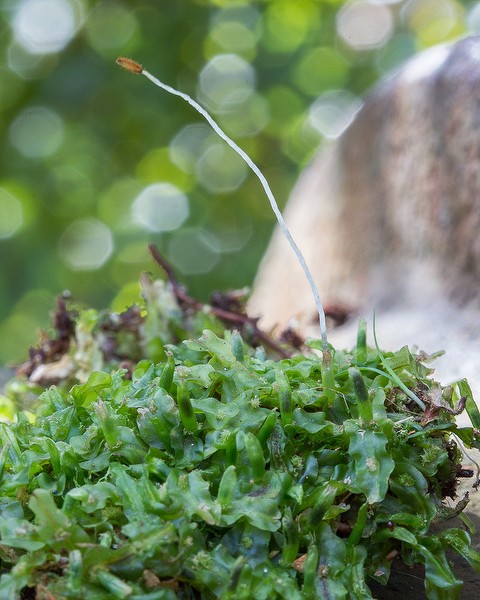
Pallavicinia – Liverwort

Pallavicinia lyellii

Pallaviciniaceae

Today when John and George went botanizing it was nippy, so we felt no surprise in finding the perkiest plants to be a species native as far north as New Brunswick, not suffering from today’s chill. This is the most widespread species you’ve never noticed. Ranging from Canada into South America, out to California, and across the world to Europe, Asia, Australia, and Africa, in other words almost everywhere.

Being that widespread of course Pallavicinia lyellii visits varied habitats with an overall affection for wet acid situations under broadleaf trees. This is exactly where we found it in Seabranch State Park abundant throughout the largely hardwood-dominated swamp at the east edge of the park, a botanical museum of ferns, mosses, lichens, and  liverworts.

Not every reader will be familiar with liverworts.   They are related to mosses and are among the most primitive land plants on earth. They are the oldest known land plant fossils, dating back 473 million years. A look at certain liverworts and a peek at similar green algae makes it easy to believe that the land plants evolved from the green algae, as they in fact did.  I don’t want to go too far down that technical road today. Suffice it to say that liverworts and their relatives have no roots, no veins, poorly (or un-) differentiated leaves or stems, no flowers, no fruits, and no seeds.  They look like seaweeds and stay close to the water.

Leafy liverwort

Leafy liverwort

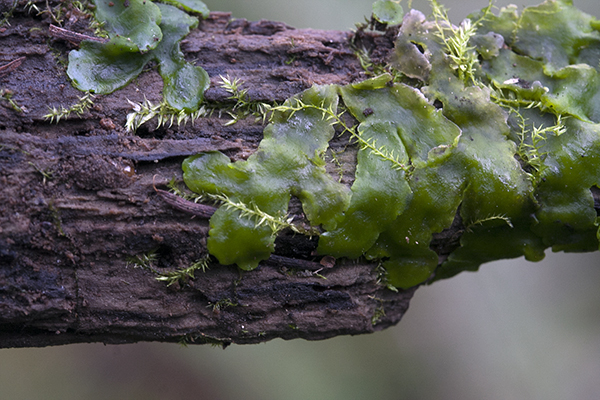
There are several thousand species of liverworts worldwide divided into two basic types. One group, called the leafy liverworts, resembles mosses by having stems and leaves, although the plants are usually even smaller (you need a hand lens), flat, and with round leaf blades. Look for them on tree trunks and wet hummocks mixed with moss.   Today’s feature species belongs to the other major group, called the thallose liverworts, these consisting of almost nothing more than what looks like a wet green leaf spread irregularly on a wet surface, often mud or decayed log.

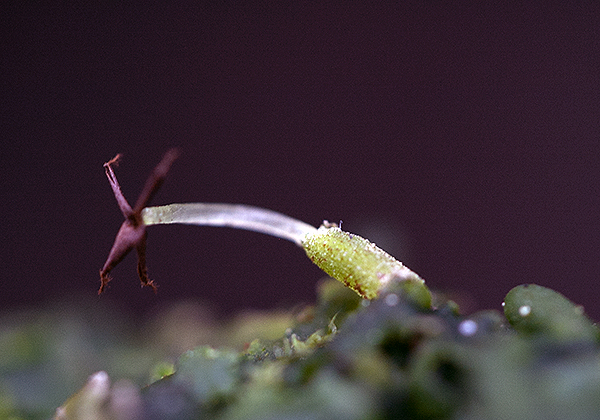
Pallavicinia lyellii  liverwort with gametophyte (green) and sporophyte (the thread). By John Bradford

Pallavicinia lyellii liverwort with gametophyte (green) and sporophyte (the thread). By John Bradford

As you can see, John captured a beautiful portrait of Pallavicinia lyellii with its leafy seaweed plant body.  The ruffly little cabbages on the foliar surfaces are the female egg-making apparatus. The sperm-making structures are on separate male plants. The brown cap on the delicate white thread is the spore-making system (sporophyte). It makes the spores that blow way to re-establish the liverwort all the way from here to Timbuktu. Spore-making plants such as fungi, mosses, ferns, and liverworts often have wide windblown distributions.

What does the name liverwort mean?  The wort part is just an old word referring to an herbaceous plant. The reference to liver is more telling. This dates back to an historical dogma called the doctrine of signatures, which attributed plants with benefits according to their appearances. So a plant resembling a fetus was good for birth, birthwort, and lungworts were beneficial for your lungs, and liverworts are liver medicines. I’m not completely sure what the resemblance to the liver is.   I’ve heard two explanations: Some liverworts are lobed in a way resembling a liver.  Alternatively, a microscopic view of a liverwort can suggest the microscopic view of a liver. Either way I don’t think they help much medically.  But they are top-quality botanical curiosities and they help make it all much more fun to explore the infinite world of green.  Here are some local liverworts from our “archives.”

Riccardia latifrons sporophyte

Riccardia sporophyte (spore-making generation) on surface on gametophyte

Riccardia pinguis (I think)

Riccardia pinguis

Sphaerocarpus, Riverbend Park, Jupiter, Florida

Sphaerocarpus, Riverbend Park, Jupiter, Florida

 
4 Comments

Posted by on January 16, 2015 in Pallavicinia


Tags:

Indian Pipes

Monotropa uniflora

Ericaceae (Monotropaceae)

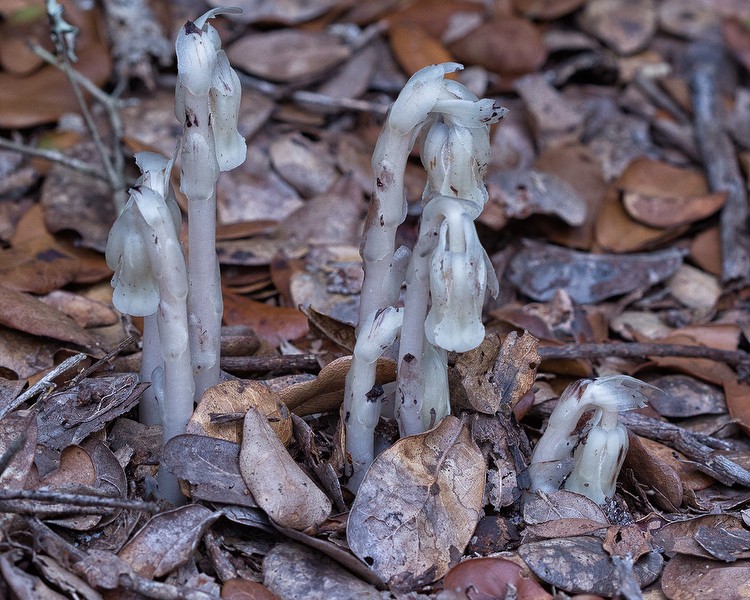
From the middle of December until this week John and George deferred exploration of Sebranch state park in favor of family activities and dental appointments, but today we got back to it. During the holiday hiatus John developed an eye for an odd plant you don’t see often. Twice he found Indian Pipes, Monotropa uniflora, a ghostly white species in the azalea family.  We checked it out in Seabranch State Park today.

Indian pipes in flower.  By John Bradford

Indian pipes in flower. By John Bradford

The pipes are white because they have no chlorophyll; they have no chlorophyll because they do not photosynthesize; they don’t photosynthesize because they depend 100% for nutrition on fungi associated with the roots. The fungi extract nutrients from decaying soil organic matter and apparently more importantly steal sugary nutrients from neighboring plants.  The guilty fungi form mushrooms, so probably you can sometimes see all three members of the trio at once:  trees, mushrooms, and Monotropas.  No, I did not say every mushroom in the vicinity is involved.  Problem is, what goes on underground is complex and exasperatingly hard to study.  Research reveals the Monotropas to be fussy about their fungal friends, although this seems to vary geographically.

What’s turned out is that in the huge world of root-fungus symbioses, Monotropa and its close relatives possess their own mycorrhizal system, not even the same as the rest of their own Ericaceae family.   The fungus makes a net around the root, covering the tip, and fungal strands penetrate the root forming “pegs” but never breaking through into the actual root cell contents.  There are major anatomical changes in the root to accommodate the invader and to facilitate nutrient transfer.  The greatest fungus-root activity occurs as pods and seeds form.

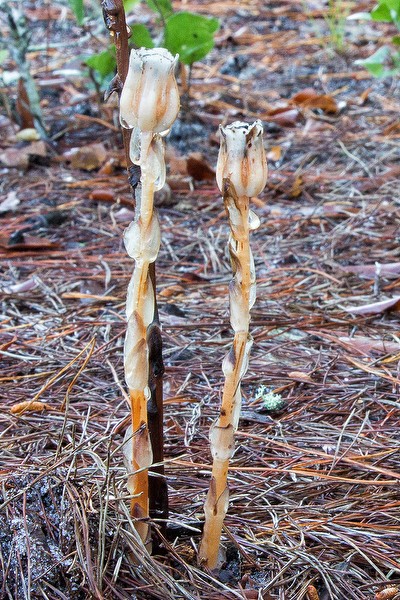
The pods stand upright.  By John Bradford

The pods stand upright. By John Bradford

Monotropa favors conifers.  Radioactive carbon introduced experimentally to conifers crossed the fungal bridge into the Monotropa, and the reverse occurred with phosphorus.  A fungus-mediated swap?  Perhaps, but you can bet there’s far more to the story.  Certainly the non-photosynthetic Monotropa needs what pine photosynthesis makes—complex carbon compounds, mostly sugars, and the pine conceivably needs help from the fungus middleman, if not from the Monotropa itself, to extract phosphorus from its dreadful soil and its organic detritus.  Who’s benefiting when and who’s getting ripped off needs more radioactive research on all three partners.  Three-way symbioses are becoming fashionable!

Mycorrhizae happen in 80-90% of all plants, but there are probably not too many cases where the fungal partner spoons sugar to its root partner.   Well, to one of its root partners, in this case, the fungus acting sort of a biological Robin Hood, stealing from the rich (pine) and giving to the poor (Monotropa).  I wonder if Monotropa is in Sherwood Forest.

Answer: Yes, Friar Tuck marveled at Monotropa.  See the 2nd paragraph, 6-7 lines up from the bottom. CLICK

(I like UK connections in the blog as a nod to our long-standing British blog friend Mary.)

The UK Monotropa underscores a bizarre distribution.  Monotropa is as widespread as it is small. There are only two species, yet Monotropa spans almost all of North America, much of South America, and is in Europe and Asia.  The genus used to be bigger, but DNA has broken up many a traditional assemblage!  (Such as reptiles, to the dismay of many, but wrong blog.  Don’t ask.)

These plants are primo examples of convergent evolution, that is, evolution of similarities among unrelated organisms. Many plants in other families are parasitic, and many have gone the no-chlorophyll route. These include the broomrapes, beach drops, squaw roots, and oodles of others.  I’ve encountered the number 400 species of no-chlorophyll fungus-dependent plant species.  This is no big surprise, given that most plants have symbiotic root fungi (mycorrhizae)—some just take it to the limit.  Here is a fun relevant link in the world’s best plant web site.  Click to visit my hero Wayne Armstrong who does community college botany right.

Indian Pipe pollination merits a quick closing remark.  You don’t see these plants often—they are ephemeral, environmentally fussy, and, well, hard to spot.  This raises questions of pollination, which botanists have addressed in recent years.  Often isolated species are self-pollinated for obvious reasons, but today’s plants need to exchange pollen with others.   And you might expect spotty species to benefit from a broad array of pollinators, but nope, just bumblebees insofar as known, pinching the environmental scope of the Monotropas.  Given their huge geographic range, though, they can’t be too imperiled.  Still, you get the feeling that— just like many other scrub species–as the scrub patches shrink as subdivisions grow, minimal viable thresholds may apply, and species may evaporate from small sites consequently.  You can’t count on postage-stamp preserves to save the day.

 
19 Comments

Posted by on January 9, 2015 in Monotropa


Tags:

Parasites of Parasites of Parasites (well, sorta) and Red-Bays

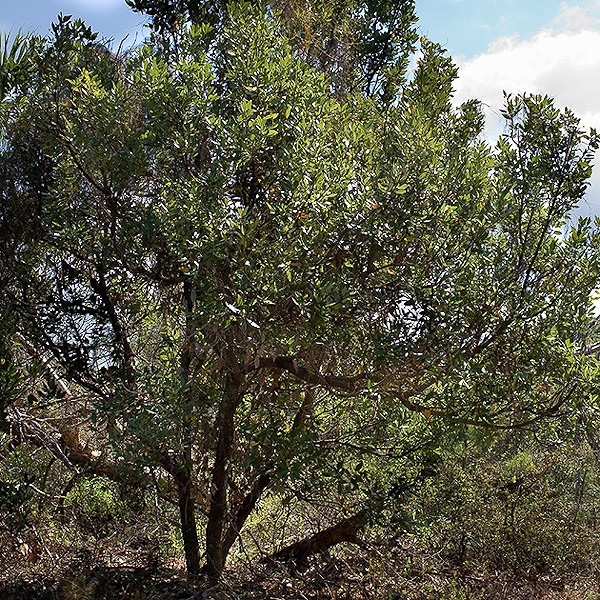
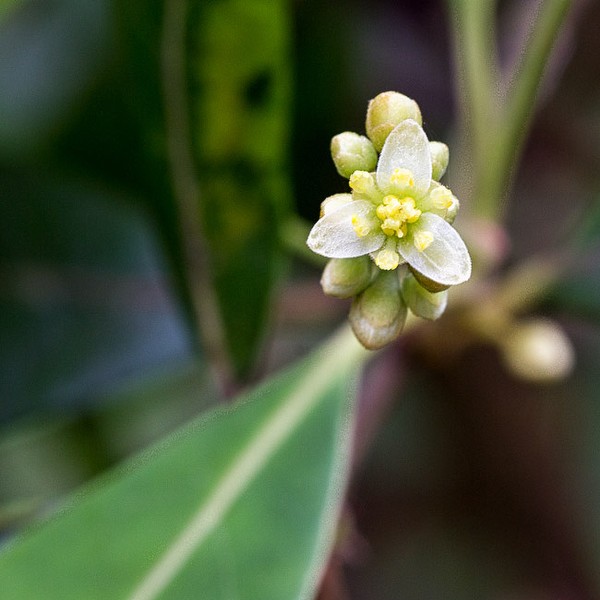
Red-Bay   Persea borbonia

Swamp-Bay  P. palustris

Silk-Bay P.  humilis (P. borbonia var. humilis)

Lauraceae

In plant groups with names resembling culinary spices, watch out for nomenclatural confusion.   And when you encounter a species complex where different taxonomists define species differently, shun fool’s arguments.  Not all plant groups have studied textbook definitions of species.   I have no interest in sorting out, pontificating upon, or quibbling over the controversial details of Persea taxonomy and naming.   A little relevant data appears at the end of the post under Notes.   Species complexes can easily generate arbitrary, semi-informed, overly specific pseudo-authoritative classification pronouncements.

Just for sloppy convenience, I’m using the term red-bay to cover all three locally native Persea species.

Persea borbonia (by John Bradford)

Persea borbonia (by John Bradford)

Laurel Wilt Disease, an exotic fungus coming with an Asian ambrosia beetle, has since 2002 marched southward from a foothold Georgia, now spanning the length of Florida to menace our red-bays, avacados, and possibly additional related species.   Because the Internet is loaded with info on this, we’ll move on summarily, providing a link.  Ambrosia beetles are not a genetically cohesive group, but rather an ecological lifestyle association:  they have specialized organs to carry fungal spores into the tunnels they bore into trunks and branches (look for telltale dangling strings of sawdust).  The fungus grows lining the burrow, and the beetle feeds on it.  The fungus clogs the plant plumbing and wilts the plant.

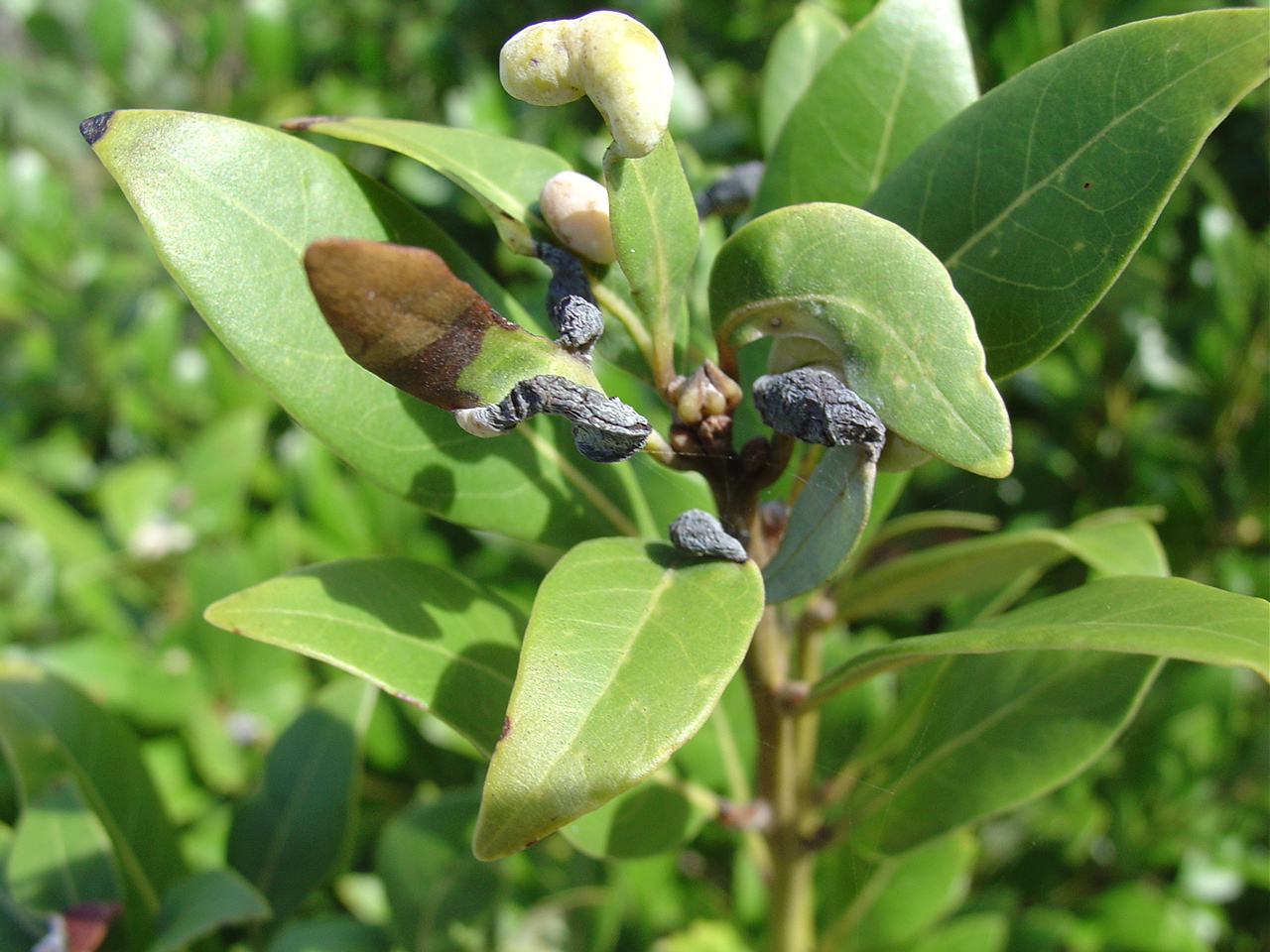
Let’s shift to other pests.  Galls on the leaf blades of all three local Persea species are so commonplace and conspicuous they aid in spotting the plants.  The galls come from the egg-laying of tiny red-bay psyllids, bewilderingly named Trioza magnolia, apparently due to old-time confusion between red-bays and sweet-bay magnolias. (See Notes below.  The bug does not bug magnolias).  Psyllids are small hemipteran sucking insects related to aphids and cicadas.  The nymphs mature under the deformed red-bay leaf margins, where the confined little pests have a waste disposal problem.  Not wishing to foul their own nest, they coat their waste in waxy balls and leave it there.    The nymphs are easy to find, to the benefit of a host of predators.

The galls are ugly, but not to a psyllid.

The galls are ugly, but not to a psyllid.

Psyllids, “plant-lice,” are masters of biological funny business.   They are juice-sucking plant parasites and at the same time are hosts to their own internal “parasites” and symbionts.   Psyllids house bacteria, and the 3-way psyllid-bacterium-hostplant relationships can become complex.    The galls are the tip of the lice-berg.   The psyllid with it sucking mouthparts injects bacteria into the host plant, where the bacteria can cause disease, and presumably can transmit to other psyllids, although the details of all the dynamics need research.   DNA technology will help.

Symbiotic bacteria can live inside the psyllid’s cells, almost as cell components.  Such bacteria have some of the briefest genetic codes known to cellular biology.  The bacteria are not mere parasites; they give back, including essential nutrients, and bacterial toxins useful to the psyllids for defense from all those varmints who hunt them (see above).  The bacterial toxins have stirred interest as antitumor agents for human medicine, and perhaps more promising, the insect-bacterial interdependence reveals an Achilles heel for potential psyllid disruption. In agriculture, they are quite the little troublemakers.

Wouldn’t it be something if those toxin-spewing psyllid-borne bacteria participate in the host shrub’s ecological relationships?     Bacteria introduced via psyllids move across grafts in the plant’s phloem.    Parasitic love vine (related to red-bay in the cinnamon family) invades its victim’s phloem.   Conceivably then, the psyllid bacteria could move from insect to red-bay phloem and onward to love vine phloem?…and there impair the parasitic vine, protecting the red-bay?  Any chance psyllid-infested red-bays are comparatively resistant to love vine attack?   Guilty, pure imagination.

Persea borbonia flowers (by John Bradford). (Flower parts in 3's are not common in Dicots, although characteristic of Lauraceae.)

Persea borbonia flowers (by John Bradford). (Flower parts in 3’s are not common in Dicots, although characteristic of Lauraceae.)

Red-bays have broad soil tolerances thanks no doubt in part to their root antibiotic called borbonol, which confers resistance to some fungal (Oomycete) rots. The crushed leaves are distinctively stinky and probably toxic, yet used a little for culinary flavoring.   Anything bioactive and smelly automatically has history in human medicine.  Red-bays have too many historic uses to list.  Name an ailment.  An interesting application, however, is as sort of folk smelling salts to counter unconsciousness.   Maybe that would help in some in my classes.

Red-bay has mixed relationships with butterflies.   The foliage murders eastern tiger swallowtail larvae, and yet is the chief larval host for the palamedes swallowtail butterfly, which probably derives nasty stuff from the leaf tissue to the butterfly’s defensive benefit.

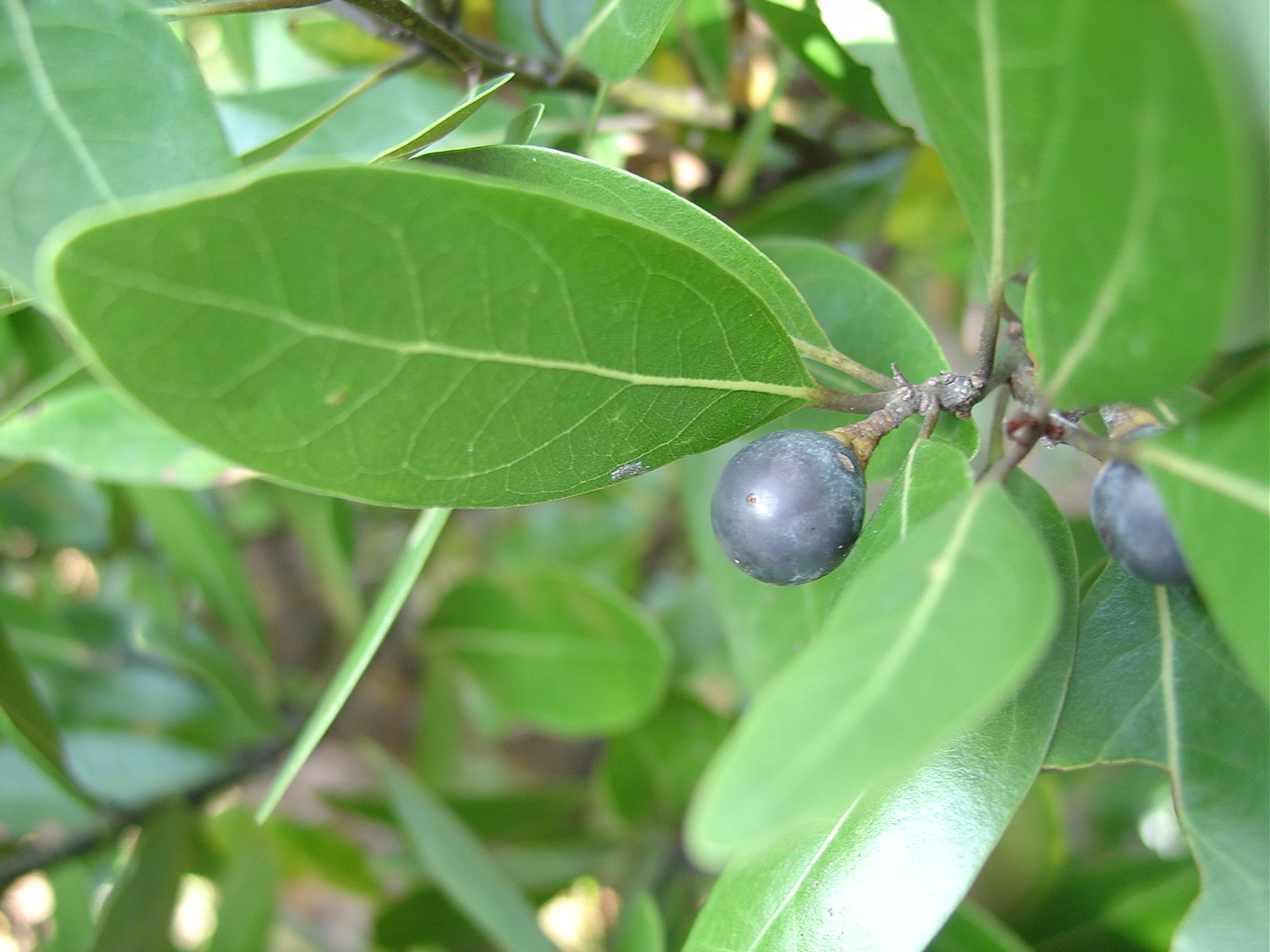
Before quittin’ a word on the fruit.  It is a little weird, a drupe (stone fruit) about the size of a marble  and black or dark blue sitting on a cup (the calyx) like a golf ball on a tee.  Perhaps more noticeable and important farther north, the fruit persists into the autumn or winter, providing late-season wildlife food.    Must be one mighty fine fruit, as we like the fruit of one closely related species, Persea americana, in our guacamole.

The fruits (by John Bradford)

The fruits (by John Bradford)

—————————————————————————————————————————————————–

Notes:

The native plants called “bays” are not the bay (laurel) leaves of the kitchen, although today’s plants and bay laurel (Laurus nobilis) all belong to the big spicy cinnamon family (Lauraceae) along with another local native favorite, lancewood (Ocotea coriacea), and more.  Sweet bay magnolia (Magnolia virginiana) is in the magnolia family (Magnoliaceae), not particularly closely related to any of the other “bays” of today, although it too has spicy foliage.  Bay-rum (Pimenta racemosa) is in the Eucalyptus family (Myrtaceae), along with allspice (Pimenta dioica), which in turn is not related to the so-called Carolina allspice (Calycanthus floridus, Calycanthaceae).    See what I mean about kitchen names getting tangled?
Persea is a large genus.  Most modern taxonomists variably interpret the local representatives as two or as three species, although some have seen merely variants of a single species, and others have diced the complex into even more species.  There’s no single “correct” answer.   My favorite general go-to guide on North American taxonomy, Flora North America, recognizes three species as follow:
  1. Red-Bay, Persea borbonia, abundant in our counties, in varied habitats, often hammocks, or coastal dunes, with the hairs on twigs and leaf undersides pressed to the leaf surface and the leaf blades often over 8 cm long. Alternatively interpretable as a mere variant of P. borbonia, if accepted as a separate species,   2. Silk-Bay, Persea humilis (or P. borbonia var. humilis)  has more abundant, silkier hairs especially on the leaf underside, and shorter leaf blades on average.  Silk-Bay is mostly a scrub species and, although abundant in Florida, is absent or nearly so from the area our blog covers.
  2. Swamp-Bay, Persea, palustris, has a broad distribution in our area and beyond in diverse habitats from swamps to woodlands. It differs from the others by kinky hairs jutting out from the twig and leaf surfaces (as opposed to pressed to the surfaces).
Not native to Florida, Persea americana is avocado.
 
4 Comments

Posted by on January 3, 2015 in Red-Bay


Tags: ,

Cypress Knees – What Are They Good For? (Absolutely Nothing?)

Note added in 2020:   The original version of this post dates back a few years.   It has been updated repeatedly due to new thoughts and new information.  If you are looking for a definitive proven answer on the adaptive significance of cypress knees,  not here.  Or not yet.

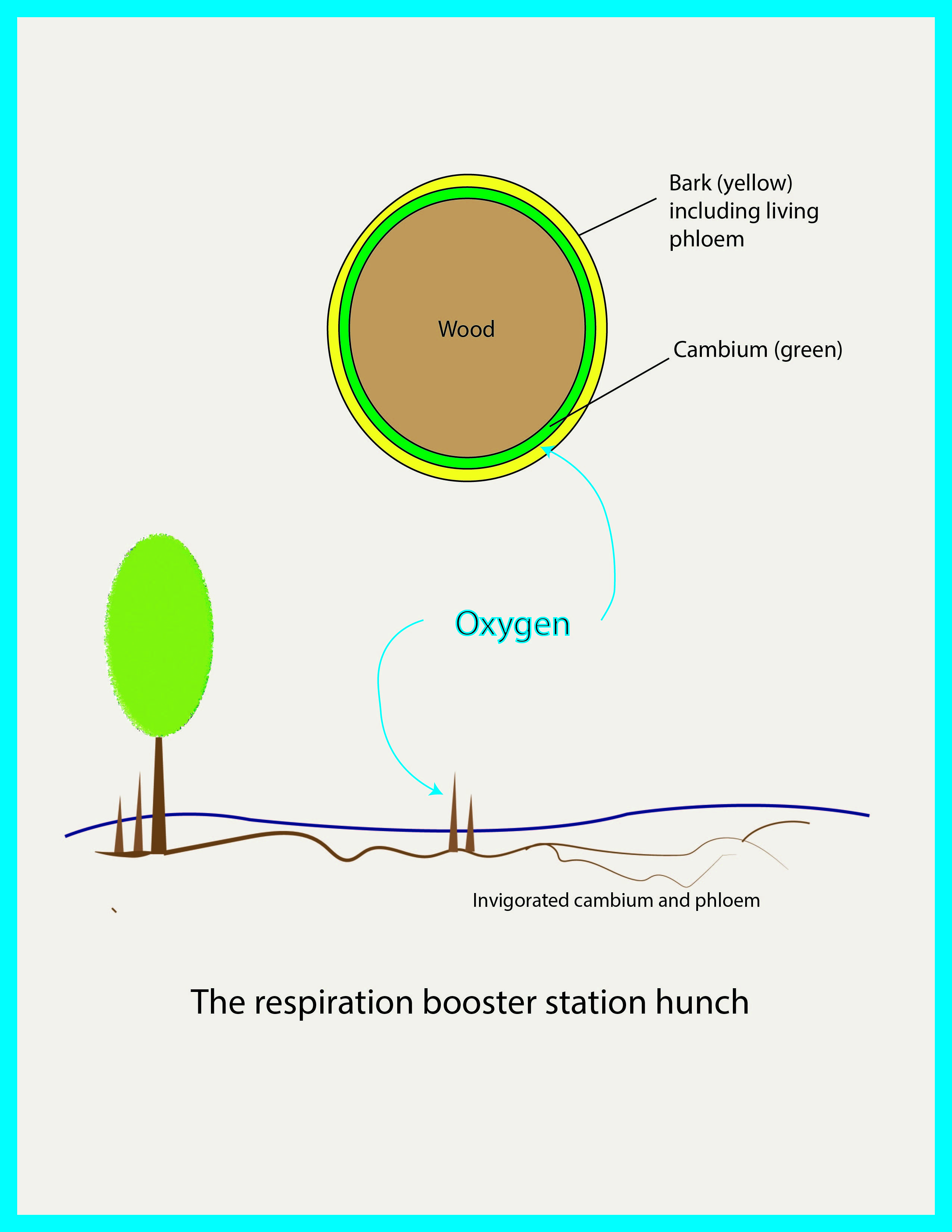
If you’d like a short answer, personally I strongly suspect the knees allow the living tissues of the root to come up for air, providing a large surface area for the vascular cambium and more importantly the sugar-pumping (and possibly storing during the leafless season) phloem,   like surface pumping stations along a pipeline.   That is by far my preferred hypothesis, and I’m trying every low-tech way to test it I can.   But much fun stuff to discuss, read on…

Observations, speculations, interpretations and questions about cypress knees date back about as far as botanical writing concerning the Southeastern U.S.    And beyond:

Any interpretation of the knees must extend beyond Taxodium distichum in and near the Southern U.S.   Other Taxodiaceae/Cupressaceae, including Asian representatives, can form knees.   Whatever functions the knees serve must pertain broadly in time, space, and related species.

It is surprising, after centuries of interest, how much interpretation is based on field observation, and how little hard data exist on knee anatomy, cellular structure, and physiology.  Not easy to study, let alone to monitor the growth of woody glaciers.   As field equipment becomes smaller, less expensive, and accessible, we may see a new development of data to help settle questions.    The phloem physiology of Taxodium roots and knees has a target on it.

And while in the realm of ifs, and, and buts,  it may be worthwhile to mention that multiple functions are possible, even if we prefer one adaptation as “the” main driving force behind knee evolution.    One function does not necessarily preclude others.    And also conceivable is no particular function.

A wonderful summary of what came before and an in-depth new analysis  is by H. S. Lanborn in the American Naturalist 1890.    There seems to have been a flurry of interest in late 19th Century botany.   Interestingly, after airing the evidence thoroughly, including the common observation that knees tend to form where aeration is needed, Lanborn disfavored the usual interpretation of cypress knees as air-exchangers  in preference for a pair of alternative hypotheses….that the knees function primarily to brace the trees against root failure during storms and to catch floating debris, which would add weight on top of the root system.
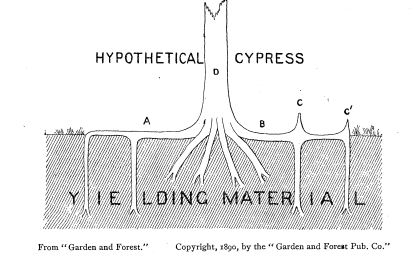
taxodium lamborn

Lanborn drew the diagram above, showing how he felt the knees with their broad bases reinforced the roots (root B stronger than root A).   Lanborn recognized that the knees rise  far higher than needed to serve as root reinforcements, which led him to the secondary hypothesis of the pegs as flotsam-catchers.    The brace-flotsam interpretation thus has a fundamental problem by invoking two functions.

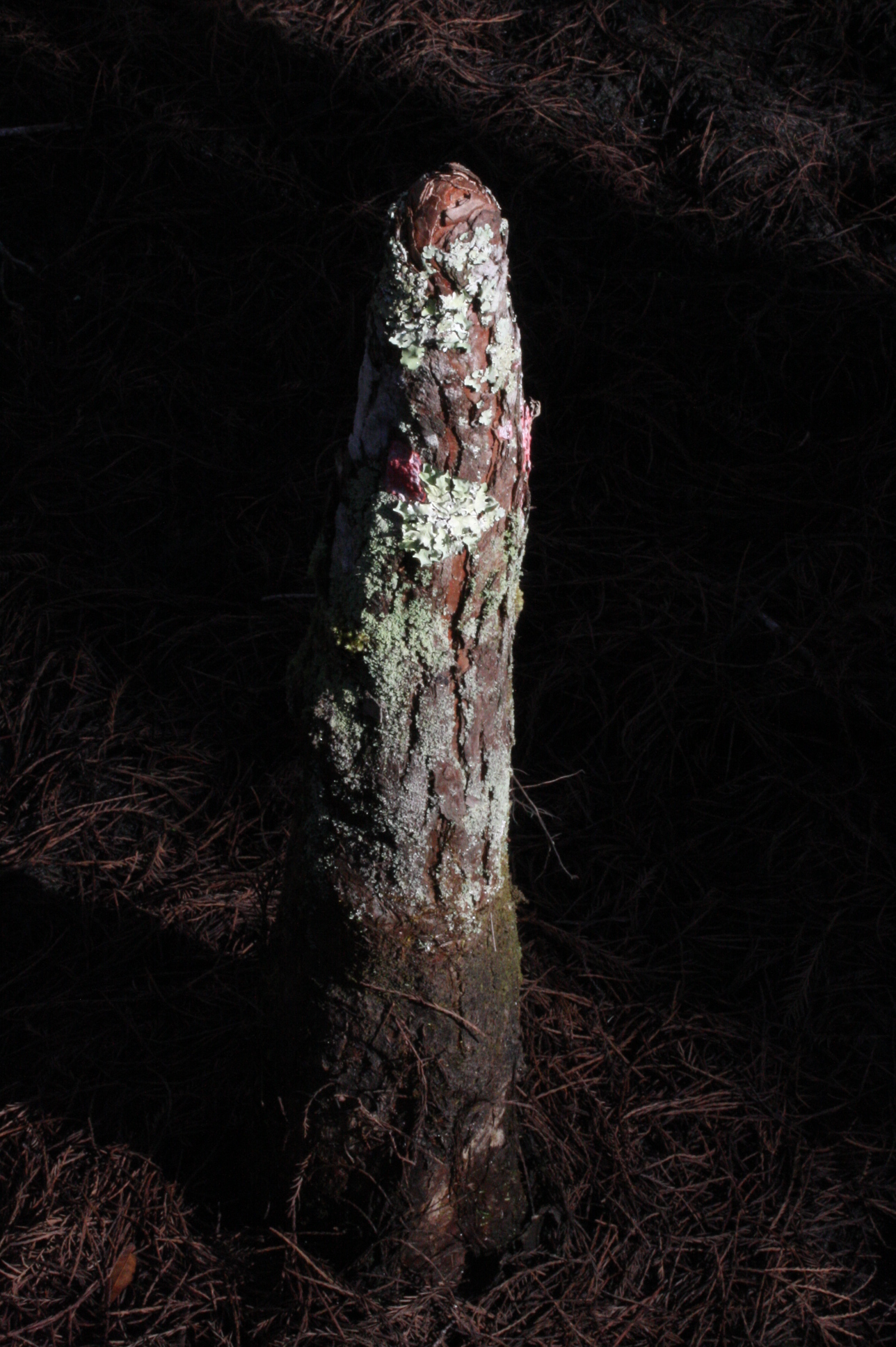
Long before and after Lanborn, the conventional interpretation of the knees is as ventilation devices.  Cypress roots run horizontally through anoxic mud and water and thus need air.   Other wetland plants have aerenchyma tissue allowing gas exchange between deep roots and the soil surface (although problematically such tissue is unknown in Bald Cypress). Despite tilting away from ventilation, Lanborn and others, including me, agree that knee formation seems to correlate (here’s a chance for quantified research) with growth where roots would otherwise be smothered under water or anoxic mud.  Assuming this correlation stands up to systematic study,  it  is in itself evidence for a role in gas exchange somehow.  After all, the knees are called “pneumatophores.”

As Lanborn quoted an earlier observer:

“It seems likely, therefore, that some process connected with the exposure of the sap to the air takes place in these protuberances.”
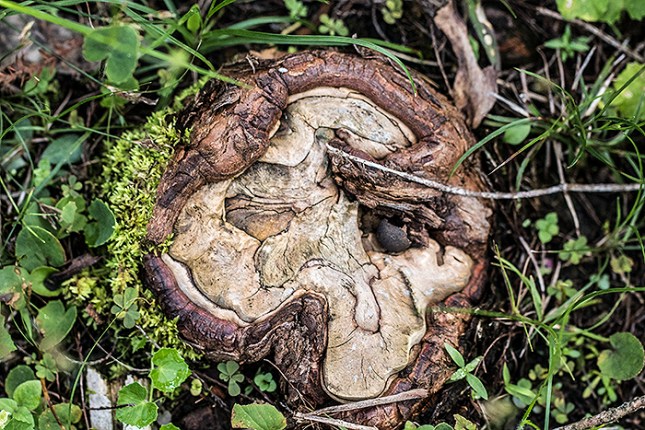
Taxodium cut off

Solid wood.   (I did not cut the knee.)

The ventilation  concept has complications.    At first glance, it is easy to suspect the knees are the above-water snorkels to a generalized root aeration system.   The knees are wood with no apparent ductwork.  The water-conducting cells are tracheids, which have a membrane (pair of adjacent cellulose cell walls) blocking the passageways (pits) from cell to cell.  The pit membranes are not air-tight but there are millions of them in the path of the gas exchange. But are the knees completely  air-tight? Not necessarily.

First of all, aging knees can become hollow with age, obviously then allowing air to pass readily to the base of an older decaying knee.  Further, a recent study shows  increased oxygen in Taxodium roots near the bases of exposed knees as opposed to under submerged knees.   CLICK for an abstract. Gases do diffuse in wood or be dissolved in water or phloem sap, but very slowly, and remember, the knees are a long distance from the young growing feeder roots, and the water movement in the wood, at least when the tree is active with foliage present, is in the wrong direction.

This study you just clicked  contradicts earlier research where aeration was not in evidence. The recent positive results are based on needle-drawn air samples from root wood near the knee bases.   The experiments dug and cut free knees with portions of root attached and transported the knees to a lab, then studied the knees in an aquarium many hours later under varied water  depths.     The experimental technique complicates interpretation of the results:

Most importantly, root xylem under natural conditions usually has negative pressure, “suction,”  as transpiration pulls  water and any dissolved oxygen inward to the trunk and up the tree, away from the feeder roots.  The instant the roots are severed  the negative pressure is eliminated,  and any related gas dynamics are lost, making it tough to know what to make of oxygen levels in such depressurized dying roots.

Further, it is not clear if the needle-drawn air samples were consistent in origin, and each from sapwood, heartwood, wood rays, or pith.     Root damage and changing conditions could elicit a hormonal response with metabolic consequences.    It was not clear if the knees used were solid, partly decayed, or even hollow (probably not, but their structural condition matters).      It was also unclear if oxygen entry was via wood, or alternatively along the porous bark we’ll return to momentarily.   Maybe even from air trapped in the bark during transport to the lab.
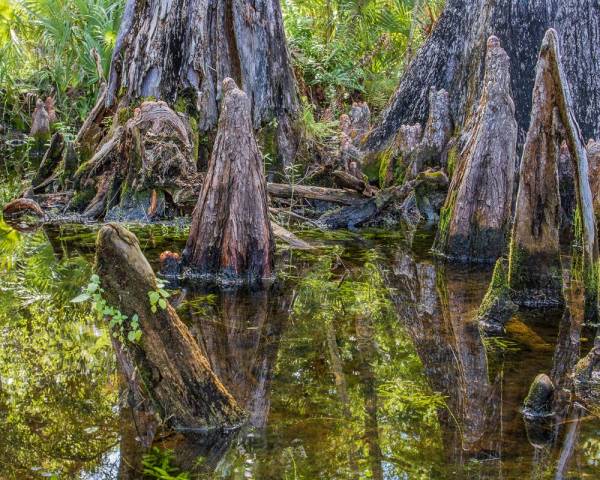
cypress knees riverben jb

By John Bradford

Despite all  these worries,  my hunch is to agree that some oxygen may well reach the base of the knee and attached adjacent root.     But then a bigger question:  exactly what living tissue (wood is mostly non-living), and where does the oxygen serve?     Perhaps oxygen makes its way along the length of that woody root snaking through the mud in ways not adequately explained anatomically, and  then somehow ventilates the system.   The concept of effective long-distance air movement in the wood is problematic.

But something else moves the length of the root through known channels under pressure and requires oxygenation: the phloem sap. So maybe the oxygen entering the knee (and possibly reaching adjacent roots) is most important at and near the knee, not to ventilate the root, but rather as a periodic surface-oxygenating rejuvenation station for the phloem, a pumping station.

There is a vague and inchoate hint of this as far back as Lanborn.  Review the quote dating to 1879 above.  It does not refer to aerating the root, but rather to exposing the sap to the air.    The root system pumps sugary phloem sap all the way from the leaves out to the tips of the tiny feeder roots.    This requires oxygen.    Oxygen is in short supply under that water and wet mud.    Knees rising periodically and exposing the phloem (and associated cambium) at the knee surface to a periodic breath of fresh air may keep the sap flowing.
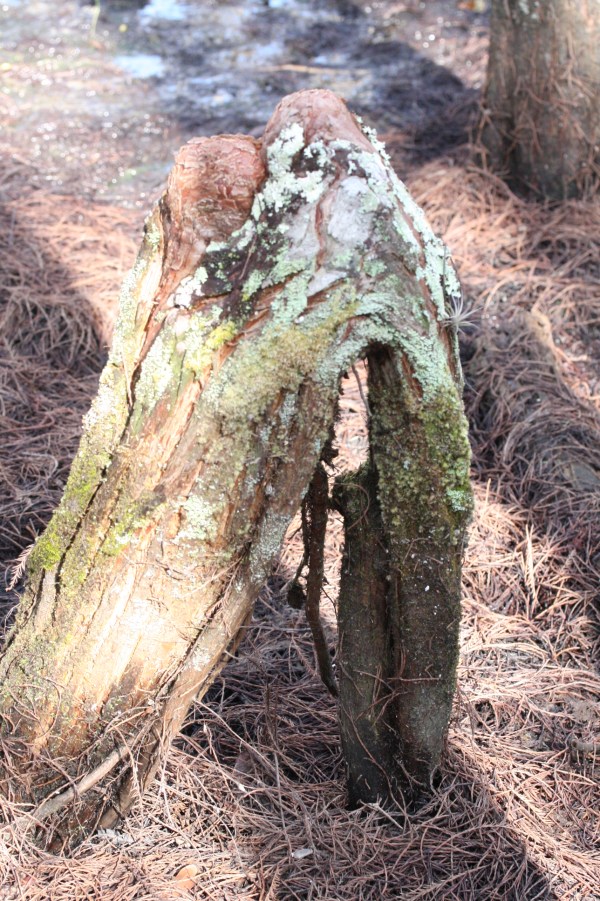
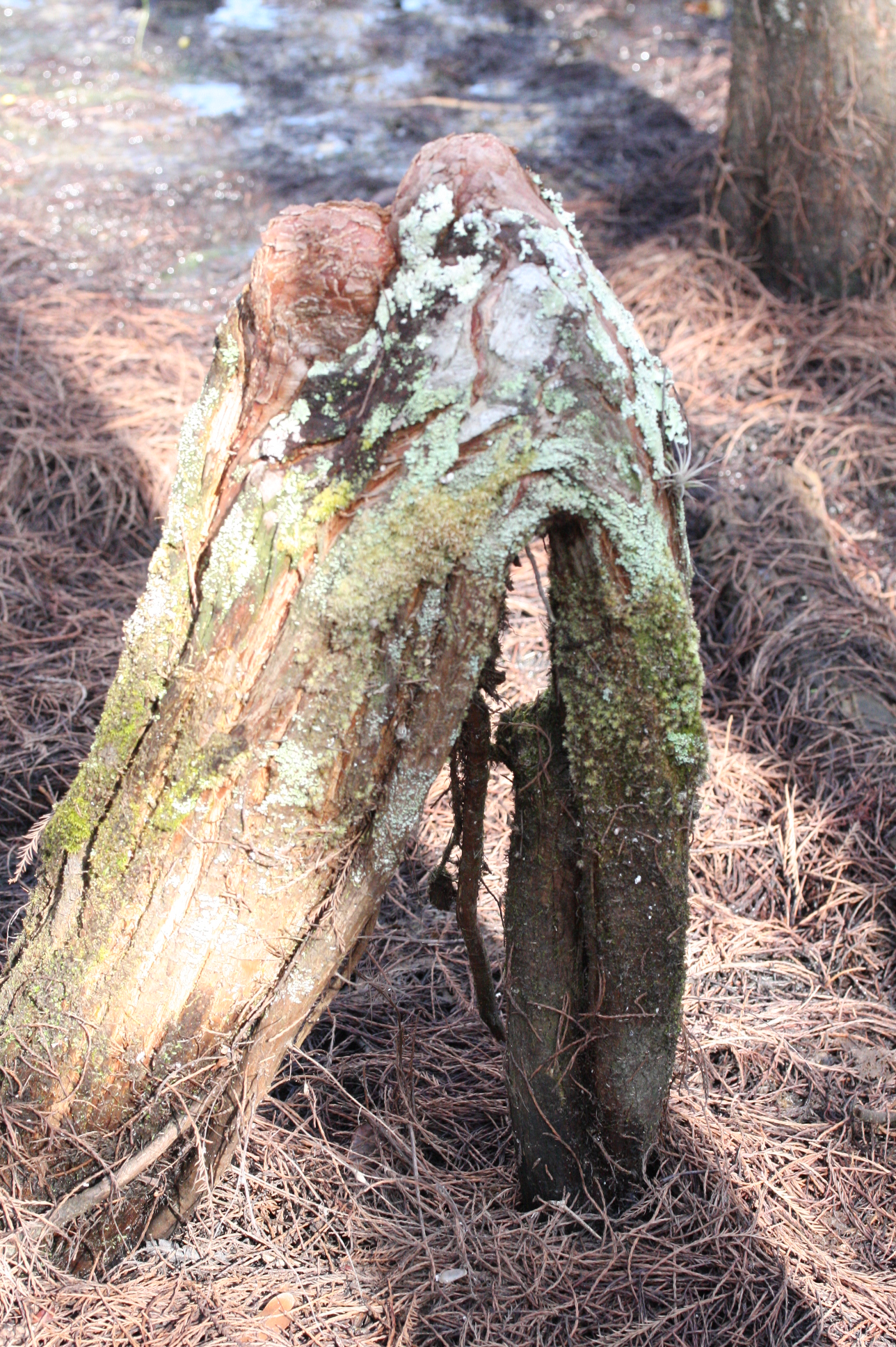
Knees often form on arched roots.
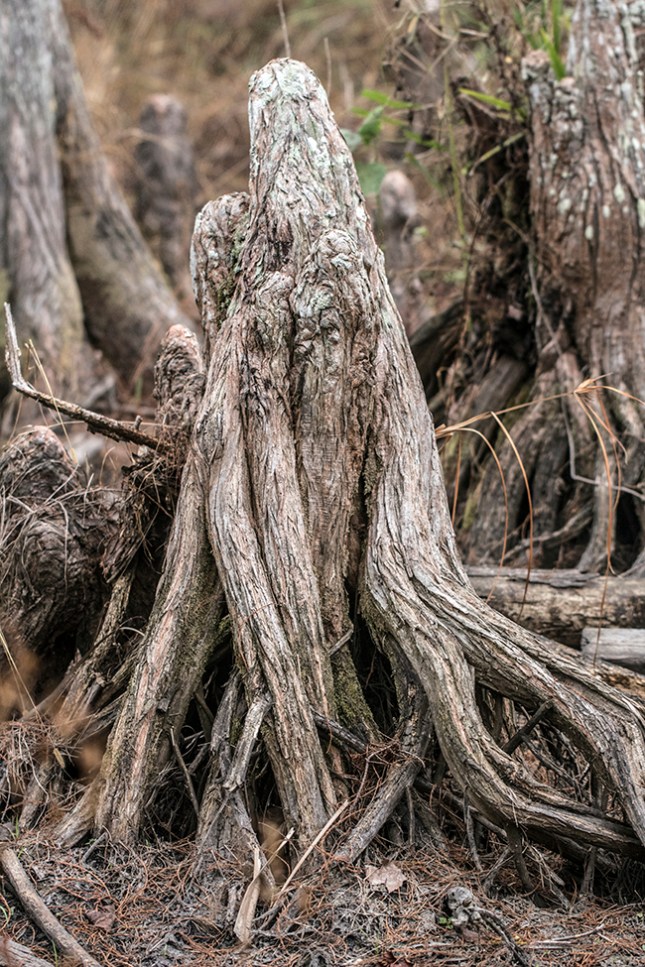
Knees often form on arched roots.


taxodium-n-jup-fltwods

A photo my dent1st would love (exposed roots).   This big old knee, and many other like it, does not say “snorkel” to me.  It says “root hub.”  It sure could be a place where radiating roots get a dose of life-giving gas exchange.

The phloem is a continuous living sleeve covering the entire root.    It has two layers:  a soft spongy outer dead layer (bark) covering the living breathing pressurized inner layer where the sugary sap flows.   Just under that is the likewise living vascular cambium responsible for growth in diameter, and all this exterior to the wood.    Think of the wood as a wire and the phloem/cambium as the plastic insulation covering the copper.

Air entering the knee would contact and presumably benefit the phloem immediately.    The knees has a large surface area potentially exposing a lot of phloem and cambium to a lot of air,  a giant gill, with no need to postulate gas exchange through dead wood under negative pressure in the wrong direction.

This would explain why the knees rise so high…to provide a big exposed surface.   This fits with the acknowledged prevalence of knees in situations  where oxygenation is needed.    And localized gas exchange at and near the knee is consistent with the recent observations of oxygen getting into the knees and adjacent roots, diffusing through wood and/or  through the porous bark, and maybe even carried along as dissolved oxygen in the reinvigorated outbound phloem sap.
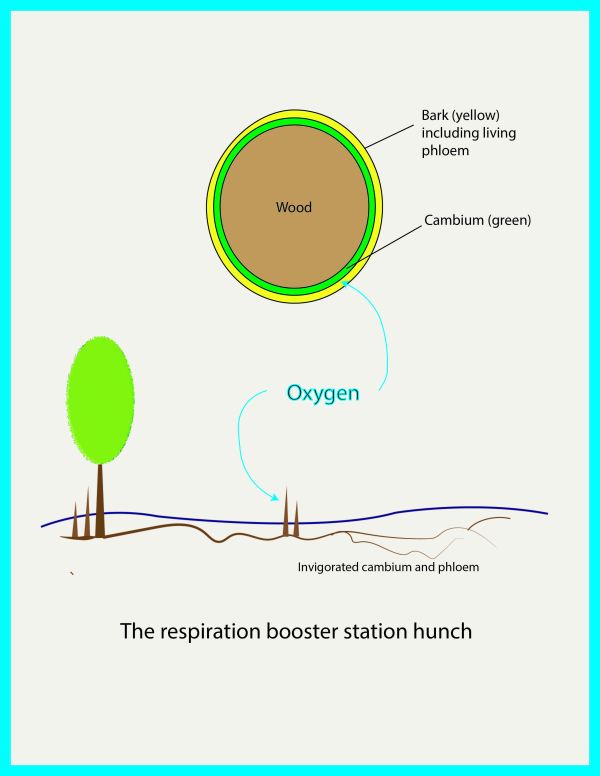
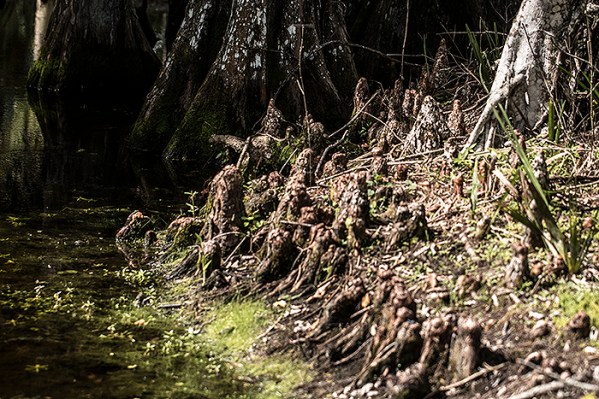
Do the knees give the otherwise submerged cambium and phloem a metabolic shot in the arm?


Taxodium on shore

Knees on shore

To continue with the phloem,  the trees are leafy much of the year, corresponding more or less to the wet season, and “bald” leafless during more or less the winter months and dry season, although the wet-leafy/dry-bakd correspondence is not exact.    In any case, the tree goes months with no photosynthesis.   No sugars being made.  What does it do about that?    In line with the idea that the knees are basically sugar movers, maybe they are in the moving and storage business, serving as sugar reserves, sort of like our livers, in between the intermittently sugar-producing leaves and the always-sugar-needing roots.  I am trying to find a way to detect sucrose storage in the knees.   A bloof glucoe meter may come in handy although it tests for glucos not sucrose,   And of coruse, you do not go to wild areas and start cutting of knees!    In the mod 80s biologist Clair Brown used an iodine test to check for starch in cut-off knees, and they were positive. Starch is stored sugar, so you may say her results were not far apart from the present ypothesis. Funny how observations converge.


Even so, I plan to see this idea through ethically and effectively.

There have been additional knee proposals.  Here are some:

  1. Serve as variable-height  launchpads for tufts of feeder roots.   The idea here is that the water levels rise and fall during the very long life of a bald cypress.  As the water level fluctuates small feeder roots might branch off the trunks and knees to exploit the oxygen-rich water at the water surface.    I have not seen such tufts personally, although supportive observations are reported.  I wonder why so many trees would make so many knees not apparently engaged in this way, seemingly an expensive investment in a rare contingency.  I  wonder similarly if the cluster of knees could make enough of a contribution to justify the substantial investment in those big woody  knees.    If the knee does sprout a tuft of feeder roots in the water  allowing nutritional supplementation (from water?)  this input is separated physically from the exponentially greater mass of feeder roots at the distal end of the root system.   The water and dissolved nutrient input from knee-roots would go into the xylem and would be pulled to the trunk by the inward/upward direction of the transpirational xylem stream, feeding the above-ground tree, not the distal root system.   Readers interested in exploring this intriguing hypothesis should consult, Stahle, D. et al. Quat. Sci. Rev. 34:  7. 2012.
  2. Allow methane to escape. (Here is some info on methane release)
  3. Rise into stumps and extract nutrients (No evidence and no apparent adaptation to this purpose, and knees generally encountered rising into thin air.)
  4. Food storage (no traction)
  5. Will grow into new trees (no)
  6. No function, merely tumors or burls. (See below)
  7. Giant thorns.  (See below)

IMG_7743

Cypress knees are often not single units, but rather commonly clustered, hinting that whatever “set off” a knee kicked off multiple knees in one fell swoop.  Some are branched, or are the fusion of adjacent knees creating a branched appearance.  Often the knees start from the high point of looping roots, as if a giant knee formed on top of the St. Louis Arch (photo above).
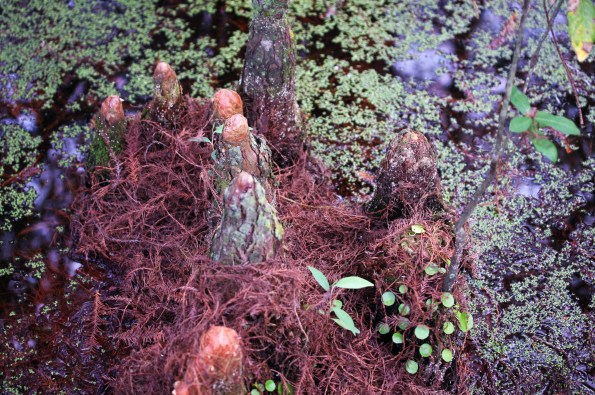
knee cluster

The could be burls, reaction wood,  hormonal aberrations, or the results of injury.  Interestingly,  Bald Cypress trunks will grow a burl at points of abrasive contact.   The knees are so widespread and so abundant,  their existence as mere burls or growth aberrations is not an appealing hypothesis.
 

IMG_5425

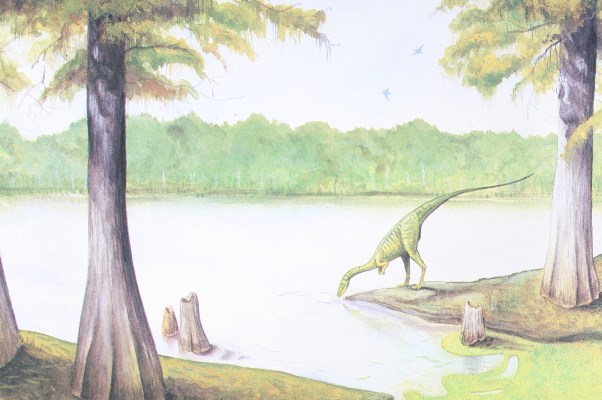
Don’t trip over those “knees.” This painting is by Brian Regal (in The Evolution and Extinctions of the Dinosaurs by D. Eastovsky and D. Weishamel. 1996) . This is based on the Triassic Chinle Formation in Arizona, probably earlier than the appearance of Taxodium, although maybe not before its similar ancestors.)


An intriguing if far-fetched possibility is maybe the knees block large herbivores.   (They sure block canoes.) Even if unlikely, fun to envision.  Members of the Taxodiaceae (or Cupressaceae) date back to dinosaurs, some of them hunky hungry herbivores.   More recently and locally, Mastodons ate Bald Cypress in massive quantities.  In the Aucilla River in the Florida Panhandle remain to this day literally truckloads, tons, of preserved Mastodon dung.  Guess what it is made of mostly:  Bald Cypress twigs.


DUNG

Yep—that’s it. 12,000 years old yet still fresh. (Photo from UF Museum of Natural History)
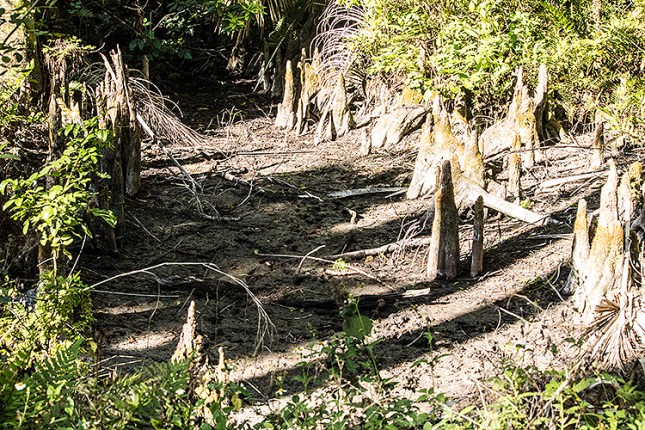
 

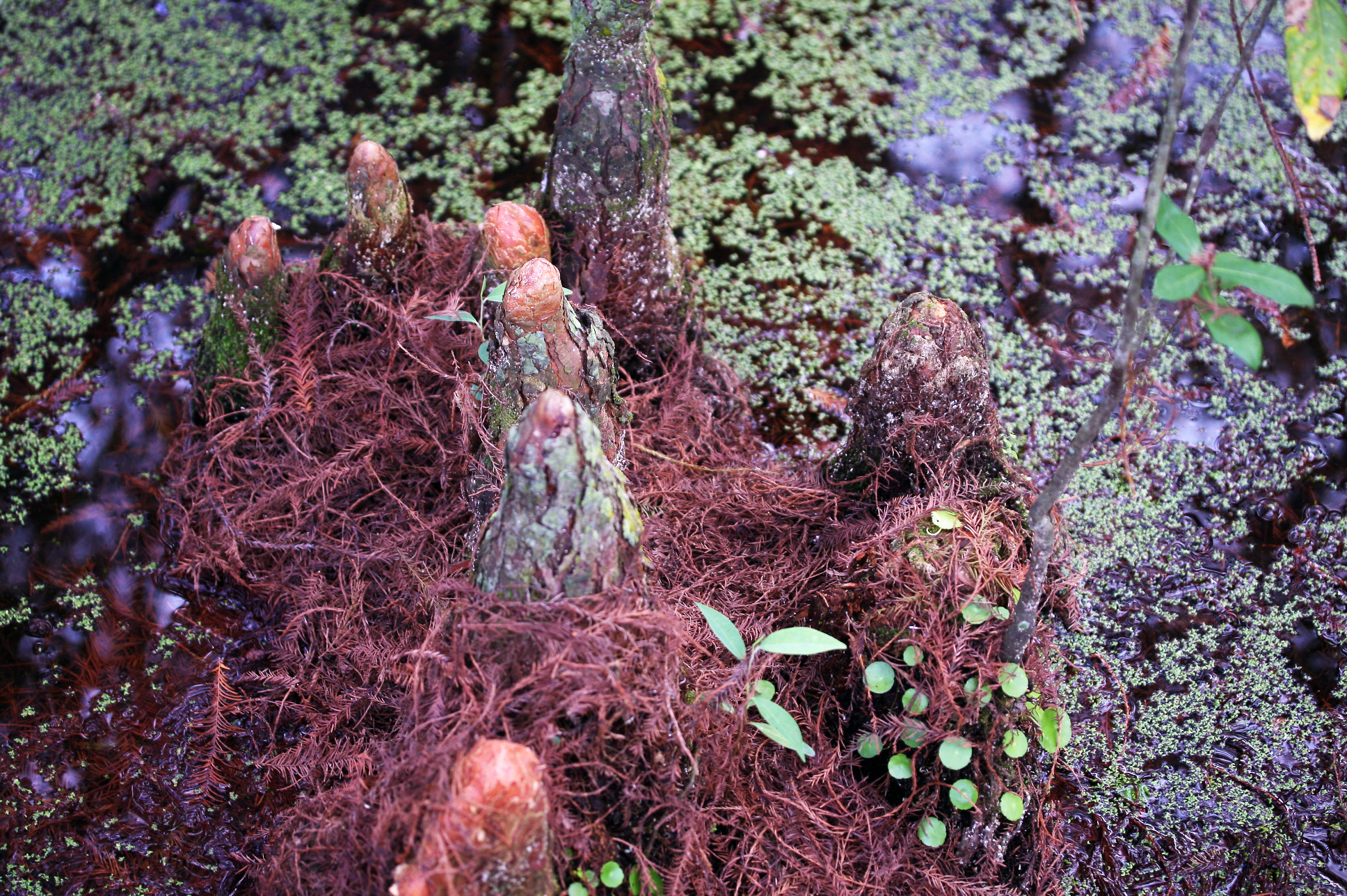
Cypress knees in creek 2
 

Notes:

Newsom, L.A., and M. C. Mihlbachler. Mastodons (Mammut americanum) Diet Foraging Patterns Based on Analysis of Dung Deposits.  Springer. 2006.


15 Comments

Posted by on December 29, 2014 in Bald Cypress


Tags: , ,

Australian-Pine, Perfect for a Pine Box

Casuarina

(Casuarina equisitifolia, C. glauca, C. cunninghamiana)

caz-you-RINE-ah (alternatively in some places caz-you-REEN-ah)

Casuarinaceae

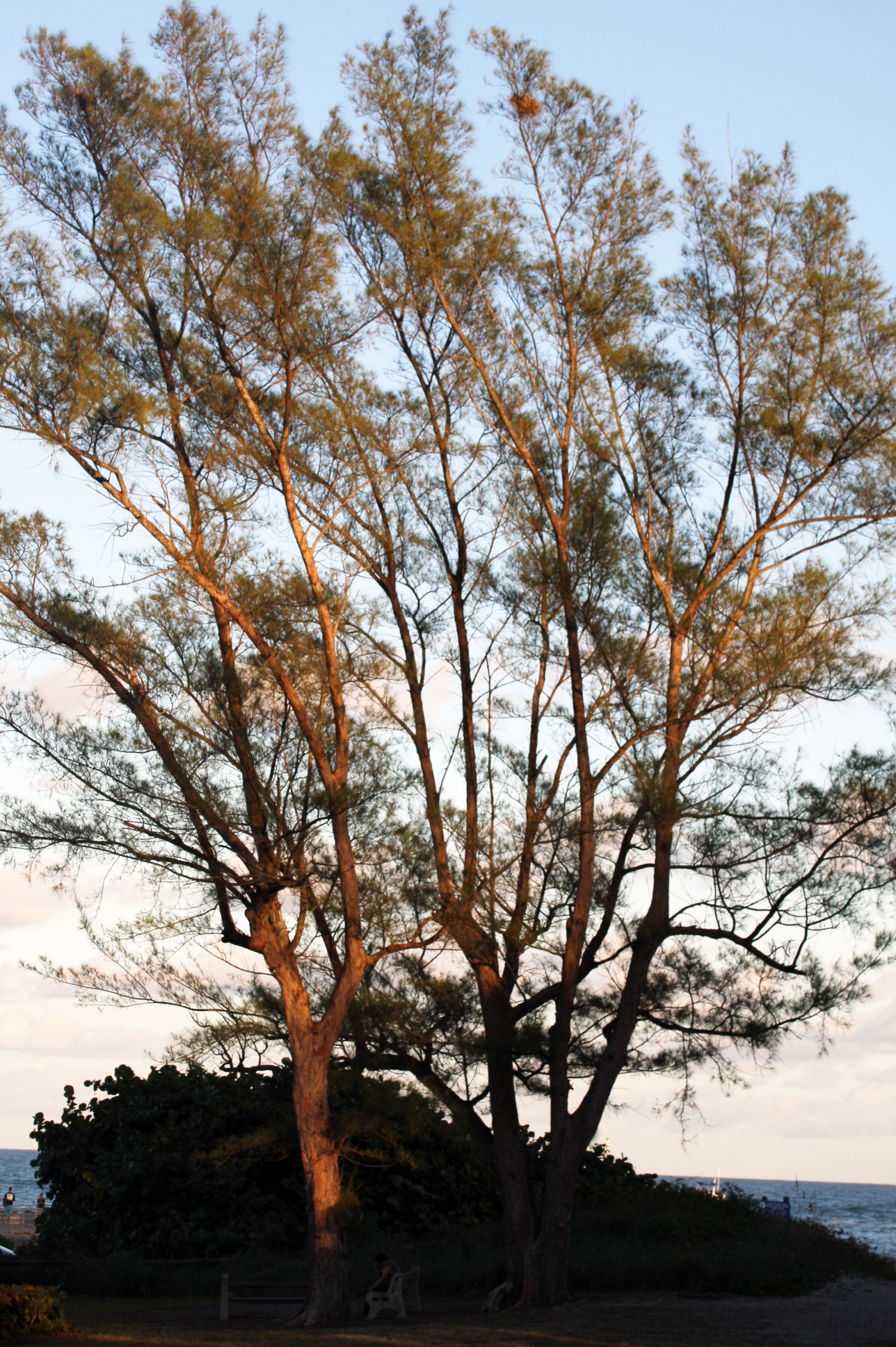
Casuarina at Jupiter Inlet, Florida

Casuarina at Jupiter Inlet, Florida

A problem with the human mind is we categorize things.  You might say we put things in a box with a label on top, and then otherwise ignore the contents. So today let’s think inside the box.
Perhaps other native plant enthusiasts share my lazy tendency to tag certain species as invasive exotics, and then fail to give them much further thought.  But when we behave that way we overlook much of our green environment.

Today’s day-after-Christmas tree is Australian-pine, species of Casuarina, not one, but three in Florida. The most common and widespread is Casuarina equisetifolia.  The name Australian-pine is a misnomer.  The trees are not related to pines and are not 100% Australian. Altogether there are perhaps 50-some species of Casuarina, depending on how you define its borders.  (Recent studies have divided an older broad genus into multiple smaller genera of Casuarinaceae.)  They are primarily Australian, although Casuarina equisitifolia lives naturally (?) also in Southeast Asia and on some Pacific islands.  Ancient peoples in boats obscured inconsiderately the precise natural origins, and the tree goes forth and multiplies unaided with small windblown fruits.

Casuarina foliage (by john Bradford)

Casuarina foliage (by John Bradford)

The Australian-pine introduction to formal botany dates to the 17th century blind botanical genius George Rumphius on the Indonesian island of Amboina.  Rumphius referred to our tree as casuaris-boom, mentioning resemblance between patterns in the wood and plumage of the cassowary bird.

No need to devote much space to Casuarina as an invasive exotic. That’s the red label already on the box, and anyone wishing more on that will find an exotic invasion of documentation elsewhere on the Internet. How Casuarina arrived in Florida is a fair question.  Its Florida roots go back at least as far as 1887, bringing to mind the Reasoner Brothers Royal Palm Nursery established in 1881, although I’m not sure they sold it.  The tree undoubtedly had been in the West Indies well before the 19th Century, and as already mentioned, the wafer fruits flutter at will over the bounding main.

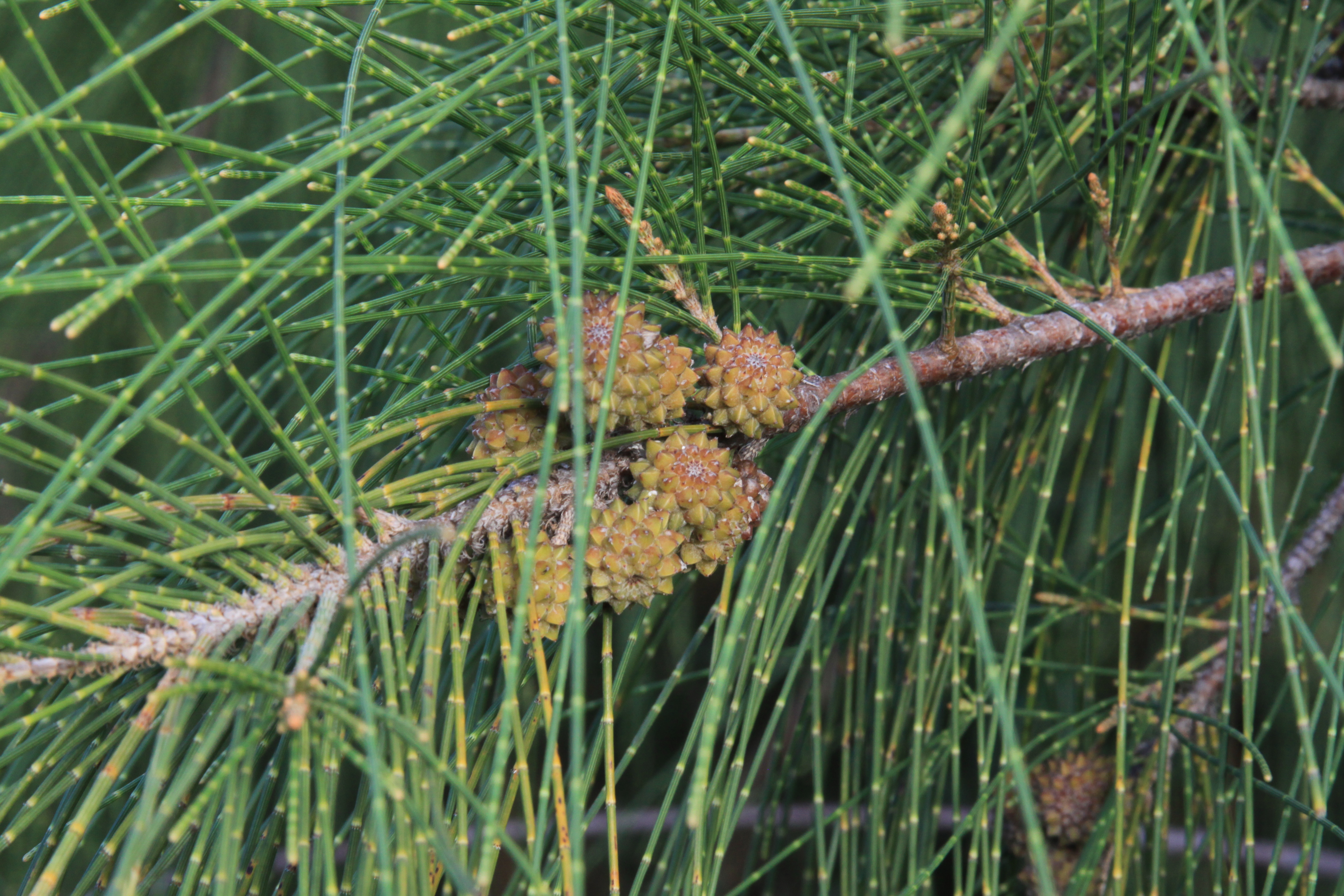
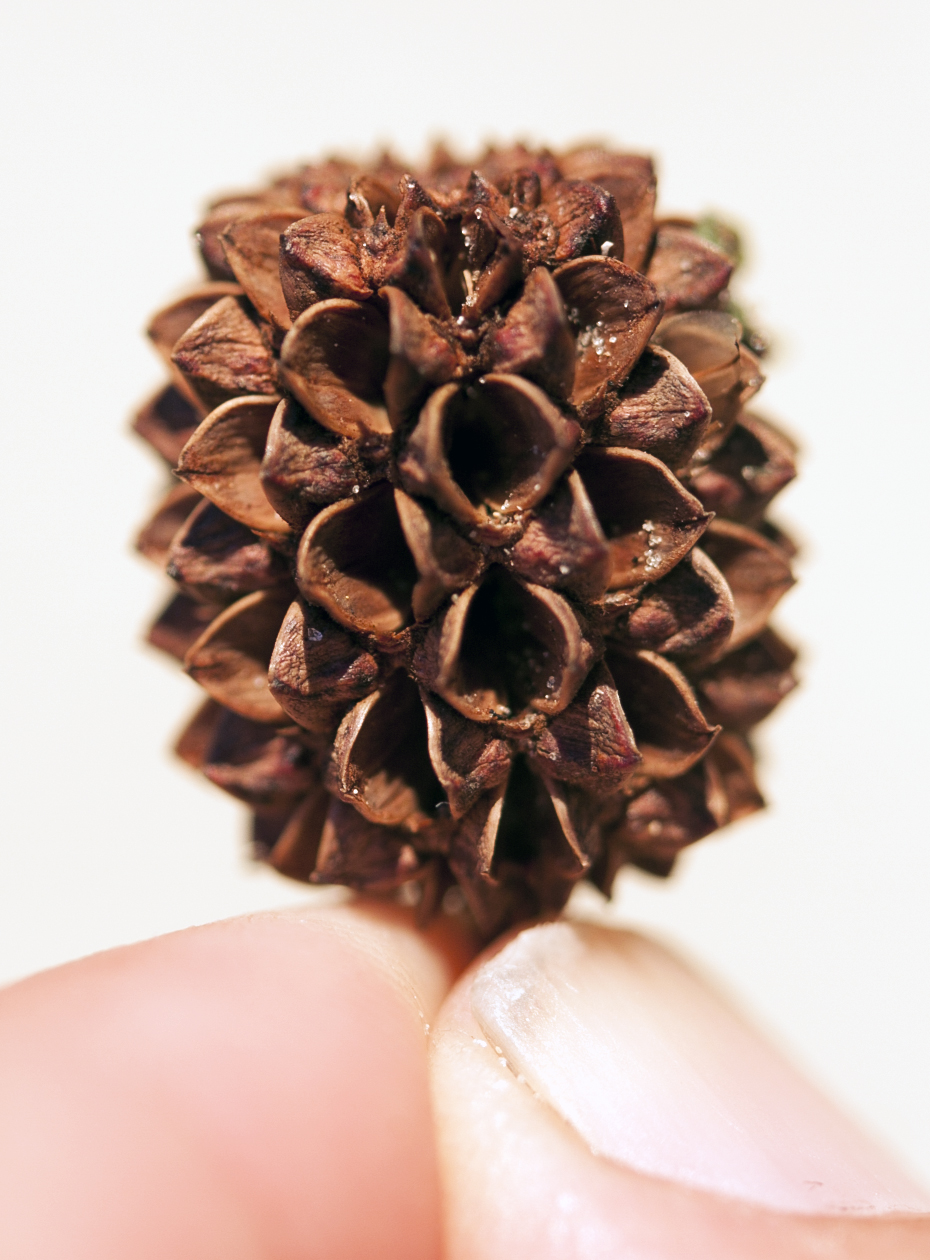
Casuarina clusters of immature bracts (specialized leaves) with fruits hidden among the bracts (by John Bradford).  The

Casuarina clusters of immature bracts (specialized leaves) with fruits hidden among the bracts (by John Bradford). The “needles” are branchlets.

Casuarinas do look like pine trees, and some 19th century botanists took them to be a missing link between the conifers and the flowering plants.  They are not conifers at all, and are 100% flowering plants.  How experts mistakenly allied our trees with conifers is puzzling as it doesn’t take much examination to spot the similarities between conifers and Australian-pines as superficial, not even involving the same parts. What look like pine needles are skinny green branches.  And what look like pine cones are specialized hardened leaves clustered with the fruits.  In short we have a beautiful example of convergent evolution, just like the marsupials of Australia exemplify convergent evolution with placental mammals in the rest of the world.

Mature, opened, bract cluster.  The fruits have blown from the apparent openings.  This cluster is from the tree at Jupiter Inlet.

Mature, opened, bract cluster. The fruits have blown from the apparent openings. This cluster is from the tree at Jupiter Inlet.

Just like a true pine tree, an Australian-pine can thrive in nasty harsh environments, such as Florida beaches and dunes. Contributing to their ability to invade (or shade, depending on your perspective) are nitrogen-fixing root nodules, something we more famously associate with legumes.  (A few local non-legumes have this ability.)

That perspective thing sure pollutes issues doesn’t it?  Casuarina is fundamentally an unwelcome guest, there is no question.  It doesn’t take much living in Florida to see the destruction. Beyond displacement of the native flora and fauna, btw,  the pollen contributes to allergies.  But where I used to live in the Caribbean the Australian pines were valuable shade trees, and I used to enjoy beer, French fries, and silver sands at the shady Casuarina resort. (Maybe sniffling a little.)

So acknowledging the dark side, let’s flip the coin. A species able to grow ten feet a year in a salty sandbox deserves a second look.  Iconic Florida botanist Julia Morton thought they were pretty good barbecue fuel, and the abundant trees are a guilt free source of mulch wood chips, although the chips may inhibit the growth of other plants.   (I have used them with no obvious calamity so far.)  The world abounds in inferior salty soil, limited water, and the need for wood and green coverage.  The trees cover mine tailings and stabilize shifting sand.  In India Casuarina plantations yield fuel after only 5-7 years, and the hard fine-grained wood supplies rough construction, tool handles, ores, and docks.

In places I’ve worked gremlins have posted signs above the copy machines urging staff to save the forest by restraint with copier paper.  Well sure, I’m all for saving the forest and the office supplies budget. So here’s a related thought: maybe Caz is not 100% foe. A commercial source of paper pulp where nothing else grows and where people need industrial jobs may be less demonic than the warning on Pandora’s label.

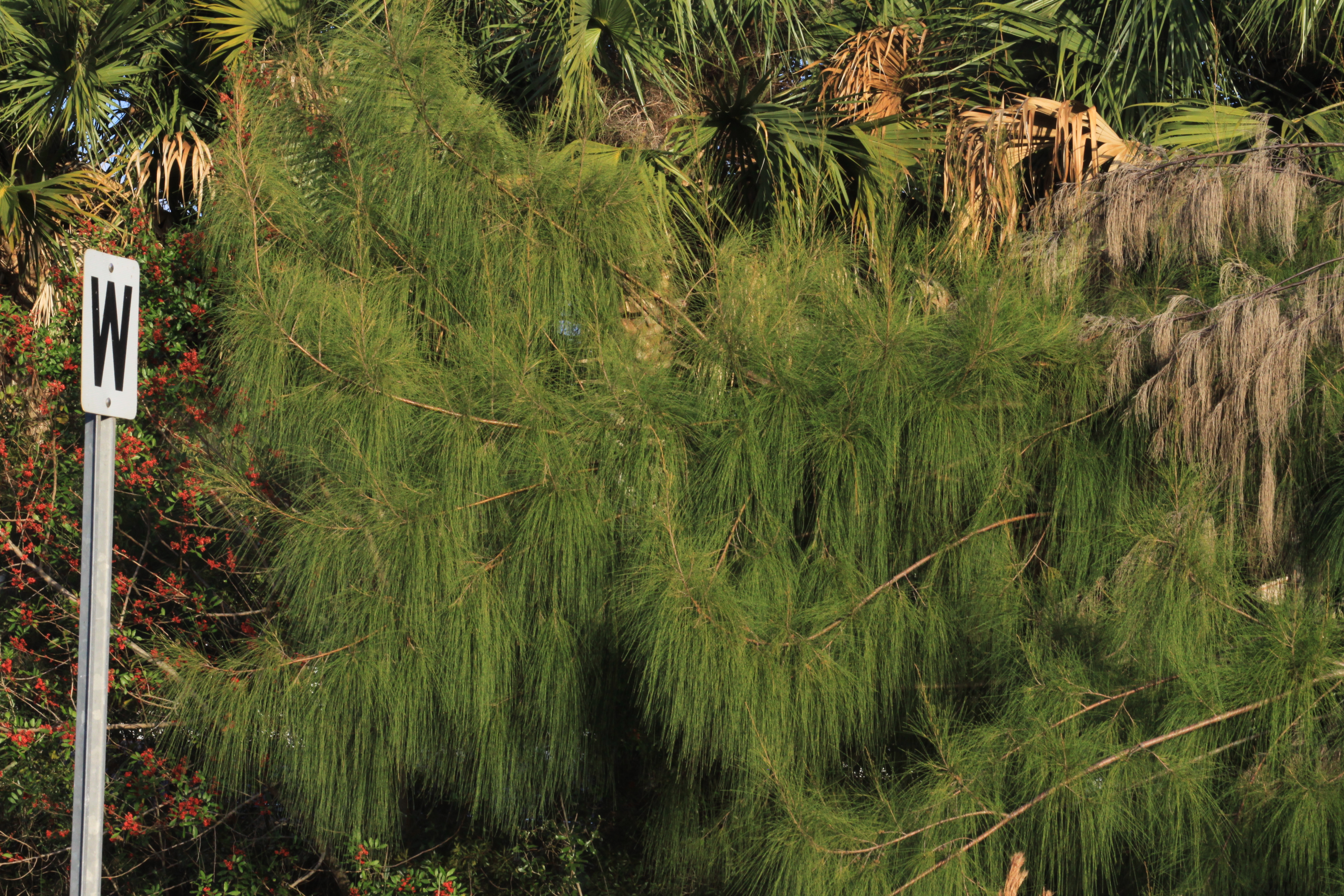
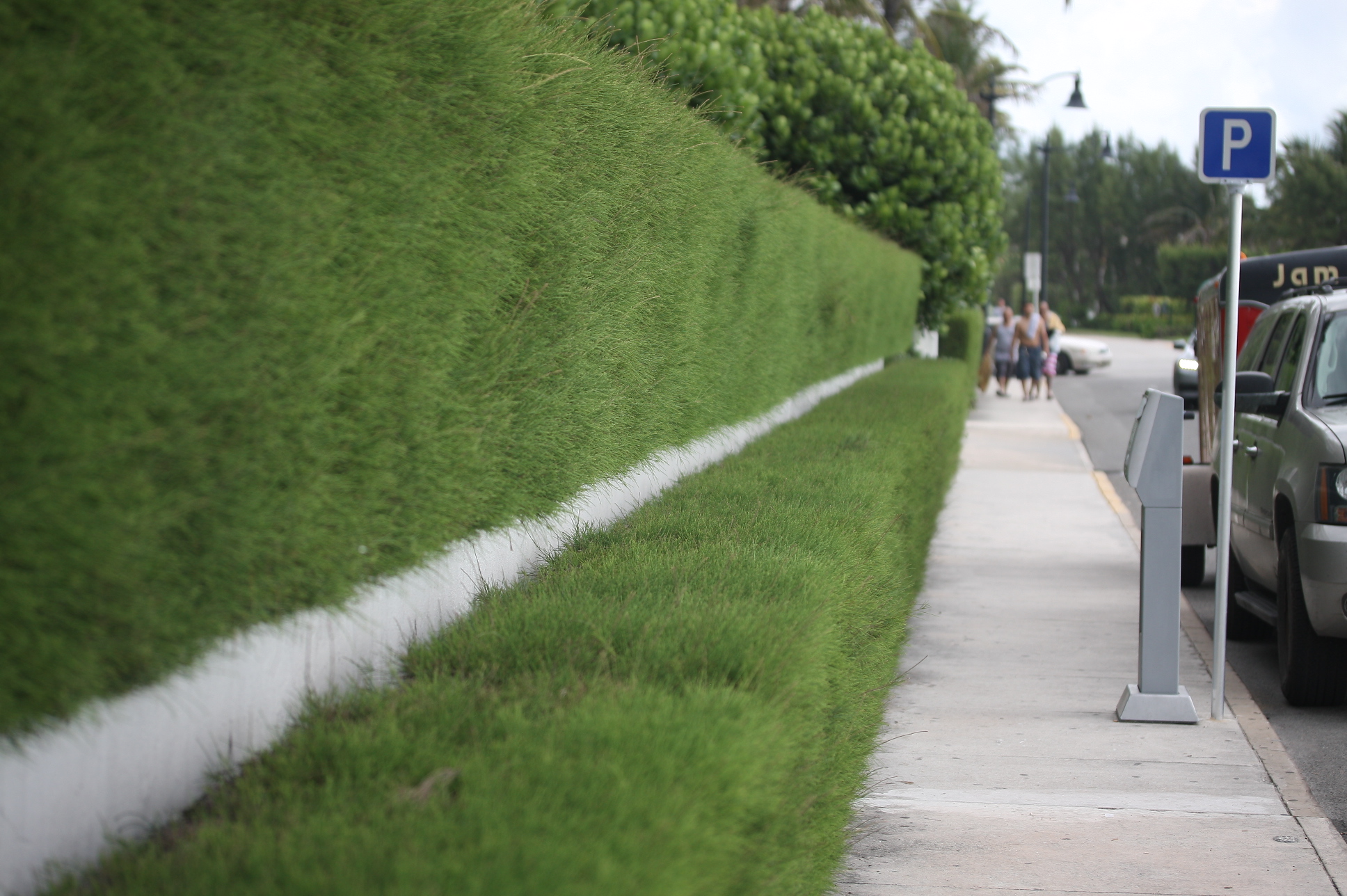
Casuarina with a haircut

Casuarina with a haircut

 
8 Comments

Posted by on December 26, 2014 in Casuarina


Tags: