Pallavicinia lyellii
Pallaviciniaceae
Today when John and George went botanizing it was nippy, so we felt no surprise in finding the perkiest plants to be a species native as far north as New Brunswick, not suffering from today’s chill. This is the most widespread species you’ve never noticed. Ranging from Canada into South America, out to California, and across the world to Europe, Asia, Australia, and Africa, in other words almost everywhere.
Being that widespread of course Pallavicinia lyellii visits varied habitats with an overall affection for wet acid situations under broadleaf trees. This is exactly where we found it in Seabranch State Park abundant throughout the largely hardwood-dominated swamp at the east edge of the park, a botanical museum of ferns, mosses, lichens, and liverworts.
Not every reader will be familiar with liverworts. They are related to mosses and are among the most primitive land plants on earth. They are the oldest known land plant fossils, dating back 473 million years. A look at certain liverworts and a peek at similar green algae makes it easy to believe that the land plants evolved from the green algae, as they in fact did. I don’t want to go too far down that technical road today. Suffice it to say that liverworts and their relatives have no roots, no veins, poorly (or un-) differentiated leaves or stems, no flowers, no fruits, and no seeds. They look like seaweeds and stay close to the water.
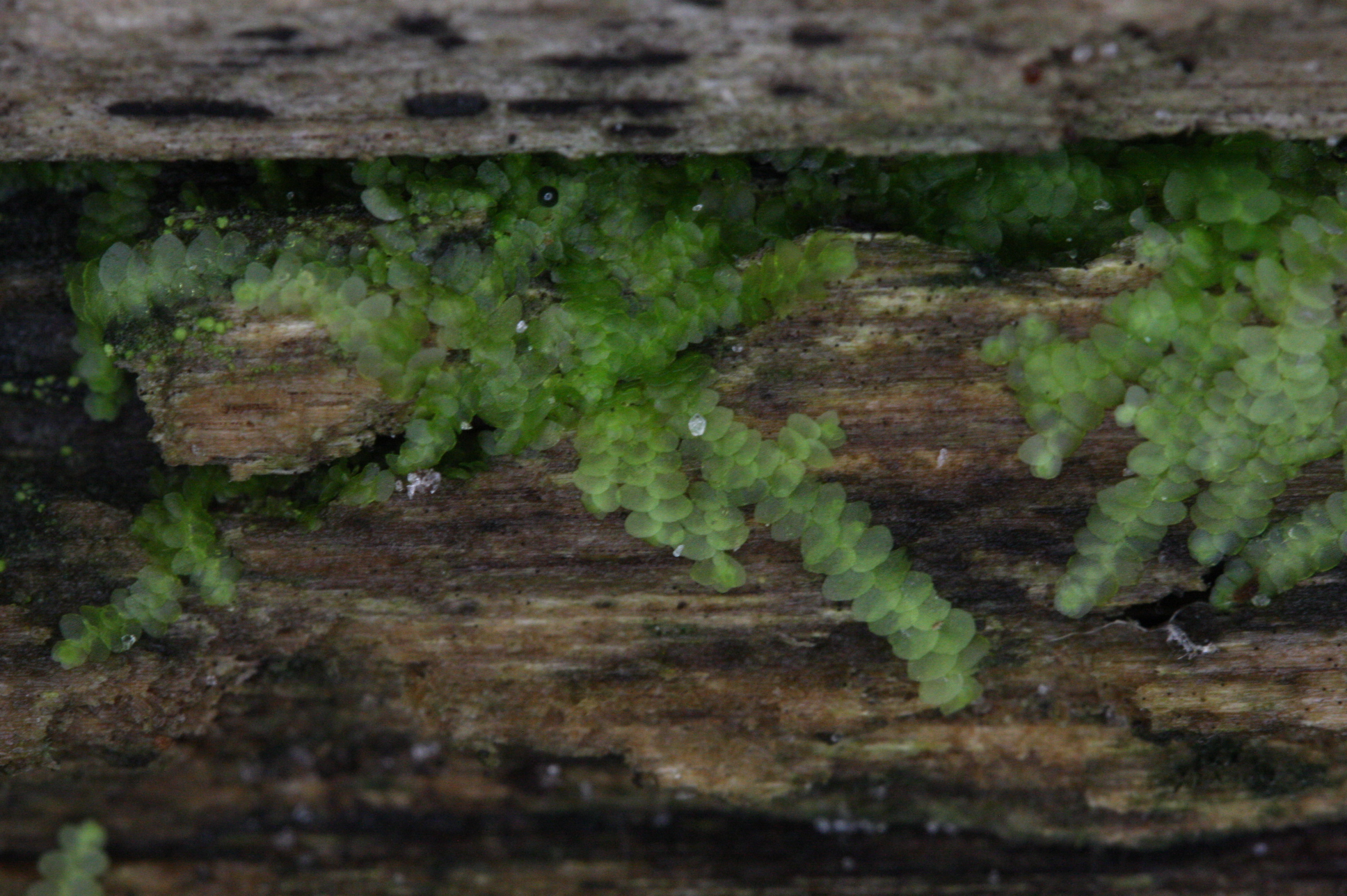
Leafy liverwort
There are several thousand species of liverworts worldwide divided into two basic types. One group, called the leafy liverworts, resembles mosses by having stems and leaves, although the plants are usually even smaller (you need a hand lens), flat, and with round leaf blades. Look for them on tree trunks and wet hummocks mixed with moss. Today’s feature species belongs to the other major group, called the thallose liverworts, these consisting of almost nothing more than what looks like a wet green leaf spread irregularly on a wet surface, often mud or decayed log.
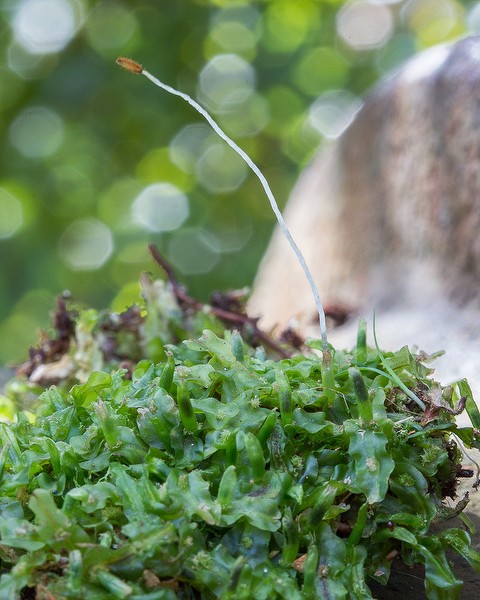
Pallavicinia lyellii liverwort with gametophyte (green) and sporophyte (the thread). By John Bradford
As you can see, John captured a beautiful portrait of Pallavicinia lyellii with its leafy seaweed plant body. The ruffly little cabbages on the foliar surfaces are the female egg-making apparatus. The sperm-making structures are on separate male plants. The brown cap on the delicate white thread is the spore-making system (sporophyte). It makes the spores that blow way to re-establish the liverwort all the way from here to Timbuktu. Spore-making plants such as fungi, mosses, ferns, and liverworts often have wide windblown distributions.
What does the name liverwort mean? The wort part is just an old word referring to an herbaceous plant. The reference to liver is more telling. This dates back to an historical dogma called the doctrine of signatures, which attributed plants with benefits according to their appearances. So a plant resembling a fetus was good for birth, birthwort, and lungworts were beneficial for your lungs, and liverworts are liver medicines. I’m not completely sure what the resemblance to the liver is. I’ve heard two explanations: Some liverworts are lobed in a way resembling a liver. Alternatively, a microscopic view of a liverwort can suggest the microscopic view of a liver. Either way I don’t think they help much medically. But they are top-quality botanical curiosities and they help make it all much more fun to explore the infinite world of green. Here are some local liverworts from our “archives.”
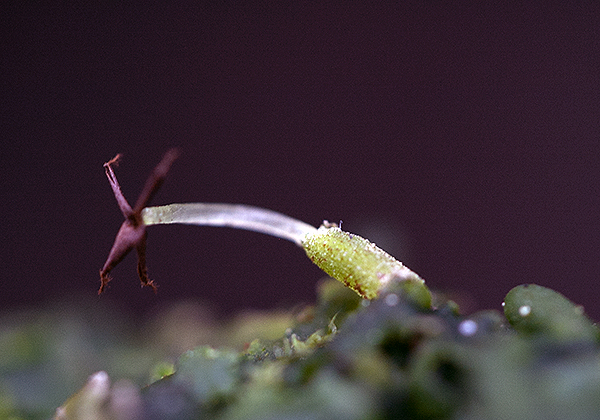
Riccardia sporophyte (spore-making generation) on surface on gametophyte
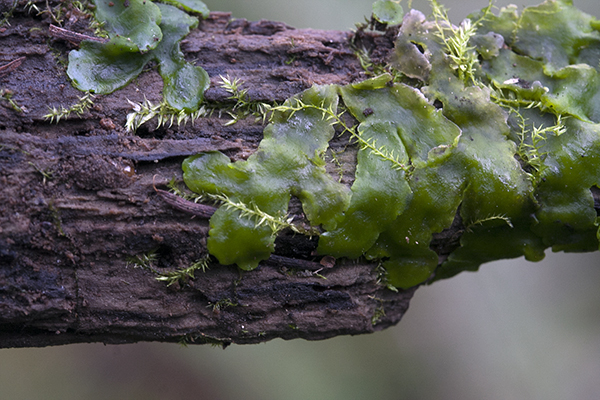
Riccardia pinguis
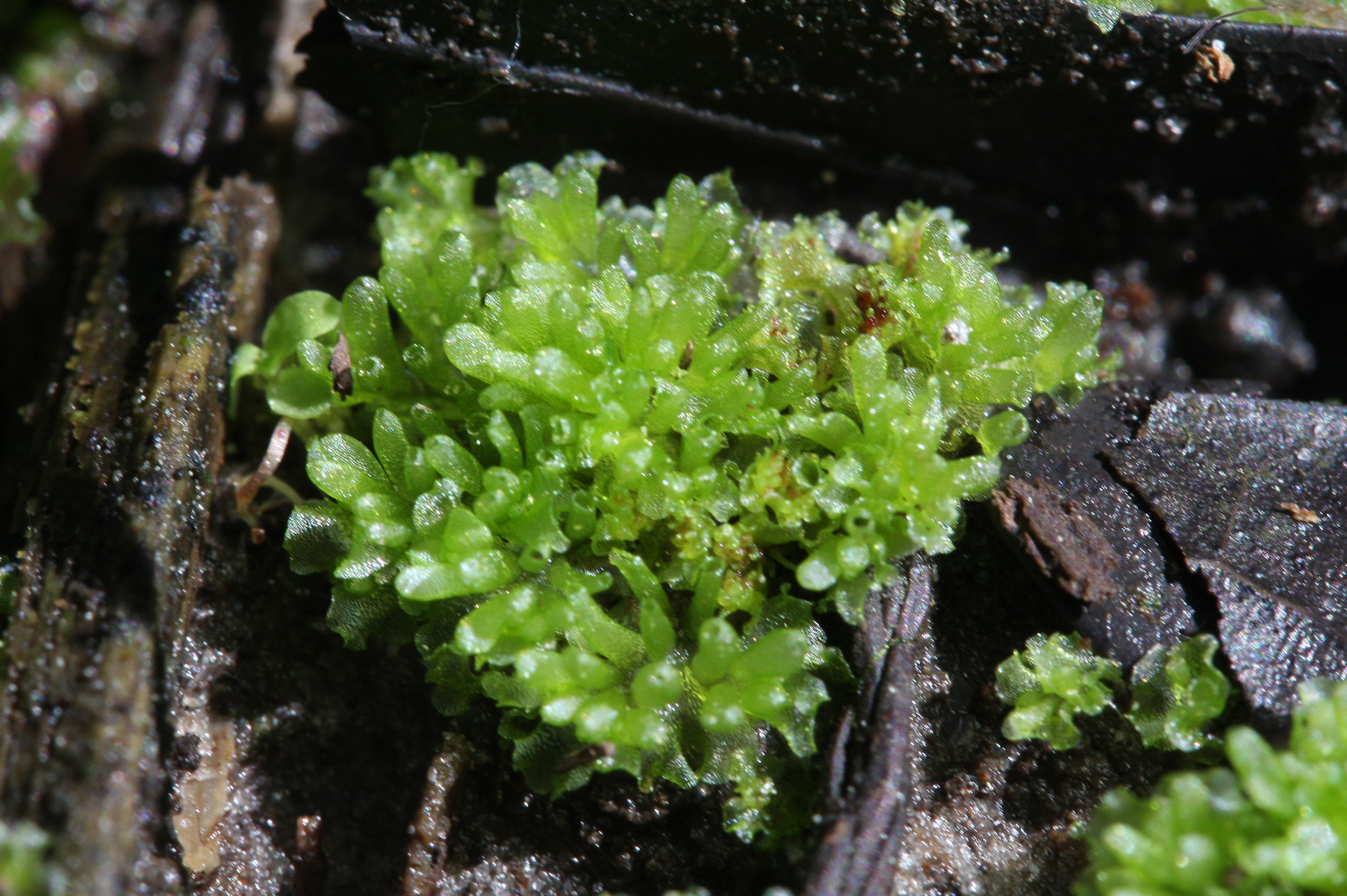
Sphaerocarpus, Riverbend Park, Jupiter, Florida
 John Bradford
 George Rogers
 George Rogers
 Dee Staley
 Treasure Coast Natives