Salvia hispanica
Lamiaceae
Something John and George did not expect in Seabranch State Park today was ch- ch- ch- Chia. It’s a perky mint similar to the native wildflower Salvia occidentalis although with the blue flowers crowded into a dense spike instead of spaced out widely.
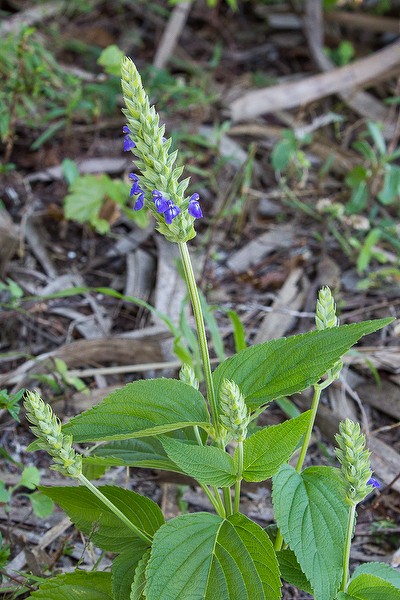
Salvia hispanica. (All photos today except the Chia pet by John Bradford.)
Everybody who has ever watched TV or battled their way through Walmart of course has seen Chia pets, maybe Homer Simpson with a rakish hairdo of Chia seedlings. I hope you’ve grown one at some point. We sometimes use them in my plant physiology class to demonstrate plant responses to light of different colors. They bend it like Beckham towards blue light. The seedlings do not resemble the adult mint.
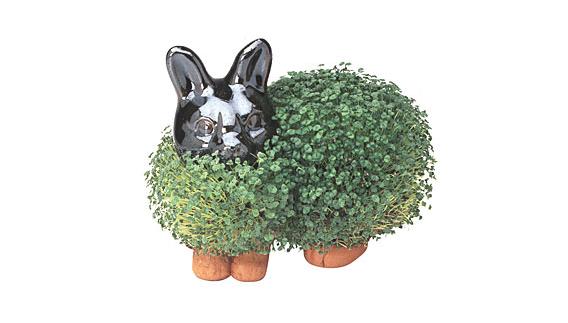
If you’re up on contemporary healthful eating trends, you probably know Chia seeds attributed with healthful benefits.
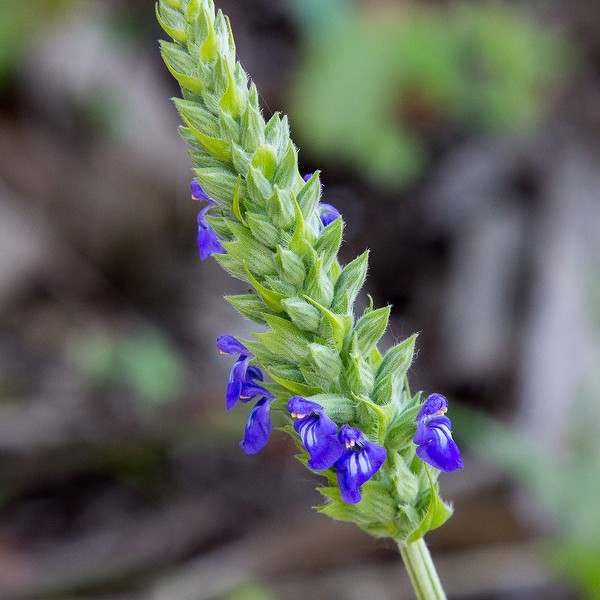
Salvia hispanica today
To be technically correct, there are multiple closely related and very similar species of Chia. Though sold under the single name Chia even by a single company, the seedling species sprouting on the ceramic pig is usually or always Salvia columbariae, whereas the dietary Chia seed is today’s Salvia hispanica.
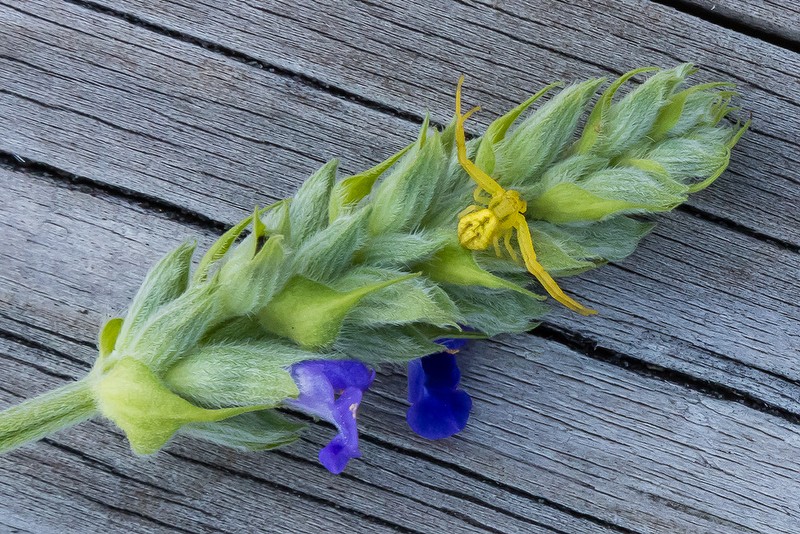
Chia, with a pet
Both grow in arid western North America, so maybe it’s not severely dismaying to find Chia blooming merrily in the sandy sun-baked arid scrub in Florida. Chias have history as snacks and meds in pre-European North American cultures. It seems the perception of the seeds as healthy and energizing dates back thousands of years. A fad diet for the Mayans. Anyone who has slathered the seeds on Elmer Fudd’s noggin knows that when moistened they expand as a gelatinous mass. So naturally the traditional applications include poultices and plasters. Perhaps more interestingly, and I say this as an ophthalmology patient, ancient peoples with a painful particle in their eye, or maybe an intrusive bug, would pop a seed under the eyelid to let the expanding jelly could capture the irritant for easy extraction. Who would think a novelty is sold on TV would have a serious time-honored history?
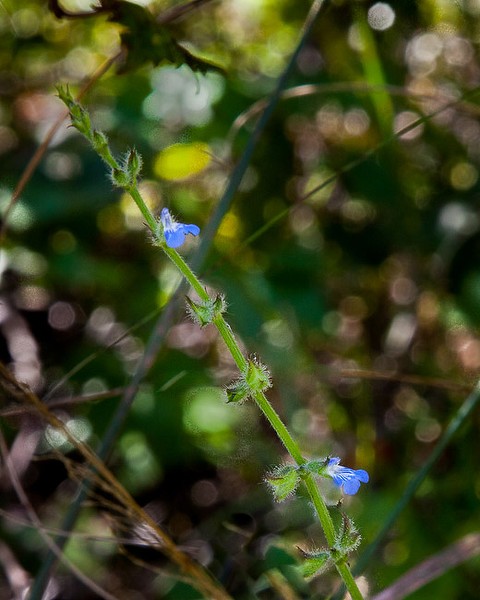
Salvia occidentalis
The time-honored history may turn into a time-honored future, if you can believe material put out by the purveyors of Chia products. According to the main supplier, and I know no reason to doubt them, farming Chia has become an industry in Uganda, where relief from hunger and poverty is life-giving. Photographs from Africa look exactly like the Salvia hispanica John and I enjoyed this morning. I don’t know if the claims are the whole truth, or if there’s an undisclosed downside, or if there is self-serving exaggeration, but at first glance it seems that buying a silly Chia pet at Walgreens may put food in the mouth of a child on the other side of the world.
Note:
This video is of interest.
 John Bradford
 George Rogers
 George Rogers
 Dee Staley
 Treasure Coast Natives