Trentepohlia aurea
Green Algae
John and George are both leaving town awhile, locking the blog in limbo for a few weeks. One last shot before bon voyage. Then no more clutter in your in-box from us. We’ve been exploring Seabranch State Park near Hobe Sound, Florida for several weeks. Arguably the most diverse region there is a dense wet coastal swamp. Today’s odd plant hangs out in the swamp, although the photographs come from other sites.
What would you think if the rain fell bloody red? It happens. To some folks blood from above portends the end of times. To others a meteor obviously whalloped an unlucky flock of bats. Not that far fetched after all, a meteor strike did eliminate the dinosaurs 60-some million years ago. To the more scientifically sanguine, red dust picked up somewhere by atmospheric currents explains the coloration. Case closed.
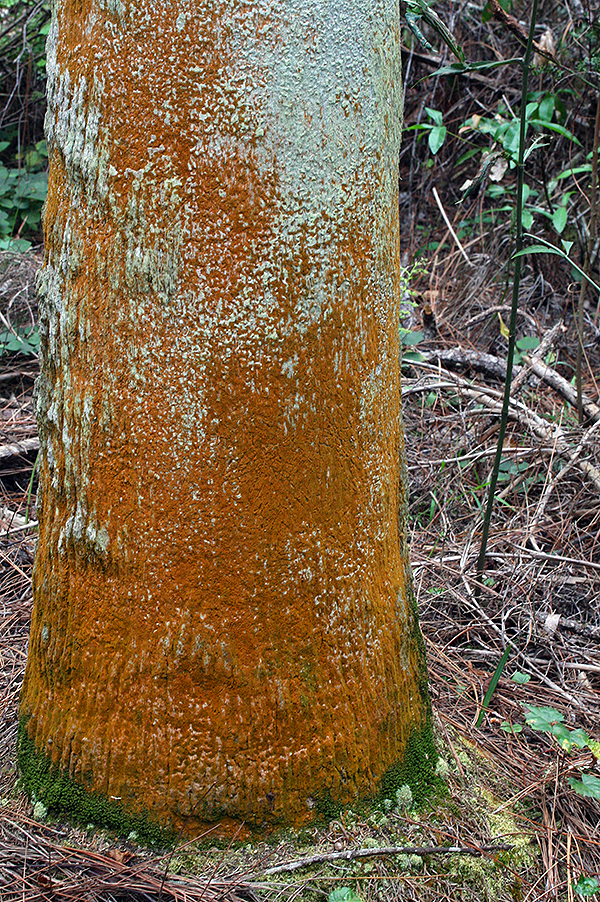
Trentepohlia on tree bark
A microscope might help. Aha! Those reddish raindrops aren’t Sahara dust, but rather a soup of living cells. But, oh my, as a team of physicists—repeat, physicists—concluded, these don’t look like any cells we’ve seen before, so they gotta be extraterrestrials. Space brood is serious stuff!
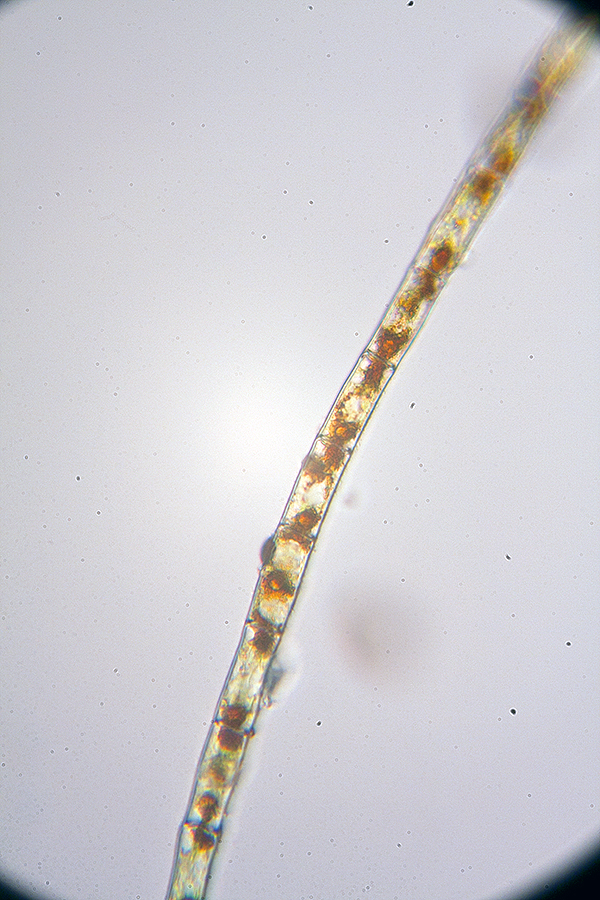
Trentepohlia through the microscope
More or less this scenario played out in connection with red rainfalls in India in 2001…and before…and after. How often does a botanical garden solve a newsworthy scientific mystery? What do microbiologists do when presented with cells of an unknown type, at least before DNA technology? Culture them, especially when they look like spores. Can you imagine the potential consequences of culturing alien spores? There’d be some finger-pointing among the oozing survivors! When the Tropical Research Garden and Research Institute in India risked unleashing the galactic fungus, the hatchlings THANK GOODNESS were earthlings— the common alga Trenepohlia. Here is a report on a similar event in Sri Lanka. CLICK
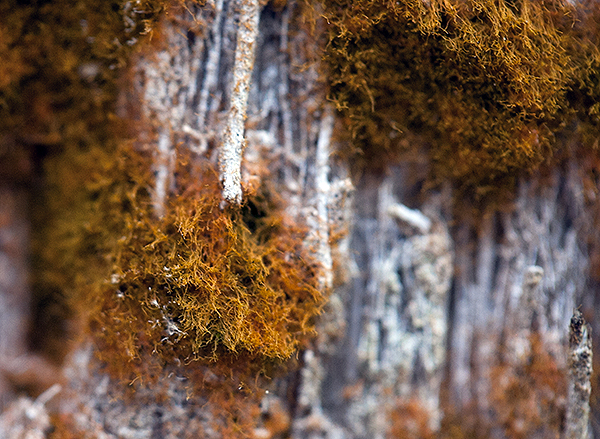
Trentepohlia up close on tree
If Florida had a tropical climate we too might experience funny rain. We have plenty of Trentepohlia, and you’ve probably seen it, at least if you stroll through swamps. It forms golden yellowish carpets on tree trunks. Some Trentepohlias are not content to enjoy a mere free perch—they can parasitize their tree host, although I don’t think our Florida Trentepohlia aurea plays that nasty game.
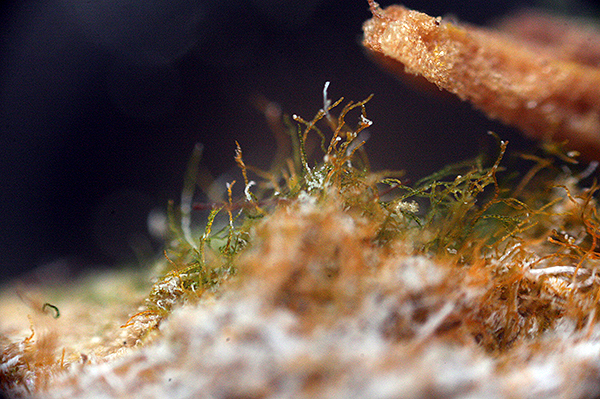
Closer
Trentepohlia is a Green Alga in a classification sense, even though it’s not colored green. The color deviation comes from high dry life on tree trunks. An alga out of water needs sunscreen. The orange pigments are related to the carotenes in oranges and carrots, giving Trentepohlia its sunshine hue, and making its spores resemble bat gore, which I’ve never seen.
 John Bradford
 George Rogers
 George Rogers
 Dee Staley
 Treasure Coast Natives