Monotropa uniflora
Ericaceae (Monotropaceae)
From the middle of December until this week John and George deferred exploration of Sebranch state park in favor of family activities and dental appointments, but today we got back to it. During the holiday hiatus John developed an eye for an odd plant you don’t see often. Twice he found Indian Pipes, Monotropa uniflora, a ghostly white species in the azalea family. We checked it out in Seabranch State Park today.
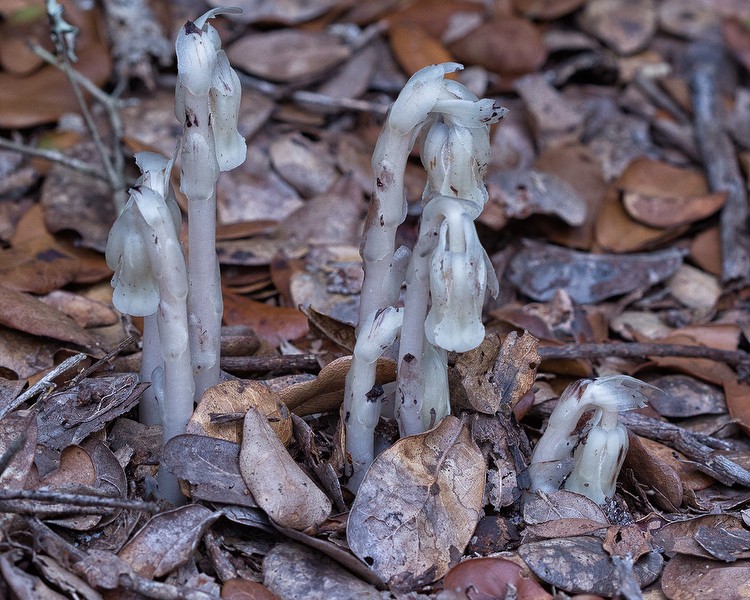
Indian pipes in flower. By John Bradford
The pipes are white because they have no chlorophyll; they have no chlorophyll because they do not photosynthesize; they don’t photosynthesize because they depend 100% for nutrition on fungi associated with the roots. The fungi extract nutrients from decaying soil organic matter and apparently more importantly steal sugary nutrients from neighboring plants. The guilty fungi form mushrooms, so probably you can sometimes see all three members of the trio at once: trees, mushrooms, and Monotropas. No, I did not say every mushroom in the vicinity is involved. Problem is, what goes on underground is complex and exasperatingly hard to study. Research reveals the Monotropas to be fussy about their fungal friends, although this seems to vary geographically.
What’s turned out is that in the huge world of root-fungus symbioses, Monotropa and its close relatives possess their own mycorrhizal system, not even the same as the rest of their own Ericaceae family. The fungus makes a net around the root, covering the tip, and fungal strands penetrate the root forming “pegs” but never breaking through into the actual root cell contents. There are major anatomical changes in the root to accommodate the invader and to facilitate nutrient transfer. The greatest fungus-root activity occurs as pods and seeds form.
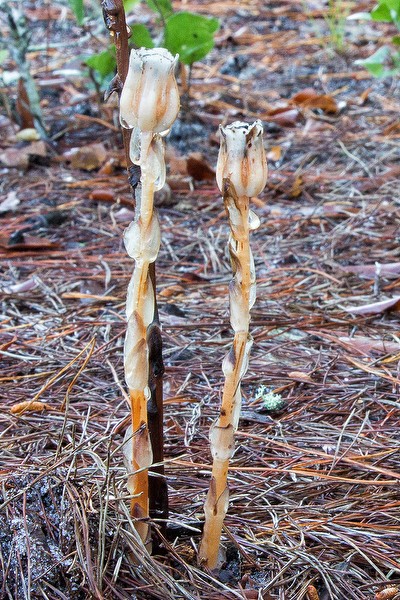
The pods stand upright. By John Bradford
Monotropa favors conifers. Radioactive carbon introduced experimentally to conifers crossed the fungal bridge into the Monotropa, and the reverse occurred with phosphorus. A fungus-mediated swap? Perhaps, but you can bet there’s far more to the story. Certainly the non-photosynthetic Monotropa needs what pine photosynthesis makes—complex carbon compounds, mostly sugars, and the pine conceivably needs help from the fungus middleman, if not from the Monotropa itself, to extract phosphorus from its dreadful soil and its organic detritus. Who’s benefiting when and who’s getting ripped off needs more radioactive research on all three partners. Three-way symbioses are becoming fashionable!
Mycorrhizae happen in 80-90% of all plants, but there are probably not too many cases where the fungal partner spoons sugar to its root partner. Well, to one of its root partners, in this case, the fungus acting sort of a biological Robin Hood, stealing from the rich (pine) and giving to the poor (Monotropa). I wonder if Monotropa is in Sherwood Forest.
Answer: Yes, Friar Tuck marveled at Monotropa. See the 2nd paragraph, 6-7 lines up from the bottom. CLICK
(I like UK connections in the blog as a nod to our long-standing British blog friend Mary.)
The UK Monotropa underscores a bizarre distribution. Monotropa is as widespread as it is small. There are only two species, yet Monotropa spans almost all of North America, much of South America, and is in Europe and Asia. The genus used to be bigger, but DNA has broken up many a traditional assemblage! (Such as reptiles, to the dismay of many, but wrong blog. Don’t ask.)
These plants are primo examples of convergent evolution, that is, evolution of similarities among unrelated organisms. Many plants in other families are parasitic, and many have gone the no-chlorophyll route. These include the broomrapes, beach drops, squaw roots, and oodles of others. I’ve encountered the number 400 species of no-chlorophyll fungus-dependent plant species. This is no big surprise, given that most plants have symbiotic root fungi (mycorrhizae)—some just take it to the limit. Here is a fun relevant link in the world’s best plant web site. Click to visit my hero Wayne Armstrong who does community college botany right.
Indian Pipe pollination merits a quick closing remark. You don’t see these plants often—they are ephemeral, environmentally fussy, and, well, hard to spot. This raises questions of pollination, which botanists have addressed in recent years. Often isolated species are self-pollinated for obvious reasons, but today’s plants need to exchange pollen with others. And you might expect spotty species to benefit from a broad array of pollinators, but nope, just bumblebees insofar as known, pinching the environmental scope of the Monotropas. Given their huge geographic range, though, they can’t be too imperiled. Still, you get the feeling that— just like many other scrub species–as the scrub patches shrink as subdivisions grow, minimal viable thresholds may apply, and species may evaporate from small sites consequently. You can’t count on postage-stamp preserves to save the day.
 John Bradford
 George Rogers
 George Rogers
 Dee Staley
 Treasure Coast Natives