Casuarina
(Casuarina equisitifolia, C. glauca, C. cunninghamiana)
caz-you-RINE-ah (alternatively in some places caz-you-REEN-ah)
Casuarinaceae
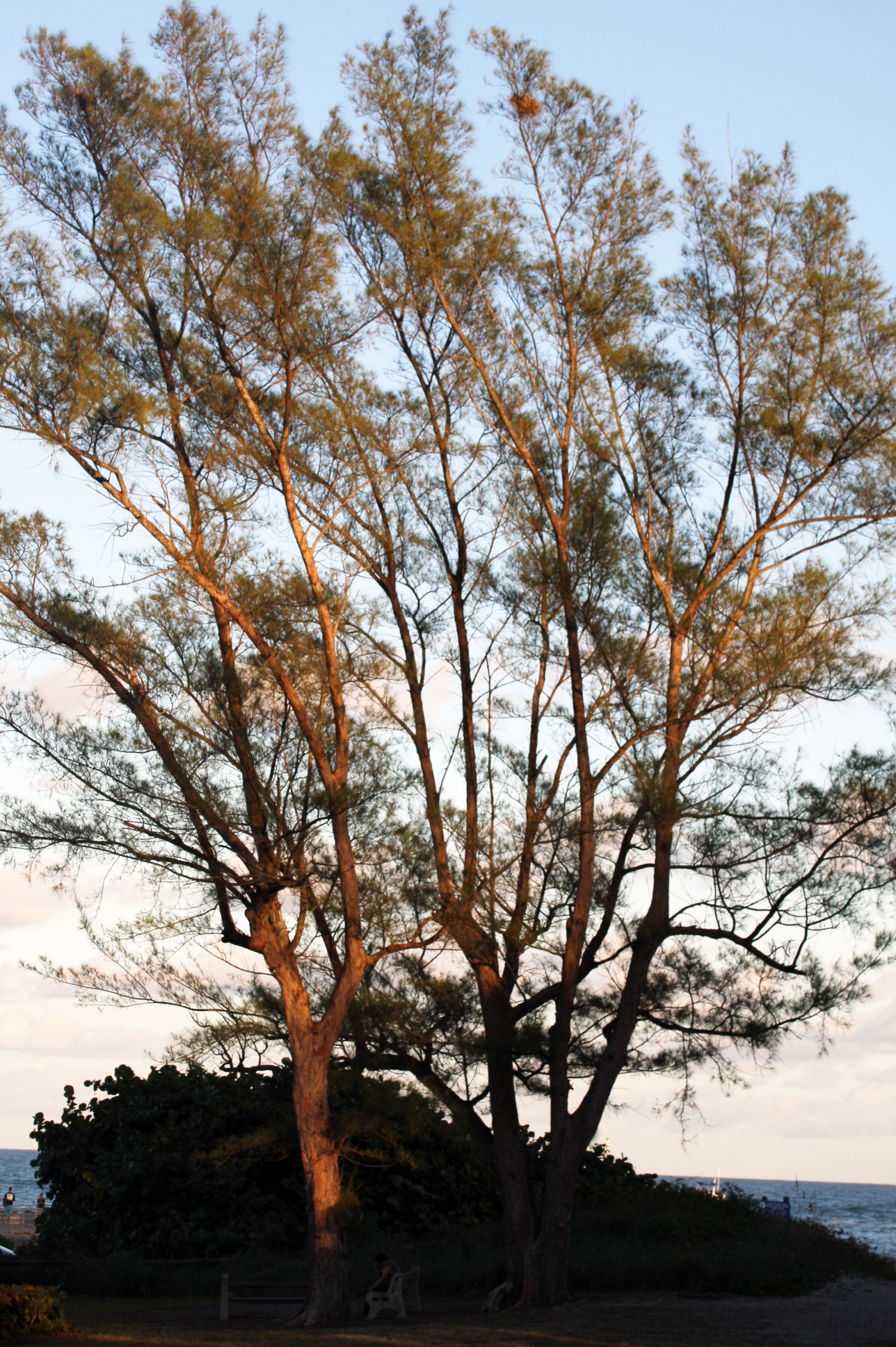
Casuarina at Jupiter Inlet, Florida
A problem with the human mind is we categorize things. You might say we put things in a box with a label on top, and then otherwise ignore the contents. So today let’s think inside the box.
Perhaps other native plant enthusiasts share my lazy tendency to tag certain species as invasive exotics, and then fail to give them much further thought. But when we behave that way we overlook much of our green environment.
Today’s day-after-Christmas tree is Australian-pine, species of Casuarina, not one, but three in Florida. The most common and widespread is Casuarina equisetifolia. The name Australian-pine is a misnomer. The trees are not related to pines and are not 100% Australian. Altogether there are perhaps 50-some species of Casuarina, depending on how you define its borders. (Recent studies have divided an older broad genus into multiple smaller genera of Casuarinaceae.) They are primarily Australian, although Casuarina equisitifolia lives naturally (?) also in Southeast Asia and on some Pacific islands. Ancient peoples in boats obscured inconsiderately the precise natural origins, and the tree goes forth and multiplies unaided with small windblown fruits.
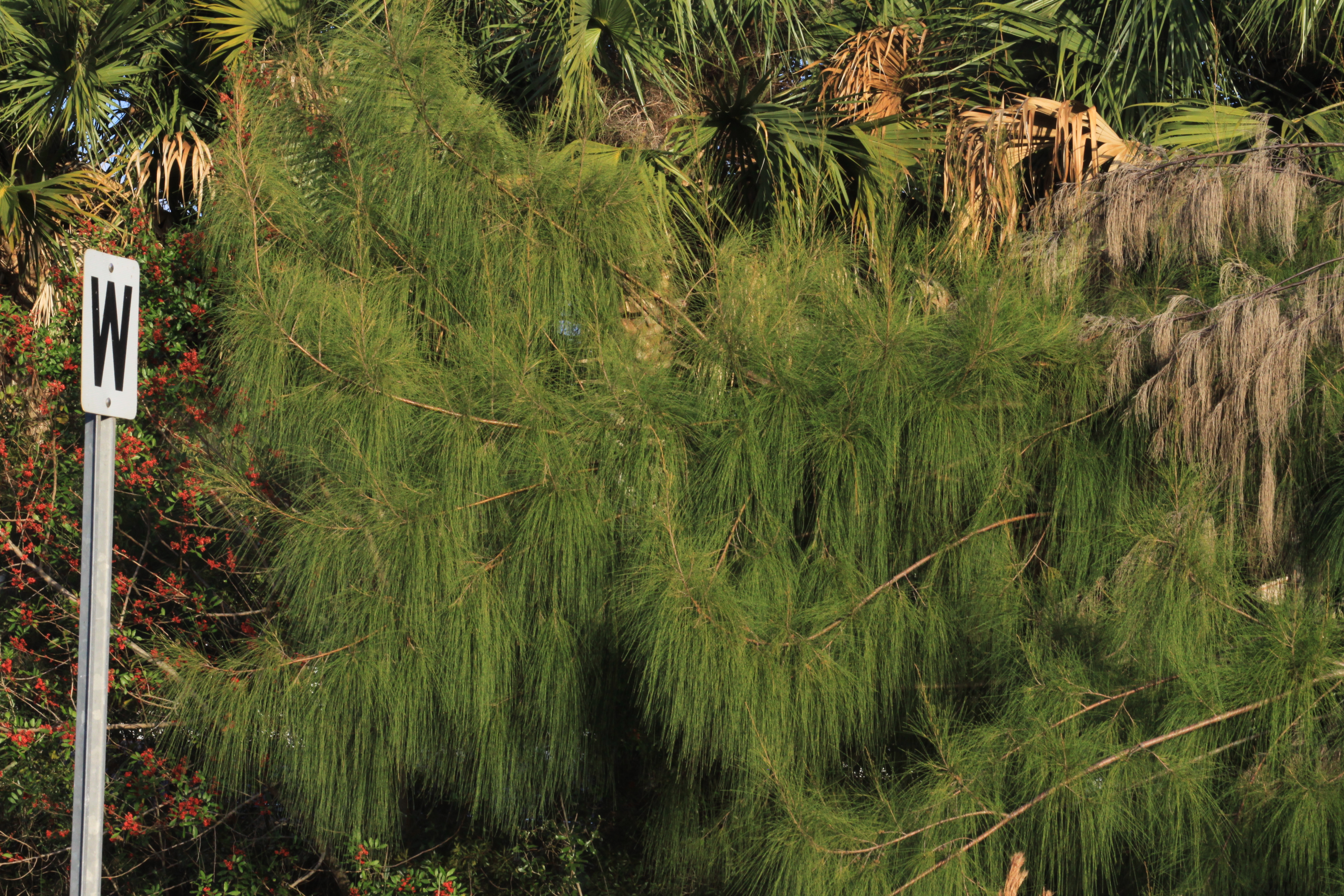
Casuarina foliage (by John Bradford)
The Australian-pine introduction to formal botany dates to the 17th century blind botanical genius George Rumphius on the Indonesian island of Amboina. Rumphius referred to our tree as casuaris-boom, mentioning resemblance between patterns in the wood and plumage of the cassowary bird.
No need to devote much space to Casuarina as an invasive exotic. That’s the red label already on the box, and anyone wishing more on that will find an exotic invasion of documentation elsewhere on the Internet. How Casuarina arrived in Florida is a fair question. Its Florida roots go back at least as far as 1887, bringing to mind the Reasoner Brothers Royal Palm Nursery established in 1881, although I’m not sure they sold it. The tree undoubtedly had been in the West Indies well before the 19th Century, and as already mentioned, the wafer fruits flutter at will over the bounding main.
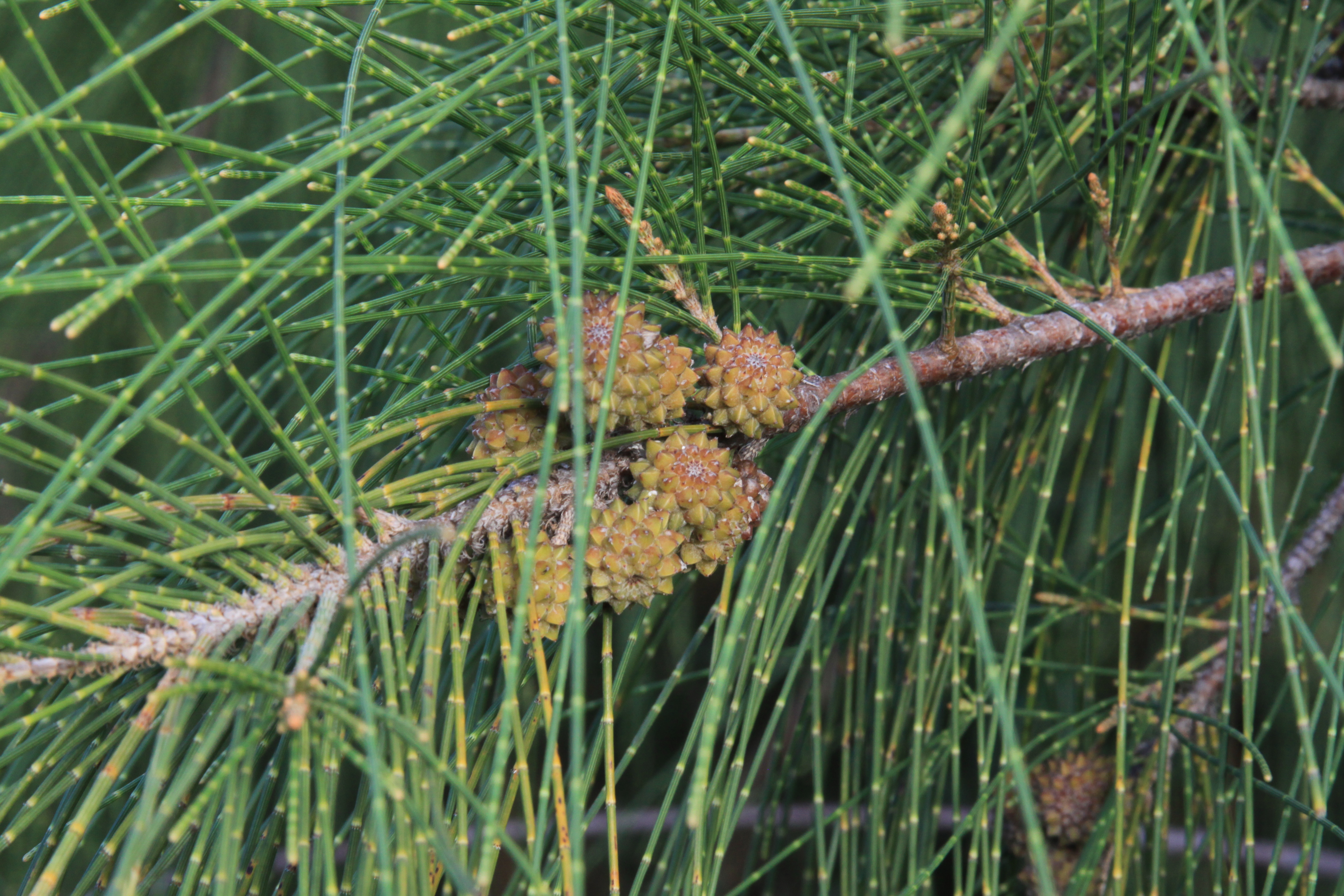
Casuarina clusters of immature bracts (specialized leaves) with fruits hidden among the bracts (by John Bradford). The “needles” are branchlets.
Casuarinas do look like pine trees, and some 19th century botanists took them to be a missing link between the conifers and the flowering plants. They are not conifers at all, and are 100% flowering plants. How experts mistakenly allied our trees with conifers is puzzling as it doesn’t take much examination to spot the similarities between conifers and Australian-pines as superficial, not even involving the same parts. What look like pine needles are skinny green branches. And what look like pine cones are specialized hardened leaves clustered with the fruits. In short we have a beautiful example of convergent evolution, just like the marsupials of Australia exemplify convergent evolution with placental mammals in the rest of the world.
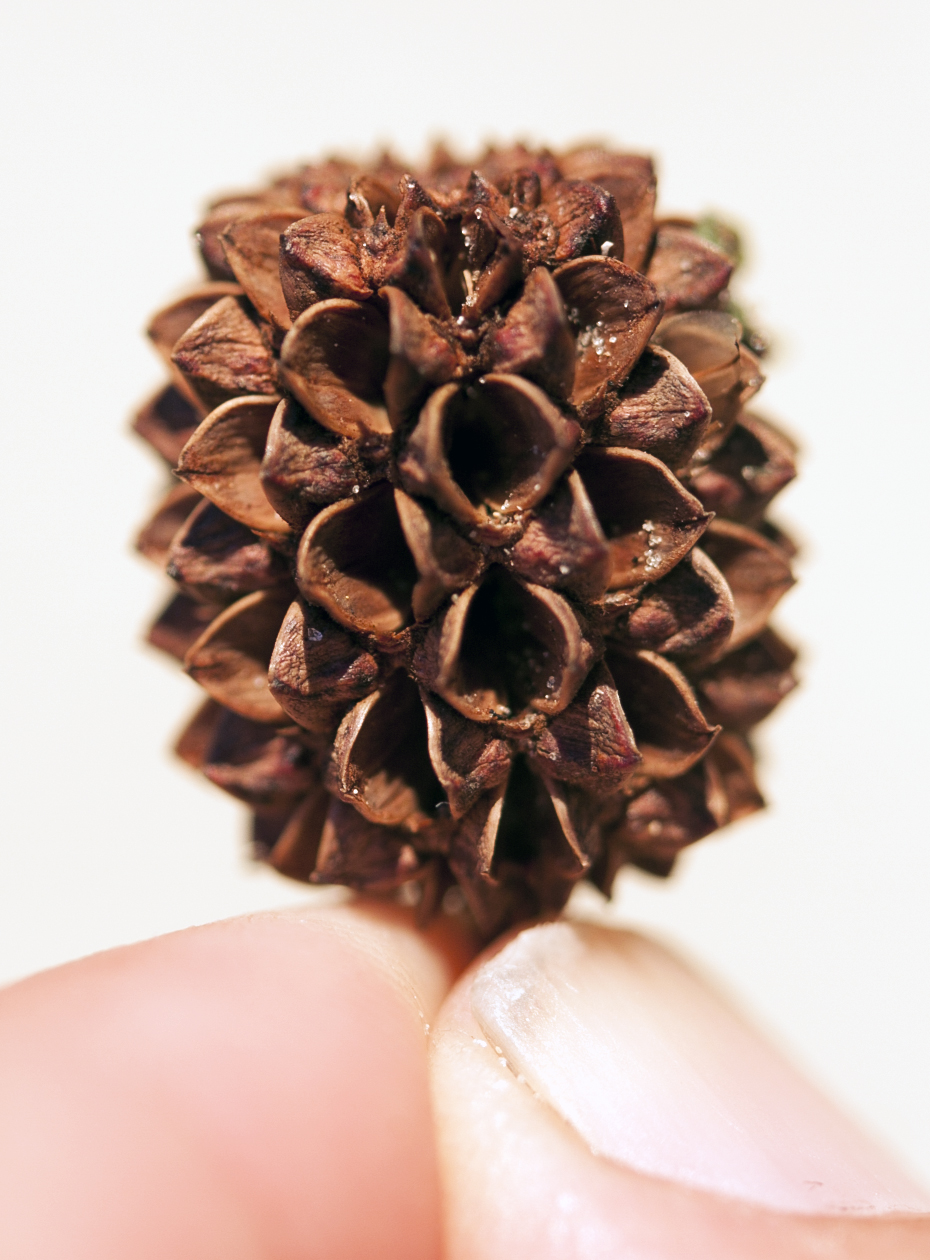
Mature, opened, bract cluster. The fruits have blown from the apparent openings. This cluster is from the tree at Jupiter Inlet.
Just like a true pine tree, an Australian-pine can thrive in nasty harsh environments, such as Florida beaches and dunes. Contributing to their ability to invade (or shade, depending on your perspective) are nitrogen-fixing root nodules, something we more famously associate with legumes. (A few local non-legumes have this ability.)
That perspective thing sure pollutes issues doesn’t it? Casuarina is fundamentally an unwelcome guest, there is no question. It doesn’t take much living in Florida to see the destruction. Beyond displacement of the native flora and fauna, btw, the pollen contributes to allergies. But where I used to live in the Caribbean the Australian pines were valuable shade trees, and I used to enjoy beer, French fries, and silver sands at the shady Casuarina resort. (Maybe sniffling a little.)
So acknowledging the dark side, let’s flip the coin. A species able to grow ten feet a year in a salty sandbox deserves a second look. Iconic Florida botanist Julia Morton thought they were pretty good barbecue fuel, and the abundant trees are a guilt free source of mulch wood chips, although the chips may inhibit the growth of other plants. (I have used them with no obvious calamity so far.) The world abounds in inferior salty soil, limited water, and the need for wood and green coverage. The trees cover mine tailings and stabilize shifting sand. In India Casuarina plantations yield fuel after only 5-7 years, and the hard fine-grained wood supplies rough construction, tool handles, ores, and docks.
In places I’ve worked gremlins have posted signs above the copy machines urging staff to save the forest by restraint with copier paper. Well sure, I’m all for saving the forest and the office supplies budget. So here’s a related thought: maybe Caz is not 100% foe. A commercial source of paper pulp where nothing else grows and where people need industrial jobs may be less demonic than the warning on Pandora’s label.
Casuarina with a haircut
 John Bradford
 George Rogers
 George Rogers
 Dee Staley
 Treasure Coast Natives
