RSS

Author Archives: George Rogers

Unknown's avatar

About George Rogers

Florida botanist

Zig Zag Bladderwort

(revisited)

Utricularia subulata

Lentibulariaceae


Several years ago I made a “Winogradsky Column” for my classroom,  a tall glass vase filled with wet mud to study wetland soil bacterial growth.   To my amazement the top half filled suddenly with a million thin strands resembling a plate of vermicelli, or an oversized fungus, or icky dead nematodes.  
Pre-Bladderworts (the thin threads, not the thicker stems)

At first, the tangled strands were a mystery, but they soon morphed into Utricularia subulata complete with its teensie traps.   Then it happened again.  This spring I filled a Tupperware with wet marsh soil to grow Harper’s Beaksedge for a project. Got more than bargained for:  first spaghetti, then beautiful sunshine flowers on delicate stalks rising from the mud.
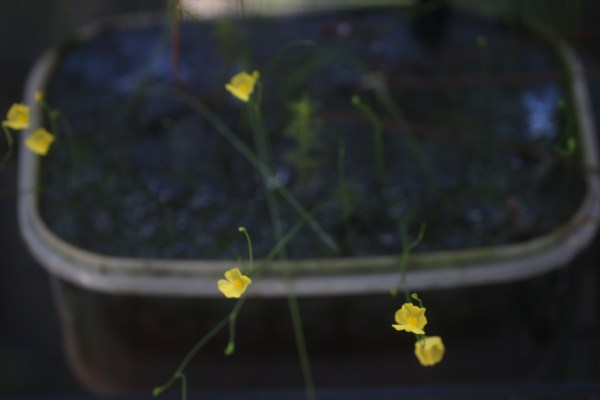
That plant has supreme reproductive power!  How does it do that?  Sure, seeds probably help, although a lot of utricularias are self-fertilizing, some, including U. subulata,  have self-fertilizing flowers that make clonal fake seeds without opening.   Even more useful when colonizing fresh marsh mud, utricularias can grow from fragments.
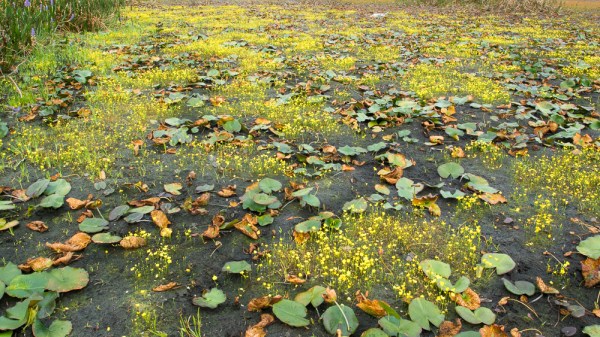
ZZBW on the march in the marsh! Are there enough pollinators for all!? Photo by ‘Soggy-Foot’ John Bradford.

Although the relative importance of this compared with seeds is unknown.    Now I’m guessing for high relative importance:  it seems the ZZBW can spring forth with astounding abundance and vigor to colonize marshes and Dollartree containers.  My gut sez that’s from little pieces, and some other utricularias have pre-formed fragments called “turions.”)

Not only can it take over a marsh, the Napoleonic little Utricularia can take over whole continents.  It thrives from New South Wales to Rio de Janeiro   To extend the guess to cross oceans—birds carrying my imaginary microfrags (or seeds, or clonal pseudoseeds)  from land to land and from pond to mudpuddle.  To test the fragment notion, I’m going to put some pieces on wet filter paper, and on moist boiled sterilized soil.  That’ll showya!

In the meantime, in 5 centuries of organized botany, a plant around the world can get discovered here, and discovered there, and discovered again some more.  How’s a 19th century botanist in Lisbon to know a species discovered there was the same as one described separately in Albany?  I counted (an incomplete list) of 24 different names for the same species.   How did they ever do it before the Internet?
 
1 Comment

Posted by on July 20, 2024 in Uncategorized


Carolina Yelloweyed Grass


Xyris caroliniana

Xyridaceae (The Xyris Family,  not real grasses.)


Xyrises are a big group, about 300 species, approximately  25 in Florida.  The local species live mostly in sunny open wetlands.    But an outlier,   Carolina Yelloweyed-Grass,  thrives relatively “high and dry” in open slash pine savannas and similar places. 

Tagalong on the Xyris

The eccentric habitat is merely one unusual feature of a species with n oddball history, starting on or near an 18th Century rice plantation way down upon the the Santee River in South Carolina. To this day, it is unclear exactly what species actually was “the first” Xyris caroliniana, as no original material exists.  That original  “X. caroliniana”  was probably not actually the species now officially designated to carry the name.   Xyris caroliniana may be the “President George Bush” of the plant world.     Serial use of one name is ok with presidents, but a bummer in botany. 

Hard to generalize about 300 species, but most Xyris species have broad flat thickened leaves fanlike meeting edge-to-edge.   Think of an Iris.  Their main ecological challenge for those aquatic xyrises may be excessive sun while aerating oxygen-starved submerged roots.

Xyris smalliana in flooded marsh

It is different up in the pine savanna where Xyris caroliniana grows.  Its problems include surviving fires.   Xyris caroliniana consequently has a safe underground bulb from which skinny grasslike leaves rise in a three-row spiral.   That the leaves and flower stalk are twisted probably reflects their spiral origins, and the twists may help the foliage compete with thick crowded grass.

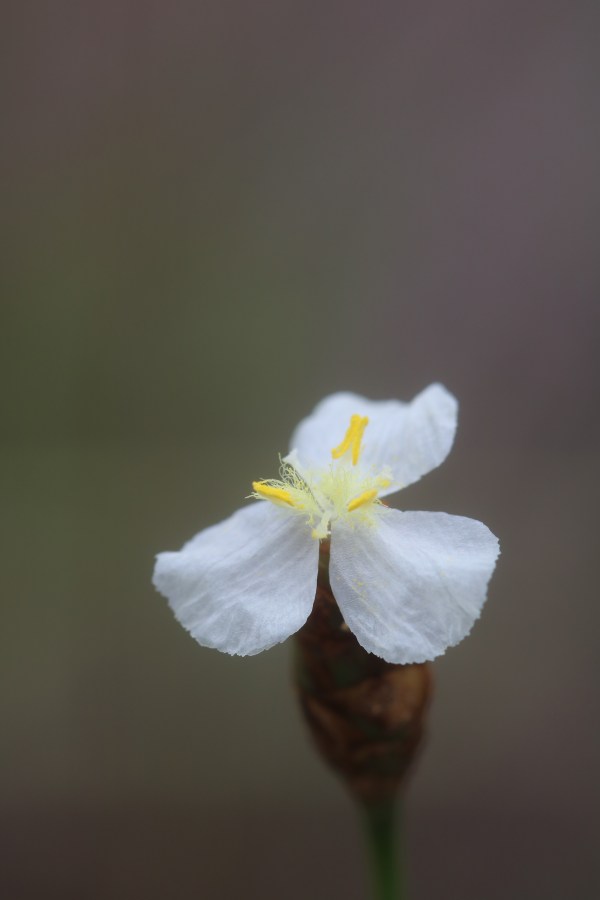
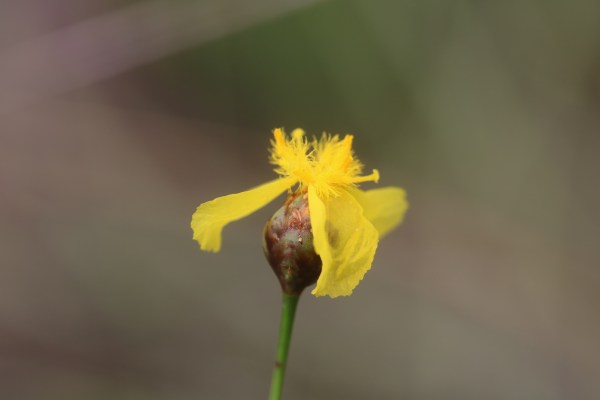
Closeup flower photos today by John Bradford.

Speaking of unusual attributes: the flower color.  With exceptions, xyrises generally blossom yellow.  Xyris caroliniana differs by having  white flowers and yellow ones on separate individuals.  In the northern part of its range, yellow dominates, whereas in South Florida white rules, but yellow occurs too, even occasionally alongside white. 

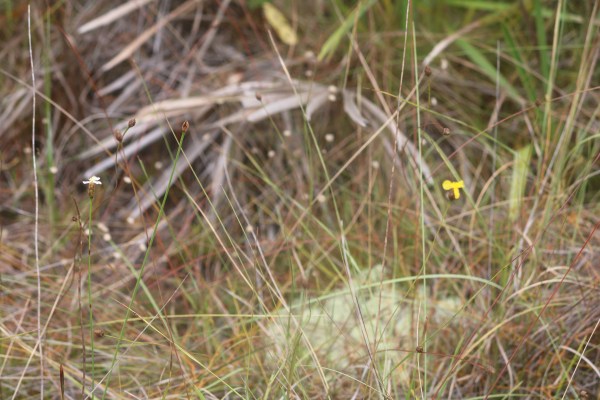
White (left) and yellow together

Despite the presence of both, it seems (with inadequate data) that on large regional scale and in a small meadow, either way,  the two colors cluster,  not at all evenly intermixed.   This uneven clustering probably does not have much to do with pollinator distributions.  Fact is, limited study shows much-to-most reproduction to be by clonal seeds produced by the plants sans pollination.   The seeds are genetic replicas of the parent. That could explain the patterning,  a white-flowered pioneer peppers its neighborhood with clonal white-flower seeds, these growing up to add more and more white-flower plants, and there’ya have it, a white-flowered cluster.   Ditto for yellow in its own corner    You’d wind up with “white zone” and “yellow zones,”  plus here and there limited mixing.

 
4 Comments

Posted by on July 11, 2024 in Uncategorized


Giant Leather Fern

Acrostichum danaeifolium (acros= tip, stichum = row, referring to rows of spore cases I guess.  Danae was a mythological Greek princess and mother of Perseus.   A plant genus, Danae, honors her, so I’ll take a guess that “danaeifolium” reflects similarity of the fern leaves to those of Danae.)

Pteridaceae, Maidenhair Fern Family


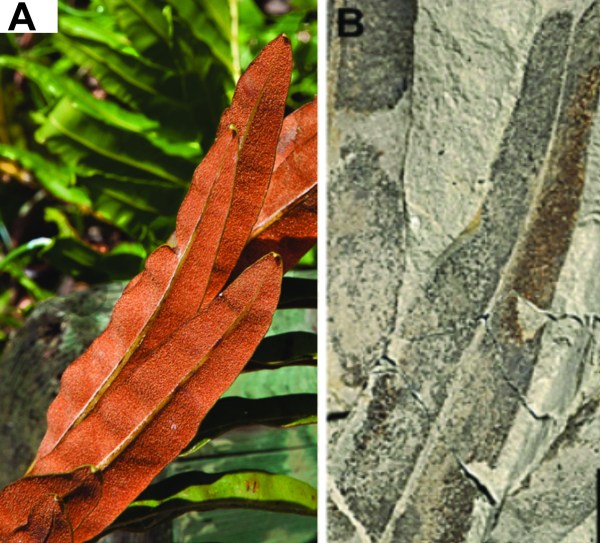
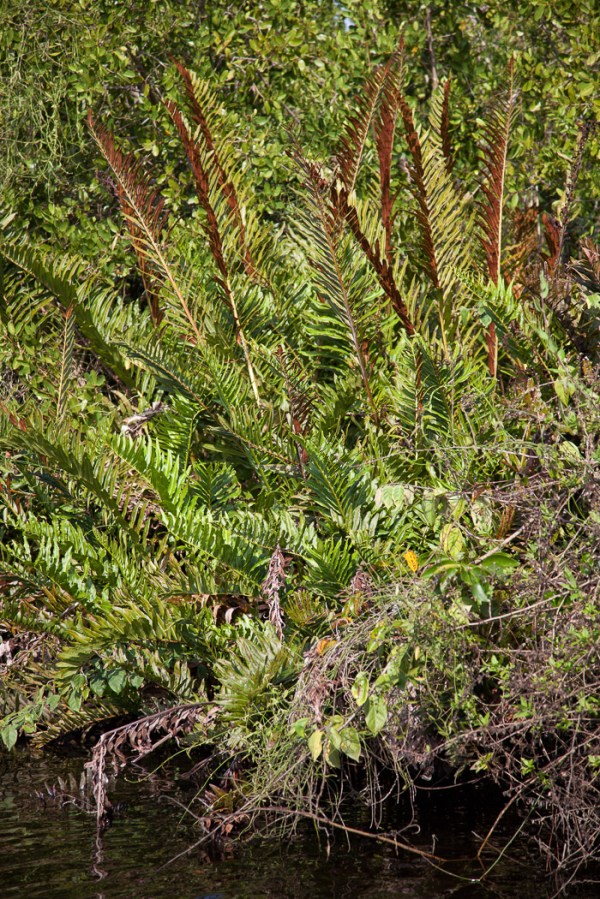
Distributed from Jacksonville to Brazil,  Giant Leather Fern is one of only two (or three) Leather Ferns in the world.    (The similar Acrostichum aureum has one known occurrence in PB County.)   Not only is Acrostichum widespread in space, but also in time, dating back at least into the Cretaceous Period.  This fossil from Spain (discovery and photo by Rafael Moreno-Dominguez) doesn’t look much different from this current specimen (discovery and photo by John Bradford).

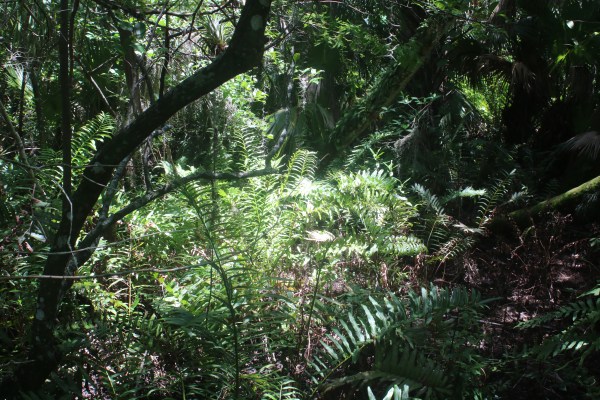
An oddity of Leather Fern was noted by plant ecologist Dan Janzen some time ago who raised the question, “why don’t mangrove forests have a more diverse understory than just Leather Ferns?”   (He had no answer.)   

By JB

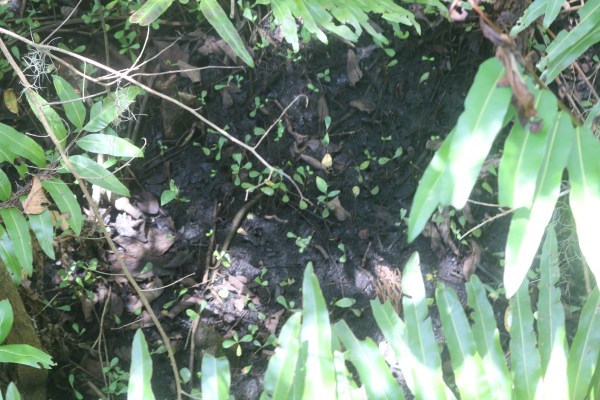
A simple-minded partial answer that would not have impressed Dr. Janzen, as I see it,  is what habitat on Earth could be worse than the mud under mangroves?  Salty! Deeply shaded! Oxygen-starved! Tides!  Moving sand and mud!   Crabs grazing!   Microbes and algae!   It is a truism in Ecology that horrid habitats make for low species counts.    But the survivors have a monopoly.    And Leather Ferns do a good job of owning the habitat.   In the photo below you can see some competitors trying to establish below Leather Fern along brackish Jones Creek in Jupiter.  No doubt those upstarts are doomed, if salty tidal water doesn’t pickle and smother them, fern-shade will.

It must be rough for seeds to establish in mangrove mud, but Leather Fern has a huge advantage by not having seeds.  Its millions of dustlike spores  “blow all over the place,” including dead branches, hummocks, and raised spots  where conditions are less harsh,  facilitating establishment.      Oddly, the tiny reproductive individuals that hatch from the spores can go through their sexual cycle in  a matter of weeks rapidly before “trouble can strike,” and they change from starting out unisexual, to becoming bisexual and apparently able to fertilize themselves as plan-B.  To be even more certain of standing its ground, the fern buds clonal babies off its rhizomes running through the mud.

Meanwhile back in the Cretaceous

 
5 Comments

Posted by on July 4, 2024 in Uncategorized


Hurricane-Grass, more than meets the eye


Fimbristylis cymosa (fim-BRIST-ah-lis sigh-MOSE-ah)

Cyperaceae, the sedge family


Oh phooey…here comes Hurricane Season.   My old island home Barbados is about to get a swirly.  In Barbados, in Florida, and around the world, how can hurricane-“grass”  withstand a hurricane, not to mention all the other tortures this weirdly immortal sedge survives?   Answer (I think):  it is one of those wonderful plants that alters its environment to its own benefit.   The fancy term is  “autogenic habitat modification.”  You might call it positive feedback.  If a beaver builds a lodge or paper wasps build a paper home, that’s autogenic modification but no big deal—creatures have intelligence and agency.  But DIY “homes” for plants are pretty nifty.  Sure, any dumb ol’ tree may funnel water and debris to its base, or  saw palmetto may shade out competitors, but some cases of “make your own space” are more wondrous.

Hurricane-grass may weather a twister, or thrive on lava (they do), or occupy asphalt, or dominate bare scrub sand where nothing else lives because, like other post-apocalyptic survivors, they have a bunker.  We sort of.

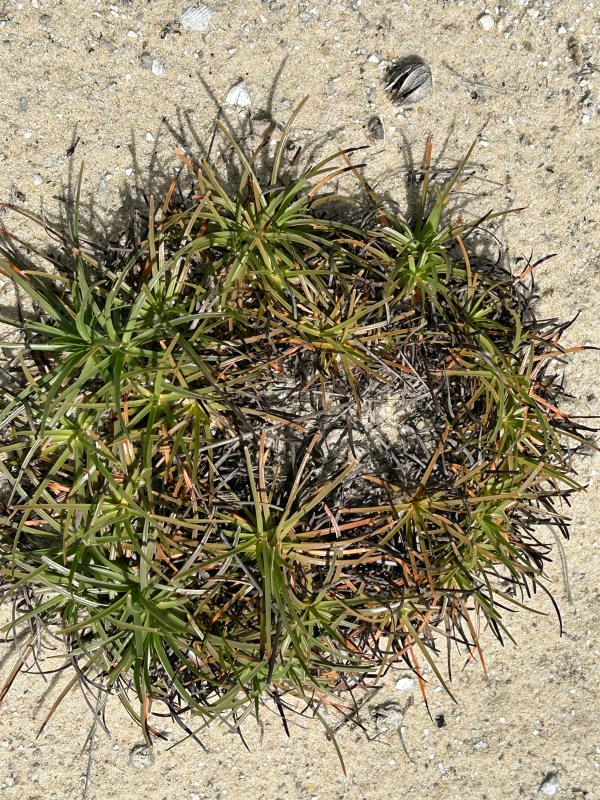
Wreath

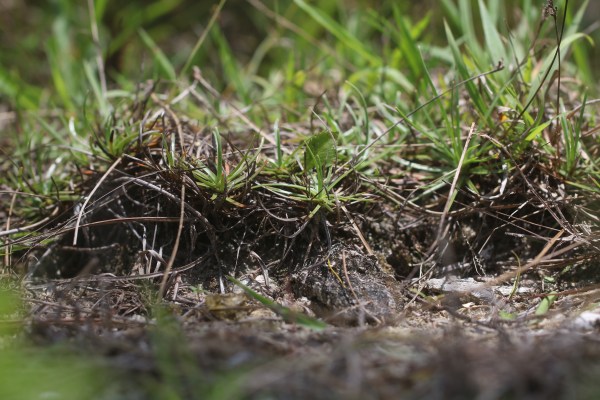
If you’re truckin’ along and spot a Hurricane-Grass it often looks like a green wreath dropped on top of the ground, a raised ring of little green rosettes, and  a black or sandy unoccupied center.   Seen from above It grows outward, like a fairy ring in the lawn, leaving the enlarging hollow center behind. Viewed from the side (lie on your belly with chin to the ground – ha ha), it looks like a tiny sand dune two inches tall having green leafy rosettes on the surface.

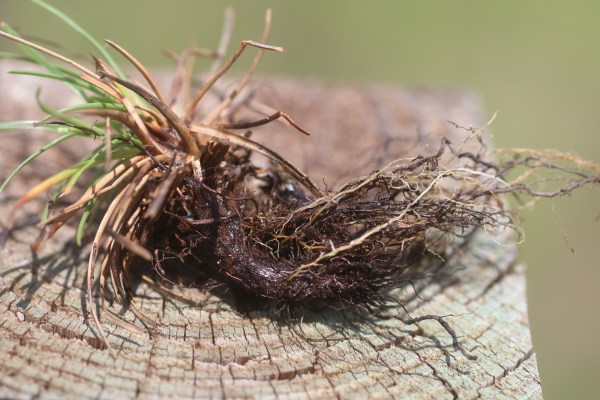
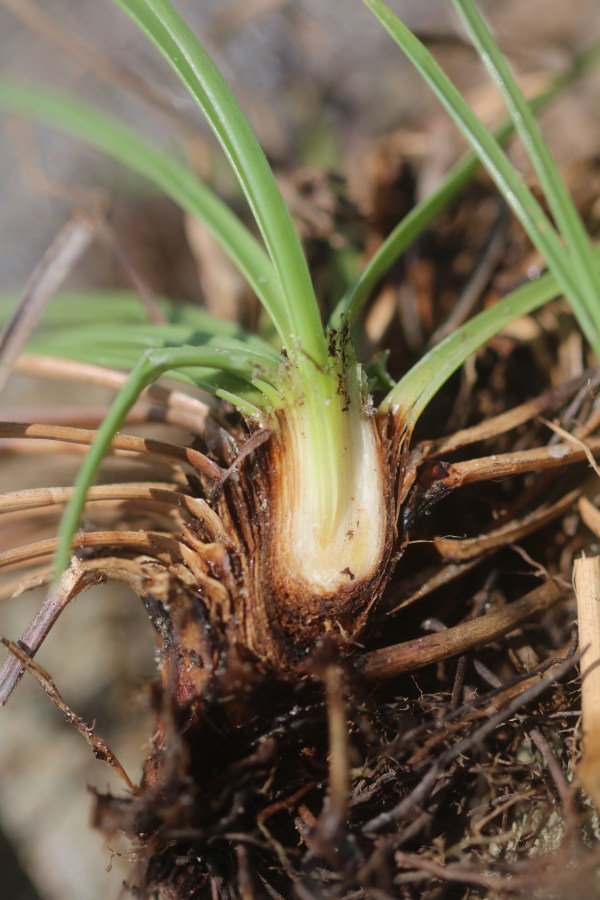
But here’s the thing, or things.  Thing 1:  Each of those rosettes on top is merely the tip of the whole plant.  The rosette on a trunk just like the tuft of leaves on top of a palm is on the palm’s trunk.   If you pull the Hurricane-grass out of the sand it actually resembles a little palm,  its  sand-covered “trunk” looking at first glance like a taproot.   But brush off the sand and look closely: the “taproot” is actually a  stem covered with old leaf bases, like the “boots” on a cabbage palm.   The weird part is that all those “trunks” are embedded in the sandy bunker.  They are “buried” aboveground in congested groups.  Think of a dense stand of palm trees up to its leaves in a raised sand dune.     Those little stems are as protected as can be, and even better, their growing tips are not even at the exposed top, but are sunken down in the mini-dune bunker. How does the colony build up that protective sandy dunelet?   Seems like sand drifting in wind (or water) catches on the exposed portions, settles, and piles up as the rosette then rises a little taller to stay exposed.
Chin on the sand view

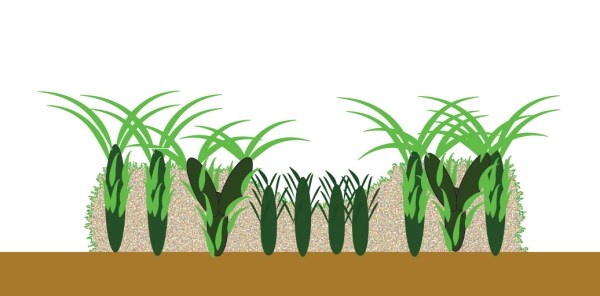
Helpful diagram of the same view. Note the mini-sand-dune, the rosettes at the top of the sand, and the branching.

Exposed! Stem (brown, superficially resembling taproot) to front and right)

Growing tip hidden safely below exposed top.

Thing 2:  How does the wreath expand?  Those buried stems become increasingly crowded by branching in a Y-shaped pattern, the dead zone in the broad hole-in-the-donut probably a good water-catcher.  

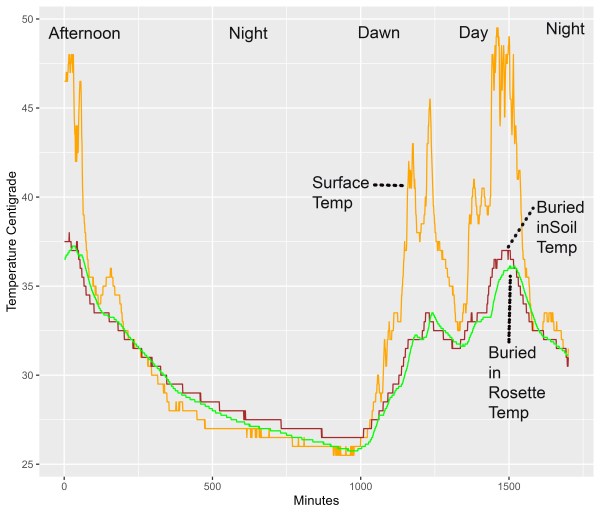
How many ways does the sand protect the sedge and its hidden growing tips?   Who knows?  Undoubtedly from sun, UV, wind, drying, abrasion, bugs, hungry hippos,  unfavorable surface soils, and in its typically hellishly hot haunts, from heat.  Just for fun I monitored hurricane-grass temperatures from yesterday afternoon  through the night and all day today.  Readings were recorded every minute for approx.1700 minutes in three positions:

Position 1. Nestled down among the hidden stems 1.5 inches below the rosettes.  (Green line)

Position 2.  Buried in the nearby soil 1.5 inches deep.   (Brown line)

Position 3.  On  the exposed soil surface.   (Orange line)

Tracking the heat for one afternoon, night, and following day. Orange = surface temperature. Green = temperature between stems 1.5 inch below rosette. Brown = buried in soil 1.5 inch.

The protection from the soil-surface temperature (orange line) was substantial, in the daytime sun cooler and more stable.   The temperatures among the stems (green line) were roughly equivalent to burial in the nearby soil (brown line), although actually a little cooler. Notice that at the highest temperature you see the biggest difference between the green and brown lines.    Betcha that gap broadens at even-higher temperatures.  

 
Leave a comment

Posted by on June 29, 2024 in Uncategorized


It’s Vine-Eat-Vine in the Scrub…

Unless you’re a Smilax


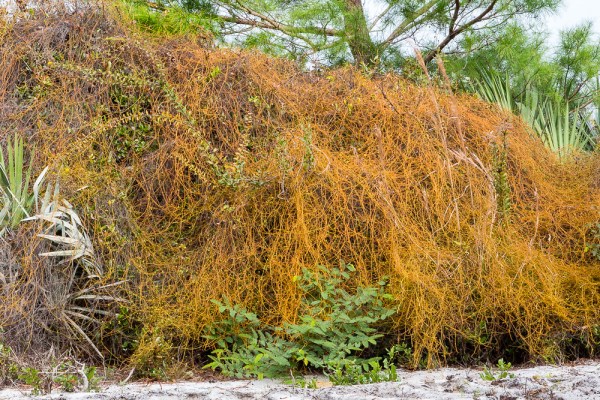
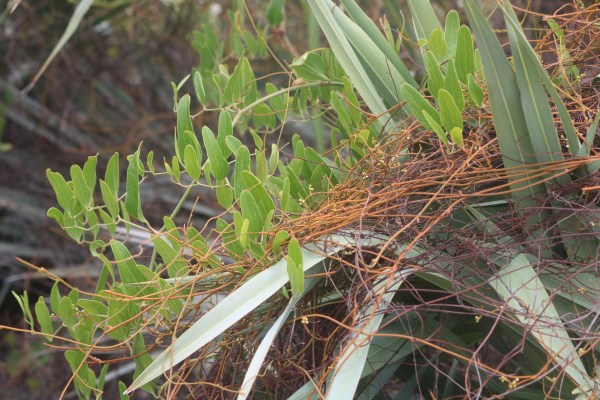
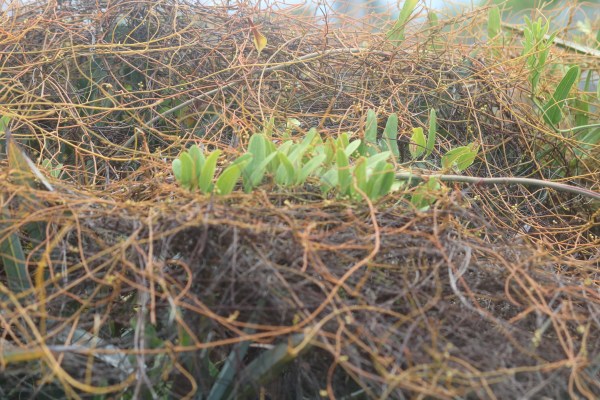
Darwinian competition is rough business:  frogs eat flies, snakes eat frogs, hawks et snakes, and Love Vine eats other vines in the scrub.   In case you don’t know Love Vine (Cassytha filiformis), it is that yellowish spaghetti vine festooned all over other plants in scrub and additional habitats. It forms massive tangles smothering and parasitizing all beneath.  

Love vine bothering its neighbors, by John Bradford

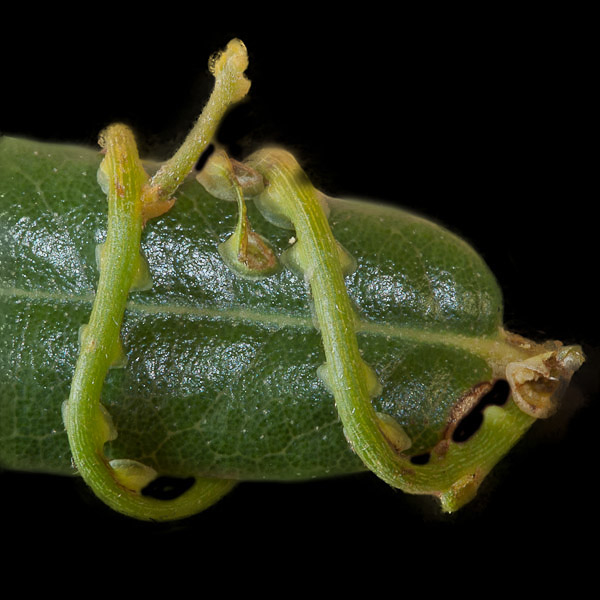
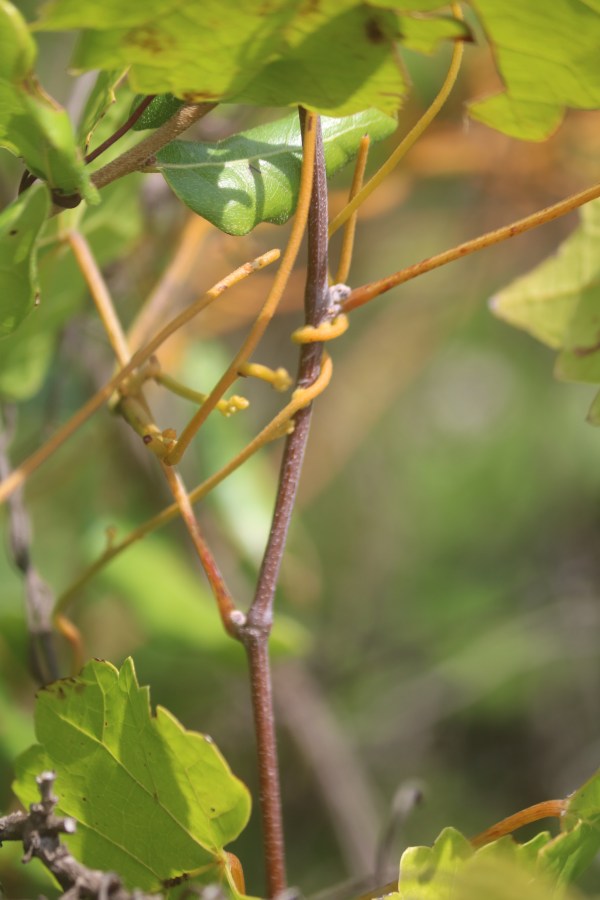
Love Vine penetrates its plant victims with little suckers called “haustoria” and sucks out sugar and water. 

Haustoria at work, JB

  Not nice, but it gets ahead in the world.    Love Vine probably came here all the way from Australia, pollinating itself to make the intercontinental hopscotch easier.   Tiny thrips, insects that parasitize the Love Vine, ride in a stowaway space between the fruit wall and an outer covering of fleshy birdfood.  Apparently the birds help the vine AND the thrips get around.   All well and good, but what interested me today is seeing in the scrub that a different vine, Earleaf Greenbrier  (Smilax auriculata), not only seems immune from the Love Vine, but also uses it to rise above the tangle  into the sun.  The invulnerable Smilax climbs up the Love Vine unmolested, and snakes along the top of the Love Vine to enjoy an easy path above all the shade, crowding, and parasitism below.

Smilax ignoring Love Vine. Can’t catch me!

It gets a little more complex.  Another  vine in the scrub (and elsewhere) is Muscadine Grape (Vitis rotundifolia).  The grape resembles Smilax in overall habit, stem diameter (when in scrub), climbing ability, leaf size, small plain clustered unisexual flowers, and making “bunches of grapes.”   Unlike Smilax, however, the grapevine falls prey to Love Vine.

Above: Grape is not immune!

Smilax comes out on top

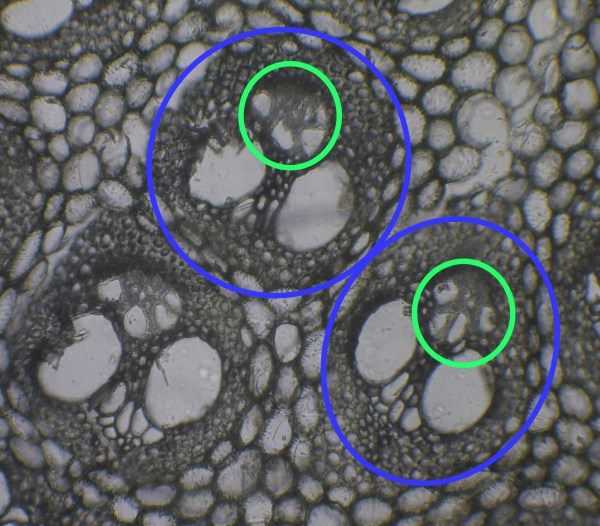
Why the difference?   Most woody plants have their water-conducting and sugary-sap poorly protected just under the bark.  Easy pickings for creepy Love Vine.    But Smilax is different:   its stem is built like cables within cables.   (Because It is a monocot if that matters to anyone.)  If you cut across the stem  and look end-on, the plumbing is deep within the stem and surrounded by a hard  protective sheath.     No parasite is going to break into that!

End view of Smilax stem magnified. The green circles surround the sugar pipes. The big blue rings circle the protective sheath. The large open ends within the sheaths are water pipes.

Don’t get me wrong. No suggestion here that the Smilax stem internal structure is a special adaptation to block Love Vine specifically (although it might have a lot to do with protection in a broad general sense). So do those thorns. Think of it as a chance thing…lucky Smilax winds up in a habitat with a stem structurethat just happens to offer an advantage against would-be competitors such as grape, or maybe species long-gone because of not having the “right stuff.”

 
5 Comments

Posted by on June 8, 2024 in Uncategorized


Tags: , , , ,

Raindrops on Roses….

(are miniature hoses)

Obviousness should not always “go without saying.”  In nature, obvious everyday experiences have plenty of beauty and wonder, and can sometimes prompt new explorations.   There’s no “eureka” in observing that rainwater trickles to the bases of plants.  Yet  it’s fun to go out after a rainshower and see where the drops drip. Plants are giant funnels.

Direct water capture is critical to some species, such as tank plant epiphytes.

Photo by John Bradford

But what’s arguably more fascinating are the more “iffy” cases.   Is there a correlation between dry habitats and plant funnel-ness?   Haven’t “done the math,” but, probably:   think Yucca in Yucatan. In other species, funnel abilities might be a mere advantage,  or sometimes the opposite. 

By JB

Many plants have “winged stems”:   blackroot, crownbeard,  winged elm, and many more. These often have “winged” or “alata” in their names.   Do the wings help channel water?  

Winged stem on crownbeard. By JB

I wonder if the corky wing in Corkystem Passionvine might absorb water into the climbing stem without recycling all the way down to the roots.   Or if the spongy bark on Peelbark St. Johnswort helps with water storage and evaporative cooling.  Ants love that species;  maybe soggy bark is why.

Coincidental association of tree and small plants at its feet, or nurse tree in action?

Nurse trees aid smaller plants around their bases.  Lots of ways a big plant may benefit a little pal, including funneling water to its base.  Vines climbing a tree may have a double plus:  a free ride up into the sun, and free water running down the host tree to the spot where both are rooted.

Ever notice how fire ant nests center around large grass clumps?   Betcha rain collection at the grass base helps wet their whistle.  And speaking of “grass,” a clump of hurricane-“grass” has lots of little sedge funnels around a big spongy tussock.    Does the “sponge” store and distribute the captured water? 

Plants in your ants.

Bald Cypress grows mostly in swamps comfortably free of water deficiency.    Its close relative Pond Cypress, by contrast, often occupies open places prone to seasonal drying.  Do its upright twigs and upright leaves help with seasonal water needs?

Big flat fluted semi-upright cabbage palm and saw palmetto leaves, in addition to being sun-catchers, sure look like water catchers.  Somebody should measure stemflow down a cabbage palm trunk.   All those vines, mosses, and ferns on the trunk love it.

Who knows.  Very little about external water dynamics has received formal study.  That just means “more freedom” to wander, wonder, speculate, and discover.  

 
1 Comment

Posted by on May 31, 2024 in Uncategorized


Pineland Heliotrope takes the heat and can’t be beat –

C4 Yourself!

Euploca polyphylla (aka Heliotropium polyphyllum)

Boraginaceae, the heliotrope family


Ever wonder how some species flourish, bloom, and prosper at ground level in the hottest, most sun-parched habitats.   I accidentally dropped a digital temperature-recorder in a dry marsh the other hellishly sunny day, and it maxed out flatlined  at  115 degrees F before I recovered it.   Who knows how much higher the actual reading should have been?   Think of walking barefoot across hot asphalt on a bright hot day.   That’s why there are no plants in Hell.   Maybe it is counterintuitive that it often tends to be (a lot) hotter on the ground than above it.    A burnin’ ring-o-fire at  ground level can raise fun questions:

All photos today by John Bradford. This is how the PH looks this morning.

Do the broad lower leaves under a saw palmetto or the skirt of dead foliage under a Golden Aster heat-shield the more-delicate tops?    How important is evaporative cooling on the down low?   Why do some plants have rosettes during the cool season and move their leaves up the stem in the heat?   Does it help dry marsh plants have a “mulch” of spongy periphyton persist from the wet season?   Does leaf litter protect shallow roots?  Why do sedges often cluster leaves at the top of the plant?  Why do low Myrtle Oaks in scrub have a bewildering array of leaf forms, sizes, and textures?  And so forth.  A fun theme for a walk with one of those point and shoot “covid” no-touch thermometers.
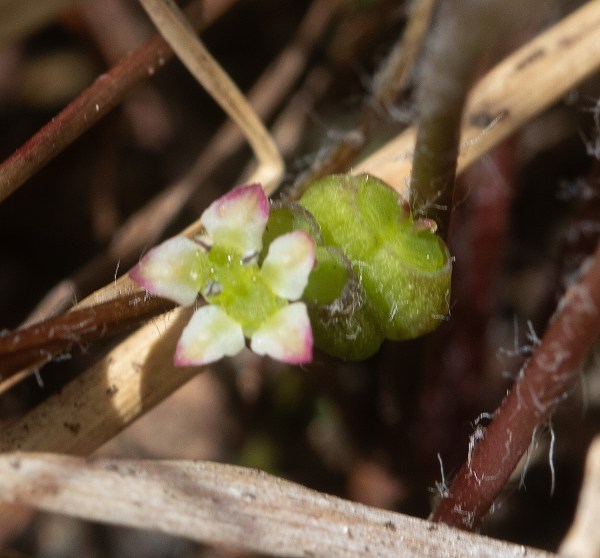
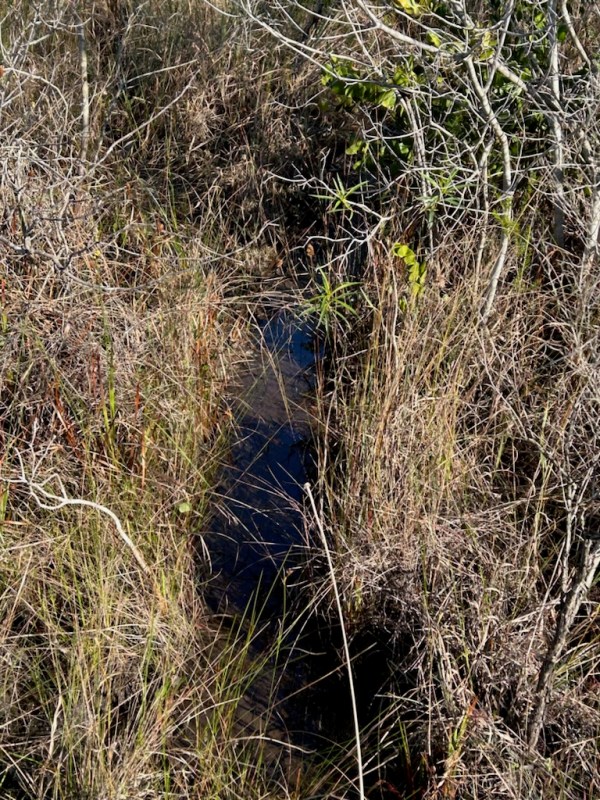
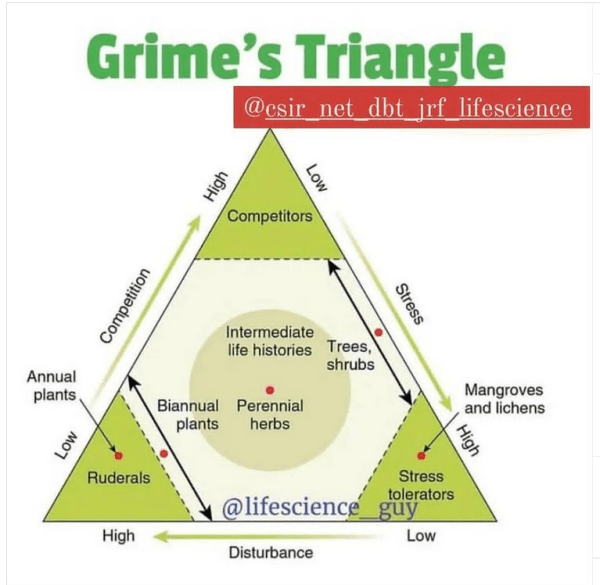
Let’s get to the point via one final question.  How do the species that actually love the hotfoot soil get away with it?   Yes, some have extreme adaptations, like Cacti.   Some dodge hot times or actual fire & flood using seeds, or deep roots, or shape-shifts.    Harsh habitats are good opportunities for species able to tolerate them, because harshness suppresses competition, and pestilence may be tamped down too.   In a “nice shaded moist” rainforest you’re competing with a zillion close neighbors.   By contrast, in the desert or Florida scrub there’s plenty of real estate,  if the harsh physical conditions don’t thwart you.   The late British ecologist J.P. Grime divided basic plant  lifestyles into a triangle:  competitors, ruderals (weedy fly-by-nights), and stress-tolerators.   (Hey, that’s kinda like office politics.)  

This all leads to the fact that being a stress tolerator can open doors.   Especially in “new” environments with changing climates, such as the passage of an ice age.   A local stress tolerator is the beautiful Pineland Heliotrope.   It stands up to ground-level cookery even without obvious protections.

Biologist Michael  Frohlich and about 19 collaborators nailed that mystery with molecular research.   Pineland Heliotrope’s secret weapon is a superpower called C4 photosynthesis, best known in grasses, which live at ground level.   C4 allows comfort and joy in places too hot and dry for many competitors.   What’s interesting about this ability in heliotropes is that only some have it.   As the Frolich team uncovered, there’s a cluster of about 18 species (in the genus Euploca)  that  evolved and diversified rapidly in hot exposed American habitats thanks to an ancestor bestowing upon them the C4 ticket to invulnerability. So they prosper in the exclusive stress-tolerator corner of Grime’s triangle.    How cool is that?


To dig in deeper:

https://academic.oup.com/botlinnean/article/199/2/497/6510913

 
2 Comments

Posted by on May 16, 2024 in Uncategorized


What the heck pollinates Centella?

Centella asiatica

Apiaceae (Carrot Family)


In the great big plant world, 250,000 flowering species, only a handful are known to be pollinated by ants.   Let’s guess:  ten species, probably too high.  That’s 0.00004 percent.  Do we have one of them here in PB County?   Maybe, maybe not.

Centella asiatica, sometimes called Pennywort, and sometimes called Gatu Kola, is an odd little wonder.   [Oops, that should be Gotu, see reader comment below.] It grows all around the tropical world, including around here in wet marshy places, although it tolerates seasonal drying.   It is one of those bioactive plants with a million historical and current medicinal and cosmetic uses, in many cultures.   (Careful,  there are toxins.) I’ve never been much interested in “medicinal plants,” so if that’s your interest, there are 100 websites with info on this species.   

How has a small creeping plant crept all over the hot-climate world?   Part of the answer is fragments.   If you take marsh soil and put it in a container nice and wet, up pop lots of baby Centellas.  A whole lot of them.   I don’t think that is from “seeds,” but rather rhizome pieces.  The reasons I don’t like “seeds” is that the flowers and fruits are rare.  I have the species growing at my home, and the babies are coming from tiny unplanted plant pieces.  That ability alone is mysterious.  How can the mud be full of ANYTHING that spawns baby Centellas every few inches?  Maybe it is magic.

To dig in deeper, the floral biology has been studied a little.  Biologist Asma Javaid and collaborators looked into it:   in pots, in  a garden, in Jammu, India.   (How does that relate to a Florida marsh?)    They found the plant to be largely self-pollinated. That I believe.  They also concluded ants are the insect pollinators to the limited extent there are insect pollinators.   But that sets off alarms:

1. See above. Ants pollination is EXTREMELY rare.

2. The results were based on potted plants in a garden.

3. Did the ants merely get on the flowers uselessly or worse, or did they actually pollinate?   In the Jammu study, flowers covered with bags produced more seeds than those open to pollination.  Maybe the ants visited the flowers in a bad way, stealing pollen or otherwise deleterious, and the bags protected the flowers from the ants?

The flowers are minute, not even ¼ inch in diameter,  held near ground level under foliage, maybe an inch in the air,  when you can find them which is not easy.   Find the flower in the photo below. (They are dead-center.)  

Find the flower

But being low does not necessarily = ants.   There are little flying insects, not to mention that pervasive self-pollination.   Today I sat on the soil in the Pine Glades Natural Area all soggy-assed for 24 minutes watching the Centella flowers to see if anything visited. Naw!  But who knows what 24 hours watching might discover.    Wherever and whenever the species originated (tropical Asia?), I’m sure Florida is distant in time and space  from the original pollination context.

So all in all, nobody knows the Florida Centella story.  Self-pollination is surely substantial.  So is super-sprouting from fragments, no doubt.  

I suspect that marsh animals, such as marsh ricerats,  help spread the fragments as they scurry around the marsh on their criss-crossing trails, which can channel flowing water able to relocate plant bits over long distances.   And that’s where it stands with Gatu Kola.   Does anything visit those tiny hidden lilac flowers here?  I’ll place a wager…not ants.

Animal (ricerat?) trail in Centella habitat marsh

 
3 Comments

Posted by on April 1, 2024 in Uncategorized


The Big Yellow Bladderwort and its Little Purple Brother


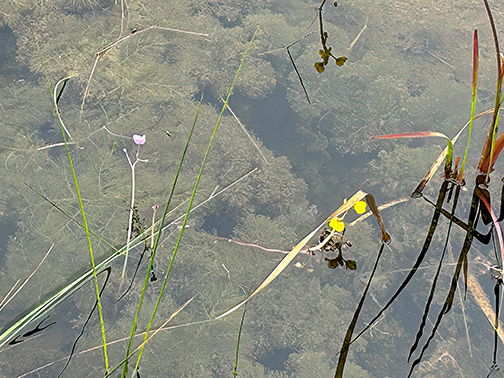
Leafy Bladderwort (Utricularia foliosa), the big brother. Flowers yellow.

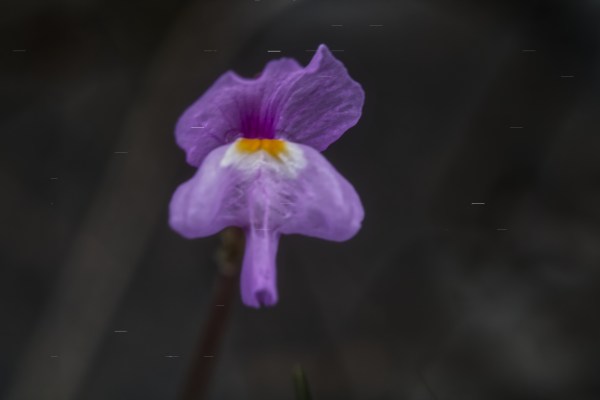
Purple Bladderwort (Utricularia purpurea), the little brother. Flowers purple.

Lentibulariaceae


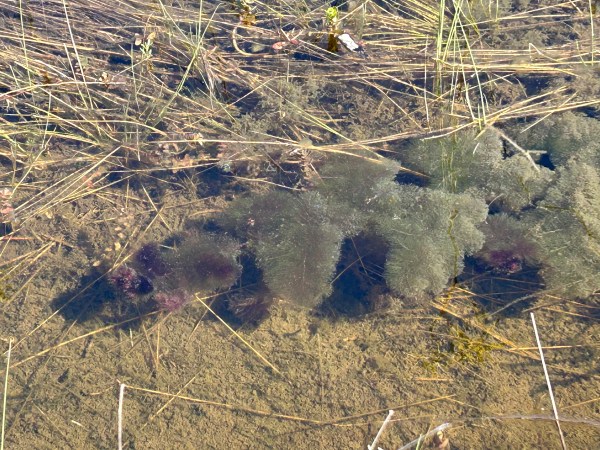
Leafy bladderwort, the clouds are the trap-bearing leaves

Same species, red at the growing tip

What gets the most attention about bladderworts is their carnivorous bladders, but that’s all over the Internet already.  Also fancy are their flowers having moveable parts, but we’ll ignore all that and look at something utterly mundane, and unexplored.  I probably need to “get a life,” but I always find it interesting when a pair of closely related species grow together, such as myrtle oak and sand live oak in a scrub, or two tillandsias on a branch, or, today, leafy bladderwort and purple bladderwort in a water-filled ditch (which I waded for a few hundred yards).   By together, think intertangled, but only in certain places.    Both can grow—elsewhere—in large quantities.  But today we’re talking about togetherness.

Hand in hand

The reason why these joint situations interest me starts with “textbook” biology which teaches simplistically that when species are too similar they can’t coexist for long,  because one theoretically outcompetes the a other.  This town ain’t big enough for the two of us!”  True to a degree, but not the whole truth.  Look at it differently…if two unrelated (or related) species share an extreme habitat they both might have similar adaptations to tolerate that harsh habitat.  You know, different desert species can both be succulent and thorny.  OK, fair enough,  maybe it is a matter of degree in part. 

So here is another part to muddy the waters.   What if the two plants sharing a habitat are  related, let’s say two species of the same genus (two oaks, or two tillandsias, or two bladderworts). Close relatives are likely to have similar needs and abilities, so maybe sharing a habitat  comes from shared DNA.  Now we have a dilemma:  if related species are too similar and living together shouldn’t that  competition problem eliminate somebody?   TOO similar may be the key.   Studies have shown that when two species of the same genus occur jointly they are often not TOO closely related.   They might be both oaks but not particularly close within the circle of oaks.    Ditto for tillandsias and bladderworts.

So with leafy bladderwort and purple bladderwort, what are the facts of the case?

1. They are both in the bladderwort genus Utricularia.   Maybe their genetic relationship helps explain how for a long distance there are none, then, pow…they pop up together.  There’s something mysterious in that shared aquatic sweetspot that “bladderworts” (plural) seem to like: correct depth?  water movement?   acidity?   Maybe one modifies conditions that then favor itself and thus the other? Who knows?  (They do.) Or maybe one arrived by bird or hog or water entangled with the other.

2.  The fact that the two species hail from different corners of the Utricularia genus fits the narrative.   Sufficiently closely related to demand the exact same point along a waterway but sufficiently unrelated to each find its own way.

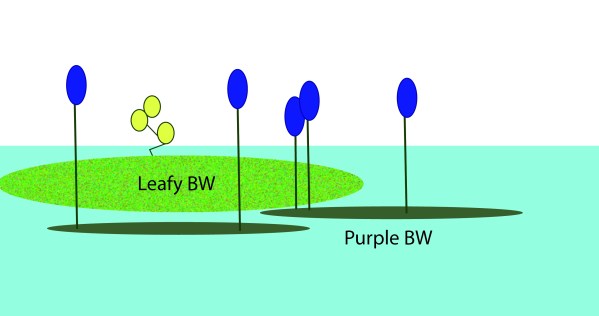
Both float and have filamentous leaves that collectively  make “poofy” clouds in the water that look like algae.  Leafy bladderwort is big and domineering,  and owns lots of  space, forming a filamentous “cloud”  in the water, overall the size of a human body or bigger.   By contrast, purple bladderwort makes a much smaller cloud with less-definite shape.    When it and leafy bladderwort go head-to-head the leafy brother grows right over the top of its purple relative.   But the “subordinate” purple bladderwort has its own little tricks.    Its flowering stalks poke up like periscopes right through the overlying leafy bladderwort.   No problem, thanks for the shade! (Thanks for the debris from above? Thanks for oxygenating the water? Thanks for removing other competitors? Thanks for attracting little victims I can trap in my bladders?)

Leafy bladderwort often tends to be a brighter green (except for red growing tips) , hinting at preference for brighter light .  By contrast, the purple bladderwort is dull-colored, not even particularly green,  and probably (though untested) tolerates deeper-darker or more turbid conditions.   It also grows “every which way,” so that it escapes the smothering leafy bladderwort, and can escape into shallower waters than its big brother.

Just another day in the marsh…

 
Leave a comment

Posted by on March 6, 2024 in Uncategorized


The Porous Pipewort and its Periphyton Partner

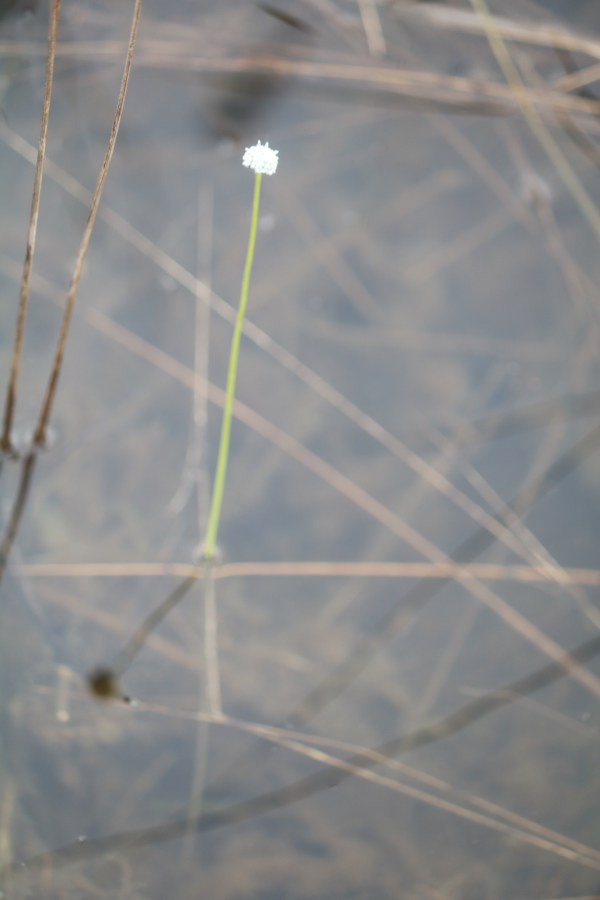
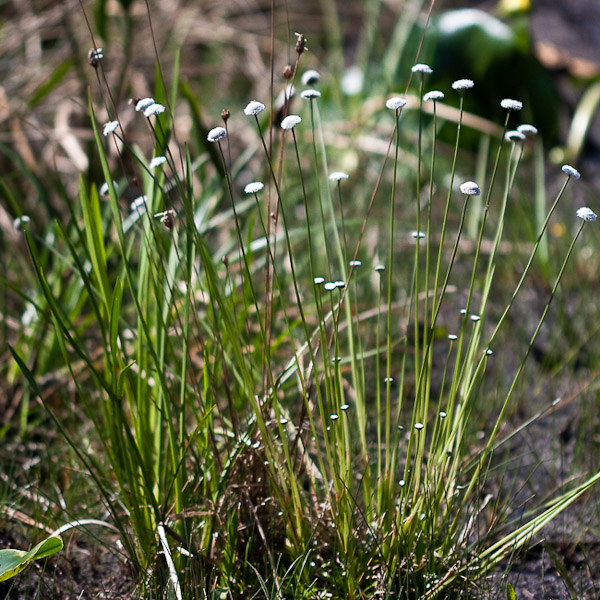
Ten-Angle Pipewort by John Bradford

South Florida seasonal depression marshescan be vast (or small) shallow basins seasonally flooded more or less a foot or so deep.  Being underwater part of the year, including now, and sun-baked dry in the spring, these flip-flop habitats are intense ecological filters where oddities survive.   Being a challenge to visit half the year, they are scarcely studied.  The animal kingdom is represented with many otters, an occasional wet feral hog, shy snipe, charming tiny fish (otter food?),  extreme ant nests, and long-distance wasps.  Speaking of otters, did you see the report of a man attacked by a rabid otter near Center St. in Jupiter back in September?  

Ten-Angle PW emersed.

Back to the plants.  Among the curiosities are two, and maybe sometimes a rare third,  species of Pipeworts, Eriocaulons.      Ten-Angle Pipewort is a large kinda-domineering clump-making species that grows with most of its spongy foliage in the air and sun above the grassy waters.   

Where the PWs grow

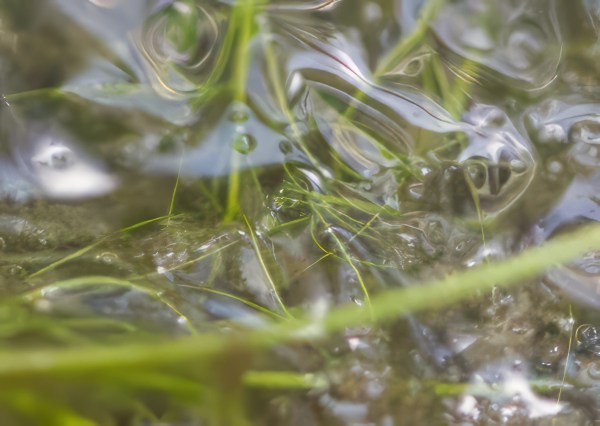
It’s funky little cousin, Flattened Pipework (E. compressum) is curiouser.   When the marsh is flooded for many months the leafy rosette, not only remains submerged, but its covering is not merely water.   The water supports a cloud of periphyton made of variable combinations of algae, blue-green “algae,” microbes,  filamentous floating bladderwort foliage,  and decaying organic debris all tangled into a stringymass.  Sometimes the cloud is essentially all a single species of algae, other times a crazy mix of things, some under a microscope shakin’ their bootys.   Studying periphyton composition, nutrient dynamics, and interactions with larger aquatic life could fill years of research, which remains overall in a primitive state, focused largely on pollution rather then overall marsh ecology.  The periphyton shades the marsh bottom, and as the water recedes becomes a green “paint” on the plants and exposed soil. Periphyton sequesters nutrients to the point of hiding phosphorus from water testing.   Some of the blue-green algae in the soup undoubtedly “fix” (capture) nitrogen.  A tangled web it weaves.  The point being that Flattened Pipewort has its submerged shaded leaves under all that, while it raises its flower stalk like a periscope.

Periscope

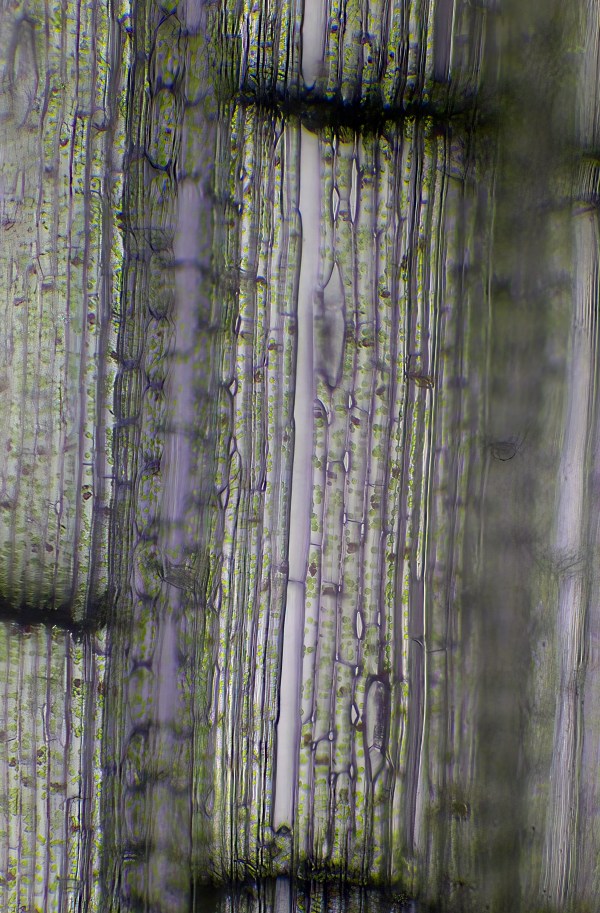
Wouldn’t it be fun now to bore you about Google-derived expertise on gas and nutrient exchange between the Pipewort and the periphyton.  That remains for future researchers with cool skills and fancy gear.    But we can peep curiously through a microscope at those submarine FPW leaves.   (When not submerged the plant can make more normal-looking leaves.)  The submerged foliage gets its main support from the water so, like many aquatic plants, the blades are delicate, thin, and translucent, especially toward in the broad basal portion.  They do have little “crossbars” visible in the photo.  Perhaps those help the leaves stay flat.  

Microscope view of submerged Flattened PW leaf. Dark bands are the “crossbars.” Note the pores.

What’s truly odd are “pores” where the leaf cell walls separate, making the blades resemble sponges.  The holes don’t fully extend to the outside. The covering must be extremely thin. The porosity would allow gas exchange among the cells all the way to their outside edges.   That’s handy in the drink where evaporation can’t pull water and nutrients through the plant, as practiced by land plants.    Water plants with filamentous leaves are sort of locked into an aquatic lifestyle (although some can make non-filamentous leaves in dry conditions).     Seems like Flattened Pipewort, by contrast, with its low  rosette passing through submerged and exposed conditions, in some habitats repeatedly,  has found a compromise.   I’ll bet as the habitat dries partially, or goes through periods of intermittent standing water and drying,  those sponge-pores close up allowing the leaves to either weather intermittent exposure, or to tide the plant over as  moisture diminishes until its “dry conditions” leaves take over. Just guessing on that though.

Flattened PW growing like a normal plant un-submerged. By JB.

 
2 Comments

Posted by on January 14, 2024 in Uncategorized