Fimbristylis cymosa (fim-BRIST-ah-lis sigh-MOSE-ah)
Cyperaceae, the sedge family
Oh phooey…here comes Hurricane Season. My old island home Barbados is about to get a swirly. In Barbados, in Florida, and around the world, how can hurricane-“grass” withstand a hurricane, not to mention all the other tortures this weirdly immortal sedge survives? Answer (I think): it is one of those wonderful plants that alters its environment to its own benefit. The fancy term is “autogenic habitat modification.” You might call it positive feedback. If a beaver builds a lodge or paper wasps build a paper home, that’s autogenic modification but no big deal—creatures have intelligence and agency. But DIY “homes” for plants are pretty nifty. Sure, any dumb ol’ tree may funnel water and debris to its base, or saw palmetto may shade out competitors, but some cases of “make your own space” are more wondrous.
Hurricane-grass may weather a twister, or thrive on lava (they do), or occupy asphalt, or dominate bare scrub sand where nothing else lives because, like other post-apocalyptic survivors, they have a bunker. We sort of.
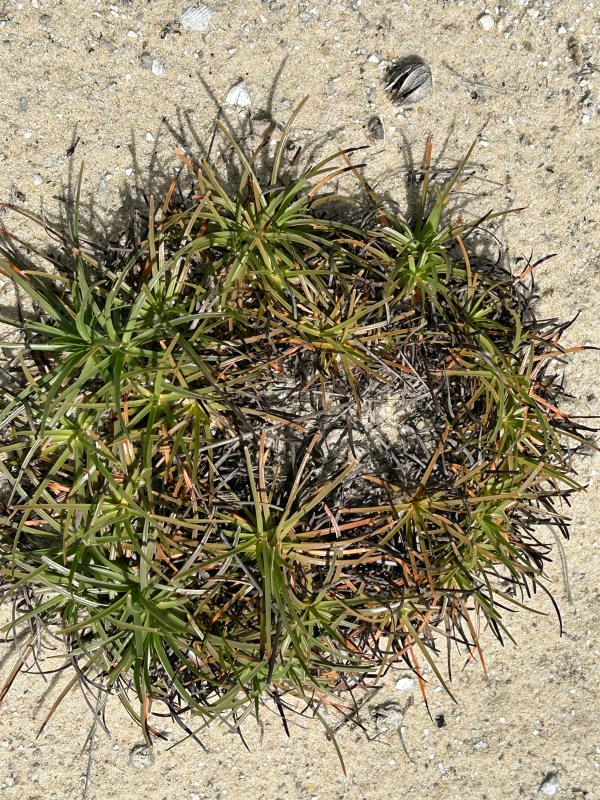
Wreath
If you’re truckin’ along and spot a Hurricane-Grass it often looks like a green wreath dropped on top of the ground, a raised ring of little green rosettes, and a black or sandy unoccupied center. Seen from above It grows outward, like a fairy ring in the lawn, leaving the enlarging hollow center behind. Viewed from the side (lie on your belly with chin to the ground – ha ha), it looks like a tiny sand dune two inches tall having green leafy rosettes on the surface.
But here’s the thing, or things. Thing 1: Each of those rosettes on top is merely the tip of the whole plant. The rosette on a trunk just like the tuft of leaves on top of a palm is on the palm’s trunk. If you pull the Hurricane-grass out of the sand it actually resembles a little palm, its sand-covered “trunk” looking at first glance like a taproot. But brush off the sand and look closely: the “taproot” is actually a stem covered with old leaf bases, like the “boots” on a cabbage palm. The weird part is that all those “trunks” are embedded in the sandy bunker. They are “buried” aboveground in congested groups. Think of a dense stand of palm trees up to its leaves in a raised sand dune. Those little stems are as protected as can be, and even better, their growing tips are not even at the exposed top, but are sunken down in the mini-dune bunker. How does the colony build up that protective sandy dunelet? Seems like sand drifting in wind (or water) catches on the exposed portions, settles, and piles up as the rosette then rises a little taller to stay exposed.
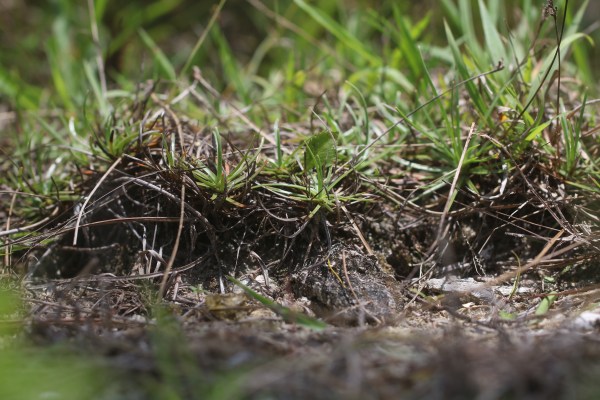
Chin on the sand view
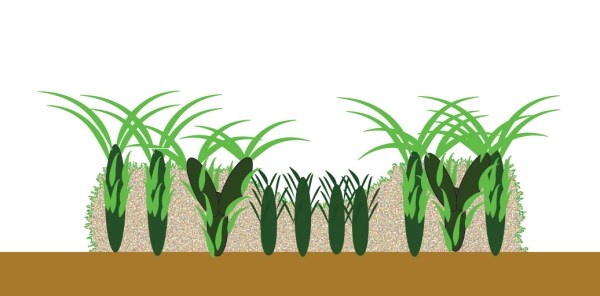
Helpful diagram of the same view. Note the mini-sand-dune, the rosettes at the top of the sand, and the branching.
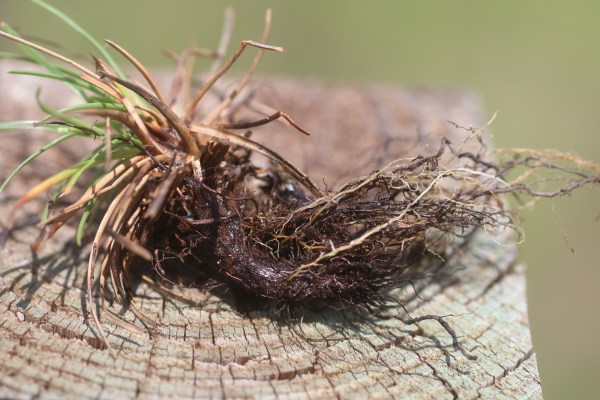
Exposed! Stem (brown, superficially resembling taproot) to front and right)
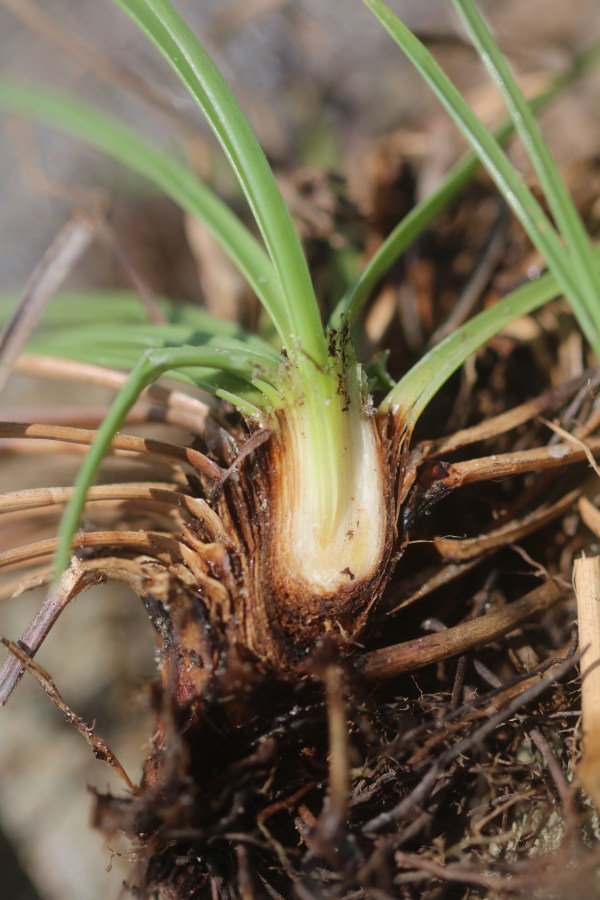
Growing tip hidden safely below exposed top.
Thing 2: How does the wreath expand? Those buried stems become increasingly crowded by branching in a Y-shaped pattern, the dead zone in the broad hole-in-the-donut probably a good water-catcher.
How many ways does the sand protect the sedge and its hidden growing tips? Who knows? Undoubtedly from sun, UV, wind, drying, abrasion, bugs, hungry hippos, unfavorable surface soils, and in its typically hellishly hot haunts, from heat. Just for fun I monitored hurricane-grass temperatures from yesterday afternoon through the night and all day today. Readings were recorded every minute for approx.1700 minutes in three positions:
Position 1. Nestled down among the hidden stems 1.5 inches below the rosettes. (Green line)
Position 2. Buried in the nearby soil 1.5 inches deep. (Brown line)
Position 3. On the exposed soil surface. (Orange line)
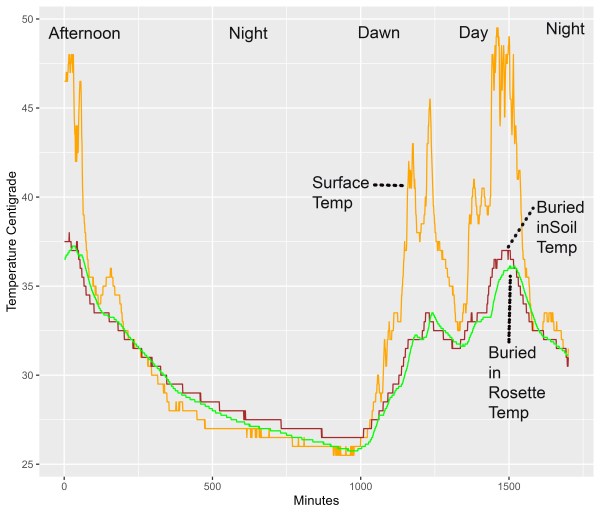
Tracking the heat for one afternoon, night, and following day. Orange = surface temperature. Green = temperature between stems 1.5 inch below rosette. Brown = buried in soil 1.5 inch.
The protection from the soil-surface temperature (orange line) was substantial, in the daytime sun cooler and more stable. The temperatures among the stems (green line) were roughly equivalent to burial in the nearby soil (brown line), although actually a little cooler. Notice that at the highest temperature you see the biggest difference between the green and brown lines. Betcha that gap broadens at even-higher temperatures.
 John Bradford
 George Rogers
 George Rogers
 Dee Staley
 Treasure Coast Natives