
Utricularia subulata
Lentibulariaceae
Several years ago I made a “Winogradsky Column” for my classroom, a tall glass vase filled with wet mud to study wetland soil bacterial growth. To my amazement the top half filled suddenly with a million thin strands resembling a plate of vermicelli, or an oversized fungus, or icky dead nematodes.
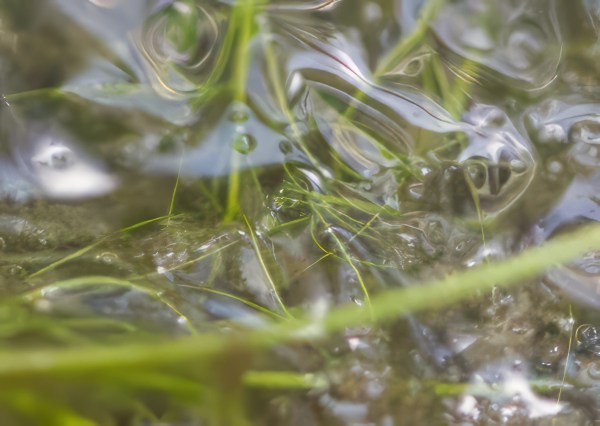
Pre-Bladderworts (the thin threads, not the thicker stems)
At first, the tangled strands were a mystery, but they soon morphed into Utricularia subulata complete with its teensie traps. Then it happened again. This spring I filled a Tupperware with wet marsh soil to grow Harper’s Beaksedge for a project. Got more than bargained for: first spaghetti, then beautiful sunshine flowers on delicate stalks rising from the mud.
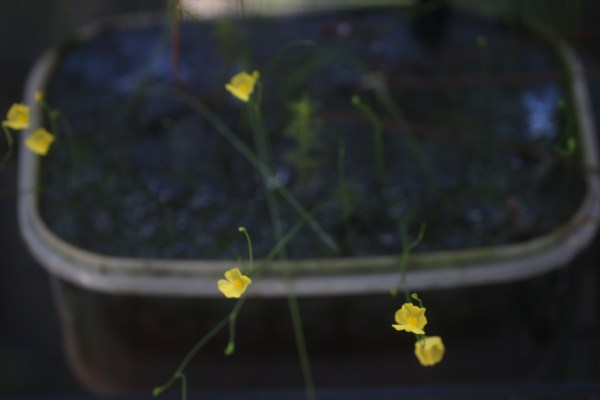
That plant has supreme reproductive power! How does it do that? Sure, seeds probably help, although a lot of utricularias are self-fertilizing, some, including U. subulata, have self-fertilizing flowers that make clonal fake seeds without opening. Even more useful when colonizing fresh marsh mud, utricularias can grow from fragments.
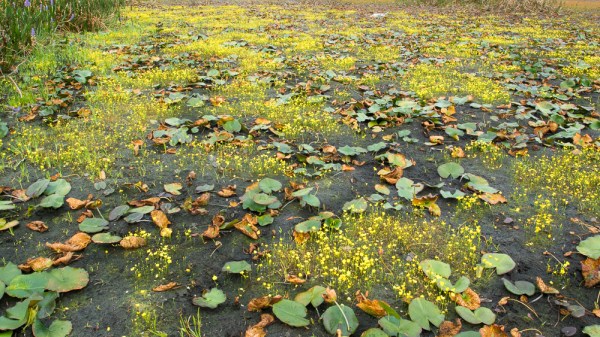
ZZBW on the march in the marsh! Are there enough pollinators for all!? Photo by ‘Soggy-Foot’ John Bradford.
Although the relative importance of this compared with seeds is unknown. Now I’m guessing for high relative importance: it seems the ZZBW can spring forth with astounding abundance and vigor to colonize marshes and Dollartree containers. My gut sez that’s from little pieces, and some other utricularias have pre-formed fragments called “turions.”)
Not only can it take over a marsh, the Napoleonic little Utricularia can take over whole continents. It thrives from New South Wales to Rio de Janeiro To extend the guess to cross oceans—birds carrying my imaginary microfrags (or seeds, or clonal pseudoseeds) from land to land and from pond to mudpuddle. To test the fragment notion, I’m going to put some pieces on wet filter paper, and on moist boiled sterilized soil. That’ll showya!
In the meantime, in 5 centuries of organized botany, a plant around the world can get discovered here, and discovered there, and discovered again some more. How’s a 19th century botanist in Lisbon to know a species discovered there was the same as one described separately in Albany? I counted (an incomplete list) of 24 different names for the same species. How did they ever do it before the Internet?
 John Bradford
 George Rogers
 George Rogers
 Dee Staley
 Treasure Coast Natives
theshrubqueen
July 20, 2024 at 3:45 pm
That is cool