Unless you’re a Smilax
Darwinian competition is rough business: frogs eat flies, snakes eat frogs, hawks et snakes, and Love Vine eats other vines in the scrub. In case you don’t know Love Vine (Cassytha filiformis), it is that yellowish spaghetti vine festooned all over other plants in scrub and additional habitats. It forms massive tangles smothering and parasitizing all beneath.
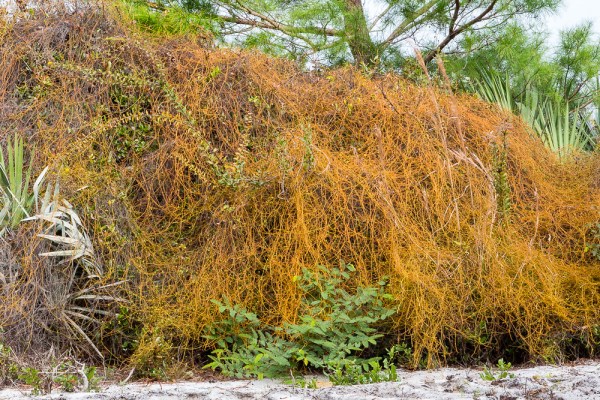
Love vine bothering its neighbors, by John Bradford
Love Vine penetrates its plant victims with little suckers called “haustoria” and sucks out sugar and water.
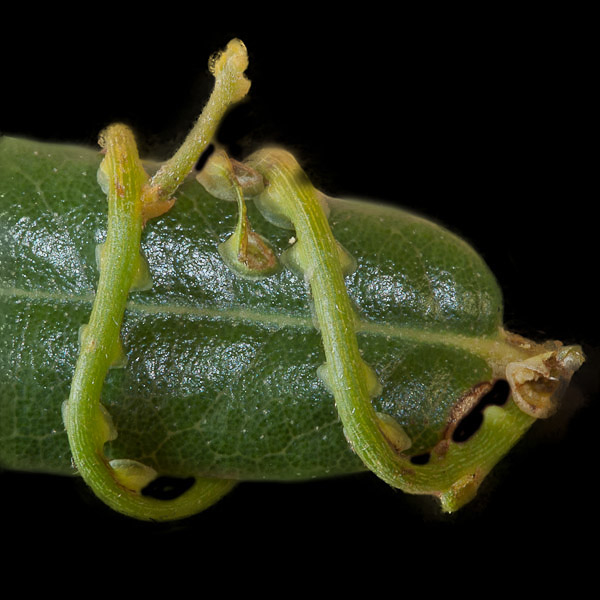
Haustoria at work, JB
Not nice, but it gets ahead in the world. Love Vine probably came here all the way from Australia, pollinating itself to make the intercontinental hopscotch easier. Tiny thrips, insects that parasitize the Love Vine, ride in a stowaway space between the fruit wall and an outer covering of fleshy birdfood. Apparently the birds help the vine AND the thrips get around. All well and good, but what interested me today is seeing in the scrub that a different vine, Earleaf Greenbrier (Smilax auriculata), not only seems immune from the Love Vine, but also uses it to rise above the tangle into the sun. The invulnerable Smilax climbs up the Love Vine unmolested, and snakes along the top of the Love Vine to enjoy an easy path above all the shade, crowding, and parasitism below.
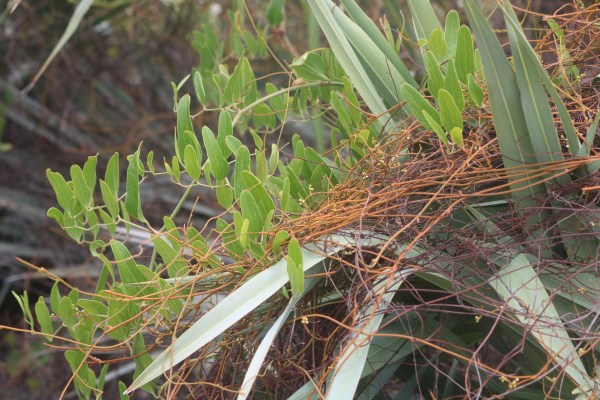
Smilax ignoring Love Vine. Can’t catch me!
It gets a little more complex. Another vine in the scrub (and elsewhere) is Muscadine Grape (Vitis rotundifolia). The grape resembles Smilax in overall habit, stem diameter (when in scrub), climbing ability, leaf size, small plain clustered unisexual flowers, and making “bunches of grapes.” Unlike Smilax, however, the grapevine falls prey to Love Vine.
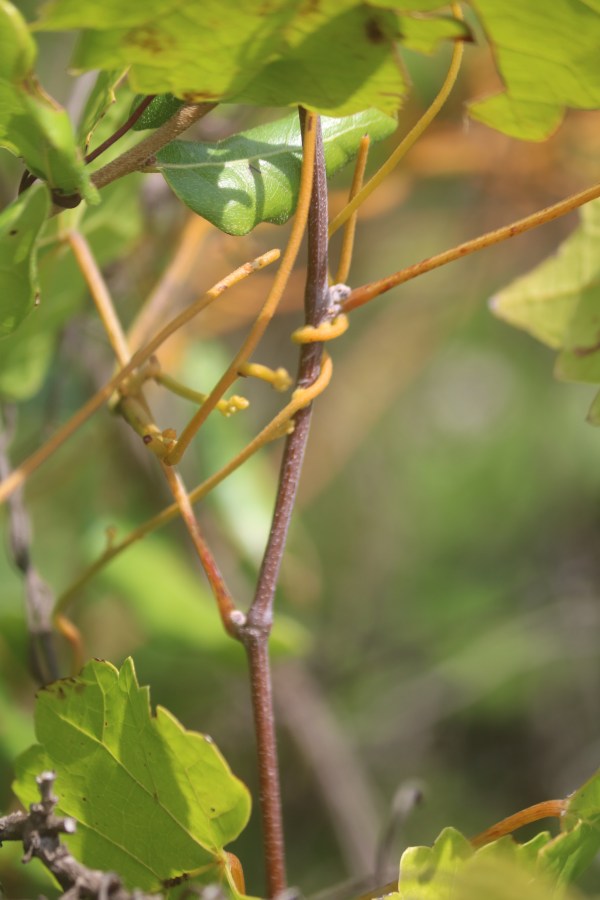
Above: Grape is not immune!
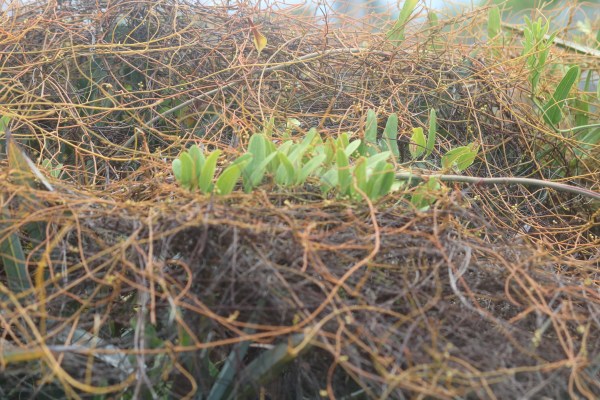
Smilax comes out on top
Why the difference? Most woody plants have their water-conducting and sugary-sap poorly protected just under the bark. Easy pickings for creepy Love Vine. But Smilax is different: its stem is built like cables within cables. (Because It is a monocot if that matters to anyone.) If you cut across the stem and look end-on, the plumbing is deep within the stem and surrounded by a hard protective sheath. No parasite is going to break into that!
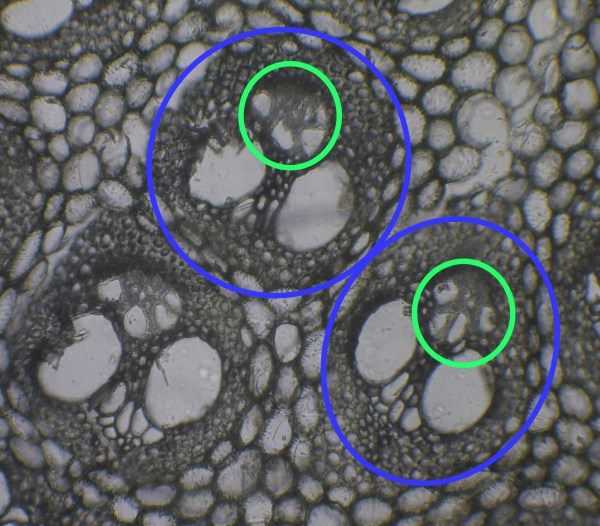
End view of Smilax stem magnified. The green circles surround the sugar pipes. The big blue rings circle the protective sheath. The large open ends within the sheaths are water pipes.
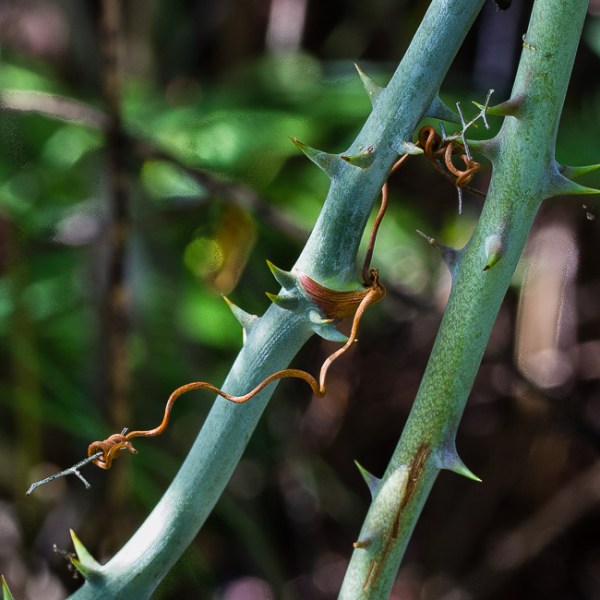
Don’t get me wrong. No suggestion here that the Smilax stem internal structure is a special adaptation to block Love Vine specifically (although it might have a lot to do with protection in a broad general sense). So do those thorns. Think of it as a chance thing…lucky Smilax winds up in a habitat with a stem structurethat just happens to offer an advantage against would-be competitors such as grape, or maybe species long-gone because of not having the “right stuff.”
 John Bradford
 George Rogers
 George Rogers
 Dee Staley
 Treasure Coast Natives