Leafy Bladderwort (Utricularia foliosa), the big brother. Flowers yellow.
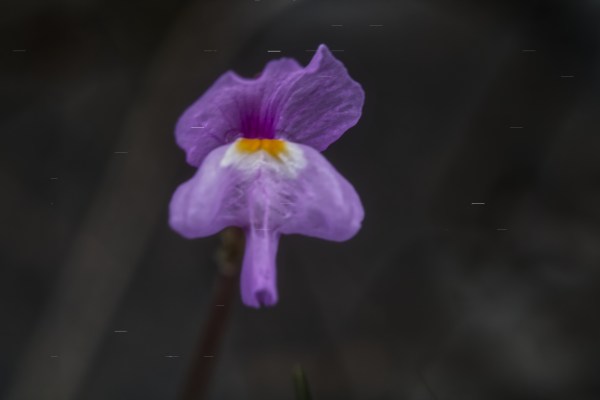
Purple Bladderwort (Utricularia purpurea), the little brother. Flowers purple.
Lentibulariaceae
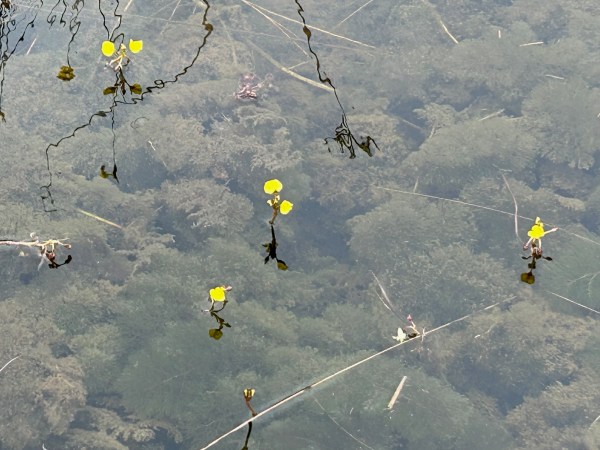
Leafy bladderwort, the clouds are the trap-bearing leaves
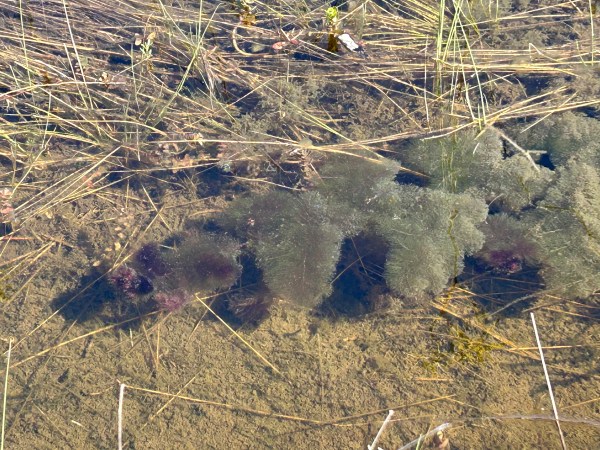
Same species, red at the growing tip
What gets the most attention about bladderworts is their carnivorous bladders, but that’s all over the Internet already. Also fancy are their flowers having moveable parts, but we’ll ignore all that and look at something utterly mundane, and unexplored. I probably need to “get a life,” but I always find it interesting when a pair of closely related species grow together, such as myrtle oak and sand live oak in a scrub, or two tillandsias on a branch, or, today, leafy bladderwort and purple bladderwort in a water-filled ditch (which I waded for a few hundred yards). By together, think intertangled, but only in certain places. Both can grow—elsewhere—in large quantities. But today we’re talking about togetherness.
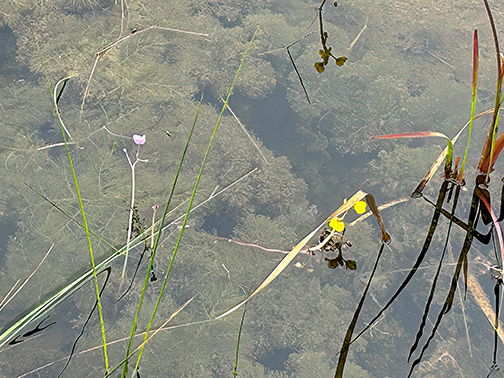
Hand in hand
The reason why these joint situations interest me starts with “textbook” biology which teaches simplistically that when species are too similar they can’t coexist for long, because one theoretically outcompetes the a other. This town ain’t big enough for the two of us!” True to a degree, but not the whole truth. Look at it differently…if two unrelated (or related) species share an extreme habitat they both might have similar adaptations to tolerate that harsh habitat. You know, different desert species can both be succulent and thorny. OK, fair enough, maybe it is a matter of degree in part.
So here is another part to muddy the waters. What if the two plants sharing a habitat are related, let’s say two species of the same genus (two oaks, or two tillandsias, or two bladderworts). Close relatives are likely to have similar needs and abilities, so maybe sharing a habitat comes from shared DNA. Now we have a dilemma: if related species are too similar and living together shouldn’t that competition problem eliminate somebody? TOO similar may be the key. Studies have shown that when two species of the same genus occur jointly they are often not TOO closely related. They might be both oaks but not particularly close within the circle of oaks. Ditto for tillandsias and bladderworts.
So with leafy bladderwort and purple bladderwort, what are the facts of the case?
1. They are both in the bladderwort genus Utricularia. Maybe their genetic relationship helps explain how for a long distance there are none, then, pow…they pop up together. There’s something mysterious in that shared aquatic sweetspot that “bladderworts” (plural) seem to like: correct depth? water movement? acidity? Maybe one modifies conditions that then favor itself and thus the other? Who knows? (They do.) Or maybe one arrived by bird or hog or water entangled with the other.
2. The fact that the two species hail from different corners of the Utricularia genus fits the narrative. Sufficiently closely related to demand the exact same point along a waterway but sufficiently unrelated to each find its own way.
Both float and have filamentous leaves that collectively make “poofy” clouds in the water that look like algae. Leafy bladderwort is big and domineering, and owns lots of space, forming a filamentous “cloud” in the water, overall the size of a human body or bigger. By contrast, purple bladderwort makes a much smaller cloud with less-definite shape. When it and leafy bladderwort go head-to-head the leafy brother grows right over the top of its purple relative. But the “subordinate” purple bladderwort has its own little tricks. Its flowering stalks poke up like periscopes right through the overlying leafy bladderwort. No problem, thanks for the shade! (Thanks for the debris from above? Thanks for oxygenating the water? Thanks for removing other competitors? Thanks for attracting little victims I can trap in my bladders?)
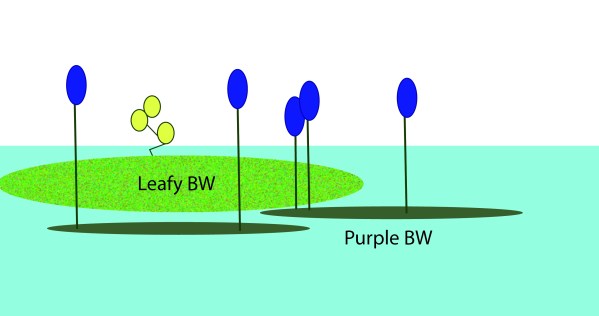
Leafy bladderwort often tends to be a brighter green (except for red growing tips) , hinting at preference for brighter light . By contrast, the purple bladderwort is dull-colored, not even particularly green, and probably (though untested) tolerates deeper-darker or more turbid conditions. It also grows “every which way,” so that it escapes the smothering leafy bladderwort, and can escape into shallower waters than its big brother.
Just another day in the marsh…
 John Bradford
 George Rogers
 George Rogers
 Dee Staley
 Treasure Coast Natives