RSS

Category Archives: Uncategorized

Noyau Vine

Merremia dissecta

Convolvulaceae

It is with extreme sadness, I must note the passing of our wonderful blog friend Mary Hart.  Some readers may recall her participation in the blog a year ago and more from Worcester in the U.K. where she had been confined to a wheelchair.   Mary was a botany student in my program during the early 90s at the University of the West Indies, Barbados, and was an avid horticulturist and naturalist, smart as a whip, a basketball fan, and a ton of fun.  She is missed. 

After some time away, John and George revisited Seabranch State Park yesterday to preview a nature walk we plan to lead there tomorrow.   Greeting visitors at the park entrance, climbing in the low scrub vegetation, is a weedy-looking morning glory vine with some history and mystery.   (Most of what I know that history comes from a 2007 article in the journal Economic Botany by the late morning glory expert Professor Dan Austin.)

Noyau literally means, “nut.” In the Caribbean context the term refers to almonds.  You guessed it. Noyau vine is almond-ish.   Not that that’s good for those who think the joy of wild plants is to eat them; essence of almond is associated with cyanide, just as in apple seeds and those laetrile apricot pits.
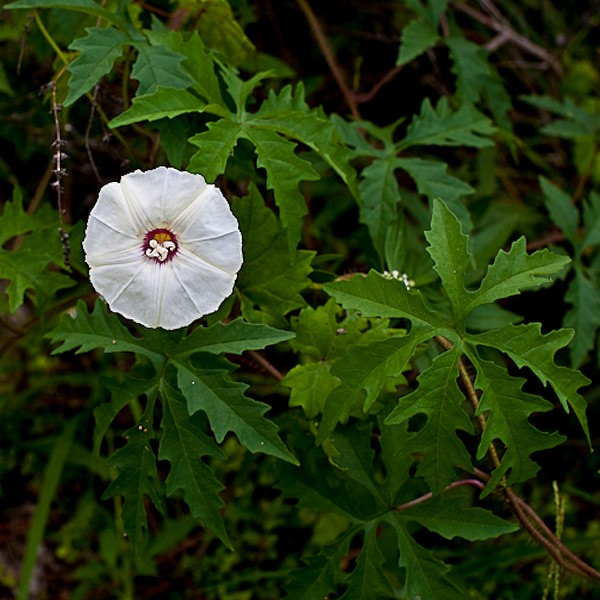
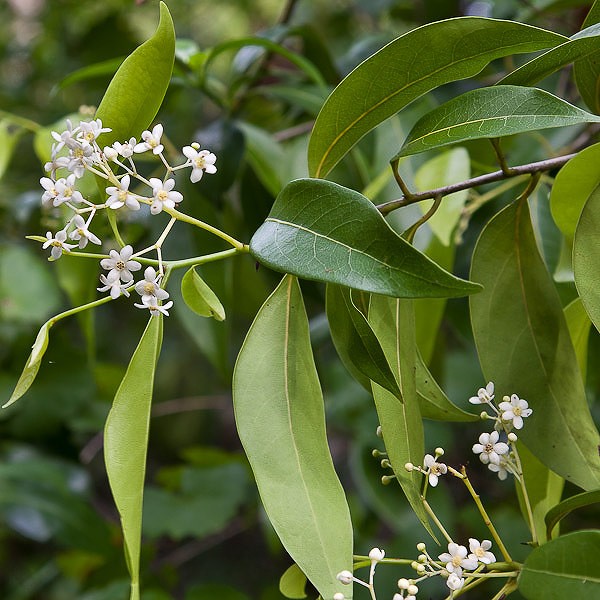
Noyau Vine (By John Bradford,  this and the next are file photos not taken yesterday)

Noyau Vine (By John Bradford, this and the next are file photos not taken yesterday)

But a little toxicity never gets in the way of plant uses; in fact poisonous-ness flags medicinal applications.  As Dr. Austin documented,  Merremia dissecta has served the variety of purposes in traditional medicines, flavoring, and even as a root food in Argentina, presumably prepared to free the entrée of cyanide.

As with so many bioactive plants, the historical medicine cabinet is boring and redundant, although ointments against skin ailments ring plausible as cyanide-based toxicity obviously may grant antibiotic powers.

What I find more interesting than the individual uses is a broader implication based on the breadth of uses:  People move useful plants around, and this creates complications in branding species as native or not native to any given region.  There are many cases perhaps where such designation should not occur, and we have before us a good example.   When you don’t know, you don’t know.
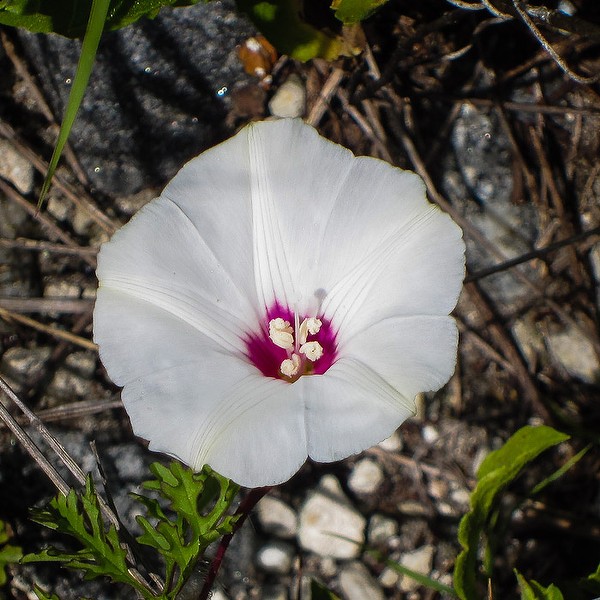
Merremia dissecta closeup

Is noyau vine a Florida native?  Look in different books and find different answers.  Should we rogue it out with malice as an abominable invasive exotic weed?  Or is the vine a native ethnobotanical treasure?   Without the possibility of certainty,  Dr. Austin tilted toward the latter, and I’m aboard on that.

Given that the species is native around the Caribbean Basin, there’s a fair chance it arrived in Florida free of human help.  To make little more interesting, of course there has been commerce around the Caribbean Basin for a very long time before Columbus spoiled the fun, although the degree of involvement of Florida in pre-Columbian Caribbean commerce is an open question.   Could it have come in a canoe or around the Gulf of Mexico from points south and west?  Sure.  We can ask the same about papayas, agaves, and more. William Bartram encountered the vine in Florida in the late 1700s.  How did it get around so early?  Non-human dispersal?  Native Americans?  Early Europeans?  A combo?

Whenever the original geographic limits,  noyau vine now with the help of people is worldwide in warm climates, and even some that aren’t so hot: Pennsylvania, Arizona, Africa where it has developed an ethnobotany of its own, and even Australia as a weed.

On tomorrow’s nature walk, we won’t eat any, but we might smash it up and see if it smells like almonds.

 
5 Comments

Posted by on March 19, 2015 in Uncategorized


Seeds of Change

Seeds of Change

Today John and George were so busy putting the finishing touches on our upcoming Native Plants MOOC (yea, it’ll be mobbed).  We didn’t take much field time, except to look at something you see every day but ponder once a decade—native woody plants coming up seemingly isolated where you don’t expect to see them.

That led to some thought on why plants wind up growing where they do.  Oh, I know the answer!   The wind, or a bird, or a bear in the woods drop a seed, and the seed grows.  Got it, but events aplenty happen between the bird ingesting the seed and a tree grows in Brooklyn.  Nature does not work in a human time and space.

For starters, that seed had to arrive from somewhere.  Maybe merely across the creek, or then again, perhaps from across the sea.  There are plenty of transoceanic examples, and the Bottle Gourd stands out.  The species has an archaeological history widespread in the Americas dating back 10,000 years and in Asia almost that long.   Botanists have debated for decades how this species could seem to be native around the ancient world so long ago.  It did not originate twice, on both sides of the Pacific.  Did very very ancient people move it thousands of miles?  One notion is that Easter Islanders took it westward to the Old World.  Another idea is that the first Native Americans brought it from Asia.  Or maybe it floated a few thousand miles.  To test the bobber theory, researchers floated some for about a year in sea water, and let them sit another six years;  the seeds sprouted like new.  Take home lesson:  seeds get around.

So then, the seeds arrived from somewhere near or far, and now they can grow.  Hold on, not so fast.  How long a delay between arrival and growth?   Maybe the season is not right this month.  Maybe conditions aren’t right this century.  How about another thousand years?  Seeds can be patient, and can await environmental cues, such as disinterrment.  In 1879 Professor William Beal at Michigan State University buried in glass jars seeds of several wild species, leaving a time capsule experiment that remains running.  The seeds are tested at intervals, and some remain willing despite attrition.  Going back farther, barley seeds from King Tut’s tomb reportedly sprouted in modern times, although the claim is disputed.

Free of dispute, Canna seeds 600 years old from an Argentinian grave spawned pretty new Cannas.  And their circumstances were weird.  The Canna seeds from the grave were inside walnuts.  Ancient biotechnicians understood how to insert Canna seeds into immature living walnuts, allowing the nuts to mature into rattles.  In 2012 30,000-year-old seeds of a Carnation relative buried (by squirrels) in Russia grew like Rip Van Winkle awakening.  That’s probably the all-time seed nap record.

Native Florida Canna.  Were its seeds 600 years old? (By John Bradford)

Native Florida Canna. Were its seeds 600 years old? (By John Bradford)

Right, so the seeds came from places unknown, then they waited patiently in the soil seed bank.  Now it is time to boogie!  The seed sprouts dutifully, and hello world!  Hello drought, hello shade, hello sun, hello frost, hello competition, hello drowning, hello bugs, hello fungi, hello hungry bunnies.  The perils facing a tender green sprout remind me of leaving home at age 18!

Obviously the conditions must be suitable—that goes without saying doesn’t it?  Probably, but even that boring observation gains interest if the seedling’s establishment requires relationships with other species.  (We’ll come back to this next week.)   It also becomes more interesting if the overall conditions are changing…oh for example, let’s say by Global Warming.  Just this year the Sunshine State figured in an eye-opening example.  In the Proceedings of the National Academy of Science, January 2014, biologist Kyle Cavanaugh and collaborators applied 28 years of satellite imagery to discern, as they say in their own title, “poleward expansion of mangroves is a threshold response to decreased frequency of extreme cold events.”   Where a mangrove might sprout has shifted in just 28 years.  That’s not my lifetime, but that of my son.

Mangrove headed north! (By John Bradford)

Mangrove headed north! (By John Bradford)

Today we looked at a lonesome Gumbo Limbo sapling with its secret history,  a single Pineland Pinweed 10 miles from any known others, and where did that baby Hercules Club come from?  A little imagination beyond “bird dropping” makes it more fun.  Maybe the guilty birds were the last flock of Carolina Parakeets in 1920.   Who can say it ain’t so?

Hercules Club (by John Bradford)

Hercules Club (by John Bradford)

 
11 Comments

Posted by on July 25, 2014 in Uncategorized


The Long Deteriorating “Fishing Ground of Presidents,” St Lucie River/Indian River Lagoon

This deserves to be distributed.

Jacqui Thurlow-Lippisch's avatarJacqui Thurlow-Lippisch

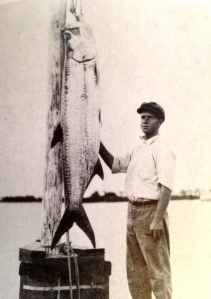
Harold R Johns, posing with a large tarpon, early 19920s, Stuart, St Lucie River. (Photo from Stuart on the St Lucie by Sandra Henderson Thurlow.) Harold R. Johns, posing with a large tarpon, early 1920s, Stuart, Florida, St Lucie River. (Photo from Stuart on the St Lucie by Sandra Henderson Thurlow.)

When the pioneers permanently opened the St Lucie Inlet in 1892, it killed the freshwater grasses that filled the waterways creating a brackish estuary that due to the convergence of tropical and temperate zones, and the nearby warmth of the Gulf Stream, became “the most diverse estuary in North America.” (Gilmore)

After a short period of time, sportfishing thrived in the area, and fishing guides called Stuart the “fishing grounds of presidents” as US president, Grover Cleveland, vacationed and fished the area in 1900 and years after.

In spite of long standing issues with the health of the estuary,  as late as the 1970/80s Dr Grant Gilmore of Harbor Branch documented over 800 species of fish living and breeding in the then healthy seagrasses around…

View original post 598 more words

 
Leave a comment

Posted by on July 14, 2014 in Uncategorized


 Plaid Shirts, Checkerboards, and Bird Food

Lancewood

Nectandra coriacea (Ocotea coriacea)

Lauraceae

Today John and George were not just taking an idle nature stroll.  We scouted images for our upcoming refurbished online course on Native Plants, visiting two neighboring hammocks near Stuart:  Twin Rivers Park and Rocky Point Hammock Park.  Species diversity makes those two small refuges living plant museums. Lancewood perfumed the air from its small white flowers asking to be today’s featured species.  Or at least to lead the parade.

Lancewood blossoms.  (Today's photos mostly by John Bradford, although some of the red and black photos below are from our older collections and who took what is forgotten.)

Lancewood blossoms. (Today’s photos mostly by John Bradford, although some of the red and black photos below are from our older collections and who took what is forgotten.)


Lancewood is a small tree or shrub in the Cinnamon Family, resembling its disease-suffering cousin Red Bay (Persea borbonia).  Red Bay leaves are grayish and usually hairy (or not) beneath instead of green and hairless, and Red Bay foliage stinks nasty when crushed as opposed to a gentle fragrance from smashed Lancewood.  Lancewood ranges from South Florida down through the Caribbean Basin.   Because I occasionally make primitive archery equipment, or used to, it interested me although perhaps not you, that prehistoric Floridians carved archery bows from the wood.  Few species are good for that.

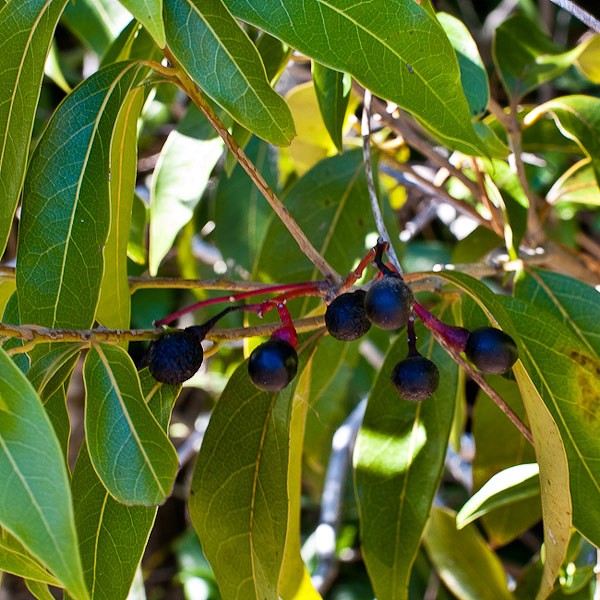
Lancewood fruits on a red "golf tee."

Lancewood fruits on a red “golf tee.”


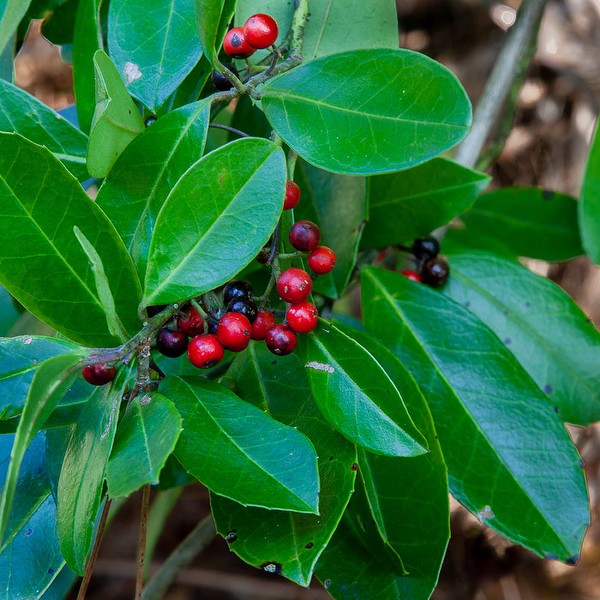
What Lancewood brought to mind today, although too early for fruits, was its blackish fruit sitting like a tiny golfball on a reddish tee.  This is one of many examples of a pervasive theme in the plant world—fruits and seeds distributed by birds often are compositions in red and black.  The colors can be on different organs depending on the species: variably on fruits, on stalks, or on seeds.  For instance, in pokeweed the berries are black fruits on red stalks.  CLICK  Flowers pollinated by birds are often red too, but this is fruit day.

The world is too full of red-black birdophilic combos to go crazy listing them.  A quick search through our dusty photo collections turned up enough examples to make the point based on local wild species.  If the search were expanded to garden species or to species in other regions we’d be at it all day.  Some pleasing Google-able examples beyond the scope of here and now include the fruits/seeds of some Clerodendrums,  Ochna, and Peonies.

Now please enjoy a little black and red:

blackredelmer


Dahoon Holly.  In many species the red-black combo comes from ripe and unripe fruits.

Dahoon Holly. In many species the red-black combo comes from ripe and unripe fruits.

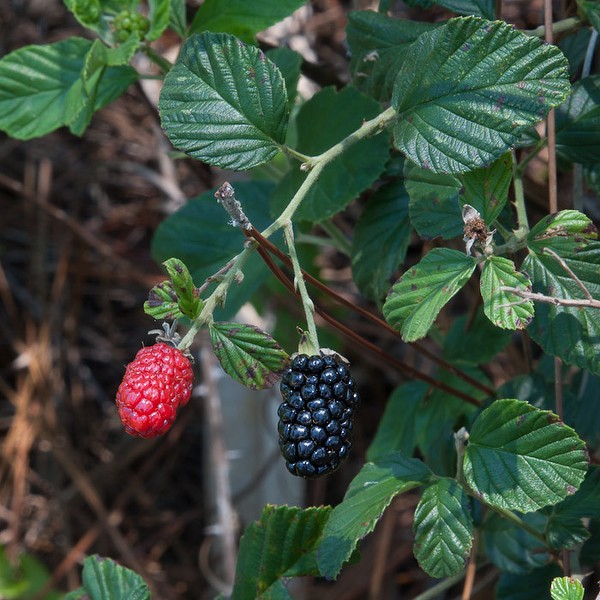
Rubus cuneifolius, unripe and ripe

Rubus cuneifolius, unripe and ripe

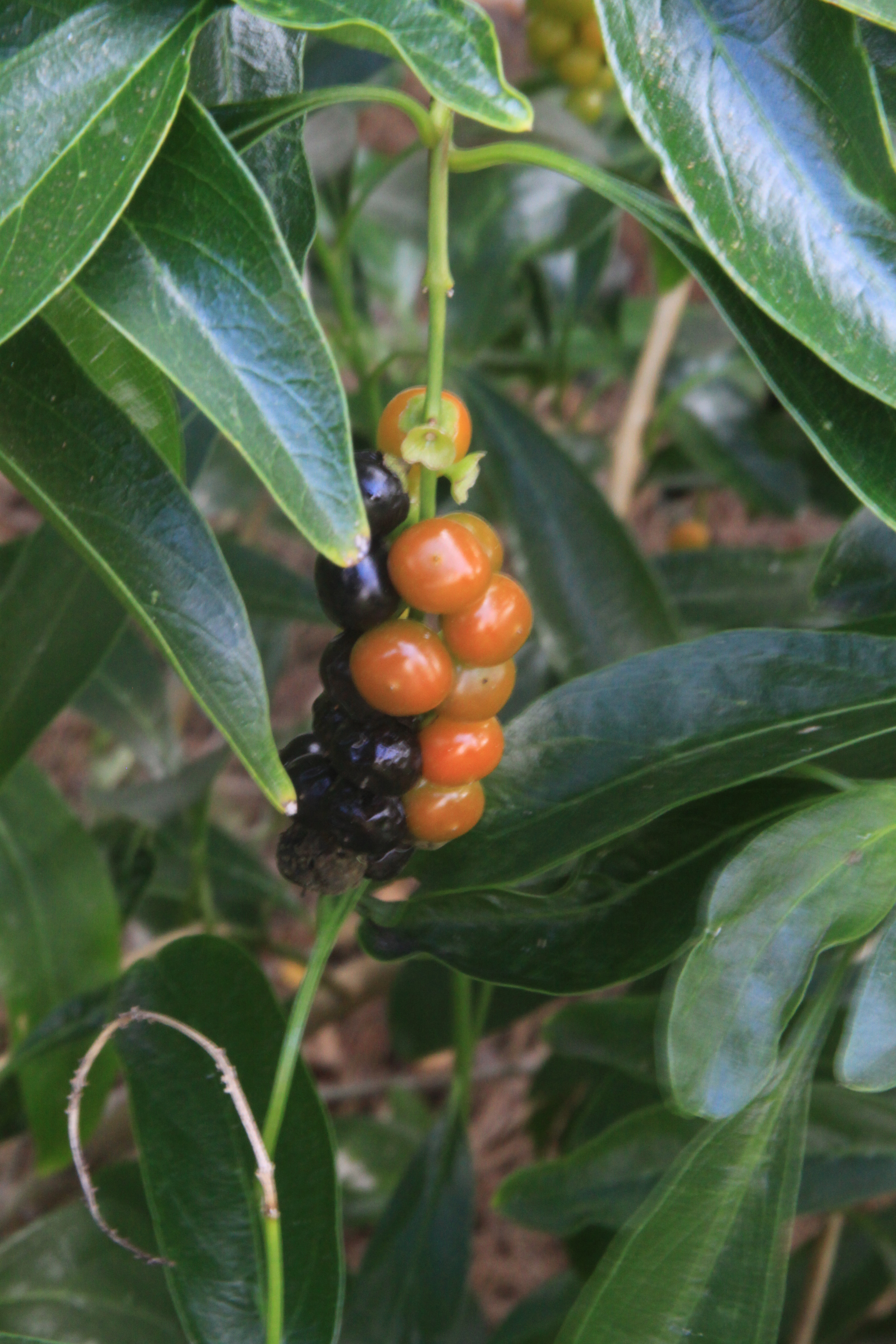
Fiddlewood mixed colors

Fiddlewood mixed colors

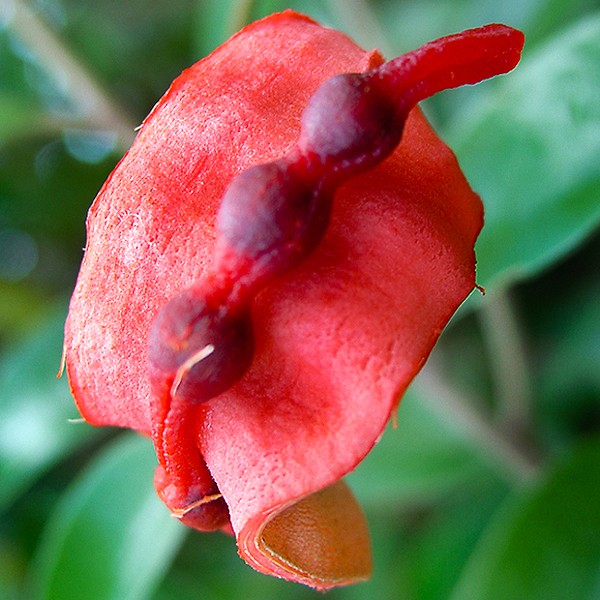
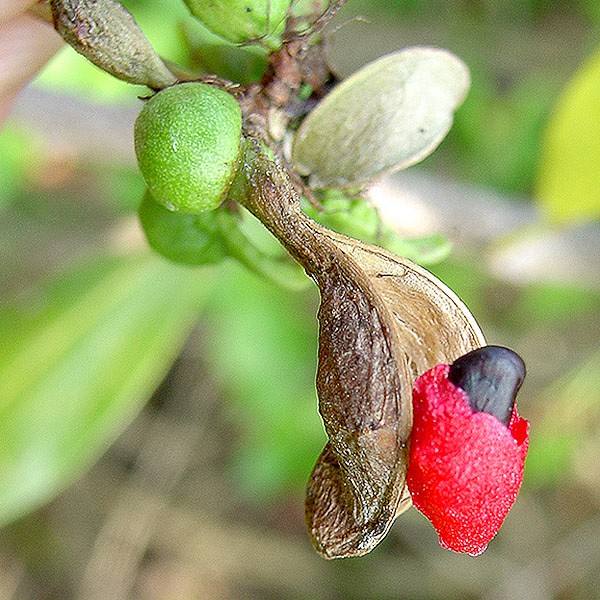
Jamaica Caper. The red inner lining of the pod is a backdrop to black seeds.

Jamaica Caper. The red inner lining of the pod is a backdrop to black seeds.

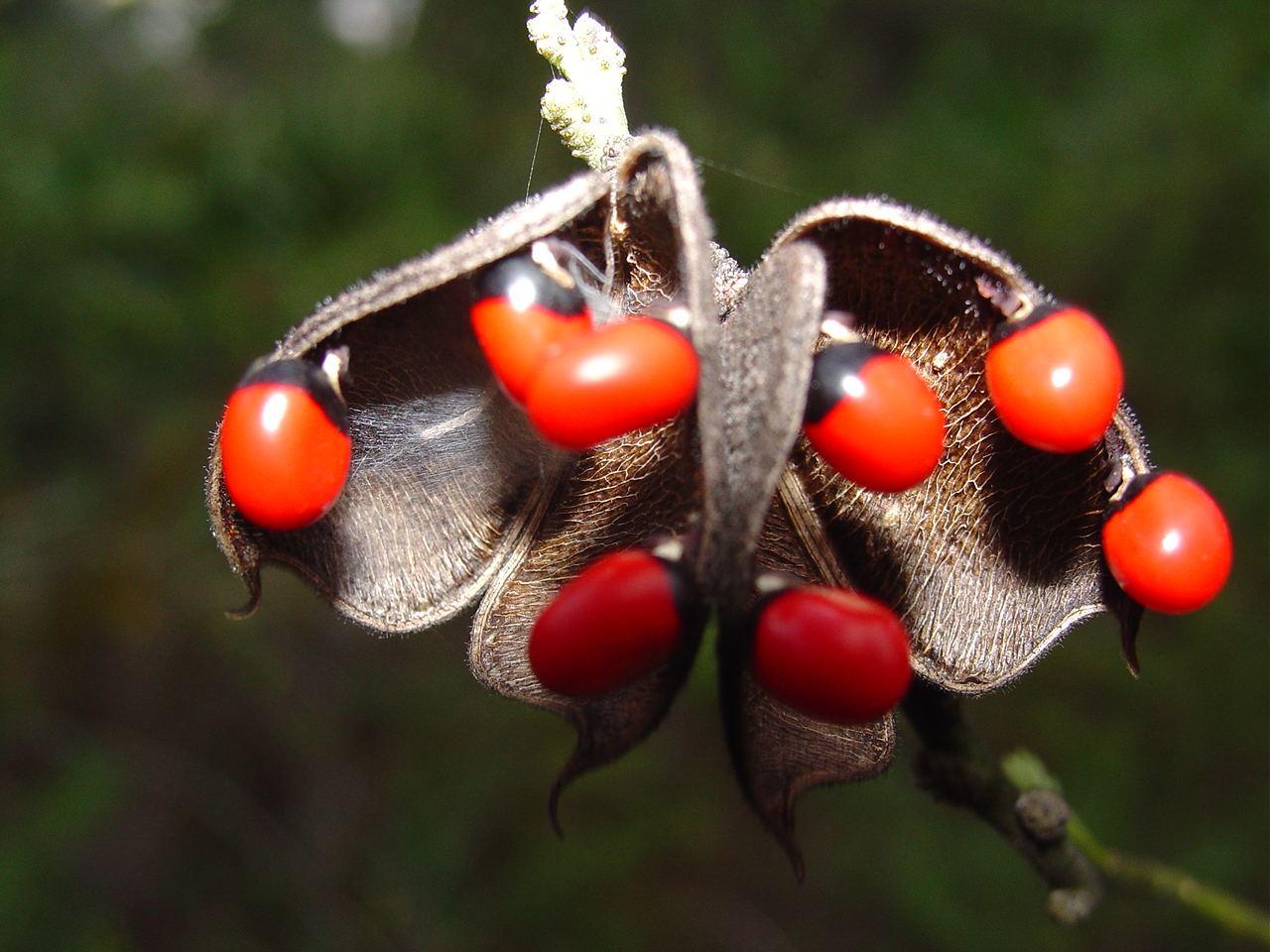
In Rosary Pea, an introduced vine, the seeds are bicolored red and black.

In Rosary Pea, an introduced vine, the seeds are bicolored red and black.


In Blackbead the seed is black with a red partial cloak (called an aril).

In Blackbead the seed is black with a red partial cloak (called an aril).


Hope you enjoyed our visit today.

Hope you enjoyed our visit today.


14 Comments

Posted by on May 30, 2014 in Lancewood, Uncategorized


Tags: , , ,

Mother Nature’s Hormone Therapy


When April’s here and meadows wide

Once more with spring’s sweet growths are pied

I close each book, drop each pursuit,

And past the brook, no longer mute,

I joyous roam the countryside.  (Jessie Redmon Fauset)


[Are there deformed frogs in the brook?]


Today’s roamed countryside was the Kiplinger Natural Area on Kanner Highway in Stuart, a bundle of habitat diversity tucked into a small package—weedy meadow, brook with baby gator, mangrove swamp, river bank, low pine woods, and marsh.   The usually modest Gallberry was having its 15 minutes of fame with millions of white flowers abuzz with happy bees.  White Pinebarren Aster (Oclemena reticulata) and Elliott’s Milkpea (Galactia elliottii) splashed more white into nature’s garden.  Rabbit Bells (Crotalaria rotundifolia) were at their yellow best, and Smilax reached out with tender new tendrils and its yellow-green “lily” blossoms.

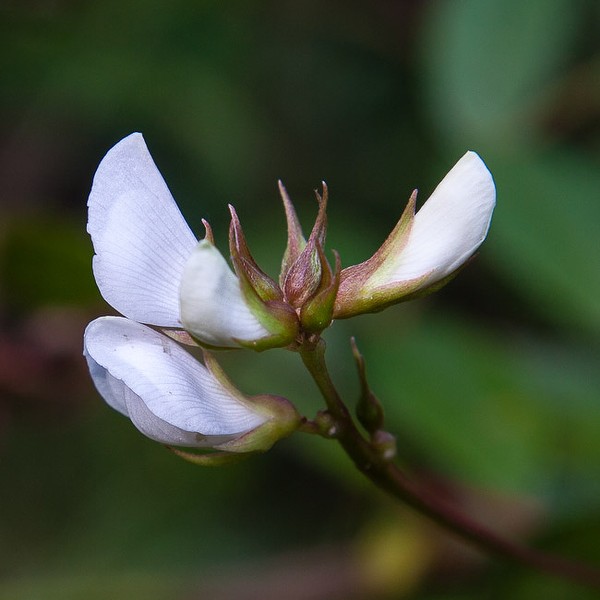
Galactia elliottii (All photos today by John Bradford)

Galactia elliottii (All photos today by John Bradford)

We’ll zoom in (again) on Smilax as an example of plants able to make compounds, phytoestrogens,  that mimic or interfere with mammalian estrogen hormones and related functions.  A lot of natural and unnatural chemicals do that. The “Silent Spring of the 90s,” increasing public awareness of environmental estrogens, was “Our Stolen Future,” 1997 by Theo Colborn and collaborators.

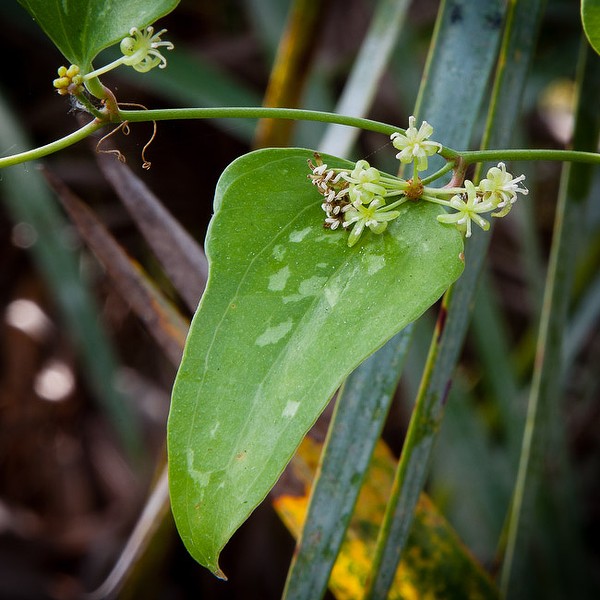
Smilax

Smilax

There are things to worry about in the estrogen endocrine-disrupting realm.

Thing 1:  Natural botanical “phytoestrogens” can impact animals, including humans for better or worse, an observation not lost on diet- and herbal-conscious writers.   When we talk of artificial estrogens, we’re not merely talking about potentially feminized males (although possible, as in the famous “teenie weenies” on Lake Apopka gators),  but also fundamental developmental disruption and cancers, especially breast cancers.  Hormonal  activity and the altered gene control of cancers are no doubt intertwined.  As two examples of dietary plant-derived phytoestrogenic booboos, A) multiple post-menopausal women have suffered uterine ailments apparently from high consumption of soy products (legumes can be high in phytoestrogens).   And B) a man developed breast cancer after six years of herbal remedies rich in phytoestrogens.

Some observers suspect that traditional plant medicines for reproductive complaints often tend to involve phytoestrogens or similar endocrine-active compounds.  After all, the first birth control pills came indirectly from yams.   And that brings us back to Smilax.

Smilax is a popular trail nibble and as a genus serves worldwide in traditional medicines including several hormonally related problems, including menstrual  complaints, perimenopausal symptoms (for which it is promoted), impotence, prostate enlargement, childbirth, and psoriasis, which has a hormonal connection.   Smilax is a much-touted source of hormonally active compounds..

(Disclaimers:  I am using the term “phytoestrogen” broadly to include compounds that mimic estrogens, or that impact directly or indirectly regulation of the mammalian estrogen-related system.  Also, Smilax has traditional non-reproductive uses too, and of course human history is loaded with attempts to alleviate reproductive ailments.)

Moving on to additional worrisome things:

Thing 2.  My colleague Maura Merkal last week shared a  report on pesticides in South Florida waters:  “Ambient Pesticide Monitoring Network:  1992-2007” (linked below).  Here is a fun fact from the report:  The chlorinated agricultural and lawn-grass herbicide Atrazine turned up at every sampling location.   Did I mention, every sampling location in our general area.   1517 detections.

Crummy, but how does it tie to Smilax?   We’re getting there.  A recent issue of the New Yorker Magazine (Feb. 10 2014)  recounted an epic battle between  University of California researcher Dr. Tyrone Hayes and the manufacturer of Atrazine.   The rub grew out of Dr. Haye’s research conclusions that a profitable herbicide is an estrogen-related source of developmental deformities in amphibians, or let’s call them canaries in the water.

To comfort ourselves we may say, sure there’s Atrazine in all the water, but optimists and vested interests claim the effects are not proven, and the concentrations are low.  (It was not “proven” that cigarettes cause lung cancer.)  There’s been a loud  “Hayes is nuts”  reaction to his research, including assertions that the results can’t be replicated and that his alarm is debunked.  But there are also independent indications that Hayes is not nuts, and there is evidence of human damage from Atrazine in the water.  It would be an understatement to call this dispute controversial.   Interested persons can conduct their own Google research on this remarkable dustup.   (Readers interested in a broad history of inconvenient research in relation to economic interests might enjoy David Michaels’s “Doubt is Their Product.”)

Thing 3.  Now let’s worry that no matter how hormonally pernicious Atrazine may or may not be, there are a lot of additional estrogen-interfering chemicals in the air and water.  Addiitonal estrogen-related compounds haunt the Ambient Pesticide study.  And even if Atrazine is in “low” concentrations now, we’re adding more and more, and what about combined effects of mixed estrogen mimics?  That brings us to worrisome thing #4.

Thing 4:  According to Our Stolen Future and other sources, hormonally-related chemicals can work in astoundingly low concentrations exponentially below what we tend to talk about in terms of toxicity thresholds, such as killing water-fleas.  (“Didn’t kill the fleas, so I guess we’re safe” does not comfort me.)   Hormones and their mimics seem to have chronic effects at levels of parts per billion, or, yikes, even parts per trillion.  But admittedly all very general and murky.

To  return to native plants, why would a natural organic plant be so crass as to make hormonally -interfering compounds?   Plants able to sabotage their herbivores’ baby-making don’t get gobbled.  Human case in point:  Cottonseed oil, containing phytoestrogens, is touted as a potential male oral contraceptive.  Turns out couples in regions heavy on dietary cottonseed oil have trouble making babies.

Are Dr. Hayes and his supporters correct?   As the detractors say, there is no “proof,”  but the fear of Dollarweed in my lawn ranks below my fear of impaired aquatic ecosystems, deformed babies, and adolescent cancers.


Notes:

Ambient Pesticide report

More on Dr. Hayes, Atrazine,  and the New  Yorker article

More on Atrazine and people:

Digest this before scarfing down herbal remedies 

Interesting blog on phytoestrogens

New  Yorker article

 
15 Comments

Posted by on April 19, 2014 in Uncategorized


What do Faculty Meetings, Lima Beans, and Elderberry Have in Common?

John and George venture out to botanize and photograph on Friday mornings.  Not yesterday, however.  George had much more fun.  The morning was spent in a faculty meeting with 80 colleagues hanging eagerly on every word of a passionate three-person debate of, “should the Health Class be a General Education course or merely required for graduation.”  About an hour in, cyanide pills came to mind.  Fortunately they were not dispensed with the leftover Christmas Cookies, and thoughts of cyanide are best channeled botanically to words on cyanide-bearing plants.  Ability to smite herbivorous foes with cyanide is scattered liberally across the plant world, from fern fiddleheads to Laetrile from apricot pits.

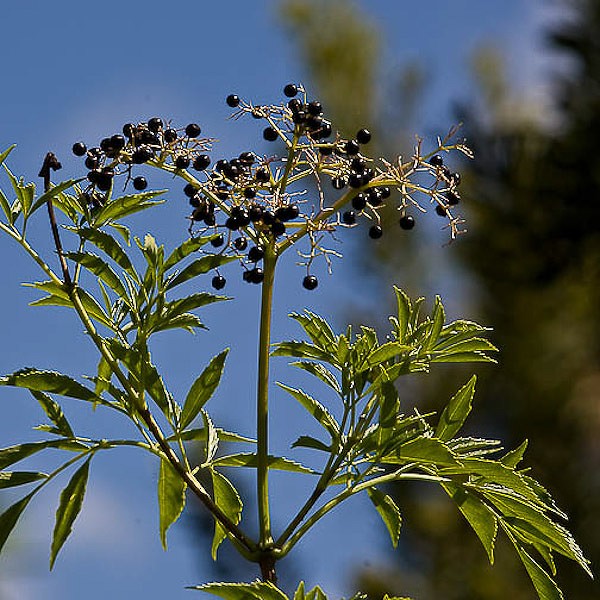
Elderberry berries.  Don't bite the seeds. (JB)

Elderberry berries. Don’t bite the seeds. (JB)

Now, pondering Health Class and cyanide together, a question comes to mind:  isn’t it unhealthy for a plant to sequester cyanide?  It’s a wicked poison to any living thing.  Cyanide stomps down basic respiratory metabolism,  so how does the plant avoid trouble?  Some plants have self-protective enzymes.  But a more interesting adaptation resembles avoiding trouble with epoxy glue…no action until key ingredients combine.    In cyanide-producing plants, the cyanide precursors are attached to sugar molecules.  They are safe until a bunny munches the leaf, allowing the precursors to encounter enzymes able to nip off the sugars and release deadly cyanide gas.  A booby trap for herbivores it is.

As with certain nations, the defense budget can become self-defeatingly costly.  That cyanide nuclear arsenal can be a burden, so cyanide-bearing species often have mixed cyanide-producing and defenseless strains.    Sweet and bitter yuca (manihot, cassava), lima beans, and almonds are culinary examples.  True also in clovers.

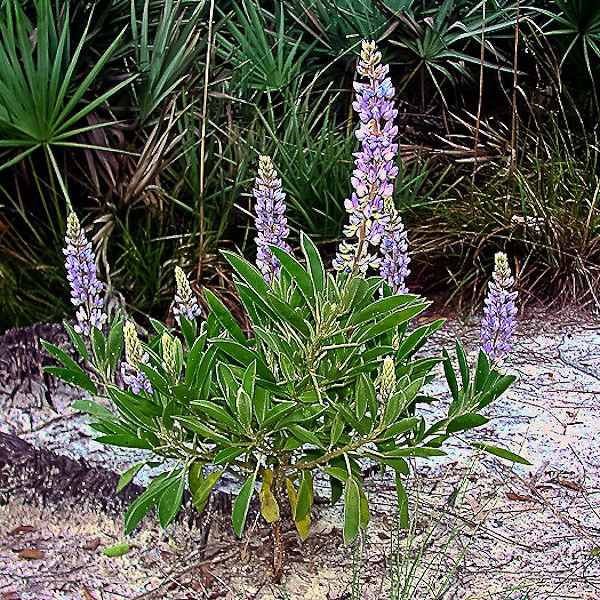
If you own a weapon, know how to shut it off!  Lupines have enzymes able to disarm cyanide (JB).

If you own a weapon, know how to shut it off! Lupines have enzymes able to disarm cyanide (JB).

Clovers and other legumes capture their own nitrogen via nitrogen-fixing bacterial companions.  Cyanide is nitrogen-intensive.  Consequently many legumes are sufficiently nitrogen-rich to invest in cyanide.  This is well studied in clovers, because they are pasture plants.  And here is a toxic twist:  frost damage allows that “epoxy glue” activation to cause clover self-poisoning.  Clovers at cooler latitudes are thus less likely to be cyanide makers than their hot-climate kin.  No doubt true also in less-studied species, including grasses.

Symbiotic relationships between grasses and nitrogen-fixing bacteria have come increasingly into focus in recent times.  Long story short:  as with legumes, grasses are turning out to be remarkably talented nitrogen-getters, and some have the cyanide to show for it.   There was a recent flurry of attention to cow-snuffing Bermuda Grass,  blamed by folks not aware of grassy cyanide on GMO-ness (the grass was not GMO).  CLICK

Bamboos can generate enough cyanide to kill a human, yet Golden Bamboo Lemurs and Pandas dine with impunity, perhaps by having enzymes able to convert cyanide to harmless amino acids?

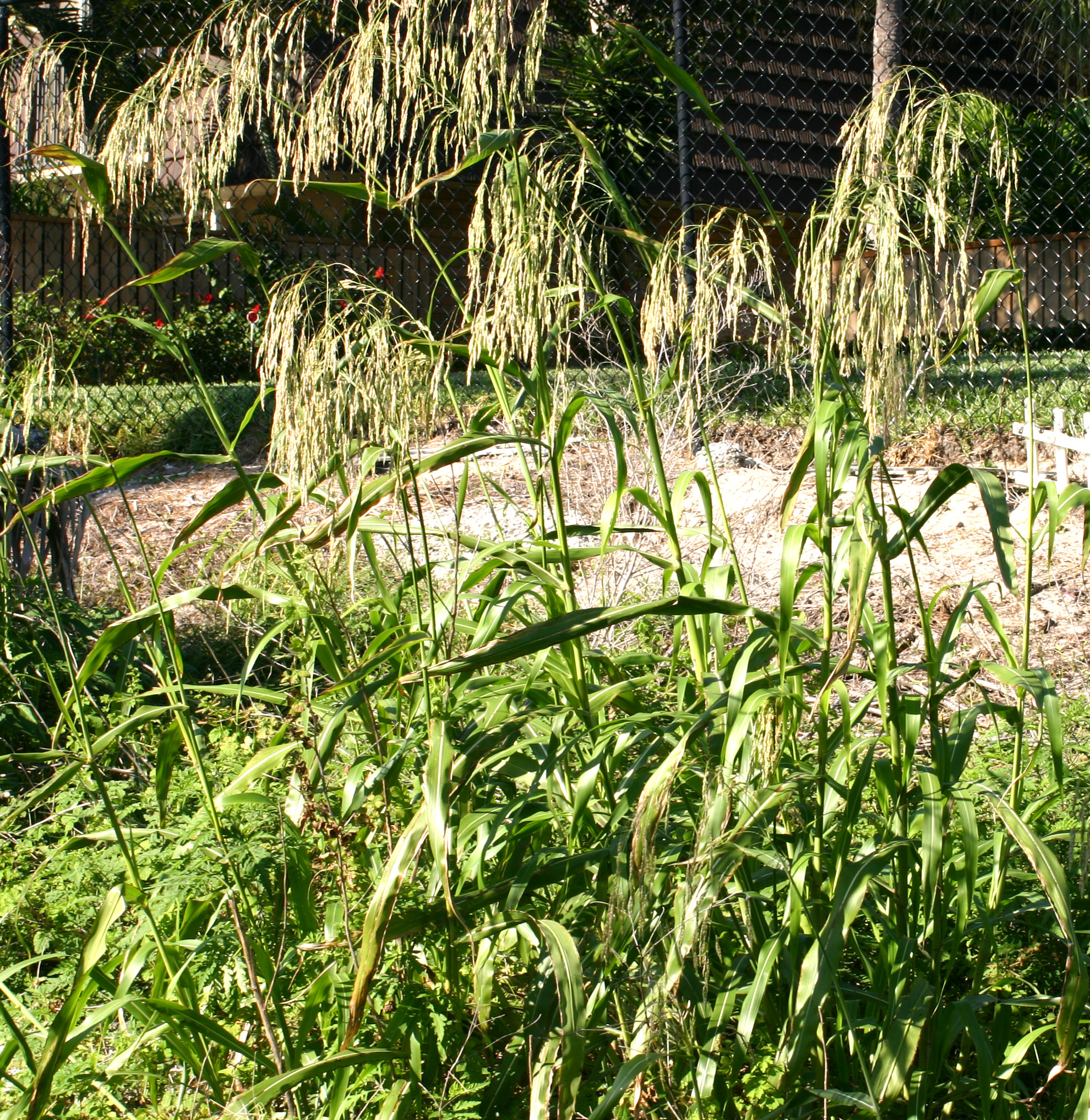
Johnson Grass (JB)

Johnson Grass (JB)

So then, what about wild cyanide in Florida?   One local example is Johnson Grass, Sorghum halpense, a large weedy wetland grass introduced into the U.S. perhaps as fodder.  It is dangerous to livestock, especially when nitrogen-fertilized, frosted, or otherwise damaged physically.

To end on a curious note, why do plant enthusiasts so often want to eat the wild plants, as though “natural” = safe?   Toxicity can work at low insidious levels, rather than simplistic “keel over and convulse.”  It would be an eye-opener to research and list every cyanide-producing species in Florida.  And watch out for those Lima Beans!

Panda-Pictures-16

 
13 Comments

Posted by on January 4, 2014 in Uncategorized


Tags: , ,

Willow Warnings and Starbucks Bees

The last-standing Cabbage Palm suffers no angst if you chainsaw the rest of the forest.  Slash Pines take their slashing without complaint.   And a Willow takes no notice of a caterpillar munching its neighbor (or does it?).

There’s a vague yet strong movement in the air these days to attribute plants with some ill-defined intelligence, feelings, or mysterious abilities, depending on whose article you read, and what you read between the lines. Pesky authors often hover around the edges of science, monitor scientific journals, and then “reveal” the more dismaying discoveries out of context in an aura of exaggerated mysticism.  Modern-day wizards.  This sort of exploitation of science has always bugged me, and a new wave is going around.  A book published this year by Michael Marder claims botany to be experiencing a “Copernican Revolution” based on “plant thinking.”   A paradigm shift!  Isn’t it fun and attention-getting to be the priest of a paradigm shift!?

You know it’s hot stuff when the New Yorker magazine (Dec. 23 this week) has an article on “The Intelligent Plant.”   Academics are getting themselves into the news with reports of corn plants communicating via root clicks, and sensitive plants learning to recognize false-alarms.

Even as authors deny it, there’s an anthropomorphic smell to the excited books, articles, and blogs.  The implications of plant sentience are precisely what make it newsworthy and exciting, despite a few “aw shucks, I’m not really saying…” The anthropomorphism is a pity, because anyone who knows anything of the birds and the bees already appreciates the beautiful complexity and fine-tuning wrought by hundreds of millions of years of plant evolution.  Plants have excited observers without paradigm shifts for centuries.

Botany is not experiencing revolution.  I think molecular biology is becoming increasingly sophisticated, revealing at ever-finer resolution marvelous complexity and interconnectedness among “lower life forms.”  Call it the increasing refinement of science, not mystical and magical “intelligence.”

That plants “do things” in response to stimulation is no big news.  Think of flowers closing by night and opening by day, or of a Bladderwort in a Florida marsh “sensing” and slurping a tiny creature into the plant’s underwater suck-trap.  A subtle plant action I’ve always liked in the Bignoniaceae Family is that after pollination the two flaplike stigmas clasp together like hands in prayer, encasing the newly arrived pollen and protecting the stigmatic surfaces.  Eerily animal-like.

“Communication” among plants is big news these days.  But really not so new at all.  It has long been known that a function of aspirin (more precisely salicylic acid) is to act as an airborne “Paul Revere” hormone—“pestilence is coming!”  The chemical alarm signal allows the plant under attack to induce defensive mechanisms (which are complex in their own right) in other blissfully complacent neighbors.  A botanical call to arms.  The growing  list of airborne plant-to-plant warning signals will enrich the plant physiology textbooks.   The scent of newly cut grass is probably loaded with bad news.

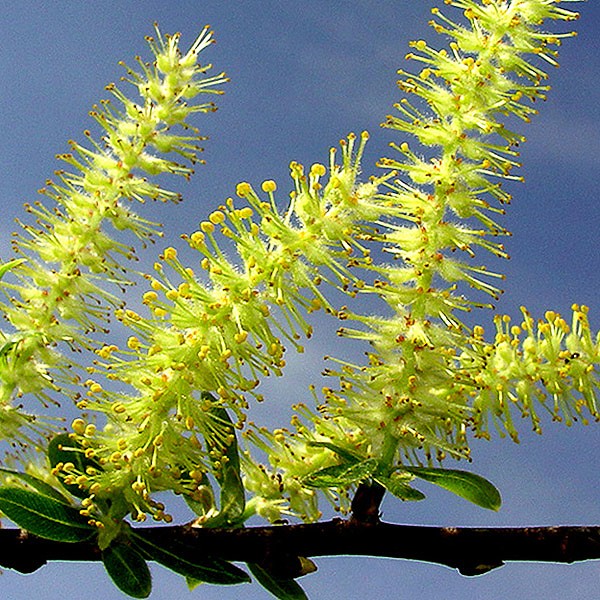
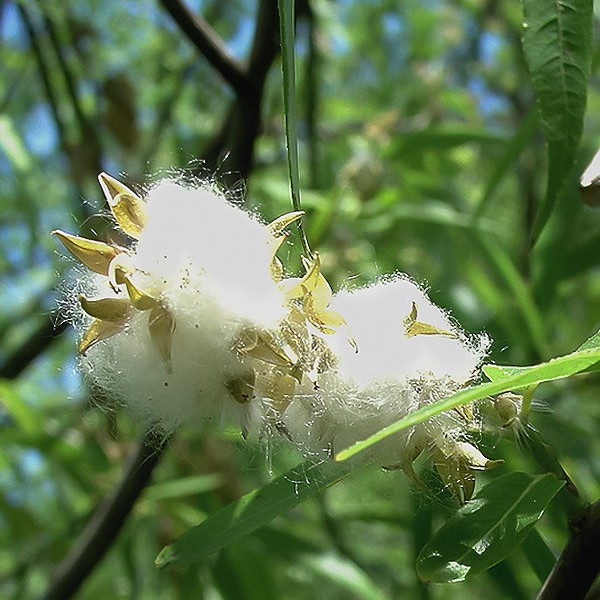
Salicylic acid is named for the Willow genus, Salix,  here portrayed in bloom by John.

Salicylic acid is named for the Willow genus, Salix, here portrayed in bloom by John.

Folks who dig “plant intelligence” a little too much tend to see such plant communication as generous and aware.  But signaling is not some sort of conscious plant-generosity, but rather probably a reflection of the well-established evolutionary principle that if you help those related to you genetically you are promoting survival of your own genes.  And if you participate in a collective defensive mechanism, such as buffalo in a circle, that protects you too.  Chemical signaling within living organisms is standard, unthinking, and well known.   Any botany student can rattle off a list of plant hormones.  Chemical signaling from animal-to-animal or insect-to-insect is commonplace.  So finding chemical signaling from plant to plant  is a wonder of nature, yet not really that surprising, and unrelated to “intelligence” by any distorted definition.

Willow fruit opening (JB)

Willow fruit opening (JB)

Speaking of plant communication, you have seen the TV commercial where the tree falling in the forest does make a sound?  “A little help here.”  Funny-right?  Forester Suzanne Simard may not think it’s all so comical.    She studies mycorrhizae, the fungal threads that extend out of roots into the soil, helping the root secure phosphorus and other nutrients.  She sees mycorrhizae not as extensions of individual trees, but as the LinkedIn of the forest tree community.  Dr. Simard sees the fungal symbionts as a shared subterranean network interlinking the trees in an internet of communication and nutrient exchange, even passing nutrients from that tree “falling in the forest” to the younger trees in need of a boost.  A “mother” tree may help sustain its progeny via fungal connections, like a mother human depositing funds in her college student son’s bank account.  There’s probably a good bit “going on down there”  in the fungal-root realm. Sorting it out will be fun for researchers to come.  Hear it straight from the source: CLICK

A remarkable article in the prestigious journal Science this Spring made the news CLICK, echoing into the popular press.  The obvious role of plant-produced drugs is as natural pesticides.  But a non-obvious role for caffeine turned up…to give the pollinating bees a buzz, as one author put it.  In Citrus flowers, caffeine in the nectar helps a bee remember the flower, and thus return for another sip of nectar, or for a cup o’ joe.

Who will discover tobacco plants addicting bird-pollinators to nicotine?

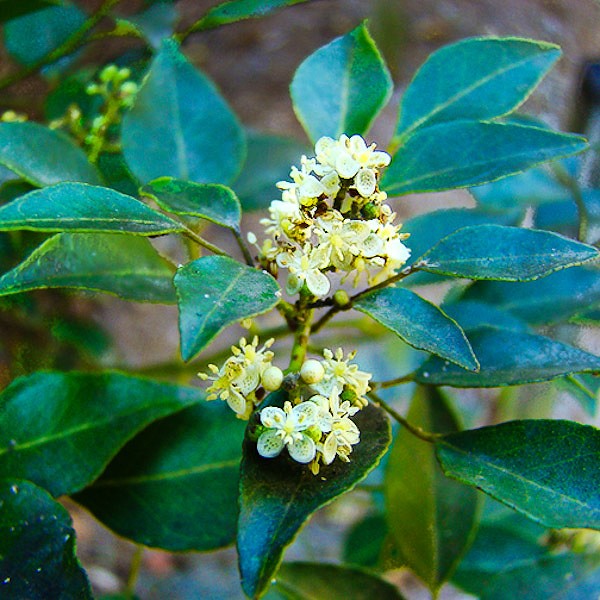
Amyris is a locally native Citrus.  Any caffeine in that sweet nectar? (JB)

Amyris is a locally native Citrus. Any caffeine in that sweet nectar? (JB)

 
11 Comments

Posted by on December 22, 2013 in Carolina Willow, Uncategorized


Tags: , , , , , ,

Doctor Doctor I Declare—I Spy Leadwort Everywhere!

Doctorbush, Leadwort

Plumbago zeylanica (P. scandens)

Plumbago

Yesterday John and George visited an unnamed coastal hammock remnant near the Hutchinson Island Nuke in St. Lucie County.  Half the site is a tangled wonderland of invasive exotic species resurrected from old illegal dumping.  Get away from the clamboring Brazilian Jasmine (Jasminum fluminense) and the Earpod Trees (Enterolobium) dropping their contorted ears, and there’s a hidden treasure chest of natural biodiversity.

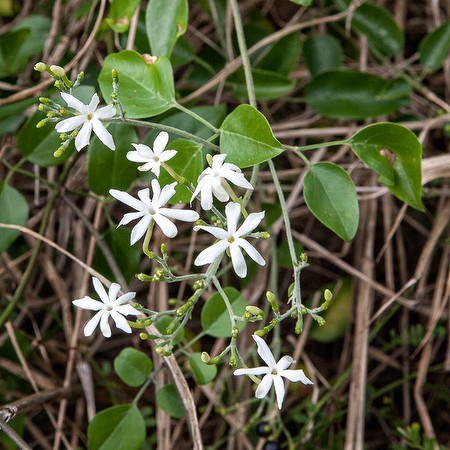
Brazilian Jasmine (invasive species, JB)

Brazilian Jasmine (invasive species, JB)

A sharp line separates the invasive tangle from relatively uninvaded hammock, including the shy understory shrub Velvetseed (Guettard elliptica) representing the Coffee Family.

Covering the forest floor—at least in areas not overrun with Sansevieria—is a mix of two medicinal alkaline-loving hammock-dwellers:  Garlicweed (Petiveria alliacea) and Doctorbush, perhaps better known as “native Plumbago” or as native Leadwort.  (The plumb in the name refers to lead, as in “plumber.”)   The pretty white flowers, shade tolerance,  and easy cultivation give Leadwort a place in native species gardens, although the usually-blue-flowered South African species Cape Leadwort (Plumbago capensis) is more familiar down at the garden club. Glands on its leaves reportedly secrete “chalk” taken up from its calcium-rich habitats.

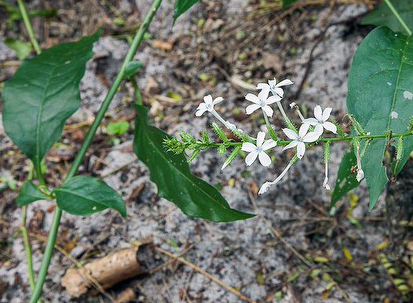
Native Plumbago (JB 12/13/13)

Native Plumbago (JB 12/13/13)

Any plant named Doctorbush better be good for something.  Its bioactive oil plumbagin irritates the skin, a promising omen for medicinal attributes!  Spanning at least 2500 years, Plumbago extracts have treated just about every discomfort known to humanity, from pimples to pregnancy.  Anyone who looks into a lot of plants finds frequent optimistic references to anti-cancer activities.   Usually a fizzle, but Plumbago has garnered far more than the usual share of modern scientifically based cancer interest, at the University of Wisconsin and far beyond.   CLICK

Plumbago zeylanica serves in Africa to welt the skin cosmetically   Long before Popeye’s anchor, Polynesian cultures were well tattooed using a diversity of coloring agents derived from sealife, from caterpillar fungus, and from plant pigments, among them Plumbago zeylanica root extracts, which give black and blue coloration.   The indigenous Hawaiian name for the plant hilie’e means, more or less, “dark dye.”  One of the many explanations of the name leadwort is lead-colored skin damage from the juice.  Anybody want a natural organic (toxic) tattoo?

Like many toxic species, Plumbago is a butterfly larval host, for species including the Cassius Blue Butterfly, which returns as a floral visitor.

Our white-flowered native species has a checkered nomenclatural past.   Are there two species, one in the New World, and a different species in the Old World?   (Plumbago scandens here and a separate P. zeylanica there?)  Or are we dealing with just one conspiracy to take over the world  that is, one broadly defined P. zeylanica.   Flora North America takes the single-species broad view, with the comment, “Plants in herbaria under these two names appear indistinguishable.”  Seems reasonable to me.

No matter how you apply names, the species (or “indistinguishable” species pair) has an enormous intercontinental distribution from New Zealand to Asia to Hawaii to Africa to South America to Florida.  How do they get around?

It probably has to do with the calyx (sepals) which persist upon maturity to encase the small fruits.  The sepals bristle with stout stalks, each capped with a sticky gland.  That is, velcro plus glue.  See Jim Conrad’s picture of the glands:  CLICK (The glue may dry as the fruits mature?)

A lot of flowers have glands at their bases, presumably to hobble thrips or other lil’ pests.  And this is probably a function for the Plumbago velcro-glands.  Yet the persistence of the gland-stalks on a calyx that continues to invest the fruit at dispersal time suggest a second function.  This plant crosses oceans and colonizes oceanic islands.  The seeds have to get there somehow.  Although Leadworts like coastal habitats, they are not strictly maritime.  In the U.S. they turn up in Arizona, in Africa on termite mounds.   Just speculating here: those velcro units look designed for snagging in plumage.  Pelagic seabirds are well known adhesive seed-carriers.  (Would they be careful about keeping a New World species separate from and Old World species?)  I found no specific data on seabirds carrying Plumbago,  so please accept Arni as a surrogate.

 
5 Comments

Posted by on December 14, 2013 in Uncategorized


Tags: , , ,

Bluethreads, Yams, and the Fungi Who Love Them

Bluethreads

Burmannia biflora

Burmanniaceae

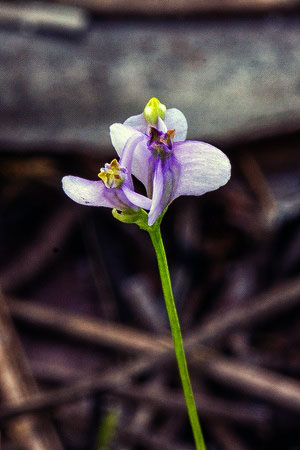
Friday John and George took a late-November look at Jonathan Dickinson State Park and came upon a remarkable species, Burmannia biflora.   The entire plant consists of one or more lilac flowers  teetering on a thread-thin unbranched green stem four inches tall.  The leaves are so tiny as to go unseen, in other words at first glance the plant is a flower on a thread so skinny it is surprising the thread can hold up the blossoms.

This link shows clearly the nearly leafless plants rising from the ground.  CLICK

Inquiring minds want to know, “how does that skinny little “leafless” waif photosynthesize enough to support itself…don’t plants need leaves for that?”

Burmannia biflora Nov. 22 (JB)

Burmannia biflora Nov. 22 (JB)

Some plants derive some or essentially all of their nutrition from sources other than photosynthesis supported by root-absorbed minerals.  Some species are parasitic on other plants.  Others are carnivorous, although these obtain mainly nitrogen from their “meat” so still must photosynthesize.  Most plants have symbiotic relationships with underground fungi, getting some of their mineral “fertilizer nutrients” from their fungal associates.  And now to get to the point, a few plants take the fungal relationship even further and derive so much substantive nutrition from symbiotic fungal partners that their photosynthetic needs and capacity dwindle, and sometimes disappear altogether.   They become saprophytic by symbiosis, flowering-plant pseudo-fungi.

The Burmannia Family is known for that.  You might see the family as an assortment of mostly (or all?) fungally nourished species, some with merely partial photosynthetic ability and others 100% on fungal life-support.  They become nutritional extensions of their fungal partners.

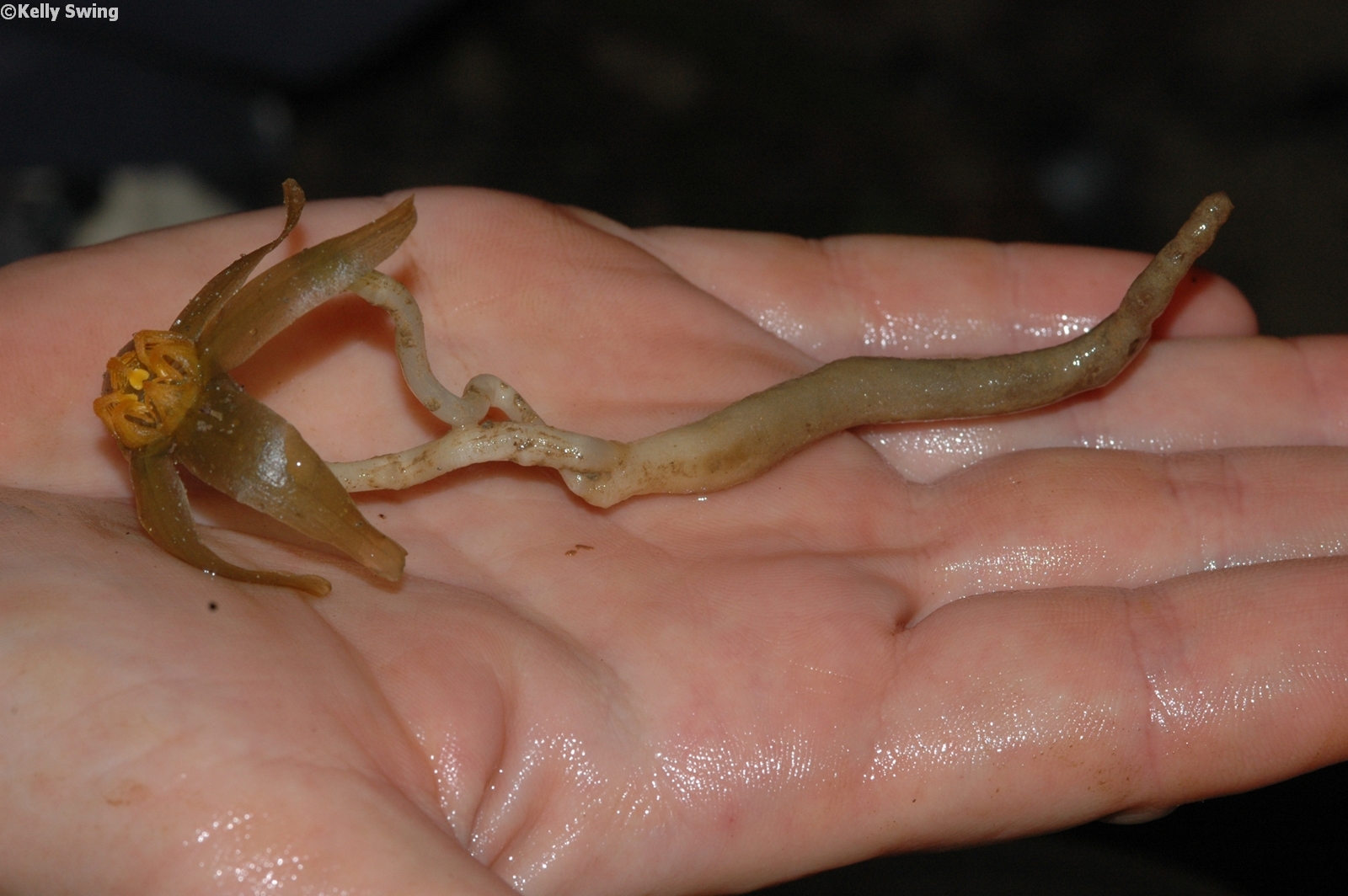
The Ecuadorian species shown below, Tiputinia foetida, unknown until 2005, is obviously completely non-photosynthetic.  There are many additional examples in the Burmannia Family.

Tiputinia by K. Swing.  This is the entire (non-green!) plant behaving like a fungus.

Tiputinia by K. Swing. This is the entire (non-green!) plant behaving like a fungus.

The nutritional relationships of our local Burmannia biflora are, to my incomplete (!) knowledge, not well known and would make a fascinating study.  The plants have some photosynthetic ability, apparently supplemented by a fungal support staff.  The roots are thick, shallow, sparse, and coarsely branched, probably a reflection of fungal symbiosis.  (Look at the root on Tiputinia above.)

In some or all members of the Burmannia Family the roots lack the internal layer known as the endodermis characteristic of “normal” roots with normal nutrient uptake by absorption.  Apparently Burmanniaceae roots don’t absorb in the conventional fashion.

Another oddity of some Burmanniaceae species is a spongy sheath called a velamen, much better known as a feature of the Orchid Family.  Burmannia and its relatives were once erroneously thought to be kin to Orchids.  DNA shows them to be more closely related to yams.  But who needs DNA for evidence?  Compare the wings on the flower bases of Johns’s Burmannia photo above to the similar winged flower bases on many yams, including our own weedy Winged Yam.

Winged Yam, note how similar the winged flowers are to the winged flowers of Burmannia. (By onlyfoods.net)

Winged Yam, note how similar the winged flowers are to the winged flowers of Burmannia. (By onlyfoods.net)

 
5 Comments

Posted by on November 24, 2013 in Bluethreads, Uncategorized


Tags:

Nature Deficit Disaster

Nature-bugs like me avidly bemoan nature-deficit-disorder, the concept that today’s children grow up in a nature vacuum sucked dry by video games, sterile air conditioned gated communities, and overly structured  upbringings.  

All true of course, but thinking back to my own childhood in industrial Wheeling, West Virginia followed by Detroit, I don’t recall childhood companions terrifically fascinated with spiders and warblers.    I do recall adult concerns about kids getting too soft and indoorsy, but then again in my recent readings of 1920s nature writings,  they worried back then too about the kids losing their grip on nature.    That worry must go back all the way to the transition from a land of farmers to the Industrial Revolution, and I kinda suspect 19th Century farm kids were more interested in the attractions of the big city than in wildflowers and butterflies.  The hippies talked about “back to nature” in the 60s, but that was mostly some silly affectation with no substance.  Were the ancient Romans interested in nature?

But even if it is long-standing human nature to ignore Mother Nature, things seem extra screwy to me when I teach a botany class with students afraid to touch a flower because it might house a bug.   When the Boy Scouts seem more concerned with silly exclusive policies than in bringing kids outside.   When lightning bugs and salamanders decline and nobody notices.   When “outdoor activity” becomes golf and soccer.   When fishing became more expensive than leisurely.  When to see butterflies I go to “Butterfly World.”  And when a college can’t teach ecology without flying everyone to Costa Rica.

Something has even happened to gardening.    Forever, hasn’t gardening been more about beauty, flowers, soil, fresh air, exercise, wind, and worms?   A personal experience, or a family experience, often multigenerational.   It was for everybody.  So when did gardening become “landscaping”?  When did ostentation loom large?  When did ego creep in?  Who in the world ever thought there’d be “garden celebrities.”  Oh come on!   Let’s dig the dirt and plant some flowers.

I don’t think it is as simple as, “when I was a kid we played outside in the hills and meadows, and now we don’t.”   (Although that may often be quite true.)    What worries me more is a slightly different shift in values, a lost ability to enjoy basic simple pleasures, nature or whatever it may be.   Life has gotten so fast, so specialized, so complex, so competitive, and so driven by some sort of new values coming at us electronically.

Enviornmentalists are fond of explaining attitudes about nature in terms of World View.   Seems to me that collectively our big World View has homogenized around an unnatural core through the electronic media bath in which we live:  giant TVs, WWW,  cable news 24/7,  pundits, gurus,  satellite radio, political polarization,  stock reports,  sports fixation.   Reminds me of my college days ca. 1970 when Marshall McLuhan with the “medium is the message” was hot classroom fodder.    I just looked him up on Wikipedia and found a comment that seems to say so much:  “Key to McLuhan’s argument is the idea that technology has no per se moral bent—it is a tool that profoundly shapes an individual’s and, by extension, a society’s self-conception and realization.”

It isn’t that our “self-conception and realization” is anti-nature, but rather merely a narcissistic cyber-world ever-evolving away from the small tangible pleasures, individual pursuits, and the values they engender.    Even our conversational social lives meld into Facebook, texting, and Twitter.  Celebrities tell us what to value.   Nature is not in the back yard—it is on the Discovery Channel.

And here I sit on a beautiful Florida summer afternoon with my face buried in a laptop computer.

 
7 Comments

Posted by on July 10, 2013 in Uncategorized