RSS

Category Archives: Uncategorized

Doctor Doctor I Declare—I Spy Leadwort Everywhere!

Doctorbush, Leadwort

Plumbago zeylanica (P. scandens)

Plumbago

Yesterday John and George visited an unnamed coastal hammock remnant near the Hutchinson Island Nuke in St. Lucie County.  Half the site is a tangled wonderland of invasive exotic species resurrected from old illegal dumping.  Get away from the clamboring Brazilian Jasmine (Jasminum fluminense) and the Earpod Trees (Enterolobium) dropping their contorted ears, and there’s a hidden treasure chest of natural biodiversity.
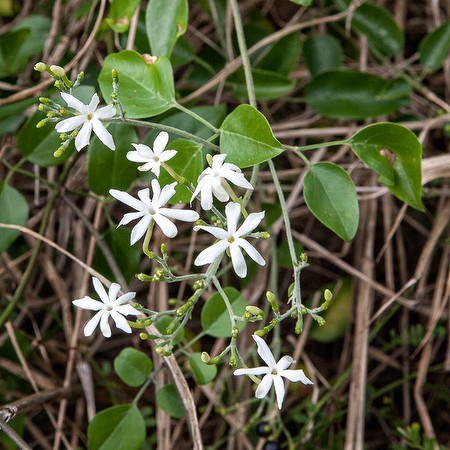
Brazilian Jasmine (invasive species, JB)

Brazilian Jasmine (invasive species, JB)

A sharp line separates the invasive tangle from relatively uninvaded hammock, including the shy understory shrub Velvetseed (Guettard elliptica) representing the Coffee Family.

Covering the forest floor—at least in areas not overrun with Sansevieria—is a mix of two medicinal alkaline-loving hammock-dwellers:  Garlicweed (Petiveria alliacea) and Doctorbush, perhaps better known as “native Plumbago” or as native Leadwort.  (The plumb in the name refers to lead, as in “plumber.”)   The pretty white flowers, shade tolerance,  and easy cultivation give Leadwort a place in native species gardens, although the usually-blue-flowered South African species Cape Leadwort (Plumbago capensis) is more familiar down at the garden club. Glands on its leaves reportedly secrete “chalk” taken up from its calcium-rich habitats.
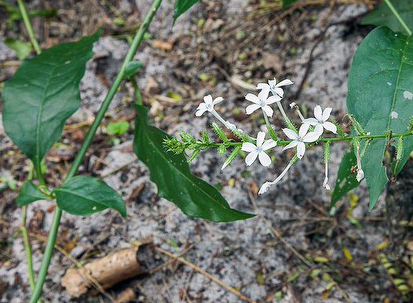
Native Plumbago (JB 12/13/13)

Native Plumbago (JB 12/13/13)

Any plant named Doctorbush better be good for something.  Its bioactive oil plumbagin irritates the skin, a promising omen for medicinal attributes!  Spanning at least 2500 years, Plumbago extracts have treated just about every discomfort known to humanity, from pimples to pregnancy.  Anyone who looks into a lot of plants finds frequent optimistic references to anti-cancer activities.   Usually a fizzle, but Plumbago has garnered far more than the usual share of modern scientifically based cancer interest, at the University of Wisconsin and far beyond.   CLICK

Plumbago zeylanica serves in Africa to welt the skin cosmetically   Long before Popeye’s anchor, Polynesian cultures were well tattooed using a diversity of coloring agents derived from sealife, from caterpillar fungus, and from plant pigments, among them Plumbago zeylanica root extracts, which give black and blue coloration.   The indigenous Hawaiian name for the plant hilie’e means, more or less, “dark dye.”  One of the many explanations of the name leadwort is lead-colored skin damage from the juice.  Anybody want a natural organic (toxic) tattoo?

Like many toxic species, Plumbago is a butterfly larval host, for species including the Cassius Blue Butterfly, which returns as a floral visitor.

Our white-flowered native species has a checkered nomenclatural past.   Are there two species, one in the New World, and a different species in the Old World?   (Plumbago scandens here and a separate P. zeylanica there?)  Or are we dealing with just one conspiracy to take over the world  that is, one broadly defined P. zeylanica.   Flora North America takes the single-species broad view, with the comment, “Plants in herbaria under these two names appear indistinguishable.”  Seems reasonable to me.

No matter how you apply names, the species (or “indistinguishable” species pair) has an enormous intercontinental distribution from New Zealand to Asia to Hawaii to Africa to South America to Florida.  How do they get around?

It probably has to do with the calyx (sepals) which persist upon maturity to encase the small fruits.  The sepals bristle with stout stalks, each capped with a sticky gland.  That is, velcro plus glue.  See Jim Conrad’s picture of the glands:  CLICK (The glue may dry as the fruits mature?)

A lot of flowers have glands at their bases, presumably to hobble thrips or other lil’ pests.  And this is probably a function for the Plumbago velcro-glands.  Yet the persistence of the gland-stalks on a calyx that continues to invest the fruit at dispersal time suggest a second function.  This plant crosses oceans and colonizes oceanic islands.  The seeds have to get there somehow.  Although Leadworts like coastal habitats, they are not strictly maritime.  In the U.S. they turn up in Arizona, in Africa on termite mounds.   Just speculating here: those velcro units look designed for snagging in plumage.  Pelagic seabirds are well known adhesive seed-carriers.  (Would they be careful about keeping a New World species separate from and Old World species?)  I found no specific data on seabirds carrying Plumbago,  so please accept Arni as a surrogate.
 
5 Comments

Posted by on December 14, 2013 in Uncategorized


Tags: , , ,

Bluethreads, Yams, and the Fungi Who Love Them

Bluethreads

Burmannia biflora

Burmanniaceae

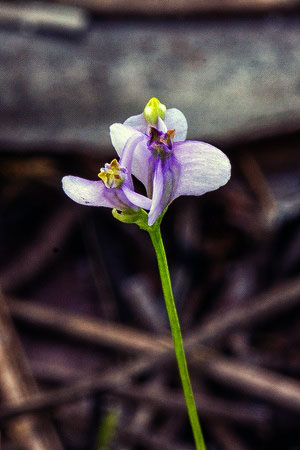
Friday John and George took a late-November look at Jonathan Dickinson State Park and came upon a remarkable species, Burmannia biflora.   The entire plant consists of one or more lilac flowers  teetering on a thread-thin unbranched green stem four inches tall.  The leaves are so tiny as to go unseen, in other words at first glance the plant is a flower on a thread so skinny it is surprising the thread can hold up the blossoms.

This link shows clearly the nearly leafless plants rising from the ground.  CLICK

Inquiring minds want to know, “how does that skinny little “leafless” waif photosynthesize enough to support itself…don’t plants need leaves for that?”

Burmannia biflora Nov. 22 (JB)

Burmannia biflora Nov. 22 (JB)

Some plants derive some or essentially all of their nutrition from sources other than photosynthesis supported by root-absorbed minerals.  Some species are parasitic on other plants.  Others are carnivorous, although these obtain mainly nitrogen from their “meat” so still must photosynthesize.  Most plants have symbiotic relationships with underground fungi, getting some of their mineral “fertilizer nutrients” from their fungal associates.  And now to get to the point, a few plants take the fungal relationship even further and derive so much substantive nutrition from symbiotic fungal partners that their photosynthetic needs and capacity dwindle, and sometimes disappear altogether.   They become saprophytic by symbiosis, flowering-plant pseudo-fungi.

The Burmannia Family is known for that.  You might see the family as an assortment of mostly (or all?) fungally nourished species, some with merely partial photosynthetic ability and others 100% on fungal life-support.  They become nutritional extensions of their fungal partners.

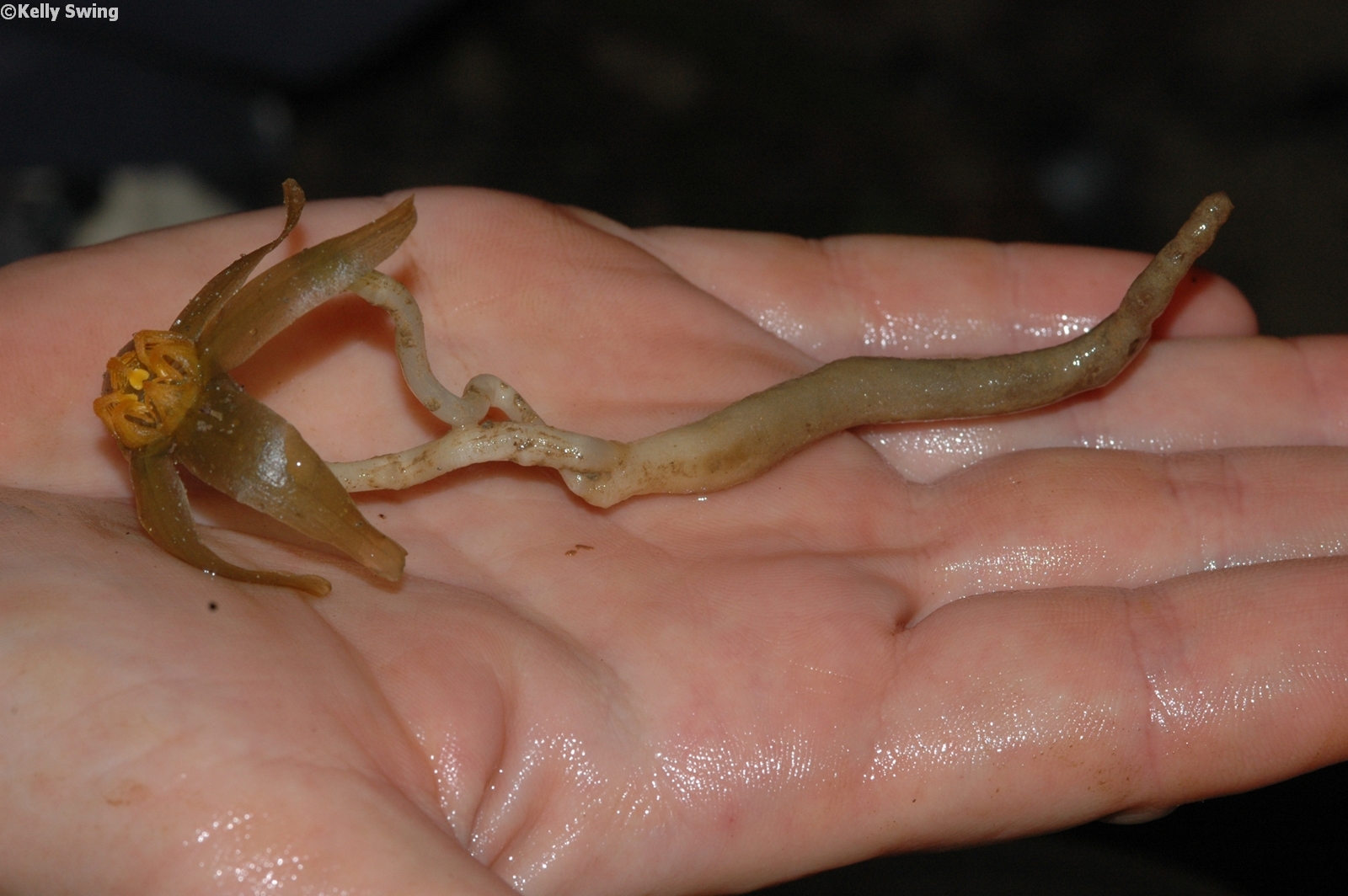
The Ecuadorian species shown below, Tiputinia foetida, unknown until 2005, is obviously completely non-photosynthetic.  There are many additional examples in the Burmannia Family.

Tiputinia by K. Swing.  This is the entire (non-green!) plant behaving like a fungus.

Tiputinia by K. Swing. This is the entire (non-green!) plant behaving like a fungus.

The nutritional relationships of our local Burmannia biflora are, to my incomplete (!) knowledge, not well known and would make a fascinating study.  The plants have some photosynthetic ability, apparently supplemented by a fungal support staff.  The roots are thick, shallow, sparse, and coarsely branched, probably a reflection of fungal symbiosis.  (Look at the root on Tiputinia above.)

In some or all members of the Burmannia Family the roots lack the internal layer known as the endodermis characteristic of “normal” roots with normal nutrient uptake by absorption.  Apparently Burmanniaceae roots don’t absorb in the conventional fashion.

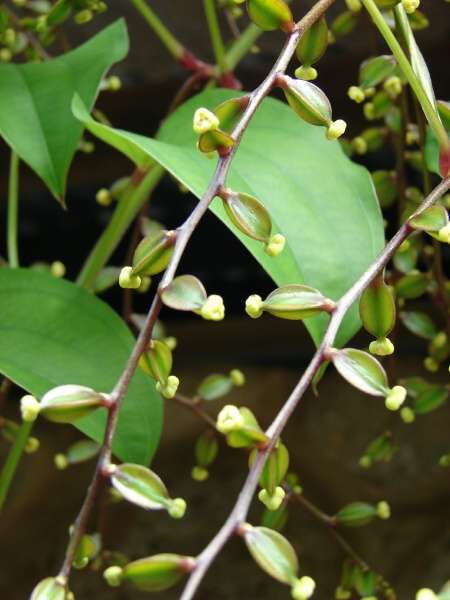
Another oddity of some Burmanniaceae species is a spongy sheath called a velamen, much better known as a feature of the Orchid Family.  Burmannia and its relatives were once erroneously thought to be kin to Orchids.  DNA shows them to be more closely related to yams.  But who needs DNA for evidence?  Compare the wings on the flower bases of Johns’s Burmannia photo above to the similar winged flower bases on many yams, including our own weedy Winged Yam.

Winged Yam, note how similar the winged flowers are to the winged flowers of Burmannia. (By onlyfoods.net)

Winged Yam, note how similar the winged flowers are to the winged flowers of Burmannia. (By onlyfoods.net)

 
5 Comments

Posted by on November 24, 2013 in Bluethreads, Uncategorized


Tags:

Nature Deficit Disaster

Nature-bugs like me avidly bemoan nature-deficit-disorder, the concept that today’s children grow up in a nature vacuum sucked dry by video games, sterile air conditioned gated communities, and overly structured  upbringings.  

All true of course, but thinking back to my own childhood in industrial Wheeling, West Virginia followed by Detroit, I don’t recall childhood companions terrifically fascinated with spiders and warblers.    I do recall adult concerns about kids getting too soft and indoorsy, but then again in my recent readings of 1920s nature writings,  they worried back then too about the kids losing their grip on nature.    That worry must go back all the way to the transition from a land of farmers to the Industrial Revolution, and I kinda suspect 19th Century farm kids were more interested in the attractions of the big city than in wildflowers and butterflies.  The hippies talked about “back to nature” in the 60s, but that was mostly some silly affectation with no substance.  Were the ancient Romans interested in nature?

But even if it is long-standing human nature to ignore Mother Nature, things seem extra screwy to me when I teach a botany class with students afraid to touch a flower because it might house a bug.   When the Boy Scouts seem more concerned with silly exclusive policies than in bringing kids outside.   When lightning bugs and salamanders decline and nobody notices.   When “outdoor activity” becomes golf and soccer.   When fishing became more expensive than leisurely.  When to see butterflies I go to “Butterfly World.”  And when a college can’t teach ecology without flying everyone to Costa Rica.

Something has even happened to gardening.    Forever, hasn’t gardening been more about beauty, flowers, soil, fresh air, exercise, wind, and worms?   A personal experience, or a family experience, often multigenerational.   It was for everybody.  So when did gardening become “landscaping”?  When did ostentation loom large?  When did ego creep in?  Who in the world ever thought there’d be “garden celebrities.”  Oh come on!   Let’s dig the dirt and plant some flowers.

I don’t think it is as simple as, “when I was a kid we played outside in the hills and meadows, and now we don’t.”   (Although that may often be quite true.)    What worries me more is a slightly different shift in values, a lost ability to enjoy basic simple pleasures, nature or whatever it may be.   Life has gotten so fast, so specialized, so complex, so competitive, and so driven by some sort of new values coming at us electronically.

Enviornmentalists are fond of explaining attitudes about nature in terms of World View.   Seems to me that collectively our big World View has homogenized around an unnatural core through the electronic media bath in which we live:  giant TVs, WWW,  cable news 24/7,  pundits, gurus,  satellite radio, political polarization,  stock reports,  sports fixation.   Reminds me of my college days ca. 1970 when Marshall McLuhan with the “medium is the message” was hot classroom fodder.    I just looked him up on Wikipedia and found a comment that seems to say so much:  “Key to McLuhan’s argument is the idea that technology has no per se moral bent—it is a tool that profoundly shapes an individual’s and, by extension, a society’s self-conception and realization.”

It isn’t that our “self-conception and realization” is anti-nature, but rather merely a narcissistic cyber-world ever-evolving away from the small tangible pleasures, individual pursuits, and the values they engender.    Even our conversational social lives meld into Facebook, texting, and Twitter.  Celebrities tell us what to value.   Nature is not in the back yard—it is on the Discovery Channel.

And here I sit on a beautiful Florida summer afternoon with my face buried in a laptop computer.

 
7 Comments

Posted by on July 10, 2013 in Uncategorized


The Quiet Invaders—Death by a Thousand (Literally) Cuts

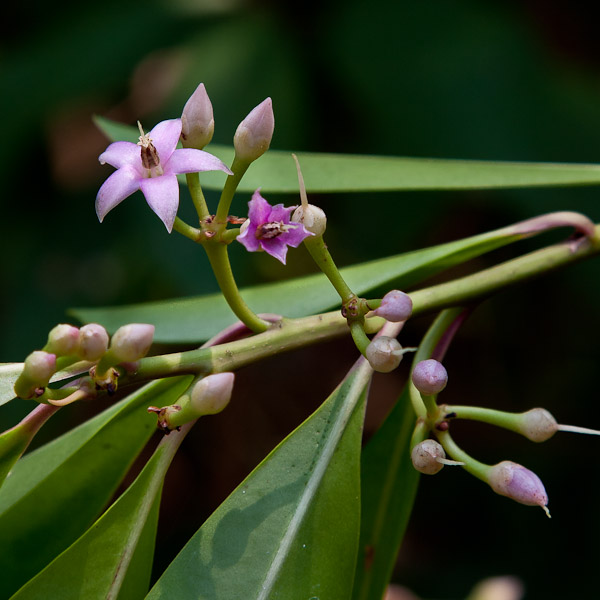
Shoebutton elliptica.  It has been mistaken for the native Marlberry. By JB.

Shoebutton Ardisia. Once popular in gardens, this Ardisia is related to and has been mistaken for the native Marlberry. (By JB)

In Palm Beach County:

Grasses: 135 total vascular plant species growing wild, 45 species non-native, 33% non-native

Sedges: total 83 total, 13 non-native, 16% non-native

Asteraceae: 95 total, 18 non-native, 19% non-native

Rubiaceae: 23 total, 7 non-native, 30% non-native

All Florida Vascular plants: 4289 total, 1421 non-native, 33% non-native

(Data from USF Atlas of FL Vascular Plants)

Every nature enthusiast decries the invasive exotic bioinvasion of Florida and worldwide. Brazilian Pepper and Climbing Fern make us cuss. We battle unwelcome Laurel Figs and Java Plums on public lands. We grouch about those who love their beachside Casuarinas. And then come the Pythons, Walking Catfish, Cane Toads, Cuban Treefrogs, and snails that look like tennis balls. (Are these good for Limpkins?) Invasive microbes and arthropods are a scourge. We know, we know.

But it is even worse than it looks. For every invasive species we know many more sneak in virtually unnoticed .

A quick and approximate survey of species growing “wild” in Palm Beach County makes the point painfully. Looking at four large plant families—the grasses, sedges, composites, and coffee family, the percentages of non-natives species are 33, 16, 19, and 30. Eighty three non-native species in Palm Beach County alone. Or statewide 1421 non-native species accounting for 1/3 of the flora. We have more invasive exotic species growing loose in Florida than the number of native species in Hawaii!

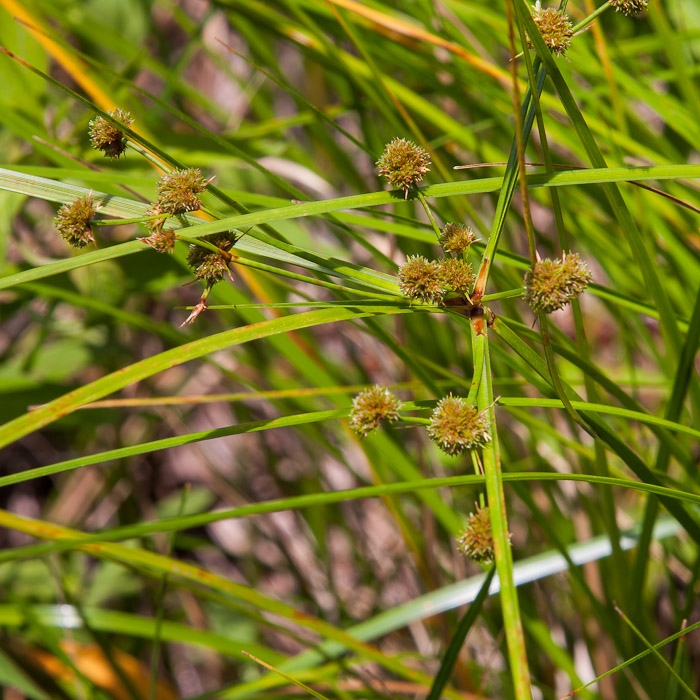
Cuban Bulrush forms floating mats.

Cuban Bulrush forms floating mats. (JB)

I don’t have data, but 1/3 of a diverse flora being non-native begs unanswered questions concerning crowding, allelopathy, competition, hybridization with native species, alterations to the soil ecosystem, impacts on wildlife, altered fire patterns, collateral pests and diseases, and more. Is Global Warming a factor?

So it’s not all Melaleuca. And, by the way, Melaleuca’s close relative, a garden favorite, Weeping Bottlebrush (Callistemon viminalis) is adding its red beauty to certain natural areas in Florida. Why don’t we just dub it Bloody Melaleuca?

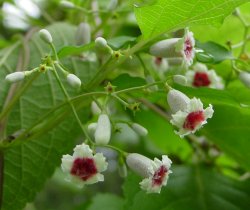
Some of the invaders are pretty, or novel, and interesting. The other day I waded into a canal for a better look at an overhanging branch bearing what I thought was Skunk Vine (Paederia foetida) in a new locale. Wrong! (I hate being blind.) But you might not have to wait long to enjoy Skunk Vine on a branch near you. The flowers are showy. And even more fun nomenclaturally, and so far limited to the Miami Area, is Sewer Vine, Paederia crudasiana, which, I’m sorry to say, makes me wonder what a crud-ass looks lie. (Sorry, blog-writer’s license)

Skunk Vine is prettier than its name. (by GR)

Skunk Vine is prettier than its name. (GR)

Speaking of runaway vines, Mile-a-Minute Vine (Mikania micrantha) is pondering the possibility of over-running Florida from a start in Miami. Why has it remained localized so far?

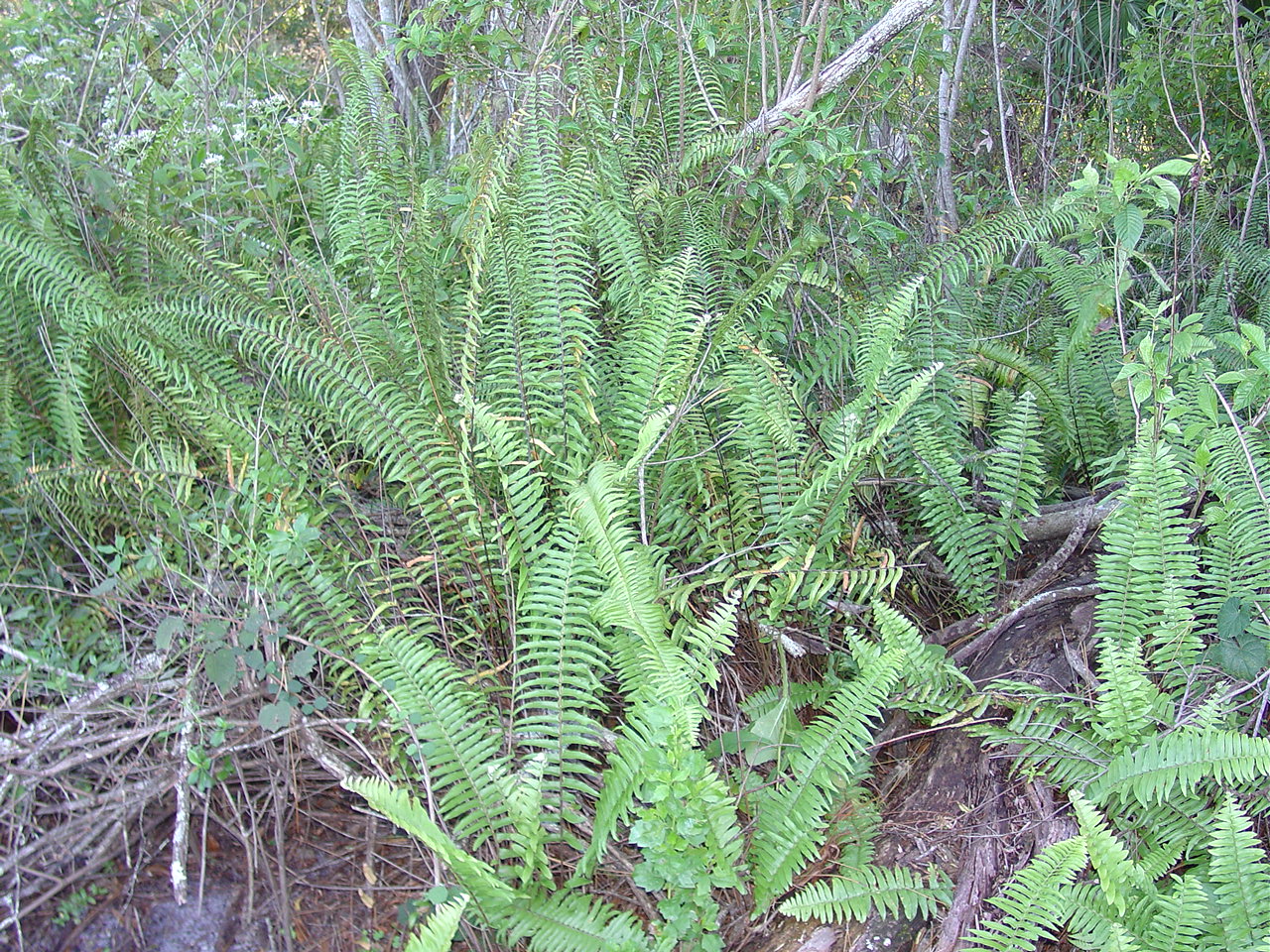
Trying to figure out which ferns are truly native is next to impossible. If you think otherwise, compare every source you can find dealing with the genus Nephrolepis. If you get it figured out definitively and with consensus, please let me know. And to make it worse, fern spores blow long distances on the wind, and ferns are especially good at hybridizing.

Native Boston Fern?  No, invasive Asian Sword Fern.  Mighty similar!  (Boston Fern has light tan shagginess sticking out on the leaf stalk.)

Native Boston Fern? No, invasive Asian Sword Fern. Mighty similar! (Boston Fern has light tan shagginess sticking out on the leaf stalk.)

So what can you do? Bulldozers, machetes, brigades of volunteers and herbicides are not enough. I heard someone say recently, “sometimes all we’ve got is resignation.” Just like crime and reality TV, we’ll never shed the curse, but at least there is one little thing we could do:

Abandon the 19th Century social cachet attached to “I have an exotic plant you don’t have,” and mature to a 21st Century preference for the native species that belong in our own back yards. Oh yea, right, I’m preaching to the other preachers.

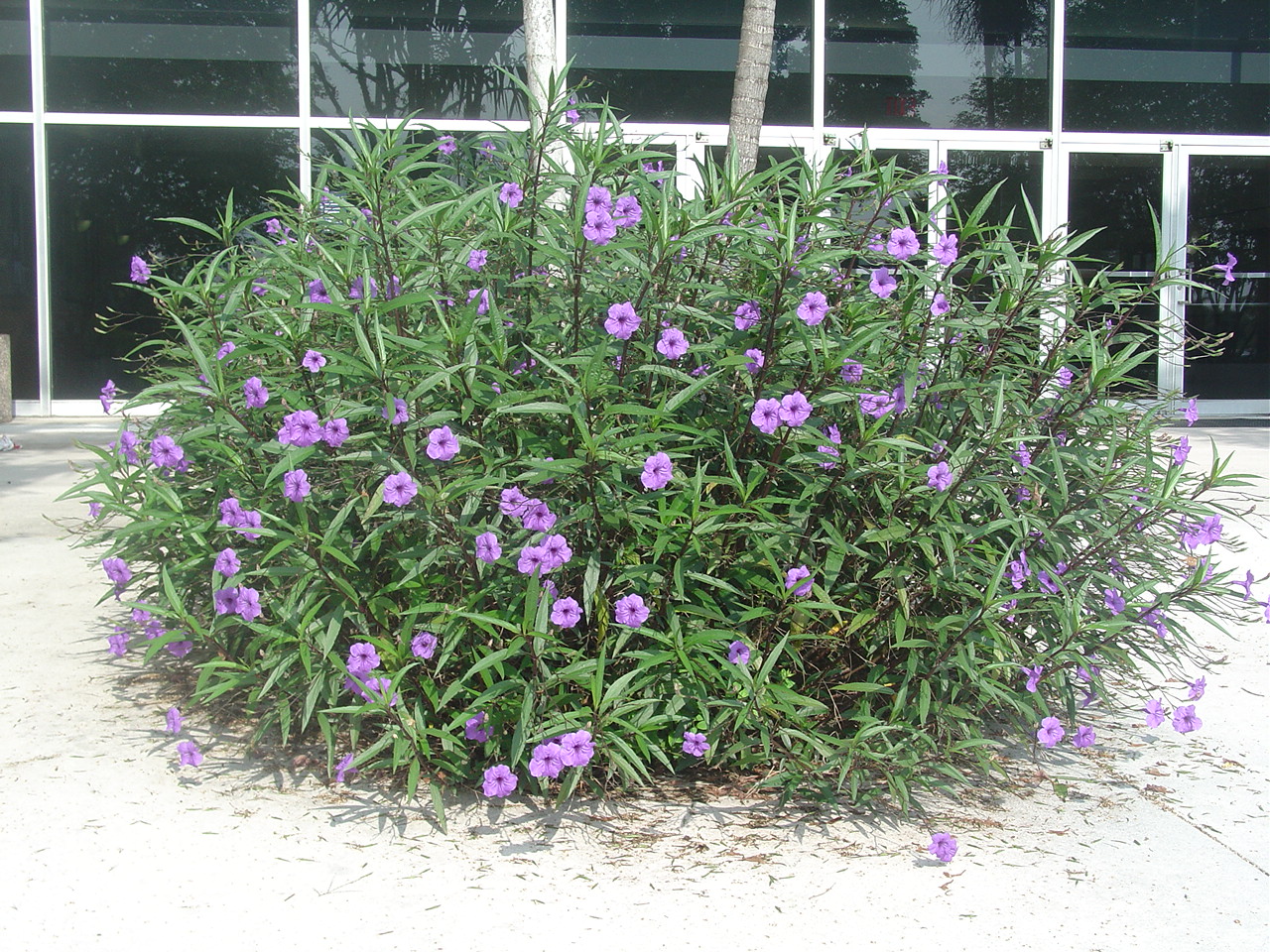
"Mexican Petunia" is not Mexican, and is not a Petunia.  It remains popular in landscapes despite being a Category I Invasive Exotic invader.

“Mexican Petunia” is not Mexican, and is not a Petunia. It remains popular in landscapes despite being a Category I Invasive Exotic.

 
4 Comments

Posted by on June 19, 2013 in Uncategorized


Tags: , , , , , , , , , , , , , ,