John and George venture out to botanize and photograph on Friday mornings. Not yesterday, however. George had much more fun. The morning was spent in a faculty meeting with 80 colleagues hanging eagerly on every word of a passionate three-person debate of, “should the Health Class be a General Education course or merely required for graduation.” About an hour in, cyanide pills came to mind. Fortunately they were not dispensed with the leftover Christmas Cookies, and thoughts of cyanide are best channeled botanically to words on cyanide-bearing plants. Ability to smite herbivorous foes with cyanide is scattered liberally across the plant world, from fern fiddleheads to Laetrile from apricot pits.
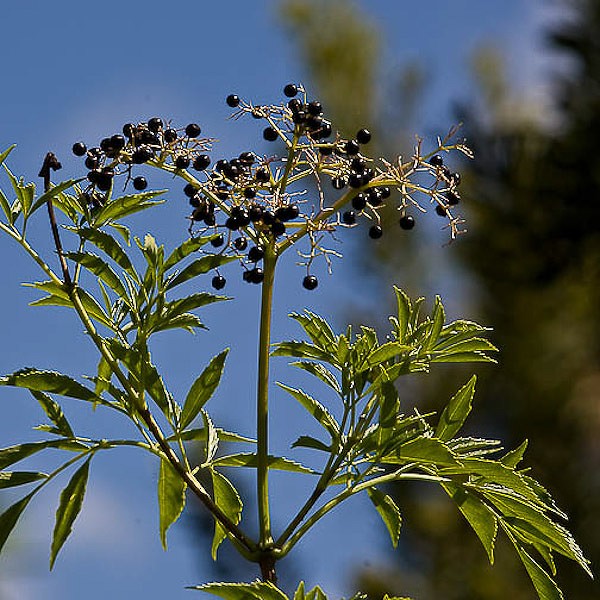
Elderberry berries. Don’t bite the seeds. (JB)
Now, pondering Health Class and cyanide together, a question comes to mind: isn’t it unhealthy for a plant to sequester cyanide? It’s a wicked poison to any living thing. Cyanide stomps down basic respiratory metabolism, so how does the plant avoid trouble? Some plants have self-protective enzymes. But a more interesting adaptation resembles avoiding trouble with epoxy glue…no action until key ingredients combine. In cyanide-producing plants, the cyanide precursors are attached to sugar molecules. They are safe until a bunny munches the leaf, allowing the precursors to encounter enzymes able to nip off the sugars and release deadly cyanide gas. A booby trap for herbivores it is.
As with certain nations, the defense budget can become self-defeatingly costly. That cyanide nuclear arsenal can be a burden, so cyanide-bearing species often have mixed cyanide-producing and defenseless strains. Sweet and bitter yuca (manihot, cassava), lima beans, and almonds are culinary examples. True also in clovers.
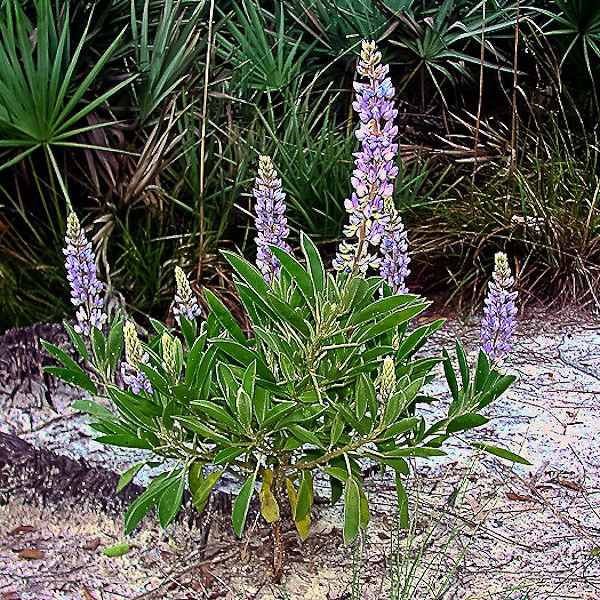
If you own a weapon, know how to shut it off! Lupines have enzymes able to disarm cyanide (JB).
Clovers and other legumes capture their own nitrogen via nitrogen-fixing bacterial companions. Cyanide is nitrogen-intensive. Consequently many legumes are sufficiently nitrogen-rich to invest in cyanide. This is well studied in clovers, because they are pasture plants. And here is a toxic twist: frost damage allows that “epoxy glue” activation to cause clover self-poisoning. Clovers at cooler latitudes are thus less likely to be cyanide makers than their hot-climate kin. No doubt true also in less-studied species, including grasses.
Symbiotic relationships between grasses and nitrogen-fixing bacteria have come increasingly into focus in recent times. Long story short: as with legumes, grasses are turning out to be remarkably talented nitrogen-getters, and some have the cyanide to show for it. There was a recent flurry of attention to cow-snuffing Bermuda Grass, blamed by folks not aware of grassy cyanide on GMO-ness (the grass was not GMO). CLICK
Bamboos can generate enough cyanide to kill a human, yet Golden Bamboo Lemurs and Pandas dine with impunity, perhaps by having enzymes able to convert cyanide to harmless amino acids?
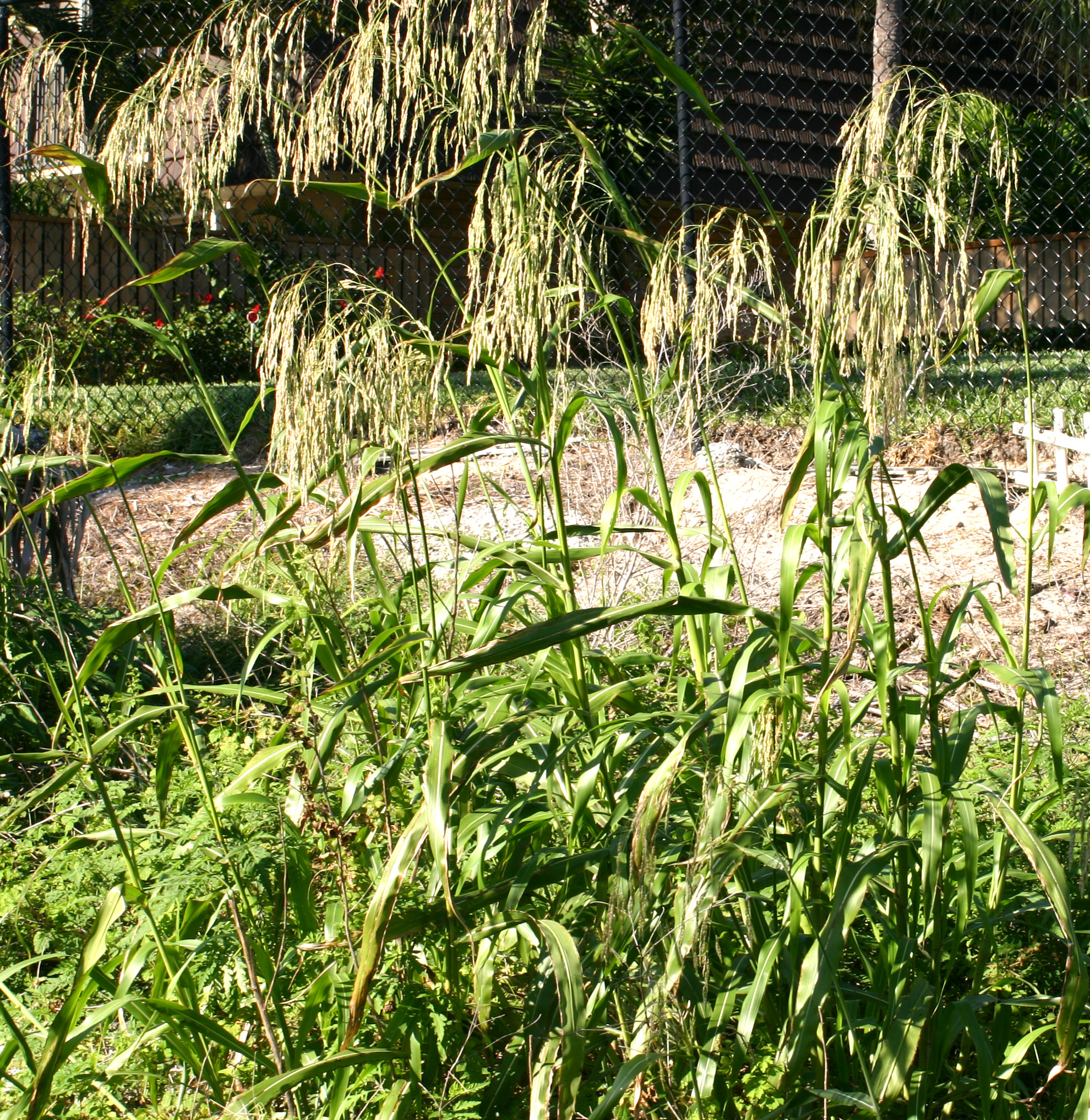
- Johnson Grass (JB)
So then, what about wild cyanide in Florida? One local example is Johnson Grass, Sorghum halpense, a large weedy wetland grass introduced into the U.S. perhaps as fodder. It is dangerous to livestock, especially when nitrogen-fertilized, frosted, or otherwise damaged physically.
To end on a curious note, why do plant enthusiasts so often want to eat the wild plants, as though “natural” = safe? Toxicity can work at low insidious levels, rather than simplistic “keel over and convulse.” It would be an eye-opener to research and list every cyanide-producing species in Florida. And watch out for those Lima Beans!

 John Bradford
 George Rogers
 George Rogers
 Dee Staley
 Treasure Coast Natives