RSS

Category Archives: Uncategorized

Carpetweed–International Plant of Mystery

Mollugo verticillata

(Mollugo is an old name from a similar plant, verticillata refers to the whorled leaves.)

Molluginaceae

No matter where you live, you see this unpretentious yet storied species.  It grows everywhere, and I do mean everywhere, covering most of North America and much of the rest of the world.  How and when it achieved global domination is an interesting question we’ll fail to answer momentarily.

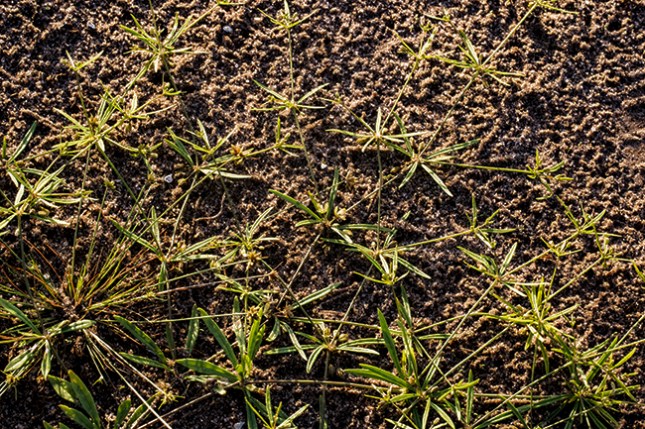
Carpetweed is one of many mat-forming ground-hugging plants often found sprawled in each others’ company in hot, exposed, periodically dry places.

Mollugo sprawling Abacoa

Reach out and expand, creating colonies all the way.

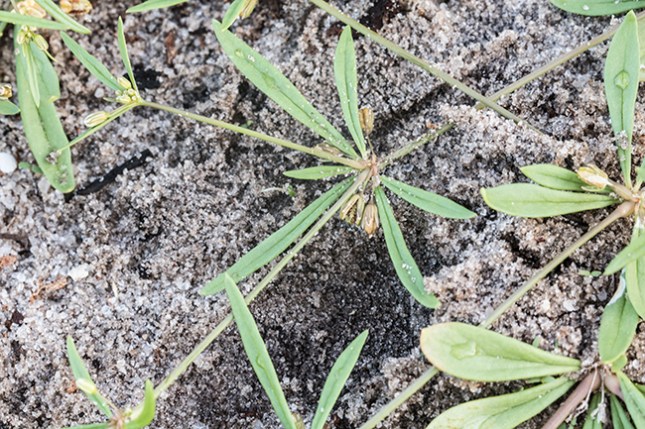
What’s so great about hugging the earth?   Although it may go without saying, botanist John Fogg said it nicely in 1945, “the species can grow laterally, covering the ground with the carpet of its own foliage, and has a distinct advantage over its competitors, for the shade thus created reduces evaporation of moisture from the surface of the soil.”   Self-mulching.   Most of a plant’s water loss is from the bottoms of its leaves,  but leaves on their bellies  lie beneath the drying wind, not losing much water, and the water they do transpire recycles into the root zone.

Mollugo leaves on sand Abacoa

Having transpiration blocked may inhibit cooling, which might explain why mat formers tend toward small leaves amenable to air cooling.

I’ve read that carpetweed seeds can germinate upon one rain event, completing their brief life cycle from seeds to new seeds in a few weeks with no second rain.  A one-rain wonder, although this needs verification.

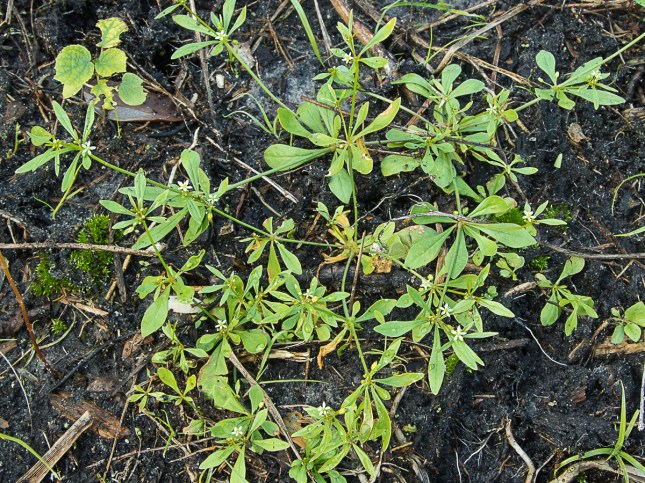
Mollugo verticillata 1Now for the distribution.   Checking the plant manuals at my elbow, here is what I find:
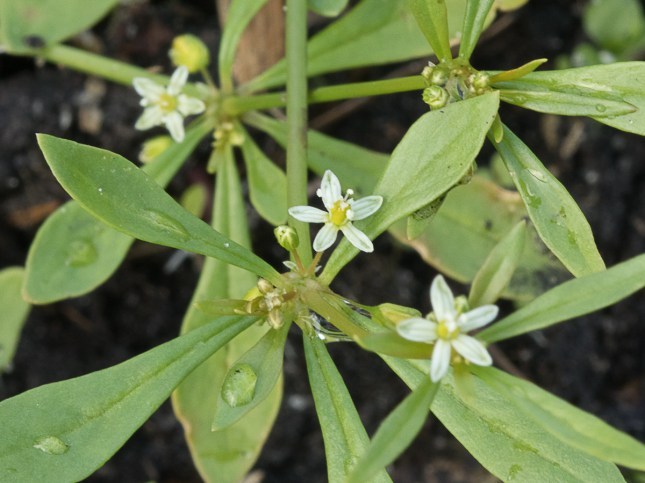
“Native to Tropical America”

“Native to Tropical North America and South America”

“Native of Tropical America”

“Introduced from Tropical America”

You get the picture,  and we see why facile statements of nativity may be too simplistic.  If carpetweed originated in Tropical America, it sure has done a fine job spreading,  now  in almost every state of the U.S., much of Canada, Africa,  Eurasia,  and Asia.  We might say, okay fine,  humanity tracked it all over the place with planes, trains, and automobiles.  But a complication may pull the rug out from under that easy view.

Botanist Jefferson Chapman and collaborators in 1974 reported charred carpetweed seeds 3000 years old  in archaeological remains near Knoxville, Tennessee. Sadly, the site is now  under pontoon boats on Lake Tellico. Seeds of the same species also turned up in Troyville, Louisiana archaeological remains from merely 1500 years ago.

Mollugo verticillata 3

Now go figure.  We must answer the unanswerable questions.

  1. If the species is native to Tropical America how did it journey 3000 years ago to Tennessee? There was limited and poorly documented ancient commerce between points in the American Tropics and the mainland, so arriving with people is possible. Florida is home to other probably non-native pre-European “natives,” such as papayas, agaves, and peppers.    On the other hand, the minute seeds could ride a bird or a storm.
  2. Why were the seeds at a human settlement? They were charred, that is, in ancient campfires.   Was somebody cooking carpetweed?  Unlikely, given the sparse seed production and the low food value of the foliage,  although possible.   More likely, it was a weed in whatever better crop was on the menu, which by the way, predated the arrival of corn and beans.

You have to use your own imagination, drifting back mentally to Tennessee three millennia ago.  What it must have been like.  Commerce with other peoples, although the extent not known.    Agriculture occurring, with its attendant weeds.   My imagination says carpetweed is a human-loving  camp-follower, where people go, it goes, and has been up to that trick for a long time whether or not it fully truly is “native to tropical America.” Could it have been a scattered and very old agricultural weed distributed from Tennessee and Louisiana to settlement-to-settlement over a large geographic area?   Sure why not.

There is another  mystery, the one most studied.   Avoiding a boring  lesson in plant physiology, let it be said that there are two main photosynthetic systems in the plant world.  Plants of cool and temperate climates tend toward “C3” photosynthesis.   By contrast, many from hot sunny climates have “C4” photosynthesis, which offers protections from heat and light.   Guess what, carpetweed is neither fish nor fowl, having aspects of both photosynthetic systems.   Such intermediacy occurs in other unrelated plants as well,  not associated with any known habitat or circumstance.   That being true, I’m only guessing, but is the tropical/nontropical C3/C4 fence straddling coupled with that quickie annual life cycle the secret to  carpeting the earth from  “native to the Tropical America” to frosty Canada?

 
3 Comments

Posted by on July 6, 2018 in Carpetweed, Uncategorized


Tags: , ,
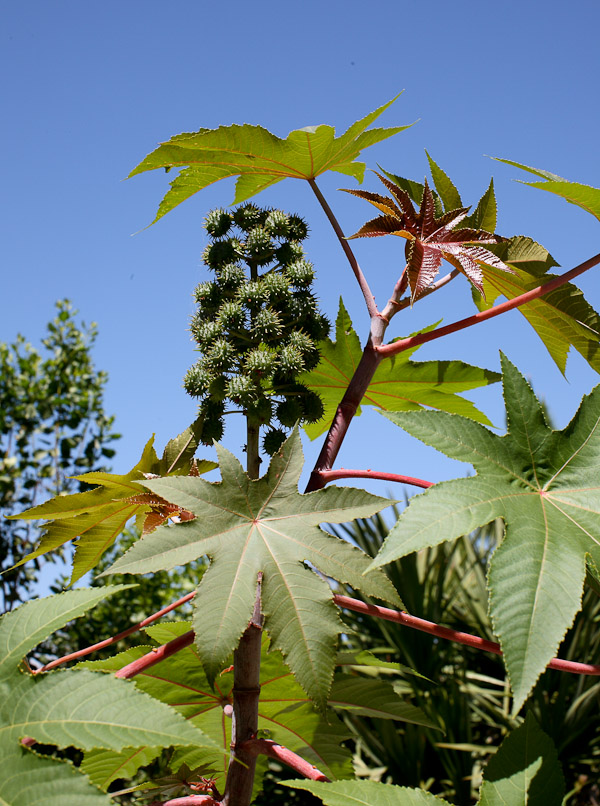
Castorbean has ways to make you talk

Ricinus communis

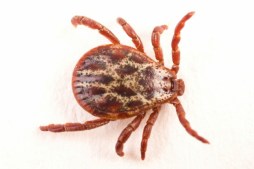
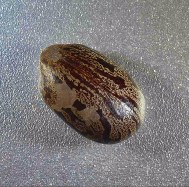
(Ricinus comes from Latin for a tick, which the seed resembles.  Bedbugs last week, ticks today.  Communis means common.) CLICK FOR TICK

Euphorbiaceae (the Spurge Family)  Misnomer alert:  Castorbeans are related to poinsettias, and are not beans.

Ricinus communis 1 - Copy

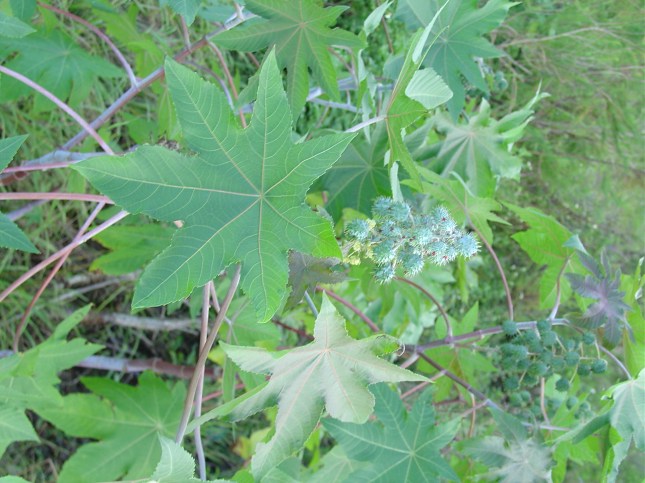
Castorbean with young fruits, as it looks now, by John Bradford.

John and I have been working on a weed project, so today a weed.  Although native to the Old Word, castorbean has made itself at home in Florida and far beyond. It’s big, booming, and blooming.  A good day to explore a storied history.

Beavers and Castrol

First, how castorbean got its name.  Beavers are of the genus Castor, and they make oil.   The oil from the plant resembles beaver oil in ways I couldn’t attest to from personal experience.    I do have experience with Castrol Motor Oil, however, which owes its name to the “bean,” and thus ultimately to the furry dam builders.   Castor oil has unique properties and an esteemed history in engine mechanics, from big airplanes to hobby micro-engines used on model planes, cars, and boats.

Most readers know castor oil not from lubricating their engines, but rather lubricating their innards.   It is a laxative, once thought to be a cure-all applied liberally to children, and is famous for its distasteful taste.  One curative application was probably against goldbricking.  “Oh, you’re too ill to go to school, then you need a big whopping spoonful of castor oil.”

Ricinus ad - Copy

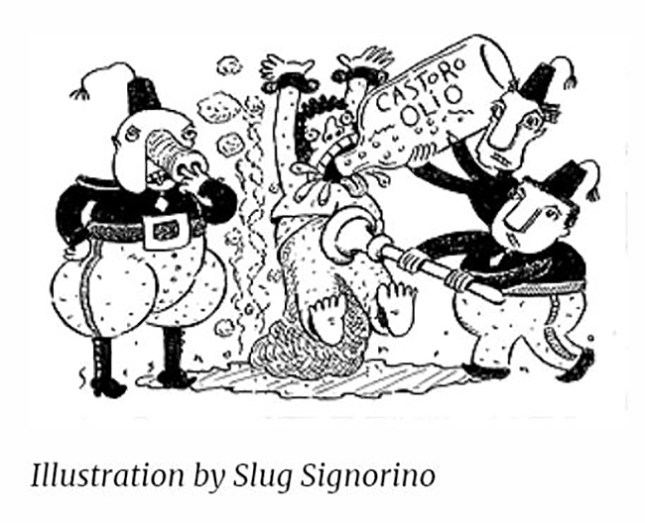
The Fascist Regime in Italy during WWII era likewise prescribed mega doses of castor oil for punishment and for coercion.   “We have ways to make you talk, although we may chat in the bathroom.”   Not nice, but beats the firing squad.   Castor oil as medicine extends back into antiquity.

Ricinus torture - Copy

Ricin

If you think castor oil is severe, how about ricin?   Ricin got in the news as a potential  WMD in the hands of terrorists.  It was also in the hands of the U.S. Military during WWI, when the American University in Washington DC became the epicenter of grim research.  Ricin got a look there for coating bullets and for powdering into a lethal cloud, but research showed it not to work well, despite one researcher getting a fatal snootful.   It got another look and another rejection as ineffective during WWII.  Therefore I doubt we have to fear it from terrorists, although the lethal protein experienced minor application in spy vs. spy,  and somebody mailed some to President Obama.  The way ricin kills is interesting…it deactivates ribosomes.

Now, if you did not just complete Biology class, it may be helpful to say ribosomes are where proteins are made.   No ribosomes, no proteins, no life.     What a great self-defense plan for a plant,  because every living thing has ribosomes.    Even so, plans and outcomes can differ.  Castorbean plants today were acreep with pesky bugs, and with ants.

Ants

Castorbean has another line of defense…ants.  The plants have glands everywhere, including where leaves join the stem, and on the leaf petioles and blades.  The glands feed ants, and the ants presumably protect.

This demonstration of ants on castorbean yesterday takes roughly one minute  CLICK

Ricinus - Copy

CB by JB

Caruncles

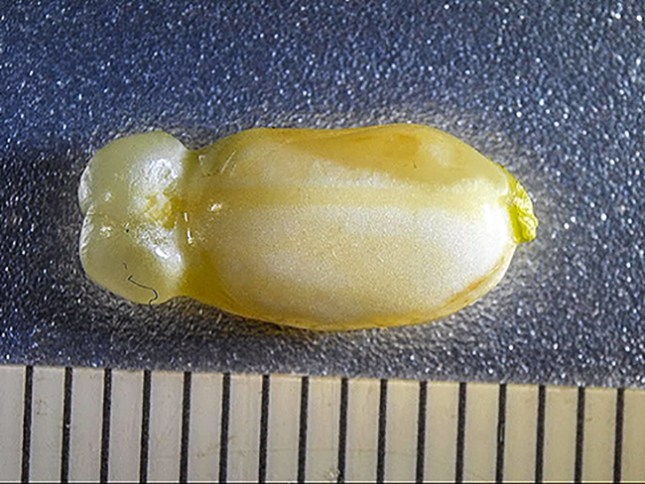
Ants may have another interest in the species.  The seed when fresh has a pair of large globular outgrowths on one end.   The double doohickey is called the caruncle.  Whatever does it do?

Ricinus seed with caruncle - Copy

Immature seed with caruncle to the left.

Traditionally fleshy seed add-ons are interpretable as ant food,  elaiosomes they call em’.  The ants grab the food body and relocate the seed, perhaps to their nice protective, aerated, fertilized nest.  These hefty castor seeds look like challenging luggage for the average ant.   Maybe the caruncle attracts above-average ants or larger critters, even rodents, to drag it. Probably.   After all, ants are mighty, and there is teamwork.  The plant is native to the Old World Tropics where there are ample ants.

Does the seed look to a bird like a tasty tick, especially with the caruncle as the tick’s head?  Can’t rule it out offhand, although consuming the seed contents and not merely the caruncle would release ricin.  Biology is full or creatures that have overcome victim defenses.   Still, the seeds seem large to pass through a bird undigested,  and consuming the flesh of the seed would not merely release the poison but also probably damage the embryo fatally.

Ricinus mature seed2 - Copy

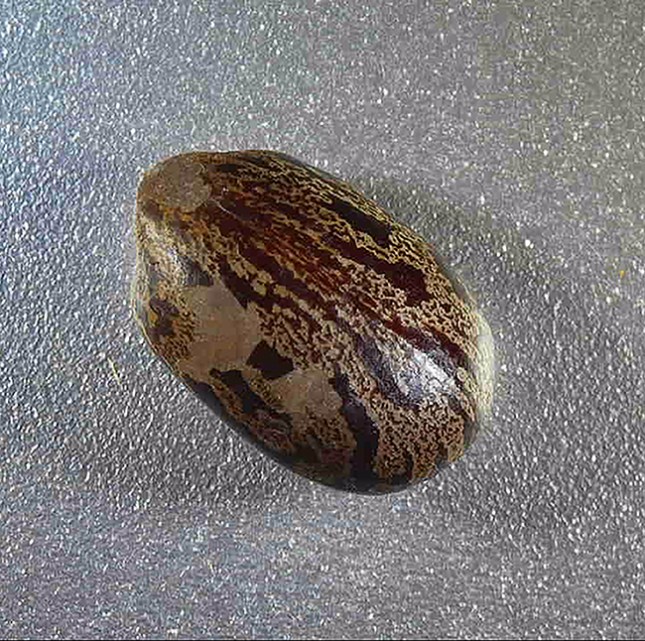
Mature seed. Caruncle gone (see the narrative).  Looks like a tick.

Conversely, could the seed surface pattern be warning coloration:  “eat me and I’ll wreck your ribosomes?”   The pattern on the seed resembles warning colors on noxious arthropods, patterned stinkbugs for instance.

To make it more confusing,  some research shows an intact caruncle to improve germination, helping with the seed’s water relations, although the scant relevant publications are not all in accord.

In any case, looking at old seed pods today, the caruncles are gone from the aging but otherwise perfect-looking seeds, and the surrounding pods are loaded with gross buggy manure and occasional wiggling larvae indicted on circumstantial evidence as caruncle snitchers.   They limit their mischief to the caruncles and maybe to the surrounding fruit walls, leaving the ricin-laced seed in mint condition.  Finding an intact caruncle required opening a fresh new fruit.

Pollination

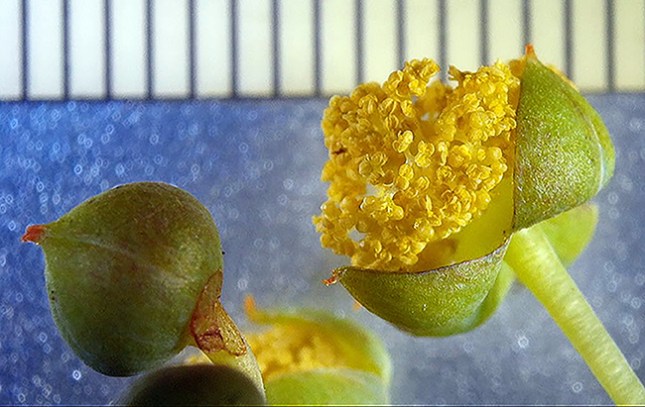
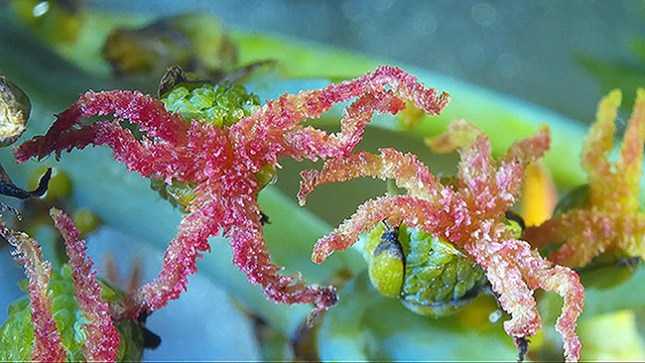
The flowers are separate male and female,  monoecious in the language of botany, with the females on the stalk above the males.   The females have big flesh-colored stigmas; the males look like paintbrushes of pollen.

Ricinus male flower 2 - Copy

Male flower

How do they exchange pollen?   Observers generally agree on wind-pollination, especially given the absence of nectar and of apparent petals, and considering the light fluffiness of the abundant pollen, as well as the attribution of allergies to airborne Ricinus pollen.  The female flowers look like sea anemones with long tentacles to catch the pollen off of the breeze.

Ricinus female flowers 2 - Copy

Female flowers look like sea anemones with long fingery flesh-tone stigmas to catch pollen from wind (and from insects?)

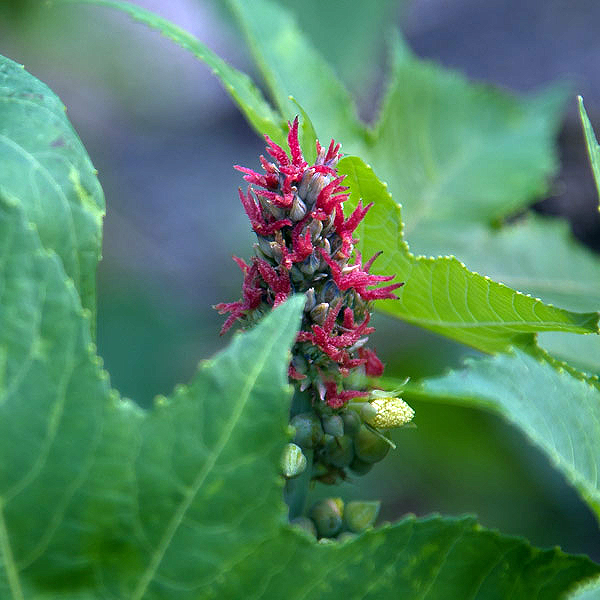
What about insect help?  Bee visitation is documented, remembering that bees collect pollen, and might then contact those big overarching stigmas.  The lurid meat color of those big fingery stigmas may help replace the petals as attractants, although red is not a bee-favored color.    In any event I’ve seen photos of bees on the flowers, so this might be a case of a species able to use wind and insects.

Ricinus communis 3 - Copy

Female flowers above, and one yellowish male flower below.  If insects don’t visit this, I’ll be a monkey’s (car) uncle.   Photo by JB.

Not many plants out there with more going on than castorbean, from Castrol oil to parental instrument of cure to Fascist instrument of torture to spy’s instrument of silent murder, and all the while rewarding ants from golden cups of nectar.  As you walk by, stop and see what insects are visiting the flowers (and send me an e-mail).  ((Really))

————————————————————————–

Abstract re. caruncle:

https://www.researchgate.net/publication/249158128_The_Caruncle_of_Ricinus_communis_L_Castor_Bean_Its_Development_and_Role_in_Seed_Dehydration_Rehydration_and_Germination

Ricinus tick - CopyRicinus mature seed2 - Copy

 
4 Comments

Posted by on June 29, 2018 in Castorbean, Uncategorized


Tags: , , , ,

Bluegreen Algae, Cyanobacteria

Hey I’m no expert on cyanobacteria, but exploring nature, peeping through microscopes, and teaching botany, they crop up.   Having the amazing ability to type words into Google and to read the results makes me a qualified Internet pundit! I self-declare a Ph.D. in cyanobacteriology.

Pundits love to define terms.   Algae and so-called bluegreen “algae” are a point of vocabularial confusion apparently beyond the comprehension of newscasters.   A complicating factor is that “algae” is a tough term to define, more descriptive of a lifestyle than of biological relationship.   A grab bag of simply constructed non-flowering water-dwellers. That is a license to use a term loosely.   Yet there is another way to see it.  Bacteria are more crisply defined.  Bacteria (and Archaea) are profoundly different from all other living things, right down to their basic biochemistry.   For vocabulary lovers they are prokaryotes as opposed to the eukaryotic algae. The bluegreen “algae” are bacteria, cyanobacteria.

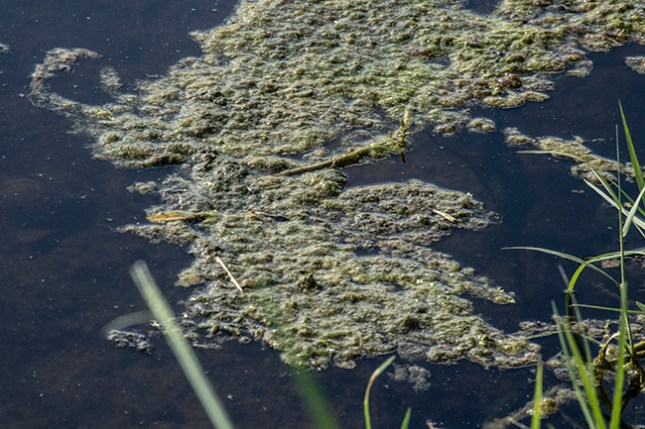
algae mat in canal

Cyanobacteria crop up in disparate contexts:

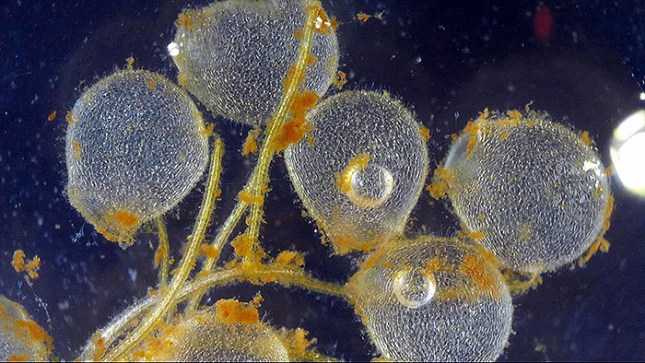
  1. As symbionts, the main “botany classroom” role. Cyanobacteria are “good guys” as the right species in the right roles. Many cycads have “coralloid roots” poking aboveground looking pathological but actually inhabited by beneficial, symbiotic, photosynthetic, nitrogen-fixing cyanobacteria.   (Nitrogen-fixers convert atmospheric nitrogen to “fertilizer.”)  If you bust apart the floating fern Azolla…lots in South Florida…it has cyanobacteria folded into its leaves, making it a rice paddy fertilizer.  Cyanobacteria can inhabit the traps of carnivorous bladderworts and turn up inside hollow-water-holding cells in sphagnum moss.   The “alga” in some (cyano)lichens can be a cyanobacterium.
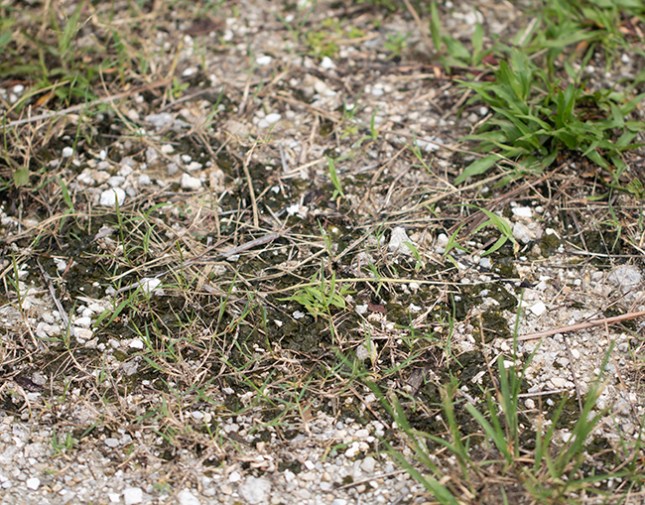
  2. Nitrogen-fixing cyanobacteria living freely, or perhaps not completely free, in the dirt and in hydric soils bring nitrogen to the earth.   During wet weather, great green globs of cyanobacteria jelly rise into prominence on the soil surface.
  3. On wet surfaces. Sometimes before I powerwash the patio, it is interesting to scrape the stains and see under the microscope who it is:   fungus?  green alga?  cyanobacteria?   Often the last-mentioned looking like dark pain on concrete and stones.
  4. In canals, lakes, and rivers. Summer in Florida, and “algae” in the news again! True algae, cyanobacteria, aquatic weeds, associated microbes and creatures, red tides, and dead zones are all part of the evil syndrome relating to our over-fertilized, over-nutrient-enriched, over-hyped Florida active adult lifestyle.   We’re a wet state, not that these problems are unique to Florida, and natural aquatic systems did not evolve dealing with all the nitrogen, phosphorus, and other nutrients humanity puts in the water.   Natural ecosystems evolved in a balance with “normal” nutrient levels, and when the levels skyrocket, some lifeforms suffer, while others benefit to the point of trouble.


Nostoc far

Rising from the wet earth


Nostoc microscope

Same as above, microscope view.

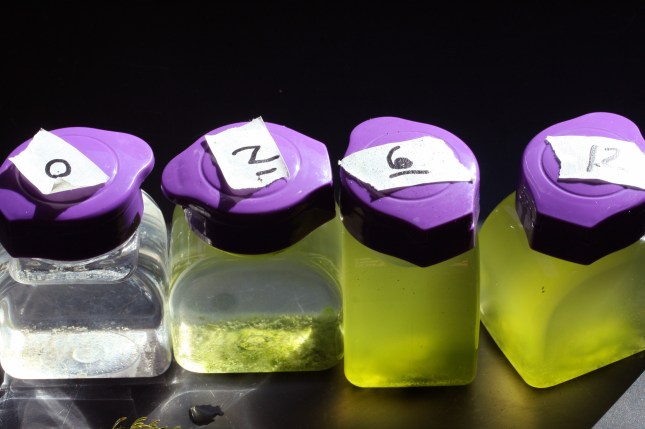
A windowsill experiment to see this is to put pondwater in four soda bottles.  In one bottle put no fertilizer,  and then increasing amounts in all the others.  One drop in one, two drops in the next, and so forth.   Wait a month.  A harmful algal bloom right before your eyes!

eutrophication - Copy

How many sources of nutrient enrichment can you think of?  Organic decay, sewage, septic systems,  manure,  biosolids,  fertilizers.  Twenty-some million Floridians and tourists generate oodles of sewage.  Treatment does not remove all the nutrients, even passage through artificial wetlands.    One way to shed nutrient-loaded sewage treatment water is as reclaimed irrigation water,  inviting turf and ornamentals to take up the nutrients,  and those nutrients are back into the ecosystem.

Agriculture comes up in the news about the polluted Lake Okeechobee system:  manure, fertilizers, backpumping.   And then there are biosolids, treated sewage sludge spread onto the earth.

As anyone who watches the news would know, releasing nutrient-enriched waters from Lake Okeechobee  causes unwanted aquatic life where the water goes: unnatural weed infestations in the Everglades and harmful algal/cyanobacterial blooms along the rivers draining the lake, extending into the sea.  That unwanted growth, especially the cyanobacteria “algae,” make dangerous toxins.

There are plenty of targets for the finger of blame, and authorities from whom to demand action.   No need to repeat the usual list of suspects.  I would not want to be any of them, because cures are not obvious, nor without downsides, and as Pogo croaks from the polluted swamp, the enemy is us.  Florida was never meant to host a gazillion people.

concrete by wall

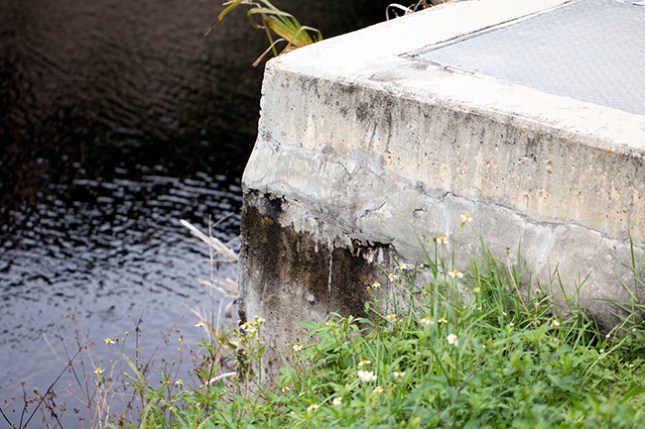
Many stains on rocks and concrete are cyanobacteria.

Which sources of trouble can we control?   Ample room for argument, but most controls will be tweaks, details, adjustments, NIMBY, and redirections.   How do you diminish sewage nutrients, agriculture, and too much rain in Lake Okeechobee (restore more natural outflow?)?    Curtail Florida development?   Heresy!    Seems to many observers, and recall my amateur status with no data, one actionable point might be limiting residential fertilizer applications, which might mean we don’t all need a big sprawling St. Augustine lawn.

Canal with algae

Cyano-soup

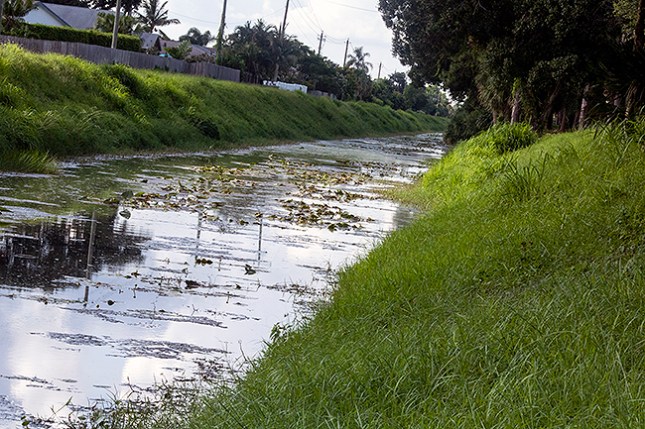
It isn’t just the Lake Okeechobee system of course.   This summer the eutrophic canals and ponds suddenly have smelly floating mats of green.       Close examination of a floating mat is eye-opening.   Tried it yesterday in a stagnant canal in Jupiter, speaking over over-development.

Algae mat microscope

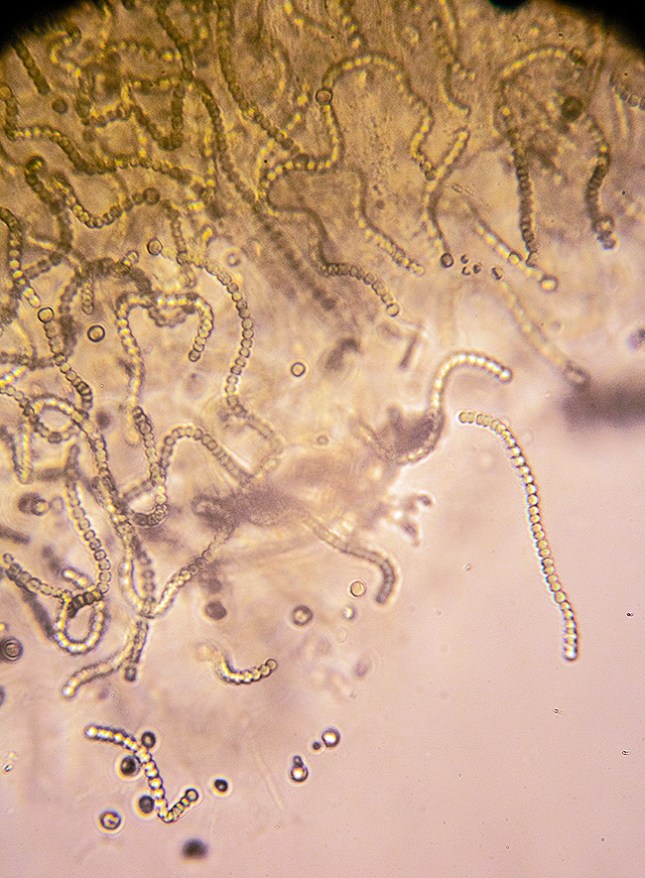
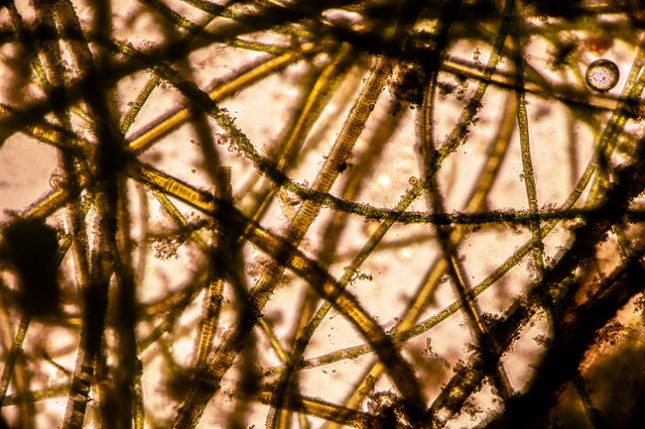
The mat from canal yesterday, dominated by Cyanobacteria (the striated filaments).

The mat is a tapestry dominated by filamentous cyanobacteria (marked by their cross-striations) interwoven with filamentous algae, varied single-celled algae and alga-like organisms, wriggling animalcules, and decaying globs of organic matter.    Those decaying globs sink, stink, and take up oxygen as they go.

CLICK for a 40 second flyover.

One of the abundant filamentous ones is called Oscillatoria.  It wiggles like some sort of mud-dwelling worm.  CLICK to see the wiggle (about 40 seconds).

This may be an artifact of my limited experience, but that experience so far finds unicellular (sometimes clinging into clusters) cyanobacteria in the St. Lucie River, with the filamentous types (strings of rectangular or circular cells) in the floating mats on canals.


Tags: , , , , ,

Bedbug Seed is the State Wildflower

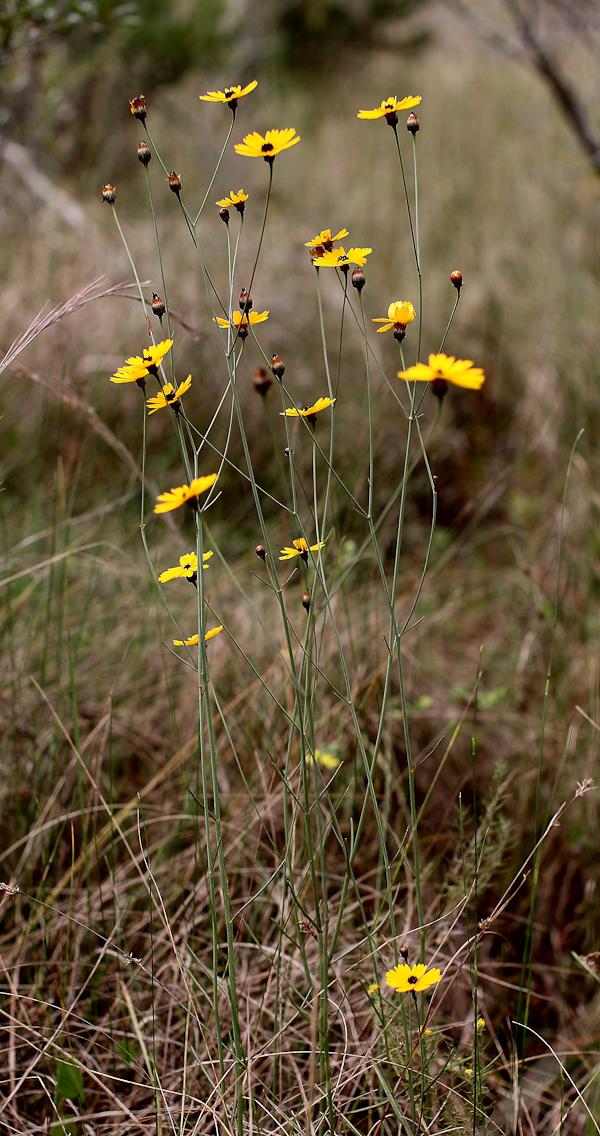
Tickseeds, Coreopsis

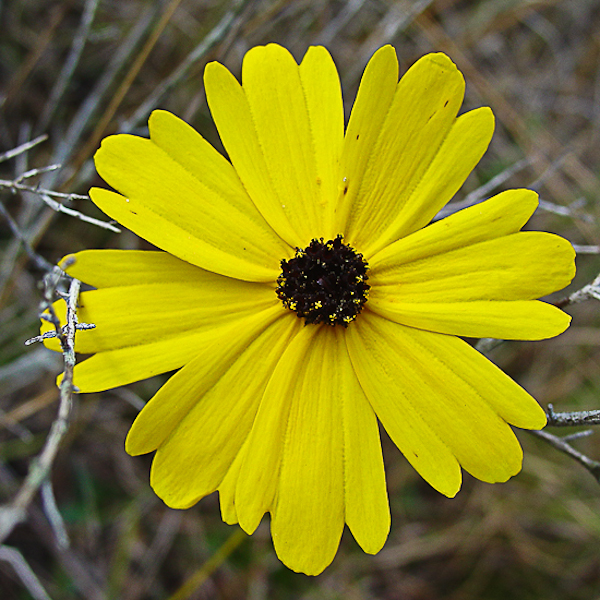
Coreopsis leavenworthii, and close relatives

(Coreopsis comes from Greek for bedbug, some species with bedbugish fruits.   Dr. M. C. Leavenworth botanized in and near Florida.)

Asteraceae, the Aster Family

Today Jon and I worked on something we never work on…landscape species.   Long story with no good natives photo ops. So in honor of garden species, here’s one horticulturists and wild plant enthusiasts both enjoy,  as well as the State of Florida, making Coreopsis species the state wildflowers.    There are over a dozen Tickseeds native in Florida, with two or three commonly encountered in our usual haunts.

Coreopsis gladiata 1

Coreopsis gladiata, by John Bradford, above and below.

Coreopsis gladiata 3 - Copy

Species depend on interpretation.  Coreopsis tinctoria beautifies most of North America and varies all over the map. The best interpretation of today’s C. leavenworthii, not my idea, is perhaps as a localized fringe element of that behemoth species. They can interbreed.

We can argue pointlessly about species status, but no sane person of taste and breeding would dare question the beauty of these little gems

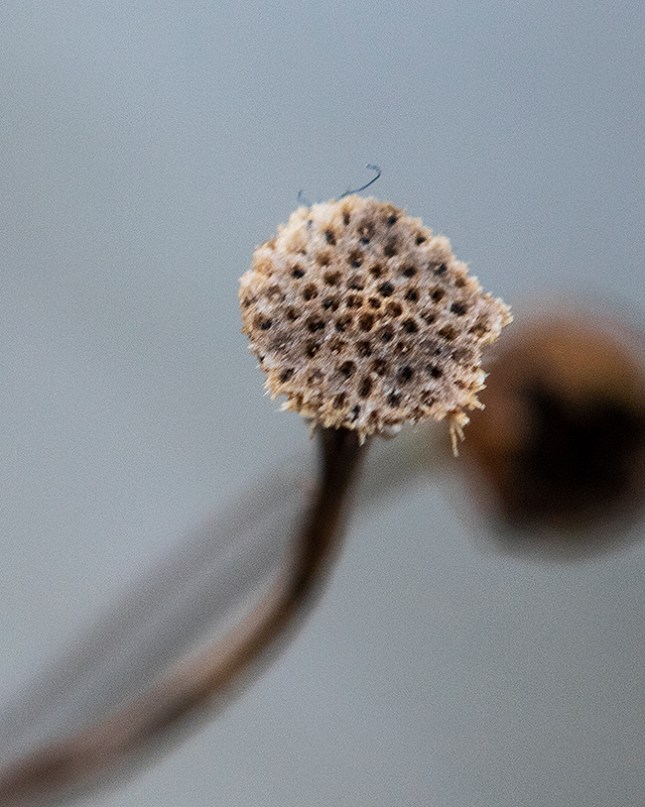
Coreopsis empty bud - Copy

C. leavenworthii…after the fruits fall away.

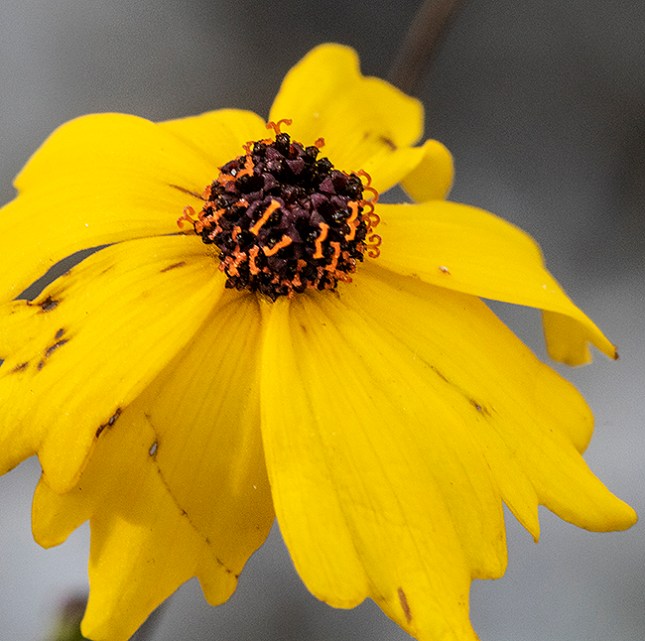
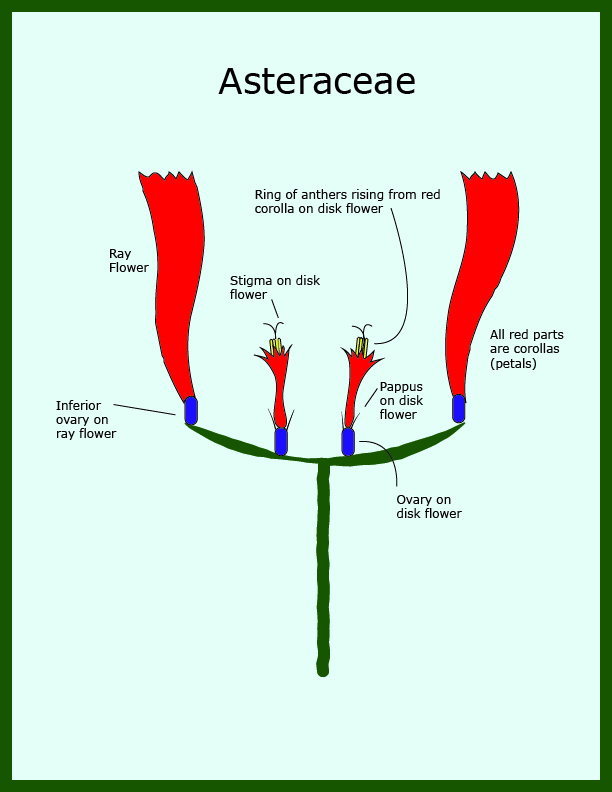
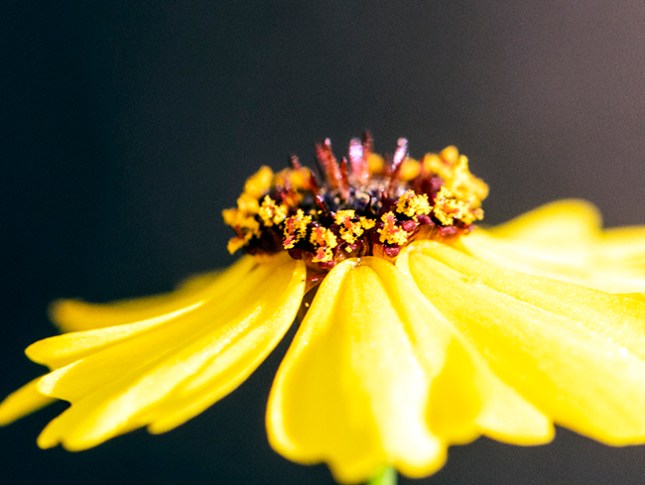
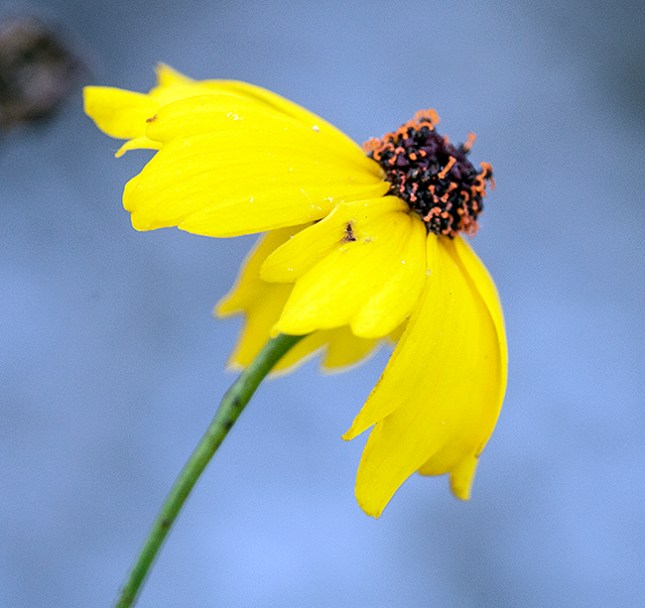
As with all members of the Aster Family, the “flower” is actually multitude, the big yellow “petals” being individual ray flowers.  The dark center hosts a crowd of tiny dark purple disc flowers with orange stigmas, looking like the Clemson school colors.

Coreopsis stigmas

clemson0758

asteraceae

An Aster Family trait Coreopsis disc flowers display is the sexuality shifting from male to female.   Stigmas rising from the lower reaches of the floral tube push yellow pollen to the surface of the flower head, starting it off male.  As those orange stigmas continue to rise they surpass the pollen, making the flower functionally female.

Watch it…just a few seconds CLICK

Coreopsis pollen close 2

The male phase, yellow pollen on the surface of the head.

Coreopsis stigmas 2

Female phase.  Pollen mostly gone, and the orange stigmas protruding.

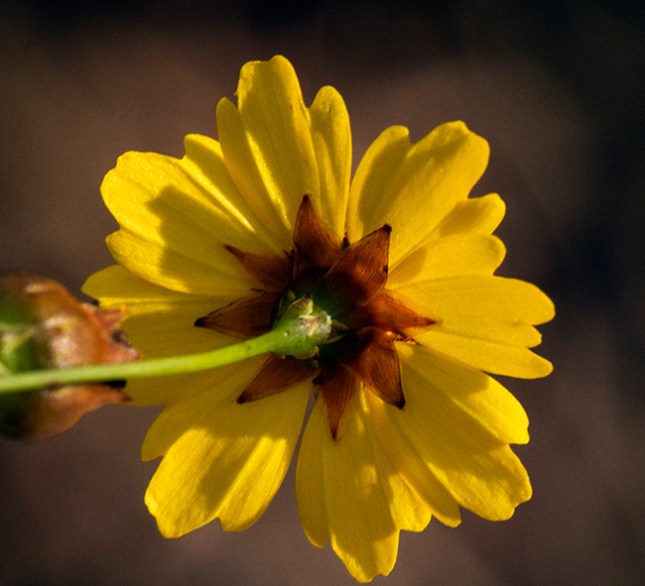
Flip over the flower head.  On the underside there’s a star of what look like sepals, but the points are the tips of specialized leaves (bracts).

Coreopsis backside - Copy

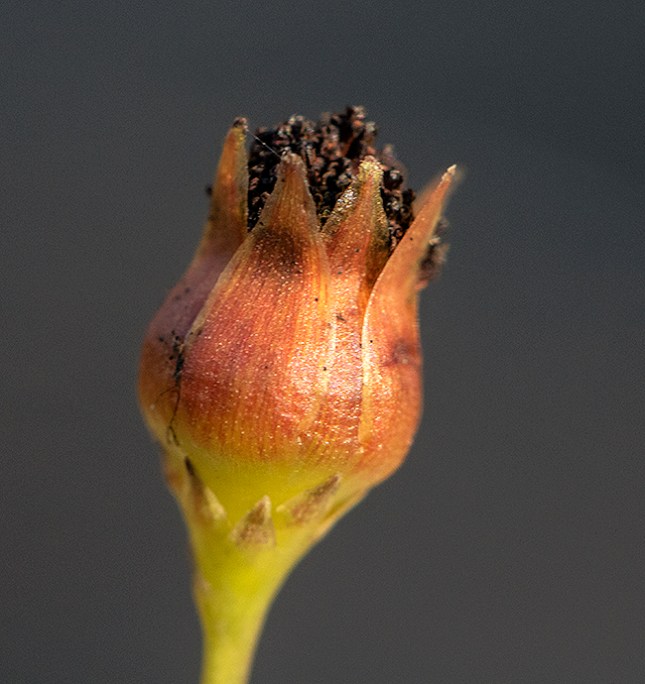
As the head transforms from flowers into a cluster of micro-fruits, those bract tips curl up to form a cup protecting the seedlike fruits.   The fruit bowl looks at first glance like a spherical bud.

Coreopsis achene bud

This “bud” is made of the bract tips seen in the photo just above, now in the fruiting phase.  They curl up together to form a cup around the little fruits.


The fruits give the name tickseed.   They’re paper-flat, and have two tiny horns it seems to help it cling to passing creatures.   Around the perimeter is a narrow wing mayb for fluttering if hte horns don’t snag transport.

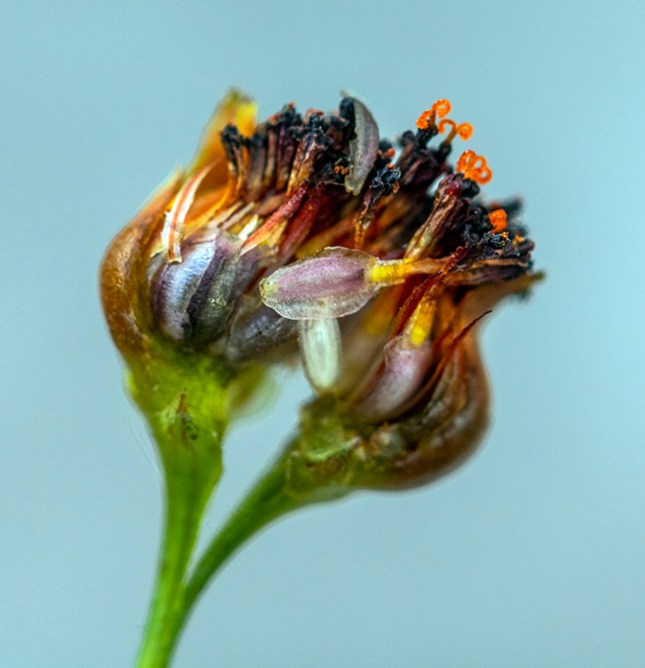
Coreopsis achene bud open - Copy

Fruit cup opened to show winged bedbug fruit, and some flowers in female phase at top right.

bedbug

Sleep tight.

 
6 Comments

Posted by on June 22, 2018 in Coreopsis, Uncategorized


Tags: ,

Sawgrass and the Crocodilians

Cladium jamaicense

(Cladium means “branched,” referring to the flower cluster.  This species vacations in Jamaica.)

Cyperaceae, the Sedge Family

John is busy today relocating, locally, so I’m on my own, in Pine Glades Natural Area near Jupiter, Florida.

What plant is most emblematic of Florida?  Well, yea okay, “palm tree,” or “Hibiscus,”  but after that, dangit, sawgrass.   It appeared  in the blog a few years ago, but nobody would recall, and it is in bloom now, so here is a revisit.   Misnomer alert, sawgrass is a sedge not a grass, but, after all, Pond Hawks are not birds.

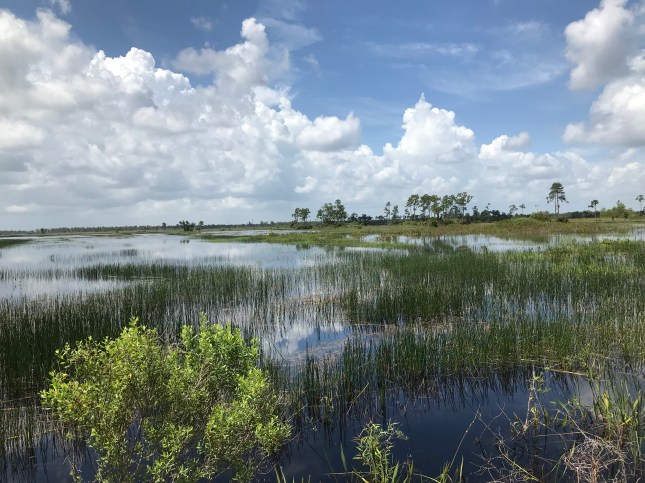
Pine Glades (2)

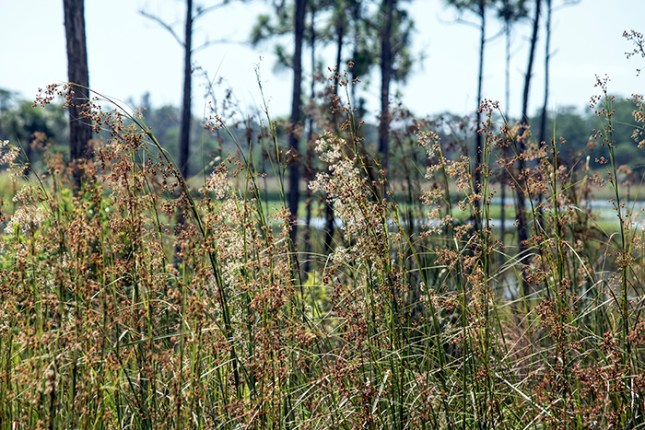
Pine Glades

Now that we’ve got that straight, sawgrass is the dominant marsh plant of the Everglades.    Such a keystone species has been the object of much study, and a tidbit from research is that sawgrass’s ability to dominate does not come from being the biggest nutrient-sucking bully in the mud,  but rather,  the opposite.   It competes on its ability to thrive on less in naturally nutrient-poor environments, perhaps even curtailed by too much P.

Cladium rain

Rain rain rain

Everglades waters experience nutrient pollution from points north, especially phosphorus.   Unlike sawgrass, competing plants use the phosphorus enrichment to achieve great vigor,  examples of the interlopers including  cattails, dollarweeds,  hempvines, and others.    And to make it worse, cattails are less fussy than sawgrass about unnatural water fluctuations.

Cladium mixed inflorescences

The stalks in the female stigma phase are the white ones.

Sawgrass is not limited to the Everglades.  There is plenty around Palm Beach County and points northward, although generally in mixed mosaics with other marsh dwellers.  The overall range is from South America to Virginia.   A similar species lives in the western states, as well as a smaller cousin (Cladium mariscoides) from Florida to Canada.

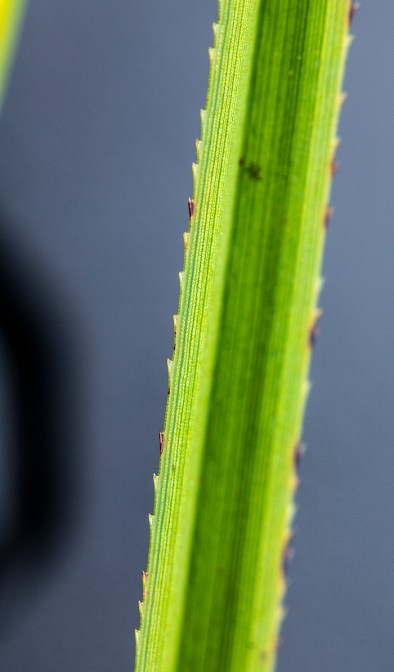
What’s the most famous thing about sawgrass?  The sawtooth leaves of course, not that serrations are unique to this species.   It’s the Saw King, however.  You have to feel sorry for chain gang escapees chased by bloodhounds into the Everglades.  I know the painful experience from recreational botanizing, let alone from draining the swamp.    Odd coincidence that Hamilton Disston the drainage conqueror of the sawgrass Everglades was a Saw King himself,  coming from the Disston (Saw Company) family.

disston saw

Cladium teeth

The serrations angle forward.  Why do they exist?  I don’t know.  The kneejerk answer is protection from herbivores, or from larger critters crashing through.    My gut says “phooey.”  When thinking about leaf structure, the mental checklist should cover water, light, and wind, and again, gut says “forget that.”   The answer I like,  from earlier botanists, is vine severance.   Take a walk in a marsh: vines everywhere on everything.  But not sawgrass, it is pristine and vineless.  Any vine braving those wind-slashed Ginsu knives would shred.    An experiment to try.

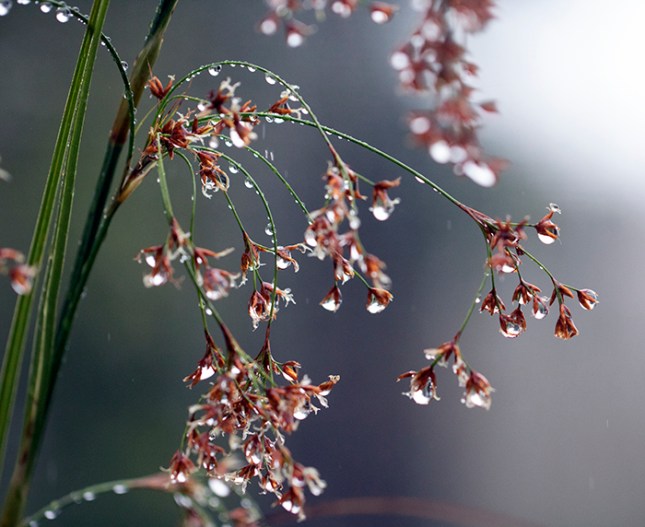
The flowers are pretty and have an odd feature.  Sedge flowers tend to mature their female pollen-receiving stigmas before the male pollen-producing stamens.    In a sawgrass an entire stem tends to have its flowers at the same phase, okay fine.  Contrary to the usual sedge female-first pattern,  however, the flowering stems start out mostly male, then go almost 100% female,  and then wind up mostly  male again mixed with maturing fruits.   They switch predominant sex twice: maleish, femaleish, maleish.

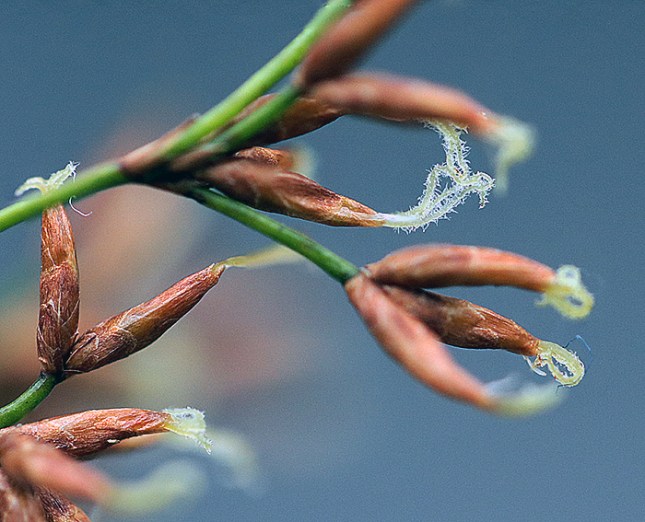
Are those mostly-male-first stems violating the ladies-first rule?  (The proper term is protogyny, pro-TOJ-en-ee.)   Not really, the flowers actually do start out female, but it all goes awry in an odd turn of events.  The flowers are in pairs, with one member of the pair older (or more developed).  The older member starts developing female-first like a good sedge, but most of these flowers  have their female units stop developing while the male stamens proceed to maturity, giving the stem a predominantly  male-first outcome.    The stalk changes its mind.

Cladium female spikelets2 - Copy

Female phase…fuzzy white stigmas

The percentage of females aborting might be highly variable or sensitive to environmental influences.  There’s room for study.

After all that, the younger members of the flower pairs mature  their female stigmas with no mishaps, allowing the stalks to switch to  mainly female phase, looking  pale  from the distance covered with white stigmas.

And finally then, after the female phase begins developing fruits, the male phase of the younger flowers arrives, with the grand finale being functionally male flowers mixed with maturing fruits.

Cladium male - Copy

Female phase dwindling,  a male anther (brown) rising.

Having one sex mature before the other is common in wind pollinated plants, promoting cross pollination and minimizing self-pollination.   So female-first sedges are no big whoop.   It may be mere ignorance, but I can’t think of any other triphasic plants.  The book-end male phases would keep pollen in the air through the population’s entire flowering and early fruiting season, while still minimizing self-pollination.

Sawgrass reproduces clonally by rhizomes, as do most marsh plants.   So then, what is the role of that complex sexual pollination cycle?   To allow seed dispersal to new establishment opportunities?  Sure, and studies have shown even within a marsh blanketed with sawgrass multiple genetically separate individuals can be interlaced.    In a marsh where sawgrass clumps mix with competing species, the seed-grown clumps are potentially each distinct genetic experiments in the competitive context.  Survival of the fittest to then spread by rhizome…and to make more seeds.

The seedlike fruits (called achenes, AY-keens) are a little puffy, probably for flotation.   Do animals help with dispersal, externally or internally?  Bird dispersal is fair to presume, and the achenes have the roughened surfaces typical of small wetland fruits and seeds, speculatively there to cling to moist and muddy creatures.  But take a guess who else may be influential in matters of the marsh ?  Wildlife biologist S.G. Platt and collaborators in 2013 documented plant dispersal by crocodilians,  and found sawgrass fruits among the  mix in alligator fecal matter.  That’s the way to conquer the marsh!  Pre-fertilized, naturally acid treated, and relocated by armored carrier.


…………….

To dig deeper https://www.ncbi.nlm.nih.gov/pmc/articles/PMC4240397/pdf/mcf197.pdf

 
5 Comments

Posted by on June 15, 2018 in Sawgrass Revisited, Uncategorized


Zebra Longwing Butterflies

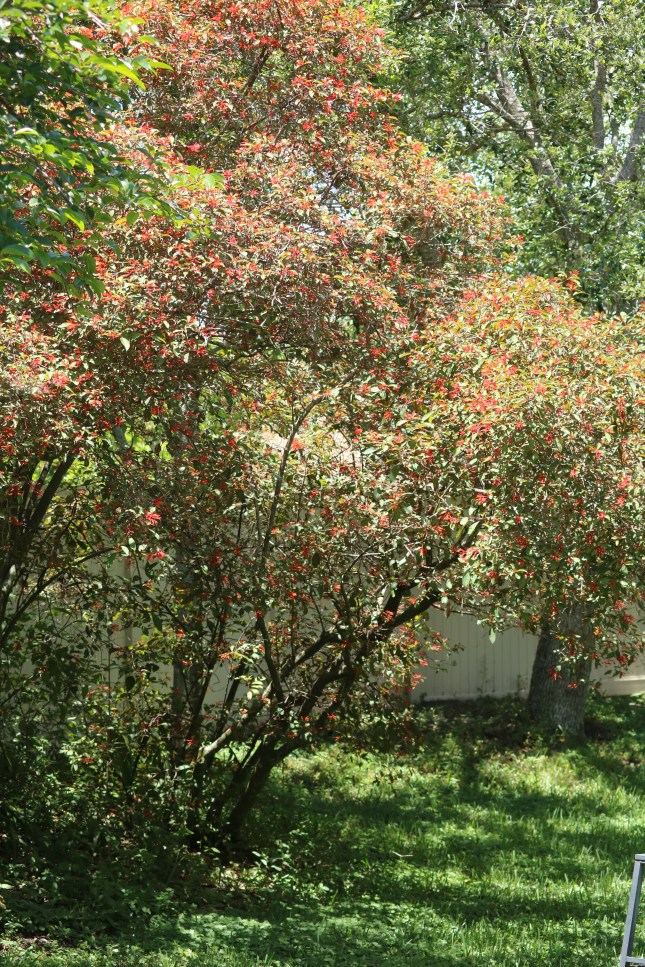
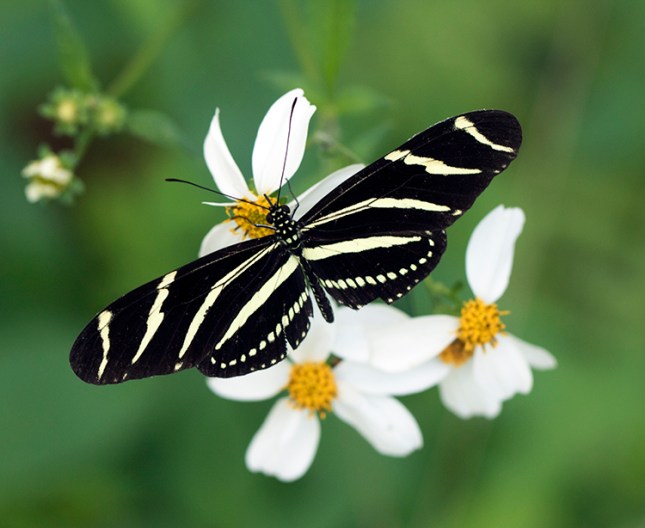
Stuck home waiting for a repair visit.   John is homebound as well.  Might as well put the trapped time to good use with backyard nature,  the feature attraction being zebra longwing butterflies dancing on the firebush.

IMG_3044

Firebush.   Zebra longwings lovin’ it!

Being our lovely state butterfly, this species is about as abundant on the internet as it is in my weedy so-called yard this morning, so we’ll attempt to cruise past the ubiquitous info on better web sites than this, and delve into some eclectic funny business.

Bidens alba with zebra longwing

Just a guess, but Bidens exposes pollen aplenty.  Perhaps this stop is for pollen.

Zebra longwings are part of the large warm-climate butterfly genus, Heliconius where most species have coloration different from ours, although the related Heliconius peruvianus in Peru and Ecuador is almost identical.   The Zebra longwing ranges from rubbing shoulders with H. peruvianus up through Texas and Florida, migrating sporadically into the central U.S., knocked back southward by Jack Frost.

The striking color pattern is probably best interpretable as “danger don’t eat me” warning coloration.   Beautiful, yet treacherous with cyanide-related poisons.  I’m not sure what percent of the toxicity comes from the host plant as opposed to what the adult manufactures, probably substantially the latter.    There is second way to interpret the color pattern,  but hold that thought a moment.   Two functions for one pattern are possible.

The black and white bristly caterpillars can denude their host passionvines, defeating the plant’s protective hairs.  The larvae bite off the hair tips, and weave a protective silk mat over the defenses.

The adult food plants are diverse, and the longwings love firebush.   Zebra longwings and close relatives are the only butterflies known to consume pollen in addition to nectar,  diversifying their salad bar.   For pollen, they like members of the squash family, although I do not know if that preference shows up in Florida.  The pollen protein extends their lifespan beyond most other butterflies,  and boosts their reproductive capacity.    Further, it probably provides raw materials for manufacturing those cyanide-based poisons.

Zebra longwings are among the pollinators known as trap-liners,  able to remember a recurring feeding route.  They circle home to the same roosting sites at night to cluster for protection from predators.   What protection comes from a butterfly gang?   Not very scary after all. Hmmm.  Here is a thought:  Zebras, the hooved mammals, obviously have similar striping, but not as a poison warning.  They probably taste dandy to a lion.   The zebra stripe protection comes from confusing big kitties by obscuring the outlines of single individuals in the herd.   When zebra longwings roost in crowds like a herd of zebras, do their “zebra” markings render angry birds unable to single out individual victims?

CLICK  for zebra op art

Same going on here?  CLICK

After squabbles for dibs, males mate with the females while the females are still in their pupa or as they emerge. The boys are drawn to the larval mating area partly by chemicals released by caterpillar damage to the host plants.   The male gifts the female with a cyanide-laced bomb (in the spermatophore) to defend the female and the brood, and leaves an “antiaphrodesiac” chemical to signal other males to flutter off.  The lepidopteran equivalent of a wedding ring.

Ever sense you don’t see as many or as diverse butterflies like you once did?    Maybe your memory has gilded your childhood, or then again  it might have something to do with pesticides, or extreme herbicidal weed control.  Aerial spraying of insecticides, chiefly the insecticide Naled to counter mosquito-borne viral diseases, is harsh on butterflies, controversially in Miami-Dade.  Naled  is a chlorinated organophosphate related to the now-banned insecticides Dursban and Diazinon, and also to the genocidal gas Sarin.   (Gratuitous inclusion of scary tie-in.)  How much do we fear Zika and West Nile?  How dangerous is Naled to butterflies and to children?  How much protection does Naled spewed from airplanes provide?  What alternatives exist?    All that is beyond the scope of our happy little blog. Yet food for thought, butterfly-lovers.

CLICK to feel sick.

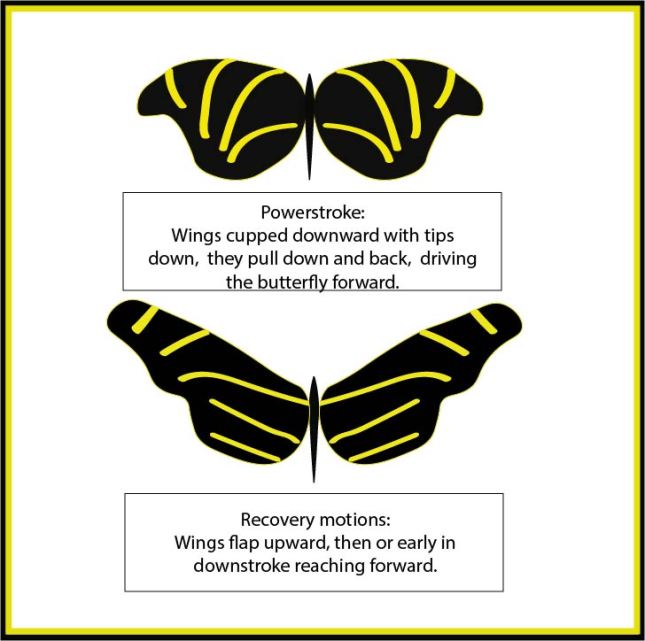
What bugs me abut butterflies is how they manage to fly.  Looking out the window right now, it looks like the wing is a firm paddle flapping up and down. But that couldn’t work— they’d just bang against the ground.  Must be more to it.  Biologists and photographers have studied butterfly aerodynamics, and the Google take-home is that the wing motion is intricate, although too quick to see…another example of the bewildering complexity of simple life forms.  The wings twist, turn, distort, curve, curl, and glide like the adjustments of a helicopter blade, or of a swimmer’s hands, although fancier and more dynamic.   I set my camera to “video,” filmed the flight, and slowed it down to try to catch some action.   The result is below, please click on the link.  Among myriad variations, prominent wing movements appear to be reaching forward, then cupping downward and pulling back, subtly resembling a swimmer doing the butterfly stroke.  How does a noggin smaller than a pinhead compute all that coordination?

CLICK HERE   and see if you can interpret the butterfly flap


Butterfly wing strokes

Here is what I think….judge for yourself.

———————————————————————

Music in video:  Ryan Andersen Happy Life

 
11 Comments

Posted by on June 8, 2018 in Uncategorized, Zebra longwing


Tags: ,

Cat-Tails Twistin’ and Chillin’  in the Wind

Typha latifolia and T. domingensis

(Typhos is Greek for marsh and is an ancient name for these plants, latifolia means broad leaves, and domingensis means lives in Dominica.)

Typhaceae

Typha latifolia 2

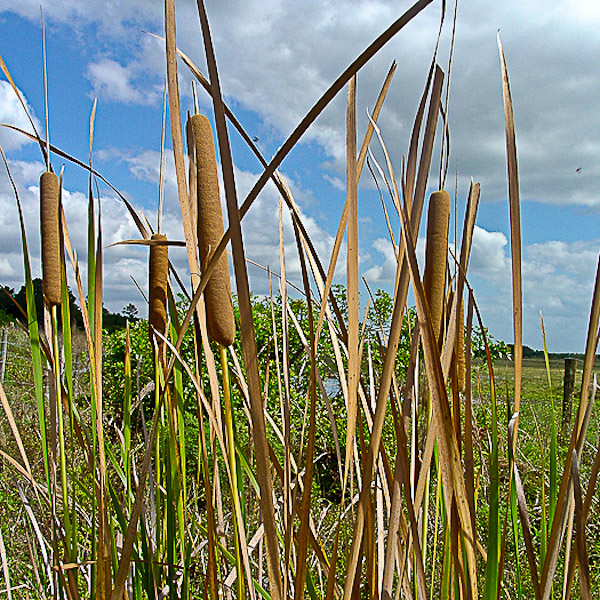
Cat-tails by John Bradford

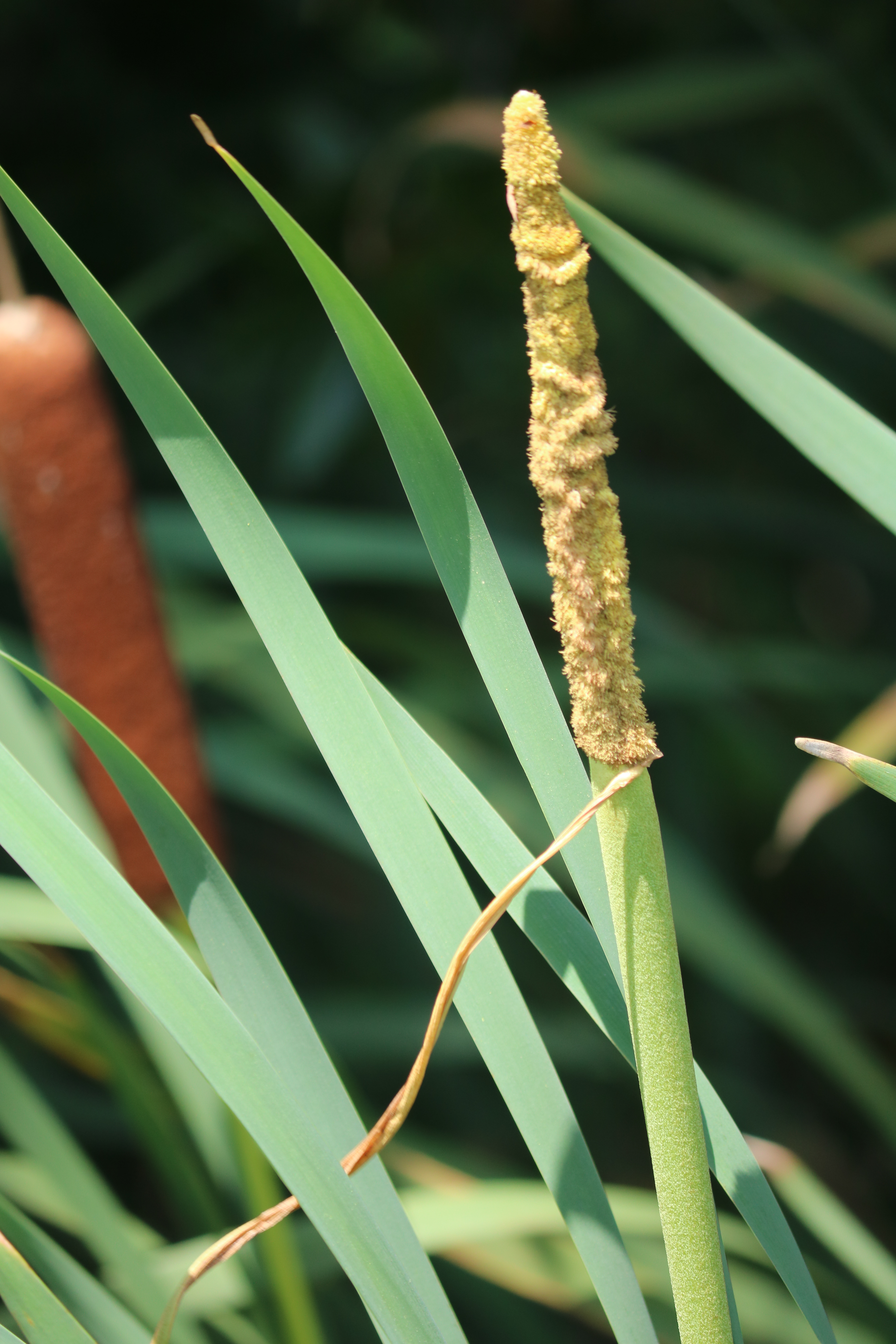
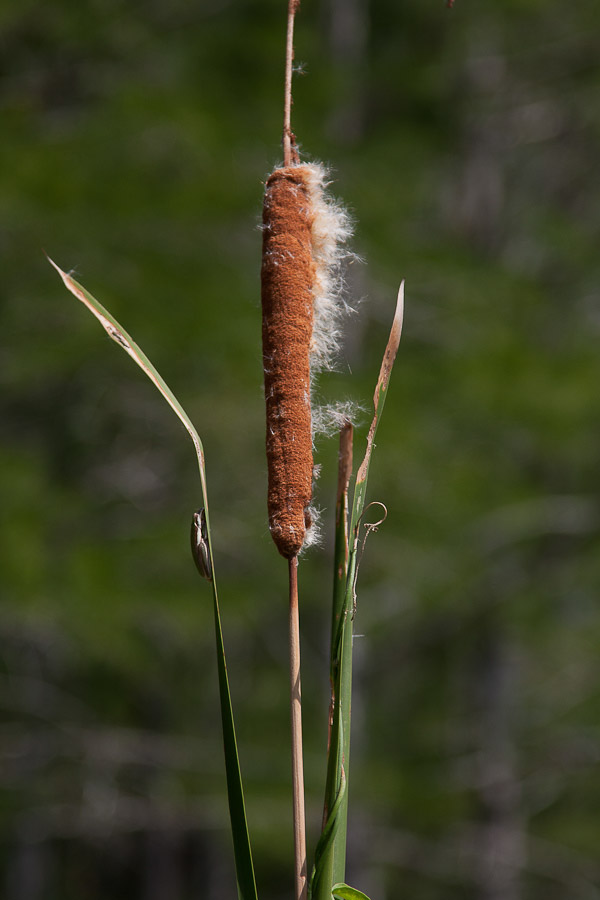
Fuzzy corn dogs on vertical skewers.  Cat-tails we all know—big, abundant, curious-looking.   John and I photographed today in the Haney Creek Natural Area near Jensen Beach, Florida where the cat-tails were twirling in the breeze.  Two native species share Florida:

  1. Typha latifolia has a huge distribution, in the U.S. from Florida to Alaska, and far beyond. Its male and female flowers are distinctively adjacent on the spike. The seedlike fruits burst in water.
  2. Typha domingensis likewise has a broad distribution, on average preferring warmer places, and often in brackish water. This species has narrower leaves, and the male and female flowers have space between them on the spike.   Its fruits don’t rupture in the drink.

Typha flower spikes sometimes have developmental abnormalities, such as two clusters of female flowers where there should be one,  or stalks with male flowers only.   Our two species hybridize, and the oddities could conceivably be due to genetic mixing. The hybrids can have orange spikes.

IMG_2729.JPG

Deformed spike

Countless historical uses for cat-tails range from medicines to weaving and thatch.  Miami botanist Julia Morton in 1974  listed hundreds of uses (see link 1 below).  The rhizomes are food, including  “Cossack Asparagus” in Russia, although local authors warn against consumption due to yuk accumulation.

What I like are the millions of fluffy windblown seedlike fruits.   Soaked in kerosene, the puffy spikes become torches, and the flammable seeds once gave dramatic theater lighting effects.    The pillowy masses stuff anything that needs to be soft or buoyant such as lifejackets during WWII, and even baseballs and cradle linings.

Typha latifolia 3

By JB. Look to the left.

Cat-tails love nutrients to a fault.   As waters become enriched with pollutant nutrients, most famously phosphorus, cat-tails expand and displace other communities.  They sometimes form extensive monocultures interlaced with rhizomes that start growing shortly after seed germination.   Typha domingensis has a positive role in stormwater treatment areas removing phosphorus pollution, yet a negative role as a pollution-fed invader degrading the Everglades.

Typha stand

Pure CT stand.  Leaves brown.

Now for the cool part—

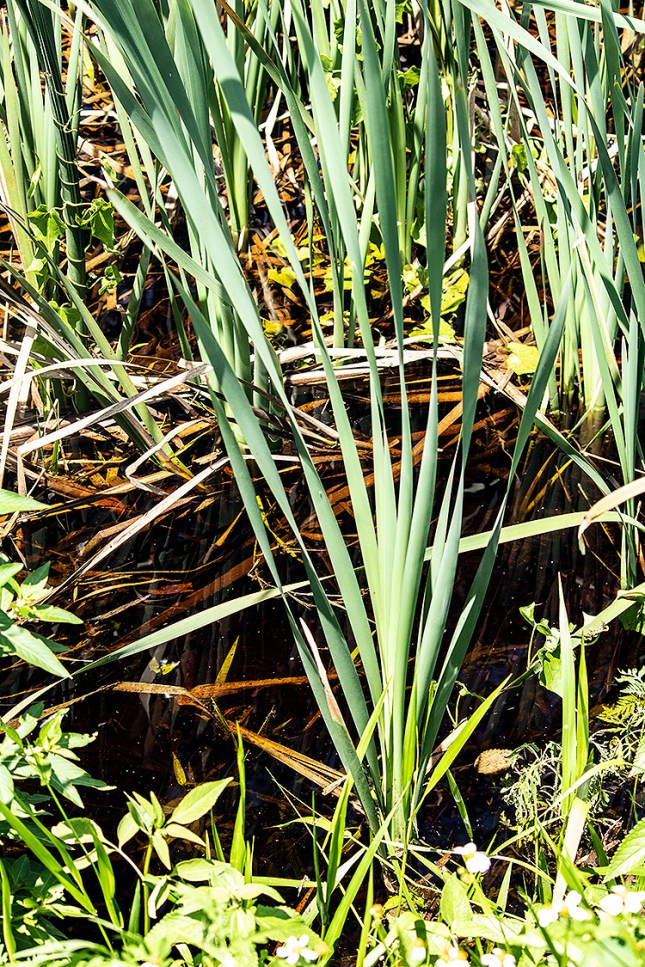
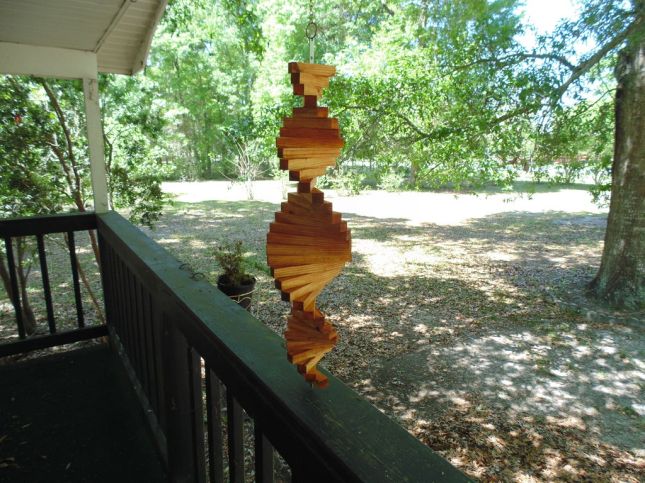
The leaves come up arranged in a fan, and twist artistically in unison as the blades  grow upward.

Typha latifolia leaf fan 1

Leaf blades twisted, and with blue sunscreen.

Why grow twisted?  Optimal positioning for photosynthesis?   Botanists have been pondering that question for a long time, sometimes in engineering detail.   Biophysicists Zi-Long Zhao,  Zong-Yuan Liu, and Xi-Qiao Feng  recently (2016) took a deep stab at it (link 3 below.)  Their study rests on the observation that the twisted leaves twirl in the wind like those twisted front porch wind-spinners.

wind spinner

We can see it happen:  CLICK FOR SHORT VIDEO TAKEN THIS WEEK

The biophysicists determined the twisted twirling to serve two functions:

1.  To reduce wind-drag on the plants making damage less likely, and 2. To reduce wind-induced vibrations.

Now do not get me wrong, I’m not questioning their elegant analyses and hard-science conclusions, yet forgive me for tossing in a speculative add-on with no data:

Many leaves, especially in wide open hot places, experience too much solar exposure, suffering direct sun damage, interference with photosynthesis, and excessive heat.  Many tropical species of open sunny areas have a special mechanism called C4 photosynthesis to protect their photosynthetic production from the blazing sun.  Cat-tails do not have this mechanism despite sharing hot sunny haunts with C4-equipped competitors.

Cat-tails thus may need some tricks of their own.   The blue waxy covering on Typha latifolia can be interpreted as sunscreen.  When the leaves twirl, no single surface experiences direct sun exposure continuously.    Instead the rays distribute evenly on both sides of the blade.  Moreover, the natural spinning fan blades probably  shed heat directly and by evaporative cooling.   Have you ever seen a sling psychrometer used for measuring relative humidity?   It works by twirling in the air a thermometer surrounded by moist wrapping.  Its evaporative cooling rate relative to a dry thermometer measures humidity.   Twirling and evaporating likewise, the Cat-tail leaf is a living sling psychrometer perhaps.

Relevant links:

  1. Botanist Julia Morton and a million uses for cat-tails:  CLICK
  2. Cat-tail weaving:  CLICK
  3. Reference for Typha leaf twisting:  CLICK
  4. Sling psychrometer:  CLICK

Pat Bowman after the blog appeared sent this cool video of the seed release.  Stand back and CLICK 

 
5 Comments

Posted by on May 25, 2018 in Cat-tails, Uncategorized


Tags: , ,

DOLLARWEED

Hydrocotyle umbellata  (and several close relatives in Florida)

(Hydrocotyle means water plate.  An umbel is the type of flower cluster shown below.)

Araliaceae (Apiaceae)

Hydrodotyle umbellata whorl close

Dollarweed Flowers by John Bradford

Hydrocotyle umbellata floating

Dollarweed today…a monoculture, with floating rhizomes.

John and I worked today at Haney Creek Natural Area.  A million bucks worth of Dollarweed there.   Did you know it is native?

To help out today I’ve invited a lawn specialist, Dr. Hoppy Lubber,  who agreed toshare 5 minutes of his precious time.

CLICK HERE

 
3 Comments

Posted by on May 18, 2018 in Dollarweed, Uncategorized


Tags:

Air-Potato Yam

Dioscorea bulbifera

(Dioscorea honors ancient Greek physician Dioscorides.  Bulbifera manes “bears bulbs.”)

Dioscoreaceae

What’s the difference between a Sweet Potato and a Yam? Answer below.

Today was pleasingly a “normal botany Friday” under hot sun after too many weeks with distractions in John’s affairs and mine, more disruptions to come.  We worked today on a photo project at the Haney Creek Natural Area near Jensen Beach, Florida.

Air-Potato Yam there is a super-vine rising over six inches per diem bullying other vegetation all the way.  For yam-lovers that sounds like a top crop, but truth be told, the underground tuber is small and bitter to toxic.  The stem-borne tubers (bulbils) resemble potatoes in appearance, but again, not lunch.

Dioscorea bulbifera 2

Overhard spud. By John Bradford.

A superior yam producer is a very similar likewise local invader, the Winged Yam, Dioscorea alata, different most notably by having a 4-angled or winged stem (vs. round), a bigger better underground yam, and smaller aboveground tubers.

Now back we go to Air-Potato.    Its tough, durable, nasty yams provide an old explanation of how it came to tropical America, as ship-board grub, maybe on slave ships.  The cruise chefs were not picky.  Confounding this old notion, however, are recent DNA studies showing Chinese ancestry for Florida populations.   Multiple arrivals are likely.  Apparently the USDA, sparked by introduction-king David Fairchild, deliberately introduced Air Potato into Florida.   Rockstar horticulturist Henry Nehrling possessed the cursed vine by 1905, noting even then its aggressive demeanor.

Dioscorea bulbifera 1

In yam leaves all the main veins converge at the notch.  By JB.

As with other “edible” species, some cultivated air-potatoes are non-toxic or minimally risky with correct preparation, whereas other strains can be dangerous, in this case with toxic compounds so similar to human steroids they have been used in making pharmaceuticals.  The first birth control pills came from yam steroids.

Dioscorea bulbifera tuber sprouting

This “potato” had dropped to the ground.  Looks like once there, it means business!  Taken today.

Whatever its edibility vs. toxicity, the plant has ancient history in food and medicine, especially in the Old World tropics, where it evidently originated, although where it is “native” is vague because humans moved it around even in ancient times.   The recorded historical medicinal uses would fill a page.  You name it. I don’t even know what some of those old ailments are.

When a plant invades, a  common course of combat is to seek its natural enemy in the invader’s homeland.   The enemy of my enemy is my friend.  True of Air-Potato, with the deliberately introduced leaf eating beetle Lilioceris cheni, which I hope remains our friend.

An obvious concern is the hit-beetle might expand its lethal ravages to native species, in the present case most notably Florida native yams.  Nobody would be dumb enough to unleash the destructors without testing their disinterest in the good species.  But, for neurotics like me, there remains the dubious doubt of potential change of tastes.  Such pest-of-the-pest introductions have run out of control before.  I think of it pessimistically this way…many weeds and insects have evolved immunity to pesticides;  it is commonplace, so why couldn’t some little enzymatic mutation allow the beetles to start munching non-target species?   And how effective are the beetles at controlling the naughty vine to begin with?    Skeptics are such nuisances.

Dioscorea bulbifera leaf lineup

I’ve no recollection of Potato-Vine in flower despite many field outings with my wife Donna’s ecology classes to examine it among other invasive exotics.  There are separate male  (pollen) and female (seed) individuals.   To the best of my Googling, male flowers seem to be unknown in Florida, and females rare.


Sweet Potatoes vs. Yams.  I love both!  A sweet potato is in the morning glory family, and is a root.   A yam is unrelated, in a family among the monocots, with the edible part being a tuber, that is, a fleshy underground stem, or one of those air-borne bulbils.
 
Leave a comment

Posted by on May 11, 2018 in Air-Potato, Uncategorized


Fiddle-Leaf Dock

Rumex pulcher

(Rumex comes from Latin rumo, to suck, because ancient peoples sucked the leaves to relieve thirst, see below.  Pulcher means pretty.)

Polygonaceae

Today splendidly in flower in a weedy meadow…I love weedy meadows!…was a locally rare treat called Fiddle-Leaf Dock.

Rumex pulcher leaf 1

Leaf looks a liddle like a fiddle if you see the resemblance.

It is one of 200 species of Docks enhancing most of the temperate world.  Like many Docks, today’s species is native to Europe and probably Asia, where plants of this genus are players in human affairs all the way back to that sucking mentioned above.   Docks are often called Sorrels, which is a flavor designation, not a botanical classification.   Sorrels tend to contain oxalic acid, giving them a “refreshing” acidy sour taste people still use for a quick pick-me-up.   I used to enjoy red Sorrel beverage in Barbados sweetened with Barbados sugar,  or with rum if you prefer.    Various Sorrels fall into divergent botanical groups, including  Hibiscus,  Oxalis, and Rumex sharing possession of oxalic acid or similar flavoring.  All this being so, Docks have long had a place in the kitchen and herb garden, where some cultivated species can be as pretty as they are tasty.

Rumex pulcher plant 2 use

Taken today…pretty reddish tones.

Oxalic acid, even if refreshing in small doses, is bad for you in many ways, so please do not eat the weeds.   Species of Rumex contain also sometimes ascorbic acid, Vitamin C,  preventing knaves from becoming scurvy knaves.

Rumex pulcher plant 1

Turning abruptly now to biology, species of Rumex have a particularly curious feature.  The fruit is a small seedlike unit called an achene (AY-keen).  Upon ripening it remains embraced in three persistent flower petals (technically, tepals)  serving as protective walls encasing the fruit.  Now for the weird part, either one or all three of these petals experience massive thickening of their mid vein into a thick glossy green, bright white, or red balloon called the tubercle. “Miss Kent” in The Magazine of Natural History described it well back in 1830:

The whole genus Rumex may appear strange at first sight on account of a tubercle (in some species very large) which destroys the outline of the flower. Some of these tubercles appear like little rubies, and add much to the beauty of the flowers.

Remember, the fancy tubercle is on the “petals” surrounding a tiny fruit, but why?  No single answer,  but first of all, the tubercle like a ruby is eye catching.  In Fiddle-Leaf Dock it is showy too, bright white rather than ruby.

Rumex pulcher tubercle 2

Wacky fruiting units with the big white tubercles destroying the outline of the flower.  The fruit is hidden behind the tubercle-bearing petal.

It probably attracts birds, which for sure eat red or white berries and seeds.   “Grain-eating” birds are reported dispersal agents for Rumex.  Isn’t it convenient that the unit the birds sees and perhaps crunches is not the fruit itself,  but rather a false grain on the protective cover?   The actual tiny non-showy fruit presumably sneaks along for the ride achieving avian dispersal in one piece.    And there’s more:

Multiple botanists have documented an odd correlation between Rumex tubercle size and proximity to the sea.   Noticed too many  times in too many places by too many observers to ignore.  Large-tubercle species tend to be coastal, and far more interestingly, within single species bigger tubercles near the sandy shores and lesser ones inland.     That leads to the obvious suspicion of tubercles aiding sea dispersal as floats and as bumpers on abrasive sands.

If the oceanic adaptations are “the” function, why do inland species have tubercles at all? And why gorgeous little rubies and shiny white gems?   I’ll guess the tubercles probably started out serving variably as bird-bait as well as floats and bumpers, with those latter two functions gaining prominence in maritime habitats.  You know, sort of pre-disposed.

 
1 Comment

Posted by on May 4, 2018 in Fiddle-Leaf Dock, Uncategorized