Cladium jamaicense
(Cladium means “branched,” referring to the flower cluster. This species vacations in Jamaica.)
Cyperaceae, the Sedge Family
John is busy today relocating, locally, so I’m on my own, in Pine Glades Natural Area near Jupiter, Florida.
What plant is most emblematic of Florida? Well, yea okay, “palm tree,” or “Hibiscus,” but after that, dangit, sawgrass. It appeared in the blog a few years ago, but nobody would recall, and it is in bloom now, so here is a revisit. Misnomer alert, sawgrass is a sedge not a grass, but, after all, Pond Hawks are not birds.
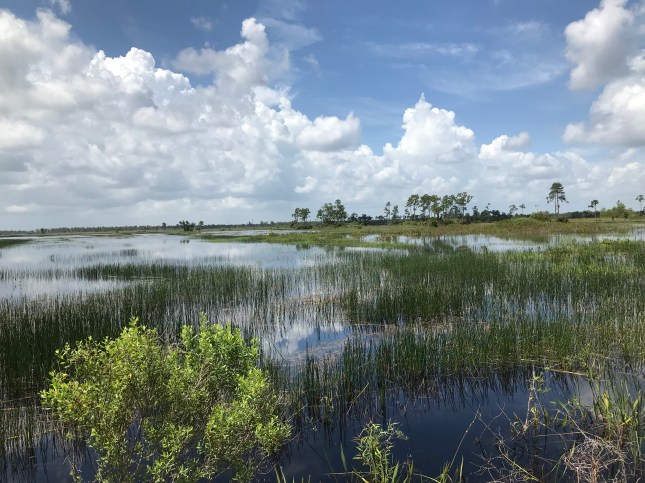
Pine Glades
Now that we’ve got that straight, sawgrass is the dominant marsh plant of the Everglades. Such a keystone species has been the object of much study, and a tidbit from research is that sawgrass’s ability to dominate does not come from being the biggest nutrient-sucking bully in the mud, but rather, the opposite. It competes on its ability to thrive on less in naturally nutrient-poor environments, perhaps even curtailed by too much P.
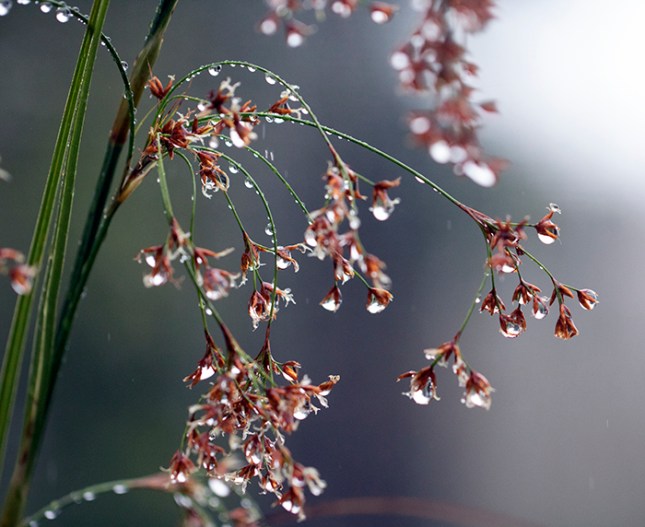
Rain rain rain
Everglades waters experience nutrient pollution from points north, especially phosphorus. Unlike sawgrass, competing plants use the phosphorus enrichment to achieve great vigor, examples of the interlopers including cattails, dollarweeds, hempvines, and others. And to make it worse, cattails are less fussy than sawgrass about unnatural water fluctuations.
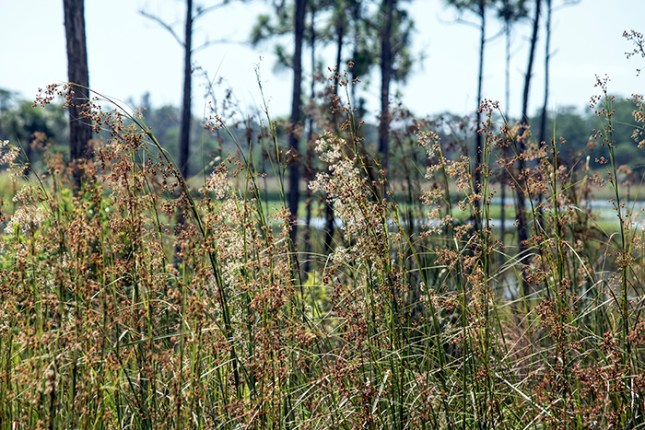
The stalks in the female stigma phase are the white ones.
Sawgrass is not limited to the Everglades. There is plenty around Palm Beach County and points northward, although generally in mixed mosaics with other marsh dwellers. The overall range is from South America to Virginia. A similar species lives in the western states, as well as a smaller cousin (Cladium mariscoides) from Florida to Canada.
What’s the most famous thing about sawgrass? The sawtooth leaves of course, not that serrations are unique to this species. It’s the Saw King, however. You have to feel sorry for chain gang escapees chased by bloodhounds into the Everglades. I know the painful experience from recreational botanizing, let alone from draining the swamp. Odd coincidence that Hamilton Disston the drainage conqueror of the sawgrass Everglades was a Saw King himself, coming from the Disston (Saw Company) family.

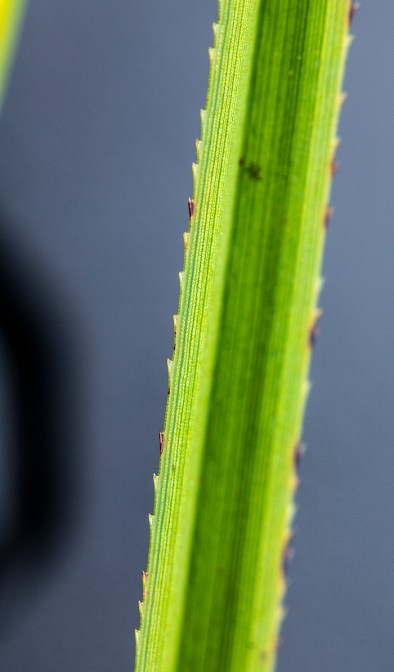
The serrations angle forward. Why do they exist? I don’t know. The kneejerk answer is protection from herbivores, or from larger critters crashing through. My gut says “phooey.” When thinking about leaf structure, the mental checklist should cover water, light, and wind, and again, gut says “forget that.” The answer I like, from earlier botanists, is vine severance. Take a walk in a marsh: vines everywhere on everything. But not sawgrass, it is pristine and vineless. Any vine braving those wind-slashed Ginsu knives would shred. An experiment to try.
The flowers are pretty and have an odd feature. Sedge flowers tend to mature their female pollen-receiving stigmas before the male pollen-producing stamens. In a sawgrass an entire stem tends to have its flowers at the same phase, okay fine. Contrary to the usual sedge female-first pattern, however, the flowering stems start out mostly male, then go almost 100% female, and then wind up mostly male again mixed with maturing fruits. They switch predominant sex twice: maleish, femaleish, maleish.
Are those mostly-male-first stems violating the ladies-first rule? (The proper term is protogyny, pro-TOJ-en-ee.) Not really, the flowers actually do start out female, but it all goes awry in an odd turn of events. The flowers are in pairs, with one member of the pair older (or more developed). The older member starts developing female-first like a good sedge, but most of these flowers have their female units stop developing while the male stamens proceed to maturity, giving the stem a predominantly male-first outcome. The stalk changes its mind.
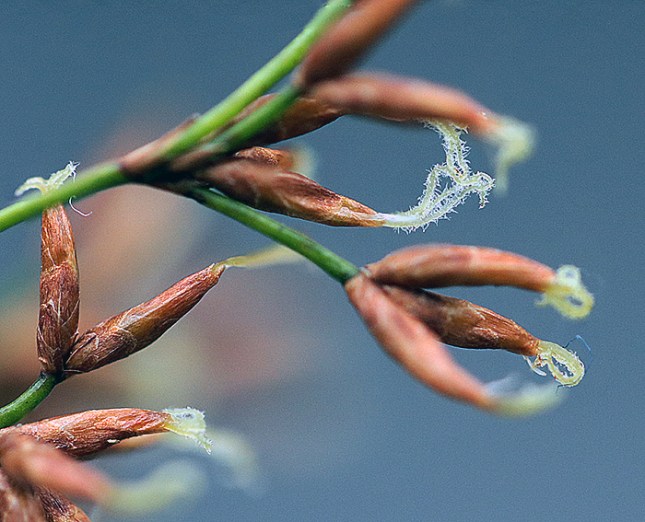
Female phase…fuzzy white stigmas
The percentage of females aborting might be highly variable or sensitive to environmental influences. There’s room for study.
After all that, the younger members of the flower pairs mature their female stigmas with no mishaps, allowing the stalks to switch to mainly female phase, looking pale from the distance covered with white stigmas.
And finally then, after the female phase begins developing fruits, the male phase of the younger flowers arrives, with the grand finale being functionally male flowers mixed with maturing fruits.
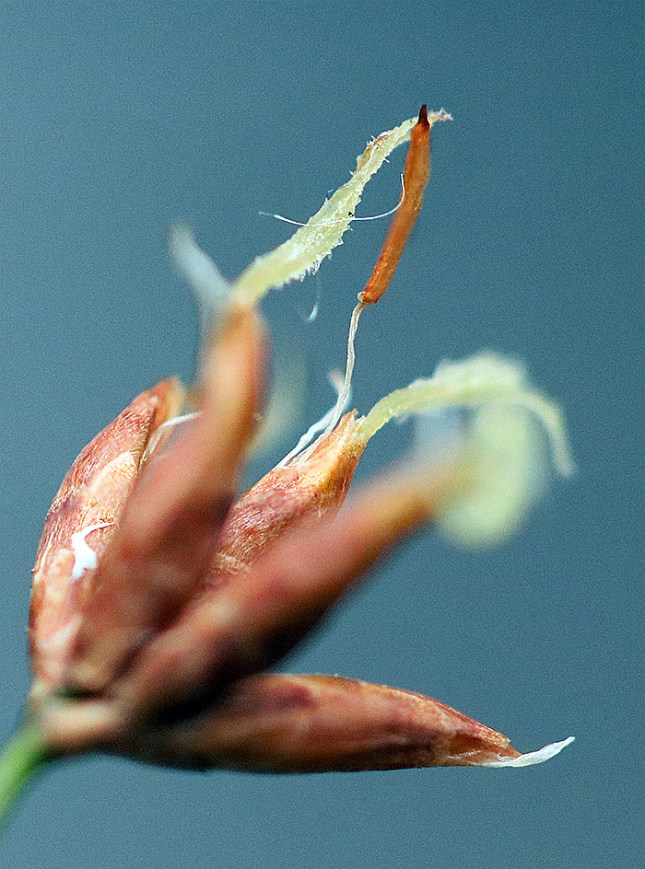
Female phase dwindling, a male anther (brown) rising.
Having one sex mature before the other is common in wind pollinated plants, promoting cross pollination and minimizing self-pollination. So female-first sedges are no big whoop. It may be mere ignorance, but I can’t think of any other triphasic plants. The book-end male phases would keep pollen in the air through the population’s entire flowering and early fruiting season, while still minimizing self-pollination.
Sawgrass reproduces clonally by rhizomes, as do most marsh plants. So then, what is the role of that complex sexual pollination cycle? To allow seed dispersal to new establishment opportunities? Sure, and studies have shown even within a marsh blanketed with sawgrass multiple genetically separate individuals can be interlaced. In a marsh where sawgrass clumps mix with competing species, the seed-grown clumps are potentially each distinct genetic experiments in the competitive context. Survival of the fittest to then spread by rhizome…and to make more seeds.
The seedlike fruits (called achenes, AY-keens) are a little puffy, probably for flotation. Do animals help with dispersal, externally or internally? Bird dispersal is fair to presume, and the achenes have the roughened surfaces typical of small wetland fruits and seeds, speculatively there to cling to moist and muddy creatures. But take a guess who else may be influential in matters of the marsh ? Wildlife biologist S.G. Platt and collaborators in 2013 documented plant dispersal by crocodilians, and found sawgrass fruits among the mix in alligator fecal matter. That’s the way to conquer the marsh! Pre-fertilized, naturally acid treated, and relocated by armored carrier.
…………….
To dig deeper https://www.ncbi.nlm.nih.gov/pmc/articles/PMC4240397/pdf/mcf197.pdf
 John Bradford
 George Rogers
 George Rogers
 Dee Staley
 Treasure Coast Natives