RSS

Category Archives: Uncategorized

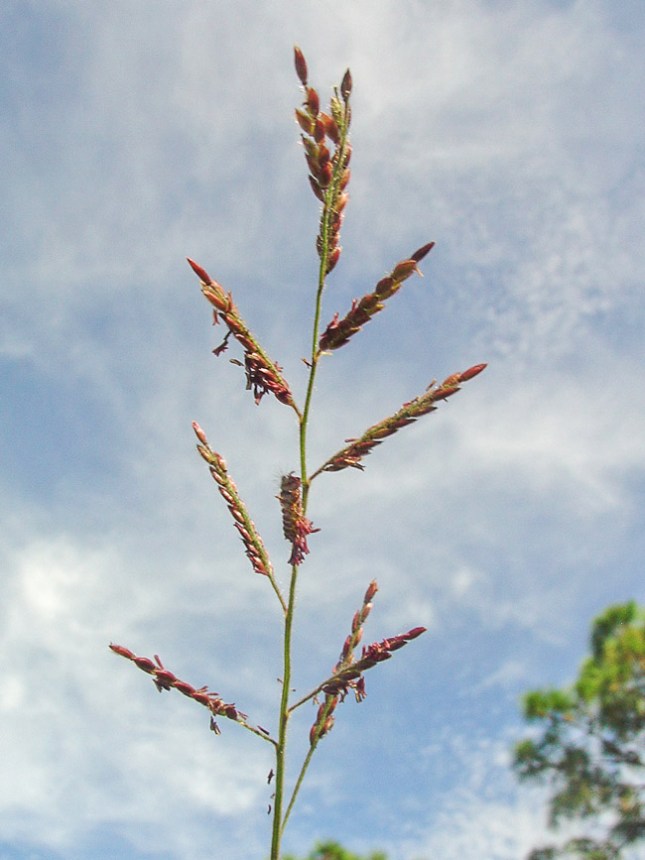
What’s Cup Grass Have In Its Cup?

Eriochloa michauxii and related species

(Eriochloa is Latin for “woolly grass.”  Andre Michaux, 1746-1802, was a French  botanical explorer in the U.S., and elsewhere.)

Poaceae

A genus of grasses a treat to encounter around here, not that often, are the Cup Grasses, in the genus  Eriochloa.   Eriochloa michauxii is native, joined by a couple of uncommon non-native or marginal species in Florida.

Er_michauxii3

Eriochloa michauxii by John Bradford

Overall, the genus is known for its adaptation to salty habitats, especially by possession of salt removal glands in some species, but that is not the main point of interest today.    Here’s the thing:

Why are they called “Cup Grasses”?

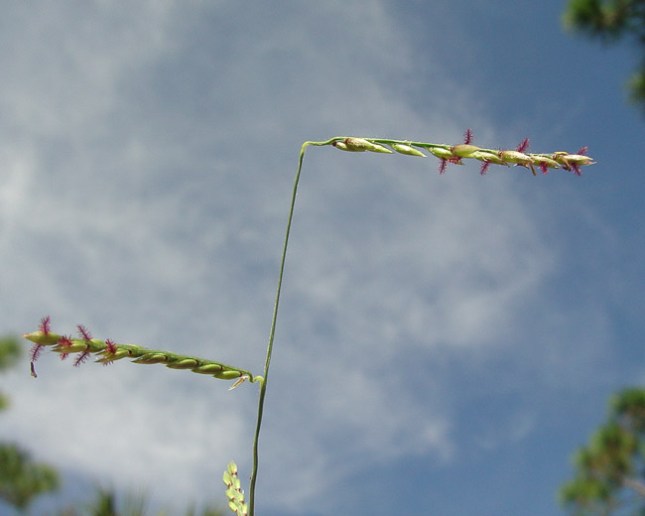
Each flower-fruit unit (spikelet) sits atop a little cup, like an egg in an egg cup.

And that being so, what good is that cup beyond helping with identification?

Er_michauxii4

By JB

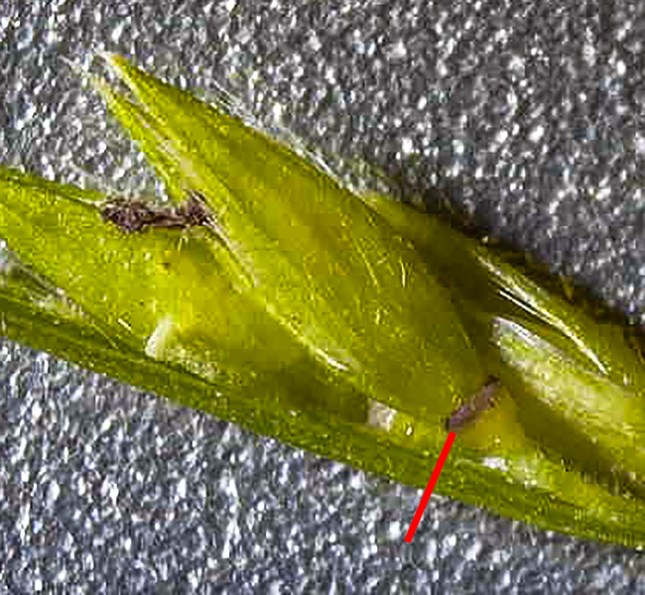
Botanists of yore thought the cup represented a modified leaf associated with grass spikelets (the lower glume), but no, the cup has emerged via fine research as an entity of its own,  curiously with a thin membrane around the rim.

Eriochloa cup

Microscope view of the cup and its rim (red bar).  The spikelet (containing flower, fruit) is the big green speartip rising from the cup diagonally across the image.

A cup, especially one with a thin extra lip around the rim must hold something.  It does…bits of fatty material, lipids, the membrane edge probably protecting the greasy contents during the collection phase.  I’m not sure exactly where the lipids originate to wind up in the cup.   Either the chalice makes the fatty deposits, or they drop in from above.   In any case, the enriched cup falls away with the spikelet at dispersal time and seems to be a goodie basket for hungry ants enticed by a fatty  treat to drag the spikelet with benefits back to their nests, thus dispersing the grass species.

 
7 Comments

Posted by on November 30, 2018 in Cup Grass, Uncategorized


Tags:

Middle Aged Meadows and the Middle-Loving Plants

I’ve always loved sunshine, butterflies, goldenrods, and fragrances in cheerful meadows evocative of childhood memories.

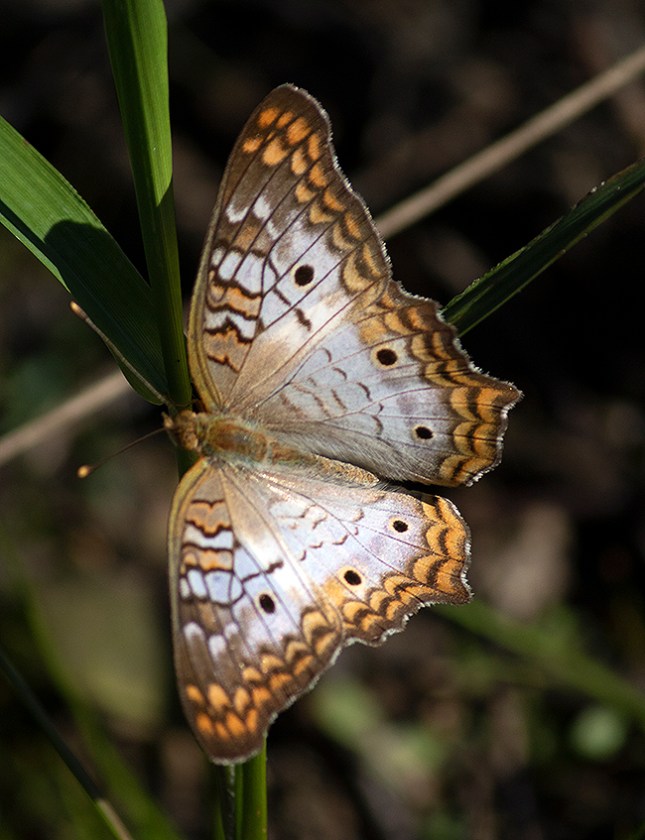
Meadow Peacock

Meadows and butterflies, it’s only natural!

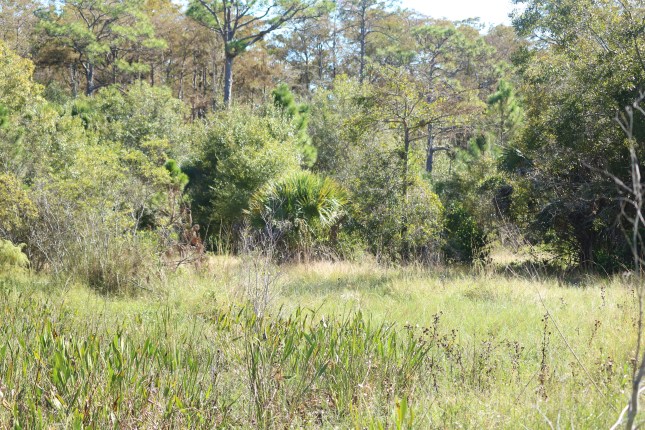
Attractive meadows in the Cypress Creek Natural Area near Jupiter, Florida, reflect several years of recovery after clearing and abandonment.   They represent a middle-successional stage.   Let me explain:

A textbook topic in Ecology is succession. Setting aside a couple controversies, the concept of ecological succession traces the history of a cleared area from its recolonization by annual pioneer weeds through a series of  plant communities onward and upward stepwise to a stable “climax” forest.      The stages and “final” outcome depend on the starting conditions, the basic habitat, and events.   The general trend with passing decades is from small and ephemeral toward large, heavy, and long-lived.

IMG_0582.JPG

Today’s meadows represent a middle stage in succession.  A fairly predictable clique of species dominates such a mid-successional moist meadow.  What do the middlers have in common?    They are not just midway in successional time, but also in structure,  not exactly weeds,  pretty big, but not exactly hunky woody shrubs or trees either.   Tweeners adapted to life in the middle, just like 8th graders in Middle School.

As succession begins the pioneer weedy species compete mostly simply to arrive, persist briefly, and disperse seeds.   But conditions change, becoming more crowded with the incoming  species being ever-taller and broader.  Mid-succession competition becomes a fight for the light, the winners rising above those who came before.    Then still later at the climax community the competition shifts again, to bearing  youngsters able to cope with the canopy shade.

Let’s go back to mid-succession and that contest to rise into the life-giving light.  The perennial weeds in our meadow are fairly tall:   goldenrods, musk-mints, and bluestem grasses as tall as I am.    The species able to surpass those perennials often are bare toward the base where the sun don’t shine,  the foliage held at 4-10 feet as required to overtop the big weeds.   Achieving comes to require some degree of woodiness.

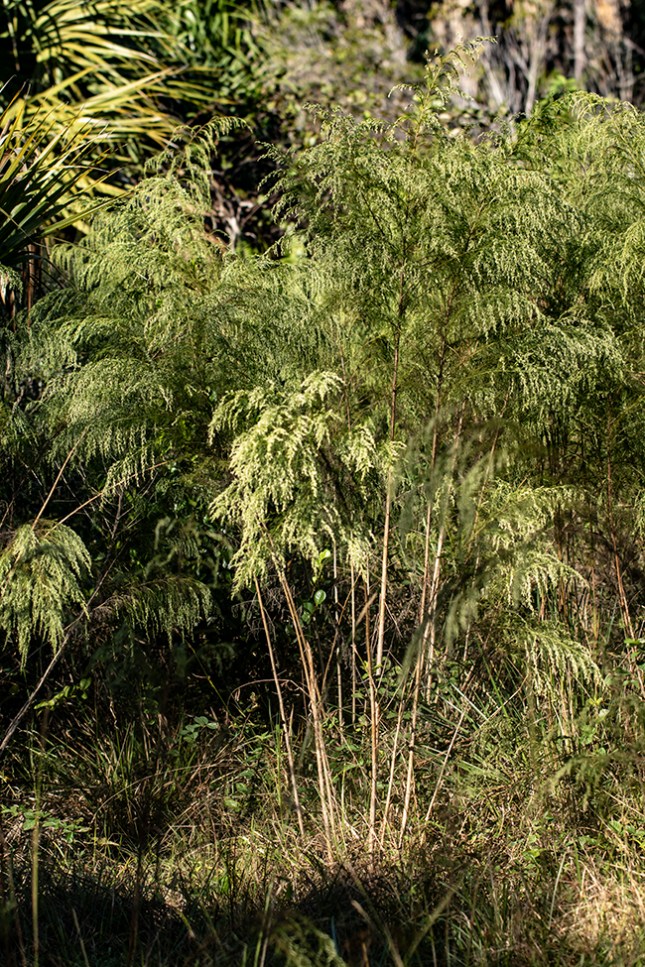
Meadow fennel

Dog Fennell with bare “bamboo” stems lifting the foliage above competitors.

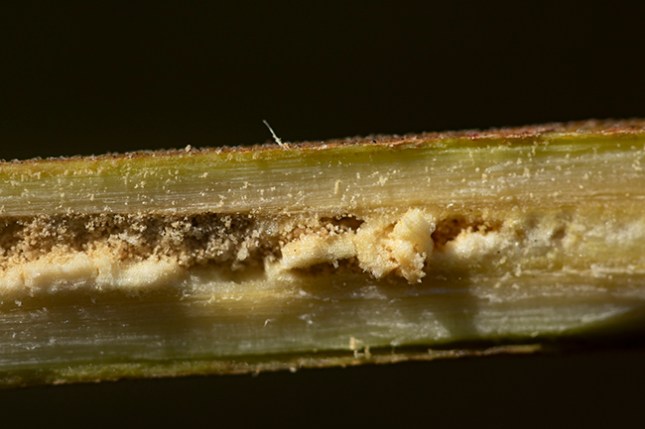
The “beginner” of woodiness is Dog Fennel,  often with stems resembling bamboo, even by having “tubular” construction the stem becoming a slightly woody cylinder around a soft pithy core.   The stems live just one season yet become just woody enough to carry the canopy aloft.   The perfect balance between “fast cheap expendable growth” and height.  It can’t decide if it is a pioneering weed or a woody shrub, a little of both.

Meadow fennel pith

Dog Fennell almost hollow.

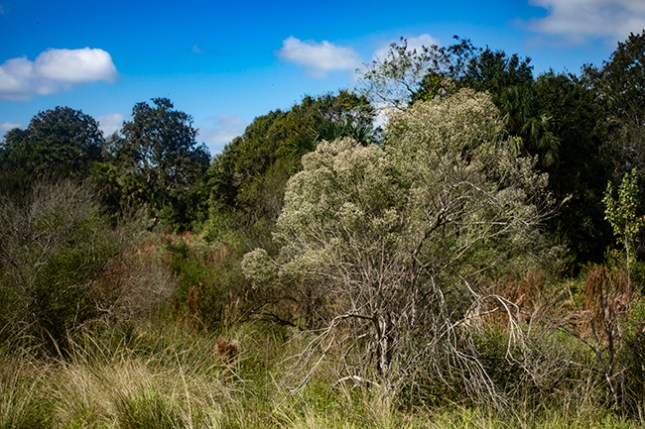
Also dominant are Saltbushes.   Along with Dog Fennell they represent the Aster Family which is usually non-woody, yet these Baccharis species have just enough woodiness to stand up and fight.    Relevantly, biologist P.B. Tomlinson, in his “The Biology of Trees Native to Tropical Florida” noted how  despite having a woody trunk, Saltbushes “more resembles an herb.”  He observed further that, “most of the woody branches are short-lived so that older plants are characterized by a mass of dead twigs.”

Meadow Baccharis

Saltbush, alive up high, shedding dead branches down low.

That tendency toward dead twigs sounds like abandoning crowded older growth in favor of new growth where sunlight is plentiful.   Saltbushes are not alone in tending to go bare down low.   Slash Pines appear as saplings early in succession, growing with the successional stages.  As they rise, the pines have an early bare base, and then begin a lifelong habit of shedding lower branches.  Observers usually interpret this as protection from ground fires, but that does not rule out a secondary benefit of lifting the leafy crown above rising competitors (which could fuel a ground fire).

Meadow pine

Another species sometimes prone to die down low  and  renew with tufts of leaves up high is Wax Myrtle, one of the dominant mid-successionists.   It and Saltbush have separate male and female individuals.

Meadow Wax Myrtle older

Wax Myrtle can dare to be bare below, with tufts above.

Wax Myrtle is one of the select few plants other than Legumes to have nitrogen-fixing root nodules,  giving it a competitive advantage on the terrible soils underlying the entire meadow.

Meadow nodule

On the Wax Myrtle root.

 
8 Comments

Posted by on November 16, 2018 in Meadow Succession, Uncategorized


Cypress Twig Gall Midges Make Big Blue Galls

Taxodiomyia cupressiananassa

Cecidomyiidae

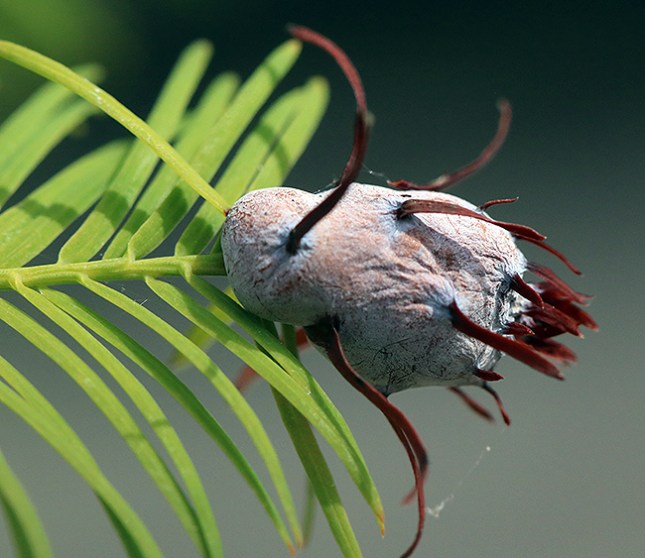
What family has the most species in the animal world?   Here is a contender, observers estimate up to a million species in the Gall Midge Family, with over 1000 named in North America alone.  They are micro-flies able to induce galls on plants as larval homes.   Many arthropods make galls, and today’s galls are the big waxy-blue eye-grabbers of the Cypress Twig Gall Midge.

Taxodium stand

Bald Cypress

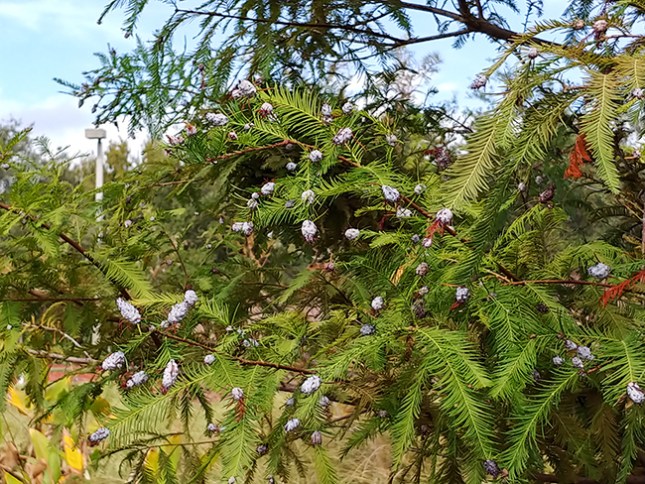
John and I were working yesterday in the aptly named Cypress Creek Natural Area, walking along the edge of a compelling Bald Cypress population.  This species has the most intriguing quirks, for instance some of the most “ornamental” galls I’ve ever seen.  The galls can be numerous, on the  tips of its twigs, looking from the distance like some ripening fruit.  They are the work of the Cypress Twig Gall Midge (and maybe sometimes a second related species).  It decorates Bald Cypress, Pond Cypress, and the Montezuma Cypress native to Mexico.

Taxodium branch galls

The galls look like Juniper “Berries”

Members of the Gall Midge Family in a general sense can be pests and parasites on plant pests, that is, they can seem to protect their host tree, a benefit employed in horticulture for natural biocontrol.  I don’t know if the Cypress Twig Gall Midge (CTGM) bugs other pests, probably not, but it does suffer its own parasitoids…parasites on the parasite.    The structure of the gall therefore no doubt serves to protect the CTGM larvae cowering within from parasitoids, and from larger predators.

Taxodium gall whole

What is the gall’s structure?  It is soft, spongy, surprisingly large, to over an inch long, and coated with a blue-white powdery material suggestive of ripening fruit.   Larvae embedded in it may be nestled safely away from most parasitoids and predators.   But there could be more to the gall structure.

taxodium gall open

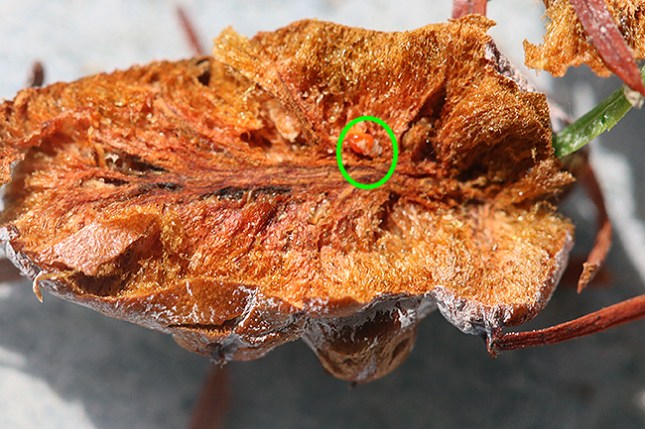
Gall opened.  There are many tiny midge larvae per gall.

And with that, we enter the speculation zone.  Beyond protecting the larvae, are there additional reasons why the galls are big, lightweight and spongy, and colorful?   How about helping to disperse the midges?   Not just storage…but moving and storage.

Bird Dispersal

The galls are the color of juniper “berries” and suggest bird-dispersed fruits.   I don’t know if birds peck them, but there a hint of plausibility hidden in a small literature on insect larvae dispersing via a bird’s guthttps://www.ncbi.nlm.nih.gov/pmc/articles/PMC1617192/

Dispersal could occur even if a bird merely pecks at the soft gall or rips part of it free and drops an uneaten fragment elsewhere.   The midges reportedly mate upon emerging from the gall, so a gall chunk with even two of the average reported 16 larvae per gall could relocate potential mates together.

Rodent Help

The galls occupy  the twig tips.  The twigs are deciduous, so the galls land on the ground. Rodents and ground-dwelling birds, even large insects, could move them or fragments hither and thither.

Floating Around

The galls bob like corks, remaining dry and waterproof.    The twigs and galls drop more or less during the relatively dry season, but then again, it does rain during their “on ground” time, some places such as creek banks have  water year-round, and we don’t know the entire temporal-spatial history of the galls anyhow.  Maybe that waxy coating has to do with flotation,  water-proofing, and decay delay.

Final Mystery

As a closing note,  biologists George Washburn and Sunshine Bael last year found a connection between midge success and fungal diversity within the gall.  The galls are little fungus gardens.   Who knows why? Do the fungi help sustain or protect the midges?   Or do midge larvae in the gall promote fungi? Or both?  Neither?  Are larger galls merely better habitats for larvae and fungi?  Does the mother midge inject fungi during oviposition, and if so, why?


Dahoon Holly …the Dollar Tree of Fruits

Ilex cassine

(Ilex is an ancient name for an Oak.   Cassine comes from cassina, the Black Drink, see below)

Aquifoliaceae, the Holly Family

Ilex cassine 5

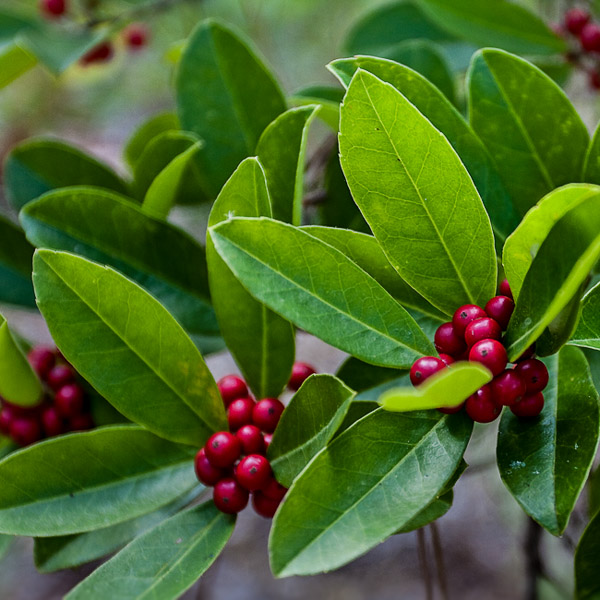
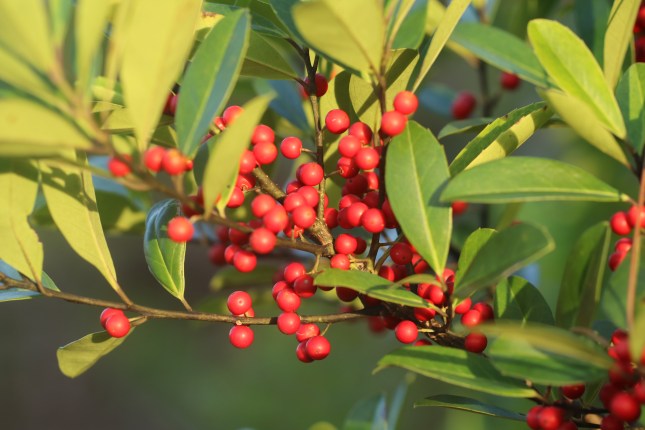
Dahoon Fruits by John Bradford

Beautiful autumn in the Florida woods: cool at long last, fall color in the Poison Ivy, goldenrods,  “asters,”  and Dahoon Holly berries (technically drupes) holiday festive in red, orange, and yellowish.  Lots and lots of them.

Dahoon Holly was the celebrity this morning as John and I chased ugly little weeds at the Haney Creek Natural Area a little north of the St. Lucie River.

Ilex cassine 8

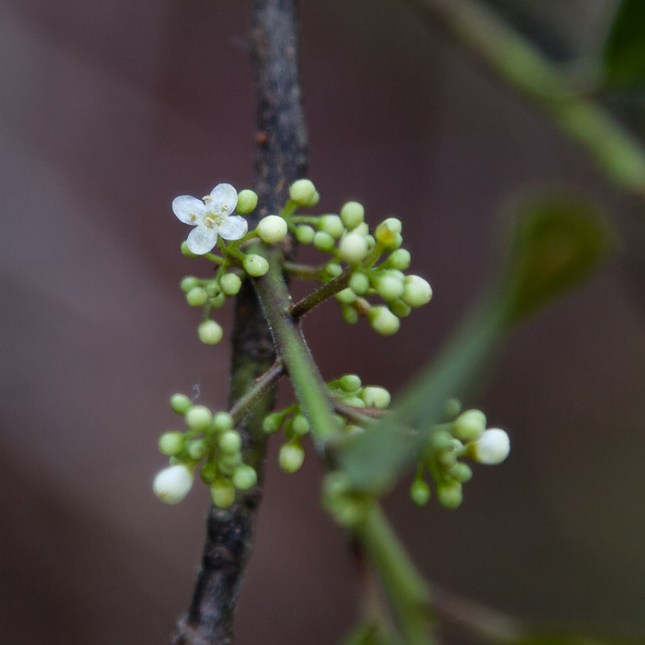
The Dahoon had flowers today, by JB (this photo not taken today however). This is male, the males and females mostly on separate trees.

To take care of the “internet-type” story first, the species name cassine comes from cassina, the Black Drink consumed by prehistoric peoples at big shindigs along the southeastern coast, and by early settlers, including  future Philadelphia Mayor Jonathan Dickinson, not to his taste.

Hollies are among the few plant groups in addition to coffee and tea offering beverage-worthy levels of caffeine.  Around the world, there are holly-based teas, most notably Yerba Mate in South America and in Publix Supermarkets.   Our local holly tea was the Black Drink with two native species in the brew…Yaupon, Ilex vomitoria, and Dahoon, Ilex cassine.  The former may have been more important, although that detail is lost to history.

Ilex cassine lichen

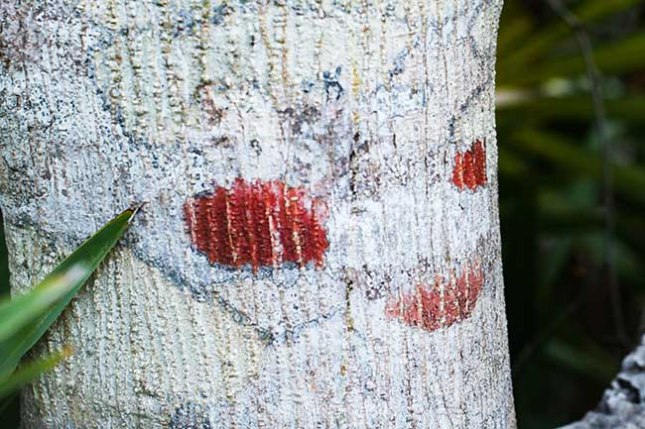
Dahoon tends toward white bark,  often decorated with smiling red lichens.

Don’t bite a Dahoon Holly fruit or leaf.  They are astoundingly bitter, as I experienced today, resembling in flavor the related and well named Gallberry, Ilex glabra.  Chugging the Black Drink caused retching, after all. Why would such delicious-looking fruits, the colors of apples, taste like Athlete’s Foot medicine?

First of all, they may taste better to the deer, small mammals, and birds who eat them, although I do not believe it.   The fruits persist largely uneaten from autumn into the winter when the flavor presumably improves.  This is a general characteristic of Hollies, and observers contend that Holly fruits become tasty(er) during winter in order to sidestep the competing rush of fall-ripening fruits on other species.   Wait them out and be the only game in town later, perhaps matching the seasonalities of certain birds. Holly fruits are reportedly “cheap,” low in fats and sugars, and thus probably not very competitive when everything else is ripe in early autumn, and then more attractive later freed of  competition.  “We’re lousy fruits but all there is.”

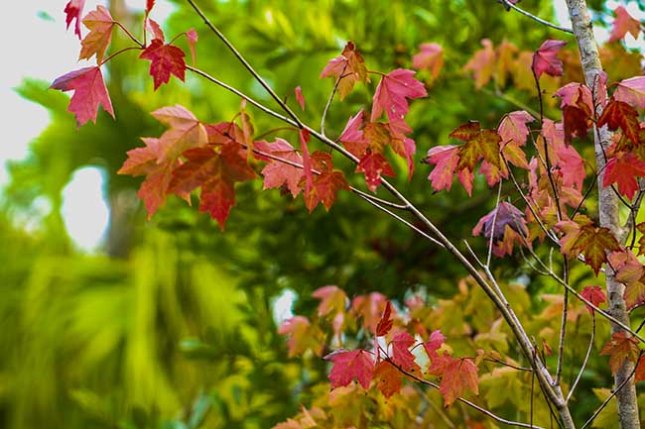
Acer rubrum leaves Baker Rd.

While we contemplated the Dahoon today a posse of raccoons watched from a tree.   Whether or not they enjoy Dahoon fruits is unclear, and I did not examine their droppings for the characteristic “seeds,” which come four per fruit.

IMG_0032

For the most part, Dahoon Holly is a species of marshes and swamps.  And that brings us to what I think is the interesting part:   these species are “at home” at every phase of ecological succession from soup to nuts.    Let’s stop a second and set the stage:

If you destroy a mature forest  (fire, storm, flood, machinery) and let it regrow, getting back to “mature” is step-wise,  requiring a series of communities occupying the site replacing each other over decades, from early “pioneer species” (mostly low weedy temporary plants) to the final woody “climax community.”   Dahoon Holly owns the entire process.  It is shade tolerant and can became a large tree in a mature forest community.  Upon becoming large it forms a broad base with prop roots.

In a middle-aged, shrub-dominated swamp or marsh, look for the Dahoon Hollies rising above the saw palmettos, buttonbush, and wax myrtle.    And now the really good part: in an open, young,  perhaps fire-cleared marshy area dominated by small more or less herbaceous plants, such as Painted Sedges, Grasses, and Xyris, puny Dahoon Hollies merely three feet tall join right in and show off big lurid fruit displays. You could (and I have) mistaken them for milkweed flower clusters from the distance.    The little Dahoon Hollies seem to “prioritize” and invest disproportionate energy in reproduction while still toddlers.

Ilex cassine young 1

This tiny Dahoon  has more fruit than the rest of the plant’s mass put together.

What may allow this is that “cheapness” of their fruits as we just considered.  Maybe a baby can’t muster the energy needed to make garish displays of fatty sugary fruits, but cheap fruits…all show but no nutrition…hey, no problem, how many do you want?


Tags: , ,

Spirogyra…Pond Scum On the Move

What do we have in common with Charles Darwin?   Wondering about the weird and beautiful Green Alga Spirogyra doing the hokey pokey, moving all about, a little surprising in a filamentous photosynthetic true alga.  What’s up with that?

If Darwin couldn’t figure it out, I can’t.  Perhaps there is no function to it, with the movement being a byproduct of growth?  Check it out and go figure:

See the Spirogyra in action in the brief footage below.    The video has been sped up 10X:

CLICK HERE   to see what Darwin saw (The tiny dancers are varied aquatic microbes.)

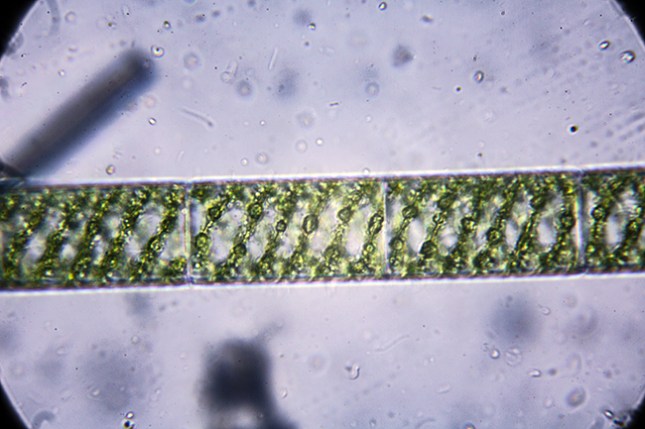
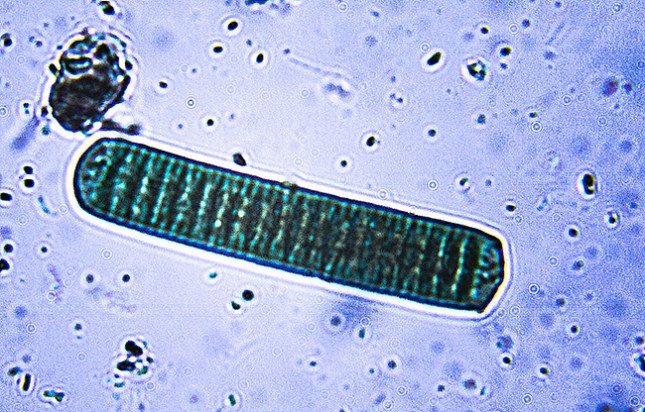
These freshwater algae have the world’s oddest chloroplasts, twisted like a ribbon running the entire length of each cell.  It must be a good arrangement, as there are 400 different species, having anywhere from one to many helical ribbon chloroplasts per cell.    We ask again, why?   It looks like the spiral shape might be a consequence of the overall cell growth pattern.  The cell wall grows in a helical pattern, and the shape of the chloroplast conforms.   Like a spring, it is stretchable…a “plus” in a cell with the rare condition of each chloroplast running the length of the cell.

Spirogyra chloroplasts.jpg

Those thickenings you see in the green chloroplasts are called pyrenoids (PIE-reh-noids). They are points of starch formation and storage.

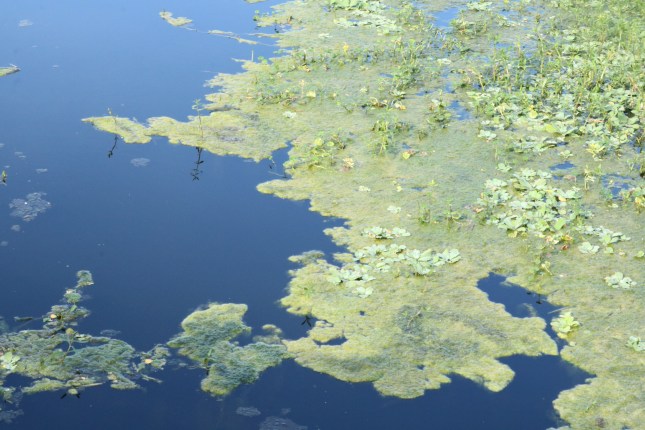
Sometimes an algae-filled pond has a different look at the end of the day as opposed to dawn.   Some algae and so-called blue-green algae rise and fall on a daily cycle, sinking during the night and bobbing to the surface during the day.   In Spirogyra the simple and probably partially accurate explanation is that  during the day oxygen from photosynthesis collects in the algal mat, causing it to float upward.  That serves the alga well by placing it above the competition for sunbeams.

At night oxygen loss diminishes buoyancy, and the mat sinks.    I think I’ve seen the mat rise sooner under sunny conditions, delayed by shade.    You can see it too below.   The Spirogyra you’ll see is on my back porch in a closed plastic bottle about a foot tall.  It yo-yos up and down daily.    The rise recorded in the short time-lapse video below was in bright sunshine.    It resinks in the dark after my bedtime.  The dark bodies dancing around are time-lapse snails.

CLICK HERE to see the Spirogyra rise up

 
3 Comments

Posted by on October 21, 2018 in Uncategorized


Bluegreen “Algae,”   Pink Flamingos, Red Tides, (and Nonpolluting Buses)

Cyanobacteria

Not many plants have a more diversified story than Cyanobacteria.  We know them in Florida as villians of “toxic algal bloom” news, featured even in the gubernatorial race.    That horror story is not my focus today.  Google will unleash that mess abundantly already.  Quickly, however, toxic “algae” blooms are not limited to the Florida Active Adult Lifestyle.  Ask the residents of Toledo who drink Lake Erie, or what’s left  of my home town, Wheeling, W.Va. where “a green paint spill” reported in the Ohio River turned out to be Cyanobacteria.  The problem is global, making it tough to point the finger of blame too ardently at any particular political entity, or demanding simplistic politicized “do something.”

IMG_3961

Now hear this!…bluegreen “algae” are not algae.  They are Cyanobacteria. Even though the term “algae” is vague, Cyanobacteria are no more algae than I am.  They are large photosynthetic bacteria.

Cyanobacteria or similar paleo-germs are contenders to be the oldest life on Earth.  The globe is about 4.5 billion years old, with Cyanobacterial evidence extending back over 3.5 billion years.   Contrast that with humans, here for maybe 2 million years.    So then Cyanos are some 2000 times older than we are.  We curse them for polluting rivers, yet, looking back a few billenia, who kickstarted  the biological world with original oxygen?

BGA from fish tankCLOSE2

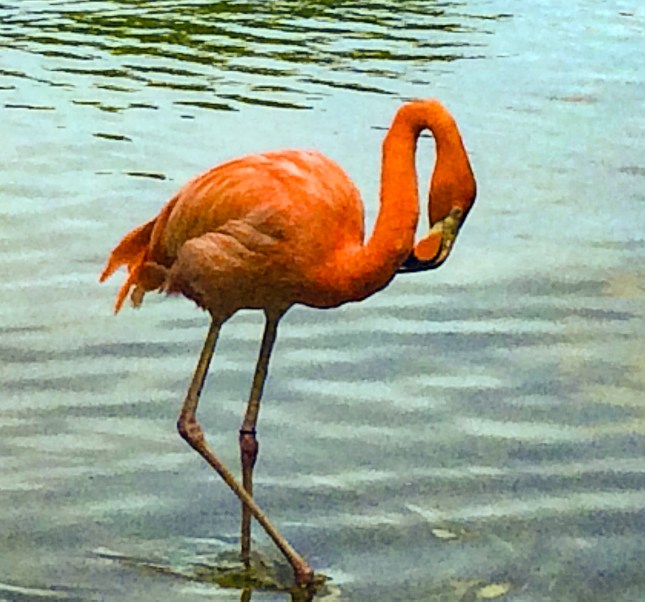
And even better, who makes the Flamingos pink?   With variation from species to species and from place to place, in a general sense Flamingo pink coloration owes mostly to pigments from Cyanobacteria, including the genus Spirulina on sale now in a health food store as a dietary aid.   I wonder if Spirulina over-consumption will give a ruddy glow.  (Just kidding.)

What about those pink Roseate Spoonbillls John and I witnessed today in Riverbend Park? They are more carnivorous than Flamingos, and their rosy pigments come from the little creatures they catch in their spoons, although ultimately the pink ink comes from plankton, presumably Cyanobacteria and perhaps also true Algae.  In the Spoonbill’s case, the path to pink may be complex.

CLICK HERE for quick peek at some Spoonbill Action!

Cyanobacteria have astounding grit.   They grow on trees, on rocks, on my back porch, on wet concrete, and mostly in salt and fresh water, where we may try to suppress them with shade.  Shade doesn’t work; some species cope by using cells called akinetes (AY-kuh-neats) able to sink and wait out bad times.

Many Cyanobacteria, especially planktonic species, including the Microcystis in toxic blooms,   have “air bladders.”  When the cell is near the sunny water surface photosynthesis there depletes buoyant carbon dioxide from the bladder and creates sinky heavy carbohydrates.  The cell thus loses buoyancy and sinks to deeper waters where there is less sun and more nutrients, such as phosphorus.   Down in the dark, the cell stocks up on nutrients, burns its heavy carbohydrates, generates carbon dioxide back into the bladder, and rises anew.  The yo-yo cycle is daily.

Lyngbya

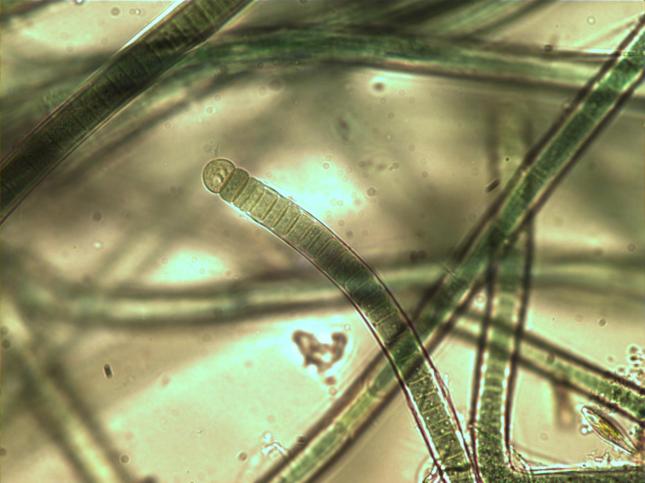
Lyngbya, with sheath

Fast growers demand much nitrogen.   Problem is, most plants can’t use nitrogen gas from the air.   Good thing we have Cyanobacteria with specialized cells called heterocysts to convert atmospheric nitrogen to ammonium fertilizer to their own benefit, to the benefit of plants that share their soil,  such as in Florida wet prairies, and to the benefit of many symbionts.

Cyanobacteria have more symbiotic relationships than you can shake an alga at.  They hook up with:  true algae, cycads, diatoms, ferns (including the floating fern Azolla used to fertilizer rice), flowering plants, fungi, hornworts, liverworts, marine worms, mosses (including Sphagnum), radiolarians, sea squirts, sponges by the dozen, and more, including partnerships awaiting discovery.  Oddly enough, if we shift our attention momentarily to the Red Tides befouling the beaches, those little agents of destruction are Dinoflagellate Algae, and guess what, Dinoflagellates and Cyanobacteria are known to have symbiotic relationships.   Every Cyanobacterial symbiosis has a story, but enough is enough for now.

Yet permit me one little example, the Southern-Hemisphere flowering plant genus Gunnera is unique so far as is known, having cyanobacteria living inside the host’s cells.   This growth-promoting intimacy is of interest in a hungry world, not merely because some Gunneras are food, but conceivably the little internal fertilizer generators could be extended to other crop plants.

Now for the surprise ending.  Not all Cyanobacteria are photosynthetic.  Recently in Spain some  turned up 2000 feet underground.   They get their energy from hydrogen just like a fuel cell.  Just think, the most primitive “plants”  of the deep past are demonstrating the most advanced energy form we know.

flamingo

Photo by Donna Rogers


Tags: , ,

White Star Sedge Can Tell Time

Rhynchospora colorata

(Rhynch-o-spora means snout-seed, and colorata has obvious meaning.)

Cyperaceae, the Sedge Family

Sedges are a funny family.  They look like Grasses at first glance, but have their own ways, and weird tricks up their sleeves.   One trick is insect pollination salted among the species.  That is a wee bit of a surprise in an almost entirely  “classic” wind-pollinated family.  “Almost” is the key word.  Many  sedges, not all of them related to each other, have switched from wind pollination to complete or partial insect pollination.  Given that insect-pollination is the original pollination mode in flowering plants, you could say these buggy sedges have switched “back” to insects from wind-loving ancestors whose own ancestors needed insects.   Flip flop flip.  If you switch “back” to insects you don’t have the original insect-attracting equipment:  nectar, fragrance,  or colorful petals. Your insect-pollination-evolution has to re-start from scratch.

The insect-pollinated sedges have reinvented insect-pollination offering pollen instead of nectar, using showy yellow anthers and white or yellow bracts (specialized leaves) in place of petals, and have reinvented sweet floral fragrances.

Rhynchospora latifolia 4.jpg

Rhynchospora latifolia by John Bradford.

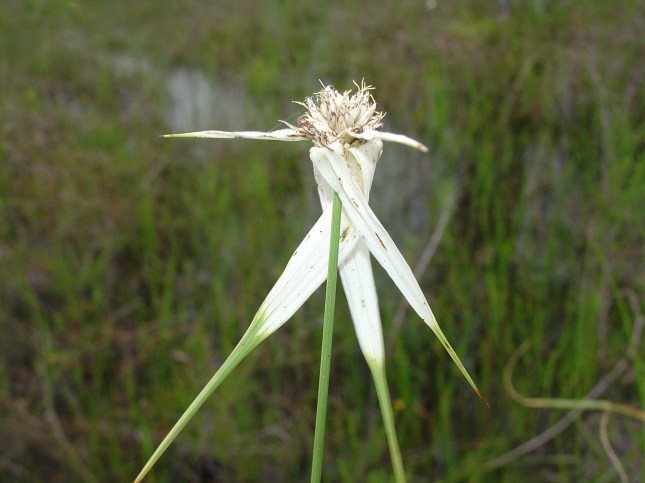
The sedge stars of insect pollination around here are species of the large and diverse genus Rhynchspora differing from the wind-pollinated species most obviously by having showy partially white bracts spreading out like petals.   When I was younger these species were known as Dichromenas (die-crow-MEAN-ahs).    The two common ones in our immediate area are Rhynchospora colorata on neutral soils and its larger cousin R. latifolia preferring acid soils.  We’ll zoom in on the former.

Its pollination is by bees.  Watch this short video to get the buzz:

CLICK HERE

The bee is a zippy rascal, so the footage is slowed by about 2/3 for easy viewing.

On top of the bee visitation, the flower has a second odd ability, to tell time.  I first learned of this talent about a similar, Brazilian, species botanist E. Leppik described in 1955 as attracting bees during mid morning,  being bereft of bees earlier and later in the day.   Although my visitations at those hours are sadly  constrained by the need to go to work,  I see the same behavior in R. colorata here.

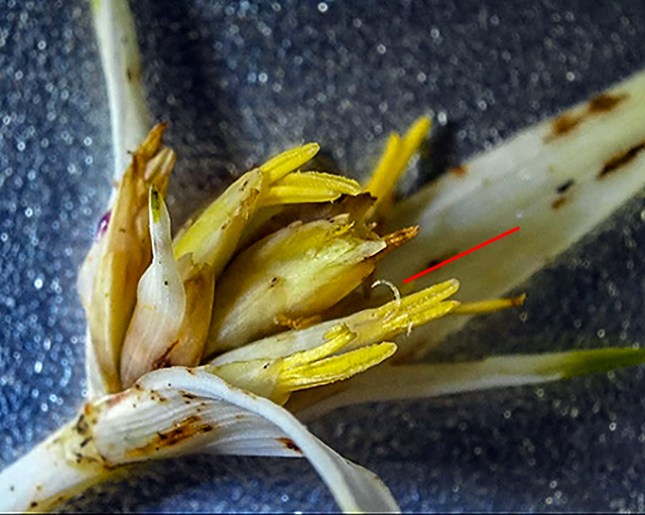
Early in the morning, the flower heads are not fragrant while they are launching the pollen-producing anthers, which become yellow and showy, and pollen-receiving stigmas,  which are inconspicuous and more ephemeral than the anthers.  The stigmas seem to become receptive before the adjoining anthers mature.

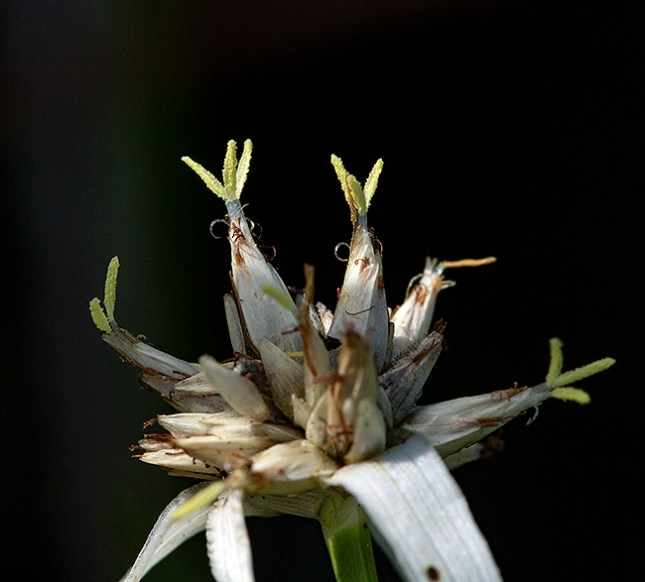
Cyperus colorata early AM

Above. Approx. 7:15  AM.  The big yellow anthers peeking out but not yet expanded. Stigmas emerging too, the curled white one marked with red pointer seems to be ahead of the anthers.

Rhynchospora colorata 1015 AM Second Photo

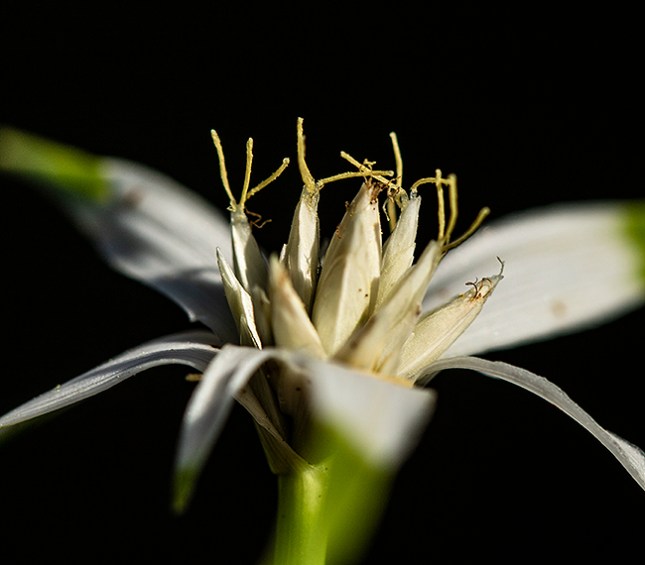
Above:  Approx. 10 AM. Bee time.   Fragrant. The anthers, dusty with pollen, standing up yellow in triads.  The curly white delicate stigmas below them apparently at their prime as well.

Rhynchospora colorata evening

Above:  Approx. 6 pm.  Stigmas withered and brown.  Anthers still present but losing color, losing perkiness, losing organization,  losing pollen.

Roughly 10-11 AM (on our current DST) the stigmas are white and glossy; the anthers protrude in jaunty clusters of three yellow covered with granular pollen; and the flower heads smell oh so fragrant.   This is the only time I’ve seen bees visiting.

By dusk the stigmas are gone or at best brown and withered; the anthers may or may not still be there, and when remaining, the pollen in gone or vastly reduced; and the floral perfume is gone or nearly so.

Leppik noted multiple species of Brazilian bee visitors, mainly stingless bees of the large genus Trigona.  We have stingless bees in Florida.  Perhaps R. colorata is important to them.   I think a pollination study of the Floridian insect-pollinated sedges would be worthwhile, if that has not occurred, and I can’t find anything like it using Google.

Rhynchospora colorata spreads into rhizome-bound clonal patches in open wet habitats, such as shores,  either mixed with other species or nearly a monoculture.   Sedge rhizomes are interesting in their own right.  They often accumulate starch generously, although it is hazardous to over generalize about a few thousand species.   Water-chestnut in stir-fry is a thickened sedge rhizome.  The hated weed purple nutsedge has prehistoric  value for its edible thickened rhizome tubers dating back almost 9000 years in Subsaharan African archaeology.     Likewise weedy locally, Yellow Nutsedge is the Chufa valued as a tasty tuber in parts of the world.  Does Rhynchospora have its own tasty tuberous rhizome?   Naw, it is slender, yet still rich with starch.

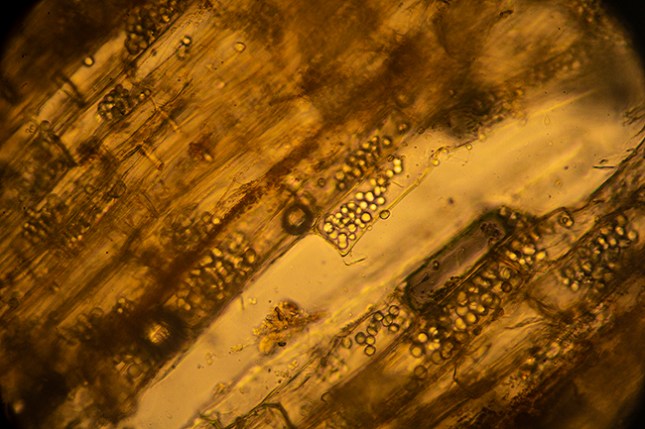
Rhynchospora colorata rhizome starch

Rhynchospora colorata. Microscope view of rhizome. The glassy beads are starch granules.  This rhizome is loaded.

 
2 Comments

Posted by on September 21, 2018 in Uncategorized, White Star Sedge


Tags:

Axil-Flower and Its Topsy Turvy Bees

Mecardonia acuminata

(Mecardonia is a fusion of the name Anton Meca y Cardona, Spanish botanist.  An acuminate leaf is pointy-tipped.)

Plantaginaceae (traditionally Scrophulariaceae)

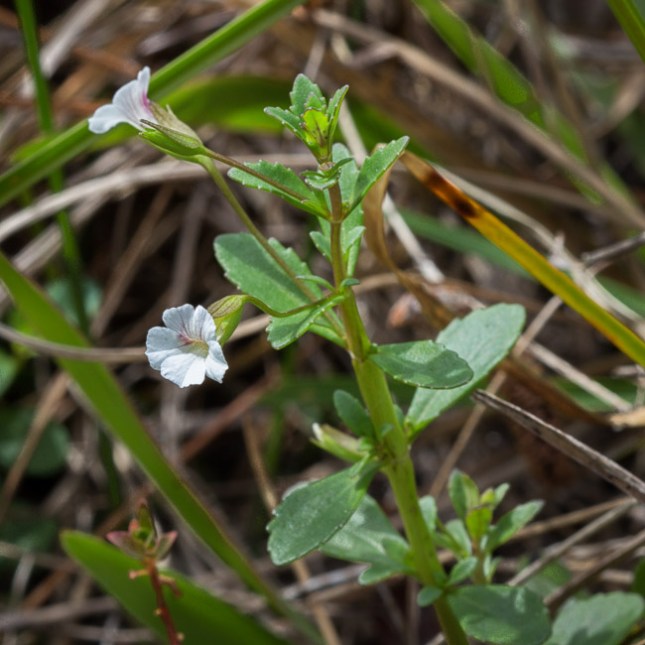
Mecardonia acuminata 3

Mecardonia acuminata by John Bradford.

John and I botanized early this morning in an immense disturbed wet meadow near Jupiter, Florida.    My goodness how certain areas can have an utterly unique flora found nowhere else nearby.    You’ve heard of flyover country, well on a smaller scale there are walk-by plants.  Poor Mecardonia acuminata is a meek species one might step on while looking for something “interesting.”    Everything is interesting, dang-it, and this little native wildflower is a bag of curiosities.

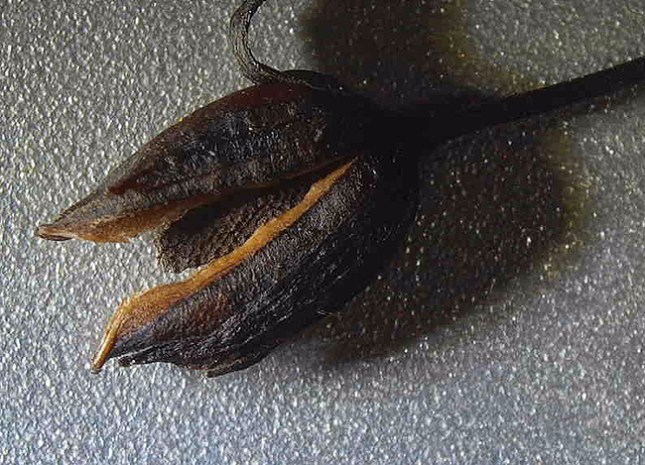
Mecardonia pod

The pod highly magnified.

The first curiosity is the ripe pod turning black, which spreads to the entire plant as it dries.  Such blackening  is scattered among species formerly classified in the Scrophulariaceae, such as our local “black” senna familiar to some readers.  The blackening reportedly comes from iridoid compounds, deterring herbivores and microbes.

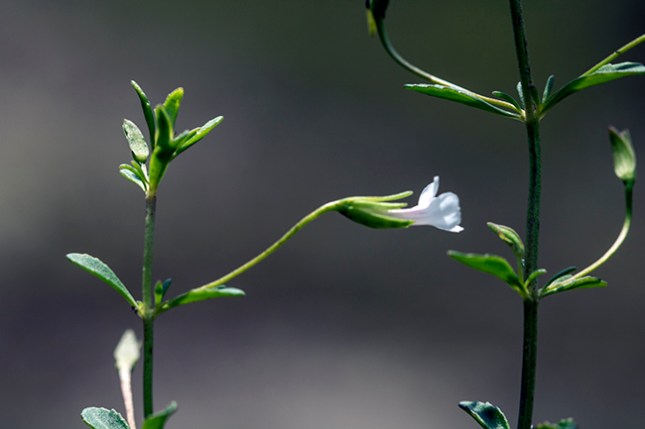
Curiosity number two is the  abnormally long flower stalk, a wand lifting the flower up away from foliage.  These plants grow in the vegetative tangles in squishy mud.   Seems like they have to elevate their blossoms for pollinator access.  Although evidence suggests sweat bees as primary pollinators, I’d not be dismayed to catch a moth or butterfly in the act, and when my imiginary lepidoptrans hover it might help to have the flowers  lifted safely above dangerous foliage.  At least one botanist has supposed  the curvature of the flower tube to thwart moth and butterfly penetration.    For a weird aspect to the wands,  read on:

As biologists A. Ahedor and W. Elisens documented recently, proceeding westward across Florida from east coast to Gulf Coast, the wands diminish progressively, averaging around 22 mm long eastward shrinking down to mid teens westward.  Go figure.   Different environmental conditions?  Different pollinators?   If you transplant a short-wand individual from Sarasota to east-coast Jupiter will it conform to the dimensions of its new lengthy neighbors?  An experiment to try.   Hint: when such experiments are attempted the original condition usually persists, genetically set.

mecardonia axil

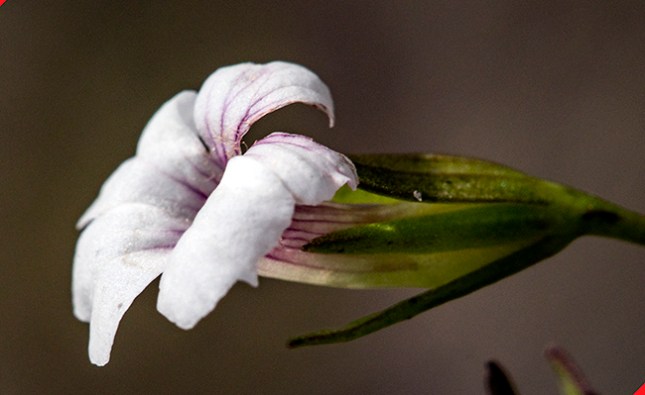
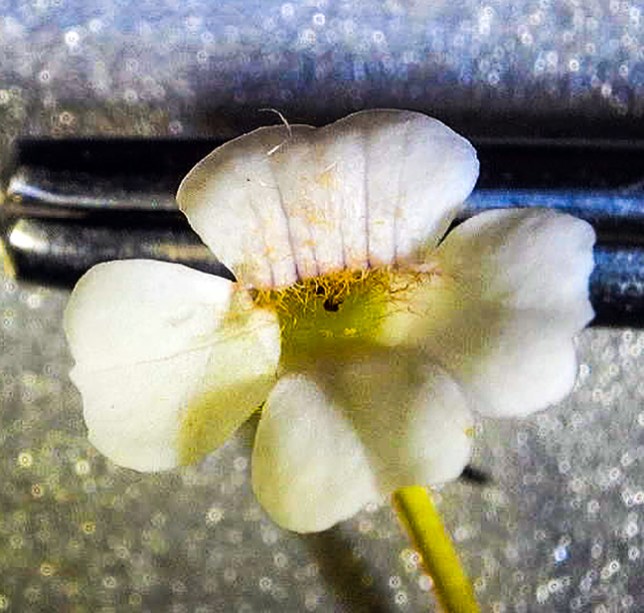
The third curiosity is floral.  Botany textbooks describe flowers pollinated by bees as often being horizontal with a tube, its entrance a landing platform marked with lines, fuzz, or bumps called nectar guides leading in.   But in Mecardonia the “landing platform” marked with pink-lavender nectar guides rises above the entrance like a sign above a door.  Signs above the tube door are not rare, for example, in many orchids and legumes, but there is a big difference.  In those orchids and legumes, even though there is a sign over the door, the plant still provides a spacious and commodious landing platform…the labellum in an orchid, the keel in the legume.  But Mecardonia has no specialized welcome mat at the door.

Mecardonia flower side view Riverbend

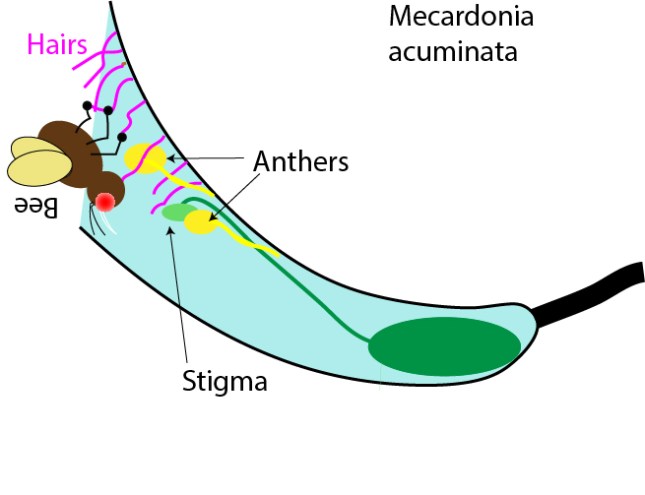
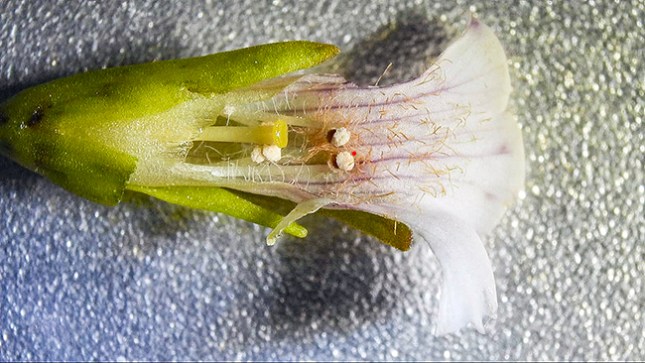
Instead, the upside-down landing platform above the door serves double duty, as advertising and as landing platform.   The bee enters the tube flipped belly-up clinging to hairs on the roof of the tube like a lizard crossing my garage ceiling.  As the bee goes in, its belly brushes against the anthers and stigma.   (There is a long-standing but unproven suspicion of self-pollination as well.)

Mecardonia bee

Observation of the bee walking on the ceiling in the Mecardonia species complex goes back to botanist Federico Delpino (1833-1905), the father of pollination biology.

mecardonia looking in1


Mecardonia open


To dig deeper: CLICK

 
3 Comments

Posted by on September 7, 2018 in Axil-Flower, Uncategorized


Tags: ,

Liatris, Blazing Stars

Liatris, Blazing Stars

Liatris chapmanii and additional species

(Nobody knows how the name “Liatris” originated.   Alvin Chapman was a 19th Century physician who documented fundamentally much of the Florida flora.)

Asteraceae

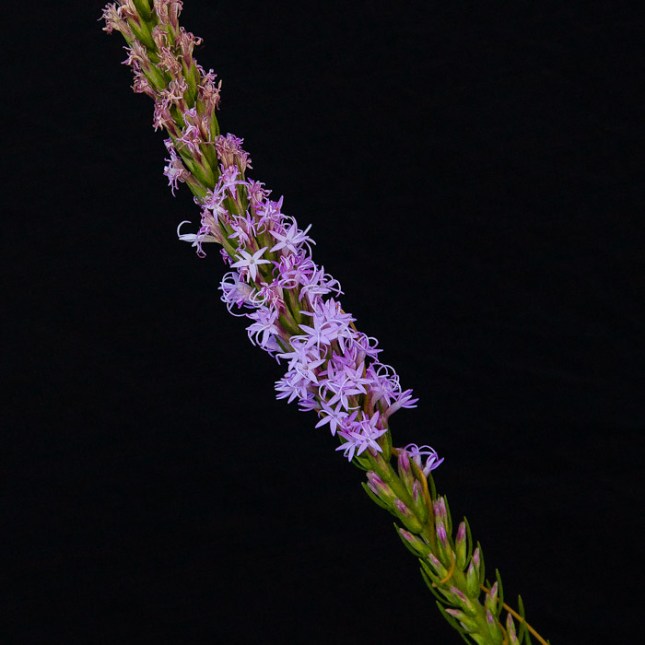
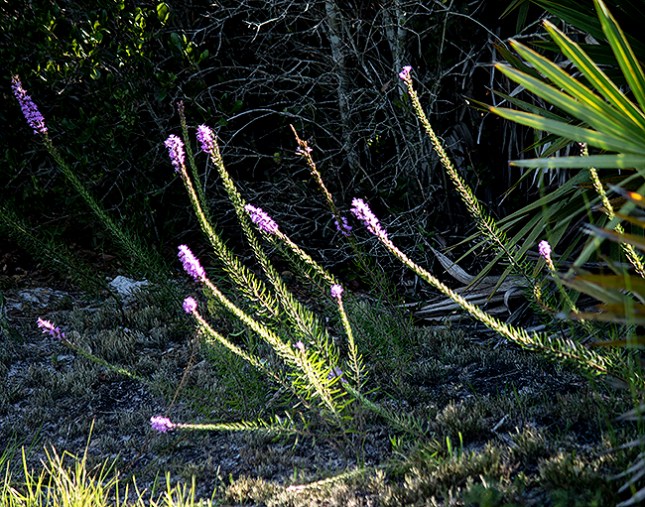
Hot hot hot.  John and I today sweltered across the Haney Creek Natural Area near Jensen Beach, Florida, a mixed habitat with an extensive white sand scrub “desert.”  Sometimes sheer beauty is the main story.   Today the Liatris plumes were surreal, hundreds of glowing purple feathery spikes waving in the wind.    Even master photographer John  can’t capture the sunshine, fragrance, and breeze with a camera.

Liatris chapmanii 5

By John Bradford

Most of those in Haney Creek are Liatris chapmanii, although there are others too. Florida is home to about 14 different Liatris species, five locally, and  four species 100% restricted to the Sunshine State.  Not a bad representation of a genus with only 37 species altogether.

liatris patch

Chapman’s Liatris today

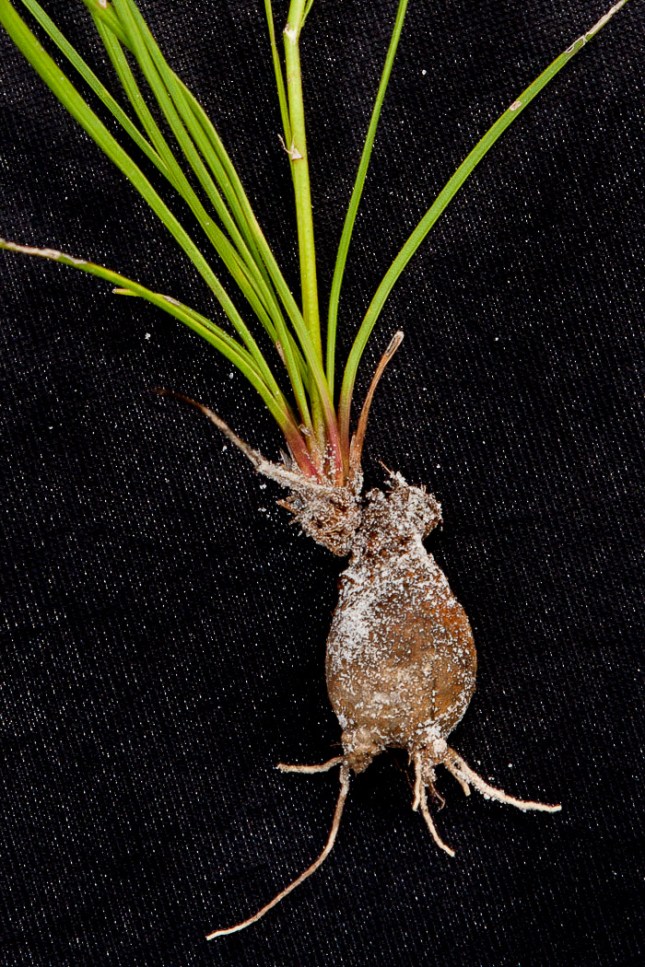
Despite their good looks, these plants are tough, famous for making subterranean corms (thick bulblike stems)  or rhizomes able to hide from fires and other hardships above the soil. Nobody would farm the corms, exactly, but Liatris is a commercially valuable cut flower, especially  the lovely Liatris spicata native to our area and up eastern North America.  The bulbous corms have been grown commercially in the bulb capital of the world, The Netherlands, and from there to Egypt where they flourish to sustain a cut flower industry there.   The corms then became abundant byproducts of that industry, and thus objects of research as potential food and drug sources, complicated by the presence of nutritional benefits and bioactivity at the same time.

Liatris gracilis 5

The corms, by JB

The raison d’etre for the Liatris flower power is to lure pollinators.   Build it and they will come:  bees, butterflies, day-flying moths, and even hummingbirds.   The Bleeding Flower Moth breeds exclusively or nearly so in Liatris flower heads, where its larvae benefit from Liatris-matched camouflage.  More remarkable, the adult moth’s coloration resembles the flowering heads.

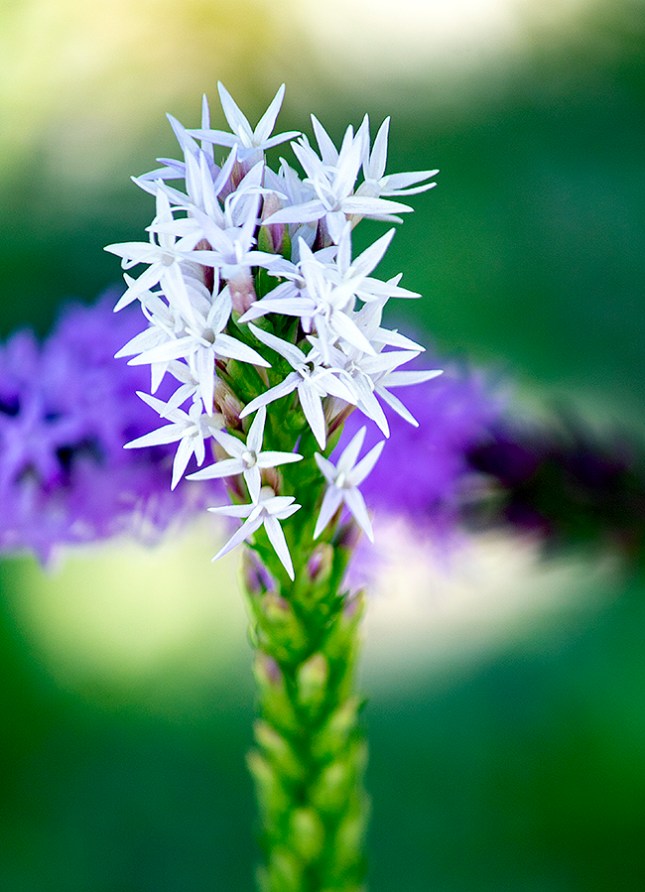
Liatris white

Some mutants are white-flowered. Today.

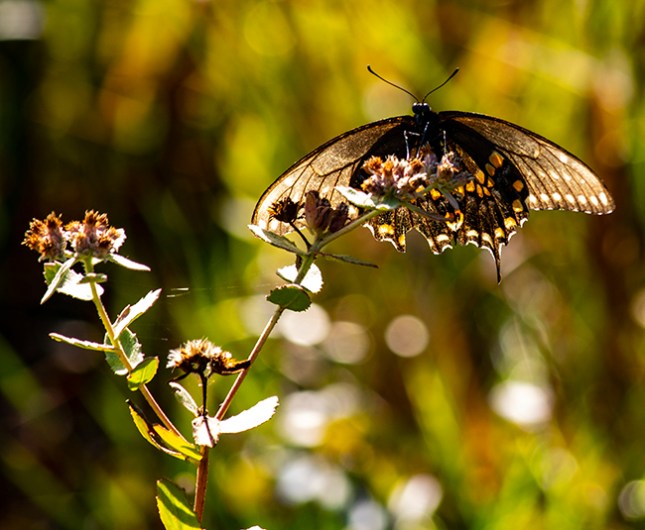
Today squinting through the sweat dripping from our brows, we failed to spot the Bleeding Flower Moths, maybe too well hidden.   In the same scrub patch fluttering about was the black swallowtail below.

liatris file swallowtail

Who is looking at whom?


7 Comments

Posted by on August 31, 2018 in Liatris, Uncategorized


Devil’s-Potato and Its Mimectic Moths

Echites umbellata

(Echis is a genus of nasty old vipers.  Echites vines look snakey, and maybe because of that have a history as  snakebite remedies.  An umbel is a type of flower arrangement.)

Apocynaceae

A Google book report is a crummy blog, and this week is honestly nothing more.  I did not set out to compile Google notes, but rather was curious about pollination in the exquisite Devil’s-Potato flower which looks like a cultivated white Mandevilla (Dipladenia) Vine. Trying to find the pollinator online took me down the rabbit hole into Alice in Mothland, complete with a large caterpillar.
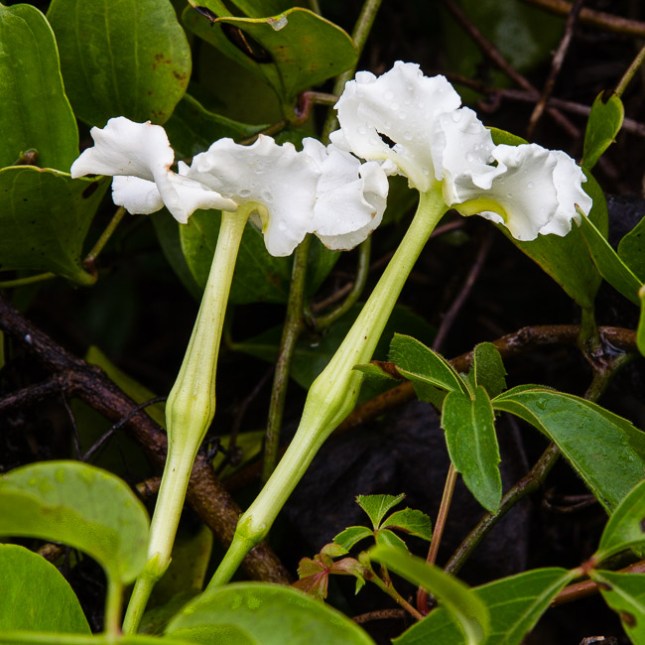
Echites umbellatus 5

Devil’s Potato by John Bradford

Before the moths comes context.  The Devil in the name comes from deadly sap, no surprise in the Apocynaceae Family.  In Jamaica the vine applied superficially to a leg pain caused vomiting transdermally.  Poison’s a good thing for immune moth larvae whose feeding makes them too poisonous to predate.

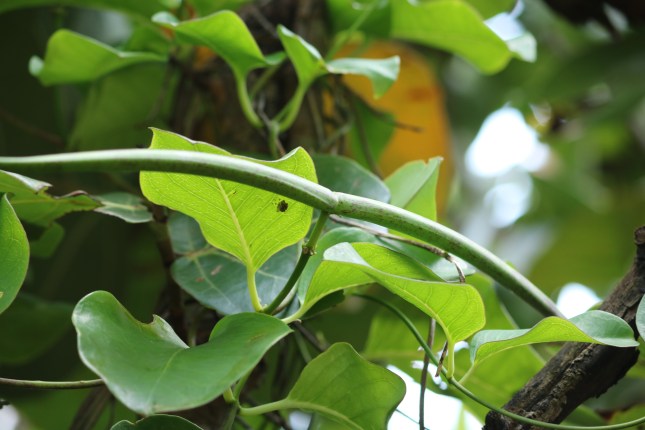
The fruit is a T-shaped double pod having two long horns joined in the middle.   The “potato” is a thick rootstock this tough vine uses to survive on stormy coastal dunes from Central America and the Caribbean to Florida.
IMG_5230

T-shaped two-horned pod

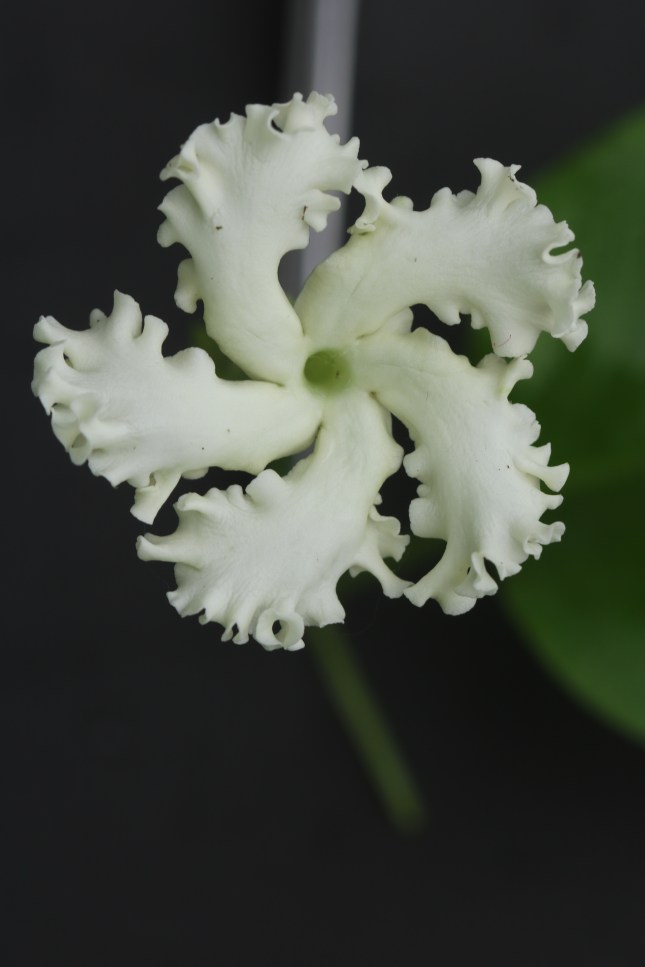
The flower is a classic textbook moth-pollinated blossom, having white coloration, a striking fancy silhouette visible at night, long narrow flower tube, and fragrance.   At mid day there is no fragrance;  at about 6 pm it is perfumed.    You’d think looking up the mothy visitor would be a no-brainer.  Tried hard yet still don’t know, but it is all about the journey.
IMG_5241

Can’t miss that silhouette, even at night. Note the narrow entrance for the moth proboscis.

Echites is intimate with at least three moth species.   John and I don’t have photos of them, but revealing links are at your fingertips below.   Here are the three moth-keteers:

  1. Uncle Sam Moth, aka Faithful Beauty (Composia fidelissima)

CLICK to see it

A patriotic beauty!  As with all three moths featured today, its larva feeds prominently on Echites umbellata, extending to other related members of the Apocynaceae, including horticultural Oleander as do the two other moths.   The moth also uses Baybean, a legume vine literally intertwined with Devil’s Potato.   Baybean has wicked poisons of its own.  Unlike most nectar-feeding moths, Uncle Sam is active by day.  Otherwise its 4th of July colors would be wasted.   A superficial impression is that this moth visits flowers smaller than Devil’s Potato, and the evening floral fragrance indicates a nocturnal or twilight moth. Therefore  I vote against it as the mystery pollinator.

  2. Oleander Moth, aka Polka Dot Wasp Moth (Syntomeida epilais)

CLICK for a peek

The Oleander Moth looks like a fearsome wasp, but is really a harmless poser.   It is poorly named, as Oleanders are horticultural introductions, and the caterpillar apparently expanded to Oleander from our native Echitites umbellata as its original larval host in Florida, probably also frangini (Plumeria) where those are native..   Closely related, Echites, Plumeria, and Oleander no doubt feature similar toxins. This polka-dotted moth with color similarity to Uncle Sam uses ultrasound to attract a mate.  The female emits a sound inaudible to you and to me,  and the male moth comes running like match.com.

That the Oleander Moth has warning coloration and the appearance of a wasp is noteworthy, but the mimicry runs deeper, again to ultrasonic signals serving not just to lure mates, but additionally to warn off moth-eating ultra-sound-navigating bats who would not see colors or waspy wings, but get the message sonically.   As with visually mimicry, moth resembling wasp, there are moths who mimic the sound warnings of other moths.

These moths have layered lines of defense: poisons, warning coloration and wasp appearance to deter birds by day as well as ultrasound warnings to deter bats in the dark.

As with Uncle Sam, the Oleander adult seems too small and too day-active to be the pollinator.  I vote nay.

  1. Tetrio Sphinx Moth (Pseudosphinx tetrio)

CLICK

Speaking of mimicry,  another caterpillar with Devil’s Potato as predominant or prominent native larval host, now expanded to Oleander,, is the Tetrio Sphinx (aka Frangipani Hornworm) Moth.   The huge caterpillar has red, yellow, and black warning coloration.  Those colors remind you of any sneaky snakes?  Ecoogist Dan Janzen suggested the caterpillar mimics a coral snake, not only in coloration, but also in a writhing and biting behavior when grabbed.

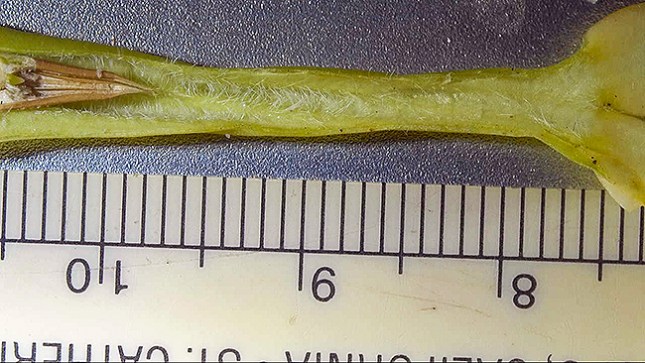
The caterpillar morphs into a large adult sphinx moth that seems just right to be the pollinator we seek.   With no data in support beyond circumstantial speculation, it gets my vote:  size match seems ok, and this moth is twilight/nocturnal.   The photo below shows the opened flower, with the entrance to the flower tube at the right, and a device to block penetration by anything other than a moth proboscis to the left.  To get from the entrance past that barricade on the left down (leftward) into the nectar, the proboscis must exceed 30 mm.   The length recorded for the Tetrio Sphinx is 49 mm, perfect.  If it is the pollination agent,  it is a handy example of a pollinator whose larval stage lives on the species it grows up to pollinate.   This is known well enough in other species pairs, such as yucca moths and the beetles that pollinate coontie.
Echites floral tube

Opened flower tube. Entrance at right.  Conical barricade at left has visible slits a moth proboscis can penetrate.  The proboscis must exceed 30 mm.  Average for the Tetrio Sphinx Moth is 49 mm.

A final odd note.  In Southeast Florida Devil’s Potato Vine is no longer abundant, as its favored habitats have become seaside condos even though at least three different moth species probably depended partly or entirely on it.   As the habitat goes, the vines go, and so go the moths…right?  Such a typical finger-wagging ending..eh?  But hold on.   Looks like all three fickle moths have taken up with cultivated Oleander.  Gotta be a lesson there.

 
4 Comments

Posted by on August 24, 2018 in Devil's Potato, Uncategorized


Tags: , ,