Rhynchospora colorata
(Rhynch-o-spora means snout-seed, and colorata has obvious meaning.)
Cyperaceae, the Sedge Family
Sedges are a funny family. They look like Grasses at first glance, but have their own ways, and weird tricks up their sleeves. One trick is insect pollination salted among the species. That is a wee bit of a surprise in an almost entirely “classic” wind-pollinated family. “Almost” is the key word. Many sedges, not all of them related to each other, have switched from wind pollination to complete or partial insect pollination. Given that insect-pollination is the original pollination mode in flowering plants, you could say these buggy sedges have switched “back” to insects from wind-loving ancestors whose own ancestors needed insects. Flip flop flip. If you switch “back” to insects you don’t have the original insect-attracting equipment: nectar, fragrance, or colorful petals. Your insect-pollination-evolution has to re-start from scratch.
The insect-pollinated sedges have reinvented insect-pollination offering pollen instead of nectar, using showy yellow anthers and white or yellow bracts (specialized leaves) in place of petals, and have reinvented sweet floral fragrances.
Rhynchospora latifolia by John Bradford.
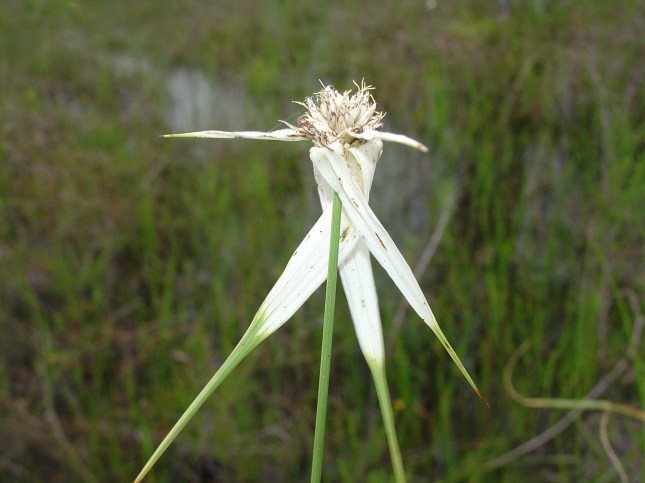
The sedge stars of insect pollination around here are species of the large and diverse genus Rhynchspora differing from the wind-pollinated species most obviously by having showy partially white bracts spreading out like petals. When I was younger these species were known as Dichromenas (die-crow-MEAN-ahs). The two common ones in our immediate area are Rhynchospora colorata on neutral soils and its larger cousin R. latifolia preferring acid soils. We’ll zoom in on the former.
Its pollination is by bees. Watch this short video to get the buzz:
The bee is a zippy rascal, so the footage is slowed by about 2/3 for easy viewing.
On top of the bee visitation, the flower has a second odd ability, to tell time. I first learned of this talent about a similar, Brazilian, species botanist E. Leppik described in 1955 as attracting bees during mid morning, being bereft of bees earlier and later in the day. Although my visitations at those hours are sadly constrained by the need to go to work, I see the same behavior in R. colorata here.
Early in the morning, the flower heads are not fragrant while they are launching the pollen-producing anthers, which become yellow and showy, and pollen-receiving stigmas, which are inconspicuous and more ephemeral than the anthers. The stigmas seem to become receptive before the adjoining anthers mature.
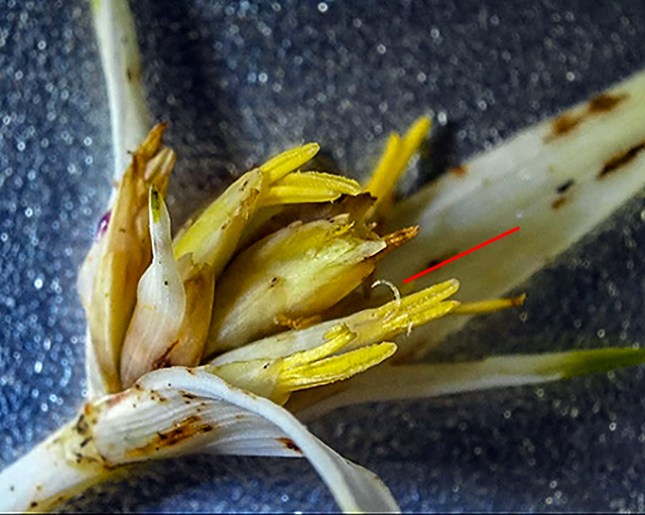
Above. Approx. 7:15 AM. The big yellow anthers peeking out but not yet expanded. Stigmas emerging too, the curled white one marked with red pointer seems to be ahead of the anthers.
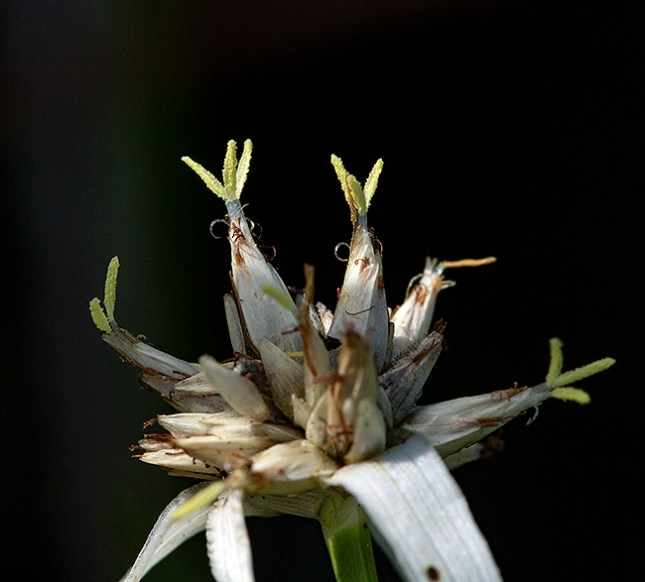
Above: Approx. 10 AM. Bee time. Fragrant. The anthers, dusty with pollen, standing up yellow in triads. The curly white delicate stigmas below them apparently at their prime as well.
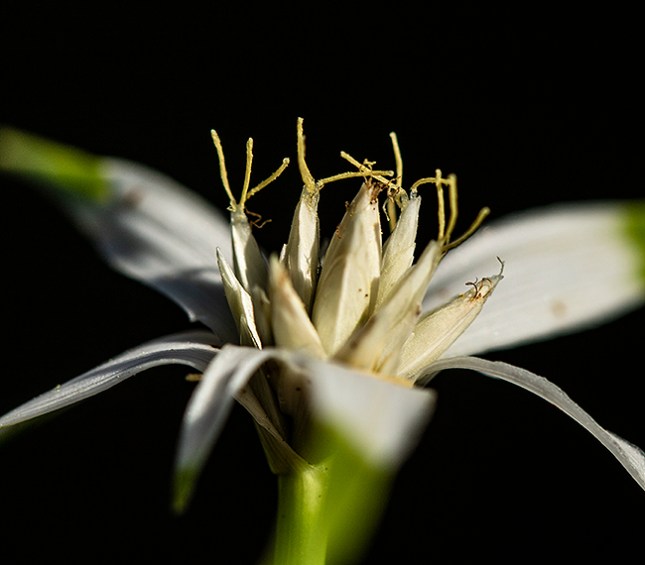
Above: Approx. 6 pm. Stigmas withered and brown. Anthers still present but losing color, losing perkiness, losing organization, losing pollen.
Roughly 10-11 AM (on our current DST) the stigmas are white and glossy; the anthers protrude in jaunty clusters of three yellow covered with granular pollen; and the flower heads smell oh so fragrant. This is the only time I’ve seen bees visiting.
By dusk the stigmas are gone or at best brown and withered; the anthers may or may not still be there, and when remaining, the pollen in gone or vastly reduced; and the floral perfume is gone or nearly so.
Leppik noted multiple species of Brazilian bee visitors, mainly stingless bees of the large genus Trigona. We have stingless bees in Florida. Perhaps R. colorata is important to them. I think a pollination study of the Floridian insect-pollinated sedges would be worthwhile, if that has not occurred, and I can’t find anything like it using Google.
Rhynchospora colorata spreads into rhizome-bound clonal patches in open wet habitats, such as shores, either mixed with other species or nearly a monoculture. Sedge rhizomes are interesting in their own right. They often accumulate starch generously, although it is hazardous to over generalize about a few thousand species. Water-chestnut in stir-fry is a thickened sedge rhizome. The hated weed purple nutsedge has prehistoric value for its edible thickened rhizome tubers dating back almost 9000 years in Subsaharan African archaeology. Likewise weedy locally, Yellow Nutsedge is the Chufa valued as a tasty tuber in parts of the world. Does Rhynchospora have its own tasty tuberous rhizome? Naw, it is slender, yet still rich with starch.
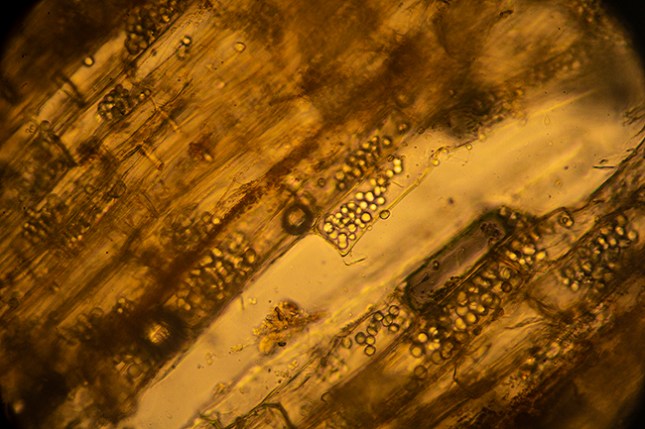
Rhynchospora colorata. Microscope view of rhizome. The glassy beads are starch granules. This rhizome is loaded.
 John Bradford
 George Rogers
 George Rogers
 Dee Staley
 Treasure Coast Natives