Mecardonia acuminata
(Mecardonia is a fusion of the name Anton Meca y Cardona, Spanish botanist. An acuminate leaf is pointy-tipped.)
Plantaginaceae (traditionally Scrophulariaceae)
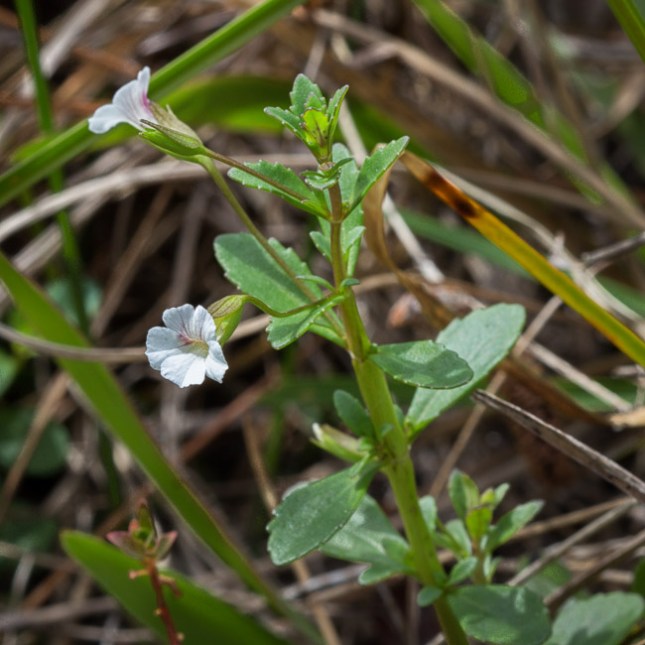
Mecardonia acuminata by John Bradford.
John and I botanized early this morning in an immense disturbed wet meadow near Jupiter, Florida. My goodness how certain areas can have an utterly unique flora found nowhere else nearby. You’ve heard of flyover country, well on a smaller scale there are walk-by plants. Poor Mecardonia acuminata is a meek species one might step on while looking for something “interesting.” Everything is interesting, dang-it, and this little native wildflower is a bag of curiosities.
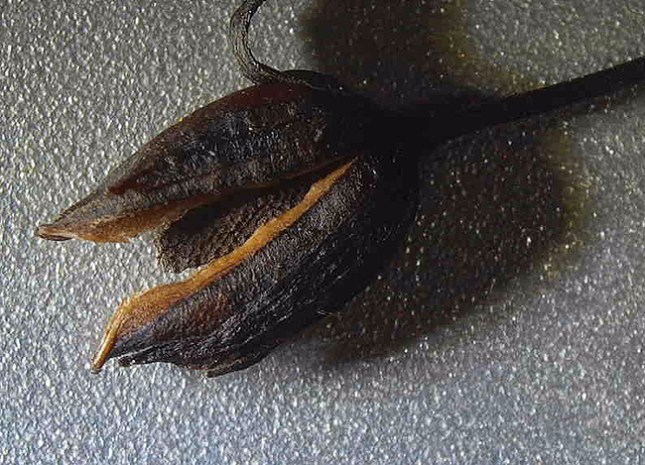
The pod highly magnified.
The first curiosity is the ripe pod turning black, which spreads to the entire plant as it dries. Such blackening is scattered among species formerly classified in the Scrophulariaceae, such as our local “black” senna familiar to some readers. The blackening reportedly comes from iridoid compounds, deterring herbivores and microbes.
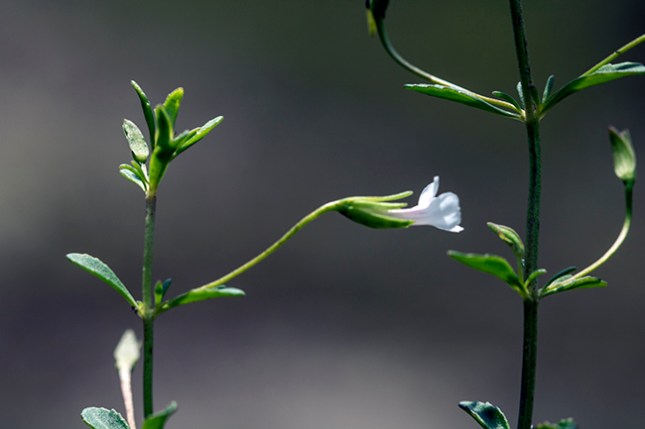
Curiosity number two is the abnormally long flower stalk, a wand lifting the flower up away from foliage. These plants grow in the vegetative tangles in squishy mud. Seems like they have to elevate their blossoms for pollinator access. Although evidence suggests sweat bees as primary pollinators, I’d not be dismayed to catch a moth or butterfly in the act, and when my imiginary lepidoptrans hover it might help to have the flowers lifted safely above dangerous foliage. At least one botanist has supposed the curvature of the flower tube to thwart moth and butterfly penetration. For a weird aspect to the wands, read on:
As biologists A. Ahedor and W. Elisens documented recently, proceeding westward across Florida from east coast to Gulf Coast, the wands diminish progressively, averaging around 22 mm long eastward shrinking down to mid teens westward. Go figure. Different environmental conditions? Different pollinators? If you transplant a short-wand individual from Sarasota to east-coast Jupiter will it conform to the dimensions of its new lengthy neighbors? An experiment to try. Hint: when such experiments are attempted the original condition usually persists, genetically set.
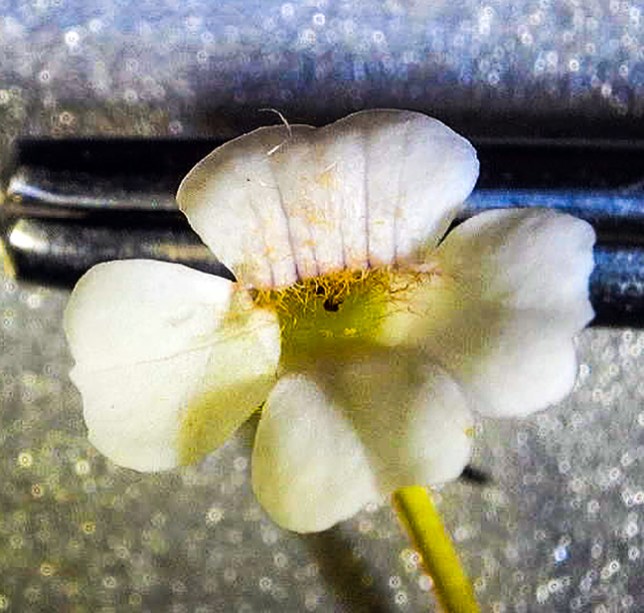
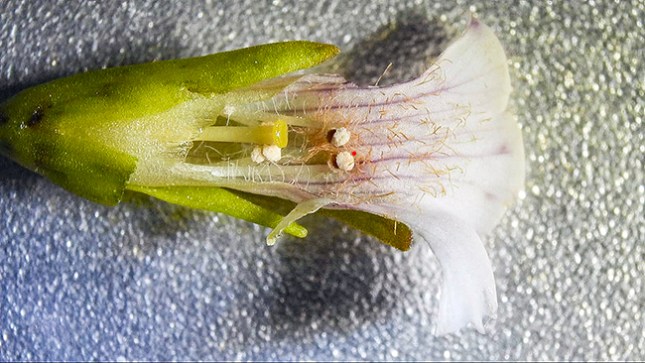
The third curiosity is floral. Botany textbooks describe flowers pollinated by bees as often being horizontal with a tube, its entrance a landing platform marked with lines, fuzz, or bumps called nectar guides leading in. But in Mecardonia the “landing platform” marked with pink-lavender nectar guides rises above the entrance like a sign above a door. Signs above the tube door are not rare, for example, in many orchids and legumes, but there is a big difference. In those orchids and legumes, even though there is a sign over the door, the plant still provides a spacious and commodious landing platform…the labellum in an orchid, the keel in the legume. But Mecardonia has no specialized welcome mat at the door.
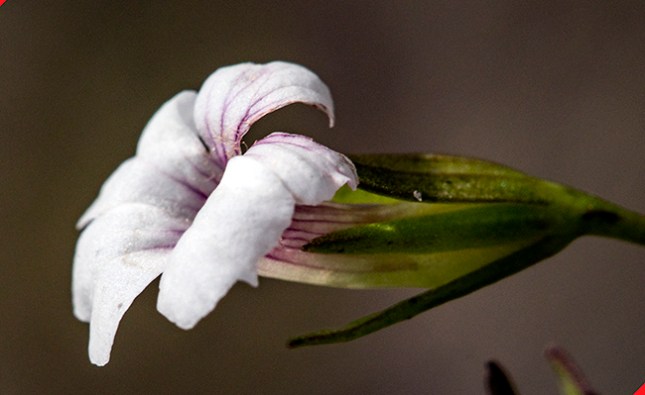
Instead, the upside-down landing platform above the door serves double duty, as advertising and as landing platform. The bee enters the tube flipped belly-up clinging to hairs on the roof of the tube like a lizard crossing my garage ceiling. As the bee goes in, its belly brushes against the anthers and stigma. (There is a long-standing but unproven suspicion of self-pollination as well.)
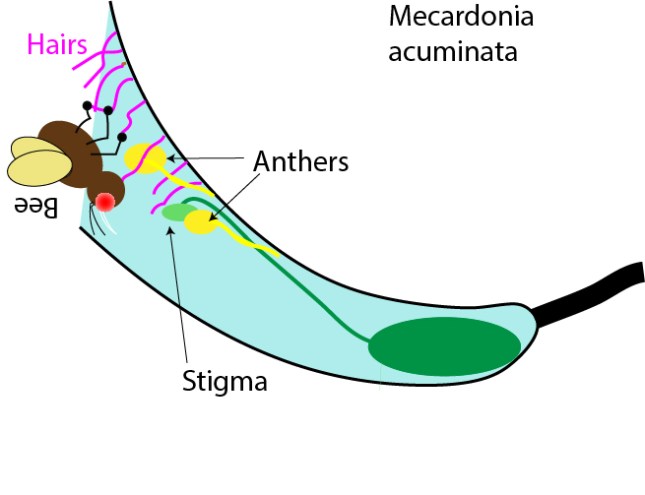
Observation of the bee walking on the ceiling in the Mecardonia species complex goes back to botanist Federico Delpino (1833-1905), the father of pollination biology.
To dig deeper: CLICK
 John Bradford
 George Rogers
 George Rogers
 Dee Staley
 Treasure Coast Natives