RSS

Tag Archives: Heliconius

Fuzzy Ball-Moss and the Longwing Slumber Party

Zebra Longwing = Heliconius charithonia

Ball-Moss = Tillandsia recurvata

Spanish-Moss = Tillandsia usneoides

Florida-Privet =  Forestiera segregata


All Florida nature lovers love the Zebra Longwing Butterfly,  and a romp through Google brings forth its ighlightsh, such as being the Florida state butterfly, and the only local butterfly known to consume pollen.  Its larval hosts are passionflowers.  

Those with butterfly gardens or good luck notice that Zebra Longwings can be social, including communal roosting at night, something biologists have pondered for a long time.  Alfred Russell Wallace, the “other” discoverer of evolution, wrote about it back in the 1870s.  Around my yard and garden the Longwing Committee has been roosting in clusters upside down like a flock of tiny bats each night  on different branches of the same Florida-Privet tree.  You can count on finding them at twilight, about a dozen per bunkhouse.   And that prompts a question…why roost like sardines in a can? There are multiple non-mutually-exclusive explanations for butterfly sleeping gangs: 1.  Protection from cold.  2. A mutual-warning system—when one is disturbed, its wing movements start a chain reaction vibrating everyone awake.   3. Collective display of warning coloration.

Longwings very early in the morning, on Ball-Moss, this on Florida-Privet.

With respect to possibility number 2, alarm system, the other morning I walked up to the huddled sleepyheads, and as I got (too) close they popped off the roost all at once. Ooga ooga!  Somebody punched the fire alarm.   

On possibility number 3,  antipredator warning coloration,  the butterflies are poisonous, and their zebra stripes are interpretably “you’ll be sorry” warning coloration, although other possibilities are conceivable.   With the help of chemicals from passionvine hostplants, the butterflies form cyanide-based heart poisons.  A scrum of them hanging together is a billboard warning. Other observers, by contrast, may think the sleeping butterfly cluster looks like twigs and shadows during their dark-hour roosting time, except for some small bright red marks on the wings.  Either way, entomologist Chris Salcedo (see dig deeper below) found Heliconius butterflies to suffer little predation while roosting.  He interpreted those red markings as signals to late recruits arriving to join the party.   They’re twilight lanterns to guide newcomers to a safe landing. 

Red spots at bases of wings

The roosting group begins gathering loosely before dark.   I’ve been sitting here on a computer this afternoon looking out the window watching the butterflies.   Here is my log of Longwing activity:

3:30 pm bright and sunny: Longwings all over the yard and garden area visiting varied flowers having no special interest in the Privet roosting tree off to the side about 50 feet from a garden full of of flowers.

4:30 pm bright and sunny:  A few butterflies visiting flowers far away from the Privet, and around the Privet an unsettled group of Longwings basking, fluttering, and flirting. 

5:30 pm long shadows: The entire backyard Longwing population hovering closely around and on the Privet, dancing among the branches.  Two earlybirds have roosted together in the nocturnal “bat position.” They are clinging to a large gall on the Privet branch.

6 pm getting dark: The original pair expanded now to a trio, and new group of about 12 clustered, with recruits arriving.

Happy hour arrivals at the roosting tree. This pair later expanded to three’s a crowd. Why are they clinging to a gall on the Privet branch?

Why roost on the Privet?  One reason according to C. Salcedo, the butterflies avoid camping under green foliage which is too humid, the sleepers preferring dryness.  The Privet is deciduous, dry leafless sticks.  Secondly, the Longwings feed on Privet flowers.   A relationship between feeding sites and roosting sites is known for Heliconius Butterflies in general.   During the later afternoon gathering phase, there’s a lot of Privet-flower-feeding goin’ on, as the butterflies have shifted away from the main garden.

You can see the feeding and other good things in this mini-movie. FLUTTER HERE

Last night the slumber party was on a Ball-Moss (Tillandsia recurvata) hanging in the Privet.  They do not occupy Ball-Moss every night, yet I wondered if they like something about it.   There’s no easily located mention on the Internet, but if you Google Image “Zebra Longwing roosting”, you find lots of photos of the butterflies on Spanish-Moss, which is similar to and related to Ball-Moss.   Those fuzzy plants look like they’d be great to grab like one of those shag-covered steering wheels.  Maybe tonight’s gall is a good perch-handle too.   The trio choosing it seems non-coincidental.


To dig deeper:
Click

 
4 Comments

Posted by on January 28, 2022 in Uncategorized, Zebra Longwings


Tags: , , , ,

Zebra Longwing Butterflies

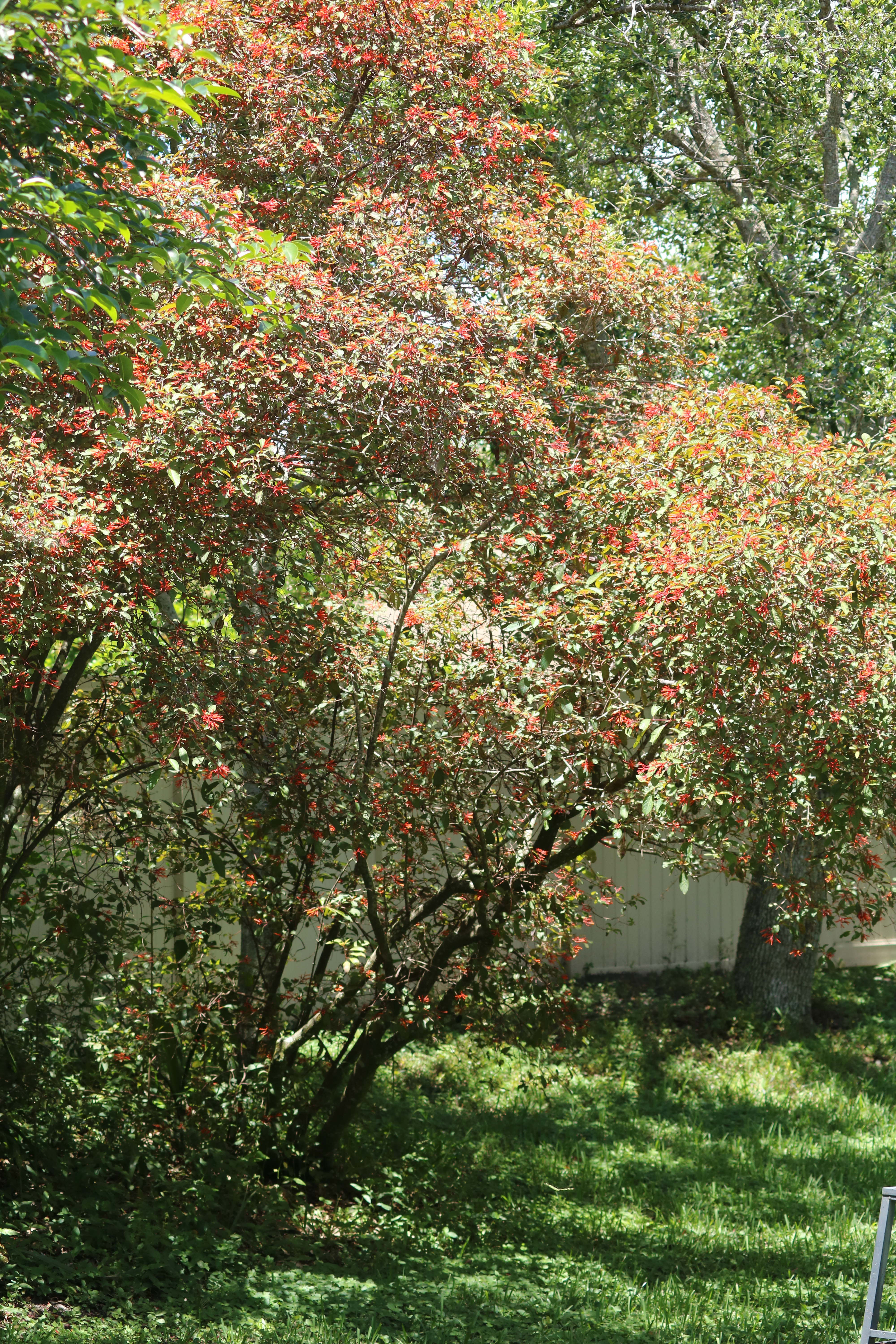
Stuck home waiting for a repair visit.   John is homebound as well.  Might as well put the trapped time to good use with backyard nature,  the feature attraction being zebra longwing butterflies dancing on the firebush.

IMG_3044

Firebush.   Zebra longwings lovin’ it!

Being our lovely state butterfly, this species is about as abundant on the internet as it is in my weedy so-called yard this morning, so we’ll attempt to cruise past the ubiquitous info on better web sites than this, and delve into some eclectic funny business.

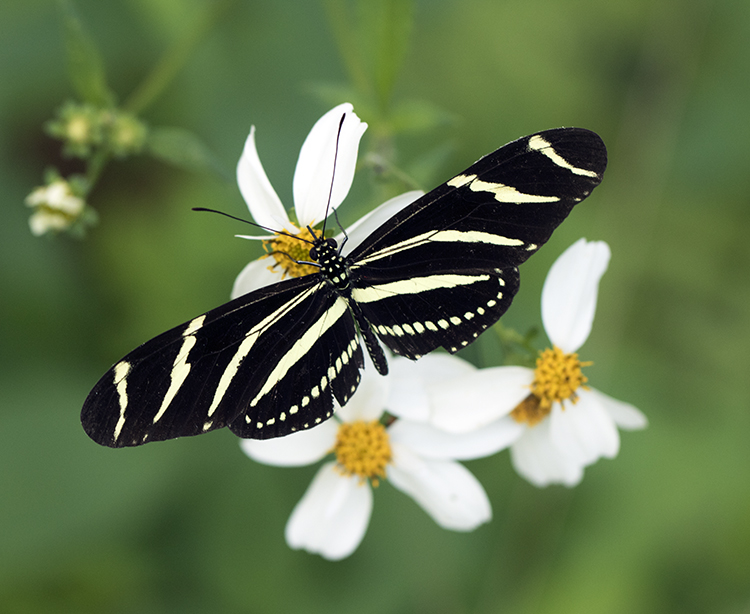
Bidens alba with zebra longwing

Just a guess, but Bidens exposes pollen aplenty.  Perhaps this stop is for pollen.

Zebra longwings are part of the large warm-climate butterfly genus, Heliconius where most species have coloration different from ours, although the related Heliconius peruvianus in Peru and Ecuador is almost identical.   The Zebra longwing ranges from rubbing shoulders with H. peruvianus up through Texas and Florida, migrating sporadically into the central U.S., knocked back southward by Jack Frost.

The striking color pattern is probably best interpretable as “danger don’t eat me” warning coloration.   Beautiful, yet treacherous with cyanide-related poisons.  I’m not sure what percent of the toxicity comes from the host plant as opposed to what the adult manufactures, probably substantially the latter.    There is second way to interpret the color pattern,  but hold that thought a moment.   Two functions for one pattern are possible.

The black and white bristly caterpillars can denude their host passionvines, defeating the plant’s protective hairs.  The larvae bite off the hair tips, and weave a protective silk mat over the defenses.

The adult food plants are diverse, and the longwings love firebush.   Zebra longwings and close relatives are the only butterflies known to consume pollen in addition to nectar,  diversifying their salad bar.   For pollen, they like members of the squash family, although I do not know if that preference shows up in Florida.  The pollen protein extends their lifespan beyond most other butterflies,  and boosts their reproductive capacity.    Further, it probably provides raw materials for manufacturing those cyanide-based poisons.

Zebra longwings are among the pollinators known as trap-liners,  able to remember a recurring feeding route.  They circle home to the same roosting sites at night to cluster for protection from predators.   What protection comes from a butterfly gang?   Not very scary after all. Hmmm.  Here is a thought:  Zebras, the hooved mammals, obviously have similar striping, but not as a poison warning.  They probably taste dandy to a lion.   The zebra stripe protection comes from confusing big kitties by obscuring the outlines of single individuals in the herd.   When zebra longwings roost in crowds like a herd of zebras, do their “zebra” markings render angry birds unable to single out individual victims?

CLICK  for zebra op art

Same going on here?  CLICK

After squabbles for dibs, males mate with the females while the females are still in their pupa or as they emerge. The boys are drawn to the larval mating area partly by chemicals released by caterpillar damage to the host plants.   The male gifts the female with a cyanide-laced bomb (in the spermatophore) to defend the female and the brood, and leaves an “antiaphrodesiac” chemical to signal other males to flutter off.  The lepidopteran equivalent of a wedding ring.

Ever sense you don’t see as many or as diverse butterflies like you once did?    Maybe your memory has gilded your childhood, or then again  it might have something to do with pesticides, or extreme herbicidal weed control.  Aerial spraying of insecticides, chiefly the insecticide Naled to counter mosquito-borne viral diseases, is harsh on butterflies, controversially in Miami-Dade.  Naled  is a chlorinated organophosphate related to the now-banned insecticides Dursban and Diazinon, and also to the genocidal gas Sarin.   (Gratuitous inclusion of scary tie-in.)  How much do we fear Zika and West Nile?  How dangerous is Naled to butterflies and to children?  How much protection does Naled spewed from airplanes provide?  What alternatives exist?    All that is beyond the scope of our happy little blog. Yet food for thought, butterfly-lovers.

CLICK to feel sick.

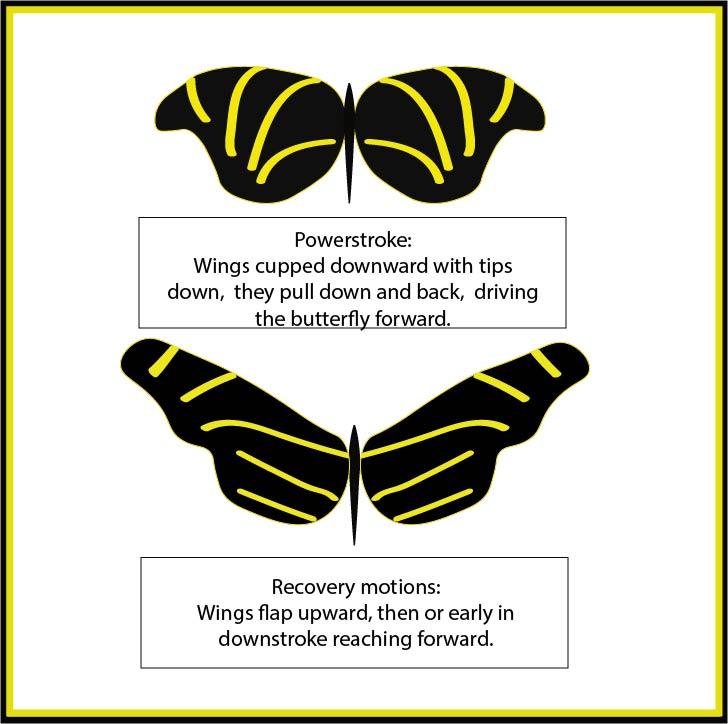
What bugs me abut butterflies is how they manage to fly.  Looking out the window right now, it looks like the wing is a firm paddle flapping up and down. But that couldn’t work— they’d just bang against the ground.  Must be more to it.  Biologists and photographers have studied butterfly aerodynamics, and the Google take-home is that the wing motion is intricate, although too quick to see…another example of the bewildering complexity of simple life forms.  The wings twist, turn, distort, curve, curl, and glide like the adjustments of a helicopter blade, or of a swimmer’s hands, although fancier and more dynamic.   I set my camera to “video,” filmed the flight, and slowed it down to try to catch some action.   The result is below, please click on the link.  Among myriad variations, prominent wing movements appear to be reaching forward, then cupping downward and pulling back, subtly resembling a swimmer doing the butterfly stroke.  How does a noggin smaller than a pinhead compute all that coordination?

CLICK HERE   and see if you can interpret the butterfly flap


Butterfly wing strokes

Here is what I think….judge for yourself.

———————————————————————

Music in video:  Ryan Andersen Happy Life

 
11 Comments

Posted by on June 8, 2018 in Uncategorized, Zebra longwing


Tags: ,