Dioscorea bulbifera
(Dioscorea honors ancient Greek physician Dioscorides. Bulbifera manes “bears bulbs.”)
Dioscoreaceae
What’s the difference between a Sweet Potato and a Yam? Answer below.
Today was pleasingly a “normal botany Friday” under hot sun after too many weeks with distractions in John’s affairs and mine, more disruptions to come. We worked today on a photo project at the Haney Creek Natural Area near Jensen Beach, Florida.
Air-Potato Yam there is a super-vine rising over six inches per diem bullying other vegetation all the way. For yam-lovers that sounds like a top crop, but truth be told, the underground tuber is small and bitter to toxic. The stem-borne tubers (bulbils) resemble potatoes in appearance, but again, not lunch.
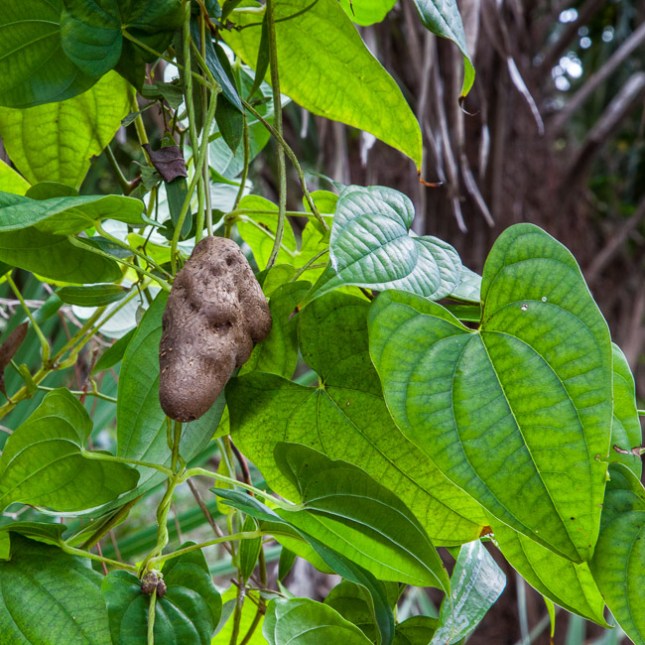
Overhard spud. By John Bradford.
A superior yam producer is a very similar likewise local invader, the Winged Yam, Dioscorea alata, different most notably by having a 4-angled or winged stem (vs. round), a bigger better underground yam, and smaller aboveground tubers.
Now back we go to Air-Potato. Its tough, durable, nasty yams provide an old explanation of how it came to tropical America, as ship-board grub, maybe on slave ships. The cruise chefs were not picky. Confounding this old notion, however, are recent DNA studies showing Chinese ancestry for Florida populations. Multiple arrivals are likely. Apparently the USDA, sparked by introduction-king David Fairchild, deliberately introduced Air Potato into Florida. Rockstar horticulturist Henry Nehrling possessed the cursed vine by 1905, noting even then its aggressive demeanor.
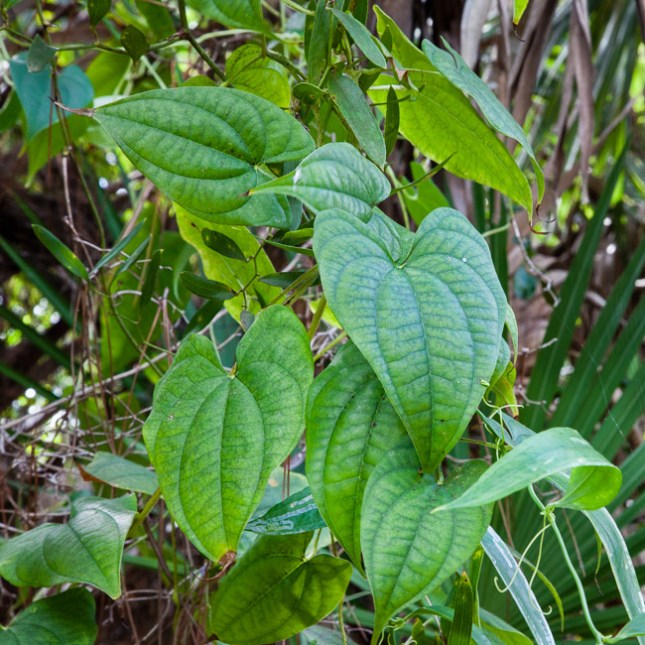
In yam leaves all the main veins converge at the notch. By JB.
As with other “edible” species, some cultivated air-potatoes are non-toxic or minimally risky with correct preparation, whereas other strains can be dangerous, in this case with toxic compounds so similar to human steroids they have been used in making pharmaceuticals. The first birth control pills came from yam steroids.
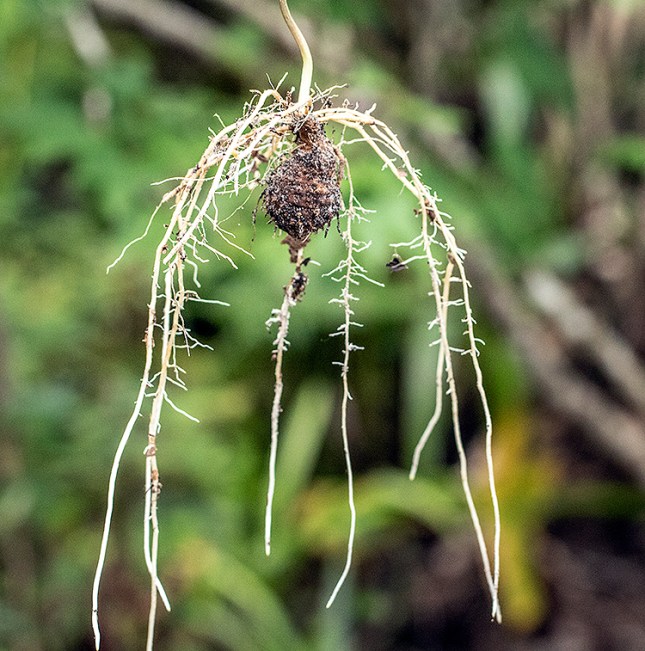
This “potato” had dropped to the ground. Looks like once there, it means business! Taken today.
Whatever its edibility vs. toxicity, the plant has ancient history in food and medicine, especially in the Old World tropics, where it evidently originated, although where it is “native” is vague because humans moved it around even in ancient times. The recorded historical medicinal uses would fill a page. You name it. I don’t even know what some of those old ailments are.
When a plant invades, a common course of combat is to seek its natural enemy in the invader’s homeland. The enemy of my enemy is my friend. True of Air-Potato, with the deliberately introduced leaf eating beetle Lilioceris cheni, which I hope remains our friend.
An obvious concern is the hit-beetle might expand its lethal ravages to native species, in the present case most notably Florida native yams. Nobody would be dumb enough to unleash the destructors without testing their disinterest in the good species. But, for neurotics like me, there remains the dubious doubt of potential change of tastes. Such pest-of-the-pest introductions have run out of control before. I think of it pessimistically this way…many weeds and insects have evolved immunity to pesticides; it is commonplace, so why couldn’t some little enzymatic mutation allow the beetles to start munching non-target species? And how effective are the beetles at controlling the naughty vine to begin with? Skeptics are such nuisances.
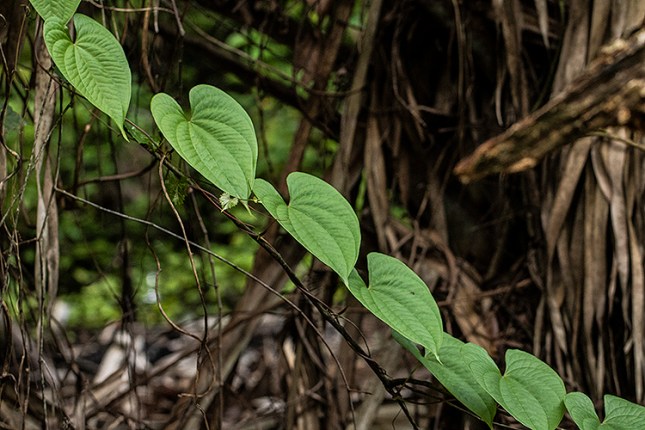
I’ve no recollection of Potato-Vine in flower despite many field outings with my wife Donna’s ecology classes to examine it among other invasive exotics. There are separate male (pollen) and female (seed) individuals. To the best of my Googling, male flowers seem to be unknown in Florida, and females rare.
 John Bradford
 George Rogers
 George Rogers
 Dee Staley
 Treasure Coast Natives