RSS

Category Archives: Uncategorized

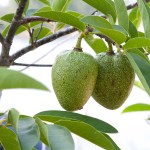
Pond Apple Has a Wavy Ventilation Grille

Pond Apple Has a Wavy Ventilation Grille

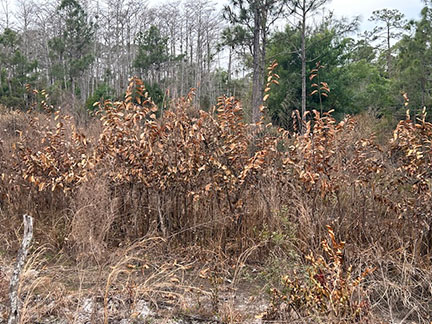
Went to check wild plant damage from the recent freeze.   Interesting how there is worse trouble out in natural areas than “in town,” a demonstration perhaps of the “urban heat island effect”  arctic blast protection by buildings, hedges, and fences.   The shrub damage out in the boonies is dramatic.

Checking the vitals of damaged twigs, I thumbnail-scratched the thin outer bark skin off of a few expecting to find a nice living green layer as in most healthy branchlets.  But Pond Apple exposed an outer bark surprise.

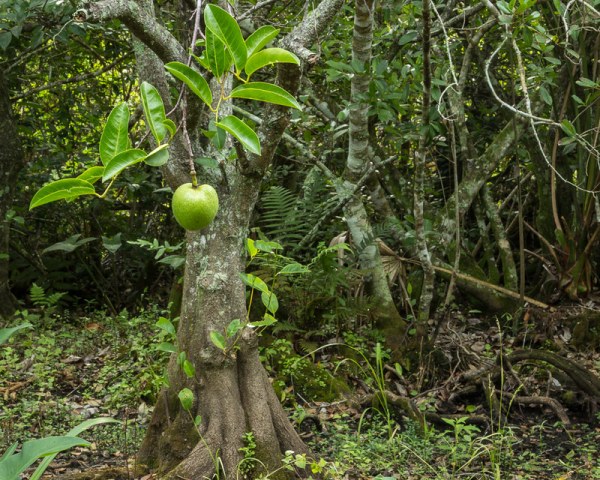
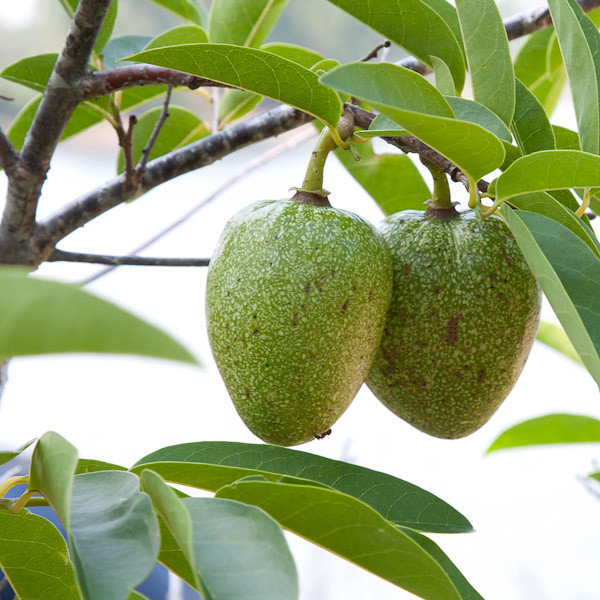
Pond Apple by John Bradford

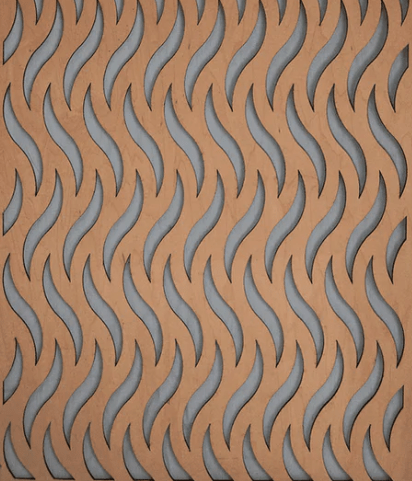
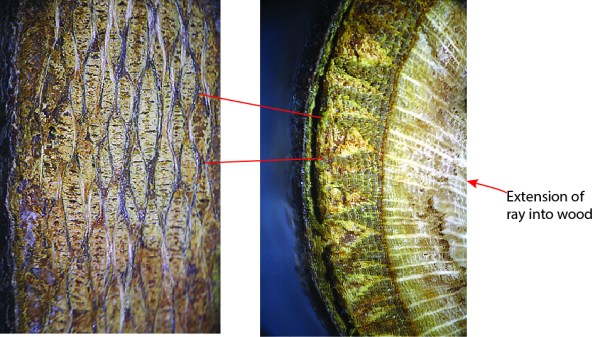
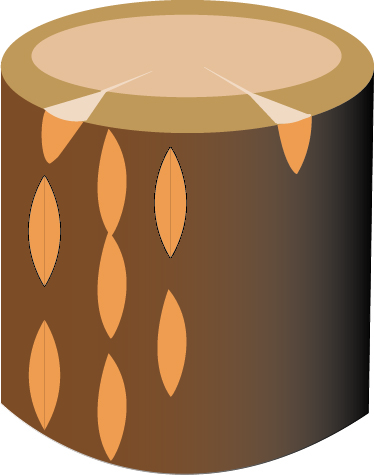
As you may know, PA is a swamp creature. Plants in floody places cope variously with  periodic or perpetual wet feet.   Big problem:  sustaining life where sogginess smothers normal life processes.   Ventilation becomes a special challenge in the wet world,    Soooo, to get to the point, scratching revealed a ventilation trait in Pond Apple new to me and kinda fascinating, at least to somebody with not much more going on. Upon scratching off  the topmost bark skin, Pond Apple reveals the pretty wavy grille you see on the left below.  The dark curvy lines are firm “wood.”   The light areas in between are soft and porous.   If you cut across the branch you find that those soft porous cups are the expanded ends of wood rays.   Wood rays are soft living veins  extending deep into the wood.    They function like my veins, helping to “circulate” water, nutrients, starch, and dissolved gases.   Hey, I like this vein analogy.   My veins meet the air in my lungs.    It looks like the Pond Apple “veins “  meet the air via those soft cup areas which  funnel air directly into the wood rays.  The outer bark seems to work as a big lung. That must helps with swamp ventilation. 

Left. The bark outer surface with skin removed. Light porous cups between wavy walls of dark wood. Right. The thin outermost skin is at the far left. The cups are seen cut across, with the red lines pointing at the outer edge of one cup. The rays connected to the cups are seen extending into the wood. The border between bark and wood is the dark curved vertical line along the center of the photo near the cup bases.

Now, a pest might say, “can’t you have air enter other trees through the bark, and wouldn’t rays have to broaden or be broken up as the branch expands?” Sure, in fact, the little corky “lenticel” spots  on branches allow gas exchange.  But it looks like swamp Pond Apple took that subtle commonplace ability and exaggerated it up into air injection turbosupercharger  for life in the wet zone.

 
1 Comment

Posted by on February 14, 2026 in Uncategorized


All Creatures Have Their Positive Traits…

Brave work by John Bradford

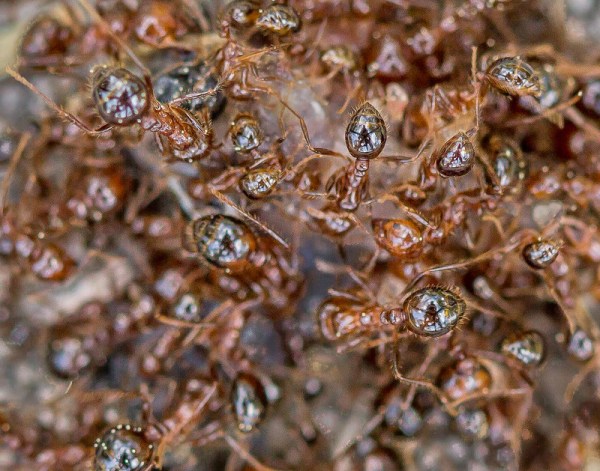
You ever see those questions on social media along the lines of, “if you had a billion dollars what would you buy”, or,  “if you could go back in time what would you change,” or how about, “is there anything you would exterminate if you could?”    That’s easy:  Imported  Fire Ants!

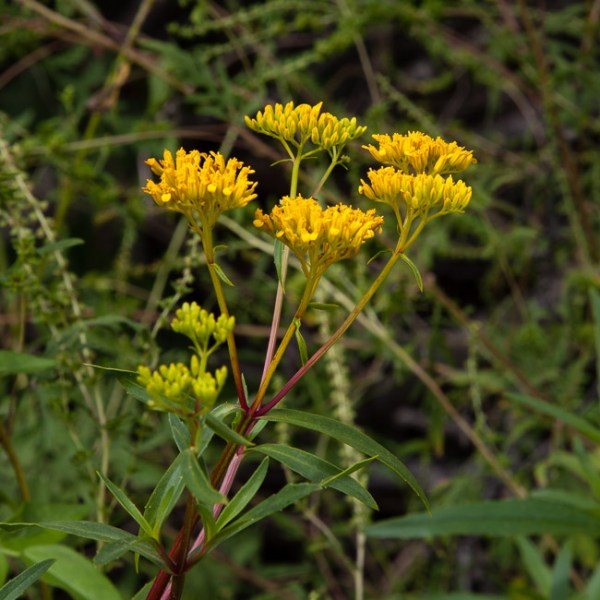
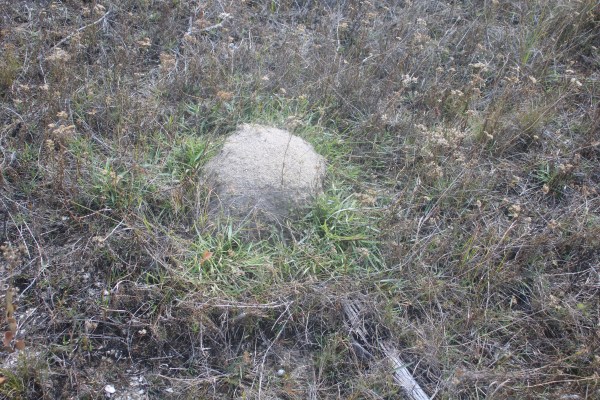
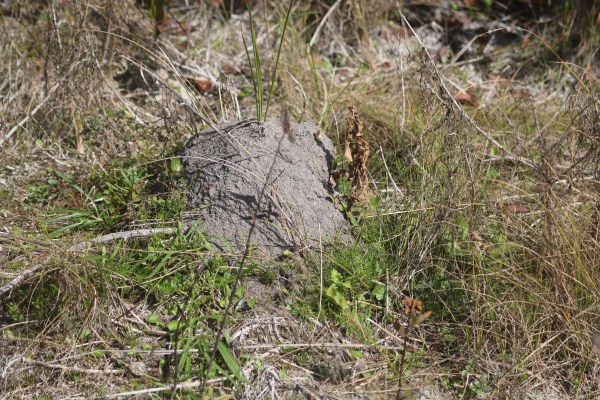
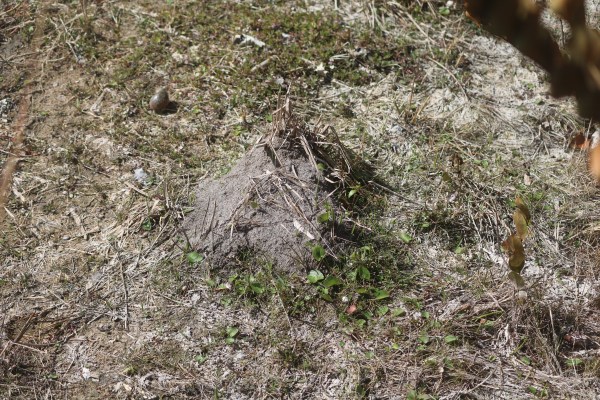
Well, not so fast now, something I noticed today exploring a swampy shoreline in Cypress Creek Natural Area is how much some plants loves big ant mounds.   Several species seemed to benefit, with the most bodacious beneficiary being  Yellowtops (Flaveria linearis).  All along the shoreline millions of Yellowtops were dead-ish aboveground and defeated.  But not around the bases of the ant mounds.   There the Yellowtops and associates are thriving…big, green, plump, expanding.   Would you expect a species typical of nutrient-poor soils to be opportunistic when it comes to “bonus” nutrition?   Yes, that is a big problem with cat-tails, and harmful algal blooms.    But Yellowtops never hurt anybody.  In fact, they have a star role in contemporary photosynthetic-nutritional research. That probably ties in to their big boost from fire ants.
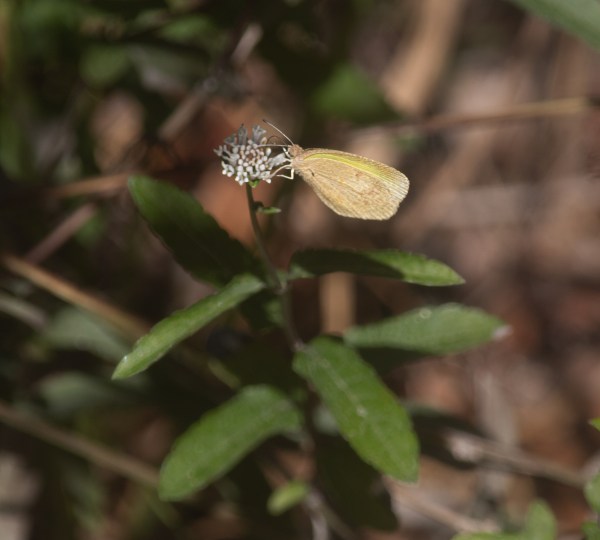
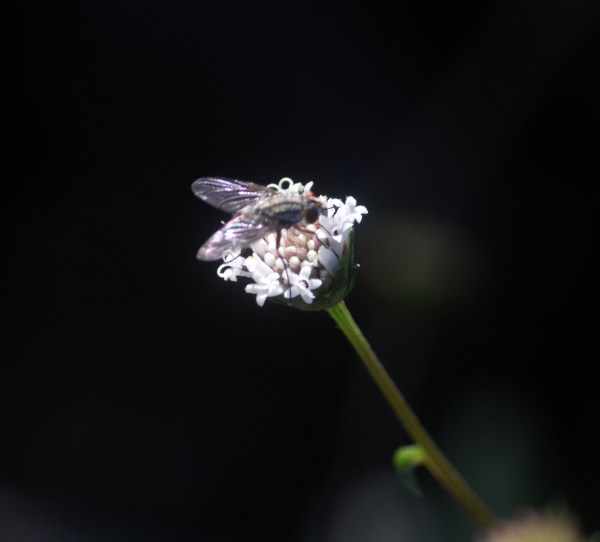
Flaveria (not this season) by JB.

What are the ant-loving plants getting?   Easy to guess.  Fire ants tote all manner of organic matter back to the nest, enriching the earth with food debris and ant waste. Benefits to mound-side plants are documented for potassium and phosphorus, interesting given that phosphorus tends to be limiting in Florida wetlands.  I’ll bet the plants are getting nitrogen aplenty too.

Hell with a yellowtops halo today

They are also getting soft “tilled, raised, and aerated” soil, obviously dandy at a waterlogged shoreline.   That porous mega-mound looks like it sponges up water at dry times, and drains freely when wet. An then of course there is that defensive perimeter!   What herbivore is going to bother a fire ant ant garden?

Doing today’s photography I kinda made that mistake.  Did you know those odious ankle-biters have secret tunnels radiating from the main mound?    When you ease up close with camera, they sneak up behind from their subway and strike with no appreciation for the one moment they are being appreciated!

 
Leave a comment

Posted by on February 9, 2026 in Uncategorized


Tillandsias: Woolly Coats Tonight

Tillandsias: Woolly Coats Tonight

Tonight around my house in Jupiter the temperature is planning to drop to 28 degrees. Hey, icicles don’t happen here (often).   That being so, we better talk about plants in relation to temperature.   Anybody with a car knows that as you drive northward in Florida in winter, every gas stop (clean restrooms at Buc-ees) is colder than the prior reststop.  Might be toasty in Miami and chillin’ in Jax. 

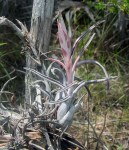
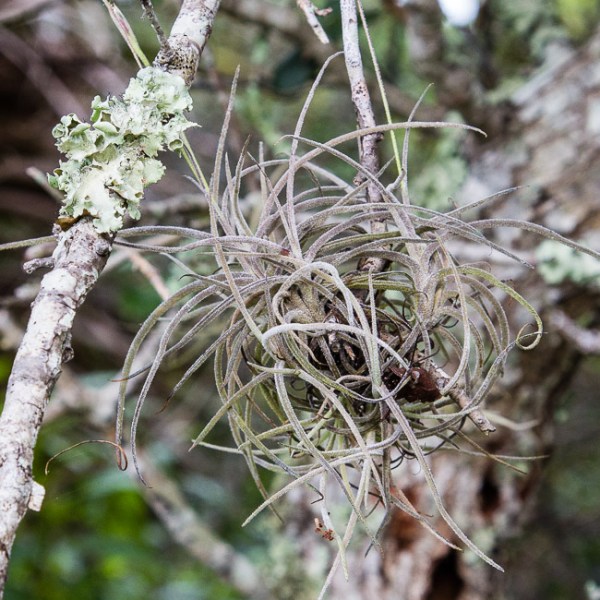
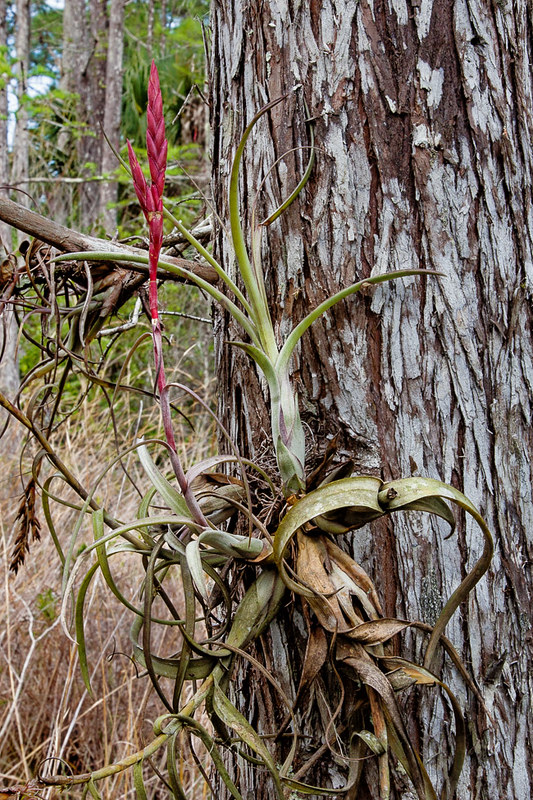
Tillandsia utriculata. All photos by John Bradford.

That being so, it might be fun to look at a large group of plants found across Florida and northward, and see how they deal with the latitudinal temperature gradient.   Hmmmmm, let’s see now,,,,I know!   Tillandsias!  There are lots of Florida species, each having a different N-S range, and each having different relevant leaf traits.

T. setacea

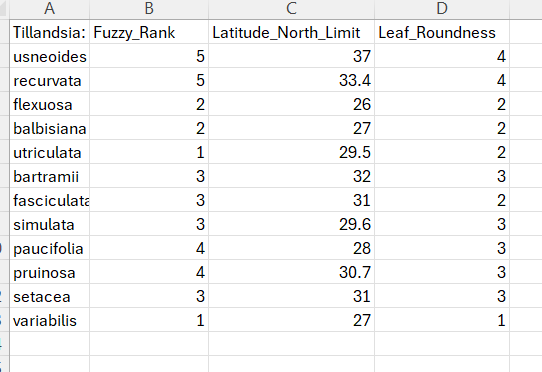
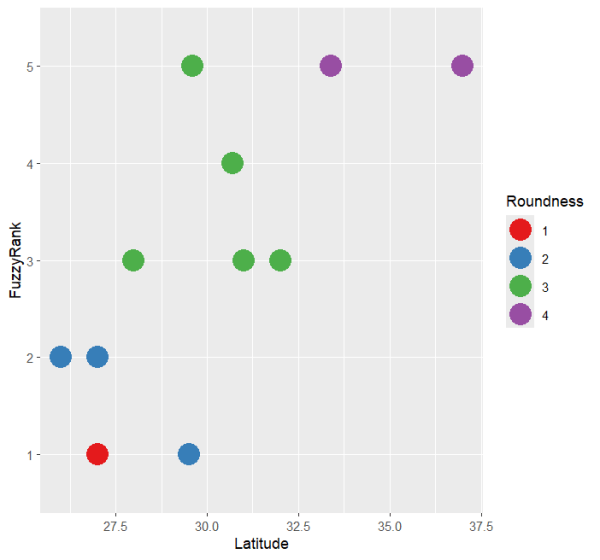
To make a fun evening of data gathering short, using mostly adjectives in the Flora of North America, you can rank the Florida native Tillandsia species by fuzziness, and by leaf roundness (from nearly flat to pencil-shaped). Here’s what I determined.

Skeptics are welcome to scrutinize Flora North America data (it is online) to see if they agree. (If not, please contribute $25 to the Florida Native Plant Society in lieu of emailing me.)

Does having a fur coat help keep a plant safer from frost?   Let’s see.

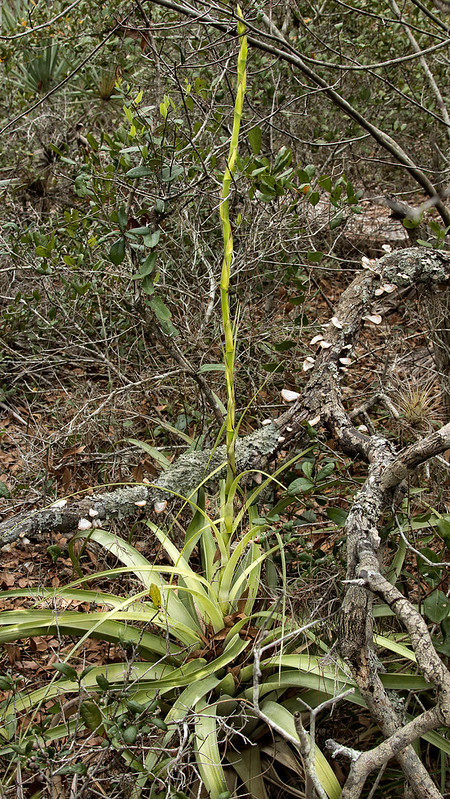
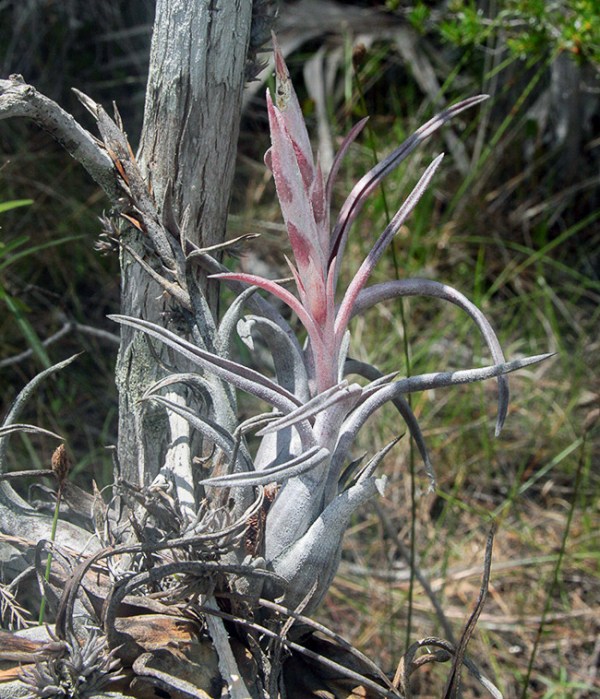
T. paucifolia

Flat things freeze faster than round things, because flat things have a lot of surface area exposed, and not much thickness to hold heat. Does having roundish leaves help protect leaves from frost?  

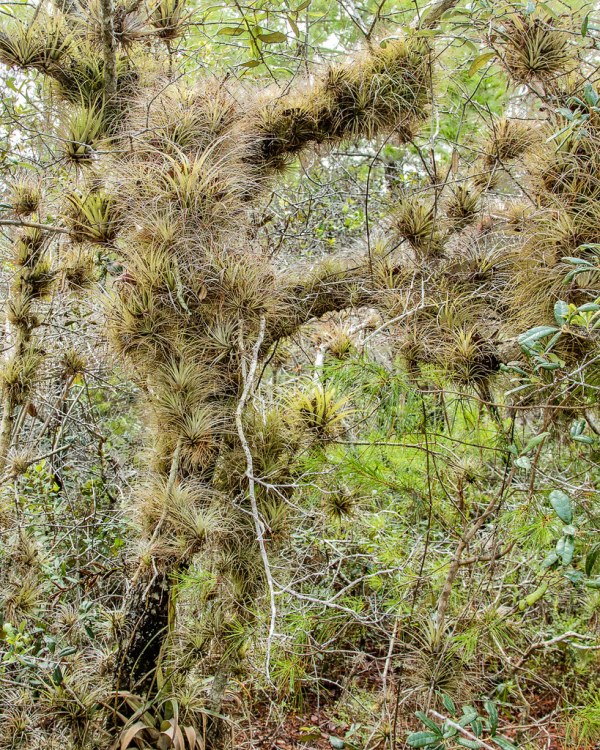
T. balbisiana

The graph below…as skimpy as it is…looks like fuzzier Tillandsia leaves  help as the species expand northward, and so does the color-coded leaf flatness. (1= flat, 4=round).

Brrrrrrrrrrrrrrrrrrrrrrrrrrrrrrrrrrrrrrrrrrrrrrrr

 
1 Comment

Posted by on January 31, 2026 in Uncategorized


Royal Ferns Have Had Their Ups and Downs

Osmunda spectabilis  (and additional species)

Osmunda spectabilis by John Bradford

The genus Osmunda, containing Royal Fern and Cinnamon Fern, both native locally in swamps, dates back to the Triassic Period and probably before.  How long ago was that?   Oh, roughly 250 million years, underfoot with dinosaurs and almost  twice as far back as flowering plants.   Depending on how you define “humans,”  very roughly  100 times older, gve or take a few eons.   Turtles first appeared during the Triassic. Florida was separating from Africa.   Been awhile.

Spore-producing portion, John Bradford

Given that they predate the full separation of the continents, and given that dust-sized fern spores fly on the wind, no surprise Osmundas are almost worldwide, although mostly in the Northern Hemisphere.

Top: Modern Osmunda by John Bradford. Bottom: Mesozoic Osmunda by Carlie Phipps, Am. Journal of Botany 1998

Being a living fossil is marvelous, sure, but what fascinates me more are extinct Osmunda tree ferns.   Among modern ferns, not in Florida, there are tree ferns as large as palms.  These modern tree ferns are not related to Osmundas.  But…..long ago and far away Osmunda ancestors were themselves tree ferns, having evolved tree-ness on their own.

Osmunda (Osmunda) iliaensis trunk fossil. By Wolfgang Putz.

Then they lost their trunks. (Almost.)   The thumbnail history probably goes somewhat like this:

  1. Ferns, including Osmunda ancestors evolved dismayingly before flowering plants. Having no flowering plant competitors, in suitable habitats they assumed the role of trees.
  2. As the Flowering Plants took over, somewhat over 60 million years ago, they competed ferns into narrower, non-tree niches.
  3. In fact, the meteor strike some 66 million years ago might have been the nail in the coffin of big tall Osmundas.
  4. In very rough terms, the demise of the tree-sized Osmundas  kinda coincided with the rise of the unrelated modern unrelated Tree Ferns, limited to moist tropics.

Thank you AI. On the left, Mesozoic Osmunda (compare the trunk roots with the bottom photo below—nothing changes in 250 million years). On the right, modern unrelated Tree Ferns. (Generated by Nano Banana).

And now to get to the good stuff!  Osmundas still yearn to be trees,  even of just a bit stumpy.   They haven’t given up.  Now in the Florida “dry” season you can see in dried swamps Royal Ferns with broad trunks, usually hidden the rest of the year by water, mud, debris, herbaceous growth, and sullen cottonmouths.  When the view becomes unobstructed the trunks can well over a foot in diameter and up to 2-3 feet tall .   The photos below were taken today in the Jupiter Ridge Natural Area. These trunks are not cut open, and they are not covered with mud. That is their natural black surface color. They are in the middle of a temporarily dry marshy pond. The covering is a mantle of dead (or some living) roots and leafy scales. Diehard throwbacks to continental drift and soaring Pterosaurs!

They can even branch in a stubby way, as seen to the right above.

Living roots on trunk

 
2 Comments

Posted by on January 27, 2026 in Uncategorized


What Does Lake Okeechobee Share with Greenland?

Sure is a lot of chatter these days about Greenland.   I’d like to contribute an otherwise unknown Florida tidbit to the discussion.  Who knows, maybe useful “inside info” for high- level negotiations and deliberations.   Although today’s 41 degree morning may raise doubts, we think of South Florida as sweaty subtropical with pythons, and Greenland as frigidly Arctic with walruses. Botanically speaking, whatever could link such contrasting lands?  Here’s a hint:  Greenland has hot springs housing  plants you don’t associate with glaciers.

I’ll bet the Vikings enjoyed a warm soak in those natural hot tub springs after pillaging across the North Atlantic.  While they were skinny dipping blissfully with a frosty tankard of mead among the polar bears,  the aquatic foliage tickling their toes might have been Little Pondweed, aka, Potomogeton pusillus.    It could tickle your tootsies here too, but good luck finding any:   the species is super-rare locally, having one known population in Lake Okeechobee, and a nearby clump near Barley Barber Swamp adjacent to Lake O.   There’s probably plenty more than that about, but who’s going swimming with the gators to look, and even if encountered, not so easy to recognize.

Photo courtesy of Gabriel Campbell

Similar problems have afflicted the pondweed in Greenland.  I don’t want to go down a boring classification icy path, but when first discovered in Greenland, the specimens had no fruits or flowers, so were named as a separate species, Potamogeton groenlandicus. Whether this should be considered distinct from the broadly widespread Potamogeton pusillus is a little unclear, but that point of confusion is not important for our outrageous cross-latitudinal botanical bridge to Greenland.

 
Leave a comment

Posted by on January 16, 2026 in Uncategorized


Manatees are Roving Reefs

Being chilly today, I did something I like to do on such days, watched the WPB Manatee Lagoon live manatee cam. As I tuned in there was a manatee unusually close to the underwater camera, presenting a view new to my experience:   a submerged live close-up of manatee skin and associated fishy business.

Seen from a little distance manatees always seem to wear a lot of algae and other tagalongs. But seeing it up close was eye-opening in two ways:

  1. A lot of the algae is not green, slimy, or stringy, but rather little rusty-brownish tufts on some but not all manatees.
  2. Swarms of tiny fish hover around some of the mighty beasts expressing interest  in manatee skin and what’s on it.

Now…I’m no expert on manatee dermatology, but a little Googling turned up novel fun. No need for a blog anymore!  AI is an instant blog on demand.   Replaced by the machine!?  Despite that impending complication, the brownish algal tufts perhaps-to-probably belong to one or more of three species of red algae (not red tide)  described since 2019 by biologists Karen Woodworth, D.W. Freshwater,  and colleagues  as manatee skin dwellers. The fist-known of the three is Melanothamnus maniticola. (Manticola means roughly “lives on manatees.”)

Photo by NOAA on Unsplash

As the algal discoverers pointed out, the alga and the manatee are a match made in heaven.  Although unproven, it seems the manatee may benefit from the algae as “sunscreen.”   And the algae have several adaptations to wastin’ away again in manatee-ville, especially a system of little “fingers” to cling to the rough skin.   The algae are extra-tough, which helps when attached to a submarine that brushes against other submarines, weeds, and logs.    Manatees have also “their own” species of barnacle  too, Chelonibia manati.  The barnacle cruises on its free ride trawling for detritus. Not well checked out, it probably enjoys first dibs on shedding manatee skin and other manatee-debree.

Yet another recently discovered unique manatee-rider gets in on the bounty.  The diatom (broadly speaking a type of microscopic algae) Tursiocola gracilis, discovered in 2015 by T. Frankovich and colleagues, behaves in a most-unplantlike fashion. It performs no photosynthesis. Rather, somehow it derives nutrition from dead manatee skin and/or microbial life on it.  The abundant diatoms are thought perhaps to suppress harmful microbes on the grateful manatee’s hide.

Fish cleaning manatees are pretty well known, extending to multiple species of fish, picking off algae, parasites, and shed skin.   They are presumably mostly beneficial, except for one annoyingly overzealous invasive catfish species.

In this video you can see the picky little fish. (The intense swarm toward the bottom of the video is bubbles.)

https://drive.google.com/file/d/14BmVy5l4-GFrKWpIdfkJ0yeZ-q4PZlyJ/view?usp=drive_link

Sure hope 2026 is a good year to be a manatee!

Extra things:

https://onlinelibrary.wiley.com/doi/10.1111/jpy.12912

https://www.researchgate.net/publication/340082479_For_Better_For_Worse_Manatee-Associated_Tursiocola_Bacillariophyta_Remain_Faithful_to_Their_Host

 
2 Comments

Posted by on January 2, 2026 in Uncategorized


Hogplum, Local Glimpse of a Cosmopolitan Player

Ximenia americana

(Ximenia comes from the name of a botanical Mexican priest.)

(Don’t confuse with Spondias, which is a different  “hogplum”)


Every species in the Florida scrub came from somewhere else, or its ancestors did.   Some local scrub plants are limited to postage stamp distributions, such as 4-petal pawpaw.   By contrast, hogplum is a globalist, despite the geo-limited name  Ximenia “americana.” Its main presence is arguably in Africa, where its roots run deep in every sense, and where  I suspect it originated.   And vastly beyond.   Here is the worldwide picture from plants of the worlds online:

How does it get around so?   Birds and grounded wildlife help, but  the main mover must be the hard and buoyant fruit “pit.”  After all, the species is not only across vast swaths of hot sandy poor-soil mainland, but also on oceanic islands, mostly near the shores.   In Florida this prickly, partly parasitic, crooked shrub lives sometimes in hammocks, more often in scrub, including the  most sunbaked, forlorn, barren spots.  We’ve looked into its biology previously:

https://treasurecoastnatives.wordpress.com/2015/08/29/hog-plum/

So today let’s  go for more of the global story.    Making plumlike fruits,  good wood where wood is hard to grow, fodder, and traditional medicines, today’s species has broad and old roles in human affairs in other regions. (BTW, although the fruits serve as human food in regions with ancestral knowledge of preparation, the species produces cyanide and maybe worse,  so no sampling!)

All of today’s plant pictures by John Bradford.

There’s a lot of it across sub-Saharan Africa. In Ethiopia the shrub has declined in recent decades due to population expansion coupled with over-harvesting for the beautiful sturdy wood used for utensils,  splinter-free handles, and charcoal.  A problem there we don’t experience much in Jupiter is competition for the fruits with baboons and monkeys, although racoons eat the plums abundantly. Speaking of wildlife,   one of many reported applications is usage internally and externally against cobra venom.   Additional medicinal uses are too numerous to list here, but a sampler I found interesting include countering  constipation (mentioned often and emphatically), fleas,  leeches, leprosy, hemorrhoids, and Staph infections.  In India fragrant Ximenia wood smoke is valued for incense and fumigation.    In places, the fermented fruits are ingredients in beer, and the fruits rarely, I think, to flavor gin. In Indonesia the leaves are ground into a condiment (although I don’t see or smell why). In Tropical Asia it turns up in jellies and preserves.

The seeds are rich in stable, easily preserved oil with every use for oil you can think of, and more:  for contraception (?), for hair, for antisepsis and healing, as a lip balm, for youthful soft skin, for cooking, and as lamp fuel.   The oil has industrial value as a binder for pills.

Our little tree has garnered climate change attention.  Burkina Fasso is well endowed with Ximenia americana where it serves all the purposes noted above. A recent study showed about 62% of the land area to be proper habitat, but climate change models reduce that by 15-25% by 2070. That is important because its fruiting peak is during months when other gathered foods become scarce. A single tree can generate 50 kg of plums, creating opportunities to sell them along roads and in markets.   The year-round foliage is a mainstay for livestock herders.

Let’s return briefly to the wood. Before WWII it was an export to Japan from the Yap Islands east of the Philippines.  I think the most remarkable use for Ximenia americana comes from Fiji.  In that nation wooden stands called kali are neck “pillows” elevating the head to avoid messing up large elaborate hair styles during sleep, especially among nobility. The favorite hardwood for kali was, you guessed it, Ximenia americana.   We already learned above it is beautiful, hard,  splinter-free and fragrant characteristics.  They polished it to a glossy finish using shark skin.

In Florida, next time you stroll through the scrub, the hogplum is not a mere thorny ankle-poker with fragrant flowers and raccoon food.   It is a gnarly green museum of worldwide significance. And I’ll bet there a whole lot we don’t know about its storied history in human affairs where its plums, wood, and oil have been needed (for keeping your hairdo tidy)  for tens of thousands of years.

 
Leave a comment

Posted by on December 26, 2025 in Uncategorized


Harvester Ants Behind Their Firewall

Are blogs past their prime?  Yes for sure, in a world of podcasts, X, streaming stuff, and laptop & desktop displacement by fancy fones and other devices.    Even so, natural history never gets old (to John and to me), so despite technology leaving us forlorn, here we go again old-school,  today about ants and plants.

Harvester ants. Big heads. Big jaws for seeds and for foes. The crowded door to the underground colony is toward the top left. By John Bradford.

In the white sandy coastal scrub native harvester ants (Pogonomyrmex badius) have some odd ways and means.   Their nests are abundant and easy to find in open sugar sand, resembling an upside pie pan with a busy central portal leading to a huge subterranean colony.  

Colony today with its black charcoal-y fence.

Around the portal is a barren “yard” scurrying with ants, the yard surrounded by a dark “fence.”   That fence is the feature attraction today.  It  is a ring of debris, much of it waste from the nest, no surprise there. The surprise is that the ring is also so loaded up with burned bits of charcoal that the overall coloration is almost black. Bits of charcoal? Yep.  

The ants seem to gather it from past fires.  WT-heck is that all about?  Nobody knows definitively, but not for lack of trying  by biologists over the years.   Several past suggestions exist, some purely speculative, some checked out.   Here’s a quick list of previously published possibilities:

1. To exclude enemies.  The “defensive perimeter” idea is obvious but flawed, especially,  “what enemies?”  The main natural enemies of Florida harvester ants are parasitic wasps.   They fly, so a fence is no D.   Also unfriendly are fire ants, but they did not evolve with harvester ants, and besides, would charcoal chunks block any kind of ant?  Maybe not physically, but perhaps as a “no trespassing” notice to encroachers even of the same species  from different colonies. The defenders have ferocious chompers, and they can sting too.  We’ll come back to the  “no trespassing” concept.

An enemy that attacks ants on the ground—after prior airborne dispersal—are ant lions, and they can lurk around harvest ant habitats.   The lions scoot across the sand to set ant traps, and a fence may discourage violating the  ant campsite.  But the ant colony is mostly subterranean and essentially immune to ant lions.   It is hard to imagine ant lions as a force to reckon with.

2. A different notion is that the black fence is a landmark ant foragers beyond the pale can see from the distance when lugging home the harvest of seeds. A homing beacon.  (Naw)

3. A third proposal is that the black charcoal, like a black car, absorbs heat to warm the nest on chilly mornings.   Trouble is, the nest can be 10 feet deep.

4. Charcoal absorbs organic compounds, perhaps including chemical signals. The resident ants could infuse the charcoal with pheromones, warning unwelcome ants to bug off.  Efforts by other people to test this have come up dry.   

https://drive.google.com/file/d/1YyNXYzAlrvX10lFF14FlGxVC0lJL9iOS/view?usp=sharing

5. A related older speculation is that the charcoal is a favorable seed bed to help stubborn seeds sprout into ant food. Investigated but never demonstrated. Undermining all explanations involving special characteristics of charcoal, non-Florida harvester ant species make similar fences but use non-absorbent pebbles instead of briquettes.  Florida harvesters in sand don’t have pebbles, so maybe the burnt bits are merely locally available substitutes. (Are harvester  ant colonies related in size, health, or abundance to charcoal availability?)   Charcoal pieces are usually sparse on scrub sand, so the investment required to gather thousands of them to the nest site must be costly!   They must also serve an important purpose.     To see if the charcoal ring “matters” to the ants, the other day  I scooped a small portion of a charcoal ring away.  Remarkably, by the following day they had repaired it fully.

John and I discussed the fence question today, and jointly have an idea to “toss into the ring.”   In all the historical speculations, there is little-to-no attention to the second function of fences: confinement.    Let’s say keeping junkyard dogs in the junkyard.    Those big-headed, heavy-jawed, biting “major” ants roaming inside the fence are scaled down junkyard dogs.   It would be a problem to junkyards and to harvester ant colonies to have the guards (and workers) wandering away willy nilly.  We suspect the fence defines the duty station for its occupants. In the video link above you can see ants wandering to the fence, and then redirecting back into the yard to remain effectively useful.

 
Leave a comment

Posted by on December 19, 2025 in Uncategorized


If  A Bee Buzzes in the Forest, and Evening-Primrose is There to Hear It, Does it Make a Sound?

Evening-Primroses, lovely members of the big genus Oenothera with almost 100 species in North America, are well represented as mostly bright yellow wildflowers in Florida,  some in  open sandy habitats. One cosmopolitan beach species, arguably native to Florida, Beach Evening-Primrose (O. drummondii), found itself called out recently as listening for  pollinators.  Yes, listening.

Photo courtesy of Harry Rose.

Biologist Marine Veits and a group of collaborators in 2019 reported honeybee buzz and similar vibes, but not other tones, to induce increased sugar concentration in the nectar.   In their interpretation, this ability sweetens the pot  upon demand, promoting bee pollination yet conserving sugar when there are no customers.   What’s more, the petals resemble one of those parabolic microphones they use to focus birdsongs, to capture frog calls, and to eavesdrop on conversations.

It may all be just as reported and interpreted, but questions come to mind:

  1. Are bees meaningful pollinators for evening-primroses?   The flowers are (actually) textbook examples of moth-pollinated blossoms, having long tubes producing nectar way down deep exclusively reached by a moth’s long proboscis.   But bees are known to visit the flowers, perhaps merely gathering pollen, as bees do.   That could result in pollination without nectar consumption.   Then again, who is to say the long tube can’t fill with sweet nectar, allowing an occasional bee sip.  

Nectar is produced at the bottom of the long skinny tube. Bee can’t reach there.

  • Would a small increase in sugar content boost pollination?  Not if the bees are there just for pollen. And even if they are obtaining some nectar, it’s not been shown (pretty hard to accomplish!) that marginally raising sugar concentration leads to more pollen deposited by more bees on more stigmas.  
  • In 2017 botanist Sebastian Anton and collaborators studied the floral dynamics of several evening-primrose species in Europe and found the flowers to not just release nectar into the tube, but also to suck it back in dynamically, depending on circumstances.  The nectar level waxes and wanes.  As the flowers reduce the nectar volume, the sugar concentration increases.  That is, sugar concentration increases when the flower is stashing away nectar, not dishing it out.   Does buzzing set off a flower alarm:  “Hey, non-moth invaders detected, hide the goodies!”   After all, some types of bees drill into flowers and steal nectar like mosquitoes stealing blood from my elbow.
  • Yet another concern is that the flowers don’t have any identified “nervous tissue,” whatever that could be in a plant.   Absence of detection does not prove absence of some subtle signal, duh, but it doesn’t help either.  Plant cells live within extremely thin delicate membranes with their own innate molecular movements and unimaginably delicate processes.  Whether or not buzz detection is usefully adaptive, vibrating cell membranes could conceivably change cross-membrane transfer dynamics, maybe even make membranes “leaky.”   That is, could vibrational sugar leakage take place with no purpose?

Who knows?   The idea is new and fascinating and plausible, and that is how science works.  Taking another look at the same question with additional bee and flower species is joyous future grist for the mill.   The original research was in the Mediterranean. Now somebody should try in Florida.

to see more:

DOI 10.1007/s00425-017-2748-y

DOI 10.1111/ele.13331

 
2 Comments

Posted by on December 13, 2025 in Uncategorized


Where did Honeycombheads Come From?

Today the Honeycombheads (Balduina angustifolia) were bright in the scrub, blooming massively attracting a whole lot of floral visitors.  We’ve enjoyed them before: https://treasurecoastnatives.wordpress.com/2021/09/10/honeycomb-heads-have-their-very-own-bee/

Most of Florida was submerged several thousand years ago, although sandy dunes and ridges here and there were above the waves.  Those “islands” and more recently exposed dunes became our modern scrub. That poses the fascinating question of, where did all the scrub flora and fauna come from? Without a deep dive into that immense topic, suffice it to say here, some species arrived from the more-arid and scrublike southwest like Scrub Jays, some wandered southward  from points north, some floated from afar by sea (like probably Ximenia), and some evolved on the scrub from variably distributed and wandering ancestors. And so forth.   You could ponder that for a whole career.

So, ya gotta wonder how we got those flamboyant Honeycombheads, which are mostly restricted to sandy open places like scrub in Florida and nearby. And now we shall speculate wildly.  (Yes, a proper DNA-based evolutionarystudy is called for, but in the absence of that I have a license to make something up.)

What makes it fun to wonder is that there are only three species of Balduina, all of them native to the Southeastern U.S., the other two (B. atropurpurea and  B. uniflora) centered on terra firma to the north of Florida. Those two species extend together from North Carolina to the Gulf,  in Floria both limited to the northern counties.  Today’s  species, B. angustifolia, seems likely a sandy scrubby southern offshoot of the more-northern pair Balduinas.   (Interestingly btw, B. uniflora has twice as many chromosomes as the other two species.)

The two “northern” species then could have existed before South Florida emerged from its ancient submersion.   The northern species both favor wet sandy shores.   Having the same number of chromosomes as B. angustifolia, B. atropurpurea (or conceivably an extinct close relative) looks like an older mainland ancestor for B. angustifolia. That species could have split off evolving into newly forming scrubby habitats as Florida rose above the sea. Even today’s scrub is not so different from the ancestral “sandy shores,” just particularly well drained and sterile.

 
Leave a comment

Posted by on November 3, 2025 in Uncategorized