Are blogs past their prime? Yes for sure, in a world of podcasts, X, streaming stuff, and laptop & desktop displacement by fancy fones and other devices. Even so, natural history never gets old (to John and to me), so despite technology leaving us forlorn, here we go again old-school, today about ants and plants.
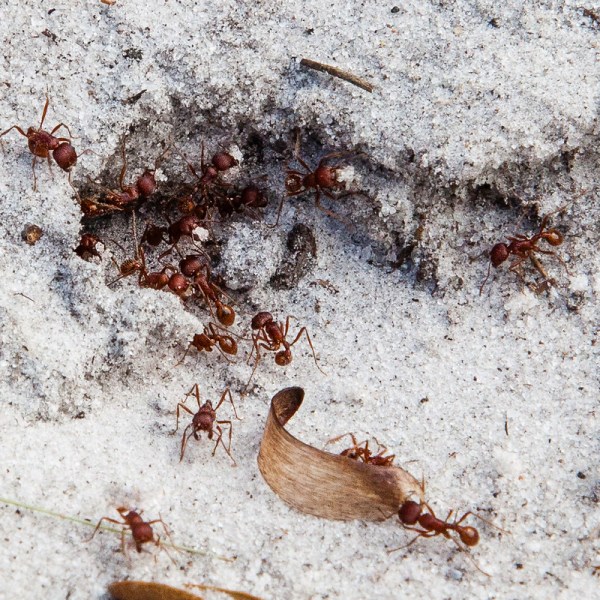
Harvester ants. Big heads. Big jaws for seeds and for foes. The crowded door to the underground colony is toward the top left. By John Bradford.
In the white sandy coastal scrub native harvester ants (Pogonomyrmex badius) have some odd ways and means. Their nests are abundant and easy to find in open sugar sand, resembling an upside pie pan with a busy central portal leading to a huge subterranean colony.
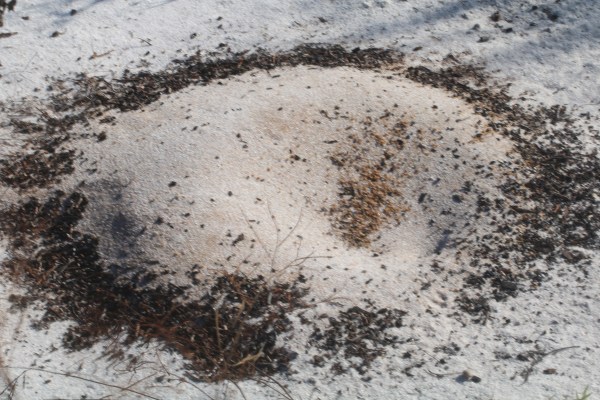
Colony today with its black charcoal-y fence.
Around the portal is a barren “yard” scurrying with ants, the yard surrounded by a dark “fence.” That fence is the feature attraction today. It is a ring of debris, much of it waste from the nest, no surprise there. The surprise is that the ring is also so loaded up with burned bits of charcoal that the overall coloration is almost black. Bits of charcoal? Yep.
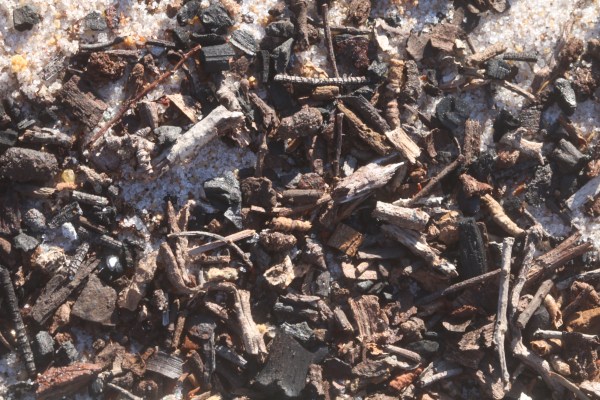
The ants seem to gather it from past fires. WT-heck is that all about? Nobody knows definitively, but not for lack of trying by biologists over the years. Several past suggestions exist, some purely speculative, some checked out. Here’s a quick list of previously published possibilities:
1. To exclude enemies. The “defensive perimeter” idea is obvious but flawed, especially, “what enemies?” The main natural enemies of Florida harvester ants are parasitic wasps. They fly, so a fence is no D. Also unfriendly are fire ants, but they did not evolve with harvester ants, and besides, would charcoal chunks block any kind of ant? Maybe not physically, but perhaps as a “no trespassing” notice to encroachers even of the same species from different colonies. The defenders have ferocious chompers, and they can sting too. We’ll come back to the “no trespassing” concept.
An enemy that attacks ants on the ground—after prior airborne dispersal—are ant lions, and they can lurk around harvest ant habitats. The lions scoot across the sand to set ant traps, and a fence may discourage violating the ant campsite. But the ant colony is mostly subterranean and essentially immune to ant lions. It is hard to imagine ant lions as a force to reckon with.
2. A different notion is that the black fence is a landmark ant foragers beyond the pale can see from the distance when lugging home the harvest of seeds. A homing beacon. (Naw)
3. A third proposal is that the black charcoal, like a black car, absorbs heat to warm the nest on chilly mornings. Trouble is, the nest can be 10 feet deep.
4. Charcoal absorbs organic compounds, perhaps including chemical signals. The resident ants could infuse the charcoal with pheromones, warning unwelcome ants to bug off. Efforts by other people to test this have come up dry.
https://drive.google.com/file/d/1YyNXYzAlrvX10lFF14FlGxVC0lJL9iOS/view?usp=sharing
5. A related older speculation is that the charcoal is a favorable seed bed to help stubborn seeds sprout into ant food. Investigated but never demonstrated. Undermining all explanations involving special characteristics of charcoal, non-Florida harvester ant species make similar fences but use non-absorbent pebbles instead of briquettes. Florida harvesters in sand don’t have pebbles, so maybe the burnt bits are merely locally available substitutes. (Are harvester ant colonies related in size, health, or abundance to charcoal availability?) Charcoal pieces are usually sparse on scrub sand, so the investment required to gather thousands of them to the nest site must be costly! They must also serve an important purpose. To see if the charcoal ring “matters” to the ants, the other day I scooped a small portion of a charcoal ring away. Remarkably, by the following day they had repaired it fully.
John and I discussed the fence question today, and jointly have an idea to “toss into the ring.” In all the historical speculations, there is little-to-no attention to the second function of fences: confinement. Let’s say keeping junkyard dogs in the junkyard. Those big-headed, heavy-jawed, biting “major” ants roaming inside the fence are scaled down junkyard dogs. It would be a problem to junkyards and to harvester ant colonies to have the guards (and workers) wandering away willy nilly. We suspect the fence defines the duty station for its occupants. In the video link above you can see ants wandering to the fence, and then redirecting back into the yard to remain effectively useful.
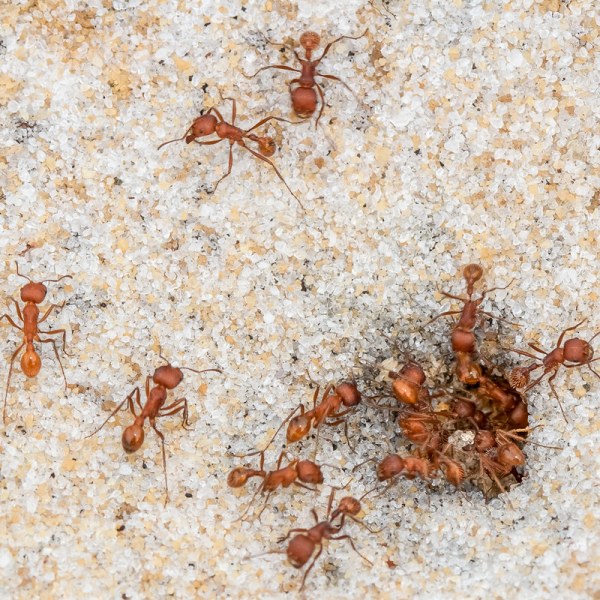
 John Bradford
 George Rogers
 George Rogers
 Dee Staley
 Treasure Coast Natives