Evening-Primroses, lovely members of the big genus Oenothera with almost 100 species in North America, are well represented as mostly bright yellow wildflowers in Florida, some in open sandy habitats. One cosmopolitan beach species, arguably native to Florida, Beach Evening-Primrose (O. drummondii), found itself called out recently as listening for pollinators. Yes, listening.
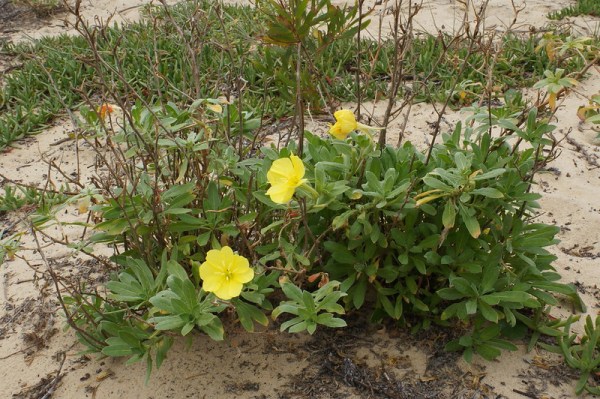
Photo courtesy of Harry Rose.
Biologist Marine Veits and a group of collaborators in 2019 reported honeybee buzz and similar vibes, but not other tones, to induce increased sugar concentration in the nectar. In their interpretation, this ability sweetens the pot upon demand, promoting bee pollination yet conserving sugar when there are no customers. What’s more, the petals resemble one of those parabolic microphones they use to focus birdsongs, to capture frog calls, and to eavesdrop on conversations.
It may all be just as reported and interpreted, but questions come to mind:
- Are bees meaningful pollinators for evening-primroses? The flowers are (actually) textbook examples of moth-pollinated blossoms, having long tubes producing nectar way down deep exclusively reached by a moth’s long proboscis. But bees are known to visit the flowers, perhaps merely gathering pollen, as bees do. That could result in pollination without nectar consumption. Then again, who is to say the long tube can’t fill with sweet nectar, allowing an occasional bee sip.
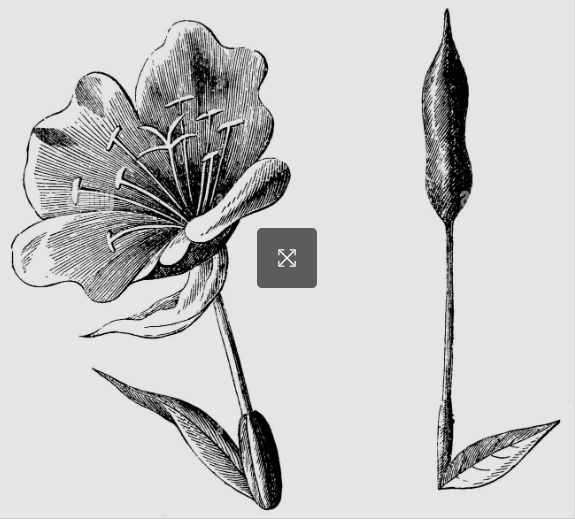
Nectar is produced at the bottom of the long skinny tube. Bee can’t reach there.
- Would a small increase in sugar content boost pollination? Not if the bees are there just for pollen. And even if they are obtaining some nectar, it’s not been shown (pretty hard to accomplish!) that marginally raising sugar concentration leads to more pollen deposited by more bees on more stigmas.
- In 2017 botanist Sebastian Anton and collaborators studied the floral dynamics of several evening-primrose species in Europe and found the flowers to not just release nectar into the tube, but also to suck it back in dynamically, depending on circumstances. The nectar level waxes and wanes. As the flowers reduce the nectar volume, the sugar concentration increases. That is, sugar concentration increases when the flower is stashing away nectar, not dishing it out. Does buzzing set off a flower alarm: “Hey, non-moth invaders detected, hide the goodies!” After all, some types of bees drill into flowers and steal nectar like mosquitoes stealing blood from my elbow.
- Yet another concern is that the flowers don’t have any identified “nervous tissue,” whatever that could be in a plant. Absence of detection does not prove absence of some subtle signal, duh, but it doesn’t help either. Plant cells live within extremely thin delicate membranes with their own innate molecular movements and unimaginably delicate processes. Whether or not buzz detection is usefully adaptive, vibrating cell membranes could conceivably change cross-membrane transfer dynamics, maybe even make membranes “leaky.” That is, could vibrational sugar leakage take place with no purpose?
Who knows? The idea is new and fascinating and plausible, and that is how science works. Taking another look at the same question with additional bee and flower species is joyous future grist for the mill. The original research was in the Mediterranean. Now somebody should try in Florida.
to see more:
DOI 10.1007/s00425-017-2748-y
DOI 10.1111/ele.13331
 John Bradford
 George Rogers
 George Rogers
 Dee Staley
 Treasure Coast Natives
Eliane M Norman
February 22, 2026 at 12:22 pm
I like your ideas. The story about aeration in the pond apple should be published.
Eliane norman
George Rogers
March 7, 2026 at 9:18 am
Hi Eliane! Thank you! You know, I might carry that forward. Hope all’s great with you.