RSS

Author Archives: George Rogers

Unknown's avatar

About George Rogers

Florida botanist

Baldwin’s Milkwort – Gotcha!

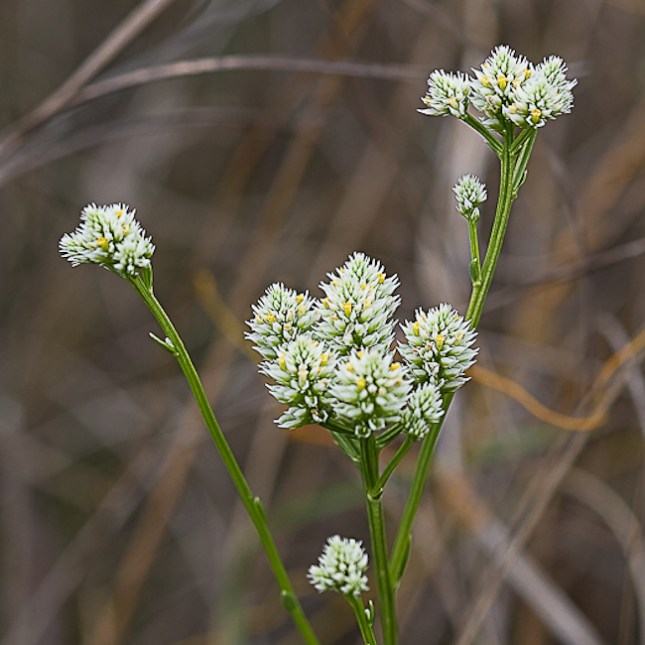
Polygala balduinii

(Polygala means much milk, from the belief that these plants promote lactation. William Baldwin was a physician and botanist active in Florida and in other states.)

Polygalaceae

Today John and I continued to fuss and fume over mangroves and soil salinity in Hobe Sound.  Adding to the experience, at this moment in flower all about the wet meadows are pretty and smelly Baldwin’s Milkwort.   Smelly because the plants upon bruising perfume the air with essence of wintergreen.

Polygala balduinii 1

Polygala balduinii by John Bradford

Wintergreen oil is methyl salicylate.   We buy the stuff to relieve discomforts, such as by rubbing it on the skin.  Big surprise…chemically the oil is essentially aspirin, likewise a derivative of salicylate, aka salicylic acid.   The methyl salicylate is bound in the intact plant to sugar, and in that condition remains in odorless reserve, until physical injury unleashes an enzyme able to separate the wintergreen from the sugar, setting the fragrance free.

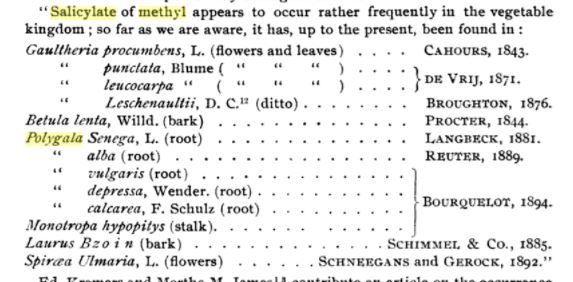
Salicylic acid is not merely a human pain reliever, it is also an air-borne hormone alerting the rest of the plant to prepare its “immune system”  for attack.  Not sure, but probably that’s what the wintergreen fragrance release upon injury is all about. Wintergreen and Polygala are not the only plants to bear methyl salicylate.   Here is the state of the art in 1898:

methy salicilate

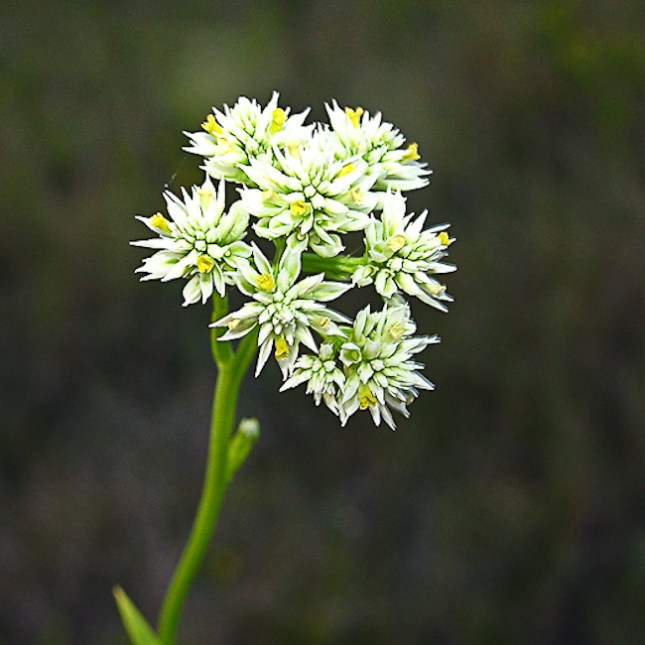
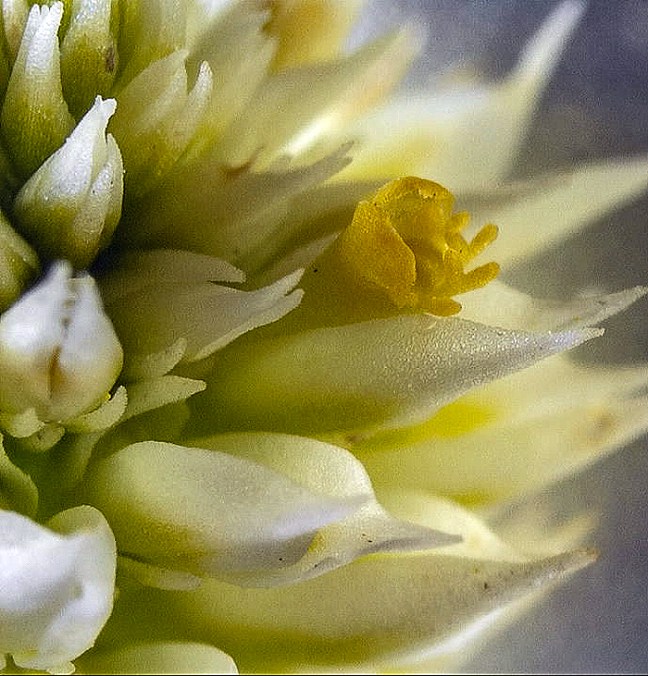
The Polygala balduinii today was so pretty, having heads of bright white flowers, each with a tiny yellow center,  we had to wonder what pollinates it.   No answers on Google.

Polygala balduinii 2

By JB


polygala close

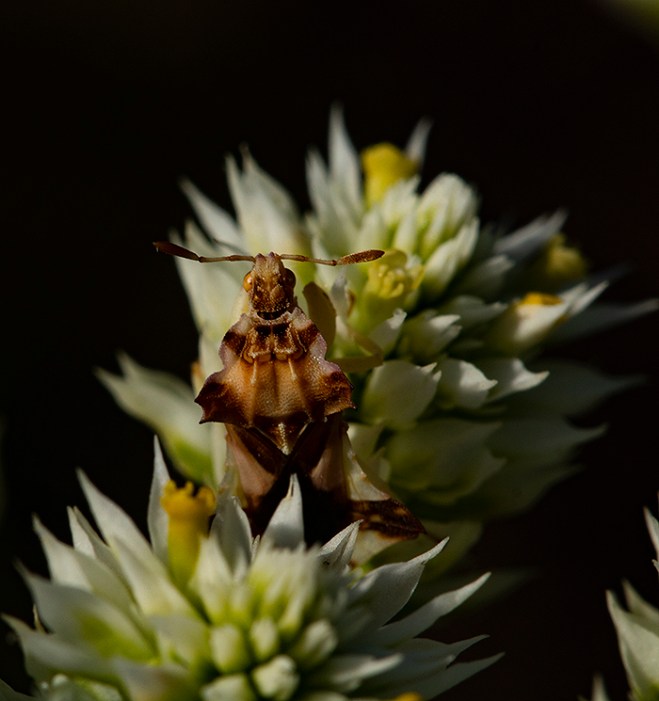
We hung around awhile to try to spot pollinator action.  Although we saw no pollinators, we did encounter somebody else likewise waiting for a floral visitor…an Ambush Bug loitering among the flower heads.

ambush bug 1

Ambush Bugs live up to their name, waiting among the attractive flowers to waylay an innocent pollinator who comes a’visiting.    These ambitious little ner-do-wells grab prey vastly larger than themselves, including honeybees, small butterflies, and roosters.

chickenhawk


White Mangrove and Its Multifarious Roots

Laguncularia racemosa

(Laguncularia comes from Latin for a small bottle, in reference to the fruit.  A raceme is a type of branched flower cluster.)

Combretaceae

This morning John and I probed the saline mud around Peck Lake, near Pt. Salerno, Florida, attempting to discern a relationship between the flora and the increasing salinity levels approaching the shore of saltwater Peck Lake.    One thing I learned is that 66 11/12 is too old for scrambling over the handrail and down off of boardwalks to get personal with crabs in the mud below.  A good place though to think about the many adaptations Mangroves have to their smelly salt life.

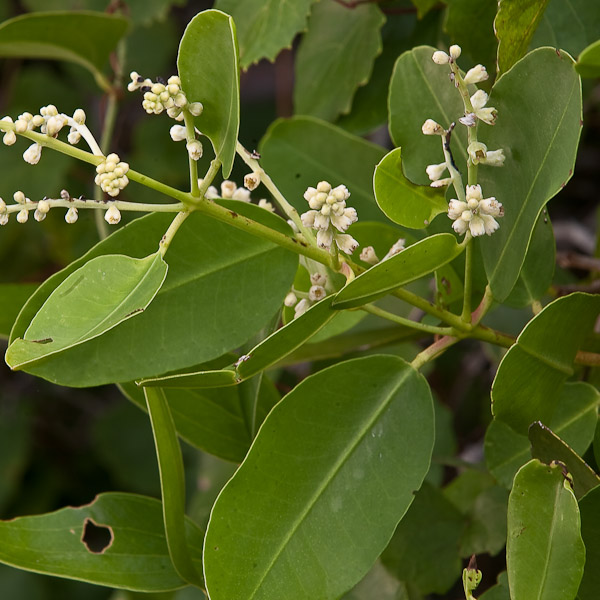
Laguncularia racemosa 4

White Mangrove by John Bradford.

Before we go on, let it be clarified that the word “Mangrove” refers to a tropical tidal swampy muddy briney lifestyle.  The many mangroves of the world are not related to each other, and the club has indefinite inclusion, where two honest observers may disagree as to whether a given species is a “mangrove” or not.

Today’s White Mangrove is more closely related to Tropical-Almond, Black-Olive, the vine Rangoon Creeper, and Buttonwood than it is to Red or Black Mangrove.    That mangroves are a result of convergent evolution is what makes them so interesting…the different ways disparate salt-swamp coastal species solve the same problems.    For instance, Red Mangroves block salt entry instead of dealing with it internally.  Reds reportedly have the lowest salt tolerance of the local Mangroves despite usually being the one with the wettest feet in the seawater.  Black and White Mangroves, by contrast, allow salt to enter the root and rise throughout the plant.

Both White and Black have tiny glands on the leaf surfaces able to pump out the brine. Yet there’s a difference.  Black Mangrove obviously dumps a lot of salt.  Its blades are usually white-crusty, and taste like a pretzel.   But White Mangrove foliage seldom has such crystal crust.  Excretion doesn’t seem to be as important to this species.   White sequesters salt in its thickened fleshy leaves, periodically discarding and replacing them.

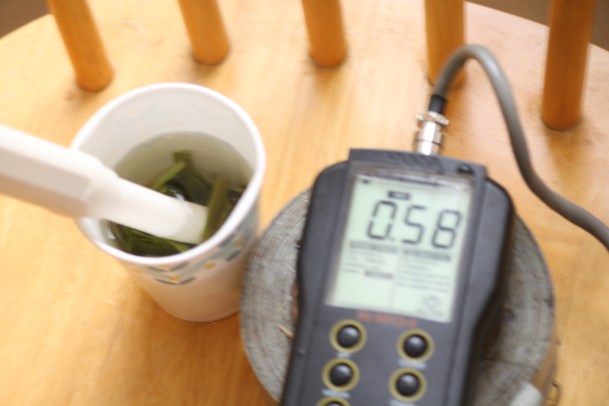
Below is a quick and dirty demo. The first cup contains only tapwater, reading 44 salinity units (mS/cm), reflecting the fact that tapwater does contain salt, defined broadly.  Toss in 5 sliced White Mangrove leaves, wait a few ticks for salt to dissolve into the tapwater, and the salinity reading climbs in the second photo.

IMG_3379

Tapwater with salinity measured (as EC in mS/cm).

IMG_3382

Same water with White Mangrove leaves giving up their salt. Note increased reading from 44 to 58.

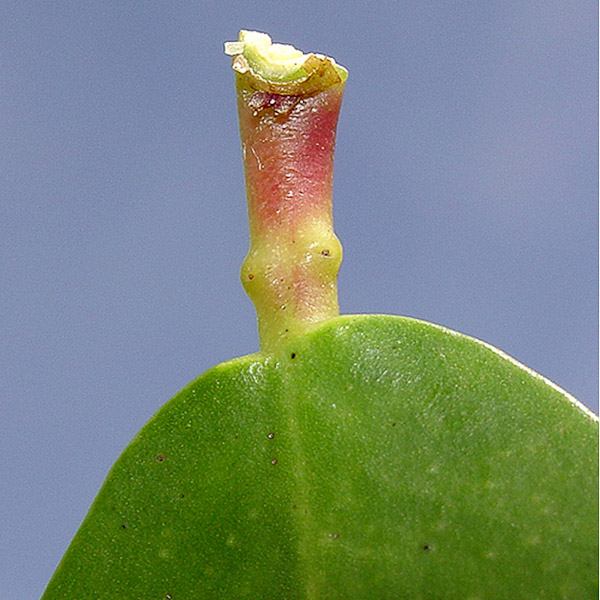
Salt glands are not the only curiosities on White Mangrove leaves.  Near the margin is a line of tiny black cavities.  These domatia are barracks for microscopic symbiotic mites.   The related Buttonwood has them as well.    On the leaf stalk (petiole) are two raised glands often misinterpreted as “salt glands.”  No…the real salt glands are microscopic, whereas those two petiole bumps are sugar fountains for symbiotic ants, in the right times and places.

Laguncularia racemosa 3

Nectaries on WM petiole, by JB. The tiny smaller glands are visible scattered lower, on the leaf blade.

The most interesting parts are the roots.    First a little context.   Mangroves live in water or in tidal muds suffocating to unspecialized roots, so the Mangroves each have different coping specialties.   Red has famous prop root flying buttresses arching out from the trunk above the water.    Black has spooky vertical “dead man’s fingers” pointing heavenward  from buried horizontal roots.   White has an intricate root aeration system, which is hard to spot.

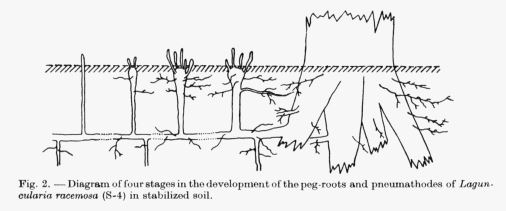
White Mangrove roots are shy, often submerged or nearly so in water or mud.  The system  entails at least four different root types, as displayed in the following 1970 diagram by botanist Jan Jenik (linked below):

laguncularia root system

Cable roots horizontal at base.  Vertical pegs rise from these, with small feeder roots along the pegs.  Clusters of little snorkels (pneumathodes) rise from the enlarged tips of the pegs.

Starting at the deepest, large thick White Mangrove roots run horizontally under the mud.   From these rise vertical medium-peg roots to a little below or a little above the water or mud.   These often have slightly swollen heads.  To the pegs are attached the thin feeder roots. What a perfect place to be a feeder root, since as the water and oxygen levels rise and fall the positions of the feeder roots probably rise and fall  by means of death and regeneration correspondingly on the pegs.

Laguncularia roots old photo 1

From Jenik, see text.

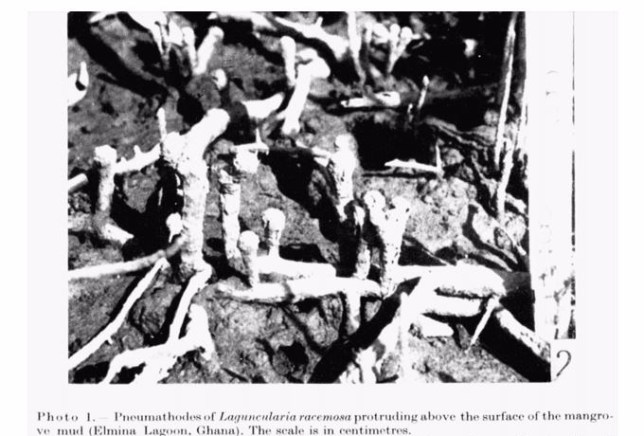
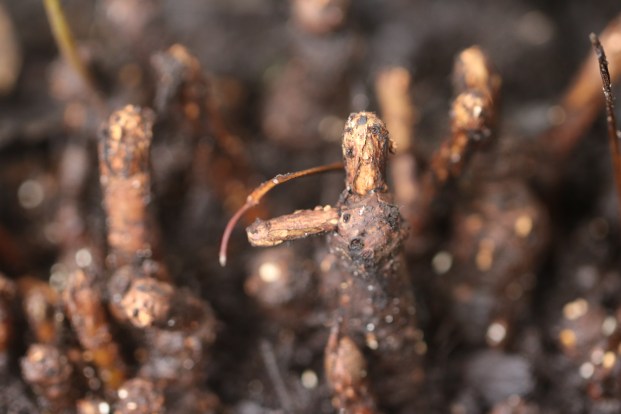
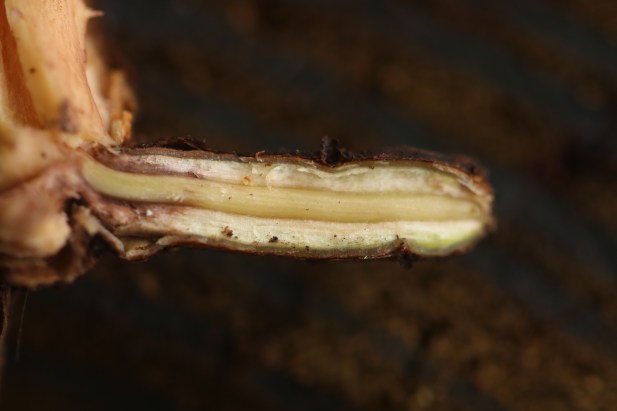
All those feeder roots need aeration.  For this purpose on the peg tips arise stubby, thick, short-lived chimneys (pneumathodes), venting air through a soft porous outer layer all the way to those needy feeder roots.


IMG_3305

Pegs with pneumathodes today.

IMG_3342

Outer layer of pneumathode is spongy.

IMG_3336

Pneumathode has big white breathing pores (lenticels).

——————————————————————————————————

[Forgive a non sequitur.  Part of the reason Bald Cypress knees do not seem to be root-zone air vents is that they are nowhere near the active feeder roots..]

Jenik article:

http://www.preslia.cz/archive/Preslia_42_1970_105-113.pdf

 
2 Comments

Posted by on March 15, 2019 in Uncategorized, White Mangrove


Livin’ Funky Below the Lichen Line

Syrrhopodon texanus and friends

(Syrrhpodon comes for Greek for crowded teeth, in reference to the spore release mechanism)

John and I worked today in Peck Lake near Pt. Salerno, Florida,   with lichens on mangroves, although for blog purposes I’m broadening to a nearby bald cypress swamp.   Lichens thrive almost anywhere, on trees, on rocks, on tortoises, but they do have secret loathings.  As covered last week, many dislike pollution.  Submersion is worse.  Baptism can set them back.  Observers in New Orleans CLICK can still pinpoint the peak water levels from Katrina marked by the “lichen line,” the trees there hosting healthy lichens above the line, and few (or after 15 years, different species) below it.

Lichen lines are divisive in PB County too, on bald cypresses where the water can rise and drop multiple feet per year.   Walk in a dry bald cypress swamp today and the lichen line is at your knees or above, equal on each trunk.
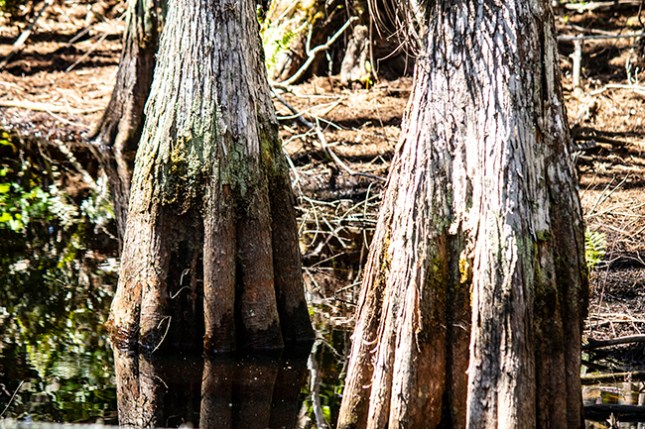
Taxodium lichen line

You don’t see many sharper borders in nature, two ecosystems separated by inches.  Above the border a dozen multicolored lichens along with tillandsias, ferns, mosses, and more.

Below it, however, bang, a completely different flora tested by the crucible of submersion half the year, high and dry the other half.  Who can withstand such eco-whiplash?  Does submersion eliminate all lichens?  Very nearly.

The lichen Leptogium crenatellum can un-drown happily, although we did not see it today.  Its “algal” component is no alga, but rather a cyanobacterium of the indestructible genus Nostoc.  Nostoc CLICK is responsible for dark jelly patches rising from soggy ground.  Leptogiums thus are called jelly lichens.  They fear no flood.  /

The main plants south of the border are mosses and liverworts, conceivably “pre-adapted” to flooding.  They belong to the group of plants, Bryophytes, most related to algae, which Bryophytes resemble by having every cell in direct contact with the water or air, exchanging gases, nutrients, and wastes like an alga in a pond.  No surprise that some mosses are fully aquatic plants, especially in the family Fontinaliaceae.   Members of this family turn up in bald cypress swamps, happy in the soup, but impaired during the high and dry times.  The dominant below-the-line Bryophytes tolerate both extremes.

Around today’s swamp the dominant moss down low is Syrropodon texanus, one tough customer.   Syrrhopodon stands up to its hard knock submerged-exposed life with reinforced leaves that when dry twist into a protective thatch roof.  Its leaf bases have big clear hollow cells called hyaline cells.  These are “canteens” the moss fills when wet, and presumably consumes slowly as needed later.
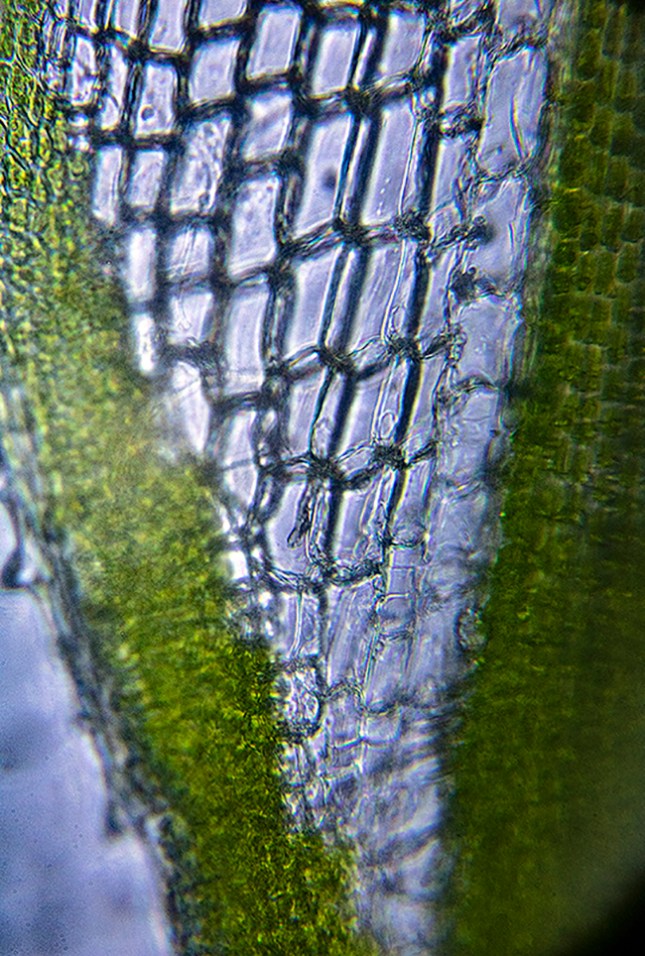
Syrrhopodon hyaline cells

Syrrhopodon hyaline cells at leaf base microscope view  The hyaline cells are the clear water bottles between the bands of living green leaf cells.

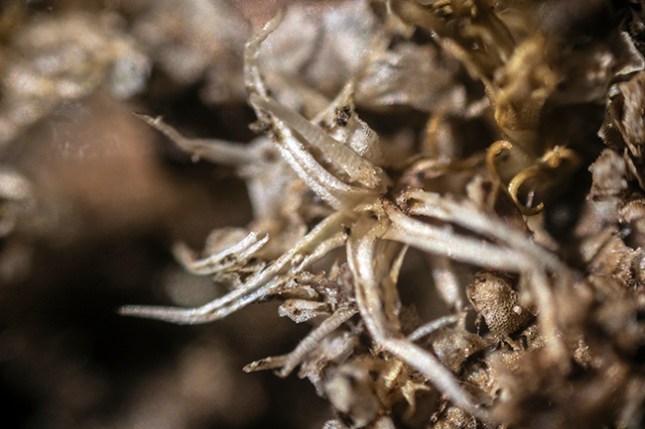
Another moss below the line, and in many other places, is Leucobryum albidum which has more hyaline cells than green cells.  The plant is a living water tank, the glassy empty cells giving  the leaves a white color.
Leucobryum close.jpg

Leucobryum is white, made 90 percent of hyaline cells.

Moss sex requires “rainsplash” to bounce the sperms to the eggs on the tips of the tiny plants.   That is impractical when underwater half the time and  clinging to an exposed tree trunk the other half.    All three of the mosses listed below each have different methods of sidestepping sexual dysfunctionality by cloning themselves using microscopic breakaway bobbers able to drift to new moorings during the floaty moths:

Leucobryum albidum suffers a reported shortage of male plants, but no problem,  no boys needed, it clones via tiny breakaway cell clumps produced on short stems.  Additionally, its detached leaves can root.

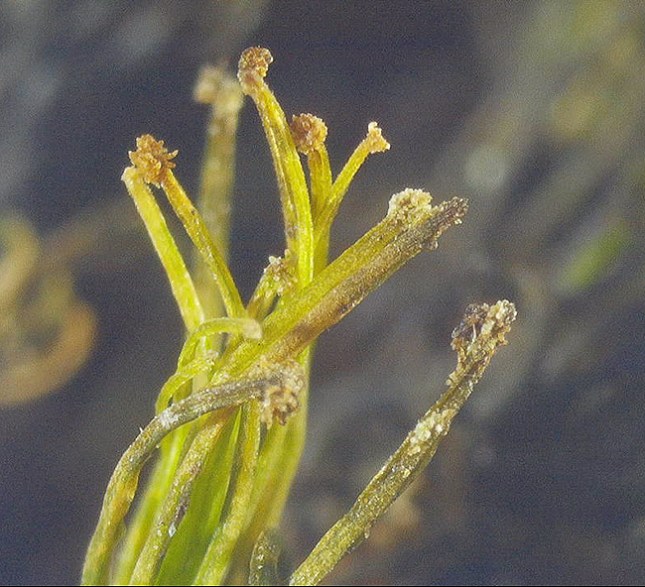
Syrrhopodon texaus disperses itsy bits produced by the thousands on the leaf tips.
Syrrhopodon gemmae

Syrrhopodon leaves dry and twisted, with micro-bobbers releasing from the tips.  Microscope view.

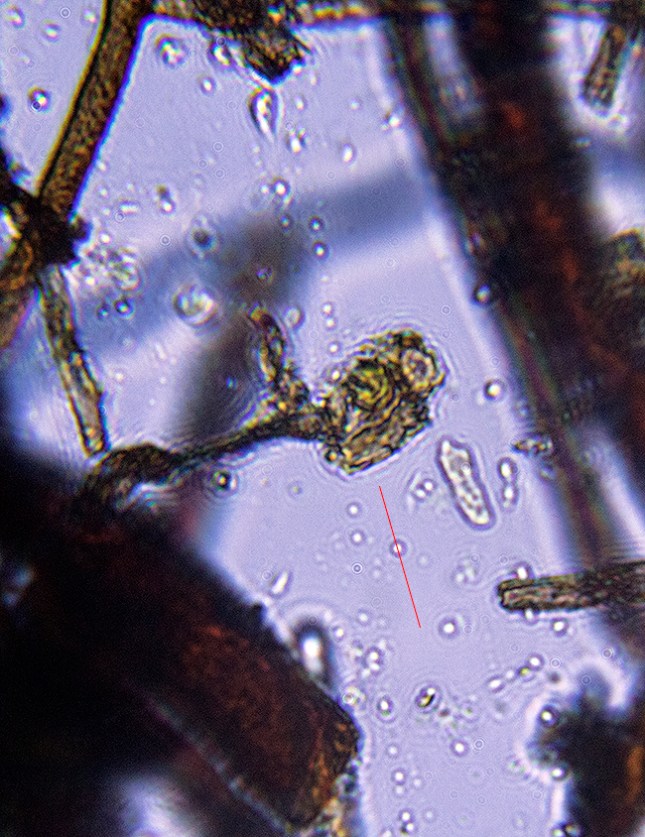
Brachymenium macrocarpum has hairlike “rhizoids” along its stem.  The rhizoids spawn microscopic “tubers” to float the species to a new tree.
BRACHTMENIUM MACROCARPUM TUBER

Rhizoid tuber microscope view, on Brachymenium.

To sum it up, if you want to live as a submarine part of the year it helps to be related to algae, to have built-in water tanks, and to disperse clonally with floaty pieces.

————————————————————-
liverwort

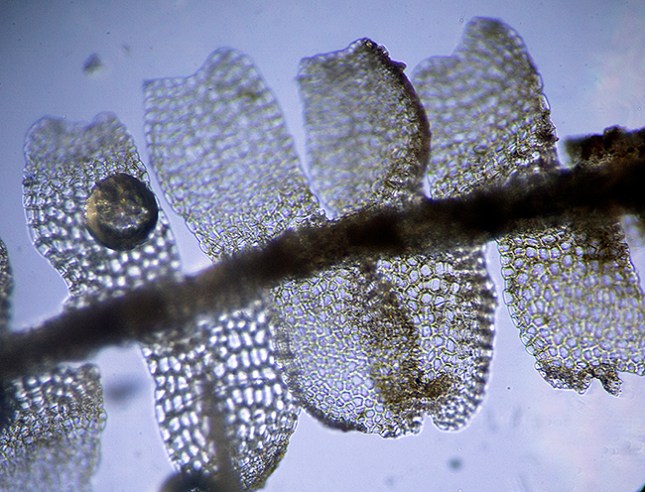
Liverwort from down below. Microscope view.


Dominant  lichens above the line in a Florida swamp:

Chiodecton montagnei

Cryptothecia rubrocincta

Heterodermia albicans

Physcia crispa

Do the mosses, liverworts, and cyanobacteria contribute oxygen to life below the lichen line? CLICK

 
3 Comments

Posted by on March 8, 2019 in Lichen Line, Uncategorized


Tags:

DYCs (revisited)

Posting a day earlier than usual due to some schedule complications.   Today my Pam Beach State College native plants class fanned out to conduct a flowery study in Riverbend Park in Jupiter, Florida.  While waiting for the students to all-ee all-ee in come  free, I wandered through lovely moist meadow and counted the DYCs.

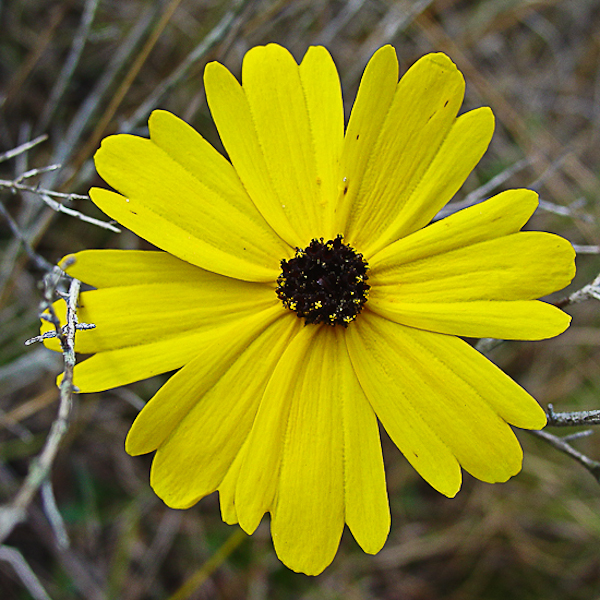
Coreopsis gladiata 3

Coreopsis by John Bradford.

DYC is a technical botanical term, standing for Darned Yellow Composites, first-muttered by somebody trying to identify them.   A Composite is a member of the Composite Family,  the Asteraceae,  with some 24,000 species one of the “big 3” families:  Composites, Orchids, and Legumes.   Everybody knows Composites, such as Dandelions, Marigolds,  Sunflowers, and so many more.  Note my cherry-picked examples—yellow.    Not all 24 K Composites are yellow, of course, but I think it fair to say most are.

Deviations from the prevalent yellowness are interesting in their own right, for examples botanists in the Middle East noting a split between non-thorny yellow Composites, and thorny ones of other colors.   Think for example, of purple spiny thistles.   Their contention was that being not-yellow was perhaps warning coloration to flag off herbivores.  Now nobody is saying all non-yellow Composites are prickly, but merely that the family is perfectly capable of being non-yellow if that is the adaptive optimum.   For the moment, let’s think about the many many many yellow members of the Aster Family.   Why should yellow be the main color of a huge family?

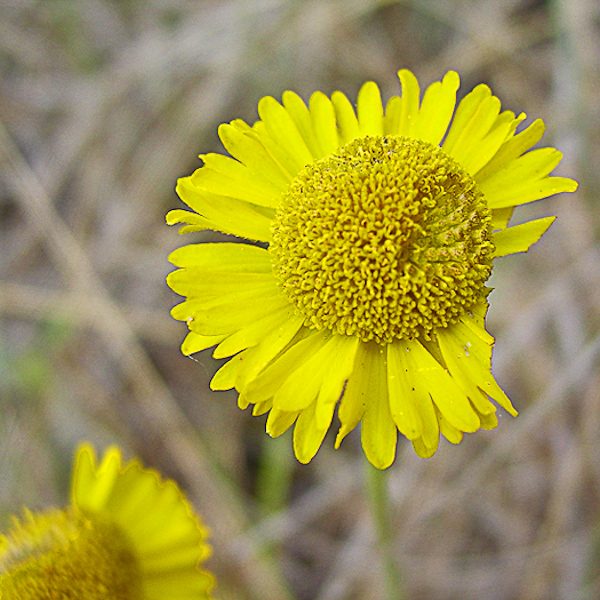
Helenium pinnatifidum 3

Helenium by JB

A boring answer may be, well, they started out that way, their great ancestor had yellow flowers, and the family diversified with the original yellowness deep in the DNA.  Okay sure, but I’ll bet there’s more to it.   Equally boring, you might wonder if yellow pigments are “cheap” to make, or if they tie in secondarily with some underlying metabolic machinery.   Yea maybe, but let’s assume that yellowness is adaptive in its own right.  That it has to do with insect pollinators.  If so, what is so great about yellow flowers in this family with respect to floral visitors?

Hold on, it is not strictly a “family” affair.   Asteraceae are predominantly plants of meadows, fields, and open sunny places.  Come to think of it, a lot of meadow-ish and open-area  flowers are yellow, such as members of the Mustard Family, yellow Poppies, many water lilies,   buttercups, and more.    Maybe there is something beneficial about yellow in meadows, fields, and similar habitats.

Does it have to do with a particular pollinator type?   In a moist meadow in Riverbend Park were most of the flowers today yellow because, say, yellow-lovin’ bees rule?  Probably not.  An idea that is not original with me is the opposite, sort of like politics or marketing.  How do you get the most votes or customers?  Appeal to the broadest audience you can.   Maybe a meadow is no place to be a one-pollinator specialist.   Maybe in the middle of the field where thousands of flowers compete and yet at the same time draw massive numbers of insects, the best approach is to generalize and attract the greatest number of pollinators of whatever sort may be willing to visit.  Wal-Mart vs. Rodeo Drive.

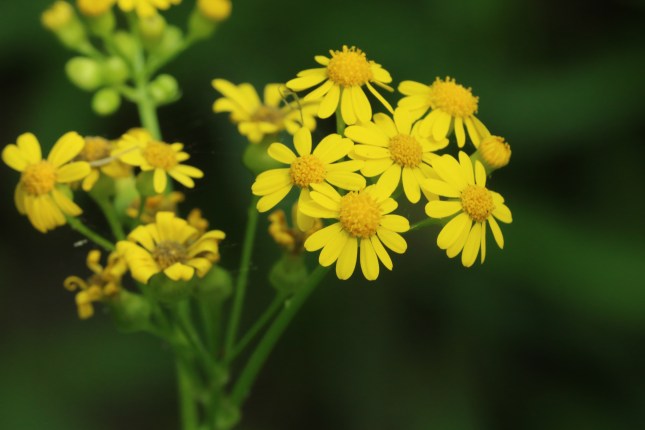
IMG_2885

Butterweed,  along Hillsboro River near Tampa this week.

The flower head in the Composite Family is an open plate or bowl anybuggy can visit.   The nectar is easily accessed near the floor of the bowl.   The head pushes the pollen to the surface of the bowl where any visitor can gather it “purposefully,” or merely be dusted with it inadvertently.  The pollen-receiving stigmas rise into the bowl where all visitors, perhaps dusted with pollen, tread and deposit pollen.      The head welcomes all comers, and they all come.   It might be intuitive to think first of honeybees, but in a Jupiter, Florida, meadow honeybees are not indigenous, although other types of bees are.   Beyond the bees, important DYC pollinators include flies, beetles, butterflies, and no doubt more.

Insects see UV, which I  do not.  All those insect visitors are seeing markings in those flower heads we’re scarcely aware of.    Pollen itself is yellowish, so a yellow flower in a sense may send an advertising signal of “woo hoo … pollen here!”    Yellow markings are often associated with flowers specialized for bees.

Casting the net beyond bees,  botanist Sara Reverte and collaborators in 2016 published a survey of pollinator-group color preferences embracing many thousand plant species in different geographic regions.   The following insect groups had yellow as their “favorite” color in at least one region:   ants, wasps, beetles, flies, and lepidopterans (butterflies and their kin).   Yellow might not be “the” best color to draw a single specialized pollinator (not many specialized orchids have yellow flowers), but  if getting the most 6-leggers into your bowl is the goal,  yellow seems a great way to build a coalition.

 
3 Comments

Posted by on February 28, 2019 in Asteraceae, Uncategorized


Liken’ Lichens

This morning John and George pondered the ways of lichens in Halpatioke Park in Stuart, Florida.   There’s always much to learn and say about these biological  curiosities.  First we’ll knock off the “Botany 101” basic lichen facts you could find all over the internet, then attempt something more off the beaten path.

IMG_3465-Edit

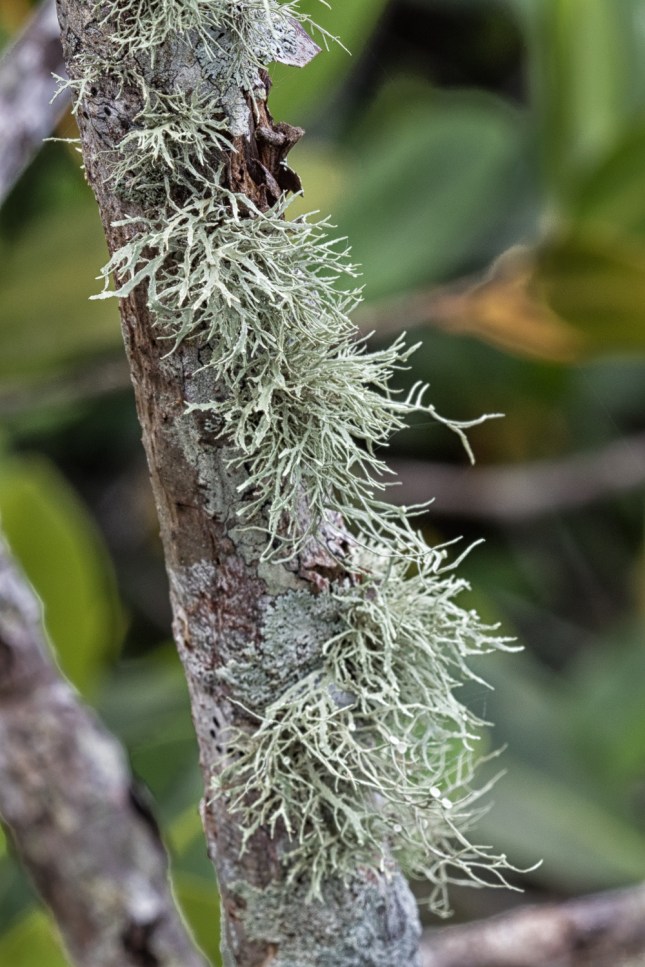
A branched “fruticose” lichen, by John Bradford.

LICHENS 101

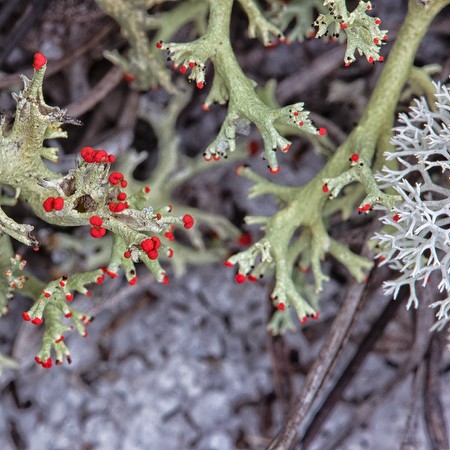
  • A lichen is a symbiotic union between a fungus and one or more algae species, or sometimes cyanobacteria, living together as one.
  • Lichens are not all related to each other. They evolved many times.
  • Lichens favor extreme habitats such as rocks, concrete, sand, and especially tree bark.
  • Lichens, when dry, go into suspended animation, and come to life when moist.
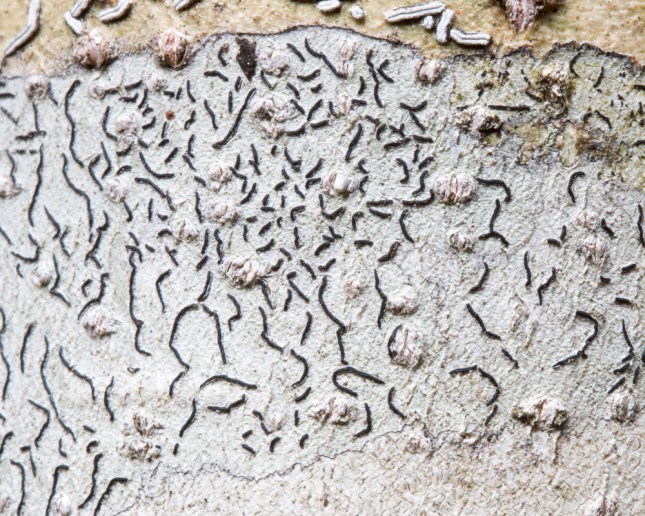
  • Lichens exhibit three different body forms:  one form resembles paint, one form resembles a crinkled leaf or fried bacon, and the third form is branched and shrubby.  They sell the last-mentioned as shrubs for model railroads and dollhouses.
  • Because lichens are two-species species, their reproduction is a coordination problem.  Most lichen reproduction is thought to be tiny clonal fragments where the fungus and alga elope together, although the fungi sometimes form spore-making organs.
  • Lichens come in beautiful colors stolen and applied as lichen fabric dyes.
  • Some lichens suppress surrounding competing vegetation.
Cladonia sp. 3

By JB

Okay then we’ve got the lichen picture.  Now for the weirder parts:

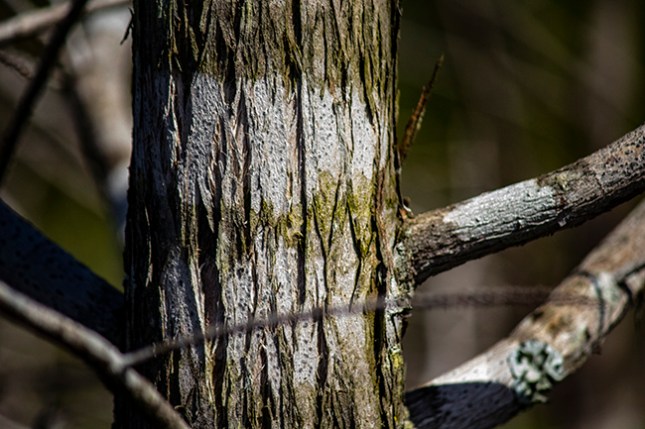
Weird thing 1.  Most lichens grow as irregular shapes, or shields, or roundish patches.   They grow in ways consistent with starting from a point and growing outward like ripples on a pond although far more irregular.  But  today John and I noticed something very different:  a tendency for multiple different types of lichens to appear as horizontal bands, partial belts,  across the oak tree trunks, especially laurel oaks.

lichen bands

Lichens often appear as horizontal band aids.

The way that comes about may be sort of obvious but then again, not.   The obvious part is knowing that the tree trunk expands in girth like my waistline after too many donuts.   It stretches horizontally but not vertically.   If you put a roundish paint spot on a tree and let it grow 10 years the dot will be stretched laterally into a horizontal bandaid.  Strtching ought to make it fragmented and thein.     If two kids take a ball of taffee and pull, it will of course get longer and thinner, or may break.  So here is the surprise…when a thickening tree taffee-stretches a lichen laterally,  it usually does not thin or fragment, even if stretched many times its original diameter.  The stretched part seems to self-heal and re-thicken, even filling in the cracks if fragmentation is apparent.   It compensates for the stretching, you might say adapted to its preordained strain.   If you’re going to dwell on a tree trunk, get ready to be stretched.  You don’t see such banded lichens on concrete, or on palm trunks,  which have minimal expansion in girth.

IMG_3472-Edit-Edit

BY JB

Weird thing 2 is the extreme sensitivity of lichens to air pollution.  There they sit on a tree with no roots and no protection, exposed to every breeze and absorbing every drop of mist and rain,  as well as everything carried in that wind, mist, and rain, including nutrients,  radioactivity, and toxic pollutants.   That tendency favors some lichens, for example, if the air pollution is rich in nitrogen compounds, certain lichens may say, “thank you for the free fertilizer.”   Most often though, it seems to me, air pollution diminishes lichen coverage and diversity.   The most obvious sources of air pollution around here are highways, and the pollution-effect was apparent today along ever-busy four-lane Indiantown Rd. in Jupiter.   Adjacent to the road is a bald cypress swamp extending from the edge of the pavement back maybe half a mile or so.     The lichen diversity and coverage is conspicuously diminished with proximity to the traffic.

lichens disappearing

The case of the disappearing lichen.  The tree(s) in the foreground far from the busy road are rich in light-colored lichens.    Follow your eye out to the road…the darker trees near the road (such as those in front of the black car, or on the far left) have few or none.  All the trees are bald or pond cypress.

 
10 Comments

Posted by on February 22, 2019 in Uncategorized


Wind-Pollinated Oaks

Quercus virginiana 9

Live Oak by John Badford

John and I worked today mostly on Oaks in Halpatioke Park in Stuart, Florida.   Many Oaks (and Pines) are shedding pollen now into the air, as we  allergy vics know so well.   Being that wind-pollinated plants are asserting themselves today,  let’s not talk about the birds and the bees, but rather the nerds in the breeze. Achoo.

Flowering plants are “all about” animal-mediated pollination.  Although there remains a ton to learn about the early evolution of flowering plants,  the standard perception is that flowering plants evolved from wind-pollinated ancestors, that their raison d’être is to offer attractants and rewards to creatures in exchange for symbiotic pollen transfer.   Yet over 10 percent of flowering plants are wind-pollinated. (I wonder if that will increase as we drive insect pollinators into oblivion.)

Quercus virginiana 5 (male flowers)

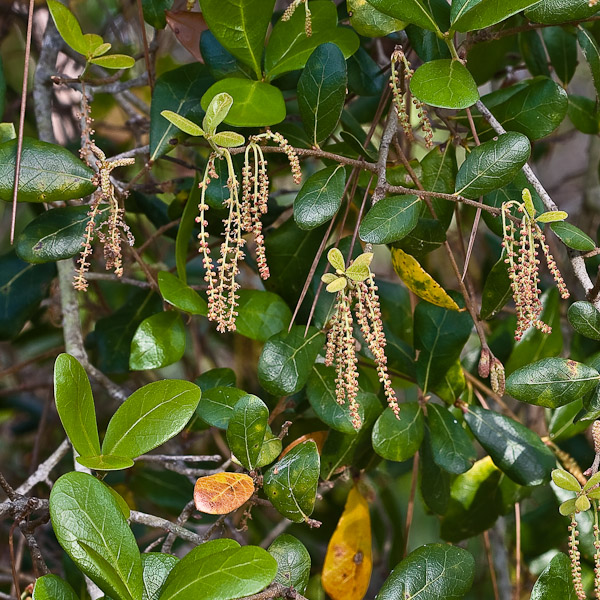
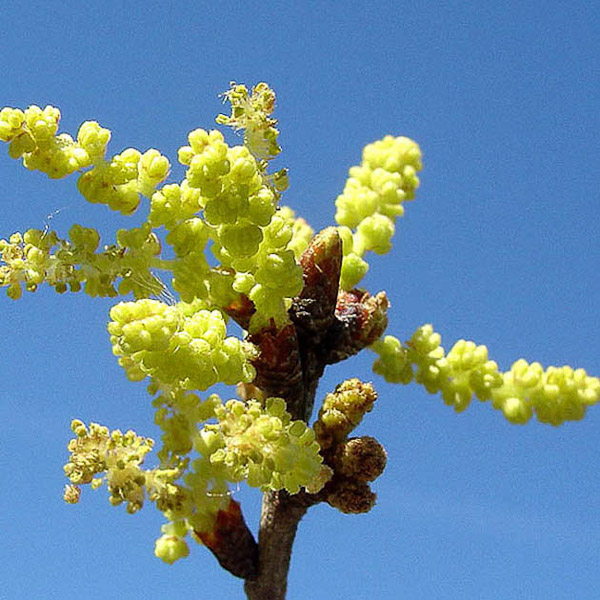
Myrtle Oak male catkins releasing pollen,  by JB

Wind-pollinated flowers represent a return to wind from insect-pollinated ancestors, that is, wind, then insects, then back to wind.   Why go retro?  Botanists estimate that the about-face has happened in over 60 instances.    Sometimes wind-pollination works better than bugs and birds, most obviously in circumstances where creature-based pollination is unreliable, such as harsh habitats and wide open spaces.

Wind-pollination is comparatively rare in tropical forests with high plant species diversity and plenty of birds, bees, moths, bats, and butterflies.  Wind-dependence becomes more prevalent in temperate and cold regions, and in places with high concentrations of relatively few plant species.    It would be pointless to dump pollen onto the wind where you are surrounded by different species.   But, by contrast, wind works if most of your neighbors are the same species as you, such as a prairie or marshland.  Not surprisingly then, most grasses and sedges are wind-pollinated.

Quercus laurifolia male

Laurel Oak today, male catkin loaded with pollen ready to spew.

Many temperate- and cool-region trees are windy.  With these,  seasonality may matter.   In the early spring the temperate trees have no leaves to block pollination, yet insects and birds may still be scarce, and why compete for animal services when the wind is free, unlimited, and continuous nice and high in the treetops?   Why make nectar, make pretty petals, and have bees steal pollen if not necessary?  Why have a motorboat when a sailboat needs no gas?  Wind-pollinated trees include hickories, walnuts, chestnuts, ashes, poplars, and today, oaks.

Many wind-pollinated plants avoid airborne self-pollination by existing as separate male and female plants, although individual Oaks have both flower types in the same tree.   The male flowers are in dangling clusters called catkins well designed for shaking oodles of pollen out into the zephyrs.

The female flowers, fewer and solitary or in small groups, are tiny acorns-to-be with big stigmas acting like catchers’ mitts to snag the pollen from the air.

QuercuslaurifoliaFemale

Female Laurel Oak female flower. Microscope view. Call it a future acorn, with the future acorn cap at its base.   The big dark-colored stigmas catch the pollen off the wind.

 
Leave a comment

Posted by on February 15, 2019 in Uncategorized, Wind Pollination


Myrtle Oak and Its Micro Mites

Quercus myrtifolia

Fagaceae

John and I sought ecological enlightenment today among the oaks of Halpatioke Park in Stuart, Florida, the home of several oak species, from massive gnarled Live Oaks to knee-high “Dwarf Live Oaks.”   In-between, Myrtle Oak, is the center of today‘s attempt to interpret little things.  Around here, Myrtle  Oak is a a scrub species, usually shrubby or a small tree, potentially fairly good-sized but rarely so..  Its overall range is most of Florida and the coastal regions of nearby states.   This species harbors mites.

Quercus myrtifolia 7

This and the following three photos by John Bradford.  All Myrtle Oak.

Quercus myrtifolia 8

Quercus myrtifolia 6

Quercus myrtifolia 5

Male flowers in catkins.

Mites are so small we can scarcely see them, even with magnifiers, which might be why mite-plant relationships are mite-y under-studied.  Gardeners may think of mites as pests, which is true enough, and some cause weird growth irregularities in their botanical hosts, such as bizarrely deformed fruit on Black Olive trees.   But that is not the whole truth and nothing but the truth.  Suppose you’re a plant species plagued by herbivorous mites, what is the best protection?

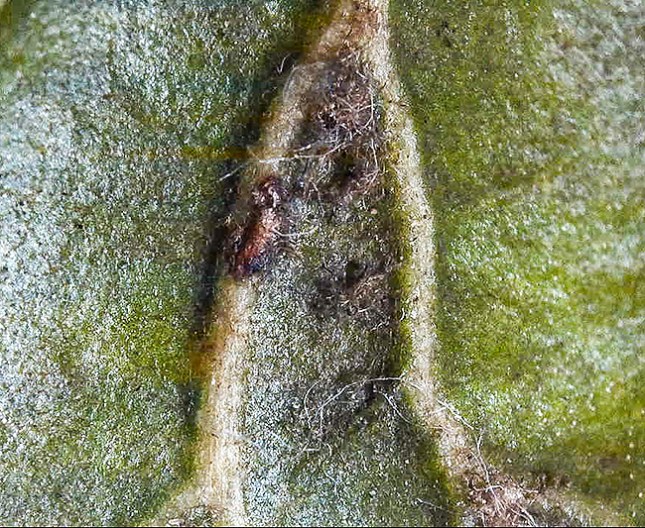
Predatory mites of course, fight fire with fire, and it turns out that many plant species provide homes for their guardian predators, which is not to say every aspect of mite-plant symbiosis is understood.  Some good mites eat fungi.  Speculators have speculated that mites may benefit host plants by providing a foliar feeding of their nitrogenous waste.   I dunno about that, but it is interesting that the Myrtle Oak domatia seem to fill up with organic matter.

domatium 1

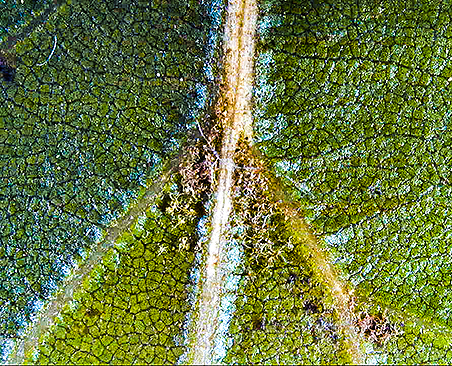
Myrtle Oak hairy armpit domatia on underside of leaf where veins join.

domatium 2

The same with apparent accumulation of organic matter.  Looking lived-in.

Whether or not the little guys make enough manure to matter, plants do provide fine accommodations for “good” mites.  Such “domatia” (think domicile) come in three forms:  leaf pits (as in white mangroves and in buttonwoods), caves under veins (as in grapes), and furry bushes made of tangled plant hairs  where leaf veins join, as in today’s oak and others.  The domatia in Myrtle Oak are conspicuous beneath the leaf.

If you flip over a Myrtle Oak leaf and spy with a hand lens (very) patiently you can spot tiny mites on the prowl, sometimes flushed from a domatium like a bunny from a bush.

CLICK HERE for a quick glimpse of a Myrtle Oak mite on the move.

Those who study mites have found that even “bad” mites have domatia too.   Maybe they merely stole them, but other observers have a more interesting explanation…that to sustain good predatory mites the plant has to offer edible “bad” mites to pay the guardians in red meat.   The plant may adaptively tolerate and even shelter prey for the hunters.

 
1 Comment

Posted by on February 8, 2019 in Uncategorized


Linden-Leaf Hibiscus and Its Buggy Friends

Hibiscus furcellatus

(Hibiscus is an ancient name.  Furcellatus means forked, as we shall discuss)

Malvaceae

Monsoon deluges and fascinating meetings combined to complicate botany fieldtrips this week, although today’s sunny skies lured me to the Delaware Scrub in Jupiter, Florida, into the midst of an old friend in full bloom, full fruit, full bud, and  full cooties.  Today’s blog is a bug-centric revisit to Linden-Leaf Hibiscus.

First and foremost, this is an ant plant.   The buds, flowers, and pods have big showy nectar glands on the outside.   These draw ants by the gazillions, who jostle rudely for a moment at the trough.  Presumably the ants protect the hibiscus from pests out to steal nectar, seeds, or other precious floral commodities.

Hibiscus gator 2 eyes

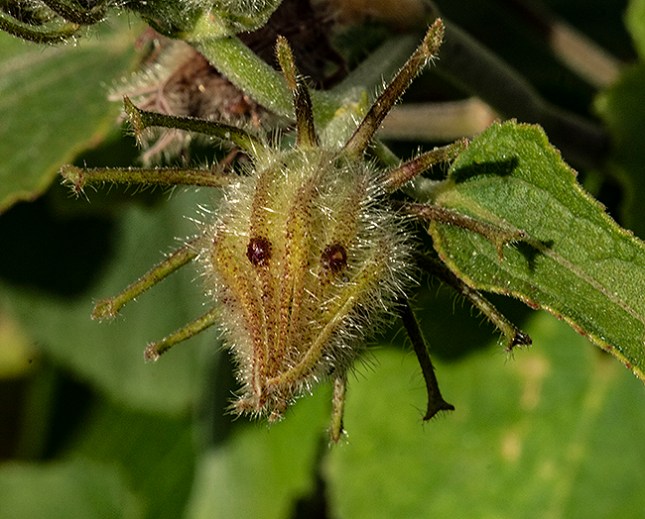
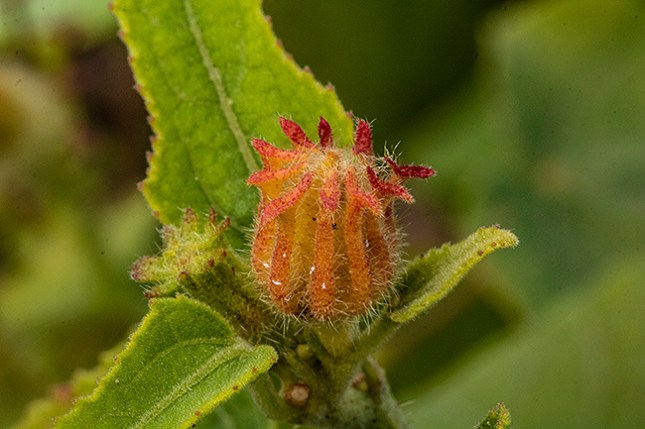
Space mouse?  No–Hibiscus bud with two big nectaries, and with the forks showing.

It wasn’t just ants hanging around.  There came flies, ladybugs, camouflaged spider, and the orange creeps featured below.

The weird thing about this Hibiscus species is a ring of stiff forks curving up around the flower and fruit base.  Technically the forks are bractlets, that is, drastically modified leaves at the floral base.  Other Hibiscus have bractlets too, but in H. furcellatus they are oversized, stiff, and forked like a snake’s tongue.  They look like they could dispense nectar, but the visiting insects reject that notion.

Perhaps they are protective.  When the blossom is open the forks don’t seem to block anything, but earlier, they form a tight cage around the precious expanding bud.  The two tines on the fork spread across the top of the bud to thwart attack from above.   No beast can feast on that big tasty encaged bud.  Closed until we say so!

Hibiscus fork palisade 1

Fork cage around bud, orange.  Younger one to the left.

The cage goes through a yellow or yellow-orange phase.   I don’t know if that is significant, although maybe the colorful “false fruit” draws a bird’s eye long enough for the birds  gobble suspicious burglars loitering on the bud.  Just a guess.

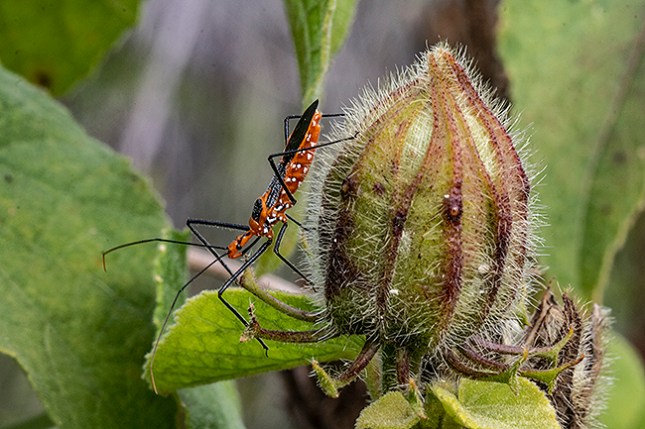
The insect posse today included Cotton Stainer Insects boosting seeds from the ripe seedpods.  Cotton Stainers owe their name to their damage to cotton flower heads, and cotton is a close relative of Hibiscus.  All in the family,  although the little orange pirates abuse non-Hibiscus relatives  too.   The bugs poke their proboscis into seeds almost as big as they are.

Watch the Cotton Stainers conduct a raid CLICK

Likewise orange but not vegetarians, assassin bugs too were there to lunch upon some of the Hibiscus visitors.

Assassin Bug

 
3 Comments

Posted by on February 2, 2019 in Uncategorized


Mighty Oaks from Little Toxic Acorns Grow

Quercus virginiana

Fagaceae

quercus virginiana 1

Live Oak by John Bradford

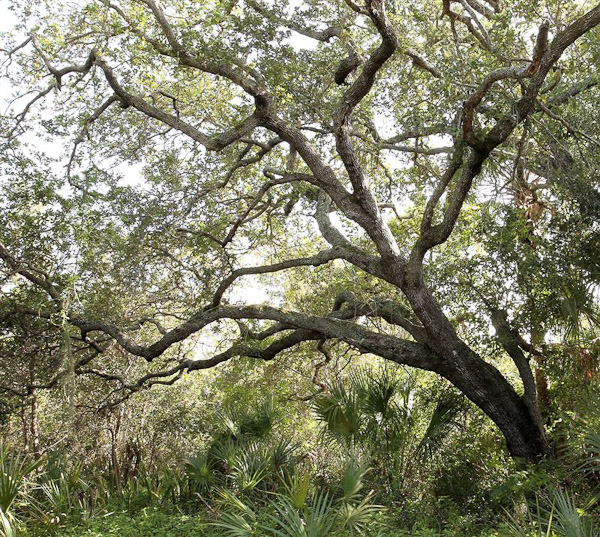
Today John and George explored Halpatioke Park along the South Fork of the St. Lucie River.  We experienced botanico-diversity, witnessing mighty Live Oak Trees supporting a dozen species of epiphytes from liverworts to orchids, mostly southern needleleaf bromeliads.   Nothing like mighty oaks to get a person thinking about little acorns.   Today’s blog required collusion.  Doing much of the research, John started it.  Or to step back further, Dee (see the blog authorship) was the ringleader.  Dee studies Scrub Jays.  Scrub Jays fancy acorns.  Dee and John started looking into acorn species preferences among the jays.   They’re the brains of this oaky operation.

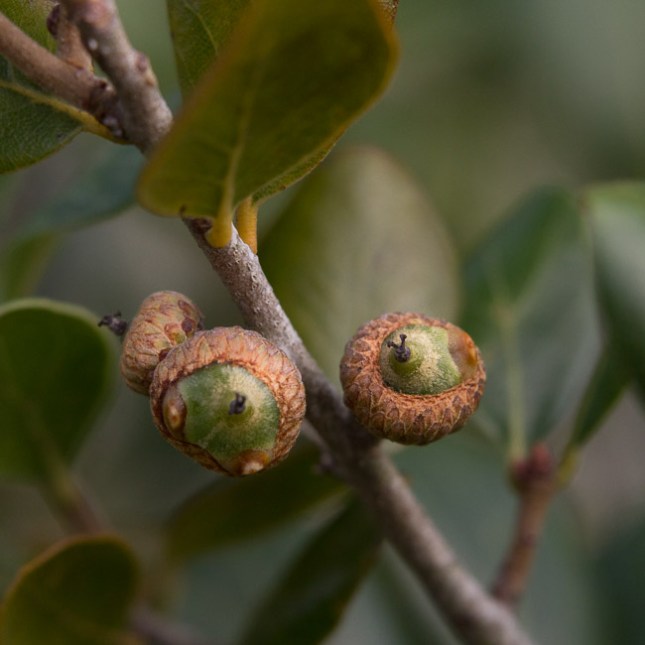
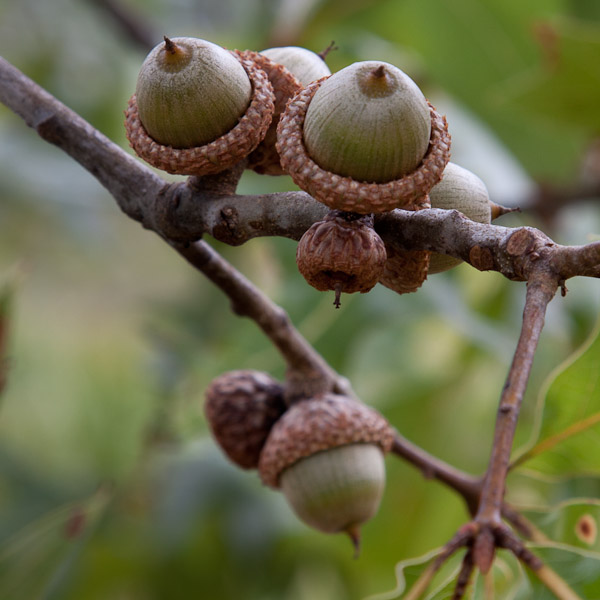
An acorn is a wonderful little space capsule for an oak embryo.  Hard on the outside, loaded with food on the inside, and with self-defense.  It is the oak fruit, containing one lonesome seed.   The cute little cap is a cluster of tiny modified leaves, bracts,  not part of the fruit.

quercus laevis 4

Acorns by JB. The cap is a leaf cluster.  The pointy tip is the style from the female flower whose ovary became the the acorn.

Acorns are loaded with nutrition appreciated by weevils, by birds especially jays, and by rodents, especially squirrels.    Weevils alone can destroy a substantial portion of an acorn crop.   Jays and squirrels feast on acorns, but there’s a tradeoff, the animals disperse surviving acorns in the process.

If everybody wants to eat you, you need protection.  The main anti-nibbling ingredient in acorns is tannin, as in tan your hide.   Tannins bind up the salivary proteins in the mouth and digestive systems of herbivores and they suppress microbes.   We exploit that ability to preserve leather.

The interesting thing John and Dee discovered is that tannin distribution is not even throughout the acorn,   especially in the Red Oak Group, defined below.   The critical vital portion of the embryo is toward the acorn’s pointy tip where the acorn concentrates tannins.    The more expendable portion is the cap end.    Creatures eating such acorns tend to reject, relocate, and maybe even bury, the nasty part which retains the ability to sprout.

quercus virginiana radicle

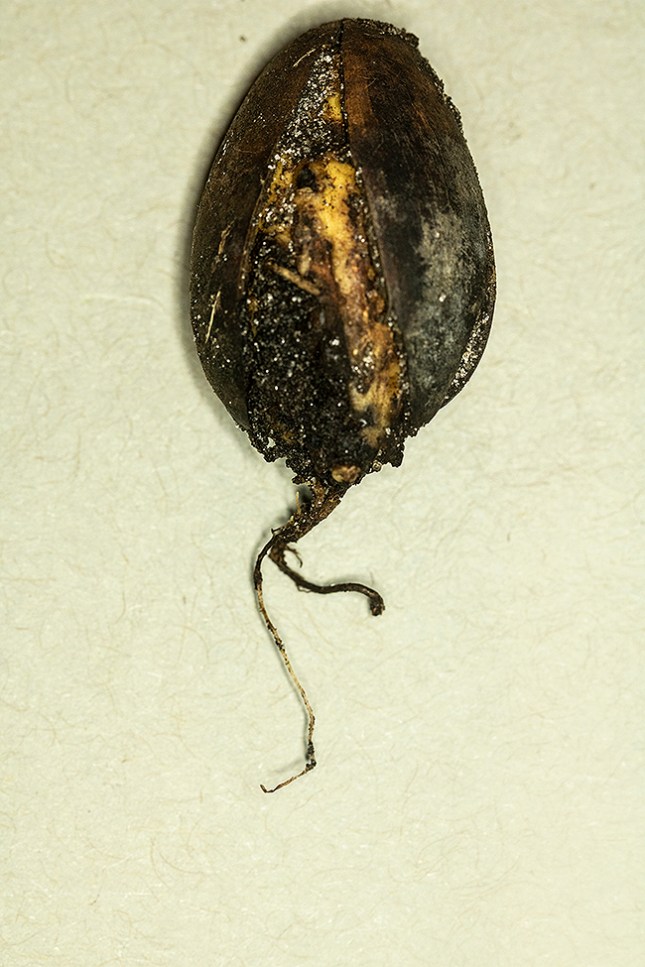
The vital part of the embryo is toward the pointy tip.  In this photo see the base of the embryo, the future root, near the acorn tip.  It will pop forth soon, as shown in the following three photos.

quercus virginiana first peek
Peek-a-boo

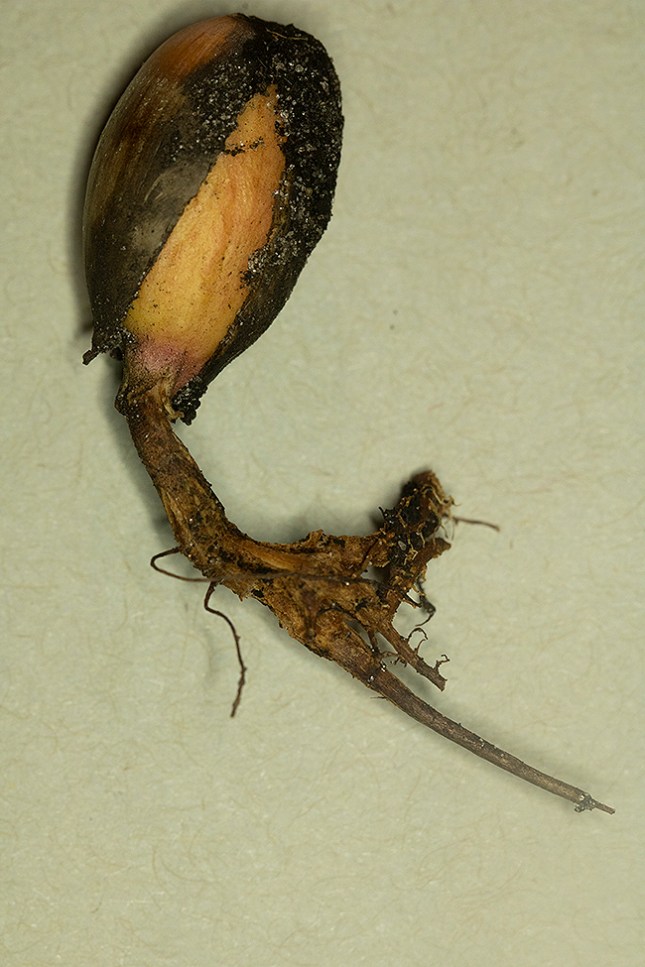
quercus virginiana half inch root

quercus virginiana cracked and large root

As germination progresses, the young root headed down and the young shoot headed up become displaced from the acorn with the food-rich seed leaves (cotyledons) remaining inside the acorn and continuing to feed the baby, as visible below.

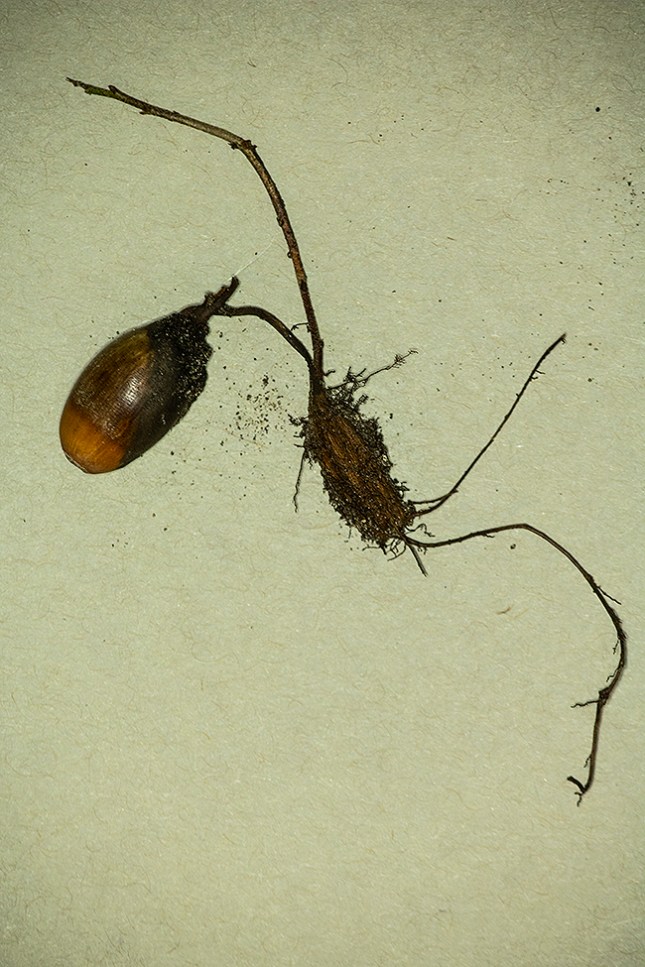
quercus virginiana with corm

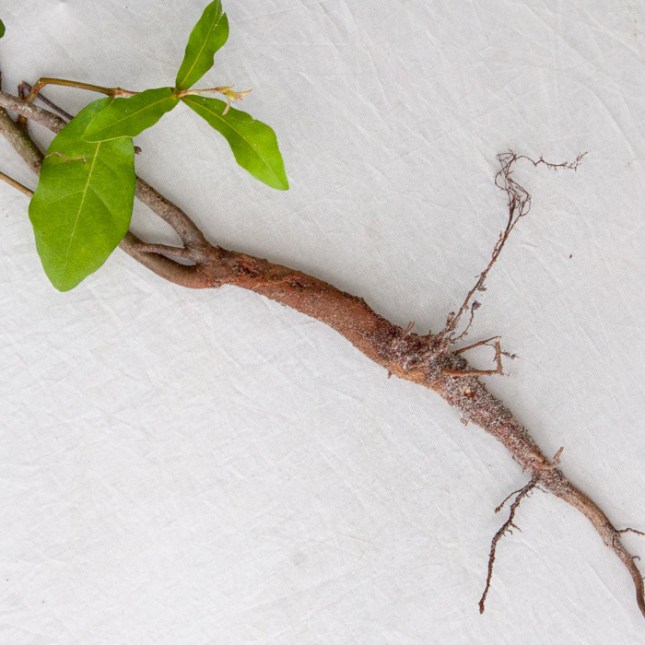
The acorn with the cotyledons inside is to the left.  The young shoot rises toward the top left corner.  The young root in Live Oak develops a thickening, pointing to the lower right, presumably protecting the young tree from fire or other aboveground peril.
quercus tuber 1

Much later, the root thickening enlarged. By JB.

Tannin is not evenly distributed among species.   The species in the Red Oak Group, locally including Myrtle Oak and Sandhill Oak, tend to have especially bitter acorns especially repugnant to distributors yet more likely to be only partially eaten non-fatally.   When animals bury acorns they are more often from the Red Oak Group.   Such acorns surviving storage are effectively relocated and planted.   They correspondingly tend to be slow to germinate.   Scrub Jays reportedly prefer such high-tannin acorns for caching, spotting them because they have less insect damage than the low-tannin alternatives.

The White Oak Group, including today’s Live Oaks as well as Chapman’s Oak and Sand Live Oak, tend  to have more-edible acorns probably more attractive to distributors yet also more susceptible to destruction.  These acorns tend to be dispersed less than the Red Oak acorns, staying nearer the parent tree, and germinating quickly.  Some years, mast years, the trees make acorns in such massive quantities that overmatch the nibblers.

Low tannin is why deer and humans prefer White Oak acorns.  Don’t try it.  Tannins are bad for you, and who knows what else is present.  Yet if you belonged to any of many acorn-eating cultures around the world you might have enjoyed acorns most often ground to flour, leached, and made into mushes, porridges, cakes, and breads.

quercus germinata 3

Quercus geminata…the twins as in Gemini.  By JB.

Dig deeper:

https://www.sciencedaily.com/releases/1998/11/981126102802.htm


3 Comments

Posted by on January 25, 2019 in Acorns, Uncategorized


Why Does the Slash Pine Prune Itself?

Pinus elliottii

Pinaceae

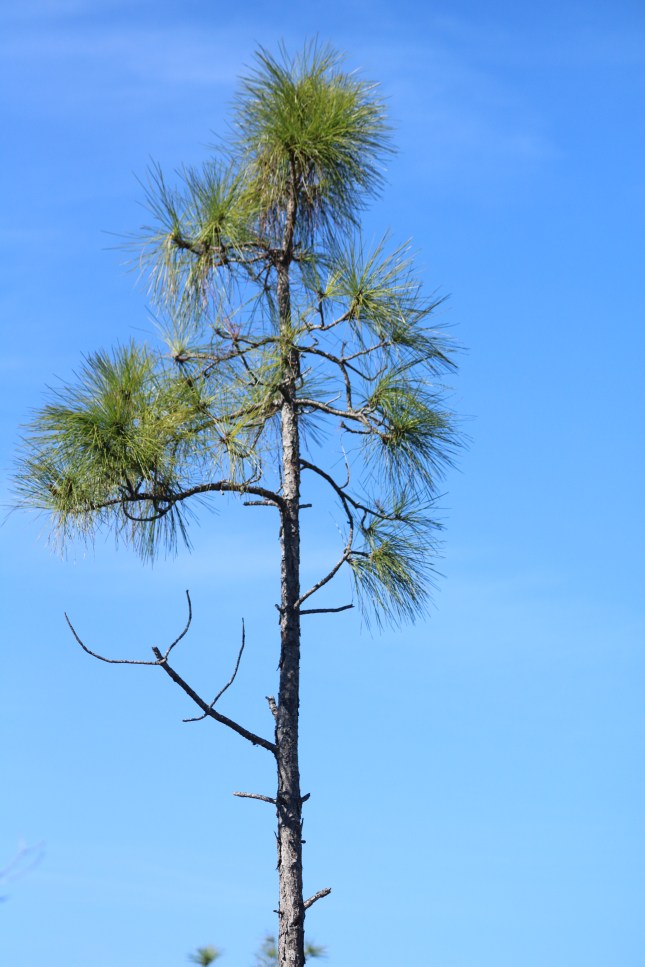
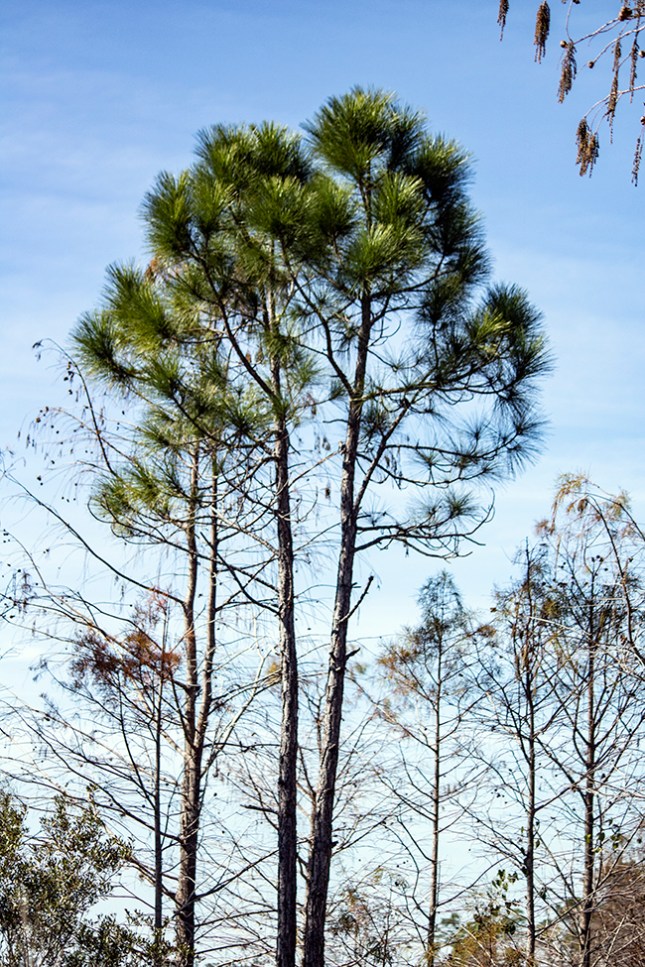
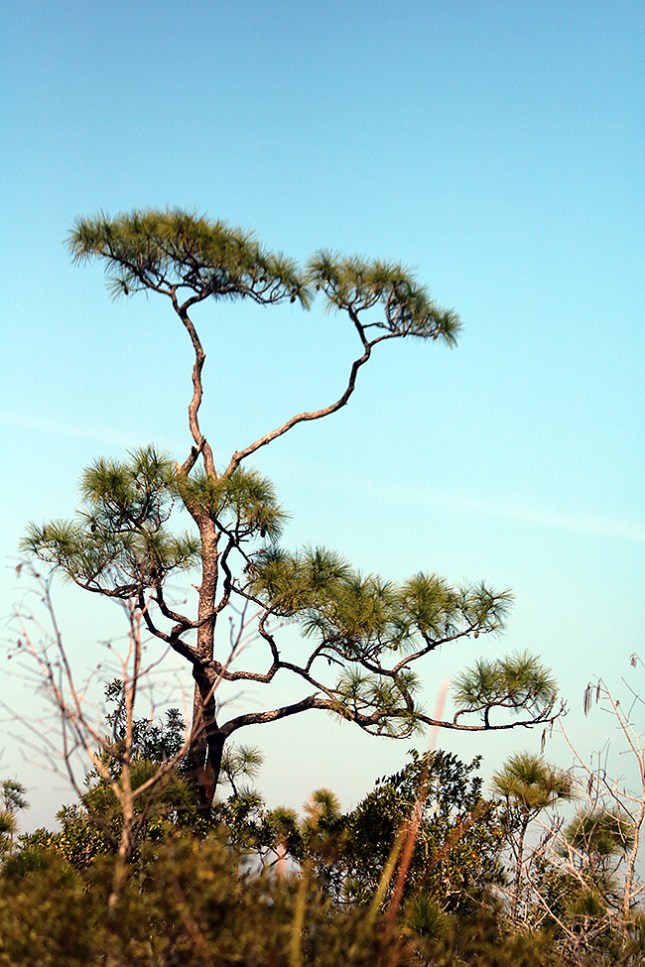
John and I botanized and photographed today at Halpatioke Park in Stuart, Florida.  Great place for pines, and for thinking about why they shed their lower limbs.   Such self-pruning is not limited to  Slash Pines, but they are mighty good at it.  The trunk becomes bare below the crown as the crown rises.

img_1814

The standard explanation is that discarding those flammable lower branches is protection from ground fires.    Ain’t sayn’ it ain’t so, but then again,  the party line strikes me as more intuitively easy to surmise than based on data.

I’ve heard other related notions, such as the lower limbs being too costly to maintain relative to their contribution to overall photosynthesis.   Also I’ve heard speculation that symbiotic fungi may facilitate severance.  Again, maybe, but those untested ideas don’t rock my world.

One more thought:  have you ever noticed how loaded with vines Slash Pines become?  Smilax, Grapes, Poison Ivy, Virginia Creeper, and more.  Those vines must sometimes weight a ton, especially when wet, and snag thunderstorms and hurricanes.  And they shade branches.  I wonder if branch shedding might help with de-vining.

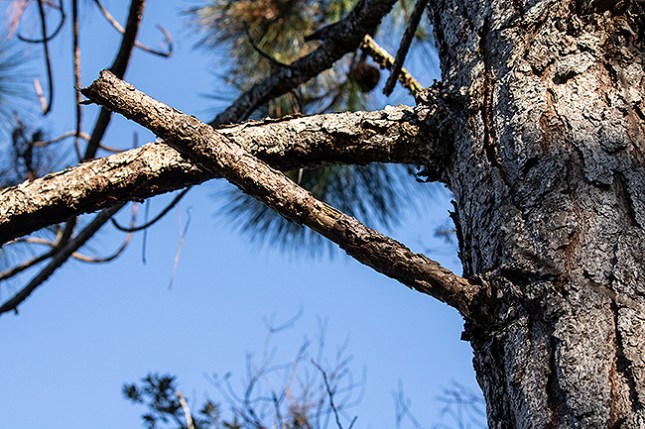
When leaves, and in some species twigs,  fall from trees they break off cleanly at a preset fracture point called an abscission zone.   Not so in Slash Pines.  The doomed branches seem to die slowly and decay on the parent tree, until they are sufficiently rotten to fall, blow, fragment, or be knocked off.  The breakage point can be anywhere from the trunk to 5 or 6 feet out.

pine brabches decaying

Instead of worrying why the tree discards branches from a standpoint of what good it may do the tree, let’s shift our gaze to how it happens, and how a Slash Pine is vastly more prone to it than its broad-leaved neighbors.  Time for comparison.

Before we dare to compare, a useful fact:  as a woody stem ages its central region loses functionality, and the outer younger wood and associated tissues are where the vital action is. Remember that, inner regions kaput, outer layers lively.

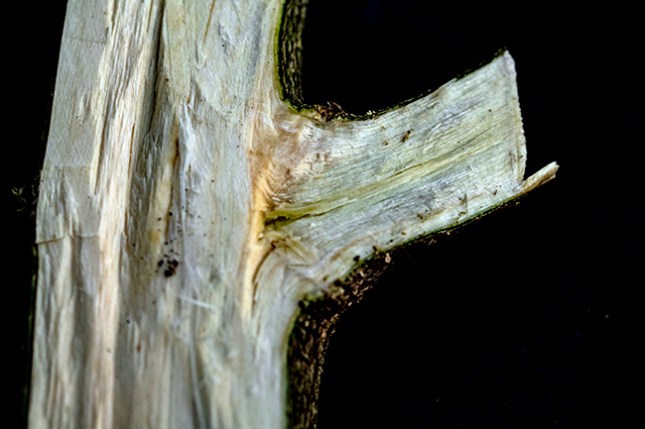
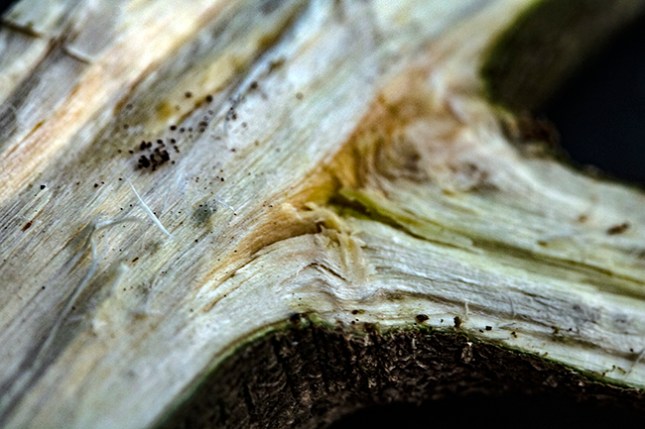
Now  look closely in the photos below at the broadleaf Florida Privet disinclined to self-pruning.    The two photos show the main stem (left) with a branch diverging to the right, split open down the middle.     Notice that the  white fibrous wood of the branch is continuous with the young outer material of the parent main  stem.   The branch and the active wood of the main stem are the same wood.  Wood from the main stem arches out into the branch and sustains its life.

privet twig cut

Florida-Privet keeps its branches.  The wood extending into the cut-off branch on the right is a continuation of the wood of its parent.  When one stops and the other starts is not clear.

privet twig close

Florida-Privet closeup showing the parent stem outer wood bending out and becoming one with the branch.

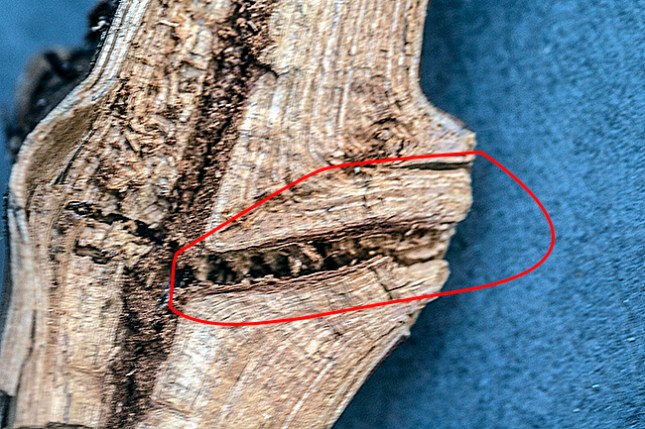
Now, by contrast, look below at the pine main branch and its side-branch, likewise split open.  The side-branch is mostly separate from the outer layers of the parent stem.   The side-branch resembles a spike driven into the core of the parent.  Its main connection to the parent is the parent’s aging inner tissues, declining and  choked by the expanding girth of the parent.    The hollow center of the parent stem is contiguous with the decaying center of the side branch.     Anchored in decline, choked,  and mostly independent from the lively outer layers of its parent,  the side-branch fails.

pine stem base circledl

The pine side-branch, circled, plunges to the center of the parent-stem whose outer layers are not much integrated into the branch.   The parent is becoming hollow at the core (the dark regions) showing insect damage…the  death tunnel extends directly into the side branch. In the upper right corner the branch is separating from the outer layers of the parent-stem. In the lower right, the outer parental layers narrow down and mostly stop short of becoming a major component of the branch, looking like their expansion may even help gag the branch base.

If the increasing diameter of the parent stem helps doom the side branch,  in cases of all else being equal, such as two adjacent trees or two forks of one tree, you’d expect the branches to fail at about the same parent-stem diameters.   Notice that in the two photos below.

pine twins

pine pom poms

If the parent-stem dies and thus quits thickening, a side-branch below the damage  may then be spared and live on.  Examine the photo below.

pine branch did not die

Looks like the death of the parent stem gave the side-branch a stay of execution.

Let’s come back now to the notion that the self-pruning is an adaptation to rise safely above ground fires.  Having branches rot because of an anatomical quirk seems a roundabout way to achieve fire avoidance.   But we could turn the beat around…maybe pines thrive in places with ground fires because they lose their lower branches.   Perhaps the chicken came before the egg.

ladybug2

 
7 Comments

Posted by on January 18, 2019 in Slash Pine branch loss, Uncategorized