Posting a day earlier than usual due to some schedule complications. Today my Pam Beach State College native plants class fanned out to conduct a flowery study in Riverbend Park in Jupiter, Florida. While waiting for the students to all-ee all-ee in come free, I wandered through lovely moist meadow and counted the DYCs.
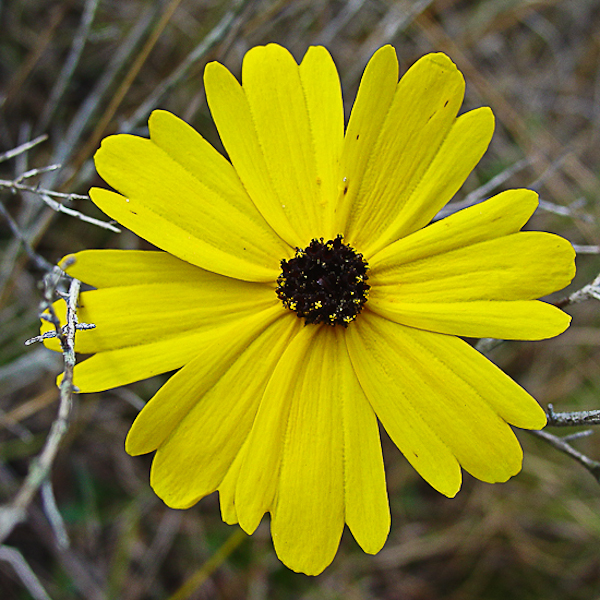
Coreopsis by John Bradford.
DYC is a technical botanical term, standing for Darned Yellow Composites, first-muttered by somebody trying to identify them. A Composite is a member of the Composite Family, the Asteraceae, with some 24,000 species one of the “big 3” families: Composites, Orchids, and Legumes. Everybody knows Composites, such as Dandelions, Marigolds, Sunflowers, and so many more. Note my cherry-picked examples—yellow. Not all 24 K Composites are yellow, of course, but I think it fair to say most are.
Deviations from the prevalent yellowness are interesting in their own right, for examples botanists in the Middle East noting a split between non-thorny yellow Composites, and thorny ones of other colors. Think for example, of purple spiny thistles. Their contention was that being not-yellow was perhaps warning coloration to flag off herbivores. Now nobody is saying all non-yellow Composites are prickly, but merely that the family is perfectly capable of being non-yellow if that is the adaptive optimum. For the moment, let’s think about the many many many yellow members of the Aster Family. Why should yellow be the main color of a huge family?
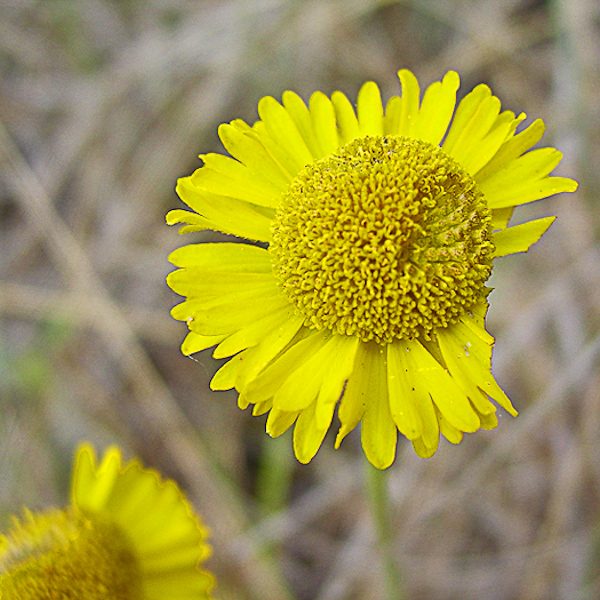
Helenium by JB
A boring answer may be, well, they started out that way, their great ancestor had yellow flowers, and the family diversified with the original yellowness deep in the DNA. Okay sure, but I’ll bet there’s more to it. Equally boring, you might wonder if yellow pigments are “cheap” to make, or if they tie in secondarily with some underlying metabolic machinery. Yea maybe, but let’s assume that yellowness is adaptive in its own right. That it has to do with insect pollinators. If so, what is so great about yellow flowers in this family with respect to floral visitors?
Hold on, it is not strictly a “family” affair. Asteraceae are predominantly plants of meadows, fields, and open sunny places. Come to think of it, a lot of meadow-ish and open-area flowers are yellow, such as members of the Mustard Family, yellow Poppies, many water lilies, buttercups, and more. Maybe there is something beneficial about yellow in meadows, fields, and similar habitats.
Does it have to do with a particular pollinator type? In a moist meadow in Riverbend Park were most of the flowers today yellow because, say, yellow-lovin’ bees rule? Probably not. An idea that is not original with me is the opposite, sort of like politics or marketing. How do you get the most votes or customers? Appeal to the broadest audience you can. Maybe a meadow is no place to be a one-pollinator specialist. Maybe in the middle of the field where thousands of flowers compete and yet at the same time draw massive numbers of insects, the best approach is to generalize and attract the greatest number of pollinators of whatever sort may be willing to visit. Wal-Mart vs. Rodeo Drive.
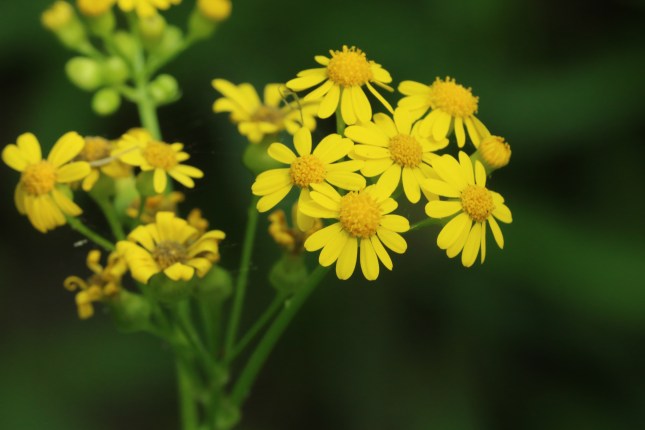
Butterweed, along Hillsboro River near Tampa this week.
The flower head in the Composite Family is an open plate or bowl anybuggy can visit. The nectar is easily accessed near the floor of the bowl. The head pushes the pollen to the surface of the bowl where any visitor can gather it “purposefully,” or merely be dusted with it inadvertently. The pollen-receiving stigmas rise into the bowl where all visitors, perhaps dusted with pollen, tread and deposit pollen. The head welcomes all comers, and they all come. It might be intuitive to think first of honeybees, but in a Jupiter, Florida, meadow honeybees are not indigenous, although other types of bees are. Beyond the bees, important DYC pollinators include flies, beetles, butterflies, and no doubt more.
Insects see UV, which I do not. All those insect visitors are seeing markings in those flower heads we’re scarcely aware of. Pollen itself is yellowish, so a yellow flower in a sense may send an advertising signal of “woo hoo … pollen here!” Yellow markings are often associated with flowers specialized for bees.
Casting the net beyond bees, botanist Sara Reverte and collaborators in 2016 published a survey of pollinator-group color preferences embracing many thousand plant species in different geographic regions. The following insect groups had yellow as their “favorite” color in at least one region: ants, wasps, beetles, flies, and lepidopterans (butterflies and their kin). Yellow might not be “the” best color to draw a single specialized pollinator (not many specialized orchids have yellow flowers), but if getting the most 6-leggers into your bowl is the goal, yellow seems a great way to build a coalition.
 John Bradford
 George Rogers
 George Rogers
 Dee Staley
 Treasure Coast Natives
theshrubqueen
March 1, 2019 at 8:51 am
Hmmm, awaiting Lanceleaf Coreopsis here, will see if legions of pollinators appear.
Robert Stevenson
March 4, 2019 at 9:40 pm
Hello, George. Wondering if you can help me out with an ID. I see these delicate little plants every February in moist areas such as swales and edges of lawns. They don’t get very tall (2″ – 4″, I’d say) and they don’t hang around long. Someone told me they were Purple toadflax/ Linaria canadensis, and tho’ the blossom looks similar, it doesn’t appear to me to be exactly the same, and L. canadensis seems to be a much taller plant. Thanks for any help you can provide. I love these little flowers! ________________________________
George Rogers
March 23, 2019 at 12:53 pm
Ohhhh.just niw fund this. Try Lobelia feayi.