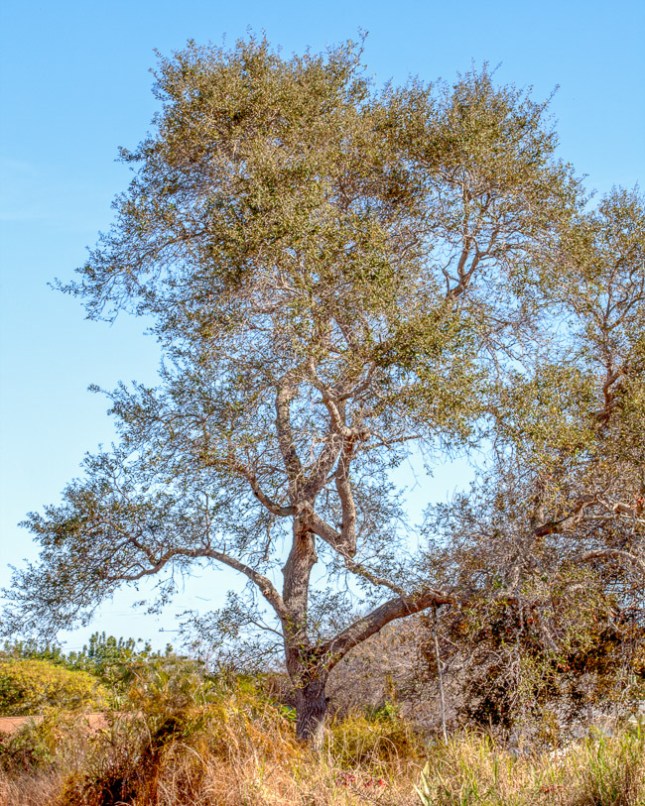
Live Oak by John Badford
John and I worked today mostly on Oaks in Halpatioke Park in Stuart, Florida. Many Oaks (and Pines) are shedding pollen now into the air, as we allergy vics know so well. Being that wind-pollinated plants are asserting themselves today, let’s not talk about the birds and the bees, but rather the nerds in the breeze. Achoo.
Flowering plants are “all about” animal-mediated pollination. Although there remains a ton to learn about the early evolution of flowering plants, the standard perception is that flowering plants evolved from wind-pollinated ancestors, that their raison d’être is to offer attractants and rewards to creatures in exchange for symbiotic pollen transfer. Yet over 10 percent of flowering plants are wind-pollinated. (I wonder if that will increase as we drive insect pollinators into oblivion.)
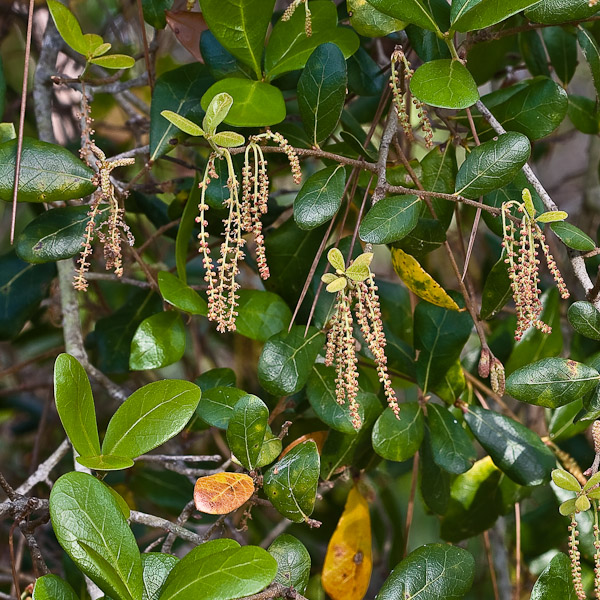
Myrtle Oak male catkins releasing pollen, by JB
Wind-pollinated flowers represent a return to wind from insect-pollinated ancestors, that is, wind, then insects, then back to wind. Why go retro? Botanists estimate that the about-face has happened in over 60 instances. Sometimes wind-pollination works better than bugs and birds, most obviously in circumstances where creature-based pollination is unreliable, such as harsh habitats and wide open spaces.
Wind-pollination is comparatively rare in tropical forests with high plant species diversity and plenty of birds, bees, moths, bats, and butterflies. Wind-dependence becomes more prevalent in temperate and cold regions, and in places with high concentrations of relatively few plant species. It would be pointless to dump pollen onto the wind where you are surrounded by different species. But, by contrast, wind works if most of your neighbors are the same species as you, such as a prairie or marshland. Not surprisingly then, most grasses and sedges are wind-pollinated.
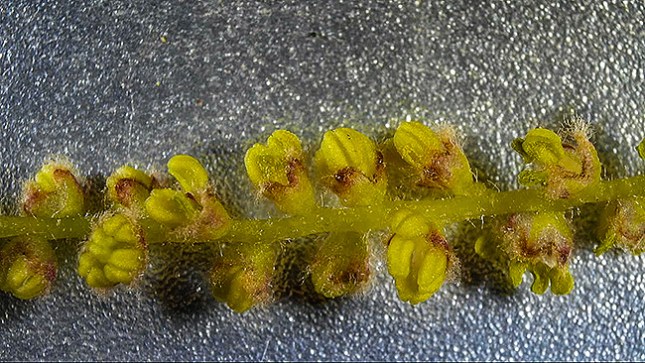
Laurel Oak today, male catkin loaded with pollen ready to spew.
Many temperate- and cool-region trees are windy. With these, seasonality may matter. In the early spring the temperate trees have no leaves to block pollination, yet insects and birds may still be scarce, and why compete for animal services when the wind is free, unlimited, and continuous nice and high in the treetops? Why make nectar, make pretty petals, and have bees steal pollen if not necessary? Why have a motorboat when a sailboat needs no gas? Wind-pollinated trees include hickories, walnuts, chestnuts, ashes, poplars, and today, oaks.
Many wind-pollinated plants avoid airborne self-pollination by existing as separate male and female plants, although individual Oaks have both flower types in the same tree. The male flowers are in dangling clusters called catkins well designed for shaking oodles of pollen out into the zephyrs.
The female flowers, fewer and solitary or in small groups, are tiny acorns-to-be with big stigmas acting like catchers’ mitts to snag the pollen from the air.
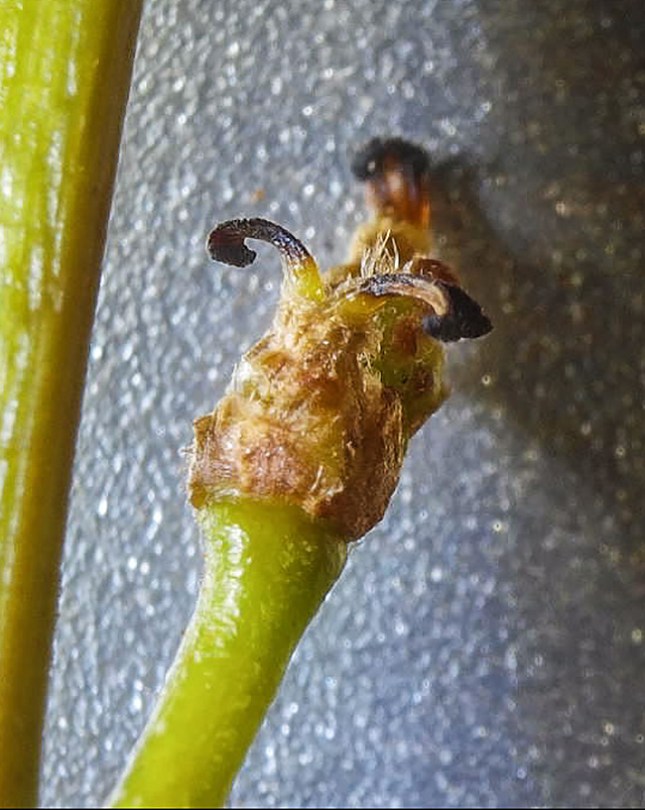
Female Laurel Oak female flower. Microscope view. Call it a future acorn, with the future acorn cap at its base. The big dark-colored stigmas catch the pollen off the wind.
 John Bradford
 George Rogers
 George Rogers
 Dee Staley
 Treasure Coast Natives