
That plants position themselves relative to each other is obvious. Every gardener has seen plants under the shade of larger plants leans out toward the light, and that seedlings germinated under the shade of taller seedlings grow extra tall and skinny in an “effort” to breach the lethal gloom.
Walk in a marsh where single species can blanket an entire area under a monoculture. Most of the “plants” in the blanket are merely the emergent portions of single or few huge sprawling rhizomes, just as a vine covering a tree can be one big spreading sprawling individual. In any case, the rising stems or clumps in a marsh seem to me to space themselves into an optimal pattern, sufficiently crowded to suppress competitors yet open enough to allow the individual rising stems to thrive.
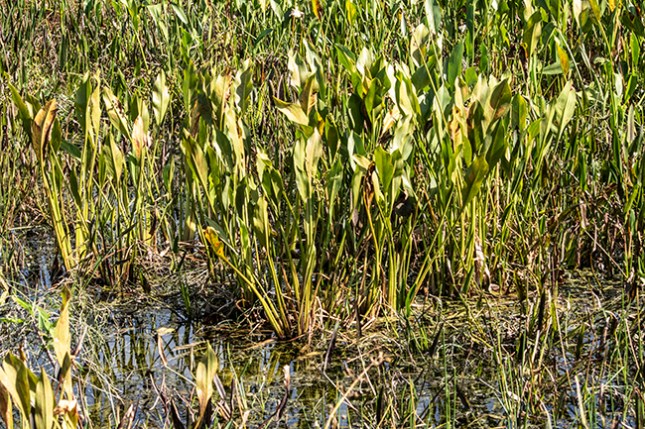
These Sagittaria clumps are nicely self-spaced, not random it seems. Crowded but not “too” crowded.
Sunflower plants lean away from each other. The inclination cuts down on competition, allowing each sunflower to grow more than if not tilted. This mutual accommodation is strong enough to impact crop yields.
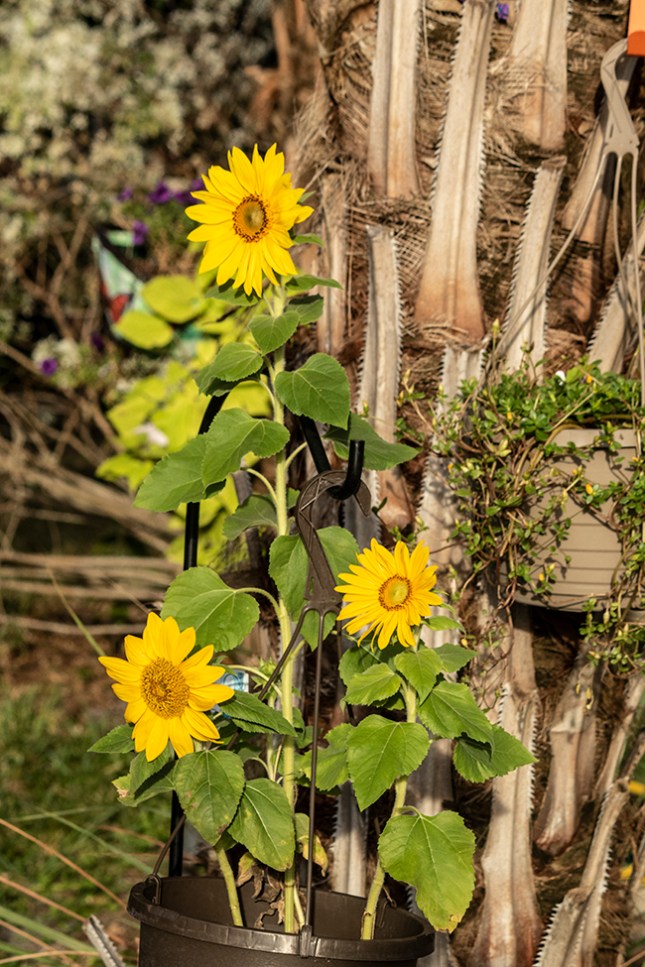
The two smaller sunflowers tilt away from their big brother, inclined left and right at the same angle.
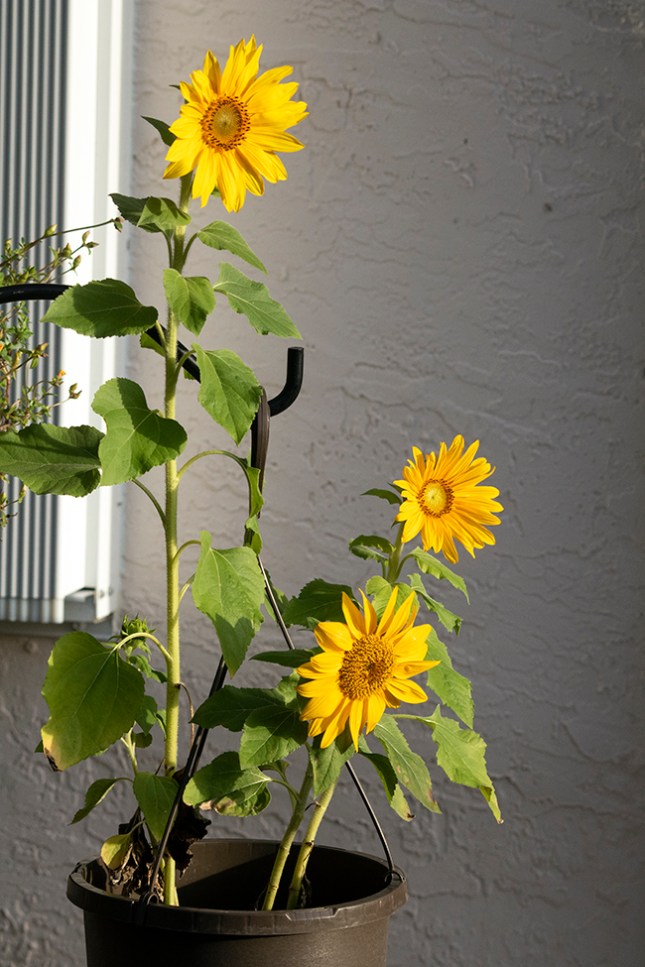
Side view of same flowers. The two little ones also lean forward, again at the same angle.
How does one sunflower recognize the existence and position of a neighbor? At first blush, research shows the main mechanism to be a subtle manifestation of a pervasive fact…that plants tend to grow toward light having strong red hues, and away from light rich in far-red coloration. Strong reds are characteristic of bright sunshine. Far-reds are typical of shade, competing vegetation, and light reflected from other leaves. The side of a sunflower facing a neighbor is experiencing more far-red than the other side where red is stronger. The neighborly side with more far-red grows a little faster, bending you away from your neighbor.
In recent years there has been a growing interest in “cooperation” among genetically related plants, something already well established in the animal kingdom. Such “kin selection” has generated a good bit of interest in the botanical world with respect to root spacings, communication via fungal interconnections, and shading. In short, one plant may “help” another plant if it is a close relative. No, it has nothing to do with plant “will,” “spirit,” or “intelligence.”
Botanist Jorge Casal and collaborators showed members of a species in the mustard family to “cooperate” in minimizing mutual shading if they are are close relatives. Related individuals produce leaves at the same height which enhances the light reflections onto each other, and thus the competition-avoidance signal mechanism reminiscent of that in sunflowers. Dr. Casals and associates then experimented on sunflowers finding that kinship may likewise influence their tendency to lean and give each other some space.
If you want to dig deeper:
https://www.pnas.org/content/pnas/114/30/7975.full.pdf
 John Bradford
 George Rogers
 George Rogers
 Dee Staley
 Treasure Coast Natives