Syrrhopodon texanus and friends
(Syrrhpodon comes for Greek for crowded teeth, in reference to the spore release mechanism)
John and I worked today in Peck Lake near Pt. Salerno, Florida, with lichens on mangroves, although for blog purposes I’m broadening to a nearby bald cypress swamp. Lichens thrive almost anywhere, on trees, on rocks, on tortoises, but they do have secret loathings. As covered last week, many dislike pollution. Submersion is worse. Baptism can set them back. Observers in New Orleans CLICK can still pinpoint the peak water levels from Katrina marked by the “lichen line,” the trees there hosting healthy lichens above the line, and few (or after 15 years, different species) below it.
Lichen lines are divisive in PB County too, on bald cypresses where the water can rise and drop multiple feet per year. Walk in a dry bald cypress swamp today and the lichen line is at your knees or above, equal on each trunk.
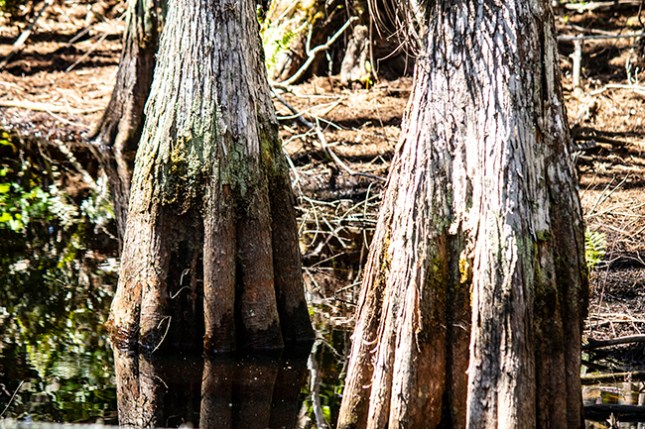
You don’t see many sharper borders in nature, two ecosystems separated by inches. Above the border a dozen multicolored lichens along with tillandsias, ferns, mosses, and more.
Below it, however, bang, a completely different flora tested by the crucible of submersion half the year, high and dry the other half. Who can withstand such eco-whiplash? Does submersion eliminate all lichens? Very nearly.
The lichen Leptogium crenatellum can un-drown happily, although we did not see it today. Its “algal” component is no alga, but rather a cyanobacterium of the indestructible genus Nostoc. Nostoc CLICK is responsible for dark jelly patches rising from soggy ground. Leptogiums thus are called jelly lichens. They fear no flood. /
The main plants south of the border are mosses and liverworts, conceivably “pre-adapted” to flooding. They belong to the group of plants, Bryophytes, most related to algae, which Bryophytes resemble by having every cell in direct contact with the water or air, exchanging gases, nutrients, and wastes like an alga in a pond. No surprise that some mosses are fully aquatic plants, especially in the family Fontinaliaceae. Members of this family turn up in bald cypress swamps, happy in the soup, but impaired during the high and dry times. The dominant below-the-line Bryophytes tolerate both extremes.
Around today’s swamp the dominant moss down low is Syrropodon texanus, one tough customer. Syrrhopodon stands up to its hard knock submerged-exposed life with reinforced leaves that when dry twist into a protective thatch roof. Its leaf bases have big clear hollow cells called hyaline cells. These are “canteens” the moss fills when wet, and presumably consumes slowly as needed later.
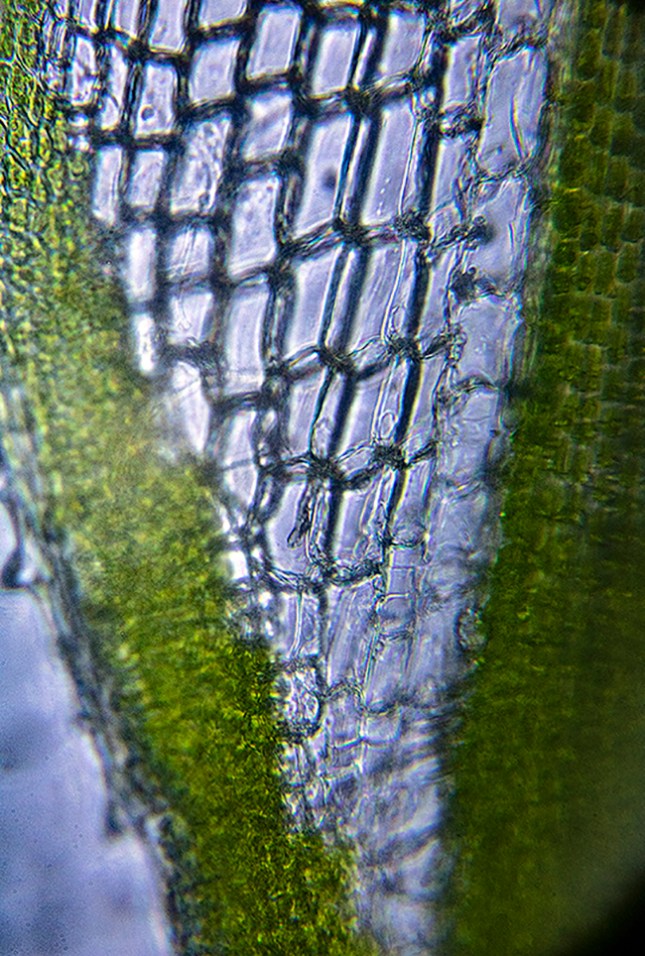
Syrrhopodon hyaline cells at leaf base microscope view The hyaline cells are the clear water bottles between the bands of living green leaf cells.
Another moss below the line, and in many other places, is Leucobryum albidum which has more hyaline cells than green cells. The plant is a living water tank, the glassy empty cells giving the leaves a white color.
Leucobryum is white, made 90 percent of hyaline cells.
Moss sex requires “rainsplash” to bounce the sperms to the eggs on the tips of the tiny plants. That is impractical when underwater half the time and clinging to an exposed tree trunk the other half. All three of the mosses listed below each have different methods of sidestepping sexual dysfunctionality by cloning themselves using microscopic breakaway bobbers able to drift to new moorings during the floaty moths:
Leucobryum albidum suffers a reported shortage of male plants, but no problem, no boys needed, it clones via tiny breakaway cell clumps produced on short stems. Additionally, its detached leaves can root.
Syrrhopodon texaus disperses itsy bits produced by the thousands on the leaf tips.
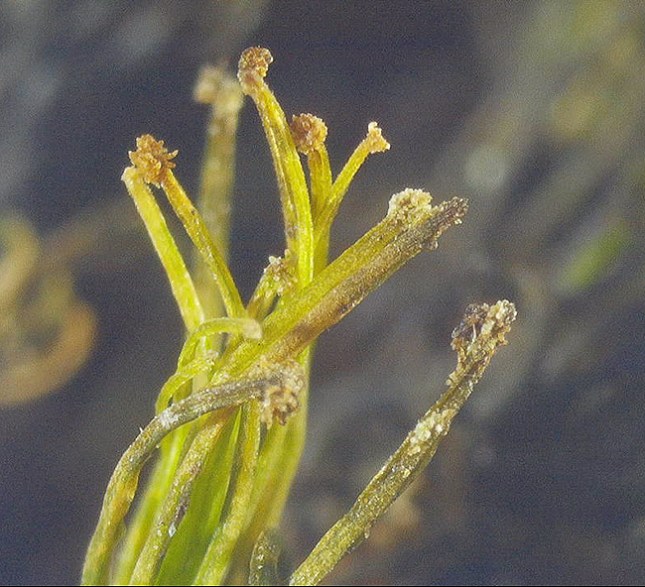
Syrrhopodon leaves dry and twisted, with micro-bobbers releasing from the tips. Microscope view.
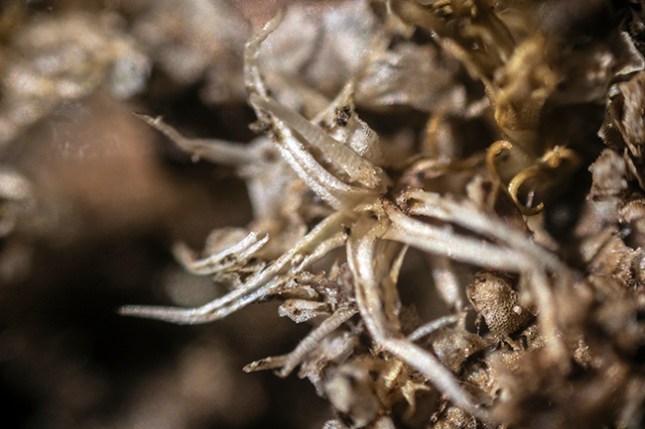
Brachymenium macrocarpum has hairlike “rhizoids” along its stem. The rhizoids spawn microscopic “tubers” to float the species to a new tree.
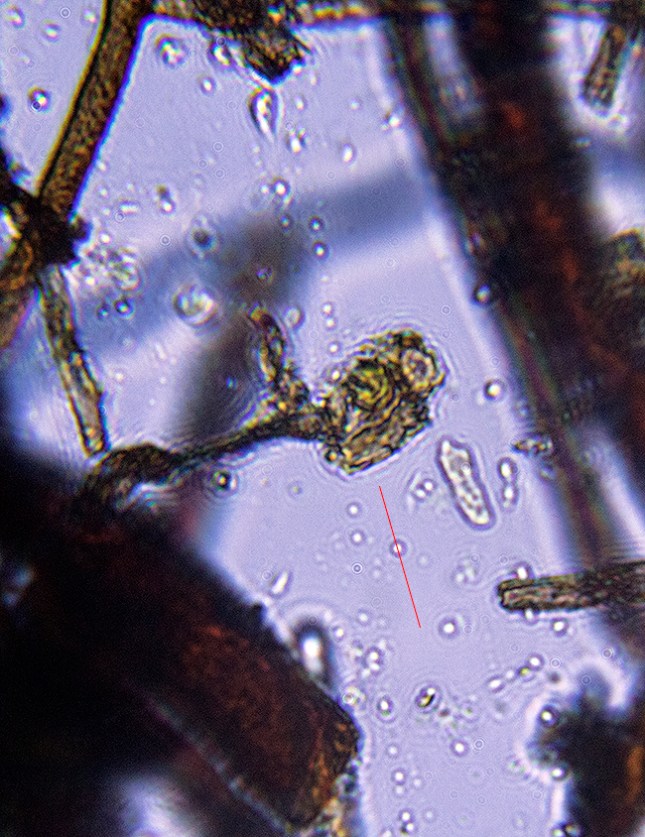
Rhizoid tuber microscope view, on Brachymenium.
To sum it up, if you want to live as a submarine part of the year it helps to be related to algae, to have built-in water tanks, and to disperse clonally with floaty pieces.
————————————————————-
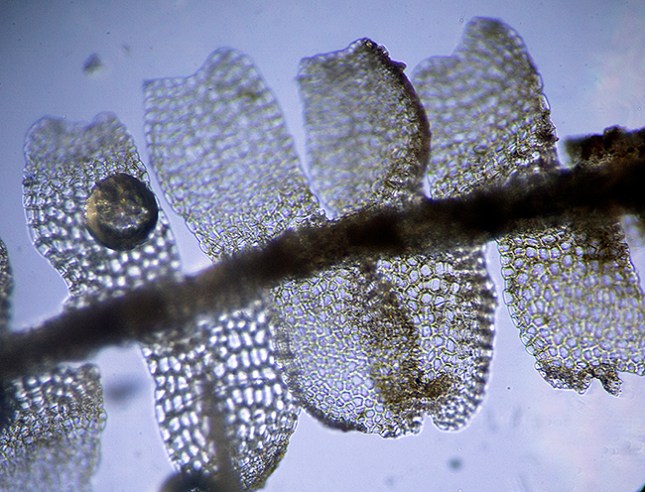
Liverwort from down below. Microscope view.
Dominant lichens above the line in a Florida swamp:
Chiodecton montagnei
Cryptothecia rubrocincta
Heterodermia albicans
Physcia crispa
Do the mosses, liverworts, and cyanobacteria contribute oxygen to life below the lichen line? CLICK
 John Bradford
 George Rogers
 George Rogers
 Dee Staley
 Treasure Coast Natives