Santa Maria Feverfew
Parthenium hysterophorus
Asteraceae or Compositae
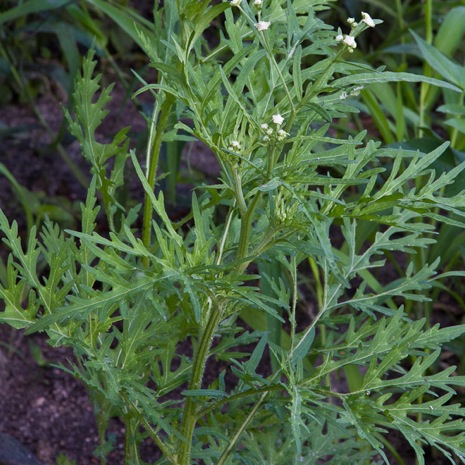
Parthenium (Today's photos by JB)
Continuing our exploration of the eastern shore of Lake Okeechobee today, John and George wallowed in invasive exotics, eating guavas, tripping over Syngonium vines, and admiring the tallest Johnson Grass we’ve ever seen. (Billy is in North Carolina.) Part of the fun was spotting one isolated little Coontie, which is native. Has it been there a millennium? Did Native Americans bring it? Did a seed float across Lake Okeechobee in a storm? Does it date from someone dumping garden refuse? Why is a Cycad the opening act for a post on Parthenium anyhow? Well, they are both bioactive and toxic.
Let’s get on-topic. An intriguing non-native plant loitering around the agricultural field borders is Santa Maria Feverfew (Parthenium hysterophorus), probably native from Mexico to South America. It is now a worldwide weed, which tends to obscure the precise point of origin.
A clue to the strange brew within, the foliage has a distinctive odor when you crush it, which is a bad idea, as the itchy-scratchy sap can raise a few blisters. Despite the hazard, it is fun to sniff weedy members of the Composite Family, because they tend to contain sesquiterpenoid lactones.
Huh? Back up a second here. Terpenoids (TURP-ah-noids) are usually pleasantly fragrant botanical essences, such as pine, lemon, citronella, and menthol. They are based on 10-carbon “terpene” chains. Just as a sesquicentennial is 150 years, a sesquiterpenoid (SES-kwa-turp-ah-noid) is a terpenoid-and-a-half, that is 15 carbons, and the term “lactone” (LACK-tone) refers to specific molecular configuration beyond the scope of our little e-chat. All right now, don’t get hung up on the chemistry—the point here is what the chemicals do. Sesquiterpenoid lactones tend to have a characteristic bitter or medicinal odor, not necessarily unpleasant, and, although found in multiple plant families, they are the flagship anti-herbivory arsenal of Composites, including Feverfew. Parthenium contains a medicine cabinet of sesquiterpene lactones as well as other toxins. The best-known lactone in today’s species is named for it, parthenin.
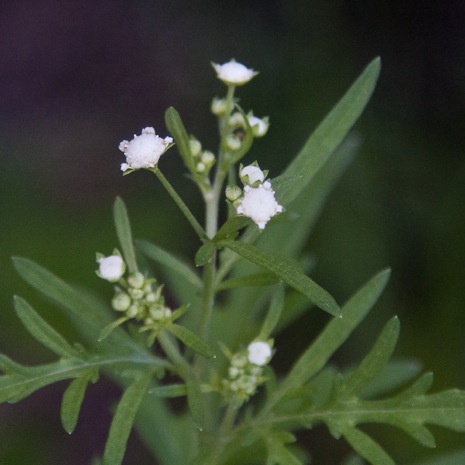
Pretty little snow white flower heads on Parthenium. It looks better than it smells.
Sesquiterpenoid lactones are a veterinarian’s (and butcher’s) nightmare. Especially hard on sheep and goats, they’re not so great for cattle and horses either. The compounds attack vegetarians in varied nasty ways—they are neurotoxic, and able to bind to animal tissues interfering with varied functions, and prone to cause digestive lesions. They cause “spewing sickness,” where the animal can drown in its own vomit. These toxins spoil the meat of livestock who eat them.
And here is an odd effect with possible benefits in human medicine: antimicrobial activity. What would a plant do with antibiotic capability? Apparently the sesquiterpenoids interfere with the microbe symbionts in the animal rumen, adding even more injury to the error of eating the wrong weed.
The compounds have insecticidal characteristics too, harnessed in some regions where Parthenium helps with flea control.
A fine line separates scary poison and useful medicine. Species of Parthenium have served historically against diarrhea, bacterial infections, malaria (some partheniums are called “wild quinine”), female troubles, pain, and fevers. But watch out, Parthenium derivatives reportedly damage human chromosomes.
If you are a plant, who do you want to suppress in addition to hungry grasshoppers and goats? Answer: competition from other weeds. One study showed parthenin, mentioned above, to thwart germination, to diminish the chlorophyll content, and to sabotage enzymes in a species of Ageratum. Maybe it has commercial value as a natural herbicide, but we don’t really want to handle it!
The botanical name is just plain odd. The name Parthenium is of debatable origins that we’ll ignore. The weirder part, hysterophorus means womb-bearing. What was Linnaeus thinking? Not clear, but the flower heads do look like the ends of the fallopian tubes.
Many members of the Composite Family contain latex. A related species, Parthenium argentatum, is the source of the rubber substitute guayule.
What a plant: it’ll cure your cooties, mutate your offspring, make the goat barf, give a horse a crummy in his tummy, sour the lamb vindaloo, irritate your skin, and self-weed the garden. Yet it looks so white-flowery innocent by the side of the canal. (This post is a team effort by John Bradford and George Rogers.)
John's and my blog this week

 John Bradford
 George Rogers
 George Rogers
 Dee Staley
 Treasure Coast Natives