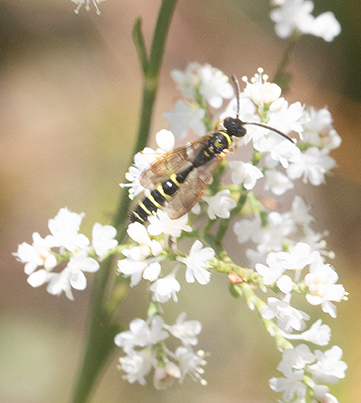
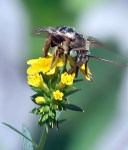
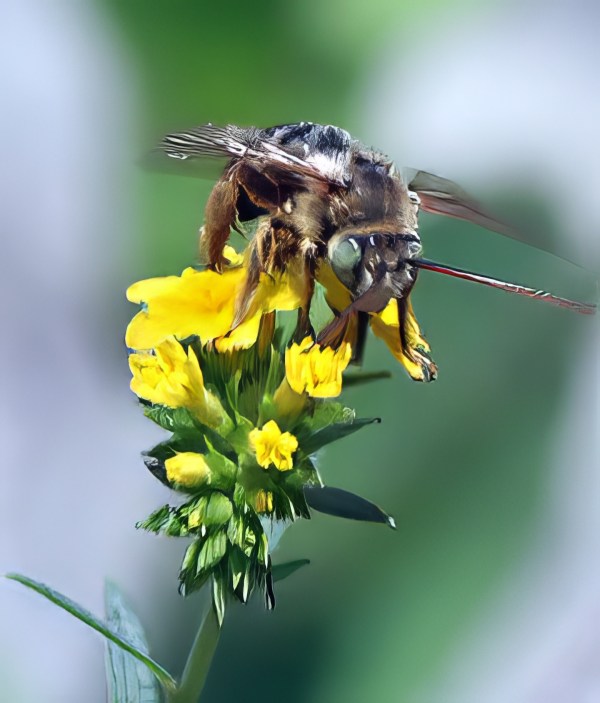
Photos today by John Bradford except the poorly focused wasp
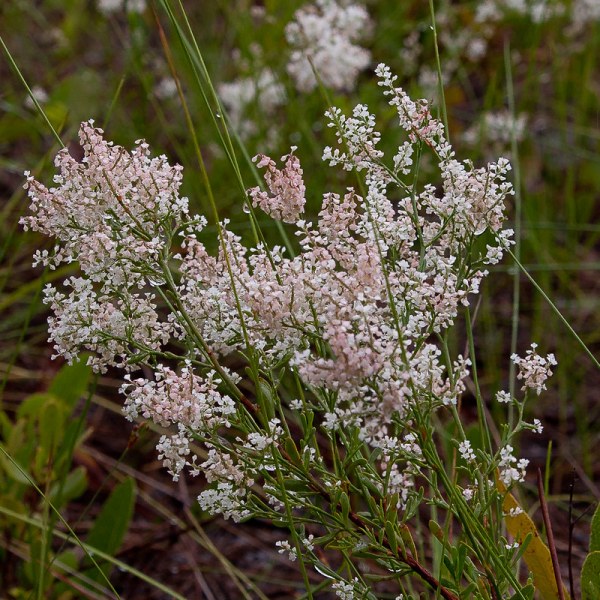
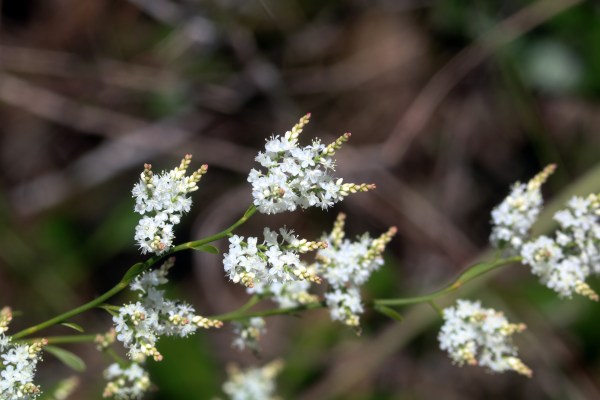
October Flowers declares October is here. Been too hot through the summer for a’wandering far, but today called out cooler, and the fall floral friends were pleasing: Smilax fruits looking like grapes, “Florida Paintbrush,” Tarflower (hey that’s not supposed to be open now!?), and the feature attraction: October Flower. Despite prior attention (https://treasurecoastnatives.wordpress.com/2021/08/27/october-flower-is-fun-to-watch/) , I can’t resist posting this white delight again. A thing I love about October Flower is rooted in the ecology of native pollinators:
They’re hurting, especially in disturbed, polluted, urban/suburban woodsy fragments. Depressing studies (not locally) tend variably to reveal urban conditions to be harsh for native pollinators. Nature lovers with suburban gardens, like me, “help the pollinators,” which can be only partially true since pollinator richness and diversity depend on diverse factors beyond garden flowers.
We all love honeybees, but, pity, they are invasive exotics al-bee-it with benefits. All this being so, I take special joy in native pollinator watching, even though the bee house in my garden is vacant. Some native wildflowers attract native visitors like bees to honey. October Flower is one of them, and being abundant in scrub remnants, it brings a buzz of “natural pollination” to a nature area near you.
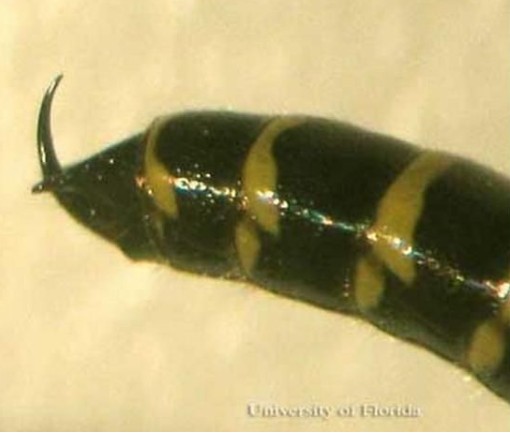
I’m no wasp expert, but I can Google like a pro, and I think today’s visitor is a male “long wasp” (Myzinum sp.). You see them as floral visitors, having a waspy kinda love for small white blossoms. Avidly gathering pollen with their faces in the flower, they seem uninterested in humans with cameras. As an instant Google expert, let me tell you a fun fact—although the male can’t sting, it has a scary looking Captain Hook false stinger, and will fake-it if bugged. Here’s a picture from the UF Museum:
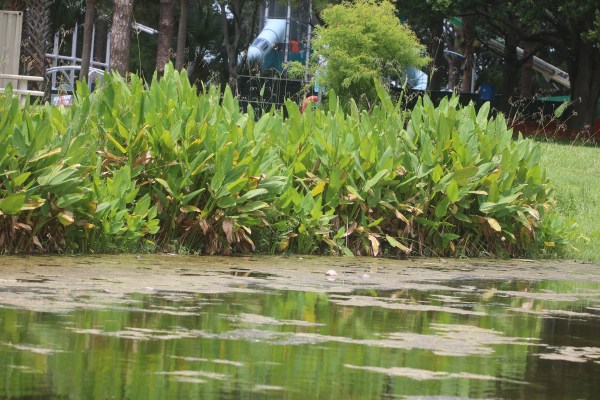
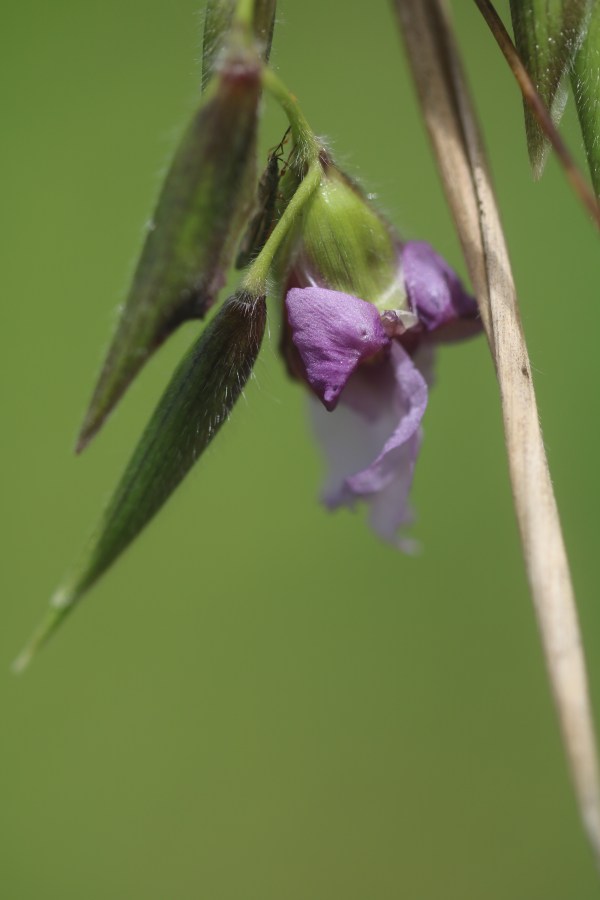
Today I took a walk on the soggy side among one of my favorite Florida tropical marvels, Alligator-Flag (Thalia geniculata). Everyone around here knows it whether they know it or not—big roadside ditch plant with “banana” leaves and paired violet flowers aloft on wands as tall as a truck . They have a complex snap trap mechanical pollination system that would impress an orchid. That was all written up in this blog, holy smokes, back in 2012.
So, after a 13-year gap, it is time for Thalia Phase II: co-habitant insects. They are weird and poorly known. The identities of the today’s Thalia companion species (in addition to the Canna Skipper) are handy thanks to a helping hand from bugnet.guide.
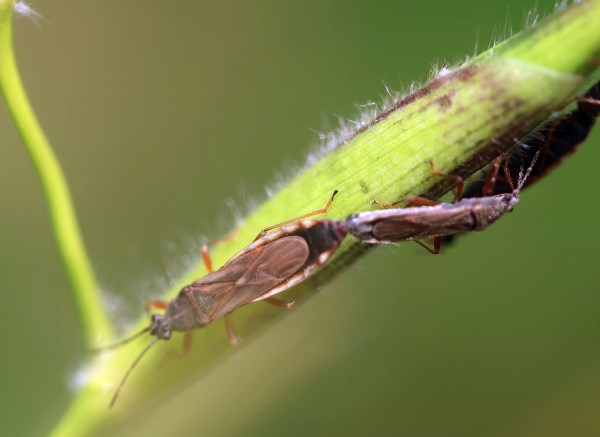
If you go look closely at Alligator-Flag inflorescences, which requires wet feet or a boardwalk such as Wakodahatchee Wetlands or Green Cay, you’ll probably find the True Bug Ischnodemus sallei scurrying, and mating immodestly, on the branchlets among the flowers. Related to the chinch bugs of suburban lawn dread, Ischnodemus sallei feeds on Thalia sap. The species has a special affinity for Thalia, at least in South Florida.
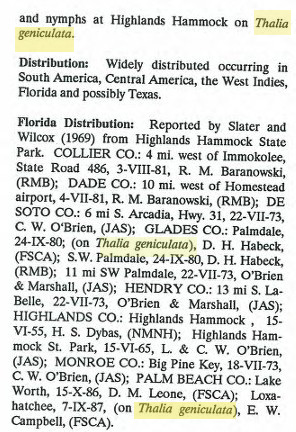
Below is the lion’s share of the knowledge of its distribution in Florida. Notice anything? (The non-Thalia reports of this species I’ve seen have been on plants related to Thalia outside of Florida.)
And here is a tidbit from UF entomologist Dr. Susan Halbert:
Don’t want to bore you by getting too far into the weeds. I just fancy a special relationship between one of our coolest wildflowers and its own bugs, even if they suck. The Ischnodemus sallei abundance on Thalia is so bountiful locally, I wonder if the insects disperse with floating plant parts of this shore-dweller.
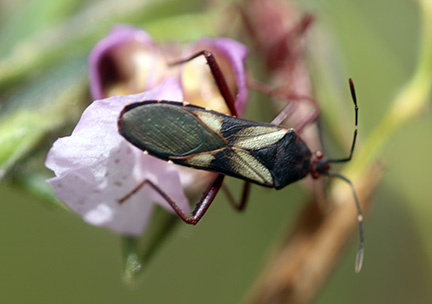
Also abundant on Thalia, and also poorly known, is a bigger, showier species of leaf-footed bug, Namacus annulicornis. If you bother Ischnodemus sallei it disappears furtively into the spaces between the leaf sheaths and the stem. By contrast, when bugged, Namacus flies off in a huff, and seems to emit a stinkum on the way..
Namacus
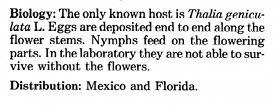
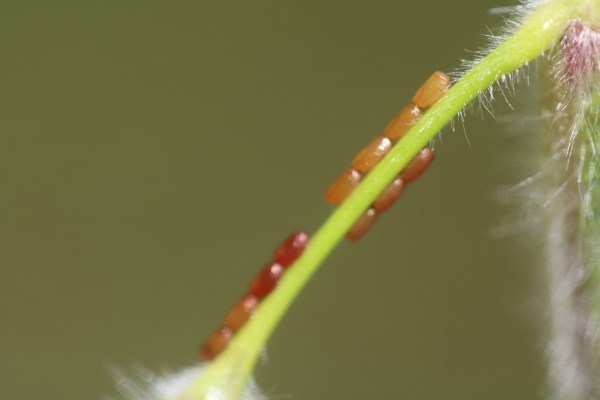
This bug appears to have Alligator-Flag as its sole host according to R. Barananowski and J. Slater in their 1986 account in the Arthropods of Florida:
Eggs
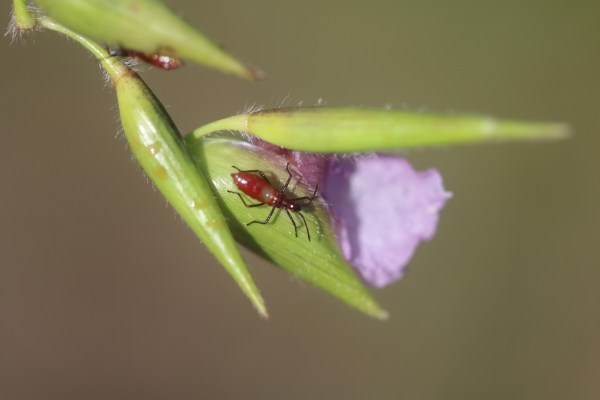
Those bright red nymphs (below) look so much like Assassin Bug nymphs, I wonder if there is mimicry of some sort.
Funny how, when a flower has an “oh-my” pollination system, its more mundane aspects can go overlooked.
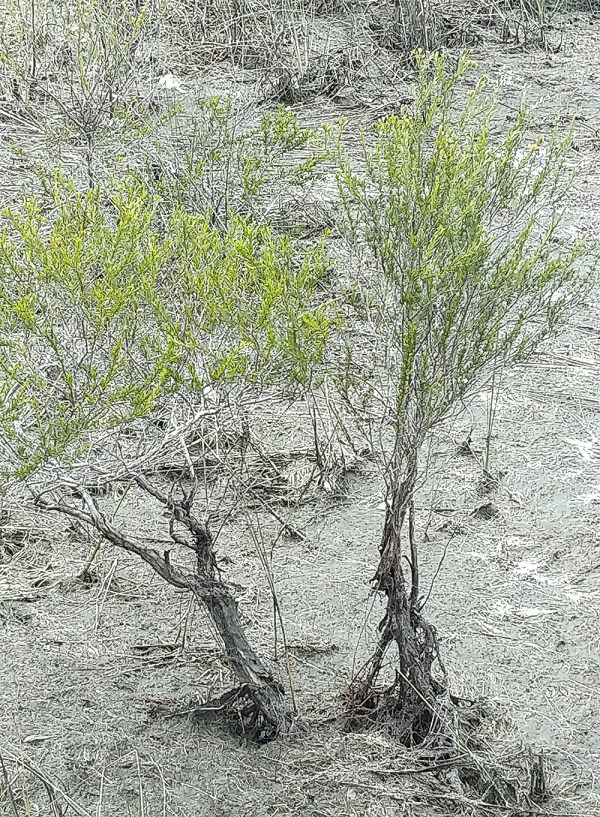
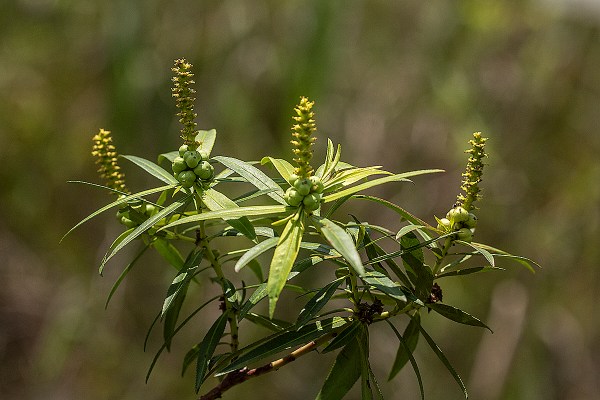
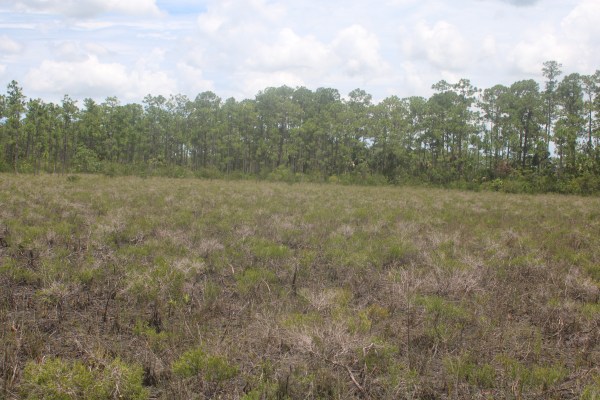
I have a “thing” for depression seasonal marshes populated with the shrubs Peelbark St. Johnswort (Hypericum fasciculatum) and Water Toothleaf (Stillingia aquatica). Such marshes are beautiful and extensive systems around here, and well beyond.
Gnarly ol’ Peelbark SJW. Most of today’s pictures (the good ones) by John Bradford.
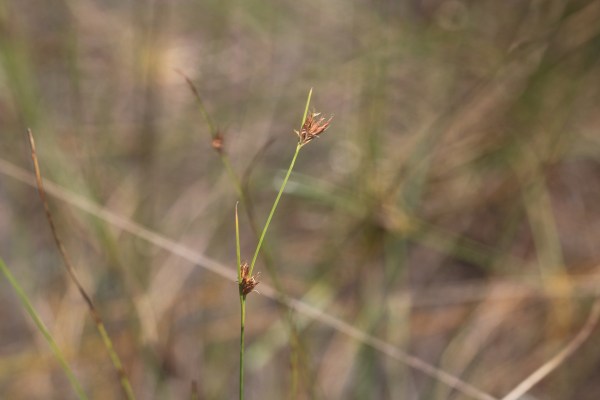
And, unlike scrub or hammock, Hypericum marshes remain virtually unstudied despite being extreme ecosystems with extreme occupants, some species largely confined to that habitat, such as , Small’s Xyris (Xyris smalliana) and Harper’s Beaksedge (Rhynchospora harperi).
Harper’s Beaksedge
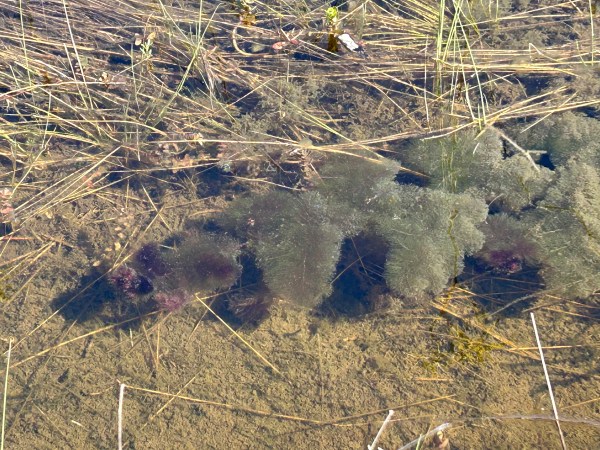
They’re a good place to look for the unusual and hard-to-spot Southern Bluethread (Burmanniacapitata), and several local carnivorous plants, including right now while the soil remains unflooded Sundews (Drosera capillaris).
Flesh-eater Utricularia frondosa
Animals live there we don’t often see, such as Roundtail Muskrats, Marsh Ricerats (I think), Crayfish, Otters, and delightful little fish when there’s water. Nobody knows much about the ecology of it all.
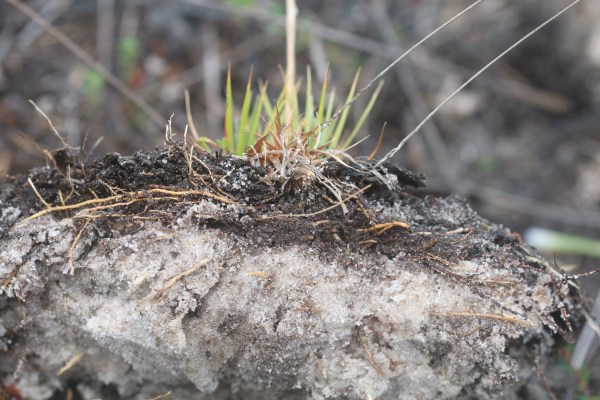
We all can plainly see everything growing in this part of Florida rests on white sand, exposed in the scrub, under a layer of duff in a pinewoods, close below the dark layer in a Cypress Swamp, and under a variable but usually strikingly thin layer of periphyton either floating or settled and decaying on the marsh bottom. That layer in most local depression marshes is just a few cm thick, and sharply demarcated from the underlying sand, like chocolate frosting on a vanilla cake. This dark material catches and accumulates in masses among the prop roots of the Peelbark SJW.
Water Toothleaf, aka Stillingia
Now here’s the thing. Every year the marsh is flooded maybe a foot or so deep, killing much of the marsh floor vegetation, with an annual rooting and regrowth next time the marsh drains. Every seed that sprouts, and every young plant that results begins life in that thin organic layer. In my warped brain, the thin periphyton-ish organic frosting holds the key to understanding the marsh.
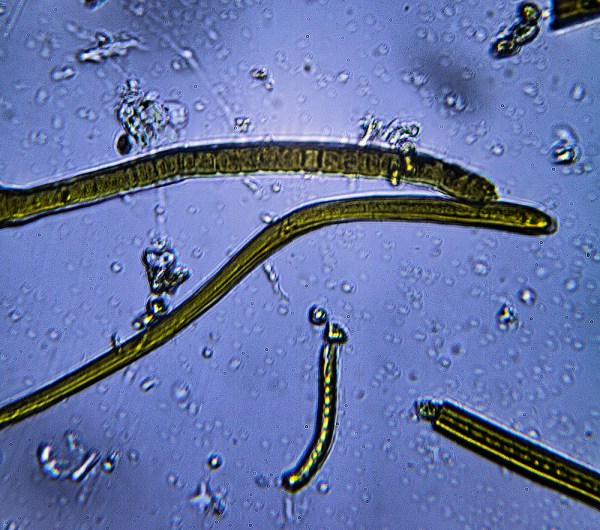
We don’t know much intimate detail about its full relationship with the plants in terms of nutrient exchange, gas exchange, microbes and so forth. Most periphyton study has had to do with rice, or the Everglades. It is known that bluegreen algae.
Bluegreen “algae” (“cyanobacteria”) in the marsh periphyton. Microscope view duh.
Periphyton decay releases nitrogen, and that periphyton sequesters phosphorus, and any gardener can see it is a natural mulch holding moisture and probably suppressing competing plants during the dry season.
Eriocaulon compressum rising from crusty periphyton mulch.
I’ll bet if you took away that thin frosting the whole system would change a bunch.
Marsh dweller at the marsh margin today
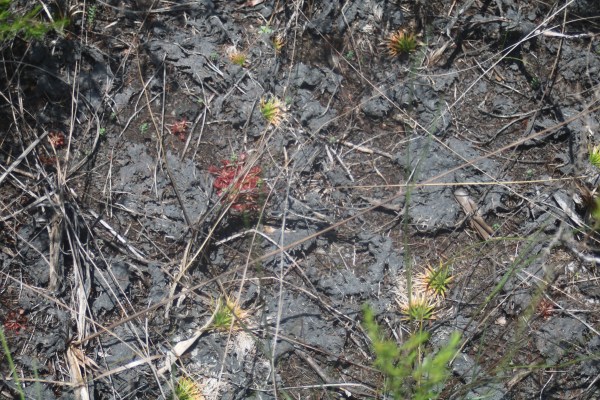
What got me thinking about periphyton is that today I walked in the still-dry (!) Hypericum Marsh off of Mack Dairy Rd. in Jupiter. In addition to the year round shrubs, the ground was salted with three main herbaceous species: young Smalls Xyris (some of which will grow large and tolerate flooding), little red sundews (will never grow large nor often survive flooding), and, mostly, flattened pipewort (Eriocaulon compressum), zillions of them. These can survive flooded, as I described in a blog past. https://treasurecoastnatives.wordpress.com/?s=eriocaulon
Eriocaulon by JB
Decided to look at the relationship between the establishing pipeworts, being one of the the marsh dominant herbaceous species, and here the role of the thin organic layer shows up. The roots of the young individuals are restricted almost entirely to the organic layer, even spreading sideways to stay in that lane. As the rosettes enlarge, eventually some large-diameter roots with hollow ventilation tissue do enter the sand.
The most important photo of the day. Look how those young Eriocaulon roots prefer the organic periphyton-ish layer. It is about an inch thick. That’s where the good stuff (organic fertilizer) is cached. As the plant enlarged some large thick roots will enter the sand, probably to guarantee water during dry times, as you can see starting now.
If I’m correct that that skimpy organic layer is a BMD (Big Marsh Deal), that notion raises questions about Hypericum marsh conservation. What if the layer becomes too thick or too thin, changes or disappears? What if fertilizers, manure, herbicides and other stuff wash in from farms, runoff, gold courses, lawns, septic systems? A large Hypericum marsh near my home is enclosed in suburban sprawl, complete with water draining in from large adjacent parking lots. That marsh has an dark mucky layer far thicker (say 7 inches) than any I’ve seen out in wilder areas, and the species composition seems to differ, for example, no Xyris smalliana. Wonder if those differences are a result of merely being a “different” marsh naturally, or of “new anthropogenic ingredients.” My unsubstantiated grouchy hunch tilts toward the latter, but nobody knows. Hope not, cuz if an ignored habitat transforms and nobody is there to hear, is it still habitat destruction?
Sundew (red), Eriocaulon rosettes, and our new friend Perry Phyton.
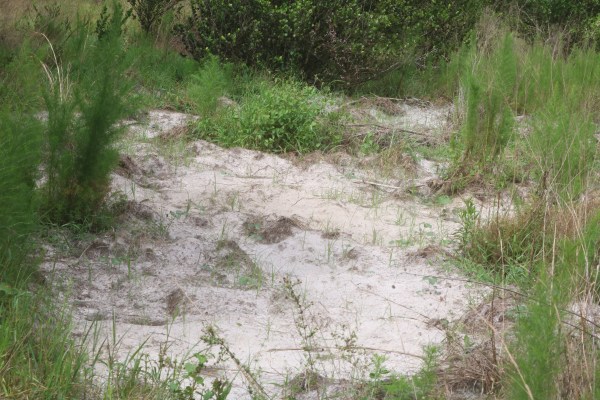
Walking in Cypress Creek today I came upon the most torn-up feral hog excavations I’ve ever stumbled into. Wetland meadows nuked down to bare white sand! (Bring your own beach chair and Modelo. Ever wonder what comes back after the nuking?
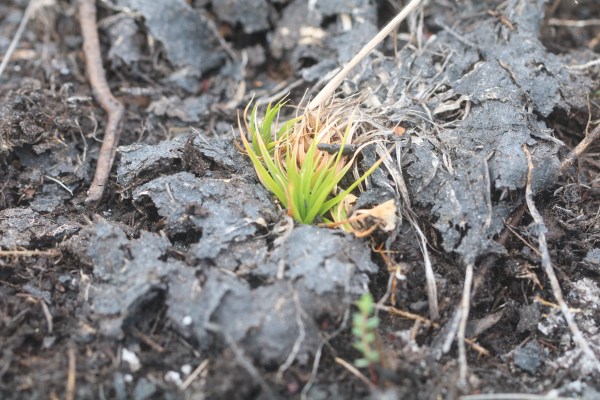
Take a look at the short-term recovery:
Does the surrounding vegetation heal the scar by growing in from the sides? No, at least not initially.
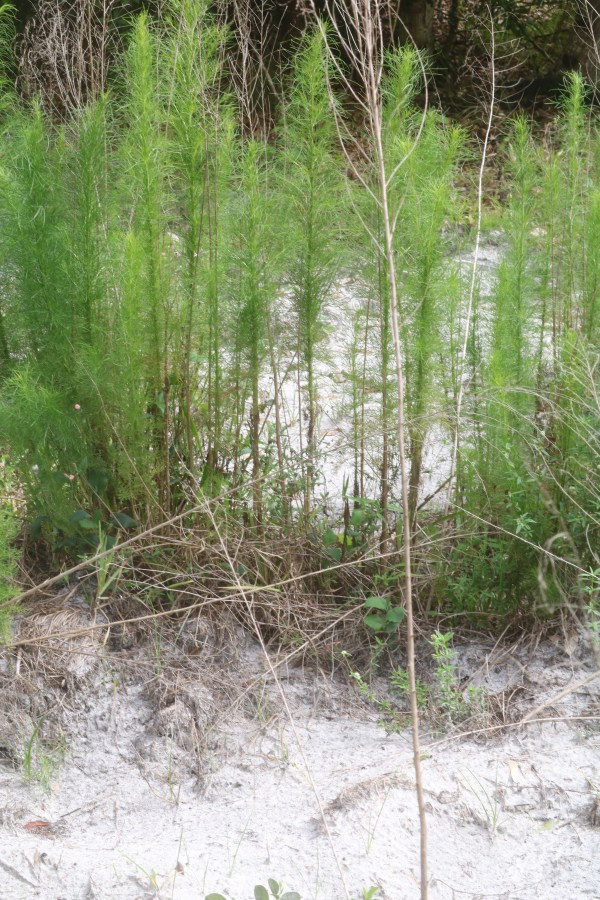
Dog Fennel is dominant in the surrounding undisturbed meadows. Does it spread into the earth wound? No, at least not initially.
Dog-fennel (tall plant) at the edge, but no affinity for the land-scar.
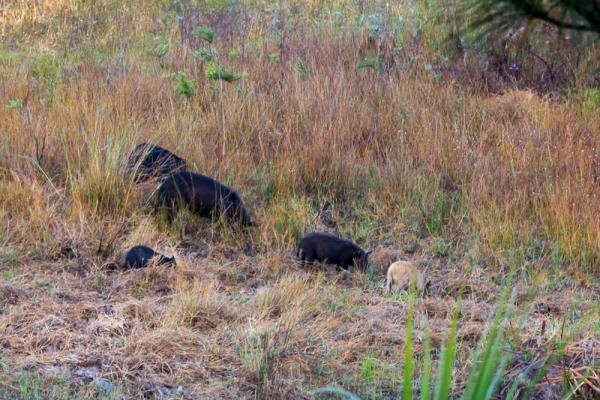
oink oink by John Bradford
Today in the fresh digs, just recovered enough to find early re-greening, there were four main species, each interesting in its own way.
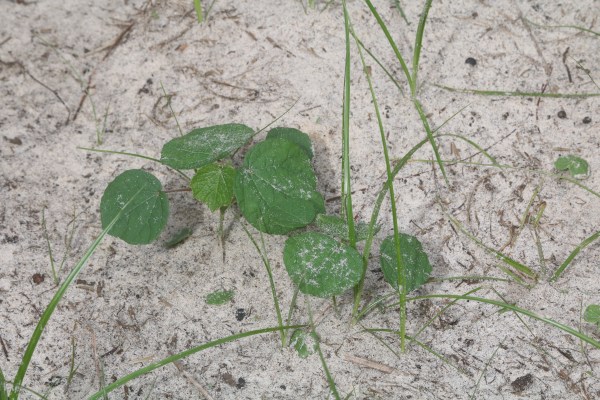
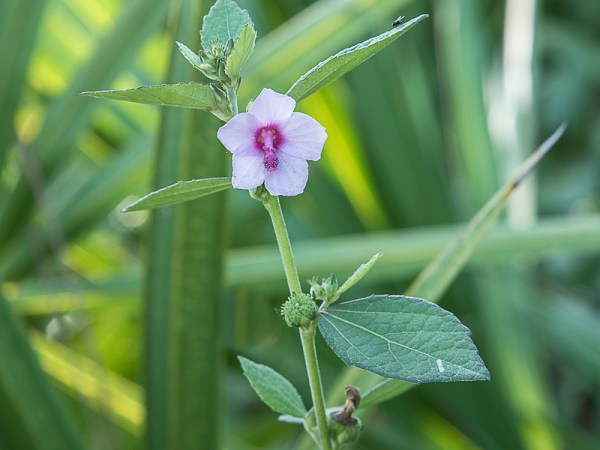
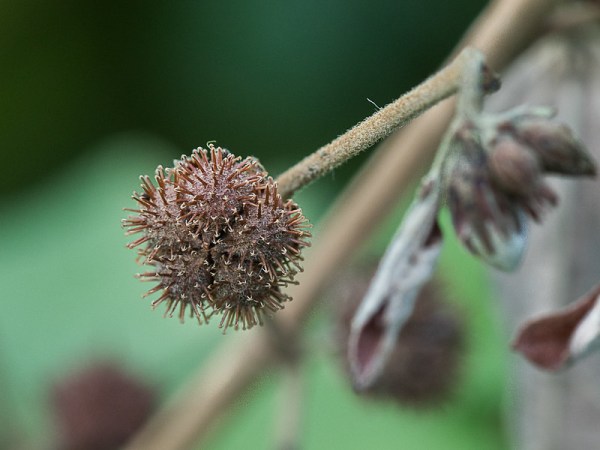
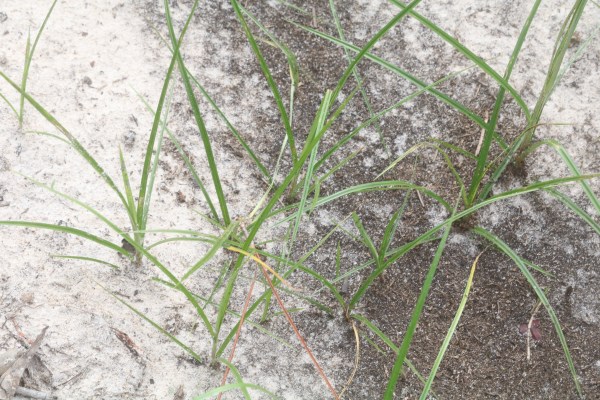
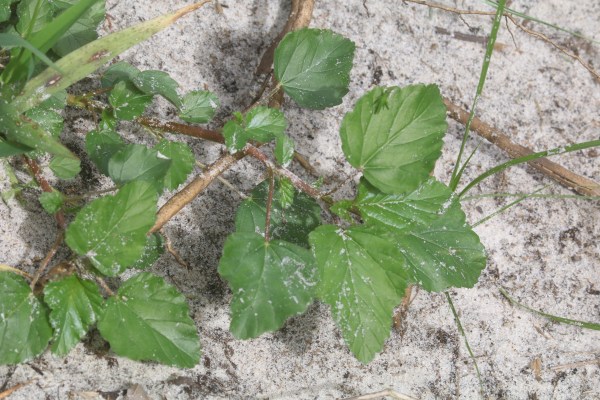
1. Baby Caesarweeds (Urena lobata), tons of them. The dominant newcomers. Caesarweed is an invasive nonnative in the Hibiscus Family brought to Florida initially as a fiber crop. It is an aggressive weed in moist places and makes millions of VELCRO-cling seed-containing burrs. I’ll bet as the hogs crash through the brush they pick up a bunch, and shed them at feeding time in the tilled “garden bed” they create , helping to “restore” their damage, like reclaiming a strip mine in West Virginia. I wonder if your tear up an adjacent area without hogs, do you get as many Caesar babies from dormancy in the soil seed bank? The reason I think not, is that the soil and its seed bank are GONE in today’s damage zones.
Baby Caesarweeds yesterday in Hogaritaville
Caesarweed by John Bradford.
Bet that clings to a pig. By John Bradford.
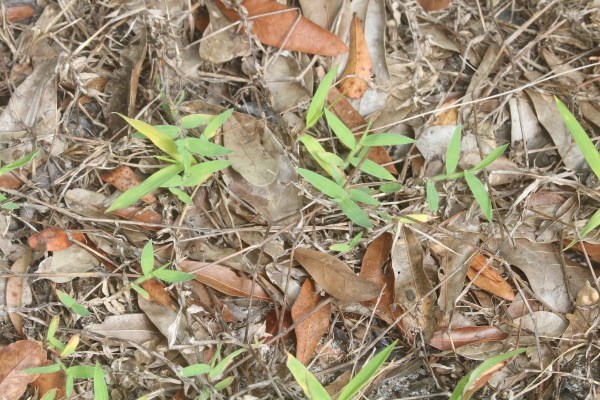
2. Erectleaf Witchgrass (Dichanthelium erectifolium). This durable grass native to seasonal wetlands is common locally, surviving fires, droughts, flooding, and apparently hogs. This species was clearly originally there before the digging, and how it survives the scalped earth as a fun little mystery. Deep roots?
This is an older more-recovered hog scar.
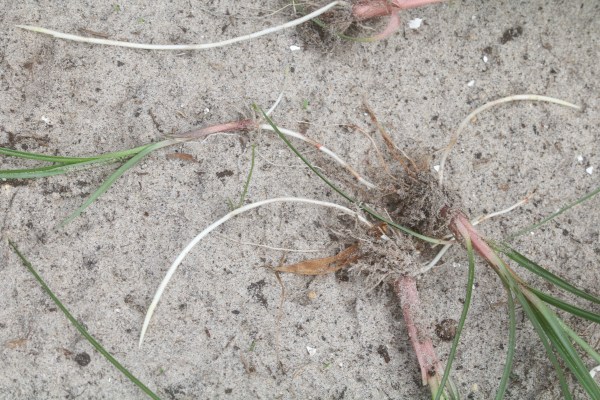
3. Yellow Nutgrass (Cyperus esculentus) is a common round-the-world weedy sedge with rhizomes and tubers. As “chufa,” it is in places an agricultural tuber crop. Somebody say “rhizomes and tubers”? Hog food! Were these possibly the main attractions at pig party time? Wonder if the sedge seeds move from site to site inside the feral porkers? Ever wonder what foods those hogs actually root for? Here are some answers. Click the link:
Speculation is fun, as long as long as the speculator is up front about their BS. Today I’m going waaayyyyyy out on a limb (or up a trunk), so don’t quote anything today as fact.
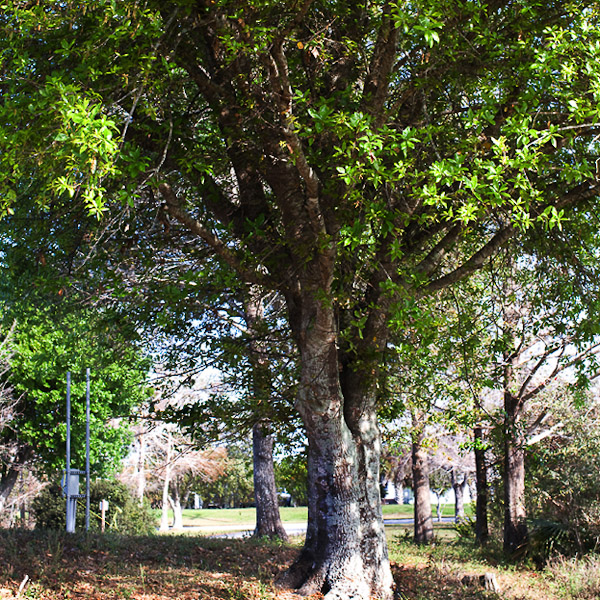
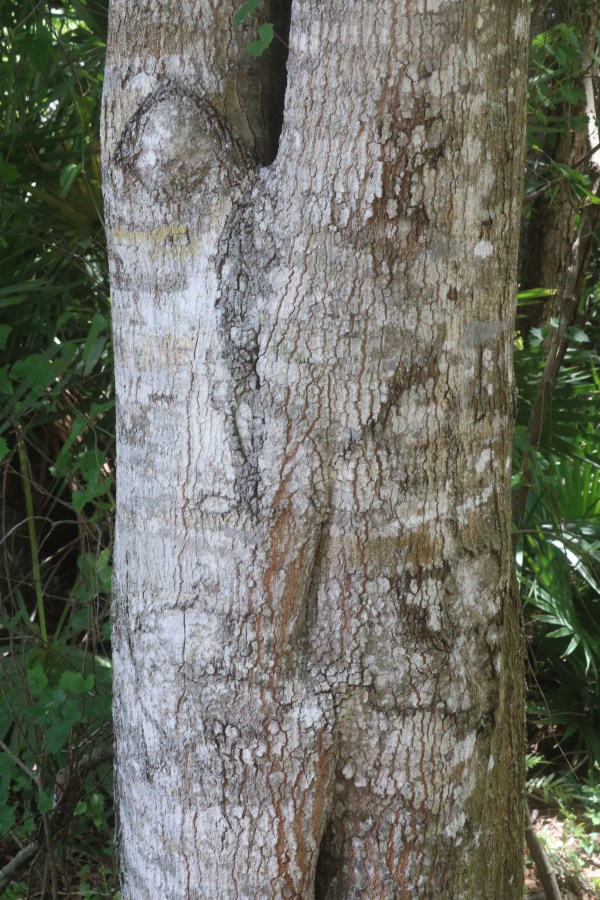
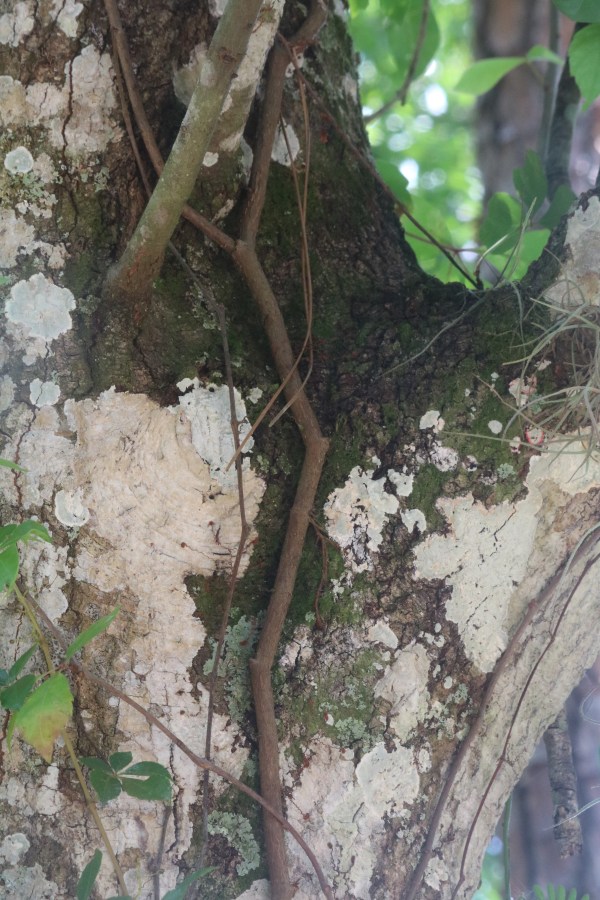
Walking in Cypress Creek today, I found myself gazing at the big lichen patches “whitewashing” the smooth trunks of laurel oaks.
Laurel Oak white-“painted” with lichens, by John Bradford
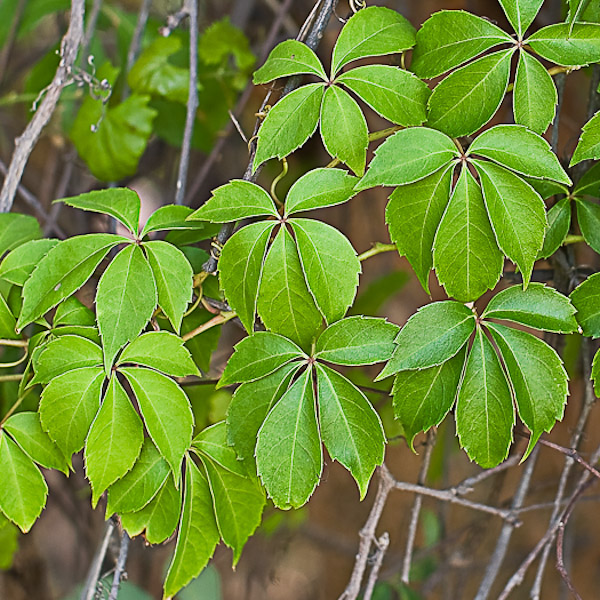
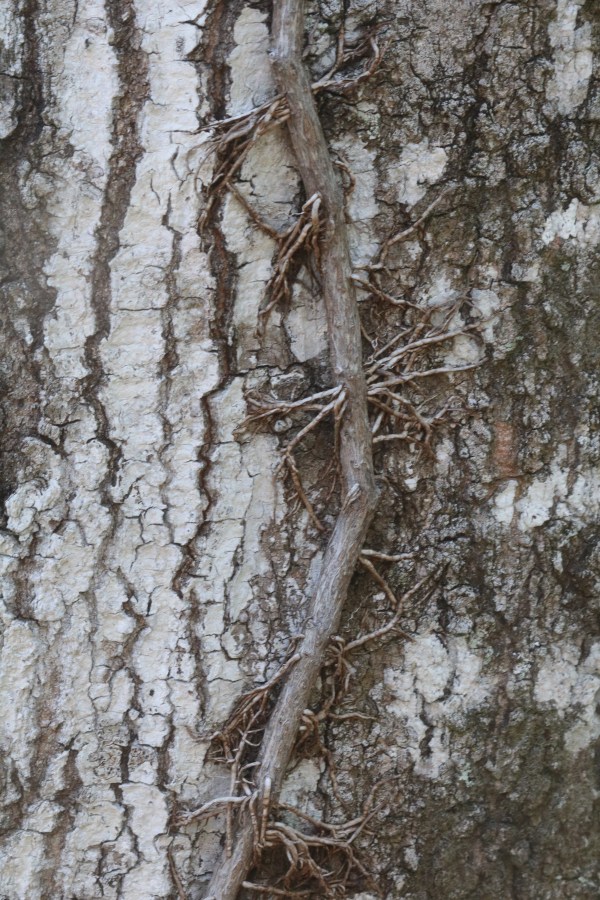
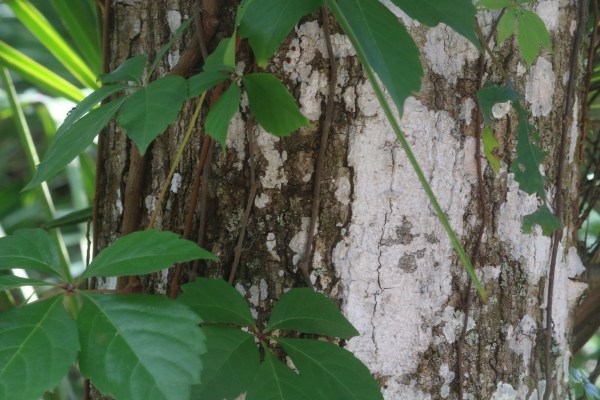
Maybe it was just that 91 degree sun-stroke broiling my noodle, but it looked like the abundant vines along the way tended to sidestep the big white lichen patches. Among the many vines thereabouts, the ones mostly climbing the oak trunks were Virginia Creeper. Virginia Creepers rise with little grabbers (tendrils) that glue themselves to the host’s bark like treefrog toes sticking to your wall.
VA Creeper by John Bradford.
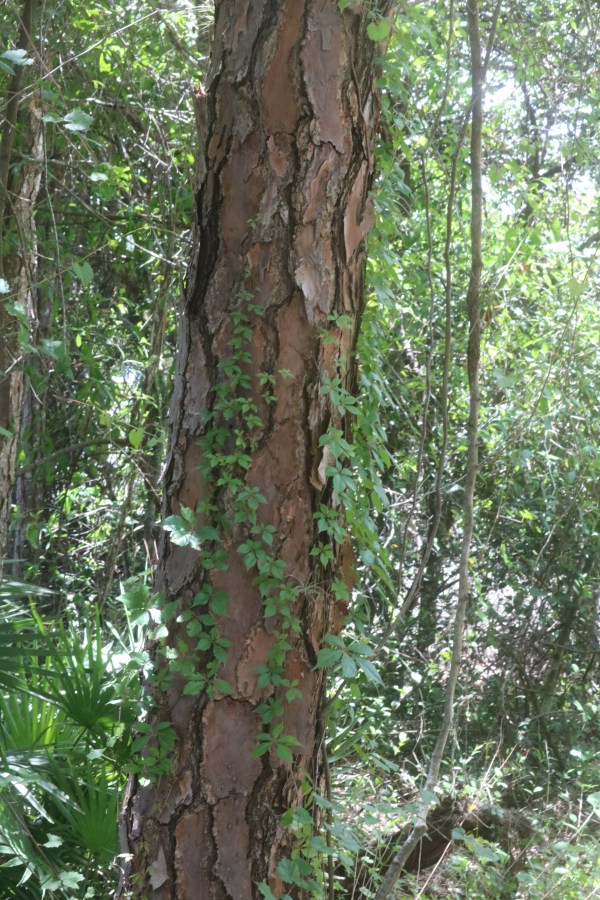
Maybe the lichen is toxic to hug. Maybe the little tendril feet just don’t cling enthusiastically to a living fungal-algal mass, or maybe the lichen changes enough over time to loosen clingy feet. Or, flip flopped, perhaps the VA creeper kills the lichen under it. Or maybe I’m wrong about the whole thing, maybe got an idea then cherry-picked pictures that agree, but to me the photos below point to vine-lichen discord. The tender creeper toes don’t seem to like to tread on the lichen. You decide. Discouraging vines probably benefits the host oak.
A pine with a vine
But just three feet from that pine here is an oak, below, crusted with lichens but no climbers.
The vine on the oak above is off to the right side of the lichen patch to its left. (The growing vine can’t see the lichen…so does it look like it “bumps into” lichen and then swerves? The little vine feet seem to tuck their toes into lichen-free nooks.)
Vine above rising through a lichen gap on an oak. (Did water running down the gap favor the vine and disfavor the lichen?)
Two dark colored vines climbing vertically on the right away from the big white patch on an oak. (The green diagonal stem across the patch is not attached to the tree.)
Changing season lengthening days, heat, rain….and my favorite places after Dunkin’ Donuts, the depression marshes, are awake: Bushmints, Gratiolas, Milkworts of every color, Rosegentians, St. Johnsworts, Stillingias, Stripeseeds, Yellow Flax. Flowers flowers and more flowers! But you know what’s missing? Pollinators (although there would more if I got moving early in the day). Where are all the bees?
Part of the answer, I fear without “hard knowledge,” is that a lot of observers have observed a decline is native bees. Don’t like that! Somebody should assess the native bees in the rural, exurban, suburban, and urban WPB area. Somebody did that in Brazil using Mexican-Clover growing along roads leading into urban habitats. Problem is, Florida native bees may not be that enthusiastic about non-native Mexican-Clover, or about roadsides. Also, there’s a correlation between more-specialized flowers and native bees. Bottom line—this concern needs a local assessment!
A second reason for not seeing many pollinators in an expansive marsh is that in my personal experience the farther out across a large depression marsh you wade, the fewer the bees. The wasps and dragonflies out there are strong long-distance fliers. But are bees reluctant to cross hundreds of meters of marshland to visit a flower? This speculation brings us to an important point: pick any flower species occurring far out into wet marshlands and odds are it can reproduce without insect pollinators. Every plant in the list above is either known or strongly suspected of being able to reproduce without insect visitors.
Southeastern Primrosewillow by John Bradford.
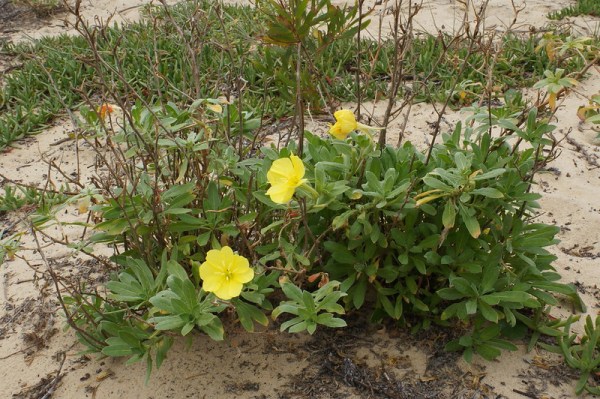
A particularly attractive example in flower now is Southeastern Primrosewillow, a modest beauty you don’t see everyday. It may be shy about hiding its sunshine yellow blossoms among the St. Johnsworts it resembles, but it sure isn’t shy about pollinating itself. Go visit in the morning, and the pollen-bearing anthers are spread off to the side, out of the way in case a visitor brings pollen to the stigma standing tall at mid flower. But in the afternoon just before the petals fall off, the anthers clasp to the stigma and powder it with “self” pollen. No way that blossom goes to waste, even if the bees let it down.
Morning with four white anthers spread to the side, stigma in the center. Enlarged portion of photo above.
Afternoon, anthers pressed against and pollinating the stigma. The pollen is white.
Southeastern Primrosewillow is native across the southeastern U.S. But look it up its range in the authoritative Flora North America, and hey what’s that? Tabasco, Mexico??
That’s 1500 miles away! The key to that leap must be self-pollination. One seed carried by a bird or a hurricane or a muddy shoe can establish far from home, self-pollinate, and spawn a nation. If that is so, wouldn’t today’s pretty wild flower turn up “unofficially” in additional hot wet places? Let’s try India. Yep, , “in rice growing areas.” Africa?—yep, one herbarium specimen in Gabon, and maybe in the People’s Republic of the Congo. You get the idea! Self-sufficiency of the meek and humble.
Wild Radish is an Old World weed you don’t see much in South Florida natural areas. In some places, however, they see far more than they’d like, being a bigtime agricultural weed resistant to herbicides and having seeds as bycatch during harvesting. Some non-farmer folks fancy the plants as “edible.” But no no no! It picks up environmental toxins. Edible? Well, it is the parent species of the radish in my salad, and the two can intercross even now. And no, WR does not have a bulbous red root.
Today in Cypress Creek
I don’t want to poison it or eat it, or cross it with salad fixings. The interesting thing, documented back in the 80s by California biologist Maureen Stanton, requires a tiny bit of background:
Here is that background. A long-standing concept in plants and animals is a spectrum of degree of parental investment in offspring. Some species make a huge investment in each offspring, providing each an advantage in establishment: humans, elephants, coconuts. At the other end of the spectrum, some parents release a huge number of undemanding “cheap” offspring into the cruel world betting on quantity instead of quality: rats, spiders, dandelions. No species has to occupy either extreme, most species are intermediate, but what you do not often see (I can’t think of another example) is one species using both strategies, making a mix of high-investment AND cheap skitter-skatter offspring.
The pods break apart rather than opening.
Wild Radish does. As Dr. Stanton documented, the seedpod starts out making one “big” seed at the base. Then higher in the pod it forms one or more smaller cheaper extra seeds. The number of smaller plan-B seeds varies considerably—apparently in good conditions the pod enjoys the luxury of adding several extras. When times are tighter or the season is short, the pods still makes the main seed while holding back on its less-endowed smaller siblings. Sort of like a royal family having a well groomed heir apparent, followed by minor princes in reserve.
As cities get bigger and as suburbs sprawl, a lot of wild creatures have expanded their ranges into town (or gotten trapped in little remnant pockets). Duh: raccoons, possums, skunks, rabbits, and coyotes, old-school. Foxes, screech owls, and even otters and martens (up north) maybe a little more recently.
Screech by John Bradford
One that I find fascinating, perhaps because they’re frequent visitors around my totally non-waterfront suburban subdivision home, are ospreys.
by John Bradford
It has long been known that ospreys take okay to cities, but usually that means the birds nest on the shore among humans yet remain on the edge of the usual bodies of water where they fish. An osprey may nest in Stuart and still have a waterfront view to the big ol’ St. Lucie River.
But what I’m noticing are ospreys nesting in urban/suburban sites far from any expanse of “obvious nice fishing places.” Some seem to nest and hang out these days in “funny” (not ha ha funny) places. The one(s) that visit me like to perch atop a big ugly Norfolk Island Pine overlooking the drainage canal passing by. The canal spawns unlovely catfish and tilapia, and maybe the occasional Mayan Cichlid. Not a gourmet menu….but easily snatched from the foot-deep water.
Nest in upper right corner above stinkwater.
There are plenty of fish in the sea (and evidently in the canals), so what do ospreys compete with each other for? Maybe suitable nesting sites.
I do a bit of botanical snooping concerning weeds in relation to resilient gopher tortoises along a stagnant canal near home, between a huge urban golf course and a roaring RR track. Not very aesthetic setting, and the “seafood” is crummy. Along the way, though lives a beautiful family of ospreys bravely nested on a powerline pole among the insulators. Explain to me again why they don’t get electrocuted up there in the hotseat. I understand the safety of birds perching on a single wire, but the potentially soggy nest spans several wires, insulators, and the pole itself which is grounded. Kinda worrisome but they seem unconcerned.
From a botanical standpoint, there are green gems sprouted along RR tracks from seeds ridin’ the rails from faraway places. The parents of todays’ trackside Mexican Poppy were probably weeds in an agricultural field along the route. This stunning prickly yellow species has made a prior appearance in the blog, but today’s angle is different. (https://treasurecoastnatives.wordpress.com/?s=poppy)
An old tropical disease, mostly in India, also South Africa, is called epidemic dropsy. Dropsy is an old-fashioned term for edema linked to heart failure and related events. Edema is usually sporadic and spotty in populations relating to age and to additional factors, so when it sweeps through a region like the flu, that’ll raise some medical eyebrows. That has occurred lots of times, causing lots of deaths, even in the “2000’s.” As recently as the 1930s, the cause remained unknown, As explained in the article we’re about to examine, there were then three theories: 1. “Contagion” (i.e. germs), 2. Bad rice. 3. Mustard seed cooking oil. Drs. R.B. Lal and S.C. Roy in the 1931 British Medical Journal narrowed the cause down to the almost-correct mustard seed oil theory, but with a big piece of the puzzle still missing. in
What is interesting is how they did it, raising the questions of were they heroes, or rat-finks, or some of both? First off, the two doctors shared an historical account of the disease around Calcutta. I call your attention to the “permanent damage to the heart” part. That sounds like something to avoid. Stay tuned on that.
The three theories then got an overview. Apparently at that time, “respectable members of the profession” had negative vibes about the mustard oil notion.
But the doctors listened to citizen science and showed those respected colleagues the path to truth by means of an experiment. And here is the kicker: The experiments took place on 12 healthy young volunteers “willing to take the risk.”
HUH? How informed was their informed consent? Did they read the fine print above about the reaper and the heart damage? I wonder how they were “volunteered.”
Glad to hear groups B and D were so cheerful! I’d be cheerful too if excluded from groups A and C. The docs never mentioned what happened to the un-cheerful group A and C volunteers. I wonder if they lived long enough to hear the rest of the story. Which is as follows:
For the rest of the story we have to know that today’s species has long been cultivated around the warm world for “argemone seed oil.” That’s good if the argemone oil is used for lubrication, fuel, and industry. Thanks to those non-food applications, Mexican Poppy has become an abundant worldwide agricultural weed. Just don’t let argemone seed oil get into the mustard seed oil, either from weedy seedy cropfield mixing, or more often, as a cheap adulterant to expensive mustard seed cooking oil.
(By the way, in more recent times argemone oil has been tried “externally” in massage oil, but guess what, it can enter transdermally, so your exotic massage then can have a very unhappy ending.)
Quick…name five native trees to PB County! Bet you forgot Pigeon-Plum! It’s kind of modest after all, not that common locally, smallish, with unshowy flowers and weird bumpy fruits on female individuals. Modest…yet talented!
Photos today by John Bradford.
First of all, those plumlike fruits are not really plums, not even fruits. The actual fruits look like seeds, and the fleshy purple covering grows from the female flower petals swelling up around the small actual fruit. No doubt the fake fruit feeds seed-spreading birds, and maybe they float. Pigeon-Plum is abundant in mush of the Caribbean, often in marly salty dry forests. Seed fragments from Pigeon-Plum go far back in Florida archaeology. The fact that ancient people ate the fruits makes me wonder if pre-European people helped disperse the species throughout the Caribbean all the way to Florida, as with peppers, agaves, and papaya. Or then again, maybe pigeons spread it.
What I find most fascinating about PP is the feature responsible for its name “diversifolia.” Many plants have different “shade” leaves and “sun” leaves, but today’s tree goes to diverse extremes. The young shoots rising from the forest floor have elongate leaves a foot long or more. The branches on mature individuals, by contrast, have normal-looking small leave the size of a pocket watch. Those big-leaved but fragile forest-floor youngsters are equipped for gathering maximum light in the protected shaded understory. The small but tough mature leaves are better for resisting exposure to sun, wind, and salt spray. And, speculatively, leaf-eating insects. The two leaf types look like two different species. Come to think of it, the two types were historically misinterpreted that way as “Coccoloba laurifolia” and C. diversifolia. In 1949 botanists Richard Howard noticed the two “species” growing on the same tree in Cuba.
Pigeon-Plum is related to Seagrape, and the two sometimes hybridize. There’s a neglected postage stamp hammock remnant along the RR tracks in Jupiter where Seagrape and Pigeon-Plum grow intimately intermixed. Really—with the stems of each rising from single clumps. Room for doubt, (!) and no DNA test handy, but suspect some of the in-between forms there are the hybrid known as Coccoloba Xhybrida.
Left to right all from same clump: PP big-leaf form. PP little leaf form. Hybrid? Seagrape.