Argemone mexicana
Papaveraceae (Poppy Family)
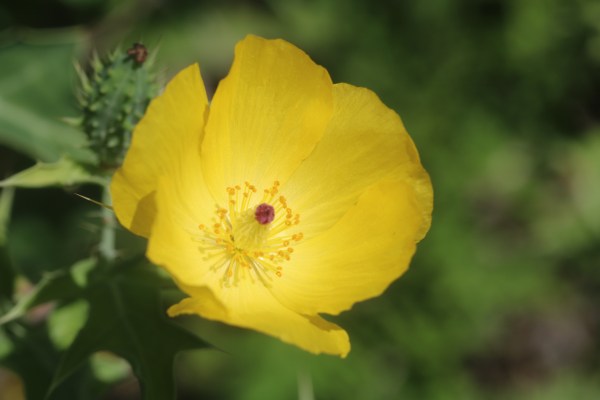
From a botanical standpoint, there are green gems sprouted along RR tracks from seeds ridin’ the rails from faraway places. The parents of todays’ trackside Mexican Poppy were probably weeds in an agricultural field along the route. This stunning prickly yellow species has made a prior appearance in the blog, but today’s angle is different. (https://treasurecoastnatives.wordpress.com/?s=poppy)

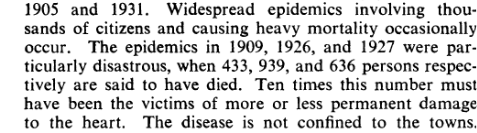
An old tropical disease, mostly in India, also South Africa, is called epidemic dropsy. Dropsy is an old-fashioned term for edema linked to heart failure and related events. Edema is usually sporadic and spotty in populations relating to age and to additional factors, so when it sweeps through a region like the flu, that’ll raise some medical eyebrows. That has occurred lots of times, causing lots of deaths, even in the “2000’s.” As recently as the 1930s, the cause remained unknown, As explained in the article we’re about to examine, there were then three theories: 1. “Contagion” (i.e. germs), 2. Bad rice. 3. Mustard seed cooking oil. Drs. R.B. Lal and S.C. Roy in the 1931 British Medical Journal narrowed the cause down to the almost-correct mustard seed oil theory, but with a big piece of the puzzle still missing. in
What is interesting is how they did it, raising the questions of were they heroes, or rat-finks, or some of both? First off, the two doctors shared an historical account of the disease around Calcutta. I call your attention to the “permanent damage to the heart” part. That sounds like something to avoid. Stay tuned on that.
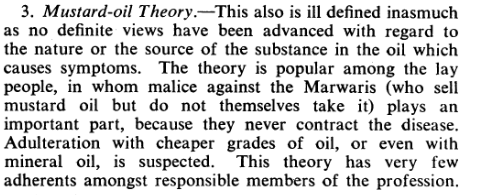
The three theories then got an overview. Apparently at that time, “respectable members of the profession” had negative vibes about the mustard oil notion.
But the doctors listened to citizen science and showed those respected colleagues the path to truth by means of an experiment. And here is the kicker: The experiments took place on 12 healthy young volunteers “willing to take the risk.”
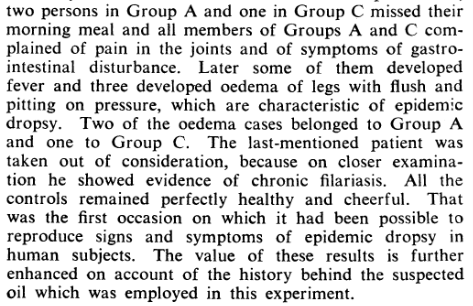
HUH? How informed was their informed consent? Did they read the fine print above about the reaper and the heart damage? I wonder how they were “volunteered.”
Glad to hear groups B and D were so cheerful! I’d be cheerful too if excluded from groups A and C. The docs never mentioned what happened to the un-cheerful group A and C volunteers. I wonder if they lived long enough to hear the rest of the story. Which is as follows:
For the rest of the story we have to know that today’s species has long been cultivated around the warm world for “argemone seed oil.” That’s good if the argemone oil is used for lubrication, fuel, and industry. Thanks to those non-food applications, Mexican Poppy has become an abundant worldwide agricultural weed. Just don’t let argemone seed oil get into the mustard seed oil, either from weedy seedy cropfield mixing, or more often, as a cheap adulterant to expensive mustard seed cooking oil.
(By the way, in more recent times argemone oil has been tried “externally” in massage oil, but guess what, it can enter transdermally, so your exotic massage then can have a very unhappy ending.)
 John Bradford
 George Rogers
 George Rogers
 Dee Staley
 Treasure Coast Natives