Category Archives: Uncategorized
Chapman’s Oak: the unloved scrub oak
Quercus chapmanii
Fagaceae, Oak Family
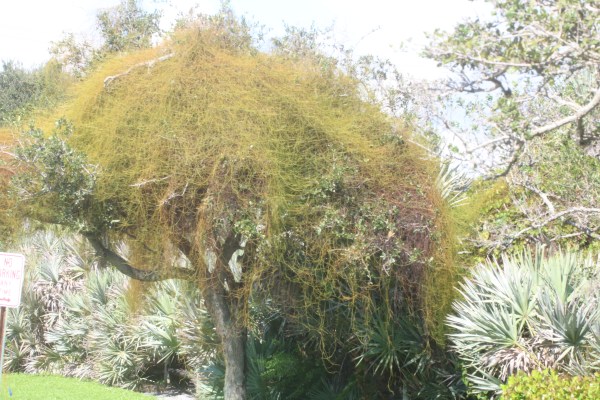
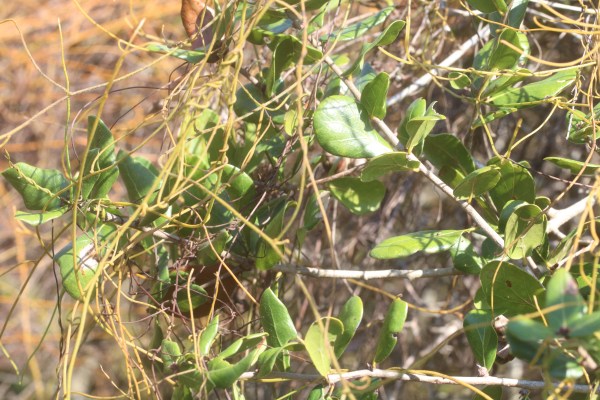
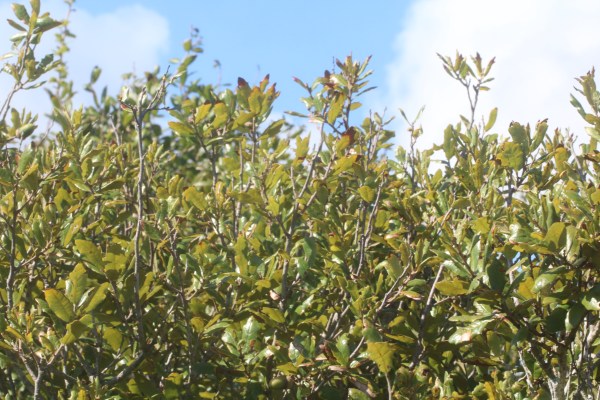
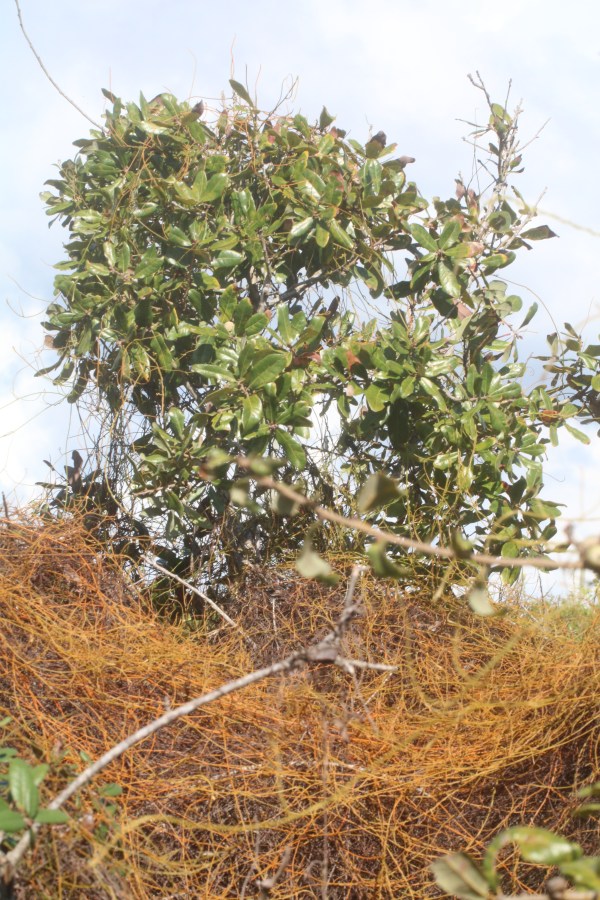
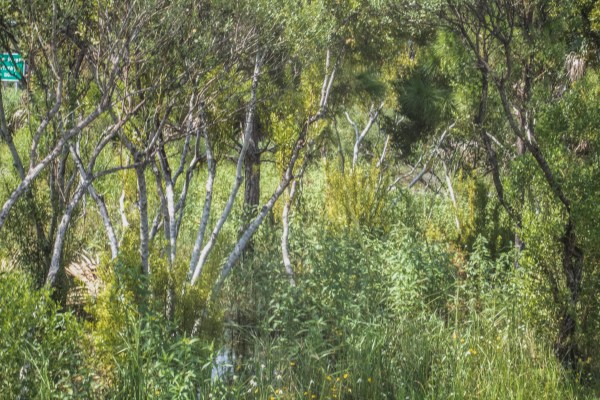
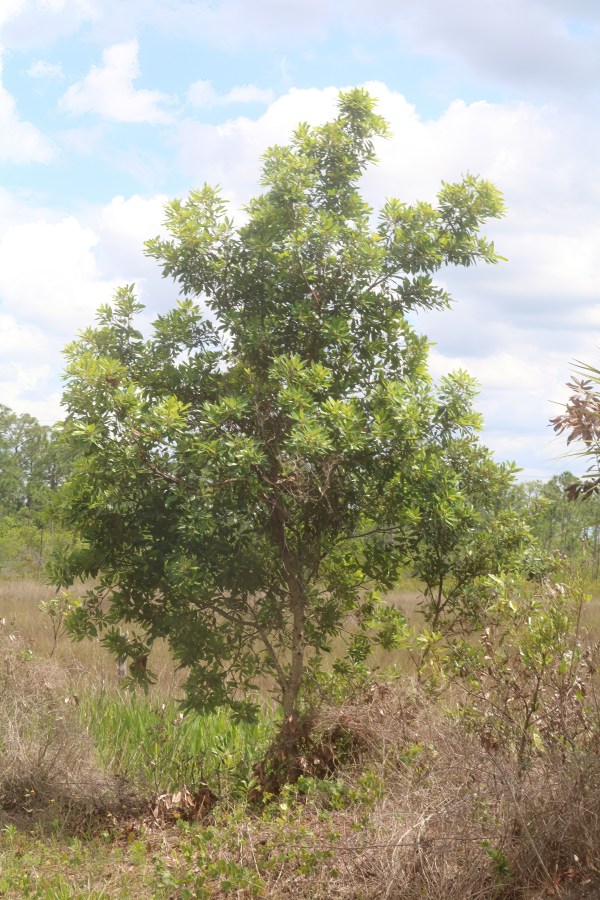
Walking in the Jupiter Inlet Outstanding Natural Area this morning, something new to me became apparent: the Chapman’s Oaks were nearly free of the otherwise rampant parasitic Lovevine (Cassytha filiformis). Caution!, many initial botanical perceptions fail to hold up under scrutiny (sad voice of experience). But at least at this time and place, the other scrubby oaks—Sand Live Oak and Myrtle Oak—were mostly tangled with the parasite. By contrast, none of several Chapman’s Oaks in multiple separate thickets had it. So join me in some speculations.

Above: Sand Live Oak at Jupiter Inlet, festooned with Love Vine.

Above: Myrtle Oak with Love Vine

Chapman’s Oak free of Love Vine
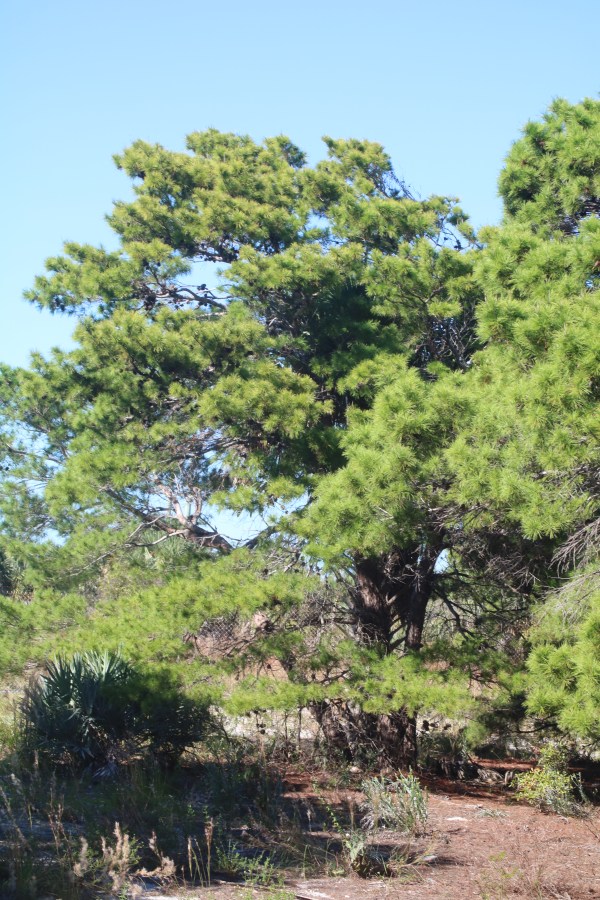
Like most local scrub zones, the area is dominated by a mix or Sand Live Oaks, Myrtle Oaks, and Saw Palmetto, with Chapman’s being a tiny minority. Given that Sand Live Oak and Myrtle Oak blanket vast scrubs in countless numbers, why is Chapman’s Oak not out-competed and gone? An obvious guess is maybe it has a specialized microhabitat, but if so, it must be subtle, given that Chapman’s lives physically intermixed with the other two.

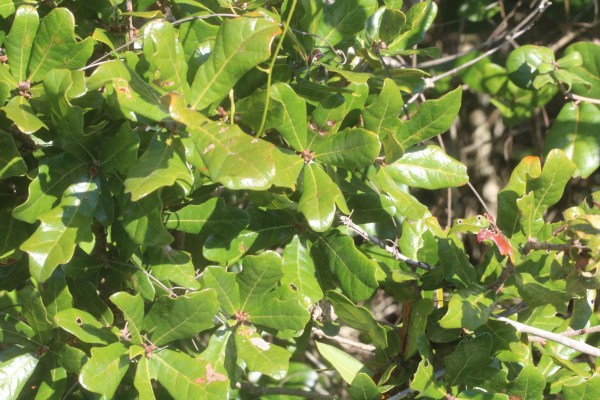
Chapman’s foliage
Another possibility is the site history of fires, hurricanes, and physical management. But that’s unknown so what we see here and now is zillions of Sand Live and Myrtle Oaks, salted here and there with a few Chapman’s. Are the three species as we encounter them giving hints about their relative abundance? Chapman’s Oaks seem to get taller faster than the other two when they all resprout at the same time. Maybe the Chapman’s survive in part by rising up quickly above their competitors, at least when young.
Chapman’s Oaks stand apart by having seasonally deciduous leaves, whereas the other two are evergreen. Maybe Chapman’s Oak can avoid competition being dormant in the dry season, and then have a growth spurt when rain and foliage return. That seasonal pattern might help with resisting Lovevine, giving Chapman’s some advantage in the scrub competition. During its brief seasonal dormancy, Chapman’s probably doesn’t have much water or sugar for the vine to steal in the twigs, and none in the leaves since they are absent. Then later, at the end of the season when leafdrop time comes, any encroaching Lovevine falls away with the falling foliage. Perhaps.

Chapman’s Oak clear of Lovevine, rising above other oaks covered with it.
Sand Wasp Watchin’
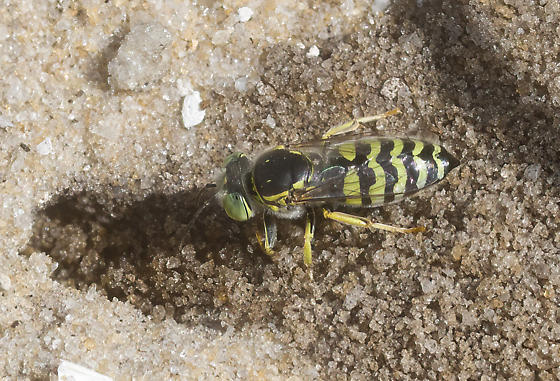
Bembix (Bembix americana? There are several species.)
A Google book report
Otis Redding sat on the dock of the bay, watchin’ the tide roll away. Jimmy Buffet nibbled on sponge cake watchin’ the sun bake. Yesterday I wasted away in Juno Beach-a-ville watchin’ a sand wasp. One of the best parts of botanizing is spotting cool creatures, from anhingas to zebra longwings, and then using the internet to research their stories. Today’s object of wonder was a splendid piece of creation, a sand wasp digging a burrow in the dune sand.
Click for a speedy peep at hot digging action!
Where does it find the energy to dig like that under the 94-degree sun? The wasps have two forms of nutrition: nectar and prey. They visit flowers, and I’ve read they prefer white ones. Are most scrub flowers white? Yea, no, maybe so…at least many are. As with so many fascinating Florida insects, today’s is not well studied, and no doubt has its secrets including mouthparts adapted to collecting nectar.

In addition to floral nectar, the sand wasp is a little buzzbomb designed for nabbing prey, although the range of victimized species seems to be one of the wasp’s secrets. Googling leads to “flies.” Somebody even said that sand wasps hanging around humans are not interested in the humans, but rather in the flies they attract. I dunno. Would like to think I don’t often attract flies. But in any case, the sand wasps are not belligerent. Just the opposite, they let you sit there broiling in the sun watching them come and go. Seeking mates? Shooing competitors? Nabbing flies? Sucking flowers?, and dig dig dig.
The wasps are solitary and ground-nesting. The female provisions her tunnel with the prey insects as larval food. Usually the female brings a victim to the nest and lays an egg on it. Like a mother bird, she can then return to the burrow repeatedly with supplementary provisions. I can’t even remember where I leave my car keys.
The one I watched yesterday had two behaviors in addition to digging. One behavior was backing into the burrow for brief periods, okay: shady, moist, and restful. The other behavior was more puzzling: she would fly away and return all within maybe 20-30 seconds if that long. The flights were too brief for floral visits or fly-catching, and she always returned empty-handed. Maybe my presence was disturbing, but unlikely—the short flights had no apparent relation to me. Mating was the likely motive. After all, no tunnel nest is complete without a fertilized egg. The males cruise around near the ground looking for hookups, so maybe the female’s brief sorties are procreational.
Saltbush, the perennial tree with annual branches does not enjoy competition
Baccharis glomeruliflora and related species
Asteraceae, Aster Family
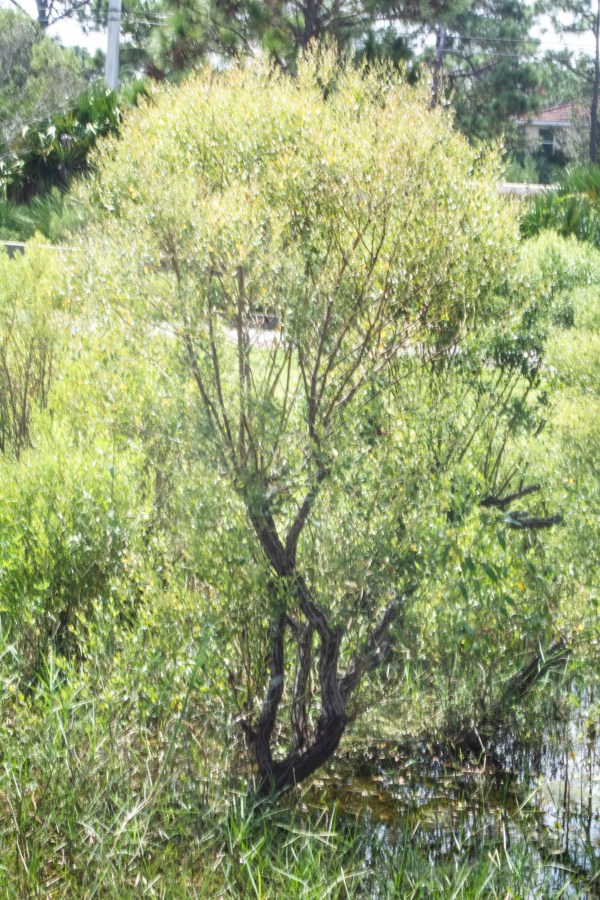
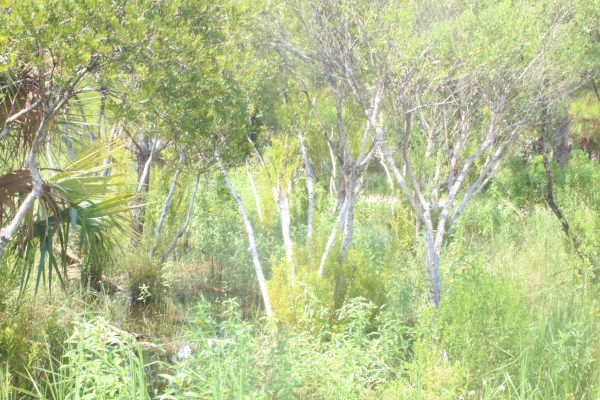
Driving home yesterday from working with John on our soon-to-be-printed photo guidebooklet to trees and shrubs (hint hint), I spotted an old favorite tree coming into bud, again. How did another year go around? Saltbushes are odd and pretty. Stopped the car and took a couple photos.

Not sure if the tops were burned, pruned, or neither.
The Aster Family is huge, with thousands of species, almost all of them herbaceous. Among the exceptions is the genus Baccharis, the 400 species of saltbushes. Funny how a family that is nearly herbaceous, when it makes a tree that tree remains partly herbaceous. Our local Baccharis glomeruliflora has a thick woody base and meaty lower branches, and yet “annual” upper branches, perfect for replacement after fires, storms, droughts, and basic bad experiences.

Those throwaway branches perhaps play a part in the attractive spacing of some Baccharis stands. The plants shower the ground with millions of seeds, yet the mature bushes practice polite social distancing. Wonder how and why?

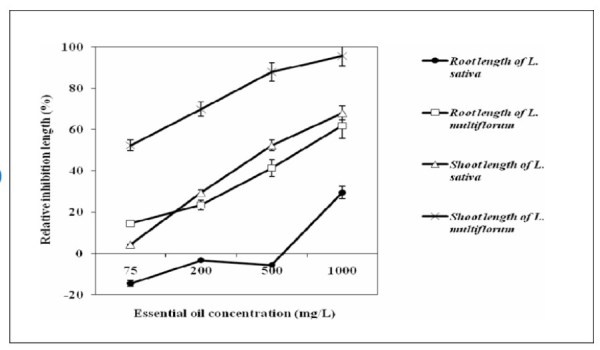
Turns out Baccharis is a wicked poisoner of surrounding vegetation. Studies by ecologist Francisco Ibanez, who made the graph below, and others have shown massive reductions in the growth of test plants, sometimes over 90% reduction. Baccharis clobbers them. Hey, saltbush acts like biblical sowing of salt. The saltbush deposits persistent oil in the soil that functions as a natural preemergent herbicide. Some researchers even suspect Baccharis to “gas” its victims. Betcha the parent plant suppresses crowding by its own babies, perhaps by dropping those disposable branches around its own feet, or their foliage, or their poison drippings. After all, in the plant world, who are your worst competitors? Answer: the apples not falling far from the tree. It is not nice, but multiple species of plants practice “autotoxicity” —we would call it infanticide.

Those rising lines show increasing death and destruction with increasing Baccharis exposure. By F. Ibanez
What Does Partridgeberry Have in Common with a Zebra?
Mitchella repens
Rubiaceae, Coffee Family
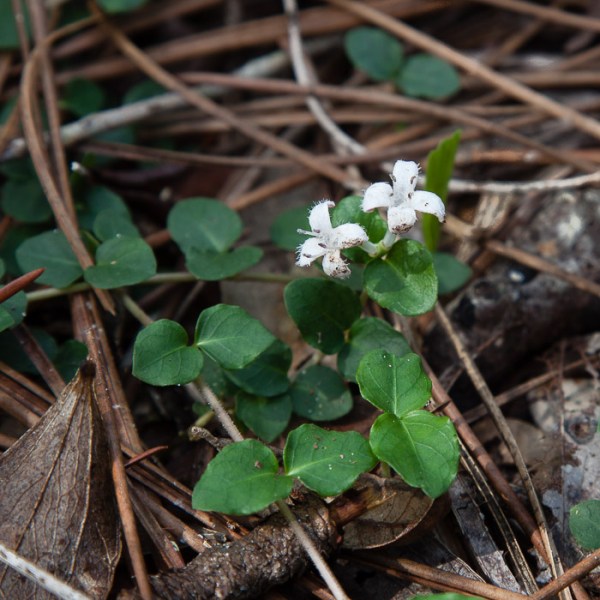
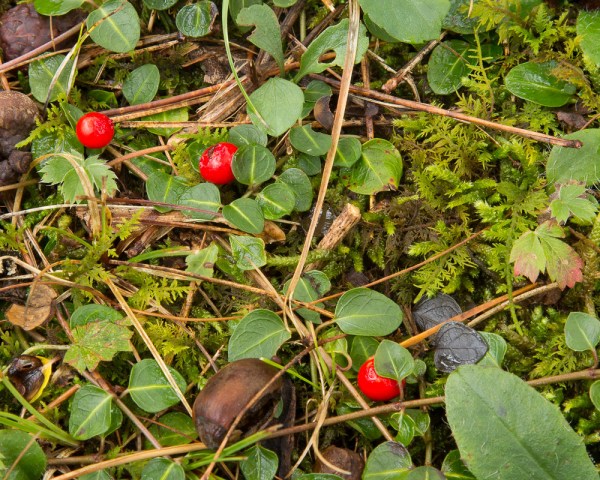
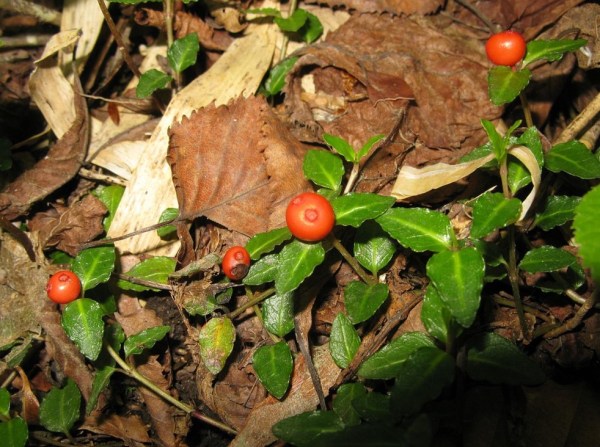
A marvelous local wildflower you don’t see everyday is Partridgeberry. I’m originally a northerner rooted botanically in Michigan, Canada, and New England, where Partridgeberry is a conspicuous delight on acidic forest floors, with its twin white flowers, scarlet berries, and white-striped leaves. Upon relocating to Florida long ago, it was a happy surprise to run into a “north woods” species hereabouts, in Halpatioke and Jonathon Dickinson parks for instance. Turns out Partridgeberry has impressive geography: ranging from the far north woods in eastern North America to Martin County, Florida, then a jump to Tex-Mex and Central America. How many species are native from the Arctic Circle to tropical Guatemala, trampled by both moose and tapirs?

By John Bradford
It gets better. Partridgeberry has a nearly identical sister species in eastern Asia, Mitchella undulata. Seems that Mitchella originated in Asia, came to North America via the Bering Strait (just like people), and wandered from Alaska to Nova Scotia to Trapper Nelson’s cabin, to Mayan ruins. Migrating birds probably helped. Not bad for a genus of just two little ground-hugger species.

P-berry near Wal-Mart in Pt. St. Lucie by JB

On a mountain in Japan (credit below)
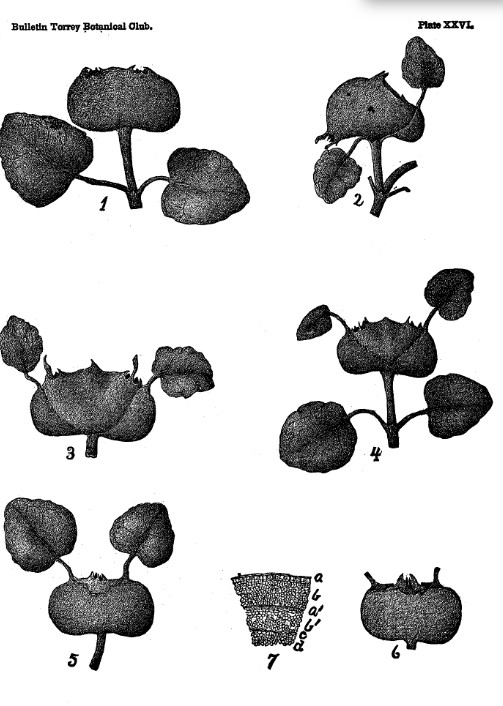
Partridgeberry has more weird aspects. The berries arise from the fused bases of the paired flowers. Those double-barreled berries can sprout leaves, apparently a curiosity to this artist in 1883:

Charles Darwin wrote about Mitchella having two types of flowers on separate plants, a mechanism called heterostyly where two breeding strains force cross-pollination within a species. In years after Darwin it turned out some populations have a third strain. Very unusual. Room for more research there!
Something of interest to leaf peepers is markings on leaves, including the white stripes on Partridgeberry leaves. Leaf markings happen in many ways for many reasons, proven or speculative. Reasons for leaf markings include viral infections, fake bug damage to discourage leaf-eaters, attracting pollinators to the flowers, fair warning (don’t eat me I’m toxic), and aiding photosynthesis in varied light conditions. That’s all nice, but Partridgeberry is especially interesting because its markings resemble those of of similar groundcover species in north woods conducting most of their photosynthesis during the fall and spring when the shady tree canopy is leafless. Why would a guild of plants with that lifestyle all have white-striped leaf syndrome? Ecologist Thomas Givnish made a suggestion, pointing out that these species have a high nitrogen content due to their seasonal growth spurts. All that nitrogen, especially at a time when other plants are leafless, makes the forest floor plants especially attractive to leaf grazers, such as deer. Those conspicuous nutritious plants need special protection.
They make protective chemicals, such as wintergreen oil in the guild-member Wintergreen and poisons in Pipsissewa. Dr. Givnish suggested that the shared white leaf stripes confuse the deers’ eyes, breaking up the outlines of the leaves, just like the stripes on a Zebra confuddle lions by breaking up the outlines of the Zebras, which have the advantage of flight potential. He did mention the need for further testing (on the discouraged herbivores, not the Zebras). To my knowledge, nobody has, however, rounded up Guatemalan tapirs and moose from Maine and tested their eyesight.
Photo credit:
M. repens, John Bradford
M. undulata, Qwert1234, CC BY-SA 3.0
What Does Sea Grape Have in Common With Waldo?
Coccoloba uvifera revisited
Polygonaceae
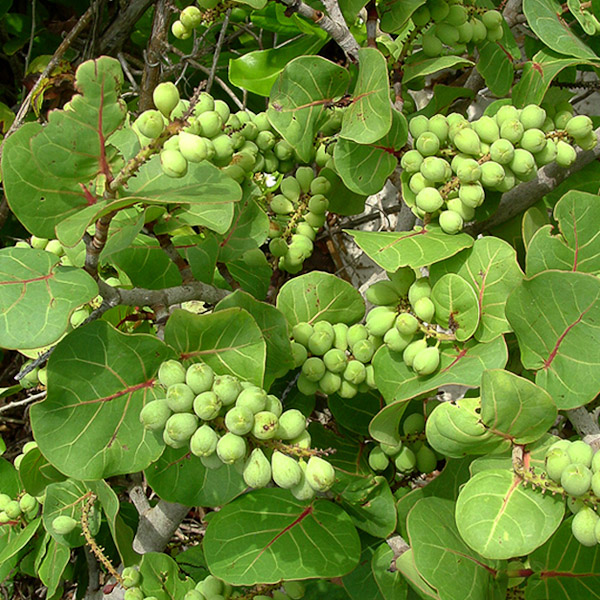
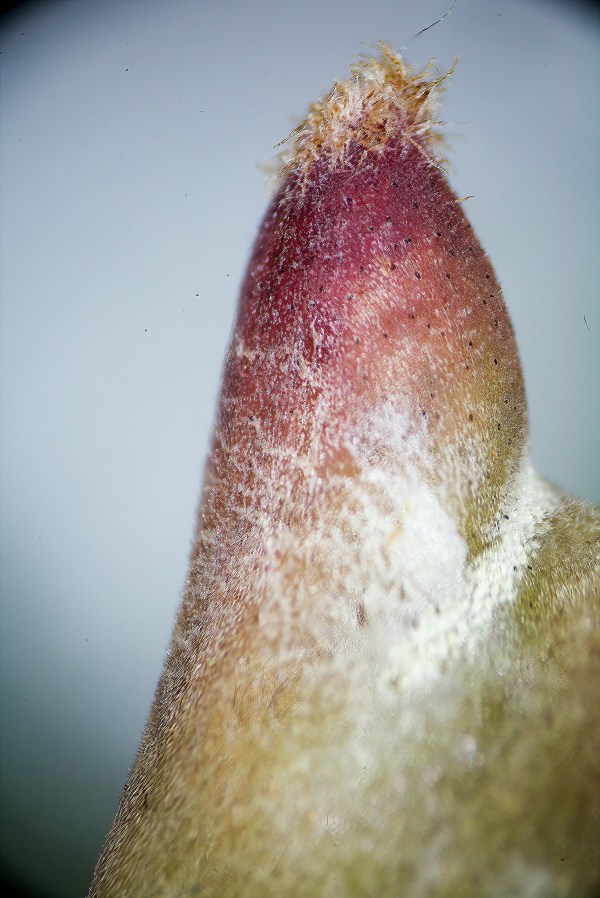
Normally a dumb ol’ bud on a branch is not worthy of your attention. But Sea Grape, at least IMHO, has the weirdest buds in town, probably an adaptation to its windward existence blasted by burnin’ sun, howlin’ winds, and blowin’ beach sand. The tree has massive, thick leaves, and its salty life doesn’t allow the luxury of leisurely unfolding those platters like a delicate maple in the gentle woodland.

By John Bradford
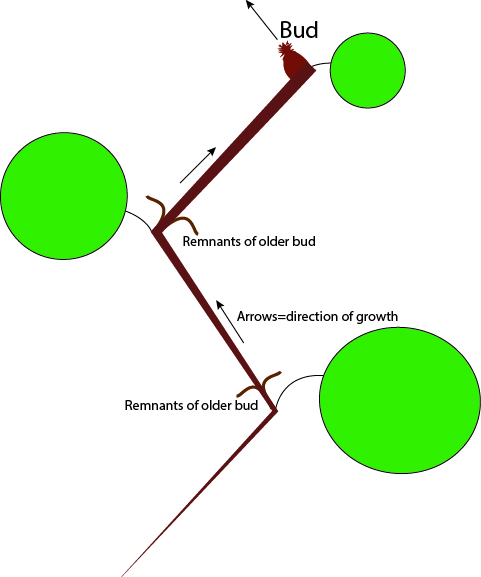
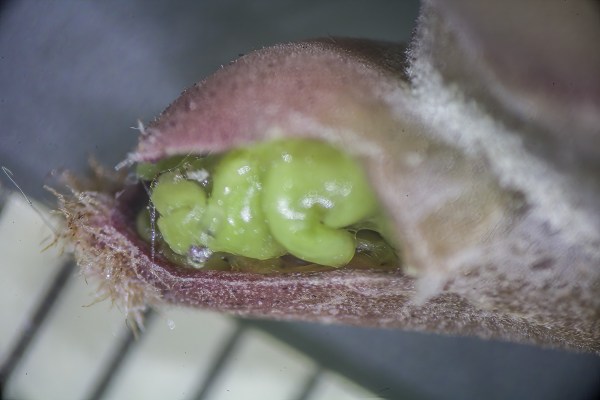
Seagrape pre-forms the leaf inside that gigantic bud, and wads it up within a liquid gel. Safe from maritime unpleasantries and from 3-digit heat index. The future next-young-stem- segment is waiting in the bud too, and pushes out behind the new leaf. When the time is right, the protected leaf and baby stem pop forth together to expand the branch a foot or so until a new bud forms and potentially suspends growth. Branch growth bobbing and weaving is episodic and zig-zagged, unlike most woody species that merely grow along the straight and narrow with no worries.

The new leaf inside the bud looks like my idea of a green brain inside a skull (never actually saw one but have watched zombie movies), and isn’t our brain cushioned by liquid gel? The buds are like little human heads, complete with hair.

Bud side view
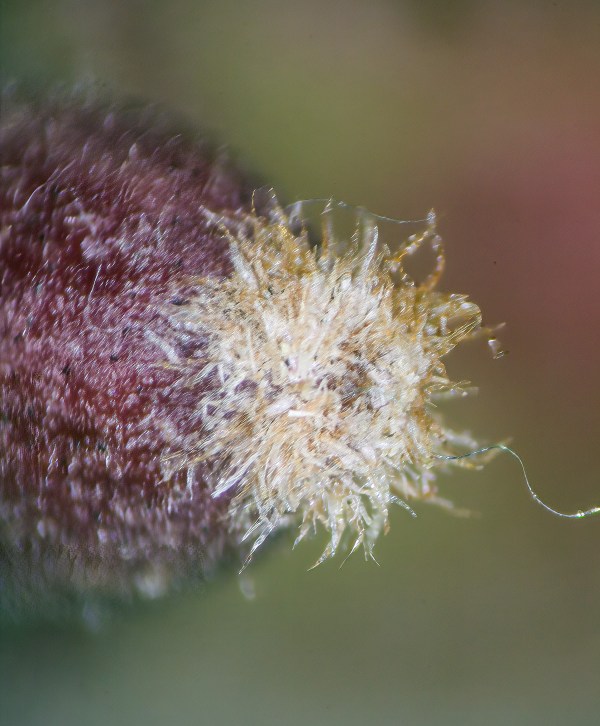
What’s particularly weird is that tassel on top. I may be utterly incorrect, but I betcha it is there to protect that big, complex, precious, vulnerable liquid-filled bud. The tassel would break up the nasty wind sweeping over the critical bud tip (just outside the “brain”) and diminish evaporation of the liquid gel. It might even catch a little fog, mist, dew, or drizzle to help resist drying.

To be far-fetched, the tassel might additionally block mutation-causing UV from bothering the tender tissues, but ok that’s a stretcher.

When growth resumes and the leaf and stem come forth, they push through the tassel or immediately alongside it.

Not brain surgery. Inside the opened bud green innards are the wadded leaf in the liquid gel.
Swamp Bay Has AI
Persea palustris
Lauraceae
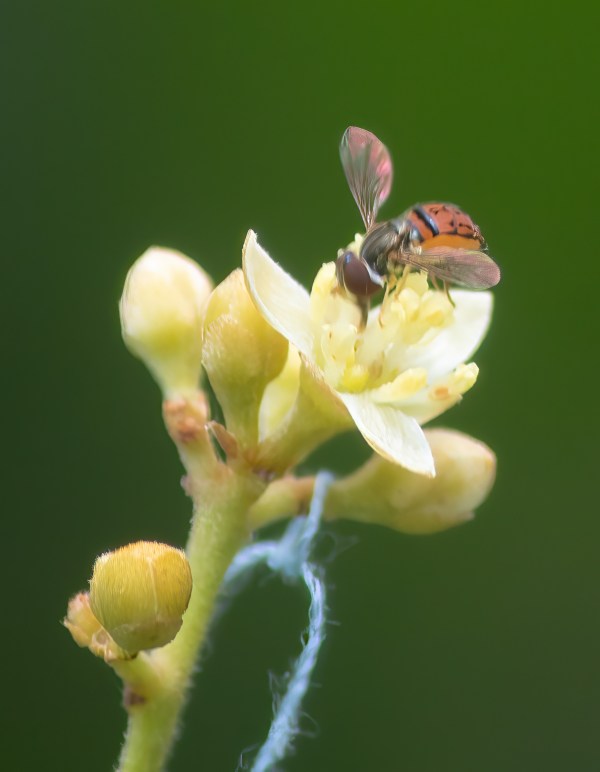
Part of the fun of plant enthusiasms is witnessing the complexities embedded in the green world. A “hard look” at any given species flowering system often turns up more fun than the birds and the bees merely moving pollen from blossom to blossom, although that is mighty nice.

Swamp Bay
Swamp Bay belongs to the genus Persea, which claims also Avocado, Red Bay, and many additional species. Avocado and probably Red Bay have systems similar to the one that will soon awe you, differing in details. Its flowering program forces cross-pollination between two different strains within the same species.

If you are wondering, the blue thread marks the flower as male in the early session.
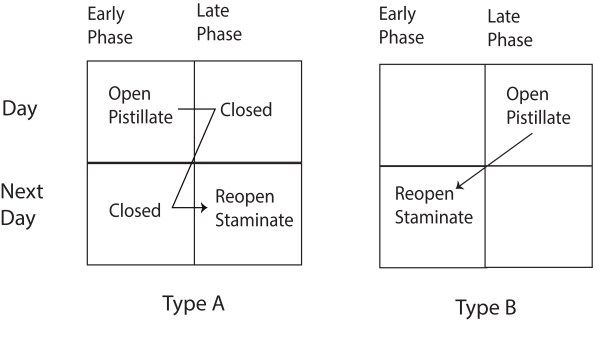
Now pay attention. This is mildly complex. The tree has two flowering periods each day: the first period is early afternoon, the second period is late afternoon-evening.
We’ll call the two strains Strain A and Strain B. Strain A opens its flowers in unison as temporarily female (pistillate) in the early session. At the end of the early session they all close and stay closed until the late session the next day. Repeat, they stay closed over 24 hours. When they re-open in the late session on the second day they have transformed from female to male (staminate), and release pollen.
Strain B, by contrast, opens its flowers synchronously as female in the late session. Yes, that is the Strain male moment, handily allowing Strain A to pollinate temporarily female Strain B. Strain B closes at sunset, to reopen transformed to male the next day in the early session. At that point the now-male Strain B can pollinate the then-female opening Strain A flowers.

Staminate = male. Pistillate = female.
Swamp Bay deviates infrequently from this pattern. Whether the exceptions are mere software glitches as opposed to being “meaningful” is unknown. The deviations may allow occasional beneficial self-pollination as assured pollination, let’s say in situations where the other strain is absent. A second possibility is that self-pollination or fruiting without pollination (it happens in many plants) may be common enough in Swamp Bay to allow the fancy system to “relax.” Nobody knows and I’ll bet nobody will know anytime soon. One thing for sure though, shifting back to Avocado, for a healthy crop you usually need a mix of the two strains close together, although they have their own deviations and many commercial Avocado trees can fruit without cross-pollination.
All that said, it boggles the mind how such a mind-boggling system with two blooming periods can force two different Persea strains to cross pollinate spanning two days. 2X2X2. I don’t think I could program that puzzle if I tried. But Swamp Bay is smart. And how do the two strains manage to be “all male” or “all female” in concert depending on the time of day anyhow?
Obviously past research is full of insights…duh. But there’s no substitute for personal experience. Here is homework. When you see a Swamp Bay or Red Bay in flower, jot down its sex (releasing pollen or not) and the time of day—early afternoon or late afternoon/evening. Or mark it with color coded thread. If the first check was early afternoon, check it for male or female at dusk a different day. Or vice versa. Like a “White Chocolate Tres Leches” donut, interesting on paper, but full marvel comes with the experience.

Butterfly Orchid. A Beautiful Bag of Questions
Encyclia tampensis
Orchidacee
How can one of the prettiest and most fragrant local wildflowers be such a stranger? Wow does it smell good! Butterfly Orchid, named for its lepidopteran appearance, not for any known association with butterflies, is unusual in our area. There no doubt used to be a lot more of them before “collectors” collected. You can buy them commercially now, presumably from tissue culture or from other ethical propagation. I don’t know anything about their commercial production, which is not today’s topic.

As it looks today
Butterfly Orchid is limited to Florida and a little bit in the Caribbean, occurring epiphytically on the trunks and main branches of several tree species, often in moist habitats, although also in scrub. When you’re not rooted in the ground, you can get around.

The flower is fantastic. Too bad nobody knows what pollinates it. In 2019 a group led by UF entomologist Hayleigh Ray recorded floral visitors to the Orchid and found out some things: 1. It does not pollinate itself (well, some Orchids do). 2. The flowers are visited by an array of bees, flies, and even beetles. 3. None of the insect visitors carried the Orchid’s pollen packets (pollinia). So the long and short of all that is, as enticing as the Butterfly Orchid is to human and arthropod alike, no human knows for sure who actually transfers its pollen.

By John Bradford
To make matters more complex, Encyclia Orchids either have no nectar, and lure pollinators with false promises, or precious little nectar, or non-nectar substances certain bees may consume or use for signaling each other. I’ve peeped “deeply” into the flowers with lights and magnifiers and found no nectar apparent, although it may come forth at secret times, or may only release when the right visitor “scratches and sniffs.”

Come on in…if you fit, and if you think there’s nectar!
Entering the inner sanctum of the flower is a trick. The narrow tunnel at the center requires force to open and penetrate. Not only are there top and bottom flaps to squeeze past, but the name Encyclia means “encircling,” in reference to two spring-loaded side flaps. The “correct” (or maybe incorrect) insect entering the flowers (or probing it with long proboscis) must push between four self-closing flaps, only to find no or skimpy nectar. Probably some type of bees but that is useless speculation.

There’s even more funny business. Way back in 1992 local biologist Dr. Suzanne Koptur reported nectaries external to the flowers (extrafloral nectaries) on E. tampensis. Usually ants going to extrafloral nectaries defend the plant that feeds them, but in the present case, from what!? Maybe botanists with cameras.
CLICK to see the spring-loaded flower
Unrelated to the nectaries (or maybe related) there’s another reported probable role for ants in some Encyclia species, although to date not reported for E. tampensis itself. That role is living at the base of the plant where organic debris collects, ants in Mexico helping to break down that compost into organic waste, aka fertilizer. It is easy to suspect that E. tampensis, with or without the aid of ants, obtains nutrition from its substantial collection of litter from above, but if anyone has tested that notion I can’t find it using Google.
Lady’s Tresses and Upwardly Mobile Bees
Spiranthes species, Bombus species
White wands waving in wet places…perhaps one of several species of Spiranthes orchids, often called Lady’s Tresses. About 15 species in Florida. What they lack in orchidaceous showiness, they make up in subtle interest. Lady’s Tresses Orchids are a fine example of the “strategies” found in floral arrangements and timing in relation to pollinators.

Although a varied mix of insects might turn up occasionally on Spiranthes species, most Lady’s Tresses receive most of their pollination from Bumblebees. Bumblebees and the twisty white wands are well matched.

This image and next by John Bradford.
For one thing, the Spiranthes wands are “in flower” for a long time as flower opening, maturation, and nectar presentation progress slowly along the wand. That being so, each wand in the marsh is in place and worth visiting for a long time, allowing the clever bees to develop a route of reliable nectar visits. That is, the bees are capable of “traplining.” Folks who study bumblebees are interested in the question of, “do they mentally map the entire route, or does the stop at one flower lead to the next?” Only the bees knows.

What we know is that it gets more complex. Presented with a vertical spike, Bumblebees (and many other floral visitors) start at the bottom and work upward from the older flowers toward the base toward the immature younger flowers above. That works out well for the bee and for the orchid. The lower mature flowers have more nectar than the upper less-mature flowers. Score one for the bee.

That works out great for the plant as well. Its flowers start out male, then become female. That way the older flowers toward the spike base are female, below the younger male flowers toward the spike top. That way a visiting bee on the rise encounters female flowers before male, or you might say it drops off pollen onto the receptive females before picking up new pollen from the males and jumping off to the next stop along the trapline. If the bee encountered the male flowers first, it would merely self-pollinate the plant instead of cross-pollinating.

Cabbage Palm Leafhopper: Stay Out of My Comfort Zone
Ormenaria rufifascia
When gardeners think of leafhoppers the first thing that probably comes to mind might be “disease vector,” but let’s set that negativity aside for now. The Cabbage Palm Leafhopper is native, specializing on Cabbage Palms, also Saw Palmetto, and sometimes additional palms. Today’s plant visitor may not be much of a problem species, and it has some enjoyably curious aspects., beginning with its relationship. The genus Ormenaria has just two species, one in the Southeastern U.S. and a little in the Caribbean, the other in the far-western states on desert plants. Wouldn’t it be fun to know how that split happened? It is probably an example of many Florida creatures having origins in the Southwest, such as Scrub Jays and Gopher tortoises.

The hopper’s coloration looks more like a tropical reef fish than an insect in the woods. Probably the same function: warn predators, “bug off, I’m nasty.”

Although the adult hopper is colorful, its larvae are not, and they have their own fascinating defenses, and their own problems studied in some depth in the 1980s by biologists Craig LaMunyon and Thomas Eisner. The larvae produce around themselves a waxy patch as a circle of protection.

Wax safety zone by Dr. Thomas Eisner
This helps in two ways. First, the granular wax provides traction for the larvae to jump away from predatory attack using spurs on their hind legs.

Spurred legs by Dr. Thomas Eisner
They can leapup to about a foot. Pretty spunky for a little rascal you may not even see. More oddly, the wax patch is an invisible force field of protection: insect predators have been shown to shun the wax. If ants enter the waxy pad they get so gunky they have to abort the hunt to clean themselves of wax. The wax on the larva itself is helpful too: it won’t stick to spider webs, and if the larval hop plops it in a puddle the wax acts as a buoyant life preserver.