Encyclia tampensis
Orchidacee
How can one of the prettiest and most fragrant local wildflowers be such a stranger? Wow does it smell good! Butterfly Orchid, named for its lepidopteran appearance, not for any known association with butterflies, is unusual in our area. There no doubt used to be a lot more of them before “collectors” collected. You can buy them commercially now, presumably from tissue culture or from other ethical propagation. I don’t know anything about their commercial production, which is not today’s topic.
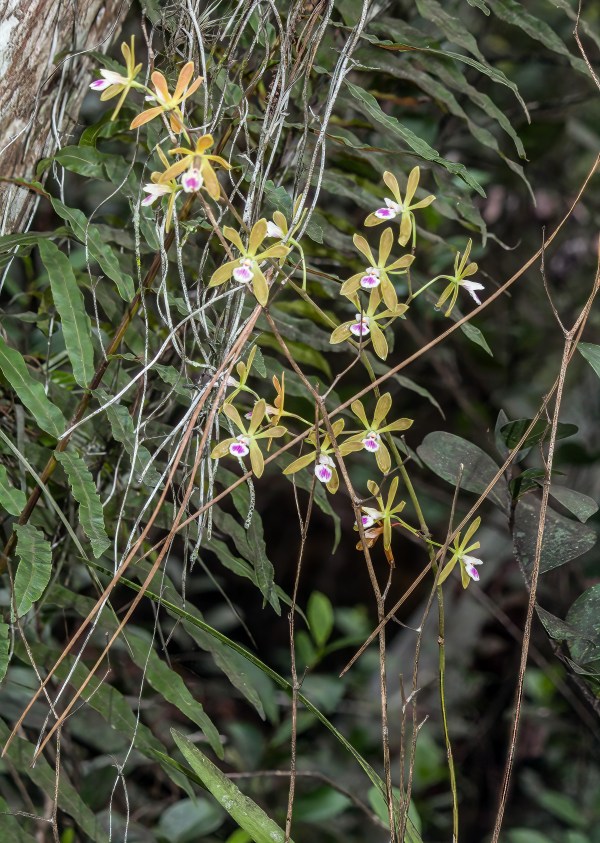
As it looks today
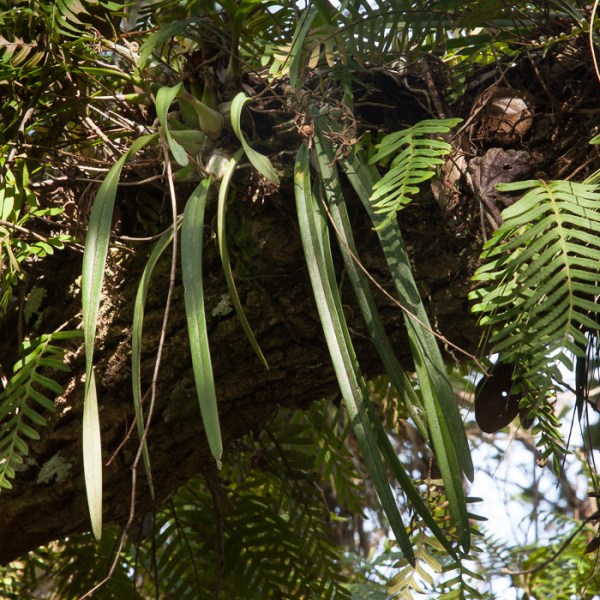
Butterfly Orchid is limited to Florida and a little bit in the Caribbean, occurring epiphytically on the trunks and main branches of several tree species, often in moist habitats, although also in scrub. When you’re not rooted in the ground, you can get around.
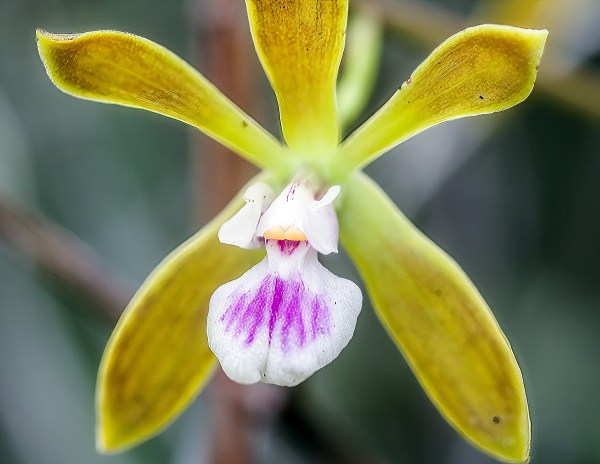
The flower is fantastic. Too bad nobody knows what pollinates it. In 2019 a group led by UF entomologist Hayleigh Ray recorded floral visitors to the Orchid and found out some things: 1. It does not pollinate itself (well, some Orchids do). 2. The flowers are visited by an array of bees, flies, and even beetles. 3. None of the insect visitors carried the Orchid’s pollen packets (pollinia). So the long and short of all that is, as enticing as the Butterfly Orchid is to human and arthropod alike, no human knows for sure who actually transfers its pollen.
By John Bradford
To make matters more complex, Encyclia Orchids either have no nectar, and lure pollinators with false promises, or precious little nectar, or non-nectar substances certain bees may consume or use for signaling each other. I’ve peeped “deeply” into the flowers with lights and magnifiers and found no nectar apparent, although it may come forth at secret times, or may only release when the right visitor “scratches and sniffs.”
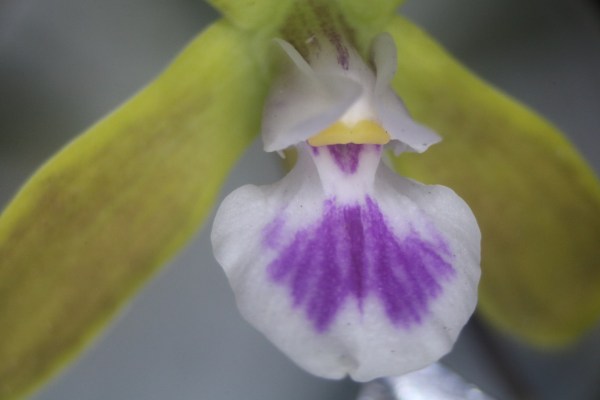
Come on in…if you fit, and if you think there’s nectar!
Entering the inner sanctum of the flower is a trick. The narrow tunnel at the center requires force to open and penetrate. Not only are there top and bottom flaps to squeeze past, but the name Encyclia means “encircling,” in reference to two spring-loaded side flaps. The “correct” (or maybe incorrect) insect entering the flowers (or probing it with long proboscis) must push between four self-closing flaps, only to find no or skimpy nectar. Probably some type of bees but that is useless speculation.
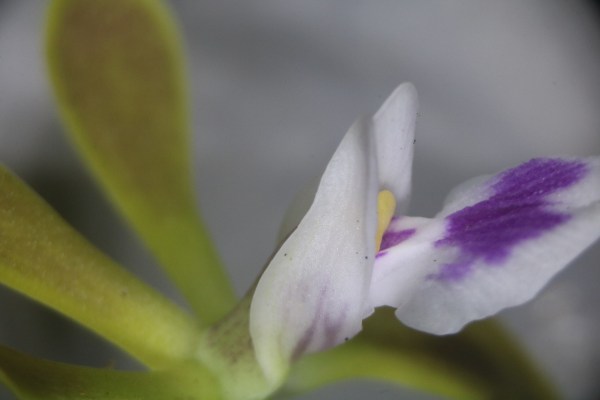
There’s even more funny business. Way back in 1992 local biologist Dr. Suzanne Koptur reported nectaries external to the flowers (extrafloral nectaries) on E. tampensis. Usually ants going to extrafloral nectaries defend the plant that feeds them, but in the present case, from what!? Maybe botanists with cameras.
CLICK to see the spring-loaded flower
Unrelated to the nectaries (or maybe related) there’s another reported probable role for ants in some Encyclia species, although to date not reported for E. tampensis itself. That role is living at the base of the plant where organic debris collects, ants in Mexico helping to break down that compost into organic waste, aka fertilizer. It is easy to suspect that E. tampensis, with or without the aid of ants, obtains nutrition from its substantial collection of litter from above, but if anyone has tested that notion I can’t find it using Google.
 John Bradford
 George Rogers
 George Rogers
 Dee Staley
 Treasure Coast Natives
H. Bernstein
June 16, 2023 at 4:08 pm
I know of a population of many thousands of plants. Where?
Ain’t sayin’.
George Rogers
June 17, 2023 at 10:00 am
sounds like a good secret place to unravel the mystery of what visits the flowers and carries the pollen…
Felicity Rask
June 16, 2023 at 5:58 pm
If a way to hand pollinate Encyclia tampensis were understood would it be possible to propagate more plants? Or are the loss of habitat and poaching the only reason this orchid is rare?
George Rogers
June 17, 2023 at 9:53 am
Don’t know every reason for rarity beyond poaching. There is habitat loss, but that would not explain failing to find it, or maybe just one in a large area of ok habitat. Hand pollinating it does work. If there is a specialized pollinator (maybe, maybe not) pollinator scarcity might be a factor. I’ve not tried, but suspect not too hard to propagate in lab.
annsbirdventures
June 16, 2023 at 9:37 pm
When we moved to Western North Carolina in 2014, I realized I had to give up my butterfly orchids. Happily, we discovered several species of orchids in our area and on our property. All are terrestrial, and some are very drab compared to the butterfly orchids. But we are grateful to have them.
Ann Weinrich
George Rogers
June 17, 2023 at 9:59 am
For darn sure. I was around “northern” orchids in life far before Florida and tropics. Nothing more exciting than, oh let’s say, …….finding an Orchid!