Mitchella repens
Rubiaceae, Coffee Family
A marvelous local wildflower you don’t see everyday is Partridgeberry. I’m originally a northerner rooted botanically in Michigan, Canada, and New England, where Partridgeberry is a conspicuous delight on acidic forest floors, with its twin white flowers, scarlet berries, and white-striped leaves. Upon relocating to Florida long ago, it was a happy surprise to run into a “north woods” species hereabouts, in Halpatioke and Jonathon Dickinson parks for instance. Turns out Partridgeberry has impressive geography: ranging from the far north woods in eastern North America to Martin County, Florida, then a jump to Tex-Mex and Central America. How many species are native from the Arctic Circle to tropical Guatemala, trampled by both moose and tapirs?
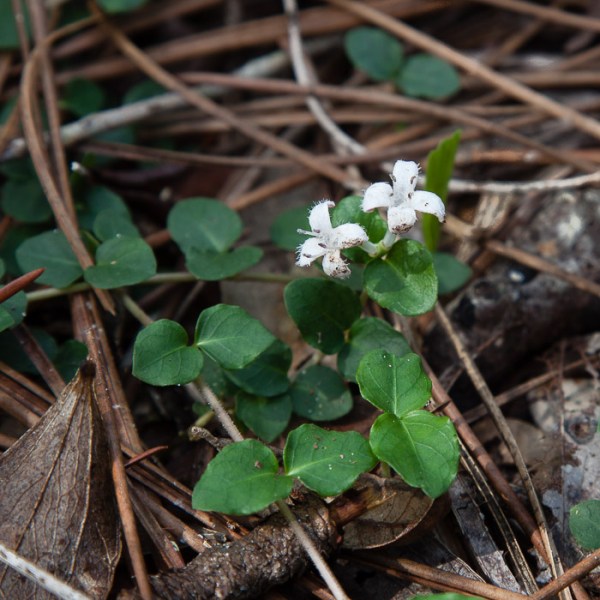
By John Bradford
It gets better. Partridgeberry has a nearly identical sister species in eastern Asia, Mitchella undulata. Seems that Mitchella originated in Asia, came to North America via the Bering Strait (just like people), and wandered from Alaska to Nova Scotia to Trapper Nelson’s cabin, to Mayan ruins. Migrating birds probably helped. Not bad for a genus of just two little ground-hugger species.
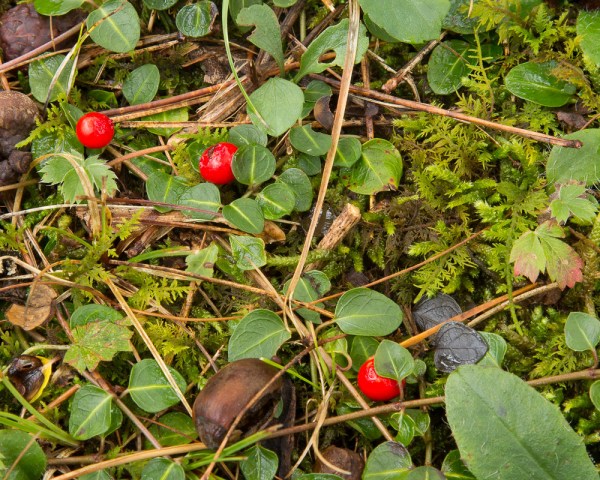
P-berry near Wal-Mart in Pt. St. Lucie by JB
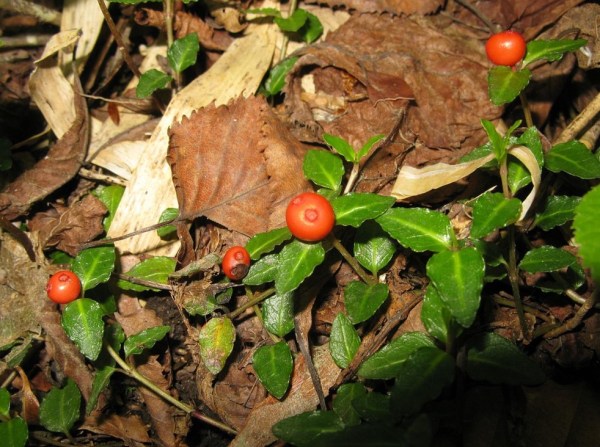
On a mountain in Japan (credit below)
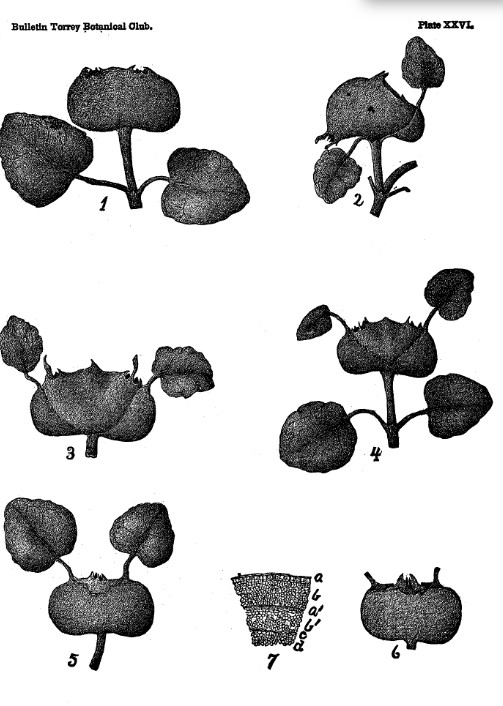
Partridgeberry has more weird aspects. The berries arise from the fused bases of the paired flowers. Those double-barreled berries can sprout leaves, apparently a curiosity to this artist in 1883:
Charles Darwin wrote about Mitchella having two types of flowers on separate plants, a mechanism called heterostyly where two breeding strains force cross-pollination within a species. In years after Darwin it turned out some populations have a third strain. Very unusual. Room for more research there!
Something of interest to leaf peepers is markings on leaves, including the white stripes on Partridgeberry leaves. Leaf markings happen in many ways for many reasons, proven or speculative. Reasons for leaf markings include viral infections, fake bug damage to discourage leaf-eaters, attracting pollinators to the flowers, fair warning (don’t eat me I’m toxic), and aiding photosynthesis in varied light conditions. That’s all nice, but Partridgeberry is especially interesting because its markings resemble those of of similar groundcover species in north woods conducting most of their photosynthesis during the fall and spring when the shady tree canopy is leafless. Why would a guild of plants with that lifestyle all have white-striped leaf syndrome? Ecologist Thomas Givnish made a suggestion, pointing out that these species have a high nitrogen content due to their seasonal growth spurts. All that nitrogen, especially at a time when other plants are leafless, makes the forest floor plants especially attractive to leaf grazers, such as deer. Those conspicuous nutritious plants need special protection.
They make protective chemicals, such as wintergreen oil in the guild-member Wintergreen and poisons in Pipsissewa. Dr. Givnish suggested that the shared white leaf stripes confuse the deers’ eyes, breaking up the outlines of the leaves, just like the stripes on a Zebra confuddle lions by breaking up the outlines of the Zebras, which have the advantage of flight potential. He did mention the need for further testing (on the discouraged herbivores, not the Zebras). To my knowledge, nobody has, however, rounded up Guatemalan tapirs and moose from Maine and tested their eyesight.
Photo credit:
M. repens, John Bradford
M. undulata, Qwert1234, CC BY-SA 3.0
 John Bradford
 George Rogers
 George Rogers
 Dee Staley
 Treasure Coast Natives
theshrubqueen
August 26, 2023 at 3:45 pm
I was wondering why I don’t see this around here…it’s that acidic thing. Very reminiscent of wintergreen.
George Rogers
August 26, 2023 at 4:06 pm
very reminiscent! Up north they hang around together. There is or was one obscure patch in Jensen (well I guess PSL off of Fed Highway). You sure don’t see many,
theshrubqueen
August 26, 2023 at 4:07 pm
I associate the wintergreen with moist soils?
George Rogers
August 26, 2023 at 7:50 pm
Been awhile since I’ve seen one! Not sure
Chris Lockhart
August 27, 2023 at 9:17 pm
So cool to hear that partridgeberry is this far south (Martin Co.). they are my absolute favorite muffin when we traveled up to Maine a few years ago.
Interesting comment about white striped leaves – that reminds me of poisonwood and camphor tree. 🙂
George Rogers
August 28, 2023 at 11:00 am
Partridgeberry muffin sounds delish. I wonder if the striped leaves thing holds water as a deer deterrent. It is true that there’s a cluster of little acid-loving groundcovers, especially up north unde4r deciduous canopies, all with more or less that “look.” Please pass the muffins and a fill up on coffee.
Chris Lockhart
August 28, 2023 at 5:39 pm
If you find a source and collect at least half a cup of berries, I’m happy to make the muffins. Have a great evening!