Quercus chapmanii
Fagaceae, Oak Family
Walking in the Jupiter Inlet Outstanding Natural Area this morning, something new to me became apparent: the Chapman’s Oaks were nearly free of the otherwise rampant parasitic Lovevine (Cassytha filiformis). Caution!, many initial botanical perceptions fail to hold up under scrutiny (sad voice of experience). But at least at this time and place, the other scrubby oaks—Sand Live Oak and Myrtle Oak—were mostly tangled with the parasite. By contrast, none of several Chapman’s Oaks in multiple separate thickets had it. So join me in some speculations.
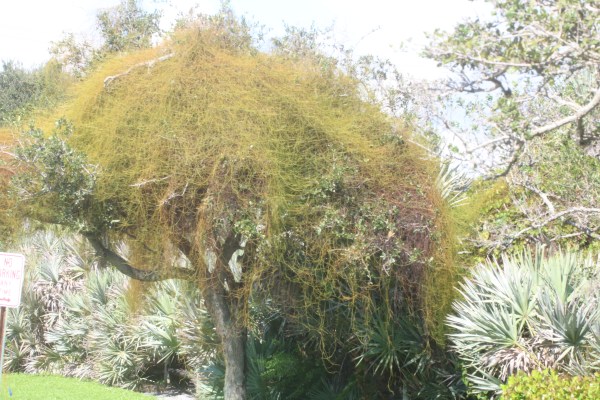
Above: Sand Live Oak at Jupiter Inlet, festooned with Love Vine.
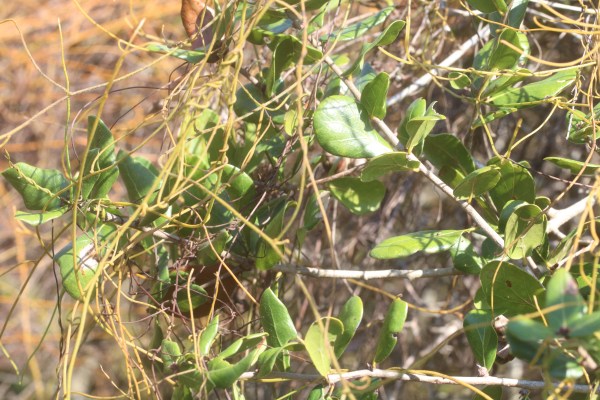
Above: Myrtle Oak with Love Vine
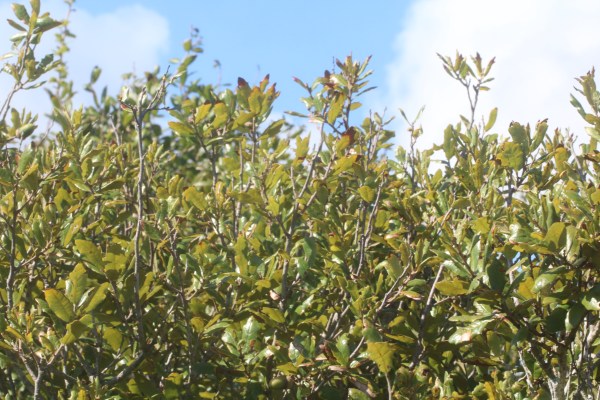
Chapman’s Oak free of Love Vine
Like most local scrub zones, the area is dominated by a mix or Sand Live Oaks, Myrtle Oaks, and Saw Palmetto, with Chapman’s being a tiny minority. Given that Sand Live Oak and Myrtle Oak blanket vast scrubs in countless numbers, why is Chapman’s Oak not out-competed and gone? An obvious guess is maybe it has a specialized microhabitat, but if so, it must be subtle, given that Chapman’s lives physically intermixed with the other two.
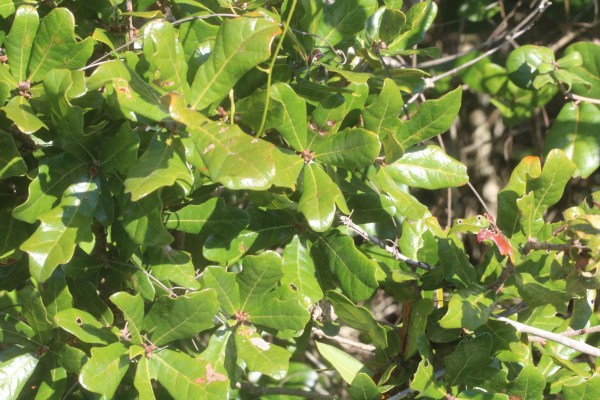
Chapman’s foliage
Another possibility is the site history of fires, hurricanes, and physical management. But that’s unknown so what we see here and now is zillions of Sand Live and Myrtle Oaks, salted here and there with a few Chapman’s. Are the three species as we encounter them giving hints about their relative abundance? Chapman’s Oaks seem to get taller faster than the other two when they all resprout at the same time. Maybe the Chapman’s survive in part by rising up quickly above their competitors, at least when young.
Chapman’s Oaks stand apart by having seasonally deciduous leaves, whereas the other two are evergreen. Maybe Chapman’s Oak can avoid competition being dormant in the dry season, and then have a growth spurt when rain and foliage return. That seasonal pattern might help with resisting Lovevine, giving Chapman’s some advantage in the scrub competition. During its brief seasonal dormancy, Chapman’s probably doesn’t have much water or sugar for the vine to steal in the twigs, and none in the leaves since they are absent. Then later, at the end of the season when leafdrop time comes, any encroaching Lovevine falls away with the falling foliage. Perhaps.
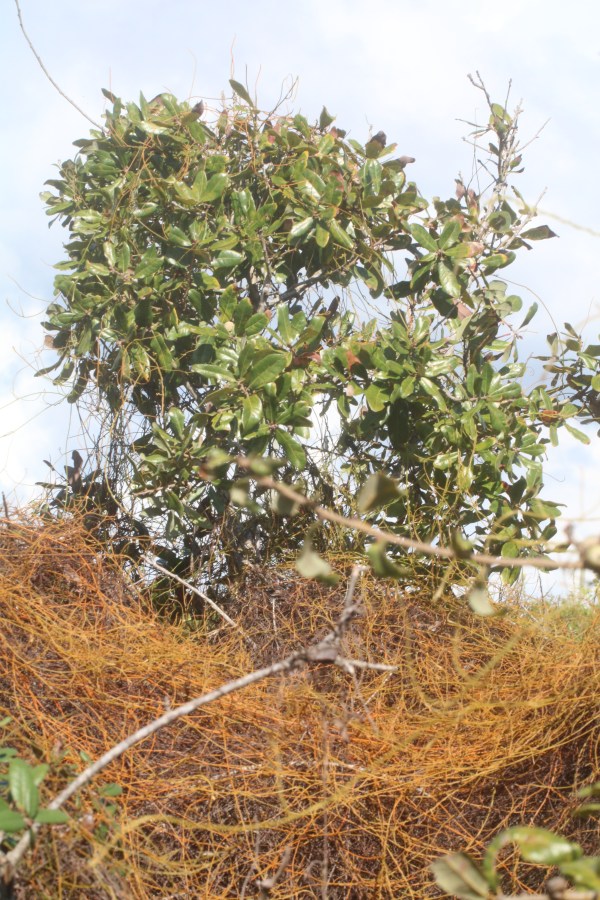
Chapman’s Oak clear of Lovevine, rising above other oaks covered with it.
 John Bradford
 George Rogers
 George Rogers
 Dee Staley
 Treasure Coast Natives
John Ericson
September 30, 2023 at 7:48 pm
Help. Have written several replies in the comment section but can’t ever get them to post! Felicity Rask
>
George Rogers
September 30, 2023 at 8:20 pm
Hi Felicity…I’ll have look at it tomorrow…
Suzanne Koptur
October 7, 2023 at 7:36 pm
some sensible speculating there!